
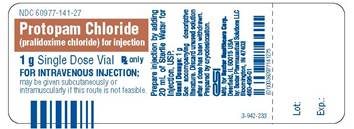
Protopam Chloride pralidoxime 1 g/20mL Injection, Powder, Lyophilized, For Solution — NDC 60977-141-01 (Billing 60977-0141-01)
This is a package of Protopam Chloride pralidoxime 1 g/20mL Injection, Powder, Lyophilized, For Solution from Baxter Healthcare Corporation, marketed since Mar 1965 and currently FDA-listed. It is this product's only package size.
NDC database record
One package, one record: these facts belong to NDC 60977-141-01 alone.
- Record
- FDA NDC Directory package listing · Human prescription drug
- Code segments
- 60977 labeler · 141 product · 01 package
- Package marketed since
- Mar 10, 1965
- Sample package
- No — commercial package
- Listing certified through
- Dec 31, 2027
- Barcode (UPC-A, from the NDC)
- 3 6097714101 5
- FDA record last changed
- Jul 24, 2026
Identity & classification
Regulatory identifiers FDA, NLM and CMS codes for this package
Drug-database identifiers Medi-Span GPI and First Databank GCN / HICL / AHFS classification
- GSN (GCN sequence number): 002557
- GCN: 07191
- GPI-14 (Medi-Span): 93000070102105
- HICL (First Databank): 001111
- AHFS class code: 91:04.20.00
- RxCUI (RxNorm): 208969
Where does this data come from?
- FDA openFDA NDC Directory · synced Oct 8, 2026
- FDA label on DailyMed · label index refreshed Oct 8, 2026
- RxNorm (NLM RxNav) · catalog refreshed Oct 1, 2026
- Medi-Span GPI (licensed)
- First Databank (licensed) · refreshed Oct 8, 2026
RxNorm drug class
This medicine belongs to the Cholinesterase Reactivator class.
Where does this data come from?
- RxClass (NLM) · catalog refreshed Oct 1, 2026
Clinical
Patient education
Supplement & herbal interactions
Where does this data come from?
- MedlinePlus (NLM) · refreshed Oct 8, 2026
- FDA label on DailyMed · label index refreshed Oct 8, 2026
Ask a licensed pharmacist directly — free, answered by our team.
Pricing
A drug doesn't have one price. Each row is a different public payment system, and none is what you'd pay at the counter — that depends on your insurance. The ⓘ on each row explains what it measures.
| Price system | Per mL | Per package |
|---|---|---|
| Retail pharmacies payNADAC · weekly | Not in the retail survey — common for institutional, discontinued, or low-volume packs. | |
| Medicaid paysCMS SDUD · 12 mo | No recent Medicaid claims on file for this NDC — rare and low-volume NDCs are suppressed in the public data. | |
| Medicare drug plans payPart D · quarterly | No Part D plan price is available for this NDC in our data. | |
| Medicare Part B allowsASP · J2730 | No ASP payment limit on file for J2730 this quarter. | |
Where does this data come from?
- CMS NADAC weekly file
- CMS ASP pricing files · refreshed Sep 20, 2026
- CMS Medicaid State Drug Utilization Data · refreshed Oct 8, 2026
- CMS Part D plan pricing files · refreshed Sep 24, 2026
- VA National Acquisition Center price file
Billing & reimbursement
Where does this data come from?
- CMS ASP NDC-HCPCS crosswalk · refreshed Sep 22, 2026
- DMEPDAC NDC-HCPCS crosswalk
- openFDA NSDE billing units · refreshed Oct 7, 2026
Packaging — all sizes for this product
| Package NDC | Description | Marketing start | Marketing end | Status |
|---|---|---|---|---|
| 60977-0141-01 You're viewing this Main listing | 6 VIAL, SINGLE-DOSE in 1 PACKAGE / 20 mL in 1 VIAL, SINGLE-DOSE | 1965-03-10 | — | Active |
Therapeutic equivalents
| Product | Labeler | Pack | NADAC/unit | TE | Status | Price vs. this |
|---|---|---|---|---|---|---|
| Protopam Chloride 1 g/20mLthis 60977-0141-01 | Baxter | 6 vials | — | — | FDA listed | — |
Where does this data come from?
- FDA openFDA NDC Directory · synced Oct 8, 2026
- FDA Orange Book · refreshed Oct 3, 2026
- CMS NADAC weekly file
Availability & generic status
We did not find an FDA-approved generic match for this exact strength, form and route.
Where does this data come from?
- FDA Orange Book · refreshed Oct 3, 2026
Inactive Ingredients / Excipients
Inactive ingredients, also called excipients, are components of the drug product other than the active ingredient. They may include fillers, dyes, coatings, preservatives, flavors, or other formulation ingredients.
💡 Tap an ingredient (hover on desktop) to see what it is and why it’s used.
-
UNII 55X04QC32I
A strong alkaline chemical used to adjust and maintain the pH balance of liquid medicines. It helps keep the medicine stable and ensures it stays effective during storage.
1 inactive ingredient listed in the exact product block matched to this NDC.
Where does this data come from?
ingredient classCode="IACT" elements from the exact product block matched by this NDC. Label-section narrative from DailyMed / the openFDA label index is shown separately when available.- FDA label on DailyMed · label index refreshed Oct 8, 2026
- FDA openFDA NDC Directory · synced Oct 8, 2026
Inactive ingredient FAQ
Are inactive ingredients the same for every manufacturer?
Why might an inactive ingredient be missing?
Can inactive ingredients matter?
Manufacturer & labeler
More NDCs from Baxter Healthcare Corporation labeler code 60977
Where does this data come from?
- FDA openFDA NDC Directory · synced Oct 8, 2026
- Drugs@FDA
Full prescribing information FDA SPL
🎯 Indications and Usage ▾
INDICATIONS AND USAGE PROTOPAM Chloride is indicated as an antidote: (1) in the treatment of poisoning due to those pesticides and chemicals (e.g., nerve agents) of the organophosphate class which have anticholinesterase activity and (2) in the control of overdosage by anticholinesterase drugs used in the treatment of myasthenia gravis. The principal indications for the use of PROTOPAM Chloride are muscle weakness and respiratory depression. In severe poisoning, respiratory depression may be due to muscle weakness.
⏱️ Dosage and Administration ▾
DOSAGE AND ADMINISTRATION Organophosphate Poisoning Treatment should include general supportive care, atropinization, and decontamination, in addition to the use of PROTOPAM Chloride. Treatment is most effective if initiated immediately after poisoning. Administration of PROTOPAM Chloride should be carried out slowly and, preferably, by infusion.
If intravenous administration is not feasible, intramuscular or subcutaneous injection should be used. Generally, little is accomplished if PROTOPAM Chloride is given more than 36 hours after termination of exposure to the poison. When the poison has been ingested, it is particularly important to take into account the likelihood of continuing absorption from the lower bowel since this constitutes new exposure and fatal relapses have been reported after initial improvement.
In such cases, additional doses of PROTOPAM Chloride may be needed every three to eight hours. In effect, the patient should be “titrated” with PROTOPAM Chloride as long as signs of poisoning recur. As in all cases of organophosphate poisoning, care should be taken to keep the patient under observation for at least 48 to 72 hours.
If dermal exposure has occurred, clothing should be removed and the hair and skin washed thoroughly with sodium bicarbonate or alcohol as soon as possible. Supportive care, including airway management, respiratory and cardiovascular support, correction of metabolic abnormalities, and seizure control, may be necessary in cases of severe organophosphate poisoning. Atropine should be given as soon as possible after hypoxemia is improved.
Atropine should not be given in the presence of significant hypoxia due to the risk of atropine-induced ventricular fibrillation. In adults, atropine may be given intravenously in doses of 2 to 4 mg. This should be repeated at 5- to 10-minute intervals until full atropinization (secretions are inhibited) or signs of atropine toxicity appear (delirium, hyperthermia, muscle twitching).
Some degree of atropinization should be maintained for at least 48 hours, and until any depressed blood cholinesterase activity is reversed. Use of morphine, theophylline, aminophylline, reserpine, and phenothiazine-type tranquilizers should be avoided in patients with organophosphate poisoning (see PRECAUTIONS, Drug Interactions ). Prolonged paralysis has been reported in patients when succinylcholine is given with drugs having anticholinesterase activity; therefore, it should be used with caution.
After the effects of atropine become apparent, PROTOPAM Chloride may be administered. Symptoms Of Nerve Agent And Insecticide Poisoning PROTOPAM Chloride dosing is based, in part, on the severity of symptoms of nerve agent intoxication. These symptoms include the following: MILD symptoms: • Blurred vision and sore eyes • Teary eyes* • Runny nose* • Increased salivation such as sudden drooling* • Chest tightness or difficulty breathing • Tremors throughout the body or muscular twitching • Nausea and vomiting • Involuntary respiratory secretions SEVERE symptoms: • Strange or confused behavior • Severe difficulty breathing or respiratory secretions • Severe muscular twitching and general weakness** • Involuntary urination and defecation* • Convulsions • Unconsciousness Symptoms in INFANTS AND YOUNG CHILDREN: * These symptoms are sometimes observed in healthy infants and young children.
In this age group, these symptoms are less reliable than other symptoms listed. Symptoms must be considered collectively when nerve agent or pesticide exposure is known or suspected. ** Infants may become drowsy or unconscious, with muscle floppiness rather than muscle twitching, soon after exposure to nerve agents or pesticides. ADULT DOSING ADULT INTRAVENOUS DOSING: Refer to the Preparation for Administration section for instructions on reconstitution and dilution of PROTOPAM Chloride that result in a 10-20 mg/mL solution for intravenous infusion.
Inject an initial dose of 1000 to 2000 mg of PROTOPAM Chl… [Excerpted — this section continues on DailyMed.]
⛔ Contraindications ▾
CONTRAINDICATIONS There are no known absolute contraindications for the use of PROTOPAM Chloride (see PRECAUTIONS, Drug Interactions and DOSAGE AND ADMINISTRATION ). Relative contraindications include known hypersensitivity to the drug and other situations in which the risk of its use clearly outweighs possible benefit.
⚠️ Warnings ▾
WARNINGS PROTOPAM Chloride is not effective in the treatment of poisoning due to phosphorus, inorganic phosphates, or organophosphates not having anticholinesterase activity. PROTOPAM Chloride is not indicated as an antidote for intoxication by pesticides of the carbamate class since it may increase the toxicity of carbaryl.
🤒 Adverse Reactions ▾
ADVERSE REACTIONS Forty to 60 minutes after intramuscular injection, mild to moderate pain may be experienced at the site of injection. Pralidoxime chloride may cause blurred vision, diplopia and impaired accommodation, dizziness, headache, drowsiness, nausea, tachycardia, increased systolic and diastolic blood pressure, hyperventilation, and muscular weakness when given parenterally to normal volunteers who have not been exposed to anticholinesterase poisons. In patients, it is very difficult to differentiate the toxic effects produced by atropine or the organophosphate compounds from those of the drug.
Elevations in SGOT and/or SGPT enzyme levels were observed in 1 of 6 normal volunteers given 1200 mg of pralidoxime chloride intramuscularly, and in 4 of 6 volunteers given 1800 mg intramuscularly. Levels returned to normal in about 2 weeks. Transient elevations in creatine phosphokinase were observed in all normal volunteers given the drug.
When atropine and pralidoxime chloride are used together, the signs of atropinization may occur earlier than might be expected when atropine is used alone. This is especially true if the total dose of atropine has been large and the administration of pralidoxime chloride has been delayed. Excitement and manic behavior immediately following recovery of consciousness have been reported in several cases.
However, similar behavior has occurred in cases of organophosphate poisoning that were not treated with pralidoxime chloride.
🔄 Drug Interactions ▾
Drug Interactions When atropine and pralidoxime chloride are used together, the signs of atropinization (flushing, mydriasis, tachycardia, dryness of the mouth and nose) may occur earlier than might be expected when atropine is used alone. This is especially true if the total dose of atropine has been large and the administration of pralidoxime chloride has been delayed. The following precautions should be kept in mind in the treatment of anticholinesterase poisoning, although they do not bear directly on the use of pralidoxime chloride: since barbiturates are potentiated by the anticholinesterases, they should be used cautiously in the treatment of convulsions; morphine, theophylline, aminophylline, reserpine, and phenothiazine-type tranquilizers should be avoided in patients with organophosphate poisoning.
Prolonged paralysis has been reported in patients when succinylcholine is given with drugs having anticholinesterase activity; therefore, it should be used with caution.
🤰 Pregnancy ▾
Pregnancy Teratogenic Effects: Animal reproduction studies have not been conducted with pralidoxime chloride. It is also not known whether pralidoxime chloride can cause fetal harm when administered to a pregnant woman or can affect reproduction capacity. Pralidoxime chloride should be given to a pregnant woman only if clearly needed.
🧒 Pediatric Use ▾
Pediatric Use There are no adequate and well-controlled clinical trials that establish the effectiveness of pralidoxime chloride in pediatric patients. Efficacy has been extrapolated from the adult population and is supported by nonclinical studies, pharmacokinetic studies in adults and experience in the pediatric population (see DOSAGE AND ADMINISTRATION ). As in adults, laryngospasm, cardiac arrest, tachycardia, and muscle rigidity or paralysis have been reported following rapid intravenous injection.
Muscle fasciculations, apnea, and convulsions have also been reported.
🧓 Geriatric Use ▾
Geriatric Use Clinical studies of PROTOPAM Chloride did not include sufficient numbers of subjects aged 65 and over to determine whether they respond differently from younger subjects. Other reported clinical experience has not identified differences in responses between the elderly and younger patients. In general, dose selection for an elderly patient should be cautious, usually starting at the low end of the dosing range, reflecting the greater frequency of decreased hepatic, renal, or cardiac function, and of concomitant disease or other drug therapy.
🆘 Overdosage ▾
OVERDOSAGE Manifestations of Overdosage Observed in normal subjects only: dizziness, blurred vision, diplopia, headache, impaired accommodation, nausea, slight tachycardia. In therapy, it has been difficult to differentiate side effects due to the drug from those due to the effects of the poison.
🧬 Clinical Pharmacology ▾
CLINICAL PHARMACOLOGY The principal action of pralidoxime chloride is to reactivate cholinesterase (mainly outside of the central nervous system) which has been inactivated by phosphorylation due to an organophosphate pesticide or related compound. The destruction of accumulated acetylcholine can then proceed, and neuromuscular junctions will again function normally. Pralidoxime chloride also slows the process of “aging” of phosphorylated cholinesterase to a nonreactivatable form, and detoxifies certain organophosphates by direct chemical reaction.
The drug has its most critical effect in relieving paralysis of the muscles of respiration. Because pralidoxime chloride is less effective in relieving depression of the respiratory center, atropine is always required concomitantly to block the effect of accumulated acetylcholine at this site. Pralidoxime chloride relieves muscarinic signs and symptoms, salivation, bronchospasm, etc., but this action is relatively unimportant since atropine is adequate for this purpose.
PROTOPAM Chloride has been studied in animals as an antidote against numerous organophosphate pesticides, chemicals, and drugs (see Animal Pharmacology and Toxicology ). Regardless of whether or not animal studies suggest that the organophosphate poison to which a particular patient has been exposed is amenable to treatment with pralidoxime chloride, the use of pralidoxime chloride should, nevertheless, be considered in any life-threatening situation resulting from poisoning by these compounds, since the limited and arbitrary conditions of pharmacologic screening do not always accurately reflect the usefulness of pralidoxime chloride in the clinical situation.
📦 How Supplied / Storage and Handling ▾
HOW SUPPLIED NDC 60977-141-01—Hospital Package: This contains six 20 mL vials of 1 g each of sterile PROTOPAM Chloride (pralidoxime chloride) for Injection white to off-white porous cake*, without diluent or syringe. *When necessary, sodium hydroxide is added during processing to adjust the pH. Storage Store at 20°-25°C (68°-77°F), excursions permitted to 15°-30°C (59°-86°F) [see USP Controlled Room Temperature].
📦 Storage and Handling ▾
Storage Store at 20°-25°C (68°-77°F), excursions permitted to 15°-30°C (59°-86°F) [see USP Controlled Room Temperature].
📋 Description ▾
DESCRIPTION Chemical name: 2-formyl-1-methylpyridinium chloride oxime. Available in the United States as PROTOPAM Chloride for Injection (PROTOPAM Chloride), pralidoxime chloride is frequently referred to as 2-PAM Chloride. Structural formula: C7H9CIN2O M.W.
172.61 Pralidoxime chloride occurs as an odorless, white, nonhygroscopic, crystalline powder which is soluble in water. Stable in air, it melts between 215º and 225ºC, with decomposition. The specific activity of the drug resides in the 2-formyl-1-methylpyridinium ion and is independent of the particular salt employed.
The chloride is preferred because of physiologic compatibility, excellent water solubility at all temperatures, and high potency per gram, due to its low molecular weight. Pralidoxime chloride is a cholinesterase reactivator. PROTOPAM Chloride for intravenous injection or infusion is prepared by cryo-desiccation.
Each vial contains 1000 mg of sterile pralidoxime chloride, and sodium hydroxide to adjust pH, to be reconstituted with 20 mL of Sterile Water for Injection, USP. The pH of the reconstituted solution is 3.5 to 4.5. Intramuscular or subcutaneous injection may be used when intravenous injection is not feasible.
PROTOPAM structural formula
⚠️ Precautions ▾
PRECAUTIONS General PROTOPAM Chloride has been well tolerated in most cases, but it must be remembered that the desperate condition of the organophosphate-poisoned patient will generally mask such minor signs and symptoms as have been noted in normal subjects. Intravenous administration of PROTOPAM Chloride should be carried out slowly and, preferably, by continuous or intermittent infusion, since temporary worsening of cholinergic manifestations (i.e. tachycardia, cardiac arrest, laryngospasm, and muscle rigidity or paralysis) may occur if PROTOPAM Chloride is infused too rapidly.
The intermittent infusion rate should not exceed 200 mg/minute. If intravenous administration is not feasible, intramuscular or subcutaneous injection should be used (see DOSAGE AND ADMINISTRATION ). PROTOPAM Chloride should be used with great caution in treating organophosphate overdosage in cases of myasthenia gravis since it may precipitate a myasthenic crisis.
Because pralidoxime is excreted in the urine, a decrease in renal function will result in increased blood levels of the drug. Thus, the dosage of PROTOPAM Chloride should be reduced in the presence of renal insufficiency. Laboratory Tests Treatment of organophosphate poisoning should be instituted without waiting for the results of laboratory tests.
Red blood cell, plasma cholinesterase, and urinary paranitrophenol measurements (in the case of parathion exposure) may be helpful in confirming the diagnosis and following the course of the illness, although such tests may be normal in the face of clinically significant organophosphate poisoning. A reduction in red blood cell cholinesterase concentration to below 50% of normal has been seen only with organophosphate ester poisoning. Drug Interactions When atropine and pralidoxime chloride are used together, the signs of atropinization (flushing, mydriasis, tachycardia, dryness of the mouth and nose) may occur earlier than might be expected when atropine is used alone.
This is especially true if the total dose of atropine has been large and the administration of pralidoxime chloride has been delayed. The following precautions should be kept in mind in the treatment of anticholinesterase poisoning, although they do not bear directly on the use of pralidoxime chloride: since barbiturates are potentiated by the anticholinesterases, they should be used cautiously in the treatment of convulsions; morphine, theophylline, aminophylline, reserpine, and phenothiazine-type tranquilizers should be avoided in patients with organophosphate poisoning.
Prolonged paralysis has been reported in patients when succinylcholine is given with drugs having anticholinesterase activity; therefore, it should be used with caution. Carcinogenesis, Mutagenesis, Impairment of Fertility Because pralidoxime chloride is indicated for short-term emergency use only, no investigations of its potential for carcinogenesis, mutagenesis, or impairment of fertility have been conducted by the manufacturer, or reported in the literature. Pregnancy Teratogenic Effects: Animal reproduction studies have not been conducted with pralidoxime chloride.
It is also not known whether pralidoxime chloride can cause fetal harm when administered to a pregnant woman or can affect reproduction capacity. Pralidoxime chloride should be given to a pregnant woman only if clearly needed. Nursing Mothers It is not known whether this drug is excreted in human milk.
Because many drugs are excreted in human milk, caution should be exercised when pralidoxime chloride is administered to a nursing woman. Pediatric Use There are no adequate and well-controlled clinical trials that establish the effectiveness of pralidoxime chloride in pediatric patients. Efficacy has been extrapolated from the adult population and is supported by nonclinical studies, pharmacokinetic studies in adults and experience in the pediatric population (see DOSAGE AND ADMINISTRATION ).
As in adults, laryngospasm, cardiac arrest, tachycardia… [Excerpted — this section continues on DailyMed.]
🍼 Nursing Mothers ▾
Nursing Mothers It is not known whether this drug is excreted in human milk. Because many drugs are excreted in human milk, caution should be exercised when pralidoxime chloride is administered to a nursing woman.
🧬 Pharmacokinetics ▾
Pharmacokinetics Animal studies suggest that the minimum therapeutic concentration of pralidoxime in plasma is 4 µg/mL; this level is reached in about 16 minutes after a single injection of 600 mg pralidoxime chloride. In one study of healthy adult volunteers and patients self-poisoned with organophosphate compounds, a single intramuscular injection of 1000 mg of pralidoxime chloride resulted in mean peak plasma levels of 7.5 ± 1.7 µg/mL and 9.9 ± 2.4 µg/mL, respectively. Time to reach the mean peak plasma levels in both groups was similar, 34 minutes in healthy adults and 33 minutes in poisoned patients.
Mean half-life was about 3 hours in both groups. Some evidence suggests that a loading dose followed by continuous intravenous infusion of pralidoxime chloride may maintain therapeutic levels longer than short intermittent infusion therapy. In a cross-over study of seven healthy adults (18 – 50 years) a short intravenous infusion dose of 16 mg/kg over 30 minutes was compared to an intravenous loading dose of 4 mg/kg over 15 minutes, followed by 3.2 mg/kg/hr for 3.75 hours (for a total dose of 16 mg/kg).
Results showed that the mean time over which plasma levels were maintained above 4 µg/mL was prolonged in the volunteers who received a loading dose followed by continuous infusion as compared to those who received short infusion therapy (257.5 ± 50.5 min vs. 118.0 ± 52.1 min). Use of continuous intravenous infusion in adult patients with organophosphate poisoning has been described in several case reports, with and without loading doses.
Infusion rates ranged from 400 – 600 mg/hr. In one case the blood levels were 11.6 – 13.7 µg /mL when given 400 mg/hr over 5 days (measured at 5, 10 and 18 hours). In another case following an initial loading dose of 1000 mg, blood levels were 11.79 µg/mL when given 500 mg/hr and 17.26 µg/mL when given 600 mg/hr.
In the latter case the pralidoxime elimination half-life was 4 hours. In two other cases blood levels were not measured. Pralidoxime chloride is distributed throughout the extracellular water; its apparent volume of distribution at steady state has been reported to range from 0.60 to
2.7L/kg. Pralidoxime chloride is not bound to plasma protein. Pralidoxime chloride is relatively short acting and repeated doses may be needed, unless continuous intravenous infusion is selected.
Simulations suggest that after a dose of 1000 mg given intravenously, concentrations fall below 4 µg/mL in about 1.5 hours. The short duration of action of pralidoxime chloride and the necessity for repeated doses should be considered especially where there is any evidence of continuing absorption of the poison. The apparent half-life of pralidoxime chloride is 74 to 77 minutes.
The drug is rapidly excreted in the urine by renal tubular secretion, partly unchanged, and partly as a metabolite produced by the liver. After intramuscular administration of 1000 mg of pralidoxime chloride, the renal clearance has been reported to be 7.2 ± 2.9 mL/min/kg in healthy volunteers and 3.6 ± 1.5 mL/min/kg in organophosphate-poisoned patients. In one study of 11 organophosphate-poisoned pediatric patients (age, 0.8 to 18 years), an intravenous loading dose of 15-50 mg/kg (mean 29 mg/kg) of pralidoxime chloride followed by a continuous infusion of 10-16 mg/kg/hr (mean 14 mg/kg/hr) over 12 to 43 hours (mean 27 ± 8 hours) resulted in an average steady state plasma concentration of 22.2 mg/L (6.9 to 47.4 mg/L) and an average body clearance of
0.88L/kg/hr (0.28 to
2.20L/kg/hr). After the continuous infusion was discontinued, determinations of the apparent volume of distribution and half-life ranged from 1.7 to
13.8L/kg and from 2.4 to 5.3 hours, respectively.
🔬 Clinical Studies ▾
CLINICAL STUDIES There are no adequate and well controlled clinical studies that establish the effectiveness of pralidoxime chloride as a treatment for poisoning with organophosphates having anticholinesterase activity. However, its use has been considered to be successful against poisoning with numerous pesticides, chemicals, and drugs. Pharmacokinetics Animal studies suggest that the minimum therapeutic concentration of pralidoxime in plasma is 4 µg/mL; this level is reached in about 16 minutes after a single injection of 600 mg pralidoxime chloride.
In one study of healthy adult volunteers and patients self-poisoned with organophosphate compounds, a single intramuscular injection of 1000 mg of pralidoxime chloride resulted in mean peak plasma levels of 7.5 ± 1.7 µg/mL and 9.9 ± 2.4 µg/mL, respectively. Time to reach the mean peak plasma levels in both groups was similar, 34 minutes in healthy adults and 33 minutes in poisoned patients. Mean half-life was about 3 hours in both groups.
Some evidence suggests that a loading dose followed by continuous intravenous infusion of pralidoxime chloride may maintain therapeutic levels longer than short intermittent infusion therapy. In a cross-over study of seven healthy adults (18 – 50 years) a short intravenous infusion dose of 16 mg/kg over 30 minutes was compared to an intravenous loading dose of 4 mg/kg over 15 minutes, followed by 3.2 mg/kg/hr for 3.75 hours (for a total dose of 16 mg/kg). Results showed that the mean time over which plasma levels were maintained above 4 µg/mL was prolonged in the volunteers who received a loading dose followed by continuous infusion as compared to those who received short infusion therapy (257.5 ± 50.5 min vs.
118.0 ± 52.1 min). Use of continuous intravenous infusion in adult patients with organophosphate poisoning has been described in several case reports, with and without loading doses. Infusion rates ranged from 400 – 600 mg/hr.
In one case the blood levels were 11.6 – 13.7 µg /mL when given 400 mg/hr over 5 days (measured at 5, 10 and 18 hours). In another case following an initial loading dose of 1000 mg, blood levels were 11.79 µg/mL when given 500 mg/hr and 17.26 µg/mL when given 600 mg/hr. In the latter case the pralidoxime elimination half-life was 4 hours.
In two other cases blood levels were not measured. Pralidoxime chloride is distributed throughout the extracellular water; its apparent volume of distribution at steady state has been reported to range from 0.60 to
2.7L/kg. Pralidoxime chloride is not bound to plasma protein. Pralidoxime chloride is relatively short acting and repeated doses may be needed, unless continuous intravenous infusion is selected.
Simulations suggest that after a dose of 1000 mg given intravenously, concentrations fall below 4 µg/mL in about 1.5 hours. The short duration of action of pralidoxime chloride and the necessity for repeated doses should be considered especially where there is any evidence of continuing absorption of the poison. The apparent half-life of pralidoxime chloride is 74 to 77 minutes.
The drug is rapidly excreted in the urine by renal tubular secretion, partly unchanged, and partly as a metabolite produced by the liver. After intramuscular administration of 1000 mg of pralidoxime chloride, the renal clearance has been reported to be 7.2 ± 2.9 mL/min/kg in healthy volunteers and 3.6 ± 1.5 mL/min/kg in organophosphate-poisoned patients. In one study of 11 organophosphate-poisoned pediatric patients (age, 0.8 to 18 years), an intravenous loading dose of 15-50 mg/kg (mean 29 mg/kg) of pralidoxime chloride followed by a continuous infusion of 10-16 mg/kg/hr (mean 14 mg/kg/hr) over 12 to 43 hours (mean 27 ± 8 hours) resulted in an average steady state plasma concentration of 22.2 mg/L (6.9 to 47.4 mg/L) and an average body clearance of
0.88L/kg/hr (0.28 to
2.20L/kg/hr). After the continuous infusion was discontinued, determinations of the apparent volume of distribution and half-life ran… [Excerpted — this section continues on DailyMed.]
🔒 Drug Abuse and Dependence ▾
DRUG ABUSE AND DEPENDENCE PROTOPAM Chloride is not subject to abuse and possesses no known potential for dependence.
📄 Carcinogenesis, Mutagenesis, Impairment of Fertility ▾
Carcinogenesis, Mutagenesis, Impairment of Fertility Because pralidoxime chloride is indicated for short-term emergency use only, no investigations of its potential for carcinogenesis, mutagenesis, or impairment of fertility have been conducted by the manufacturer, or reported in the literature.
📄 Package Label / Principal Display Panel ▾
PACKAGE LABEL - Principal Display Panel Container Label Container Label NDC 60977-141-27 Protopam Chloride (pralidoxime chloride) for injection 1 g Single Dose Vial Rx only FOR INTRAVENOUS INJECTION; may be given subcutaneously or intramuscularly if this route is not feasible. 2D Barcode Prepare Intravenous injection by adding 20 mL of Sterile Water for Injection, USP. For other routes of administration, please see full prescribing information.
Usual Dosage: 1 g See accompanying descriptive literature. Discard unused solution after a dose has been withdrawn. Prepared by cryodesiccation.
Baxter Logo Mfd. for Baxter Healthcare Corporation Deerfield, IL 60015 USA 07-09-00-2249 3-6476-233 Barcode (01)00360977141275 Lot: Exp: Carton Label Carton Label NDC 60977-141-01 Protopam Chloride (pralidoxime chloride) for injection 1 g Rx only 6 x 1 g Single Dose Vials FOR INTRAVENOUS INJECTION; may also be given by intramuscular or subcutaneous injection if the intravenous route is not feasible. Enclosed in this package are six vials, each containing 1 g of sterile Protopam Chloride (pralidoxime chloride). When necessary, either 1N hydrochloric acid or 1N sodium hydroxide may be added during processing to adjust the pH.
Prepare injection by adding 20 mL of Sterile Water for Injection, USP (not supplied in this package). For other routes of administration, please see full prescribing information. Usual Dosage: 1 g See accompanying descriptive literature.
Discard unused solution after a dose has been withdrawn. Prepared by cryodesiccation. Enclosed product circular for human use.
Store at 20°-25°C (68°-77°F) [see USP Controlled Room Temperature]. Baxter and Protopam are trademarks of Baxter International Inc. 07-03-00-1472 3-6477-233 2D Barcode NDC 60977-141-01 Protopam Chloride (pralidoxime chloride) for injection 1 g Rx only 6 x 1 g Single Dose Vials FOR INTRAVENOUS INJECTION; may also be given by intramuscular or subcutaneous injection if the intravenous route is not feasible.
Baxter Logo Manufactured for: Baxter Healthcare Corporation Deerfield, IL 60015, USA NDC 60977-141-01 Protopam Chloride (pralidoxime chloride) for injection 1 g Rx only Rx Only 6 x 1 g Single Dose Vials FOR INTRAVENOUS INJECTION; may also be given by intramuscular or subcutaneous injection if the intravenous route is not feasible. Baxter Logo Manufactured for: Baxter Healthcare Corporation Deerfield, IL 60015, USA NDC 60977-141-01 Protopam Chloride (pralidoxime chloride) for injection 1 g 6 x 1 g Single Dose Vials Container Label NDC 60977-141-27 Carton Label NDC 60977-141-01
About this NDC listing & data coverage
What data is (and isn’t) available for this NDC — tap to expand
| NDC identity (package / product / labeler codes) | ✓ Available |
| Labeler | ✓ Available |
| Product & package description | ✓ Available |
| Marketing category & status | ✓ Available |
| Active ingredient / dosage form / route | ✓ Available |
| FDA label (SPL via DailyMed) | ✓ Available |
| Package photos | ✓ Available |
| Inactive ingredients (structured) | ✓ Available |
| NADAC pharmacy acquisition price (CMS) | — Not published for this NDC CMS publishes NADAC only for NDCs reported in its retail-pharmacy survey. |
| Orange Book / therapeutic-equivalence data | — Not published for this NDC Applies only to products approved under an NDA/ANDA; many listings are out of scope. |
| HCPCS J-code billing crosswalk | ✓ Available |
| Medicaid utilization (CMS SDUD) | — Not published for this NDC CMS reports utilization only for NDCs with Medicaid claims above its privacy threshold. |