
HomeNDC LookupIngredientsTrifluridine › 61314-0044-75
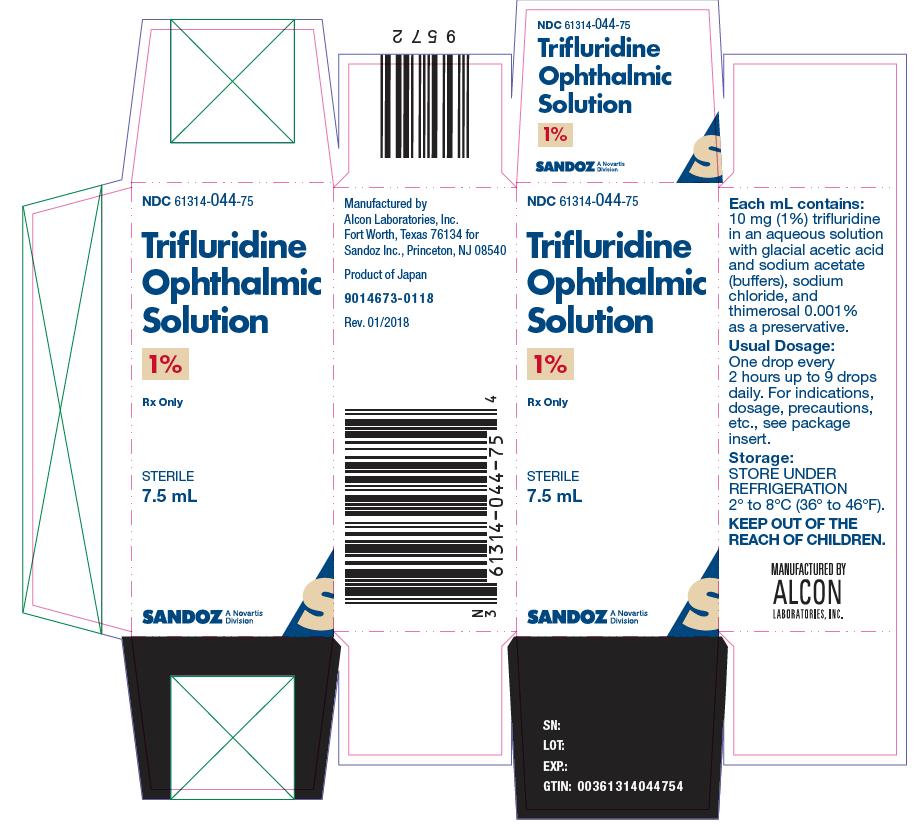
Trifluridine 10 mg/mL Solution, 7.5 mL — NDC 61314-0044-75 package photo

Trifluridine 10 mg/mL Solution, 7.5 mL

by Sandoz Inc · 7.5 mL in 1 BOTTLE, PLASTIC (61314-044-75)
NDC 61314-0044-75
🏷️ FDA NDC (as labeled) 61314-044-75 billing pads the product segment with a zero
Rx only Generic On market Non-controlled
🗂️ Data synced Jul 24, 2026 · sources: openFDA · FDA label (DailyMed) · FDA Orange & Purple Book · First Databank · CMS NADAC, ASP, Medicare & Medicaid · RxNorm
📋 All sources & update times →

🆔 Identity & classification

FDA NDC (as labeled) 61314-044-75
Product NDC 61314-044
11-digit billing NDC 61314004475
NCPDP billing unit ML — per mL (volume)
RxCUI 313477
UNII RMW9V5RW38
Application # ANDA074311
SPL Set ID abc1d07f-91ee-4421-bc9b-457d0ed41f4c
Established class (EPC) Nucleoside Analog Antiviral; Nucleoside Metabolic Inhibitor
Mechanism of action Nucleic Acid Synthesis Inhibitors
DEA schedule Non-controlled
Marketing category ANDA
Marketing status On market
FDA listing status Listed (active directory)
Marketing start 2001-05-14
Route OPHTHALMIC
Dosage form SOLUTION
Substance TRIFLURIDINE
GPI-14 86103020002005
GPI class Trifluridine
GCN Seq No 007942
GCN 33500
HICL code 003504
Ingredient (HICL) Trifluridine
HIC1 code Q
Therapeutic class — broad (HIC1) Ear/Eye/Nose/Rectum/Topical/Vagina/Other
HIC2 code Q6
Therapeutic class — intermediate (HIC2) Ophthalmic Preparations
HIC3 code Q6V
Therapeutic class — specific (HIC3) Eye Antivirals
AHFS code 52:04.20.00
AHFS class Antivirals (Eent)
FDB label name TRIFLURIDINE 1% EYE DROPS
FDB brand name Trifluridine
Legend status F — Federal legend — prescription drug or device
TE code (Orange Book) AT · RLD · RS
Why two NDCs? The FDA registers this code as 61314-044-75 — a 5-3-2 layout, and that's what's printed on the package and shown on DailyMed. For insurance claims, every NDC is standardized to a uniform 11-digit 5-4-2 format by adding a zero to the product segment → 61314-0044-75. Same drug, same package — only the format differs.
Where does this data come from?
Identifiers from the FDA openFDA NDC Directory and Structured Product Labeling; RxCUI from RxNorm (NLM); GPI from Medi-Span; GCN / HIC / AHFS / legend from First Databank.

🏷️ RxNorm drug class

This medicine belongs to the Nucleoside Analog Antiviral class.

Pharmacologic class Nucleoside Analog Antiviral, Nucleoside Metabolic Inhibitor
Drug family (ATC) Antivirals
How it works Nucleic Acid Synthesis Inhibitors
Where does this data come from?
Therapeutic classes from RxNorm RxClass (U.S. National Library of Medicine) — Established Pharmacologic Class (FDA), ATC drug family (WHO) and mechanism of action, matched by this product’s RxCUI.

🏭 Manufacturer & labeler

LabelerSandoz Inc
Application holderSANDOZ INC
FDA applicationANDA074311 (ANDA)
Labeler code61314
First marketedMay 2001
Product typeHuman Prescription Drug
Portfolio387 products on file
The labeler markets the product; the application holder owns the FDA approval. They’re often the same company but can differ (e.g. a repackager or an authorized generic). A mailing address / phone appears here when the manufacturer includes it in the product’s FDA label (not all do).
Where does this data come from?
Labeler, application holder and registered establishment from the FDA openFDA NDC Directory and Drugs@FDA; address/contact from the product’s FDA label.

🩺 Clinical

Label name TRIFLURIDINE 1% EYE DROPS Ingredient Trifluridine
Where does this data come from?
Plain-language summary from MedlinePlus (U.S. National Library of Medicine); supplement & herbal interactions and nutrient depletion data from the Natural Medicines database; our full guide is HelloPharmacist editorial content.

🧪 Inactive Ingredients / Excipients

Inactive ingredients, also called excipients, are components of the drug product other than the active ingredient. They may include fillers, dyes, coatings, preservatives, flavors, or other formulation ingredients.

💡 Tap an ingredient (hover on desktop) to see what it is and why it’s used.

  • UNII Q40Q9N063P
    Acetic acid is a weak organic acid commonly used in medicines as a buffer and pH adjuster. It helps maintain the proper acidity level to ensure the drug remains stable and effective in its formulation.
  • UNII 4550K0SC9B
    Sodium acetate is a salt derived from acetic acid. It acts as a buffer to help maintain the medicine's pH stability and may serve as a preservative or solubilizer in liquid formulations.
  • UNII 451W47IQ8X
    Sodium chloride is common table salt. It's used in medicines as a buffer to maintain proper pH, as a filler to add bulk, or to adjust the osmotic balance in liquid formulations.
  • UNII 2225PI3MOV
    A mercury-containing preservative used to prevent bacterial and fungal contamination in multi-dose vials of vaccines and some injectable medicines. It stops microorganisms from growing in the product during storage and use.

4 inactive ingredients listed in the exact product block matched to this NDC.

Where does this data come from?
Data sourced from official FDA Structured Product Labeling (SPL) via DailyMedingredient classCode="IACT" elements from the exact product block matched by this NDC. Label-section narrative from DailyMed / the openFDA label index is shown separately when available.

Inactive ingredient FAQ

Are inactive ingredients the same for every manufacturer?
No. Inactive ingredients can differ by manufacturer, dosage form, strength, and package / product version.
Why might an inactive ingredient be missing?
Some SPLs do not provide a complete structured inactive-ingredient list, and older or unusual labels may only include the information in narrative text.
Can inactive ingredients matter?
Yes. They can matter for allergies, intolerances, dyes, gluten / lactose concerns, preservatives, and formulation differences — but confirm with a pharmacist or the manufacturer when it’s clinically important.

💲 Pricing

A drug doesn't have one price. Each row is a different public payment system, and none is what you'd pay at the counter — that depends on your insurance. The ⓘ on each row explains what it measures.

Price systemPer mLPer package
Retail pharmacies payNADAC · weekly $23.463 $175.97 / 7.5 ml
Medicaid paysCMS SDUD · 12 mo $20.69 $155.19 / 7.5 ml
Medicare drug plans payPart D · Q2 2026 $22.75 $170.59 / 7.5 ml
NADAC price history (per mL) — tap or hover for the price & month
Sep 2021 Aug 2023 Mar 2026 Aug 2026 $24.030 $20.397
▲ Up 15% over the last 14 months.
Where does this data come from?
NADAC (National Average Drug Acquisition Cost) is the CMS weekly pharmacy-acquisition-cost survey — what pharmacies pay. ASP (Average Sales Price) is the CMS Medicare Part B drug-payment file, published quarterly. Medicaid pays is computed by us from CMS State Drug Utilization Data (total reimbursed ÷ units, trailing 12 months) — gross of rebates and inclusive of dispensing fees, so it reflects what Medicaid paid, not an acquisition cost. Medicare drug plans pay is the median negotiated point-of-sale unit cost across plans listing this NDC in the CMS quarterly Prescription Drug Plan pricing files, before rebates. The VA pays is the federal contract price (FSS, and the statutory Big 4 ceiling where listed) from the VA National Acquisition Center pharmaceutical price file. All are free public government data; each measures a different payer, so the figures are not directly comparable.

🔁 Therapeutic equivalents

ProductLabelerPackNADAC/unitTEStatusPrice vs. this
Trifluridine 10 mg/mLthis 61314-0044-75 Sandoz 7.5 ml $23.463 AT Availability likely
About this product: this is a generic version of the medicine. FDA equivalence ratings are shown when available, and other versions are listed above, least expensive first.
Where does this data come from?
Equivalents are other NDCs of the same ingredient, form and route from the openFDA NDC Directory, ranked least-expensive-first by NADAC. Therapeutic-equivalence (AB) ratings come from the FDA Orange Book; biologics use the FDA Purple Book for biosimilar & interchangeable status.

Availability & generic status

🏛️
2001
On the market since
May 2001
📍
2026
Currently FDA-listed
25 years listed
🔓
·
Generic on the market
this product is a generic
This is a generic drug

This product is an FDA-approved generic. Other versions of the same drug are listed under Therapeutic equivalents, least expensive first.

Where does this data come from?
Patents and exclusivity from the FDA Orange Book (small-molecule drugs), refreshed from public FDA data. Generic launch timing is an estimate, not a guarantee.

🗺️ Medicaid utilization & spend

📍 This exact package only: Medicaid data is reported per full 11-digit NDC — labeler, product and pack size — so every number here is for 61314-0044-75, not the drug overall. Other pack sizes report separately.
💊 Pharmacy benefit only: These are Medicaid outpatient pharmacy claims, billed by NDC. They exclude the medical benefit — clinic- or hospital-administered drugs billed under HCPCS J-codes — so drugs used mostly that way (e.g. Avastin, Lucentis, Keytruda) can look low or missing here. That’s expected, not an error.
📅 Q1 2025 – Q4 2025 · 4 quarters of data
ⓘ The newest quarter is usually incomplete when first published; states restate recent quarters in later CMS releases, so the latest figures typically revise upward. State coverage-policy changes can also shift quarter-to-quarter totals.
Prescriptions last 4 qtrs
1.6K
Units reimbursed last 4 qtrs
12.3K
Gross reimbursed last 4 qtrs
$253.9K
Avg / prescription
$156.43
Avg / unit
$20.6919
Latest quarter Q4 2025
328Rx
Medicaid pays / mL
$20.6919
gross reimbursed
vs
NADAC / mL
$23.4625
acquisition cost
=
Spread
−$2.7706
-12% vs cost
What Medicaid paid per mL (before rebates; includes the pharmacy’s dispensing fee) compared with NADAC — the average price pharmacies pay to buy the drug. A positive spread means Medicaid reimbursed more than the purchase price, before manufacturer rebates.
Fee-for-service vs managed care
48% FFS 52% MCO
Fee-for-service · 778 Rx Managed care · 845 Rx
State Medicaid map
Alaska: no data reported AK Maine: no data reported ME Washington: no data reported WA Idaho: no data reported ID Montana: no data reported MT North Dakota: no data reported ND Minnesota: no data reported MN Wisconsin: 90 units · 1.5 per 100k residents WI Michigan: 360 units · 3.6 per 100k residents MI New York: 1,823 units · 9.3 per 100k residents NY Vermont: no data reported VT New Hampshire: no data reported NH Oregon: no data reported OR Nevada: no data reported NV Wyoming: no data reported WY South Dakota: no data reported SD Iowa: no data reported IA Illinois: 368 units · 2.9 per 100k residents IL Indiana: 593 units · 8.6 per 100k residents IN Ohio: 473 units · 4.0 per 100k residents OH Pennsylvania: 780 units · 6.0 per 100k residents PA New Jersey: 698 units · 7.5 per 100k residents NJ Massachusetts: no data reported MA California: 3,825 units · 9.8 per 100k residents CA Utah: no data reported UT Colorado: no data reported CO Nebraska: no data reported NE Missouri: no data reported MO Kentucky: 593 units · 13.1 per 100k residents KY West Virginia: no data reported WV Virginia: 578 units · 6.6 per 100k residents VA Maryland: 83 units · 1.3 per 100k residents MD Connecticut: no data reported CT Rhode Island: no data reported RI Arizona: 465 units · 6.3 per 100k residents AZ New Mexico: no data reported NM Kansas: no data reported KS Arkansas: no data reported AR Tennessee: 203 units · 2.8 per 100k residents TN North Carolina: 105 units · 1.0 per 100k residents NC South Carolina: no data reported SC Delaware: no data reported DE Oklahoma: no data reported OK Louisiana: 465 units · 10.2 per 100k residents LA Mississippi: no data reported MS Alabama: no data reported AL Georgia: no data reported GA D.C.: no data reported DC Hawaii: 128 units · 8.9 per 100k residents HI Texas: 210 units · 0.7 per 100k residents TX Florida: 435 units · 1.9 per 100k residents FL
Units reimbursed · per 100k residents
0.713.1
gray = no data reported
Colors are per 100,000 residents, so big states don’t automatically dominate. Tap or hover a state for its actual totals.
Tap or hover a state
…for its Medicaid breakdown
🏆 Top states by units · per 100k residents
1 Kentucky 13.1 /100k
2 Louisiana 10.2 /100k
3 California 9.8 /100k
4 New York 9.3 /100k
5 Hawaii 8.9 /100k
6 Indiana 8.6 /100k
7 New Jersey 7.5 /100k
8 Virginia 6.6 /100k
National units — by quarter
💵 About the dollar figures: “reimbursed” is what Medicaid paid pharmacies before confidential manufacturer rebates, so the program’s real net cost is lower than these numbers. Fee-for-service and managed-care claims are combined unless split above. Source: CMS State Drug Utilization Data; per-100k rates use 2023 Census population estimates.

📊 Medicare Part D spend CMS · PART D · 2026 (Q1)

Medicare Part D (outpatient prescription) spending for Trifluridine — the program that covers self-administered drugs. 1 manufacturer.
⚠️ Drug-level data: CMS publishes Part D spending by drug, not by NDC — these figures combine every manufacturer, strength and package size sold under the name Trifluridine. That’s a different level of aggregation than the Medicaid card above, which is specific to this exact 11-digit NDC (pack size included), so the two aren’t directly comparable.
Period
Total Part D spend
$373.1K
Claims incl. refills
2.2K
Beneficiaries
1.9K
Spend / beneficiary
$200.47
Spend / claim
$171.92
Trend by period
💵 About the dollar figures: spending is what Part D plans paid before confidential manufacturer rebates, so the program’s real net cost is lower. A blank patient count means fewer than 11 people — CMS hides counts that small to protect privacy. Source: CMS Medicare Quarterly Part D Spending by Drug (data.cms.gov), updated quarterly.

🔬 Reported adverse events (FAERS)

Read carefully: FAERS reports are voluntary and unverified. Counts are not incidence, do not establish causation, are subject to reporting bias, and cannot be used to compare one drug to another. Shown for signal context only. Reports for Trifluridine — the ingredient across all brands.

Top reported reactions

Death3,124
Disease Progression1,811
Fatigue1,426
Nausea1,206
Diarrhoea1,064
Decreased Appetite692
Vomiting653

Age at onset

Infant4
Adolescent2
Adult1,604
Elderly1,487

Reporter sex

11,088 reports
Male · 58%
Female · 42%
Unknown · 0%

Serious outcomes

Death4,280
Hospitalization3,037
Life-threatening132
Disabling58
Reports over time (by year) — tap or hover for the count & year
2019 2021 2023 2026 1,092 327
Most recent year is provisional (FAERS lags ~3 months).
Where does this data come from?
Adverse-event reports from the FDA Adverse Event Reporting System (FAERS) via openFDA. FAERS reports are voluntary and unverified — counts are not incidence and don’t establish causation.

📦 Packaging — all sizes for this product

Package NDCDescription Marketing startStatus
61314-0044-75 You're viewing this 7.5 mL in 1 BOTTLE, PLASTIC (61314-044-75) 2001-05-14 Active

📄 Full prescribing information FDA SPL

The complete FDA label for this product — the official prescribing information, verbatim, section by section. Jump with a chip, search within the label, or expand everything.
🎯 Indications and Usage 27 words

INDICATIONS AND USAGE: Trifluridine Ophthalmic Solution is indicated for the treatment of primary keratoconjunctivitis and recurrent epithelial keratitis due to herpes simplex virus, types 1 and 2.

⏱️ Dosage and Administration 110 words

DOSAGE AND ADMINISTRATION: Instill one drop of Trifluridine Ophthalmic Solution onto the cornea of the affected eye every 2 hours while awake for a maximum daily dosage of nine drops until the cornea ulcer has completely re-epithelialized. Following re-epithelialization, treatment for an additional 7 days of one drop every 4 hours while awake for a minimum daily dosage of five drops is recommended. If there are no signs of improvement after 7 days of therapy or complete re-epithelialization has not occurred after 14 days of therapy, other forms of therapy should be considered.

Continuous administration of trifluridine for periods exceeding 21 days should be avoided because of potential ocular toxicity.

Contraindications 17 words

CONTRAINDICATIONS: Trifluridine Ophthalmic Solution is contraindicated for patients who develop hypersensitivity reactions or chemical intolerance to trifluridine.

⚠️ Warnings 17 words

WARNINGS: The recommended dosage and frequency of administration should not be exceeded (See DOSAGE AND ADMINISTRATION ).

🤒 Adverse Reactions 52 words

ADVERSE REACTIONS: The most frequent adverse reactions reported during controlled clinical trials were mild, transient burning or stinging upon instillation (4.6%) and palpebral edema (2.8%). Other adverse reactions in decreasing order of reported frequency were superficial punctate keratopathy, epithelial keratopathy, hypersensitivity reaction, stromal edema, irritation, keratitis sicca, hyperemia, and increased intraocular pressure.

🤰 Pregnancy 173 words

Pregnancy: Teratogenic Effects: Trifluridine was not teratogenic at doses up to 5 mg/kg/day (23 times the estimated human exposure) when given subcutaneously to rats and rabbits. However, fetal toxicity consisting of delayed ossification of portions of the skeleton occurred at dose levels of 2.5 and 5 mg /kg /day in rats and at 2.5 mg/kg/day in rabbits. In addition, both 2.5 and 5 mg/kg/day produced fetal death and resorption in rabbits.

In both rats and rabbits, 1 mg/kg/day (5 times the estimated human exposure) was a no-effect level. There were no teratogenic or fetotoxic effects after topical application of trifluridine (approximately 5 times the estimated human exposure) to the eyes of rabbits on the 6th through the 18th days of pregnancy. In a non-standard test, trifluridine solution has been shown to be teratogenic when injected directly into the yolk sac of chicken eggs.

There are no adequate and well-controlled studies in pregnant women. Trifluridine Ophthalmic Solution should be used during pregnancy only if the potential benefit justifies the potential risk to the fetus.

🧒 Pediatric Use 17 words

Pediatric Use: Safety and effectiveness in pediatric patients below six years of age have not been established.

🧓 Geriatric Use 17 words

Geriatric Use: No overall differences in safety or effectiveness have been observed between elderly and younger patients.

🆘 Overdosage 108 words

OVERDOSAGE: Overdosage by ocular instillation is unlikely because any excess solution should be quickly expelled from the conjunctival sac. Acute overdosage by accidental oral ingestion of trifluridine has not occurred. However, should such ingestion occur, the 75 mg dosage of trifluridine in a 7.5 mL bottle of Trifluridine Ophthalmic Solution is not likely to produce adverse effects.

Single intravenous doses of 1.5 to 30 mg/kg/day in children and adults with neoplastic disease produce reversible bone marrow depression as the only potentially serious toxic effect and only after three to five courses of therapy. The acute oral LD 50 in the mouse and rat was 4379 mg/kg or higher.

🧬 Clinical Pharmacology ~2 min read

CLINICAL PHARMACOLOGY: Trifluridine is a fluorinated pyrimidine nucleoside with in vitro and in vivo activity against herpes simplex virus, types 1 and 2 and vacciniavirus. Some strains of adenovirus are also inhibited in vitro . Trifluridine is also effective in the treatment of epithelial keratitis that has not responded clinically to the topical administration of idoxuridine or when ocular toxicity or hypersensitivity to idoxuridine has occurred.

In a smaller number of patients found to be resistant to topical vidarabine, trifluridine was also effective. Trifluridine interferes with DNA synthesis in cultured mammalian cells. However, its antiviral mechanism of action is not completely known.

In vitro perfusion studies on excised rabbit corneas have shown that trifluridine penetrates the intact cornea as evidenced by recovery of parental drug and its major metabolite, 5-carboxy-2´-deoxyuridine, on the endothelial side of the cornea. Absence of the corneal epithelium enhances the penetration of trifluridine approximately two-fold. Intraocular penetration of trifluridine occurs after topical instillation of trifluridine into human eyes.

Decreased corneal integrity or stromal or uveal inflammation may enhance the penetration of trifluridine into the aqueous humor. Unlike the results of ocular penetration of trifluridine in vitro , 5-carboxy-2´-deoxyuridine was not found in detectable concentrations within the aqueous humor of the human eye. Systemic absorption of trifluridine following therapeutic dosing with trifluridine appears to be negligible.

No detectable concentrations of trifluridine or 5-carboxy-2´-deoxyuridine were found in the sera of adult healthy normal subjects who had trifluridine instilled into their eyes seven times daily for 14 consecutive days. Clinical Studies: During a controlled multicenter clinical trial, 92 of 97 (95%) patients (78 of 81 with dendritic and 14 of 16 with geographic ulcers) responded to therapy with trifluridine as evidenced by complete corneal re-epithelialization within the 14-day therapy period. Fifty-six of 75 (75%) patients (49 of 58 with dendritic and 7 of 17 with geographic ulcers) responded to idoxuridine therapy.

The mean time to corneal re-epithelialization for dendritic ulcers (6 days) and geographic ulcers (7 days) was similar for both therapies. In other clinical studies, trifluridine was evaluated in the treatment of herpes simplex virus keratitis in patients who were unresponsive or intolerant to the topical administration of idoxuridine or vidarabine. Trifluridine was effective in 138 of 150 (92%) patients (109 of 114 with dendritic and 29 of 36 with geographic ulcers) as evidenced by corneal re-epithelialization.

The mean time to corneal re-epithelialization was 6 days for patients with dendritic ulcers and 12 days for patients with geographic ulcers. The clinical efficacy of trifluridine in the treatment of stromal keratitis and uveitis due to herpes simplex virus or ophthalmic infections caused by vacciniavirus and adenovirus has not been established by well-controlled clinical trials. Trifluridine has not been shown to be effective in the prophylaxis of herpes simplex virus keratoconjunctivitis and epithelial keratitis by well-controlled clinical trials.

Trifluridine is not effective against bacterial, fungal or chlamydial infections of the cornea or nonviral trophic lesions.

📦 How Supplied / Storage and Handling 36 words

HOW SUPPLIED: Trifluridine Ophthalmic Solution, 1% in a 7.5 mL fill packaged in a natural plastic bottle with a natural plastic flat tip and a white plastic closure. 7.5mL- NDC 61314-044-75 Store under refrigeration 2-8°C (36-46°F).

📋 Description 82 words

DESCRIPTION: Trifluridine Ophthalmic Solution (also known as trifluorothymidine, F 3 TdR, F 3 T), an antiviral drug for topical treatment of epithelial keratitis caused by herpes simplex virus. The chemical name of trifluridine is α,α,α-trifluorothymidine. Trifluridine has the following structural formula.

Trifluridine sterile ophthalmic solution contains 1% trifluridine in an aqueous solution with acetic acid and sodium acetate (buffers), sodium chloride, and thimerosal 0.001% (added as a preservative). The pH range is 5.5 to 6.0 and osmolality is approximately 283 mOsm. chemical

Source: FDA Structured Product Labeling, mirrored from DailyMed / openFDA. Prefer the government’s original formatting? View this label on DailyMed ↗
For educational and professional reference only — not medical advice. Pricing reflects published NADAC and CMS ASP (free public data) and may differ from your acquisition cost; always verify before billing or dispensing.