
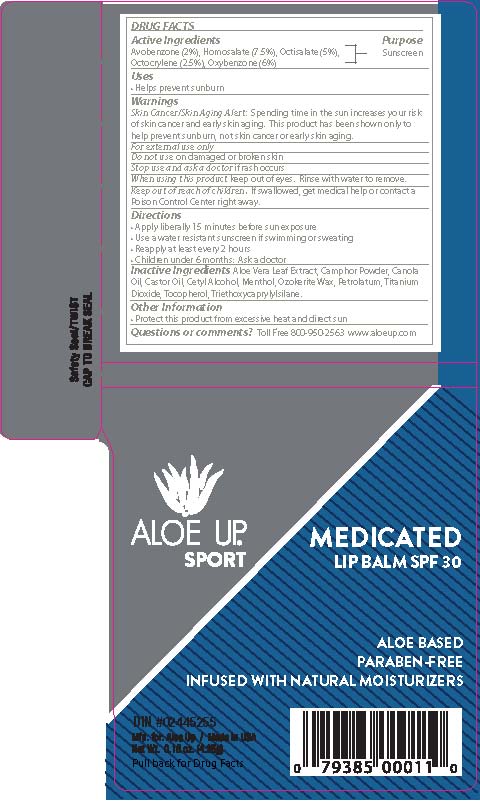
ALOE UP MEDICATED LIP BALM SPF 30 AVOBENZONE, HOMOSALATE, OCTISALATE, OCTOCRYLENE, OXYBENZONE 2 g/100g; 7.5 g/100g; 5 g/100g; 2.5 g/100g; 6 g/100g Lipstick, 4.25 g
🆔 Identity & classification
Where does this data come from?
🏭 Manufacturer & labeler
Where does this data come from?
🩺 Clinical
Aloe Up Medicated Lip Balm SPF 30 is a topical lipstick product marketed as an over-the-counter monograph drug. It contains five UV-filtering ingredients (avobenzone, homosalate, octisalate, octocrylene, and oxybenzone) that are typically used together to help protect lips from ultraviolet sun exposure. This type of product is commonly used as a lip sunscreen to reduce UV-related damage to the lips.
Patient education
Supplement & herbal interactions
Where does this data come from?
Ask a licensed pharmacist directly — free, answered by our team.
🧪 Inactive Ingredients / Excipients
Inactive ingredients, also called excipients, are components of the drug product other than the active ingredient. They may include fillers, dyes, coatings, preservatives, flavors, or other formulation ingredients.
💡 Tap an ingredient (hover on desktop) to see what it is and why it’s used.
-
UNII ZY81Z83H0X
Aloe vera leaf is a plant extract derived from the aloe plant. It is used in medicines as a natural moisturizer and skin-soothing agent in topical formulations.
-
UNII 5TJD82A1ET
A cooling crystalline substance made synthetically that is added to medicines as a fragrance, flavoring agent, and mild local irritant to produce a cooling or warming sensation on the skin or mucous membranes.
-
UNII 331KBJ17RK
Canola oil is a plant-based oil derived from rapeseed. It's used in medicines as a solvent and carrier to help dissolve or suspend active ingredients, and may improve how the body absorbs certain medications.
-
UNII Q1LS2UJO3A
Ceresin is a purified mineral wax derived from ozocerite. It functions as a binding agent, thickener, and coating material in medicines to help hold ingredients together and provide texture or protective coating.
-
UNII 936JST6JCN
Cetyl alcohol is a waxy, fatty substance derived from plant or animal sources. It acts as an emulsifier and thickener in medicines, helping blend oil and water components and giving products a smooth, creamy texture.
-
UNII L7T10EIP3A
A cooling compound from mint plants used as a flavoring agent and to create a fresh sensation in medicines. It helps mask bitter tastes and improve how the product feels in the mouth.
-
UNII 4T6H12BN9U
Petrolatum is a purified mineral oil-based jelly derived from petroleum. In medicines, it acts as an emollient, lubricant, and moisture barrier to soften skin, reduce friction, and help prevent water loss from formulations.
-
UNII 15FIX9V2JP
Titanium dioxide is a bright white mineral powder commonly used as a colorant and opacifying agent. It makes pills and tablets white or lighter in color and helps make coatings non-transparent.
-
UNII R0ZB2556P8
Tocopherol is a form of vitamin E derived from plant oils. It acts as an antioxidant in medicines to prevent oils and fats from breaking down and spoiling during storage.
-
UNII LDC331P08E
A silicone-based compound that acts as a glidant and flow agent in solid medications. It reduces friction between powder particles, helping the medicine flow smoothly during manufacturing and tablet compression.
10 inactive ingredients listed in the exact product block matched to this NDC.
Label-section wording can be broader than the structured product block and may mention additional formulation ingredients.
Where does this data come from?
ingredient classCode="IACT" elements from the exact product block matched by this NDC. Label-section narrative from DailyMed / the openFDA label index is shown separately when available.Inactive ingredient FAQ
Are inactive ingredients the same for every manufacturer?
Why might an inactive ingredient be missing?
Can inactive ingredients matter?
💲 Pricing
A drug doesn't have one price. Each row is a different public payment system, and none is what you'd pay at the counter — that depends on your insurance. The ⓘ on each row explains what it measures.
| Price system | Per each | Per package |
|---|---|---|
| Retail pharmacies payNADAC · weekly | Not in the retail survey — common for institutional, discontinued, or low-volume packs. | |
| Medicaid paysCMS SDUD · 12 mo | No recent Medicaid claims on file for this NDC — rare and low-volume NDCs are suppressed in the public data. | |
| Medicare drug plans payPart D · quarterly | No Part D plan price is available for this NDC in our data. | |
Where does this data come from?
🔁 Therapeutic equivalents
| Product | Labeler | Pack | NADAC/unit | TE | Status | Price vs. this |
|---|---|---|---|---|---|---|
| Aloe Up Medicated Lip Balm Spf 30 2 g/100g; 7.5 g/100g; 5 g/100g; 2.5 g/100g; 6 g/100gthis 61477-0224-11 | Aloe | 4.25 g | — | — | FDA listed | — |
Where does this data come from?
⏳ Availability & generic status
We did not find an FDA-approved generic match for this exact strength, form and route.
Where does this data come from?
🔬 Reported adverse events (FAERS)
Top reported reactions
Age at onset
Reporter sex
Serious outcomes
Where does this data come from?
📦 Packaging — all sizes for this product
| Package NDC | Description | Marketing start | Status |
|---|---|---|---|
| 61477-0224-11 You're viewing this | 4.25 g in 1 TUBE (61477-224-11) | 2019-05-17 | Active |
🧭 About this NDC listing & data coverage
What data is (and isn’t) available for this NDC — tap to expand
| NDC identity (package / product / labeler codes) | ✓ Available |
| Labeler | ✓ Available |
| Product & package description | ✓ Available |
| Marketing category & status | ✓ Available |
| Active ingredient / dosage form / route | ✓ Available |
| FDA label (SPL via DailyMed) | ✓ Available |
| Package photos | ✓ Available |
| Inactive ingredients (structured) | ✓ Available |
| NADAC pharmacy acquisition price (CMS) | — Not published for this NDC CMS publishes NADAC only for NDCs reported in its retail-pharmacy survey. |
| Orange Book / therapeutic-equivalence data | — Not published for this NDC Applies only to products approved under an NDA/ANDA; many listings are out of scope. |
| HCPCS J-code billing crosswalk | — Not published for this NDC Most self-administered / retail products have no J-code — that is normal. |
| Medicaid utilization (CMS SDUD) | — Not published for this NDC CMS reports utilization only for NDCs with Medicaid claims above its privacy threshold. |
Questions about this listing
Is this NDC FDA-approved?
Why is there no price listed?
Is the NDC printed on the package the same as the 11-digit billing NDC?
What do the three segments of this NDC mean?
Is this package still being marketed?
Who lists this product with the FDA?
Do I need a prescription for this product?
Where does this data come from?
📄 FDA label — Drug Facts FDA SPL
🎯 Indications and Usage ▾
USES HELPS PREVENT SUNBURN.
⏱️ Dosage and Administration ▾
DIRECTIONS • Apply liberally 15 minutes before sun exposure • Use a water resistant sunscreen if swimming or sweating • Reapply at least every 2 hours • Children under 6 months: Ask a doctor
⚠️ Warnings ▾
WARNINGS Skin Cancer/Skin Aging Alert: Spending time in the sun increases your risk of skin cancer and early skin aging. This product has been shown only to help prevent sunburn, not skin cancer or early skin aging. For external use only Do not use on damaged or broken skin Stop use and ask a doctor if rash occurs When using this product keep out of eyes. Rinse with water to remove.
🧪 Active Ingredient ▾
ACTIVE INGREDIENTS AVOBENZONE (2%) HOMOSALATE (7.5%) OCTISALATE (5%) OCTOCRYLENE (2.5%) OXYBENZONE (6%)
🧪 Inactive Ingredients ▾
INACTIVE INGREDIENTS Aloe Vera Leaf Extract, Camphor Powder, Canola Oil, Castor Oil, Cetyl Alcohol, Menthol, Ozokerite Wax, Petrolatum, Titanium Dioxide, Tocopherol, Triethoxycaprylylsilane.
🎯 Purpose ▾
PURPOSE SUNSCREEN