
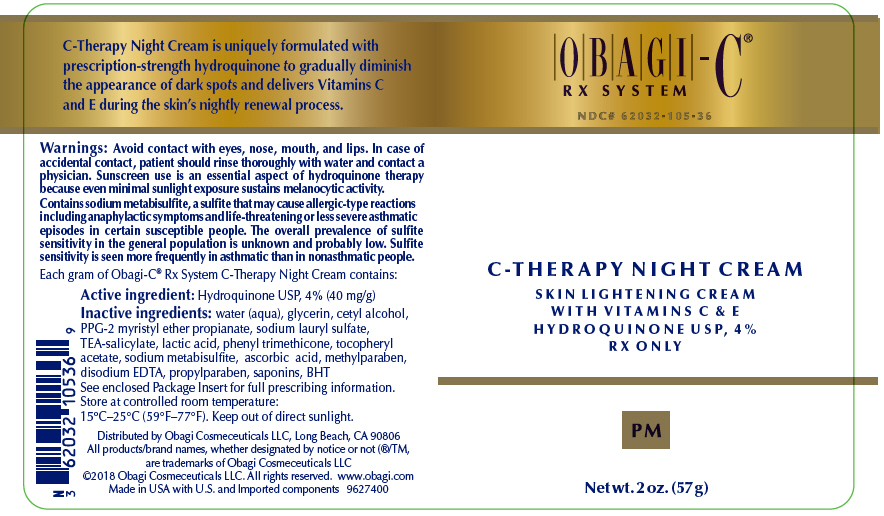
Obagi-C Rx system C-Therapy Night Skin Lightening with Vitamins C and E HYDROQUINONE 40 mg/g Cream, 57 g
🆔 Identity & classification
Where does this data come from?
🏷️ RxNorm drug class
This medicine belongs to the Melanin Synthesis Inhibitor class.
Where does this data come from?
🏭 Manufacturer & labeler
Where does this data come from?
🩺 Clinical
This is a topical cream containing hydroquinone, a melanin synthesis inhibitor typically used in skin-lightening products. Hydroquinone is commonly applied to the skin to help reduce the appearance of dark spots, uneven skin tone, and hyperpigmentation. This product is marketed without an approved FDA application and is being distributed under a different regulatory pathway.
Patient education
Supplement & herbal interactions
Where does this data come from?
Ask a licensed pharmacist directly — free, answered by our team.
💊 What it looks like
Where does this data come from?
🧪 Inactive Ingredients / Excipients
Inactive ingredients, also called excipients, are components of the drug product other than the active ingredient. They may include fillers, dyes, coatings, preservatives, flavors, or other formulation ingredients.
💡 Tap an ingredient (hover on desktop) to see what it is and why it’s used.
-
UNII 9E8X80D2L0
A synthetic form of vitamin E used as an antioxidant and preservative in medications. It helps prevent the active ingredients from degrading when exposed to oxygen or light.
-
UNII PQ6CK8PD0R
Ascorbic acid, also known as vitamin C, is a white crystalline powder. It serves as an antioxidant to prevent degradation of other ingredients and may also function as a preservative in the formulation.
-
UNII 1P9D0Z171K
BHT is a synthetic antioxidant that prevents fats and oils in medicines from breaking down and becoming rancid. It helps keep the product stable and effective during storage.
-
UNII 936JST6JCN
Cetyl alcohol is a waxy, fatty substance derived from plant or animal sources. It acts as an emulsifier and thickener in medicines, helping blend oil and water components and giving products a smooth, creamy texture.
-
UNII 7FLD91C86K
Edetate disodium is a chemical compound that binds and removes certain metal ions. In medicines, it acts as a preservative and stabilizer by preventing metals like calcium from interfering with the product's shelf life and consistency.
-
UNII PDC6A3C0OX
Glycerin is a clear, thick liquid derived from plant oils or fats. It acts as a humectant to retain moisture, a sweetener, and a solvent in medications.
-
UNII 33X04XA5AT
Lactic acid is a naturally occurring organic acid derived from milk or plant sources. It lowers and maintains pH in formulations, helps preserve the product, and can enhance ingredient stability and absorption.
-
UNII A2I8C7HI9T
Methylparaben is a preservative derived from benzoic acid that prevents growth of bacteria, fungi, and mold in medicines. It extends the product's shelf life and maintains safety during storage.
-
UNII DR0K5NOJ4R
Phenyl trimethicone is a silicone-based lubricant and glidant. It helps powder particles flow smoothly and reduces friction during tablet or capsule manufacturing and filling.
-
UNII 88R97D8U8A
A synthetic liquid derived from propylene glycol and myristic acid. It functions as an emollient and solvent in topical formulations, helping to soften the skin and improve the texture and spreadability of the product.
-
UNII Z8IX2SC1OH
Propylparaben is a chemical preservative used to prevent bacterial and fungal growth in medicines and personal care products. It helps extend shelf life and maintain product safety during storage.
-
UNII 368GB5141J
A detergent and foaming agent derived from coconut or palm oil. In medications, it helps break down and mix oil and water-based ingredients, aids in tablet disintegration, and improves how the drug dissolves and spreads in the mouth or digestive system.
-
UNII 4VON5FNS3C
Sodium metabisulfite is a preservative derived from sulfur compounds. It prevents microbial growth and oxidation in medicines, helping extend shelf life and maintain product stability.
-
UNII H8O4040BHD
Trolamine salicylate is a salt formed from salicylic acid and triethanolamine. It's used in topical medicines as an anti-inflammatory agent and penetration enhancer to help active ingredients absorb through the skin.
-
UNII 059QF0KO0R
Water is a liquid solvent that dissolves and mixes ingredients together in liquid medicines, syrups, and injections. It helps distribute the active drug evenly throughout the product.
15 inactive ingredients listed in the exact product block matched to this NDC.
Where does this data come from?
ingredient classCode="IACT" elements from the exact product block matched by this NDC. Label-section narrative from DailyMed / the openFDA label index is shown separately when available.Inactive ingredient FAQ
Are inactive ingredients the same for every manufacturer?
Why might an inactive ingredient be missing?
Can inactive ingredients matter?
💲 Pricing
A drug doesn't have one price. Each row is a different public payment system, and none is what you'd pay at the counter — that depends on your insurance. The ⓘ on each row explains what it measures.
| Price system | Per g | Per package |
|---|---|---|
| Retail pharmacies payNADAC · weekly | Not in the retail survey — common for institutional, discontinued, or low-volume packs. | |
| Medicaid paysCMS SDUD · 12 mo | No recent Medicaid claims on file for this NDC — rare and low-volume NDCs are suppressed in the public data. | |
| Medicare drug plans payPart D · quarterly | No Part D plan price is available for this NDC in our data. | |
Where does this data come from?
🔁 Therapeutic equivalents
| Product | Labeler | Pack | NADAC/unit | TE | Status | Price vs. this |
|---|---|---|---|---|---|---|
| Hydroquinone 4% 40 mg/g 75834-0137-01 | Nivagen | 1 tube | $0.454 | — | Availability likely | — |
| Hydroquinone 4% 40 mg/g 42192-0151-01 | Acella | 1 tube | $0.517 | — | Availability likely | — |
| Hydroquinone 40 mg/g 69367-0174-01 | Westminster | 1 tube | $0.517 | — | Availability likely | — |
| hydroquinone 40 mg/g 10135-0724-99 | Marlex | 1 tube | — | — | FDA listed | — |
| Hydroquinone cream 40 mg/g 24689-0101-01 | APNAR | 1 tube | — | — | FDA listed | — |
| Hydroquinone 4% 40 mg/g 50405-0800-01 | SOHM, | 1 tube | — | — | FDA listed | — |
| NU-DERM BLENDER Skin Lightener and Blending 40 mg/g 62032-0100-10 | Obagi | 28 g | — | — | FDA listed | — |
| NU-DERM CLEAR Skin Bleaching and Corrector 40 mg/g 62032-0101-36 | Obagi | 57 g | — | — | FDA listed | — |
| Obagi-C Rx system C-Therapy Night Skin Lightening with Vitamins C and E 40 mg/gthis 62032-0105-36 | Obagi | 57 g | — | — | FDA listed | — |
| NU-DERM SUNFADER Skin Lightener with Sunscreen (SPF 15) PABA FREE 40 mg/g; 75 mg/g; 55 mg/g 62032-0116-36 | Obagi | 57 g | — | — | FDA listed | — |
| Hydroquinone 4% 40 mg/g 71399-0400-01 | Akron | 28.35 g | — | — | FDA listed | — |
| Hydroquinone 4% 40 mg/g 72162-2422-02 | Bryant | 1 tube | — | — | FDA listed | — |
| Hydro-Q 40 mg/g 30815-0040-01 | Dermavance | 1 tube | — | — | FDA listed | — |
Where does this data come from?
⏳ Availability & generic status
We did not find an FDA-approved generic match for this exact strength, form and route.
Where does this data come from?
🔬 Reported adverse events (FAERS)
Top reported reactions
Age at onset
Reporter sex
Serious outcomes
Where does this data come from?
📦 Packaging — all sizes for this product
| Package NDC | Description | Marketing start | Status |
|---|---|---|---|
| 62032-0105-36 You're viewing this | 57 g in 1 BOTTLE, PLASTIC (62032-105-36) | 2010-01-01 | Active |
🧭 About this NDC listing & data coverage
Listed without an FDA application
This product's marketing category indicates it is marketed without an approved FDA application (no NDA, ANDA, or BLA on file). Having an NDC does not by itself establish FDA approval — the NDC Directory is a listing system, not an approval decision. Approval-linked data such as Orange Book therapeutic-equivalence ratings therefore does not apply.
What data is (and isn’t) available for this NDC — tap to expand
| NDC identity (package / product / labeler codes) | ✓ Available |
| Labeler | ✓ Available |
| Product & package description | ✓ Available |
| Marketing category & status | ✓ Available |
| Active ingredient / dosage form / route | ✓ Available |
| FDA label (SPL via DailyMed) | ✓ Available |
| Package photos | ✓ Available |
| Inactive ingredients (structured) | ✓ Available |
| NADAC pharmacy acquisition price (CMS) | — Not published for this NDC CMS publishes NADAC only for NDCs reported in its retail-pharmacy survey. |
| Orange Book / therapeutic-equivalence data | — Not published for this NDC Applies only to products approved under an NDA/ANDA; many listings are out of scope. |
| HCPCS J-code billing crosswalk | — Not published for this NDC Most self-administered / retail products have no J-code — that is normal. |
| Medicaid utilization (CMS SDUD) | — Not published for this NDC CMS reports utilization only for NDCs with Medicaid claims above its privacy threshold. |
Questions about this listing
Is this NDC FDA-approved?
Why is there no price listed?
Is the NDC printed on the package the same as the 11-digit billing NDC?
What do the three segments of this NDC mean?
Is this package still being marketed?
Who lists this product with the FDA?
Do I need a prescription for this product?
Where does this data come from?
📄 Full prescribing information FDA SPL
🎯 Indications and Usage ▾
INDICATIONS AND USAGE The gradual bleaching of hyperpigmented skin conditions such as chloasma, melasma, freckles, senile lentigines, and other unwanted areas of melanin hyperpigmentation.
⏱️ Dosage and Administration ▾
DOSAGE AND ADMINISTRATION A thin application should be applied once or twice daily or as directed by a physician. If no improvement is seen after three (3) months of treatment, use of this product should be discontinued. Sun exposure should be limited by using a sunscreen agent or protective clothing to cover bleached skin when using and after using this product in order to prevent darkening from reoccurring.
⛔ Contraindications ▾
CONTRAINDICATIONS People with prior history of sensitivity or allergic reaction to this product or any of its ingredients should not use it. The safety of topical hydroquinone use during pregnancy or in children (12 years and under) has not been established.
⚠️ Warnings ▾
WARNINGS • Hydroquinone is a skin-bleaching agent, which may produce unwanted cosmetic effects if not used as directed. The physician should be familiar with the contents of this insert before prescribing or dispensing this product. • Test for skin sensitivity before using by applying a small amount to an unbroken patch of skin and check within 24 hours. Minor redness is not a contraindication, but where there is itching or vesicle formation or excessive inflammatory response, the product should be discontinued and a physician consulted.
Close patient supervision is recommended. • Avoid contact with eyes, nose, mouth, and lips. In case of accidental contact, the patient should rinse thoroughly with water and contact a physician. • Sunscreen use is an essential aspect of hydroquinone therapy because even minimal sunlight exposure sustains melanocytic activity. The Obagi-C ® Rx System C-Therapy Night Cream contains sodium metabisulfite, a sulfite that may cause allergic-type reactions including anaphylactic symptoms and life-threatening or less severe asthmatic episodes in certain susceptible people.
The overall prevalence of sulfite sensitivity in the general population is unknown and probably low. Sulfite sensitivity is seen more frequently in asthmatic than in nonasthmatic people.
🤒 Adverse Reactions ▾
ADVERSE REACTIONS No systemic adverse reactions have been reported. Occasional hypersensitivity (localized contact dermatitis) may occur, in which case the product should be discontinued and physician notified immediately. To report SUSPECTED ADVERSE REACTIONS, contact Obagi Medical Products, a division of Valeant Pharmaceuticals North America LLC, at 1-800-321-4576 or FDA at 1-800-FDA-1088 or www.fda.gov/medwatch.
🤰 Pregnancy ▾
Pregnancy Pregnancy Category C Animal reproduction studies have not been conducted with topical hydroquinone. It is also not known whether hydroquinone can cause fetal harm when used topically on a pregnant woman or affect reproductive capacity. It is not known to what degree, if any, topical hydroquinone is absorbed systemically. Topical hydroquinone should be used on pregnant women only when clearly indicated.
🧒 Pediatric Use ▾
Pediatric Usage Safety and effectiveness in children, below the age of 12 years, have not been established.
🧬 Clinical Pharmacology ▾
CLINICAL PHARMACOLOGY Topical application of hydroquinone produces a reversible depigmentation of the skin by inhibition of the enzymatic oxidation of tyrosine to 3, 4-dihydroxyphenylalanine (DOPA) and suppression of other melanocyte metabolic processes. Exposure to sunlight or ultraviolet light will cause repigmentation of the bleached areas, which may be prevented by the use of sunscreen agents contained in the Obagi-C ® Rx System Sun Shield Matte Broad Spectrum SPF 50.
📦 How Supplied / Storage and Handling ▾
HOW SUPPLIED Obagi-C ® Rx System C-Clarifying Serum (Hydroquinone, USP 4%) for Normal to Dry Skin is available as follows: 1 fl. oz. (30 mL) bottle NDC 62032-106-10 Obagi-C ® Rx System C-Clarifying Serum (Hydroquinone, USP 4%) for Normal to Oily Skin is available as follows: 1 fl. oz. (30 mL) bottle NDC 62032-122-10 Obagi-C ® Rx System C-Therapy Night Cream (Hydroquinone, USP 4%) is available as follows: Net wt.
2 oz. (57 g) bottle NDC 62032-105-36 Store at controlled room temperature: 15° to 25°C (59° to 77°F). Keep out of direct sunlight.
📋 Description ▾
Description Hydroquinone is 1,4-benzenediol. Hydroquinone occurs as fine, white needles. The drug is freely soluble in water and in alcohol. Chemically, hydroquinone is designated as p-dihydroxybenzene; the empirical formula is C 6 H 6 O 2 ; molecular weight is 110.11 g per mol. The chemical structure is in the diagram. chemstructure
💬 Information for Patients ▾
PATIENT INFORMATION For Topical Use Only Complete skin care regimen formulated with 4% hydroquinone to reduce hyperpigmentation and other essential ingredients to help address the signs of skin aging caused by photoaging. Please read this product information prior to use of the Obagi-C ® Rx System. Any questions regarding your particular skin care regimen should be directed to your physician.
More information about the Obagi-C® Rx System or other Obagi systems is available at our website at www.obagi.com.