
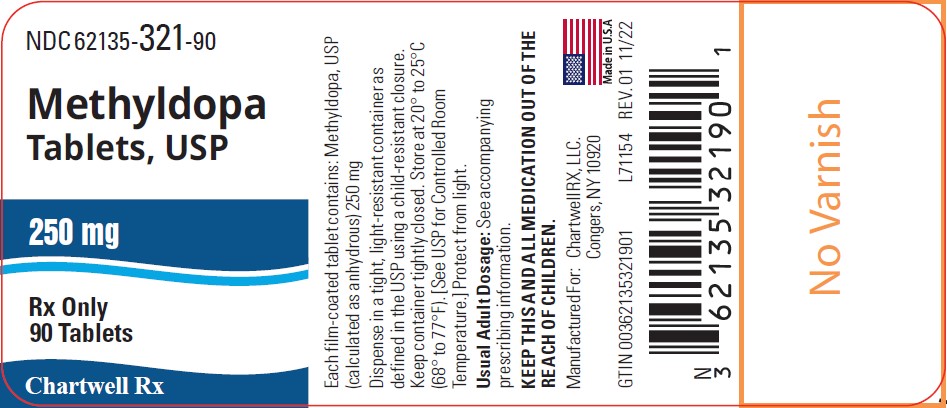
Methyldopa 250 mg Tablet, Film Coated, 90-count — NDC 62135-321-90 (Billing 62135-0321-90)
This is a package of 90 tablets of Methyldopa 250 mg Tablet, Film Coated from Chartwell RX, LLC, marketed since Jun 1984 and currently FDA-listed; retail pharmacies pay about $7.50 per tablet (NADAC). It is the main listing for this product, which comes in 2 package sizes.
NDC database record
One package, one record: these facts belong to NDC 62135-321-90 alone.
- Record
- FDA NDC Directory package listing · Human prescription drug
- Code segments
- 62135 labeler · 321 product · 90 package
- Package marketed since
- Nov 22, 2022
- Sample package
- No — commercial package
- Listing certified through
- Dec 31, 2026
- Billing quantity
- 90 EA per package
- Barcode (UPC)
- 0362135322908, 0362135322182, 0362135321901, 0362135321185
- Medicaid fills, this package
- 93 prescriptions in the last four reported quarters
- FDA record last changed
- Jul 24, 2026
Identity & classification
Regulatory identifiers FDA, NLM and CMS codes for this package
Drug-database identifiers Medi-Span GPI and First Databank GCN / HICL / AHFS classification
- GSN (GCN sequence number): 000361
- GCN: 01431
- GPI-14 (Medi-Span): 36201030000310
- HICL (First Databank): 000118
- AHFS class code: 24:24.00.00
- RxCUI (RxNorm): 197956
Where does this data come from?
- FDA openFDA NDC Directory · synced Oct 1, 2026
- FDA label on DailyMed · label index refreshed Oct 5, 2026
- RxNorm (NLM RxNav) · catalog refreshed Oct 1, 2026
- Medi-Span GPI (licensed)
- First Databank (licensed) · refreshed Oct 1, 2026
RxNorm drug class
This medicine belongs to the Central alpha-2 Adrenergic Agonist class.
Where does this data come from?
- RxClass (NLM) · catalog refreshed Oct 1, 2026
Clinical
- It treats high blood pressure (hypertension). It is taken by mouth as a tablet, and your prescriber adjusts the dose until your pressure is where it should be.
- Sleepiness is common when you first start or when the dose goes up, and it usually fades. Your prescriber may raise the dose in the evening to help. Headache and weakness can also...
- Please don’t stop on your own. Methyldopa wears off fast, and your blood pressure usually climbs back within about 48 hours. Talk to your prescriber first.
- Can I stop it if my blood pressure looks good?
Patient education
Supplement & herbal interactions
Some supplements/herbs that may interact with Methyldopa — tap one for details:
Methyldopa may be associated with lower levels of 1 nutrient — worth a chat with your pharmacist, not a cause for alarm.
Where does this data come from?
- MedlinePlus (NLM) · refreshed Oct 1, 2026
- FDA label on DailyMed · label index refreshed Oct 5, 2026
Ask a licensed pharmacist directly — free, answered by our team.
Pricing
A drug doesn't have one price. Each row is a different public payment system, and none is what you'd pay at the counter — that depends on your insurance. The ⓘ on each row explains what it measures.
| Price system | Per ea | Per package |
|---|---|---|
| Retail pharmacies payNADAC · weekly | $7.500 | $674.99 / 90 tablets |
| Medicaid paysCMS SDUD · 12 mo | $7.24 | $651.76 / 90 tablets |
| Medicare drug plans payPart D · Q2 2026 | $6.38 | $574.64 / 90 tablets |
Where does this data come from?
- CMS NADAC weekly file · file of Jul 15, 2026
- CMS ASP pricing files · refreshed Sep 20, 2026
- CMS Medicaid State Drug Utilization Data · through Q1 2026
- CMS Part D plan pricing files · refreshed Sep 24, 2026
- VA National Acquisition Center price file
Packaging — all sizes for this product
| Package NDC | Description | Per unit | Per pack | Marketing start | Marketing end | Status |
|---|---|---|---|---|---|---|
| 62135-0321-18 62135-321-18 | 180 TABLET, FILM COATED in 1 BOTTLE | $7.50 / ea | $1,349.98 | 2022-11-22 | — | Active |
| 62135-0321-90 You're viewing this Main listing | 90 TABLET, FILM COATED in 1 BOTTLE | $7.50 / ea | $674.99 | 2022-11-22 | — | Active |
You're viewing the smallest of 2 pack sizes for this product.
This pack effectively ties for the lowest per-ea cost of the 2 priced pack sizes ($7.50 NADAC).
Pack size FAQ
What quantity is in this package?
How does this package differ from NDC 62135-0321-18?
What NDC number is used to bill for this package of Methyldopa 250 mg Tablet, Film Coated?
Prices are the latest CMS NADAC pharmacy acquisition cost per NDC; per-pack figures are per-unit × pack quantity, shown only when the pack is denominated in the same measure NADAC prices.
Therapeutic equivalents
| Product | Labeler | Pack | NADAC/unit | TE | Status | Price vs. this |
|---|---|---|---|---|---|---|
| Methyldopa 250 mgthis 62135-0321-90 | Chartwell | 90 tablets | $7.500 | — | Availability likely | — |
| Methyldopa 250 mg 64980-0571-01 | Rising | 100 tablets | $7.500 | — | Availability likely | — |
Where does this data come from?
- FDA openFDA NDC Directory · synced Oct 1, 2026
- FDA Orange Book · refreshed Oct 3, 2026
- CMS NADAC weekly file · file of Jul 15, 2026
Availability & generic status
FDA-approved generic versions are listed, and recent pricing/market data suggests they may be available — see Therapeutic equivalents.
Where does this data come from?
- FDA Orange Book · refreshed Oct 3, 2026
What it looks like
Where does this data come from?
- FDA label on DailyMed · label index refreshed Oct 5, 2026
Inactive Ingredients / Excipients
Inactive ingredients, also called excipients, are components of the drug product other than the active ingredient. They may include fillers, dyes, coatings, preservatives, flavors, or other formulation ingredients.
💡 Tap an ingredient (hover on desktop) to see what it is and why it’s used.
-
UNII XF417D3PSL
Anhydrous citric acid is a sour, crystalline powder derived from citric acid with water removed. In medicines, it acts as a buffer to control pH, adds tartness to improve taste, and helps tablets disintegrate.
-
UNII 7Z8S9VYZ4B
Ethylcellulose is a plant-derived thickener and film-former made by chemically modifying cellulose. It's used as a binder to hold tablet ingredients together, a coating to control how quickly medicine is released, or a thickener in liquid formulations.
-
UNII 3NXW29V3WO
Hypromellose is a plant-based thickener made from cellulose. It's used in medicines as a binder to hold ingredients together, a coating for tablets, and a thickener for liquids.
-
UNII EWQ57Q8I5X
Lactose monohydrate is a natural sugar derived from milk. It serves as a filler and binder in tablets and capsules, helping create the proper size, texture, and consistency of the medicine.
-
UNII 70097M6I30
Magnesium stearate is a salt made from magnesium and stearic acid, a fatty substance. It's used in tablets and capsules as a lubricant and glidant to help ingredients flow smoothly during manufacturing and prevent sticking.
-
UNII OP1R32D61U
Microcrystalline cellulose is a purified form of cellulose, a natural fiber from plant sources. It acts as a binder and filler in tablets and capsules, helping hold ingredients together and give the medicine its shape and size.
-
UNII 3WJQ0SDW1A
Polyethylene glycol is a synthetic liquid or solid polymer used in medicines as a solvent, lubricant, and humectant. It helps dissolve active ingredients, reduces friction during manufacturing, and retains moisture in the final product.
-
UNII ETJ7Z6XBU4
Silicon dioxide is a naturally occurring mineral used as a glidant and anti-caking agent. It helps powder ingredients flow smoothly and prevents clumping during manufacturing and storage.
-
UNII O8232NY3SJ
A plant-based carbohydrate derived from corn kernels. It acts as a filler to add bulk, a binder to hold ingredients together, and a disintegrant to help the tablet break apart in your stomach for absorption.
9 inactive ingredients listed in the exact product block matched to this NDC.
Where does this data come from?
ingredient classCode="IACT" elements from the exact product block matched by this NDC. Label-section narrative from DailyMed / the openFDA label index is shown separately when available.- FDA label on DailyMed · label index refreshed Oct 5, 2026
- FDA openFDA NDC Directory · synced Oct 1, 2026
Inactive ingredient FAQ
Are inactive ingredients the same for every manufacturer?
Why might an inactive ingredient be missing?
Can inactive ingredients matter?
Manufacturer & labeler
More NDCs from Chartwell RX, LLC labeler code 62135
- Ciprofloxacin 500 mg Tablet, Film Coated NDC 62135-309-01
- Ciprofloxacin 750 mg Tablet, Film Coated NDC 62135-310-20
- Anagrelide .5 mg Capsule NDC 62135-312-12
- Anagrelide 1 mg Capsule NDC 62135-313-60
- Rifampin 150 mg Capsule NDC 62135-315-30
- Rifampin 300 mg Capsule NDC 62135-316-60
- Methyldopa 500 mg Tablet, Film Coated NDC 62135-322-18
- Prednisolone Sodium Phosphate 5 mg/5mL Solution NDC 62135-330-24
- Diltiazem Hydrochloride 30 mg Tablet NDC 62135-333-12
- Diltiazem Hydrochloride 60 mg Tablet NDC 62135-334-12
- Diltiazem Hydrochloride 90 mg Tablet NDC 62135-335-90
- Diltiazem Hydrochloride 120 mg Tablet NDC 62135-336-90
Where does this data come from?
- FDA openFDA NDC Directory · synced Oct 1, 2026
- Drugs@FDA
Full prescribing information FDA SPL
🎯 Indications and Usage ▾
INDICATION AND USAGE Hypertension.
⏱️ Dosage and Administration ▾
DOSAGE AND ADMINISTRATION ADULTS Initiation of Therapy The usual starting dosage of Methyldopa is 250 mg two or three times a day in the first 48 hours. The daily dosage then may be increased or decreased, preferably at intervals of not less than two days, until an adequate response is achieved. To minimize the sedation, start dosage increases in the evening.
By adjustment of dosage, morning hypotension may be prevented without sacrificing control of afternoon blood pressure. When methyldopa is given to patients on other antihypertensives, the dose of these agents may need to be adjusted to effect a smooth transition. When Methyldopa is given with antihypertensives other than thiazides, the initial dosage of Methyldopa should be limited to 500 mg daily in divided doses; when Methyldopa is added to a thiazide, the dosage of thiazide need not be changed.
Maintenance Therapy The usual daily dosage of Methyldopa is 500 mg to 2 g in two to four doses. Although occasional patients have responded to higher doses, the maximum recommended daily dosage is 3 g. Once an effective dosage range is attained, a smooth blood pressure response occurs in most patients in 12 to 24 hours.
Since methyldopa has a relatively short duration of action, withdrawal is followed by return of hypertension usually within 48 hours. This is not complicated by an overshoot of blood pressure. Occasionally tolerance may occur, usually between the second and third month of therapy.
Adding a diuretic or increasing the dosage of methyldopa frequently will restore effective control of blood pressure. A thiazide may be added at any time during methyldopa therapy and is recommended if therapy has not been started with a thiazide or if effective control of blood pressure cannot be maintained on 2 g of methyldopa daily. Methyldopa is largely excreted by the kidney and patients with impaired renal function may respond to smaller doses.
Syncope in older patients may be related to an increased sensitivity and advanced arteriosclerotic vascular disease. This may be avoided by lower doses. ( See PRECAUTIONS, Geriatric Use ) PEDIATRIC PATIENTS Initial dosage is based on 10 mg/kg of body weight daily in two to four doses.
The daily dosage then is increased or decreased until an adequate response is achieved. The maximum dosage is 65 mg/kg or 3 g daily, whichever is less. ( See PRECAUTIONS, Pediatric Use )
⛔ Contraindications ▾
CONTRAINDICATIONS Methyldopa is contraindicated in patients: — with active hepatic disease, such as acute hepatitis and active cirrhosis — with liver disorders previously associated with methyldopa therapy ( see WARNINGS ) — with hypersensitivity to any component of these products. — on therapy with monoamine oxidase (MAO) inhibitors.
⚠️ Warnings ▾
WARNINGS It is important to recognize that a positive Coombs test, hemolytic anemia, and liver disorders may occur with methyldopa therapy. The rare occurrences of hemolytic anemia or liver disorders could lead to potentially fatal complications unless properly recognized and managed. Read this section carefully to understand these reactions.
With prolonged methyldopa therapy, 10 to 20 percent of patients develop a positive direct Coombs test which usually occurs between 6 and 12 months of methyldopa therapy. Lowest incidence is at daily dosage of 1 g or less. This on rare occasions may be associated with hemolytic anemia, which could lead to potentially fatal complications.
One cannot predict which patients with a positive direct Coombs test may develop hemolytic anemia. Prior existence or development of a positive direct Coombs test is not in itself a contraindication to use of methyldopa. If a positive Coombs test develops during methyldopa therapy, the physician should determine whether hemolytic anemia exists and whether the positive Coombs test may be a problem.
For example, in addition to a positive direct Coombs test there is less often a positive indirect Coombs test which may interfere with cross matching of blood. Before treatment is started, it is desirable to do a blood count (hematocrit, hemoglobin, or red cell count) for a baseline or to establish whether there is anemia. Periodic blood counts should be done during therapy to detect hemolytic anemia.
It may be useful to do a direct Coombs test before therapy and at 6 and 12 months after the start of therapy. If Coombs-positive hemolytic anemia occurs, the cause may be methyldopa and the drug should be discontinued. Usually the anemia remits promptly.
If not, corticosteroids may be given and other causes of anemia should be considered. If the hemolytic anemia is related to methyldopa, the drug should not be reinstituted. When methyldopa causes Coombs positivity alone or with hemolytic anemia, the red cell is usually coated with gamma globulin of the IgG (gamma G) class only.
The positive Coombs test may not revert to normal until weeks to months after methyldopa is stopped. Should the need for transfusion arise in a patient receiving methyldopa, both a direct and an indirect Coombs test should be performed. In the absence of hemolytic anemia, usually only the direct Coombs test will be positive.
A positive direct Coombs test alone will not interfere with typing or cross matching. If the indirect Coombs test is also positive, problems may arise in the major cross match and the assistance of a hematologist or transfusion expert will be needed. Occasionally, fever has occurred within the first 3 weeks of methyldopa therapy, associated in some cases with eosinophilia or abnormalities in one or more liver function tests, such as serum alkaline phosphatase, serum transaminases (SGOT, SGPT), bilirubin, and prothrombin time.
Jaundice, with or without fever, may occur with onset usually within the first 2 to 3 months of therapy. In some patients the findings are consistent with those of cholestasis. In others the findings are consistent with hepatitis and hepatocellular injury.
Rarely, fatal hepatic necrosis has been reported after use of methyldopa. These hepatic changes may represent hypersensitivity reactions. Periodic determinations of hepatic function should be done particularly during the first 6 to 12 weeks of therapy or whenever an unexplained fever occurs.
If fever, abnormalities in liver function tests, or jaundice appear, stop therapy with methyldopa. If caused by methyldopa, the temperature and abnormalities in liver function characteristically have reverted to normal when the drug was discontinued. Methyldopa should not be reinstituted in such patients.
Rarely, a reversible reduction of the white blood cell count with a primary effect on the granulocytes has been seen. The granulocyte count returned promptly to normal on discontinuance of the drug. Rare cases… [Excerpted — this section continues on DailyMed.]
🤒 Adverse Reactions ▾
ADVERSE REACTIONS Sedation, usually transient, may occur during the initial period of therapy or whenever the dose is increased. Headache, asthenia, or weakness may be noted as early and transient symptoms. However, significant adverse effects due to Methyldopa have been infrequent and this agent usually is well tolerated.
The following adverse reactions have been reported and, within each category, are listed in order of decreasing severity. Cardiovascular: Aggravation of angina pectoris, congestive heart failure, prolonged carotid sinus hypersensitivity, orthostatic hypotension (decrease daily dosage), edema or weight gain, bradycardia. Digestive: Pancreatitis, colitis, vomiting, diarrhea, sialadenitis, sore or “black” tongue, nausea, constipation, distension, flatus, dryness of mouth.
Endocrine: Hyperprolactinemia. Hematologic: Bone marrow depression, leukopenia, granulocytopenia, thrombocytopenia, hemolytic anemia; positive tests for antinuclear antibody, LE cells, and rheumatoid factor, positive Coombs test. Hepatic: Liver disorders including hepatitis, jaundice, abnormal liver function tests ( see WARNINGS ).
Hypersensitivity: Myocarditis, pericarditis, vasculitis, lupus-like syndrome, drug-related fever, eosinophilia. Nervous System/Psychiatric: Parkinsonism, Bell's palsy, decreased mental acuity, involuntary choreoathetotic movements, symptoms of cerebrovascular insufficiency, psychic disturbances including nightmares and reversible mild psychoses or depression, headache, sedation, asthenia or weakness, dizziness, lightheadedness, paresthesias. Metabolic: Rise in BUN.
Musculoskeletal: Arthralgia, with or without joint swelling; myalgia. Respiratory: Nasal stuffiness. Skin: Toxic epidermal necrolysis, rash.
Urogenital: Amenorrhea, breast enlargement, gynecomastia, lactation, impotence, decreased libido.
🆘 Overdosage ▾
OVERDOSAGE Acute overdosage may produce acute hypotension with other responses attributable to brain and gastrointestinal malfunction (excessive sedation, weakness, bradycardia, dizziness, lightheadedness, constipation, distention, flatus, diarrhea, nausea, vomiting). In the event of overdosage, symptomatic and supportive measures should be employed. When ingestion is recent, gastric lavage or emesis may reduce absorption.
When ingestion has been earlier, infusions may be helpful to promote urinary excretion. Otherwise, management includes special attention to cardiac rate and output, blood volume, electrolyte balance, paralytic ileus, urinary function and cerebral activity. Sympathomimetic drugs [e.g., levarterenol, epinephrine, ARAMINE * (Metaraminol Bitartrate)] may be indicated.
Methyldopa is dialyzable. The oral LD 50 of methyldopa is greater than 1.5 g/kg in both the mouse and the rat.
🧬 Clinical Pharmacology ▾
CLINICAL PHARMACOLOGY Methyldopa is an aromatic-amino-acid decarboxylase inhibitor in animals and in man. Although the mechanism of action has yet to be conclusively demonstrated, the antihypertensive effect of methyldopa probably is due to its metabolism to alpha-methylnorepinephrine, which then lowers arterial pressure by stimulation of central inhibitory alpha-adrenergic receptors, false neurotransmission, and/or reduction of plasma renin activity. Methyldopa has been shown to cause a net reduction in the tissue concentration of serotonin, dopamine, norepinephrine, and epinephrine.
Only methyldopa, the L -isomer of alpha-methyldopa, has the ability to inhibit dopa decarboxylase and to deplete animal tissues of norepinephrine. In man the antihypertensive activity appears to be due solely to the L -isomer. About twice the dose of the racemate ( DL -alpha-methyldopa) is required for equal antihypertensive effect.
Methyldopa has no direct effect on cardiac function and usually does not reduce glomerular filtration rate, renal blood flow, or filtration fraction. Cardiac output usually is maintained without cardiac acceleration. In some patients the heart rate is slowed.
Normal or elevated plasma renin activity may decrease in the course of methyldopa therapy. Methyldopa reduces both supine and standing blood pressure. Methyldopa usually produces highly effective lowering of the supine pressure with infrequent symptomatic postural hypotension.
Exercise hypotension and diurnal blood pressure variations rarely occur. Pharmacokinetics and Metabolism The maximum decrease in blood pressure occurs four to six hours after oral dosage. Once an effective dosage level is attained, a smooth blood pressure response occurs in most patients in 12 to 24 hours.
After withdrawal, blood pressure usually returns to pretreatment levels within 24-48 hours. Methyldopa is extensively metabolized. The known urinary metabolites are: α-methyldopa mono-0-sulfate; 3-0-methyl-α-methyldopa; 3,4-dihydroxyphenylacetone; α-methyldopamine; 3-0-methyl-α-methyldopamine and their conjugates.
Approximately 70% of the drug which is absorbed is excreted in the urine as methyldopa and its mono-0-sulfate conjugate. The renal clearance is about 130 mL/min in normal subjects and is diminished in renal insufficiency. The plasma half-life of methyldopa is 105 minutes.
After oral doses, excretion is essentially complete in 36 hours. Methyldopa crosses the placental barrier, appears in cord blood, and appears in breast milk.
📦 How Supplied / Storage and Handling ▾
HOW SUPPLIED Methyldopa Tablets, USP , 250 mg, are White, round film coated tablets, debossed with “CE” over “87” on one side and plain on the other side. They are supplied as follows: NDC 62135-321-90 bottles of 90 NDC 62135-321-18 bottles of 180 Methyldopa Tablets, USP , 500 mg, are White, round film coated tablets, debossed with “CE” over “88” on one side and plain on the other side. They are supplied as follows: NDC 62135-322-90 bottles of 90 NDC 62135-322-18 bottles of 180 Storage Store Methyldopa Tablets at controlled room temperature 20° to 25°C (68° to 77°F) [see USP].
Manufactured for: Chartwell RX, LLC Congers, NY 10920 L71158 Rev. 11/2022
📋 Description ▾
DESCRIPTION Methyldopa is an antihypertensive drug. Methyldopa, the L -isomer of alpha-methyldopa, is levo-3-(3,4-dihydroxyphenyl)-2-methylalanine. Its empirical formula is C 10 H 13 NO 4 , with a molecular weight of 211.22, and its structural formula is: Methyldopa is a white to yellowish white, odorless fine powder, and is soluble in water.
Methyldopa Tablets, USP is supplied as tablets, for oral use, in two strengths: 250 mg and 500 mg of methyldopa per tablet. Inactive ingredients in the tablets are: lactose monohydrate, hypromellose , citric acid, corn starch, colloidal silicon dioxide, microcrystalline cellulose, ethyl cellulose, magnesium stearate, and polyethylene glycol. image description
⚠️ Precautions ▾
PRECAUTIONS General Methyldopa should be used with caution in patients with a history of previous liver disease or dysfunction ( see WARNINGS ). Some patients taking methyldopa experience clinical edema or weight gain which may be controlled by use of a diuretic. Methyldopa should not be continued if edema progresses or signs of heart failure appear.
Hypertension has recurred occasionally after dialysis in patients given methyldopa because the drug is removed by this procedure. Rarely involuntary choreoathetotic movements have been observed during therapy with methyldopa in patients with severe bilateral cerebrovascular disease. Should these movements occur, stop therapy.
Laboratory Tests Blood count, Coombs test, and liver function tests are recommended before initiating therapy and at periodic intervals ( see WARNINGS ). Drug Interactions When methyldopa is used with other antihypertensive drugs, potentiation of antihypertensive effect may occur. Patients should be followed carefully to detect side reactions or unusual manifestations of drug idiosyncrasy.
Patients may require reduced doses of anesthetics when on methyldopa. If hypotension does occur during anesthesia, it usually can be controlled by vasopressors. The adrenergic receptors remain sensitive during treatment with methyldopa.
When methyldopa and lithium are given concomitantly the patient should be carefully monitored for symptoms of lithium toxicity. Read the circular for lithium preparations. Several studies demonstrate a decrease in the bioavailability of methyldopa when it is ingested with ferrous sulfate or ferrous gluconate.
This may adversely affect blood pressure control in patients treated with methyldopa. Coadministration of methyldopa with ferrous sulfate or ferrous gluconate is not recommended. Monoamine oxidase (MAO) inhibitors: see CONTRAINDICATIONS .
Drug/Laboratory Test Interactions Methyldopa may interfere with measurement of: urinary uric acid by the phosphotungstate method, serum creatinine by the alkaline picrate method, and SGOT by colorimetric methods. Interference with spectrophotometric methods for SGOT analysis has not been reported. Since methyldopa causes fluorescence in urine samples at the same wave lengths as catecholamines, falsely high levels of urinary catecholamines may be reported.
This will interfere with the diagnosis of pheochromocytoma. It is important to recognize this phenomenon before a patient with a possible pheochromocytoma is subjected to surgery. Methyldopa does not interfere with measurement of VMA (vanillylmandelic acid), a test for pheochromocytoma, by those methods which convert VMA to vanillin.
Methyldopa is not recommended for the treatment of patients with pheochromocytoma. Rarely, when urine is exposed to air after voiding, it may darken because of breakdown of methyldopa or its metabolites. Carcinogenesis, Mutagenesis, Impairment of Fertility No evidence of a tumorigenic effect was seen when methyldopa was given for two years to mice at doses up to 1,800 mg/kg/day or to rats at doses up to 240 mg/kg/day (30 and 4 times the maximum recommended human dose in mice and rats, respectively, when compared on the basis of body weight; 2.5 and 0.6 times the maximum recommended human dose in mice and rats, respectively, when compared on the basis of body surface area; calculations assume a patient weight of 50 kg).
Methyldopa was not mutagenic in the Ames Test and did not increase chromosomal aberration or sister chromatid exchanges in Chinese hamster ovary cells. These in vitro studies were carried out both with and without exogenous metabolic activation. Fertility was unaffected when methyldopa was given to male and female rats at 100 mg/kg/day (1.7 times the maximum daily human dose when compared on the basis of body weight; 0.2 times the maximum daily human dose when compared on the basis of body surface area).
Methyldopa decreased sperm count, sperm motility, the number of late spermatids and the male fertility i… [Excerpted — this section continues on DailyMed.]
📄 Package Label / Principal Display Panel ▾
PACKAGE LABEL.PRINCIPAL DISPLAY PANEL Methyldopa Tablets USP 250 mg - NDC-62135-321-90-90's Bottle Label Methyldopa Tablets USP 250 mg - NDC 62135-321-18-180's Bottle Label Methyldopa Tablets USP 500 mg - NDC 62135-322-90-90's Bottle Label Methyldopa Tablets USP 500 mg - NDC 62135-322-18-180's Bottle Label image description image description image description image description