
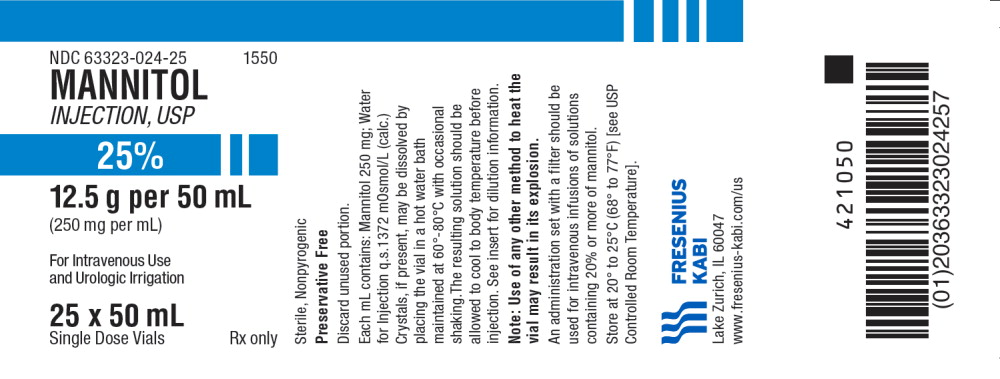
Mannitol 250 mg/mL Injection, Solution — NDC 63323-024-25 (Billing 63323-0024-25)
This is a package of Mannitol 250 mg/mL Injection, Solution from Fresenius Kabi USA, LLC, marketed since Mar 2000 and currently FDA-listed. It is this product's only package size.
NDC database record
One package, one record: these facts belong to NDC 63323-024-25 alone.
- Record
- FDA NDC Directory package listing · Human prescription drug
- Code segments
- 63323 labeler · 024 product · 25 package
- Package marketed since
- Mar 19, 2000
- Sample package
- No — commercial package
- Listing certified through
- Dec 31, 2026
- Barcode (UPC)
- 0363323024017
- Medicaid fills, this package
- 84 prescriptions in the last four reported quarters
- FDA record last changed
- Jul 24, 2026
Identity & classification
Regulatory identifiers FDA, NLM and CMS codes for this package
Drug-database identifiers Medi-Span GPI and First Databank GCN / HICL / AHFS classification
- GSN (GCN sequence number): 008151
- GCN: 34551
- GPI-14 (Medi-Span): 37400030002025
- HICL (First Databank): 003635
- AHFS class code: 24:36.12.00
- RxCUI (RxNorm): 311450
Where does this data come from?
- FDA openFDA NDC Directory · synced Oct 8, 2026
- FDA label on DailyMed · label index refreshed Oct 8, 2026
- RxNorm (NLM RxNav) · catalog refreshed Oct 1, 2026
- Medi-Span GPI (licensed)
- First Databank (licensed) · refreshed Oct 8, 2026
RxNorm drug class
This medicine belongs to the Osmotic Diuretic class.
Where does this data come from?
- RxClass (NLM) · catalog refreshed Oct 1, 2026
Clinical
Patient education
Supplement & herbal interactions
Some supplements/herbs that may interact with Mannitol — tap one for details:
Mannitol may be associated with lower levels of 7 nutrients — worth a chat with your pharmacist, not a cause for alarm.
Where does this data come from?
- MedlinePlus (NLM) · refreshed Oct 8, 2026
- FDA label on DailyMed · label index refreshed Oct 8, 2026
Ask a licensed pharmacist directly — free, answered by our team.
Pricing
A drug doesn't have one price. Each row is a different public payment system, and none is what you'd pay at the counter — that depends on your insurance. The ⓘ on each row explains what it measures.
| Price system | Per mL | Per package |
|---|---|---|
| Retail pharmacies payNADAC · weekly | Not in the retail survey — common for institutional, discontinued, or low-volume packs. | |
| Medicaid paysCMS SDUD · 12 mo | $9.98 | $12,472.88 / 1250 ml |
| Medicare drug plans payPart D · quarterly | No Part D plan price is available for this NDC in our data. | |
| Medicare Part B allowsASP · J2151 | $0.071 / J2151 unit | — |
Where does this data come from?
- CMS NADAC weekly file
- CMS ASP pricing files · refreshed Sep 20, 2026
- CMS Medicaid State Drug Utilization Data · through Q1 2026
- CMS Part D plan pricing files · refreshed Sep 24, 2026
- VA National Acquisition Center price file
Billing & reimbursement
Where does this data come from?
- CMS ASP NDC-HCPCS crosswalk · refreshed Sep 22, 2026
- DMEPDAC NDC-HCPCS crosswalk
- openFDA NSDE billing units · refreshed Oct 7, 2026
Packaging — all sizes for this product
| Package NDC | Description | Marketing start | Marketing end | Status |
|---|---|---|---|---|
| 63323-0024-25 You're viewing this Main listing | 25 VIAL, SINGLE-DOSE in 1 TRAY / 50 mL in 1 VIAL, SINGLE-DOSE | 2000-03-19 | — | Active |
Therapeutic equivalents
| Product | Labeler | Pack | NADAC/unit | TE | Status | Price vs. this |
|---|---|---|---|---|---|---|
| Mannitol 12.5 g/50mL 00404-9905-50 | Henry | 1 vial | — | — | FDA listed | — |
| Mannitol 12.5 g/50mL 00409-4031-01 | Hospira, | 25 vials | — | — | FDA listed | — |
| Mannitol 12.5 g/50mL 51662-1468-01 | HF | 50 ml | — | — | FDA listed | — |
| Mannitol 250 mg/mLthis 63323-0024-25 | Fresenius | 25 vials | — | AP | FDA listed | — |
| Mannitol 250 mg/mL 84549-0024-25 | ProPharma | 50 ml | — | AP | FDA listed | — |
Where does this data come from?
- FDA openFDA NDC Directory · synced Oct 8, 2026
- FDA Orange Book · refreshed Oct 3, 2026
- CMS NADAC weekly file
Availability & generic status
This product is an FDA-approved generic. Other versions of the same drug are listed under Therapeutic equivalents, least expensive first.
Where does this data come from?
- FDA Orange Book · refreshed Oct 3, 2026
Inactive Ingredients / Excipients
Inactive ingredients, also called excipients, are components of the drug product other than the active ingredient. They may include fillers, dyes, coatings, preservatives, flavors, or other formulation ingredients.
Where does this data come from?
IACT rows and label-wide narrative are kept separate; availability and product-level specificity depend on the submitted label.- FDA label on DailyMed · label index refreshed Oct 8, 2026
- FDA openFDA NDC Directory · synced Oct 8, 2026
Inactive ingredient FAQ
Are inactive ingredients the same for every manufacturer?
Why might an inactive ingredient be missing?
Can inactive ingredients matter?
Manufacturer & labeler
More NDCs from Fresenius Kabi USA, LLC labeler code 63323
- Gentamicin 40 mg/mL Injection, Solution NDC 63323-010-02
- Chloramphenicol Sodium Succinate 1 g/10mL Injection, Powder, Lyophilized, For Solution NDC 63323-011-15
- Oxytocin 10 [USP'U]/mL Injection, Solution NDC 63323-012-01
- Thiamine 100 mg/mL Injection, Solution NDC 63323-013-02
- Chorionic Gonadotropin Kit NDC 63323-030-11
- SODIUM ACETATE 4 meq/100mL Injection, Solution, Concentrate NDC 63323-032-00
- Cyanocobalamin 1000 ug/mL Injection, Solution NDC 63323-044-01
- Heparin Sodium 5000 [USP'U]/mL Injection, Solution NDC 63323-047-10
- Magnesium Sulfate 500 mg/mL Injection, Solution NDC 63323-064-02
- Sodium Bicarbonate 42 mg/mL Injection, Solution NDC 63323-083-05
Where does this data come from?
- FDA openFDA NDC Directory · synced Oct 8, 2026
- Drugs@FDA
Full prescribing information FDA SPL
🎯 Indications and Usage ▾
INDICATIONS AND USAGE For Intravenous Injection Mannitol Injection, USP is indicated for the following therapeutic uses: • The promotion of diuresis, in the prevention and/or treatment of the oliguric phase of acute renal failure before irreversible renal failure becomes established. • The reduction of intracranial pressure and treatment of cerebral edema by reducing brain mass. • The reduction of elevated intraocular pressure when it cannot be lowered by other means. • The promotion of urinary excretion of toxic substances.
For Urologic Irrigation Mannitol solution, 2.5% is indicated as an irrigation solution in transurethral prostatic resection or other transurethral surgical procedures.
For Intravenous Injection Mannitol Injection, USP is indicated for the following therapeutic uses: • The promotion of diuresis, in the prevention and/or treatment of the oliguric phase of acute renal failure before irreversible renal failure becomes established. • The reduction of intracranial pressure and treatment of cerebral edema by reducing brain mass. • The reduction of elevated intraocular pressure when it cannot be lowered by other means. • The promotion of urinary excretion of toxic substances.
For Urologic Irrigation Mannitol solution, 2.5% is indicated as an irrigation solution in transurethral prostatic resection or other transurethral surgical procedures.
⏱️ Dosage and Administration ▾
DOSAGE AND ADMINISTRATION For Intravenous Injection General Recommendations –Give mannitol injection only intravenously. The total dosage, concentration and rate of administration should be governed by the nature and severity of the condition being treated, fluid requirement and urinary output. Usual adult dosage ranges from 50 to 200 g in 24 hours but in most instances an adequate response will be achieved at a dosage of approximately 100 g in 24 hours.
The rate is usually adjusted to maintain an adequate urine flow (at least 30 to 50 mL/hr). Test Dose –In marked oliguria or inadequate renal function a test dose of mannitol should be given. The test dose may be approximately 0.2 g/kg (about 50 mL of a 25% solution) infused in three to five minutes to produce an adequate urine flow (at least 30 to 50 mL/hr).
If urine flow does not increase within two or three hours a second test dose may be given. If there is an inadequate response the patient should be reevaluated. Prevention of Acute Renal Failure (Oliguria) –When used during surgery, immediately postoperatively or following trauma, 50 to100 g of mannitol as a 5 to 25% solution maybe given.
The concentration and amount will depend upon the fluid requirements of the patient. Following suspected or actual hemolytic transfusion reactions 20 g of mannitol may be given intravenously over a five minute period to provoke diuresis. If diuresis does not occur the 20 g dose may be repeated.
If there is an adequate urine flow (30 to 50 mL/hr) then intravenous fluids containing not more than 50 to 75 mEq of sodium per liter should be given in sufficient volume to match the desired urine flow (100 mL/hr) until fluids can be taken orally. Treatment of Oliguria –The usual dose for treatment of oliguria is 50 to 100 g as a 15 to 25% solution. Reduction of Intracranial Pressure, Cerebral Edema or Intraocular Pressure –A 25% solution of mannitol is recommended since its effectiveness depends on establishing intravascular hyperosmolarity.
When used before or after surgery, a total dose of 1.5 to 2 g/kg can be given over a period of 30 to 60 minutes. Careful evaluation must be made of the circulatory and renal reserve prior to and during use of mannitol at this relatively high dose and rapid infusion rate. Careful attention must be paid to fluid and electrolyte balance, body weight, and total input and output before and after infusion of mannitol.
Evidence of reduced cerebral spinal fluid pressure may be observed within 15 minutes after starting infusion. Maximal reduction of intraocular pressure occurs 30 to 60 minutes after injection. Urinary Excretion of Toxic Substances –Mannitol in 5 to 25% solutions is used as an infusion as long as indicated if the level of urinary output remains high.
The concentration will depend upon the fluid requirement and urinary output. Intravenous water and electrolytes must be given to replace the loss of these substances in the urine, sweat and expired air. If benefits are not observed after 200 g of mannitol are given, discontinue it. mannitol-image For Urologic Irrigation A 2.5% solution is used.
The use of 2.5% mannitol solution minimizes the hemolytic effect of water alone, the entrance of hemolyzed blood into the circulation, and the resulting hemoglobinemia which is considered a major factor in producing serious renal complications. PREPARATION OF DILUTIONS FOR UROLOGIC IRRIGATION Concentration How Prepared 2.5% Add contents of two 50 mL vials (25% mannitol) to 900 mL Sterile Water for Injection.
For Intravenous Injection General Recommendations –Give mannitol injection only intravenously. The total dosage, concentration and rate of administration should be governed by the nature and severity of the condition being treated, fluid requirement and urinary output. Usual adult dosage ranges from 50 to 200 g in 24 hours but in most instances an adequate response will be achieved at a dosage of approximately 100 g in 24 hours.
The rate is usually adjusted to… [Excerpted — this section continues on DailyMed.]
⛔ Contraindications ▾
CONTRAINDICATIONS • Well established anuria due to severe renal disease. • Severe pulmonary congestion or frank pulmonary edema. • Active intracranial bleeding except during craniotomy. • Severe dehydration. • Progressive renal damage or dysfunction after institution of mannitol therapy, including increasing oliguria and azotemia. • Progressive heart failure or pulmonary congestion after mannitol therapy is started.
⚠️ Warnings ▾
WARNINGS In severe impairment of renal function a test dose should be given (see DOSAGE AND ADMINISTRATION ). A second test dose may be given if there is an inadequate response. No more than two test doses should be attempted.
Excessive loss of water and electrolytes may lead to serious imbalances. Serum sodium and potassium should be carefully monitored during mannitol therapy. The diuresis after rapid infusion of mannitol may increase preexisting hemoconcentration.
With continued use of mannitol a loss of water in excess of electrolytes can cause hypernatremia. Shift of sodium-free intracellular fluid into the extracellular compartment after mannitol infusion may lower serum sodium concentration and aggravate preexisting hyponatremia. Closely monitor the urine output and discontinue mannitol infusion promptly if output is low.
Inadequate urine output results in accumulation of mannitol, expansion of extracellular fluid volume and could result in water intoxication or congestive heart failure. Renal function must be closely monitored during mannitol infusion. Mannitol solution must be used with caution in patients with significant cardiopulmonary or renal dysfunction.
Irrigating solutions used in transurethral prostatectomy have been shown to enter the systemic circulation in relatively large volumes, exert a systemic effect and may significantly alter cardiopulmonary and renal dynamics.
🤒 Adverse Reactions ▾
ADVERSE REACTIONS Reactions are infrequent and may include: To report SUSPECTED ADVERSE REACTIONS, contact Fresenius Kabi USA, LLC at 1-800-551-7176 or FDA at 1-800-FDA-1088 or www.fda.gov/medwatch. Metabolic: fluid and electrolyte imbalance, acidosis, dehydration. Gastrointestinal: dryness of mouth, nausea, vomiting, diarrhea.
Genitourinary: osmotic nephrosis, urinary retention. Central Nervous System: headache, convulsions, dizziness. Special Senses: Blurred vision, rhinitis.
Cardiovascular: pulmonary edema, edema, hypotension, hypertension, tachycardia, angina-like chest pains. Dermatologic: skin necrosis, thrombophlebitis. Hypersensitivity: urticaria.
Miscellaneous: thirst, arm pain, chills, fever.
🧬 Clinical Pharmacology ▾
CLINICAL PHARMACOLOGY Mannitol is an osmotic diuretic. After intravenous injection it is confined to the extracellular space, metabolized only slightly and excreted rapidly by the kidneys. Approximately 80% of a 100 g dose appears in the urine in three hours.
Mannitol is freely filtered by the glomeruli with less than 10% tubular reabsorption. It is not secreted by tubular cells. It induces diuresis by elevating the osmolarity of the glomerular filtrate and thereby hinders tubular reabsorption of water.
Urinary output of water and excretion of sodium and chloride are enhanced. Mannitol is poorly absorbed from the gastrointestinal tract. Mannitol injection is free of electrolytes and is used in urology as a nonhemolytic irrigant.
The amount of mannitol absorbed intravascularly during transurethral prostatic surgery is variable and depends primarily on the extent of the surgery. Such mannitol is excreted by the kidneys and produces osmotic diuresis.
📦 How Supplied / Storage and Handling ▾
HOW SUPPLIED: Mannitol Injection, USP, 25% Product Code Unit of Sale Strength Each 1550 NDC 63323-024-25 Unit of 25 250 mg per mL NDC 63323-024-01 50 mL Single Dose Flip-off Top Vial Use only if solution is clear and seal intact and undamaged. Store at 20° to 25°C (68° to 77°F) [see USP Controlled Room Temperature]. Preservative Free. Discard unused portion.
📋 Description ▾
DESCRIPTION Mannitol is a 6-carbon sugar alcohol and has the following structure: C 6 H 14 O 6 182.17 Mannitol occurs naturally in fruits and vegetables, and is metabolically inert in humans. Mannitol Injection, USP, 25%, an osmotic diuretic, is a sterile, nonpyrogenic solution of mannitol in Water for Injection. It is a supersaturated solution at room temperature.
Each mL contains: Mannitol 250 mg; Water for Injection q.s. The osmolar concentration is 1372 mOsmol/L (calc.). It contains no antimicrobial agents.
The pH of a 5% solution is between 4.5 and 7.0. mannitol-structure
⚠️ Precautions ▾
PRECAUTIONS General Crystals, if present in mannitol injection, 25%, may be dissolved by placing the vial in a hot water bath maintained at 60° to 80°C with occasional shaking. The resulting solution should be allowed to cool to body temperature before injection. An administration set with a filter should be used for intravenous infusions of solutions containing 20% or more of mannitol.
NOTE: Use of any other method to heat the vial may result in its explosion. The cardiovascular status should be carefully evaluated before mannitol is administered by rapid intravenous injection or before and during transurethral resection since expansion of extracellular fluid may lead to fulminating congestive heart failure. By sustaining diuresis, mannitol may obscure and intensify inadequate hydration or hypovolemia.
Unless it is essential, electrolyte-free mannitol solutions should not be combined with blood. When it is essential to give the combination, at least 20 mEq of sodium chloride should be added to each liter of mannitol solution to avoid pseudoagglutination. The contents of opened containers should be used promptly and unused contents should be discarded.
A white flocculant mannitol precipitate may result from contact with PVC surfaces which act as nuclei for rapid rate crystallization of small crystals. This condition has also been reported to occur when mannitol has come in contact with other plastic and rough glass surfaces. Attempting to resolubilize the white flocculant precipitate with the aid of heat is not useful because crystallization may recur in a short period of time.
Carcinogenesis, Mutagenesis, Impairment of Fertility In an early study of 1, 5 or 10% mannitol, given for 94 weeks in the diet of Wistar rats, a low incidence of benign thymomas occurred in females which was apparently treatment related. A subsequent life-time study at similar dose levels in Spraque-Dawley, Fischer and Wistar rats revealed no carcinogenic effect in the thymus. Mannitol had no mutagenic activity in a series of in vitro and in vivo test systems.
Adequate studies measuring the effects of mannitol on fertility have not been done. Pregnancy Pregnancy Category B –Teratogenic studies in the mouse, rat and rabbit at oral doses up to 1600 mg/kg did not reveal harm to the fetus or adverse effects on reproduction due to mannitol. There are, however, no adequate and well-controlled studies in pregnant women.
Because animal reproduction studies are not always predictive of human response, this drug should be used during pregnancy only if clearly needed. Nursing Mothers It is not known whether this drug is excreted in human milk. Because many drugs are excreted in human milk, caution should be exercised when mannitol is given to a nursing mother.
Pediatric Use Dosage requirements in children below the age of 12 years have not been established.
General Crystals, if present in mannitol injection, 25%, may be dissolved by placing the vial in a hot water bath maintained at 60° to 80°C with occasional shaking. The resulting solution should be allowed to cool to body temperature before injection. An administration set with a filter should be used for intravenous infusions of solutions containing 20% or more of mannitol.
NOTE: Use of any other method to heat the vial may result in its explosion. The cardiovascular status should be carefully evaluated before mannitol is administered by rapid intravenous injection or before and during transurethral resection since expansion of extracellular fluid may lead to fulminating congestive heart failure. By sustaining diuresis, mannitol may obscure and intensify inadequate hydration or hypovolemia.
Unless it is essential, electrolyte-free mannitol solutions should not be combined with blood. When it is essential to give the combination, at least 20 mEq of sodium chloride should be added to each liter of mannitol solution to avoid pseudoagglutination. The contents of opened containers should be used promptly and unuse… [Excerpted — this section continues on DailyMed.]
📄 Package Label / Principal Display Panel ▾
PACKAGE LABEL - PRINCIPAL DISPLAY - Mannitol 50 mL Single Dose Vial Label NDC63323-024-01 1550 MANNITOL INJECTION, USP 25% 12.5 g per 50 mL (250 mg per mL) For Intravenous Use and Urologic Irrigation 50 mL Single Dose Vial Rx only PACKAGE LABEL - PRINCIPAL DISPLAY - Mannitol 50 mL Single Dose Vial Label
PACKAGE LABEL - PRINCIPAL DISPLAY - Mannitol 50 mL Single Dose Vial Tray Label NDC 63323-024-25 1550 MANNITOL INJECTION, USP 25% 12.5 g per 50 mL (250 mg per mL) For Intravenous Use and Urologic Irrigation 25 x 50 mL Single Dose Vials Rx only PACKAGE LABEL - PRINCIPAL DISPLAY - Mannitol 50 mL Single Dose Vial Tray Label
Medicaid utilization & spend
Medicare Part D spend CMS · PART D · 2025 (Q1-Q4)
About this NDC listing & data coverage
What data is (and isn’t) available for this NDC — tap to expand
| NDC identity (package / product / labeler codes) | ✓ Available |
| Labeler | ✓ Available |
| Product & package description | ✓ Available |
| Marketing category & status | ✓ Available |
| Active ingredient / dosage form / route | ✓ Available |
| FDA label (SPL via DailyMed) | ✓ Available |
| Package photos | ✓ Available |
| Inactive ingredients (structured) | — Not published for this NDC The labeler did not submit a structured excipient list, or no SPL is available. |
| NADAC pharmacy acquisition price (CMS) | — Not published for this NDC CMS publishes NADAC only for NDCs reported in its retail-pharmacy survey. |
| Orange Book / therapeutic-equivalence data | ✓ Available |
| HCPCS J-code billing crosswalk | ✓ Available |
| Medicaid utilization (CMS SDUD) | ✓ Available |