
Magnesium Sulfate 500 mg/mL Injection, Solution — NDC 63323-064-02 (Billing 63323-0064-02)
This is a package of Magnesium Sulfate 500 mg/mL Injection, Solution from Fresenius Kabi USA, LLC, no longer marketed (first marketed Aug 2000), no longer in the FDA NDC Directory.
NDC database record
One package, one record: these facts belong to NDC 63323-064-02 alone.
- Record
- FDA NDC Directory package listing · Human prescription drug
- Code segments
- 63323 labeler · 064 product · 02 package
- Listing certified through
- Dec 31, 2027
- Barcode (UPC-A, from the NDC)
- 3 6332306402 0
- FDA record last changed
- Oct 2, 2026
Identity & classification
Regulatory identifiers FDA, NLM and CMS codes for this package
Drug-database identifiers Medi-Span GPI and First Databank GCN / HICL / AHFS classification
- GSN (GCN sequence number): 001417
- GCN: 04163
- GPI-14 (Medi-Span): 79400010402020
- HICL (First Databank): 000610
- AHFS class code: 24:04.04.92
- RxCUI (RxNorm): 1658221
Where does this data come from?
- FDA openFDA NDC Directory · synced Oct 1, 2026
- FDA label on DailyMed · label index refreshed Oct 5, 2026
- RxNorm (NLM RxNav) · catalog refreshed Oct 1, 2026
- Medi-Span GPI (licensed)
- First Databank (licensed) · refreshed Oct 1, 2026
RxNorm drug class
This medicine belongs to the Osmotically acting laxatives class.
Where does this data come from?
- RxClass (NLM) · catalog refreshed Oct 1, 2026
Clinical
- It depends on the product. Injections treat low magnesium and prevent and control seizures in preeclampsia and eclampsia. Oral products such as Epsom Salts relieve occasional const...
- Dissolve the dose in a full glass (8 ounces) of water and drink it, with extra liquid as directed. A bowel movement usually comes in ½ to 6 hours. Follow the age-based package dire...
- Flushing, sweating, low blood pressure, drowsiness and weaker reflexes are the most common. Your care team watches for these and checks your magnesium levels.
- What side effects should I expect with the injection?
Patient education
Supplement & herbal interactions
Where does this data come from?
- MedlinePlus (NLM) · refreshed Oct 1, 2026
- FDA label on DailyMed · label index refreshed Oct 5, 2026
Ask a licensed pharmacist directly — free, answered by our team.
Pricing
A drug doesn't have one price. Each row is a different public payment system, and none is what you'd pay at the counter — that depends on your insurance. The ⓘ on each row explains what it measures.
| Price system | Per mL | Per package |
|---|---|---|
| Retail pharmacies payNADAC · weekly | Not in the retail survey — common for institutional, discontinued, or low-volume packs. | |
| Medicaid paysCMS SDUD · 12 mo | No recent Medicaid claims on file for this NDC — rare and low-volume NDCs are suppressed in the public data. | |
| Medicare drug plans payPart D · quarterly | No Part D plan price is available for this NDC in our data. | |
| Medicare Part B allowsASP · J3475 | $0.446 / J3475 unit | — |
Where does this data come from?
- CMS NADAC weekly file
- CMS ASP pricing files · refreshed Sep 20, 2026
- CMS Medicaid State Drug Utilization Data · refreshed Oct 5, 2026
- CMS Part D plan pricing files · refreshed Sep 24, 2026
- VA National Acquisition Center price file
Billing & reimbursement
Where does this data come from?
- CMS ASP NDC-HCPCS crosswalk · refreshed Sep 22, 2026
- DMEPDAC NDC-HCPCS crosswalk
- openFDA NSDE billing units · refreshed Sep 7, 2026
Packaging — all sizes for this product
| Package NDC | Description | Marketing start | Marketing end | Status |
|---|---|---|---|---|
| 63323-0064-23 63323-064-23 | 25 VIAL, GLASS in 1 TRAY / 2 mL in 1 VIAL, GLASS | 2000-08-08 | — | Active |
| 63323-0064-03 63323-064-03 Main listing | 25 VIAL, SINGLE-DOSE in 1 CARTON / 2 mL in 1 VIAL, SINGLE-DOSE | 2000-08-08 | — | Active |
| 63323-0064-11 63323-064-11 | 25 VIAL, SINGLE-DOSE in 1 TRAY / 10 mL in 1 VIAL, SINGLE-DOSE | 2000-08-08 | — | Active |
| 63323-0064-43 63323-064-43 | 25 VIAL, GLASS in 1 TRAY / 2 mL in 1 VIAL, GLASS | 2000-08-08 | — | Active |
| 63323-0064-02 You're viewing this | 25 VIAL, SINGLE-DOSE in 1 TRAY / 2 mL in 1 VIAL, SINGLE-DOSE | 2000-08-08 | — | Discontinued by firm |
| 63323-0064-10 63323-064-10 | 25 VIAL, SINGLE-DOSE in 1 TRAY / 10 mL in 1 VIAL, SINGLE-DOSE | 2000-08-08 | — | Discontinued by firm |
Pack size FAQ
What quantity is in this package?
What NDC number is used to bill for this package of Magnesium Sulfate 500 mg/mL Injection, Solution?
Therapeutic equivalents
| Product | Labeler | Pack | NADAC/unit | TE | Status | Price vs. this |
|---|---|---|---|---|---|---|
| Magnesium Sulfate 500 mg/mL 63323-0642-20 | Fresenius | 25 vials | — | AP | FDA listed | — |
| Magnesium Sulfate 500 mg/mL 71872-7229-01 | Medical | 1 vial | — | AP | FDA listed | — |
| Magnesium Sulfate 500 mg/mL 84549-0064-11 | ProPharma | 10 ml | — | AP | FDA listed | — |
| Magnesium Sulfate 500 mg/mLthis 63323-0064-02 | Fresenius | 25 vials | — | AP | Discontinued | — |
| Magnesium Sulfate 500 mg/mL 70518-4375-00 | REMEDYREPACK | 25 vials | — | AP | FDA listed | — |
| Magnesium Sulfate 500 mg/mL 00404-9903-10 | Henry | 1 syringe | — | AP | FDA listed | — |
| Magnesium Sulfate 500 mg/mL 31722-0394-32 | Camber | 25 vials | — | AP | FDA listed | — |
| Magnesium Sulfate 500 mg/mL 71872-7142-01 | Medical | 1 vial | — | AP | FDA listed | — |
| Magnesium Sulfate 500 mg/mL 71872-7381-01 | Medical | 1 vial | — | AP | FDA listed | — |
Where does this data come from?
- FDA openFDA NDC Directory · synced Oct 1, 2026
- FDA Orange Book · refreshed Oct 3, 2026
- CMS NADAC weekly file
Availability & generic status
The FDA lists approved generic versions of this medicine, but that does not always mean a pharmacy can get one today. Patent rules, launch agreements, supply and pricing can affect when generics actually arrive.
Where does this data come from?
- FDA Orange Book · refreshed Oct 3, 2026
Inactive Ingredients / Excipients
Inactive ingredients, also called excipients, are components of the drug product other than the active ingredient. They may include fillers, dyes, coatings, preservatives, flavors, or other formulation ingredients.
🧪 Avoiding an ingredient? See Magnesium Sulfate Heptahydrate inactive ingredients by manufacturer: every current product's list side by side, so you can ask your pharmacy for the version that does not list it.
💡 Tap an ingredient (hover on desktop) to see what it is and why it’s used.
-
UNII 55X04QC32I
A strong alkaline chemical used to adjust and maintain the pH balance of liquid medicines. It helps keep the medicine stable and ensures it stays effective during storage.
-
UNII O40UQP6WCF
A strong acid used in small amounts to adjust and maintain the pH balance of a medicine, helping ensure stability and proper dissolution of the active ingredients.
2 inactive ingredients listed in the exact product block matched to this NDC.
Where does this data come from?
ingredient classCode="IACT" elements from the exact product block matched by this NDC. Label-section narrative from DailyMed / the openFDA label index is shown separately when available.- FDA label on DailyMed · label index refreshed Oct 5, 2026
- FDA openFDA NDC Directory · synced Oct 1, 2026
Inactive ingredient FAQ
Are inactive ingredients the same for every manufacturer?
Why might an inactive ingredient be missing?
Can inactive ingredients matter?
Manufacturer & labeler
More NDCs from Fresenius Kabi USA, LLC labeler code 63323
- Thiamine 100 mg/mL Injection, Solution NDC 63323-013-02
- Mannitol 250 mg/mL Injection, Solution NDC 63323-024-25
- Chorionic Gonadotropin Kit NDC 63323-030-11
- SODIUM ACETATE 4 meq/100mL Injection, Solution, Concentrate NDC 63323-032-00
- Cyanocobalamin 1000 ug/mL Injection, Solution NDC 63323-044-01
- Heparin Sodium 5000 [USP'U]/mL Injection, Solution NDC 63323-047-10
- Sodium Bicarbonate 42 mg/mL Injection, Solution NDC 63323-083-05
- Sodium Chloride 234 mg/mL Injection, Solution NDC 63323-088-61
- Sodium Bicarbonate 84 mg/mL Injection, Solution NDC 63323-089-50
- Sodium Chloride 2.5 meq/mL Injection, Solution, Concentrate NDC 63323-090-20
- Sodium Chloride 4 meq/mL Injection, Solution, Concentrate NDC 63323-093-30
- Sodium Chloride 4 meq/mL Injection, Solution, Concentrate NDC 63323-095-61
Where does this data come from?
- FDA openFDA NDC Directory · synced Oct 1, 2026
- Drugs@FDA
Full prescribing information FDA SPL
🎯 Indications and Usage ▾
INDICATIONS AND USAGE Magnesium Sulfate Injection, USP is suitable for replacement therapy in magnesium deficiency, especially in acute hypomagnesemia accompanied by signs of tetany similar to those observed in hypocalcemia. In such cases, the serum magnesium level is usually below the lower limit of normal (1.5 to 2.5 mEq/L) and the serum calcium level is normal (4.3 to 5.3 mEq/L) or elevated. In total parenteral nutrition (TPN), magnesium sulfate may be added to the nutrient admixture to correct or prevent hypomagnesemia which can arise during the course of therapy.
Magnesium sulfate injection is also indicated for the prevention and control of seizures in a pre-eclampsia and eclampsia, respectively.
⏱️ Dosage and Administration ▾
DOSAGE AND ADMINISTRATION Dosage of magnesium sulfate must be carefully adjusted according to individual requirements and response, and administration of the drug should be discontinued as soon as the desired effect is obtained. Both IV and IM administration are appropriate. IM administration of the undiluted 50% solution results in therapeutic plasma levels in 60 minutes, whereas IV doses will provide a therapeutic level almost immediately.
The rate of IV injection should generally not exceed 150 mg/minute (1.5 mL of a 10% concentration or its equivalent), except in severe eclampsia with seizures (see below). Continuous maternal administration of magnesium sulfate in pregnancy beyond 5 to 7 days can cause fetal abnormalities. Solutions for IV infusion must be diluted to a concentration of 20% or less prior to administration.
The diluents commonly used are 5% Dextrose Injection, USP and 0.9% Sodium Chloride Injection, USP. Deep IM injection of the undiluted (50%) solution is appropriate for adults, but the solution should be diluted to a 20% or less concentration prior to such injection in children. In Magnesium Deficiency In the treatment of mild magnesium deficiency, the usual adult dose is 1 g, equivalent to 8.12 mEq of magnesium (2 mL of the 50% solution) injected IM every six hours for four doses (equivalent to a total of 32.5 mEq of magnesium per 24 hours).
For severe hypomagnesemia, as much as 250 mg (approximately 2 mEq) per kg of body weight (0.5 mL of the 50% solution) may be given IM within a period of four hours if necessary. Alternatively, 5 g (approximately 40 mEq) can be added to one liter of 5% Dextrose Injection, USP or 0.9% Sodium Chloride Injection, USP for slow IV infusion over a three-hour period. In the treatment of deficiency states, caution must be observed to prevent exceeding the renal excretory capacity.
In Hyperalimentation In TPN, maintenance requirements for magnesium are not precisely known. The maintenance dose used in adults ranges from 8 to 24 mEq (1 to 3 g) daily; for infants, the range is 2 to 10 mEq (0.25 to 1.25 g) daily. In Pre-eclampsia or Eclampsia In severe pre-eclampsia or eclampsia, the total initial dose is 10 to 14 g of magnesium sulfate.
Intravenously, a dose of 4 to 5 g in 250 mL of 5% Dextrose Injection, USP or 0.9% Sodium Chloride Injection, USP may be infused. Simultaneously, IM doses of up to 10 g (5 g or 10 mL of the undiluted 50% solution in each buttock) are given. Alternatively, the initial IV dose of 4 g may be given by diluting the 50% solution to a 10 or 20% concentration; the diluted fluid (40 mL of a 10% solution or 20 mL of a 20% solution) may then be injected IV over a period of three to four minutes.
Subsequently, 4 to 5 g (8 to 10 mL of the 50% solution) are injected IM into alternate buttocks every four hours as needed, depending on the continuing presence of the patellar reflex and adequate respiratory function. Alternatively, after the initial IV dose, some clinicians administer 1 to 2 g/hour by constant IV infusion. Therapy should continue until paroxysms cease.
A serum magnesium level of 6 mg/100 mL is considered optimal for control of seizures. A total daily (24 hr) dose of 30 to 40 g should not be exceeded. In the presence of severe renal insufficiency, the maximum dosage of magnesium sulfate is 20 grams/48 hours and frequent serum magnesium concentrations must be obtained.
Continuous use of magnesium sulfate in pregnancy beyond 5 to 7 days can cause fetal abnormalities. Other uses In counteracting the muscle-stimulating effects of barium poisoning, the usual dose of magnesium sulfate is 1 to 2 g given IV. For controlling seizures associated with epilepsy, glomerulonephritis or hypothyroidism, the usual adult dose is 1 g administered IM or IV.
In paroxysmal atrial tachycardia, magnesium should be used only if simpler measures have failed and there is no evidence of myocardial damage. The usual dose is 3 to 4 g (30 to 40 mL of a 10% solution) administered I… [Excerpted — this section continues on DailyMed.]
⛔ Contraindications ▾
CONTRAINDICATIONS Parenteral administration of the drug is contraindicated in patients with heart block or myocardial damage.
⚠️ Warnings ▾
WARNINGS FETAL HARM: Continuous administration of magnesium sulfate beyond 5 to 7 days to pregnant women can lead to hypocalcemia and bone abnormalities in the developing fetus. These bone abnormalities include skeletal demineralization and osteopenia. In addition, cases of neonatal fracture have been reported.
The shortest duration of treatment that can lead to fetal harm is not known. Magnesium sulfate should be used during pregnancy only if clearly needed. If magnesium sulfate is given for treatment of preterm labor, the woman should be informed that the efficacy and safety of such use have not been established and that use of magnesium sulfate beyond 5 to 7 days may cause fetal abnormalities.
ALUMINUM TOXICITY: This product contains aluminum that may be toxic. Aluminum may reach toxic levels with prolonged parenteral administration if kidney function is impaired. Premature neonates are particularly at risk because their kidneys are immature, and they require large amounts of calcium and phosphate solutions, which contain aluminum.
Research indicates that patients with impaired kidney function, including premature neonates, who receive parenteral levels of aluminum at greater than 4 to 5 mcg/kg/day accumulate aluminum at levels associated with central nervous system and bone toxicity. Tissue loading may occur at even lower rates of administration. Parenteral use in the presence of renal insufficiency may lead to magnesium intoxication.
IV use in eclampsia should be reserved for immediate control of life-threatening convulsions.
🤒 Adverse Reactions ▾
ADVERSE REACTIONS The adverse effects of parenterally administered magnesium usually are the result of magnesium intoxication. These include flushing, sweating, hypotension, depressed reflexes, flaccid paralysis, hypothermia, circulatory collapse, cardiac and CNS depression proceeding to respiratory paralysis. Hypocalcemia with signs of tetany secondary to magnesium sulfate therapy for eclampsia has been reported.
🆘 Overdosage ▾
OVERDOSAGE Magnesium intoxication is manifested by a sharp drop in blood pressure and respiratory paralysis. Disappearance of the patellar reflex is a useful clinical sign to detect the onset of magnesium intoxication. In the event of overdosage, artificial ventilation must be provided until a calcium salt can be injected IV to antagonize the effects of magnesium.
For Treatment of Overdose Artificial respiration is often required. Intravenous calcium, 10 to 20 mL of a 5% solution (diluted if desirable with isotonic sodium chloride for injection) is used to counteract effects of hypermagnesemia. Subcutaneous physostigmine, 0.5 to 1 mg may be helpful.
Hypermagnesemia in the newborn may require resuscitation and assisted ventilation via endotracheal intubation or intermittent positive pressure ventilation as well as IV calcium.
For Treatment of Overdose Artificial respiration is often required. Intravenous calcium, 10 to 20 mL of a 5% solution (diluted if desirable with isotonic sodium chloride for injection) is used to counteract effects of hypermagnesemia. Subcutaneous physostigmine, 0.5 to 1 mg may be helpful.
Hypermagnesemia in the newborn may require resuscitation and assisted ventilation via endotracheal intubation or intermittent positive pressure ventilation as well as IV calcium.
🧬 Clinical Pharmacology ▾
CLINICAL PHARMACOLOGY Magnesium is an important cofactor for enzymatic reactions and plays an important role in neurochemical transmission and muscular excitability. As a nutritional adjunct in hyperalimentation, the precise mechanism of action for magnesium is uncertain. Early symptoms of hypomagnesemia (less than 1.5 mEq/L) may develop as early as three to four days or within weeks.
Predominant deficiency effects are neurological, e.g., muscle irritability, clonic twitching and tremors. Hypocalcemia and hypokalemia often follow low serum levels of magnesium. While there are large stores of magnesium present intracellularly and in the bones of adults, these stores often are not mobilized sufficiently to maintain plasma levels.
Parenteral magnesium therapy repairs the plasma deficit and causes deficiency symptoms and signs to cease. Magnesium prevents or controls convulsions by blocking neuromuscular transmission and decreasing the amount of acetylcholine liberated at the end-plate by the motor nerve impulse. Magnesium is said to have a depressant effect on the central nervous system (CNS), but it does not adversely affect the woman, fetus or neonate when used as directed in eclampsia or pre-eclampsia.
Normal plasma magnesium levels range from 1.5 to 2.5 mEq/L. As plasma magnesium rises above 4 mEq/L, the deep tendon reflexes are first decreased and then disappear as the plasma level approaches 10 mEq/L. At this level respiratory paralysis may occur.
Heart block also may occur at this or lower plasma levels of magnesium. Serum magnesium concentrations in excess of 12 mEq/L may be fatal. Magnesium acts peripherally to produce vasodilation.
With low doses only flushing and sweating occur, but larger doses cause lowering of blood pressure. The central and peripheral effects of magnesium poisoning are antagonized to some extent by IV administration of calcium. Pharmacokinetics With IV administration the onset of anticonvulsant action is immediate and lasts about 30 minutes.
Following IM administration, the onset of action occurs in about one hour and persists for three to four hours. Effective anticonvulsant serum levels range from 2.5 to 7.5 mEq/L. Magnesium is excreted solely by the kidneys at a rate proportional to the plasma concentration and glomerular filtration.
Pharmacokinetics With IV administration the onset of anticonvulsant action is immediate and lasts about 30 minutes. Following IM administration, the onset of action occurs in about one hour and persists for three to four hours. Effective anticonvulsant serum levels range from 2.5 to 7.5 mEq/L. Magnesium is excreted solely by the kidneys at a rate proportional to the plasma concentration and glomerular filtration.
📦 How Supplied / Storage and Handling ▾
HOW SUPPLIED *Packaged in glass vials. Product Code Unit of Sale Each Magnesium Sulfate Heptahydrate Fill Volume Magnesium mg/mL Sulfate mg/mL NP964003* NDC 63323-064-23 Unit of 25 NDC 63323-064-21 500 mg per mL 2 mL 49.3 194.7 Do not administer unless solution is clear and seal is intact. Contains no preservative. Discard unused portion. Store at 20° to 25°C (68° to 77°F) [see USP Controlled Room Temperature].
📋 Description ▾
DESCRIPTION Magnesium Sulfate Injection, USP 50% is a sterile, nonpyrogenic, concentrated solution of magnesium sulfate heptahydrate in Water for Injection. It is administered by the intravenous (IV) or intramuscular (IM) routes as an electrolyte replenisher or anticonvulsant. Must be diluted before IV use.
Each mL contains: Magnesium sulfate heptahydrate 500 mg; Water for Injection q.s. Sulfuric acid and/or sodium hydroxide may have been added for pH adjustment. The pH of a 5% solution is between 5.5 and 7.0.
(Osmolarity: 4,060 mOsmol/L (calc.); 2.03 mM/mL magnesium sulfate anhydrous; 4.06 mEq/mL magnesium sulfate anhydrous). The solution contains no bacteriostat, antimicrobial agent or added buffer (except for pH adjustment) and is intended only for use as a single dose injection. When smaller doses are required the unused portion should be discarded with the entire unit.
Magnesium sulfate heptahydrate is chemically designated MgSO 4 •7H 2 O, with a molecular weight of 246.47 and occurs as colorless crystals or white powder freely soluble in water.
⚠️ Precautions ▾
PRECAUTIONS General Administer with caution if flushing and sweating occurs. When barbiturates, narcotics or other hypnotics (or systemic anesthetics) are to be given in conjunction with magnesium, their dosage should be adjusted with caution because of additive CNS depressant effects of magnesium. Because magnesium is removed from the body solely by the kidneys, the drug should be used with caution in patients with renal impairment.
Urine output should be maintained at a level of 100 mL or more during the four hours preceding each dose. Monitoring serum magnesium levels and the patient’s clinical status is essential to avoid the consequences of overdosage in toxemia. Clinical indications of a safe dosage regimen include the presence of the patellar reflex (knee jerk) and absence of respiratory depression (approximately 16 breaths or more/min).
When repeated doses of the drug are given parenterally, knee jerk reflexes should be tested before each dose and if they are absent, no additional magnesium should be given until they return. Serum magnesium levels usually sufficient to control convulsions range from 3 to 6 mg/100 mL (2.5 to 5 mEq/L). The strength of the deep tendon reflexes begins to diminish when magnesium levels exceed 4 mEq/L.
Reflexes may be absent at 10 mEq magnesium/L, where respiratory paralysis is a potential hazard. An injectable calcium salt should be immediately available to counteract the potential hazards of magnesium intoxication in eclampsia. Magnesium sulfate injection (50%) must be diluted to a concentration of 20% or less prior to IV infusion.
Rate of administration should be slow and cautious, to avoid producing hypermagnesemia. The 50% solution also should be diluted to 20% or less for IM injection in infants and children. Laboratory Tests Magnesium sulfate injection should not be given unless hypomagnesemia has been confirmed and the serum concentration of magnesium is monitored.
The normal serum level is 1.5 to 2.5 mEq/L. Drug Interactions CNS Depressants —When barbiturates, narcotics or other hypnotics (or systemic anesthetics), or other CNS depressants are to be given in conjunction with magnesium, their dosage should be adjusted with caution because of additive CNS depressant effects of magnesium. CNS depression and peripheral transmission defects produced by magnesium may be antagonized by calcium.
Neuromuscular Blocking Agents —Excessive neuromuscular block has occurred in patients receiving parenteral magnesium sulfate and a neuromuscular blocking agent; these drugs should be administered concomitantly with caution. Cardiac Glycosides —Magnesium sulfate should be administered with extreme caution in digitalized patients, because serious changes in cardiac conduction which can result in heart block may occur if administration of calcium is required to treat magnesium toxicity. Pregnancy Teratogenic Effects: Pregnancy Category D (See WARNINGS and PRECAUTIONS ) See WARNINGS and PRECAUTIONS .
Magnesium sulfate can cause fetal abnormalities when administered beyond 5 to 7 days to pregnant women. There are retrospective epidemiological studies and case reports documenting fetal abnormalities such as hypocalcemia, skeletal demineralization, osteopenia and other skeletal abnormalities with continuous maternal administration of magnesium sulfate for more than 5 to 7 days. 1-10 Magnesium sulfate injection should be used during pregnancy only if clearly needed.
If this drug is used during pregnancy, the woman should be apprised of the potential hazard to the fetus. Nonteratogenic Effects: When administered by continuous IV infusion (especially for more than 24 hours preceding delivery) to control convulsions in a toxemic woman, the newborn may show signs of magnesium toxicity, including neuromuscular or respiratory depression (see OVERDOSAGE ). Labor and Delivery Continuous administration of magnesium sulfate is an unapproved treatment for preterm labor.
The safety and efficacy of such use have not bee… [Excerpted — this section continues on DailyMed.]
📚 References ▾
REFERENCES 1. Yokoyama K, Takahashi N, Yada Y. Prolonged maternal magnesium administration and bone metabolism in neonates.
Early Hum Dev . 2010;86(3):187-91. Epub 2010 Mar 12.
2. Wedig KE, Kogan J, Schorry EK et al. Skeletal demineralization and fractures caused by fetal magnesium toxicity.
J Perinatol. 2006; 26(6):371-4. 3.
Nassar AH, Sakhel K, Maarouf H, et al. Adverse maternal and neonatal outcome of prolonged course of magnesium sulfate tocolysis. Acta Obstet Gynecol Scan.
2006;85(9):1099-103. 4. Malaeb SN, Rassi A, Haddad MC.
Bone mineralization in newborns whose mothers received magnesium sulphate for tocolysis of premature labor. Pediatr Radiol. 2004;34(5):384-6.
Epub 2004 Feb 18. 5. Matsuda Y, Maeda Y, Ito M, et al.
Effect of magnesium sulfate treatment on neonatal bone abnormalities. Gynecol Obstet Invest. 1997;44(2):82-8.
6. Schanler RJ, Smith LG, Burns PA. Effects of long-term maternal intravenous magnesium sulfate therapy on neonatal calcium metabolism and bone mineral content.
Gynecol Obstet Invest. 1997;43(4):236-41. 7.
Santi MD, Henry GW, Douglas GL. Magnesium sulfate treatment of preterm labor as a cause of abnormal neonatal bone mineralization. J Pediatr Orthop.
1994;14(2):249-53. 8. Holcomb WL, Shackelford GD, Petrie RH.
Magnesium tocolysis and neonatal bone abnormalities: a controlled study. Obstet Gynecol. 1991; 78(4):611-4.
9. Cumming WA, Thomas VJ. Hypermagnesemia: a cause of abnormal metaphyses in the neonate.
Am J Roentgenol. 1989; 152(5):1071-2. 10.
Lamm CL, Norton KL, Murphy RJ. Congenital rickets associated with magnesium sulfate infusion for tocolysis. J Pediatr.
1988; 113(6):1078-82. 11. McGuinness GA, Weinstein MM, Cruikshank DP, et al.
Effects of magnesium sulfate treatment on perinatal calcium metabolism. II. Neonatal responses.
Obstet Gynecol. 1980;56(5): 595-600. 12.
Riaz M, Porat R, Brodsky NL, et al. The effects of maternal magnesium sulfate treatment on newborns: a prospective controlled study. J Perinatol .
1998;18(6 pt 1):449-54.
📄 Package Label / Principal Display Panel ▾
PACKAGE LABEL - PRINCIPAL DISPLAY - Magnesium Sulfate 2 mL Single Dose Vial Label Magnesium Sulfate Injection, USP 50% 1 gram per 2 mL (500 mg per mL) For IM or IV use. MUST BE DILUTED BEFORE IV USE. 2 mL Single Dose Vial Rx only 4.06 mEq/mL 4.06 mOsmol/mL PACKAGE LABEL - PRINCIPAL DISPLAY - Magnesium Sulfate 2 mL Single Dose Vial Label
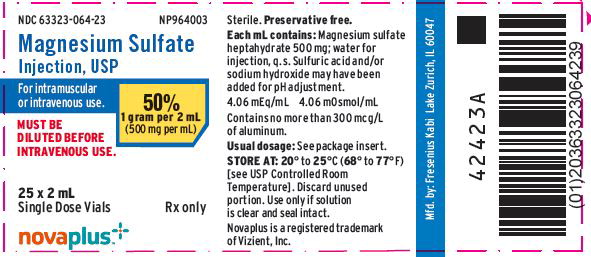
PACKAGE LABEL - PRINCIPAL DISPLAY - Magnesium Sulfate 2 mL Single Dose Vial Tray Label NDC 63323-064-23 NP964003 Magnesium Sulfate Injection, USP For intramuscular or intravenous use. 50% 1 gram per 2 mL (500 mg per mL) MUST BE DILUTED BEFORE INTRAVENOUS USE. 25 x 2 mL Single Dose Vials Rx only PACKAGE LABEL - PRINCIPAL DISPLAY - Magnesium Sulfate 2 mL Single Dose Vial Tray Label
Medicaid utilization by pack size
Medicare Part D spend CMS · PART D · 2026 (Q1)
Reported adverse events (FAERS)
Top reported reactions
Age at onset
Reporter sex
Serious outcomes
Where does this data come from?
About this NDC listing & data coverage
What data is (and isn’t) available for this NDC — tap to expand
| NDC identity (package / product / labeler codes) | ✓ Available |
| Labeler | ✓ Available |
| Product & package description | ✓ Available |
| Marketing category & status | ✓ Available |
| Active ingredient / dosage form / route | ✓ Available |
| FDA label (SPL via DailyMed) | ✓ Available |
| Package photos | ✓ Available |
| Inactive ingredients (structured) | ✓ Available |
| NADAC pharmacy acquisition price (CMS) | — Not published for this NDC CMS publishes NADAC only for NDCs reported in its retail-pharmacy survey. |
| Orange Book / therapeutic-equivalence data | ✓ Available |
| HCPCS J-code billing crosswalk | ✓ Available |
| Medicaid utilization (CMS SDUD) | — Not published for this NDC CMS reports utilization only for NDCs with Medicaid claims above its privacy threshold. |