
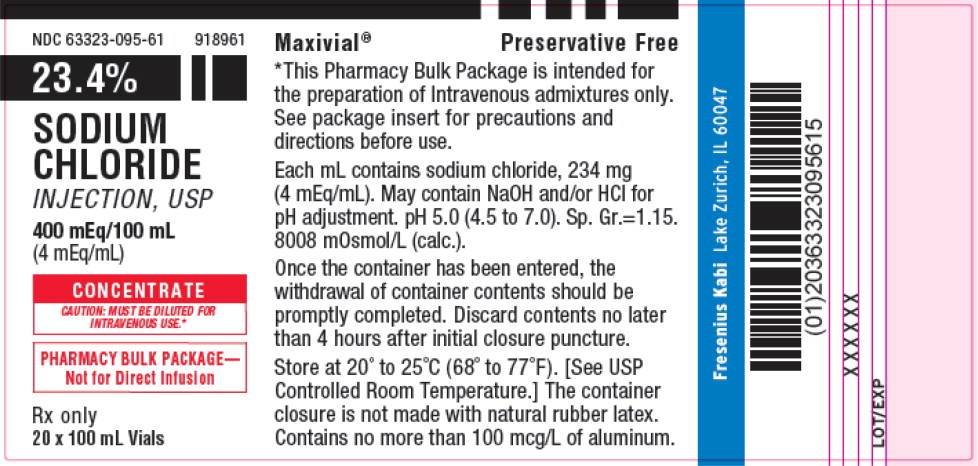
Sodium Chloride 4 meq/mL Injection, Solution, Concentrate — NDC 63323-095-61 (Billing 63323-0095-61)
This is a package of Sodium Chloride 4 meq/mL Injection, Solution, Concentrate from Fresenius Kabi USA, LLC, marketed since Feb 2022 and currently FDA-listed. It is this product's only package size.
NDC database record
One package, one record: these facts belong to NDC 63323-095-61 alone.
- Record
- FDA NDC Directory package listing · Human prescription drug
- Code segments
- 63323 labeler · 095 product · 61 package
- Package marketed since
- Feb 14, 2022
- Sample package
- No — commercial package
- Listing certified through
- Dec 31, 2026
- Barcode (UPC)
- 0363323095024
- Medicaid fills, this package
- 5,746 prescriptions in the last four reported quarters
- FDA record last changed
- Jul 24, 2026
Other active recalls for Sodium Chloride (different manufacturers) — 6 · tap to view
Identity & classification
Regulatory identifiers FDA, NLM and CMS codes for this package
Drug-database identifiers Medi-Span GPI and First Databank GCN / HICL / AHFS classification
- GSN (GCN sequence number): 001220
- GCN: 02971
- GPI-14 (Medi-Span): 79750010002045
- HICL (First Databank): 000538
- AHFS class code: 40:12.00.00
- RxCUI (RxNorm): 313016
Where does this data come from?
- FDA openFDA NDC Directory · synced Oct 8, 2026
- FDA label on DailyMed · label index refreshed Oct 8, 2026
- RxNorm (NLM RxNav) · catalog refreshed Oct 1, 2026
- Medi-Span GPI (licensed)
- First Databank (licensed) · refreshed Oct 8, 2026
RxNorm drug class
This medicine belongs to the Sodium class.
Where does this data come from?
- RxClass (NLM) · catalog refreshed Oct 1, 2026
Clinical
- It depends on the product. IV forms replace fluid and salt, while injection diluents dissolve other drugs. Other forms are used for rinsing, nasal congestion and nasal care, or to...
- Follow the directions on your product. Many are used as often as needed by adults and children 4 and over. Do not share the bottle, because that can spread infection.
- Some people get fever, irritation or infection at the IV site, or too much fluid in the body. Tell your nurse right away if the IV site hurts or looks red.
- What side effects should I expect with IV sodium chloride?
Patient education
Supplement & herbal interactions
Some supplements/herbs that may interact with Sodium Chloride — tap one for details:
Where does this data come from?
- MedlinePlus (NLM) · refreshed Oct 8, 2026
- FDA label on DailyMed · label index refreshed Oct 8, 2026
Ask a licensed pharmacist directly — free, answered by our team.
Pricing
A drug doesn't have one price. Each row is a different public payment system, and none is what you'd pay at the counter — that depends on your insurance. The ⓘ on each row explains what it measures.
| Price system | Per mL | Per package |
|---|---|---|
| Retail pharmacies payNADAC · weekly | Not in the retail survey — common for institutional, discontinued, or low-volume packs. | |
| Medicaid paysCMS SDUD · 12 mo | $2.58 | $5,166.60 / 2000 ml |
| Medicare drug plans payPart D · quarterly | No Part D plan price is available for this NDC in our data. | |
| Medicare Part B allowsASP · J7131 | No ASP payment limit on file for J7131 this quarter. | |
Where does this data come from?
- CMS NADAC weekly file
- CMS ASP pricing files · refreshed Sep 20, 2026
- CMS Medicaid State Drug Utilization Data · through Q1 2026
- CMS Part D plan pricing files · refreshed Sep 24, 2026
- VA National Acquisition Center price file
Billing & reimbursement
Where does this data come from?
- CMS ASP NDC-HCPCS crosswalk · refreshed Sep 22, 2026
- DMEPDAC NDC-HCPCS crosswalk
- openFDA NSDE billing units · refreshed Oct 7, 2026
Packaging — all sizes for this product
| Package NDC | Description | Marketing start | Marketing end | Status |
|---|---|---|---|---|
| 63323-0095-61 You're viewing this Main listing | 20 VIAL, PLASTIC in 1 TRAY / 100 mL in 1 VIAL, PLASTIC | 2022-02-14 | — | Active |
Therapeutic equivalents
| Product | Labeler | Pack | NADAC/unit | TE | Status | Price vs. this |
|---|---|---|---|---|---|---|
| Sodium Chloride 234 mg/mL 00409-1141-02 | Hospira, | 25 vials | — | AP | FDA listed | — |
| Sodium Chloride 234 mg/mL 63323-0088-61 | Fresenius | 10 vials | — | — | FDA listed | — |
| Sodium Chloride 4 meq/mLthis 63323-0095-61 | Fresenius | 20 vials | — | — | FDA listed | — |
| Sodium Chloride 4 meq/mL 63323-0099-63 | Fresenius | 10 vials | — | AP | FDA listed | — |
| Sodium Chloride 4 meq/mL 63323-0093-30 | Fresenius | 25 vials | — | AP | FDA listed | — |
| Sodium Chloride 4 meq/mL 00404-9978-30 | Henry | 1 vial | — | AP | FDA listed | — |
Where does this data come from?
- FDA openFDA NDC Directory · synced Oct 8, 2026
- FDA Orange Book · refreshed Oct 3, 2026
- CMS NADAC weekly file
Availability & generic status
This product is an FDA-approved generic. Other versions of the same drug are listed under Therapeutic equivalents, least expensive first.
Where does this data come from?
- FDA Orange Book · refreshed Oct 3, 2026
Inactive Ingredients / Excipients
Inactive ingredients, also called excipients, are components of the drug product other than the active ingredient. They may include fillers, dyes, coatings, preservatives, flavors, or other formulation ingredients.
🧪 Avoiding an ingredient? See Sodium Chloride inactive ingredients by manufacturer: every current product's list side by side, so you can ask your pharmacy for the version that does not list it.
💡 Tap an ingredient (hover on desktop) to see what it is and why it’s used.
-
UNII QTT17582CB
A strong acid used to adjust and maintain the proper pH level in liquid medicines, ensuring stability and preventing breakdown of active ingredients.
-
UNII 55X04QC32I
A strong alkaline chemical used to adjust and maintain the pH balance of liquid medicines. It helps keep the medicine stable and ensures it stays effective during storage.
-
UNII 059QF0KO0R
Water is a liquid solvent that dissolves and mixes ingredients together in liquid medicines, syrups, and injections. It helps distribute the active drug evenly throughout the product.
3 inactive ingredients listed in the exact product block matched to this NDC.
Where does this data come from?
ingredient classCode="IACT" elements from the exact product block matched by this NDC. Label-section narrative from DailyMed / the openFDA label index is shown separately when available.- FDA label on DailyMed · label index refreshed Oct 8, 2026
- FDA openFDA NDC Directory · synced Oct 8, 2026
Inactive ingredient FAQ
Are inactive ingredients the same for every manufacturer?
Why might an inactive ingredient be missing?
Can inactive ingredients matter?
Manufacturer & labeler
More NDCs from Fresenius Kabi USA, LLC labeler code 63323
- Magnesium Sulfate 500 mg/mL Injection, Solution NDC 63323-064-02
- Sodium Bicarbonate 42 mg/mL Injection, Solution NDC 63323-083-05
- Sodium Chloride 234 mg/mL Injection, Solution NDC 63323-088-61
- Sodium Bicarbonate 84 mg/mL Injection, Solution NDC 63323-089-50
- Sodium Chloride 2.5 meq/mL Injection, Solution, Concentrate NDC 63323-090-20
- Sodium Chloride 4 meq/mL Injection, Solution, Concentrate NDC 63323-093-30
- Sodium Chloride 4 meq/mL Injection, Solution, Concentrate NDC 63323-099-63
- Doxorubicin Hydrochloride 2 mg/mL Injection, Solution NDC 63323-101-61
- GEMCITABINE 200 mg/5mL Injection, Powder, Lyophilized, For Solution NDC 63323-102-13
- Cisplatin 1 mg/mL Injection, Solution NDC 63323-103-51
- Etoposide 20 mg/mL Injection, Solution NDC 63323-104-05
- magnesium sulfate 40 mg/mL Injection, Solution NDC 63323-106-01
Where does this data come from?
- FDA openFDA NDC Directory · synced Oct 8, 2026
- Drugs@FDA
Full prescribing information FDA SPL
🎯 Indications and Usage ▾
INDICATIONS AND USAGE 23.4% Sodium Chloride Injection, USP is indicated for use as an electrolyte replenisher in parenteral fluid therapy. It serves as an additive for total parenteral nutrition (TPN) and as an additive for carbohydrate containing I.V. fluids.
⏱️ Dosage and Administration ▾
DOSAGE AND ADMINISTRATION 23.4% Sodium Chloride Injection, USP Additive Solution is administered intravenously only after addition to a larger volume of fluid. The dose, dilution and rate of injection are dependent upon the individual needs of each patient. In solutions for total parenteral nutrition (TPN), 120 mEq of sodium/day (range: 75-180 mEq/day) is the recommended adult dosage, whereas the recommended dosage is 3-4 mEq/kg/day for preterm infants.
Parenteral drug products should be inspected visually for particulate matter and discoloration prior to administration, whenever solution and container permit. Discard unused portion. Additives may be incompatible with the fluid dispensed from this container.
Consult with pharmacist, if available. When admixing, use aseptic technique, mix thoroughly and do not store. Directions for Proper Use of Pharmacy Bulk Package Use Aseptic Technique During use, container must be stored and all manipulations performed in an appropriate laminar flow hood.
To hang the bottle use plastic hanger. Remove fliptop cap from vial and cleanse closure with antiseptic. Insert suitable sterile dispensing set or transfer device and suspend unit in a laminar flow hood.
The closure should be entered only once and after initial entry, the withdrawal of container contents should be completed promptly in one continuous operation. Should this not be possible, a maximum time of 4 hours from initial closure puncture is permitted to complete fluid transfer operations; i.e., discard container no later than 4 hours after initial closure puncture. Sequentially dispense aliquots of 23.4% Sodium Chloride Injection, USP into intravenous containers using appropriate transfer device.
During fluid transfer operations, the Pharmacy Bulk Package should be maintained under the storage conditions recommended in the labeling. Inspect solution after admixing. Discard if the solution is discolored or particulates are observed.
⛔ Contraindications ▾
CONTRAINDICATIONS 23.4% Sodium Chloride Injection, USP Additive Solution is contraindicated in patients with hypernatremia or fluid retention.
⚠️ Warnings ▾
WARNINGS 23.4% Sodium Chloride Injection, USP is hypertonic and must be diluted prior to administration. Inadvertent direct injection or absorption of concentrated sodium chloride solution may give rise to sudden hypernatremia and such complications as cardiovascular shock, central nervous system disorders, specifically osmotic demyelination syndrome, extensive hemolysis, cortical necrosis of the kidneys and severe local tissue necrosis (if administered extravascularly). Solutions containing sodium ions should be used with great care, if at all, in patients with congestive heart failure, severe renal insufficiency and in clinical states in which there exists edema with sodium retention.
In patients with diminished renal function, administration of solutions containing sodium may result in sodium retention. The intravenous administration of this solution (after appropriate dilution) can cause fluid and/or solute overloading resulting in dilution of other serum electrolyte concentrations, overhydration, congested states or pulmonary edema. Excessive administration of potassium-free solutions may result in significant hypokalemia.
WARNING: This product contains aluminum that may be toxic. Aluminum may reach toxic levels with prolonged parenteral administration if kidney function is impaired. Premature neonates are particularly at risk because their kidneys are immature, and they require large amounts of calcium and phosphate solutions, which contain aluminum.
Research indicates that patients with impaired kidney function, including premature neonates, who receive parenteral levels of aluminum at greater than 4 to 5 mcg/kg/day accumulate aluminum at levels associated with central nervous system and bone toxicity. Tissue loading may occur at even lower rates of administration.
🤒 Adverse Reactions ▾
ADVERSE REACTIONS To report SUSPECTED ADVERSE REACTIONS, contact Fresenius Kabi USA, LLC at 1-800-551-7176 or FDA at 1-800-FDA-1088 or www.fda.gov/medwatch. Sodium overload can occur with intravenous infusion of excessive amounts of sodium containing solutions. See WARNINGS and PRECAUTIONS .
🤰 Pregnancy ▾
Pregnancy − Animal reproduction studies have not been conducted with 23.4% Sodium Chloride Injection, USP. It is also not known whether sodium chloride can cause fetal harm when administered to a pregnant woman or can affect reproduction capacity. Sodium chloride should be given to a pregnant woman only if clearly needed.
🧒 Pediatric Use ▾
Pediatric Use − Safety and effectiveness of 23.4% Sodium Chloride Injection, USP have not been established in pediatric patients. Its limited use in pediatric patients has been inadequate to fully define proper dosage and limitations for use.
🧓 Geriatric Use ▾
Geriatric Use − An evaluation of current literature revealed no clinical experience identifying differences in response between elderly and younger patients. In general, dose selection for an elderly patient should be cautious, usually starting at the low end of the dosing range, reflecting the greater frequency of decreased hepatic, renal, or cardiac function, and of concomitant disease or other drug therapy. This drug is known to be substantially excreted by the kidney, and the risk of toxic reactions to this drug may be greater in patients with impaired renal function.
Because elderly patients are more likely to have decreased renal function, care should be taken in dose selection, and it may be useful to monitor renal function.
🆘 Overdosage ▾
OVERDOSAGE Excessive administration of 23.4% Sodium Chloride Injection, USP may result in electrolyte imbalance with water retention, edema, loss of potassium and aggravation of an existing acidosis. See WARNINGS .
🧬 Clinical Pharmacology ▾
CLINICAL PHARMACOLOGY Sodium chloride in water dissociates to provide sodium (Na + ) and chloride (Cl - ) ions. These ions are normal constituents of the body fluids (principally extracellular) and are essential for maintaining electrolyte balance. Sodium is the principal cation of extracellular fluid.
It comprises more than 90% of the total cations at its normal plasma concentration of approximately 142 mEq/L. While the sodium ion can diffuse across cell membranes, the intracellular sodium is maintained at a much lower concentration than extracellular sodium through the expenditure of energy by the cell (so called “sodium cation pump”). Loss of intracellular potassium ion is usually accompanied by an increase in intracellular sodium ion.
Sodium is the principal ion that determines osmotic pressure of interstitial fluids and the degree of tissue hydration. When serum sodium concentration is low, the secretion of antidiuretic hormone (ADH) by the pituitary is inhibited, thereby preventing water reabsorption by the distal renal tubules. On the other hand, adrenal secretion of aldosterone increases renal tubular reabsorption of sodium in an effort to re-establish normal serum sodium concentration.
Chloride (Cl - ) has an integral role in buffering action when oxygen and carbon dioxide exchange occurs in the red blood cells. The distribution and excretion of sodium (Na + ) and chloride (Cl - ) are largely under the control of the kidney which maintains a balance between intake and output.
📦 How Supplied / Storage and Handling ▾
HOW SUPPLIED 23.4% Sodium Chloride Injection, USP (4 mEq/mL) is supplied as follows: Product Code Unit of Sale Strength/Concentration Each 918961 NDC 63323-095-61 Unit of 20 400 mEq/100 mL (4 mEq/mL) NDC 63323-095-02 100 mL fill in a 100 mL Plastic Fliptop Vial Pharmacy Bulk Package Store at 20° to 25°C (68° to 77°F) [see USP Controlled Room Temperature]. Preservative Free. The container closure is not made with natural rubber latex.
Lake Zurich, IL 60047 www.fresenius-kabi.com/us 451722 /Issued: November 2021 Fresenius Kabi Logo
📋 Description ▾
DESCRIPTION 23.4% Sodium Chloride Injection, USP Additive Solution is a sterile, nonpyrogenic, concentrated solution for intravenous administration ONLY AFTER DILUTION to replenish electrolytes. The preparations contain 23.4 g of sodium chloride (400 mEq each of Na+ and Cl - ) in Water for Injection, USP. The solution contains no bacteriostat, antimicrobial agent or added buffer.
The additive may contain sodium hydroxide and/or hydrochloric acid for pH adjustment. The pH is 5.0 (4.5 to 7.0). The specific gravity is 1.15, and the osmolarity is 8008 mOsmol/L (calc).
Sodium Chloride, USP is chemically designated NaCl, a white crystalline compound freely soluble in water. The molecular weight is 58.44 g/mol. The Pharmacy Bulk Package is a sterile dosage form which contains multiple single doses for preparation of admixtures for intravenous infusion (see DOSAGE AND ADMINISTRATION ).
⚠️ Precautions ▾
PRECAUTIONS General − Excessive amounts of sodium chloride by any route may cause hypokalemia and acidosis. Excessive amounts by the parenteral route may precipitate congestive heart failure and acute pulmonary edema, especially in patients with cardiovascular disease and in patients receiving corticosteroids or corticotropin or drugs that may give rise to sodium retention. Special caution should be used in administering sodium-containing solutions to patients with severe renal impairment, cirrhosis of the liver or other edematous or sodium-retaining states.
Clinical evaluation and periodic laboratory determinations are necessary to monitor changes in fluid balance, electrolyte concentrations, and acid-base balance during prolonged parenteral therapy or whenever the condition of the patient warrants such evaluation. Do not use unless the solution is clear and seal is intact. Pregnancy − Animal reproduction studies have not been conducted with 23.4% Sodium Chloride Injection, USP.
It is also not known whether sodium chloride can cause fetal harm when administered to a pregnant woman or can affect reproduction capacity. Sodium chloride should be given to a pregnant woman only if clearly needed. Nursing Mothers − It is not known whether 23.4% Sodium Chloride Injection, USP is excreted in human milk.
Because many drugs are excreted in human milk, caution should be exercised when sodium chloride is administered to a nursing woman. Pediatric Use − Safety and effectiveness of 23.4% Sodium Chloride Injection, USP have not been established in pediatric patients. Its limited use in pediatric patients has been inadequate to fully define proper dosage and limitations for use.
Geriatric Use − An evaluation of current literature revealed no clinical experience identifying differences in response between elderly and younger patients. In general, dose selection for an elderly patient should be cautious, usually starting at the low end of the dosing range, reflecting the greater frequency of decreased hepatic, renal, or cardiac function, and of concomitant disease or other drug therapy. This drug is known to be substantially excreted by the kidney, and the risk of toxic reactions to this drug may be greater in patients with impaired renal function.
Because elderly patients are more likely to have decreased renal function, care should be taken in dose selection, and it may be useful to monitor renal function.
🍼 Nursing Mothers ▾
Nursing Mothers − It is not known whether 23.4% Sodium Chloride Injection, USP is excreted in human milk. Because many drugs are excreted in human milk, caution should be exercised when sodium chloride is administered to a nursing woman.
📄 Package Label / Principal Display Panel ▾
PACKAGE LABEL - PRINCIPAL DISPLAY – 23.4% Sodium Chloride Injection, USP Vial Label NDC 63323-095-02 918961 23.4% SODIUM CHLORIDE INJECTION, USP 400 mEq/100 mL (4 mEq/mL) CONCENTRATE CAUTION: MUST BE DILUTED FOR INTRAVENOUS USE* PHARMACY BULK PACKAGE- Not for Direct Infusion Rx only PACKAGE LABEL - PRINCIPAL DISPLAY – 23.4% Sodium Chloride Injection, USP Vial Label
PACKAGE LABEL - PRINCIPAL DISPLAY – 23.4% Sodium Chloride Injection, USP Tray Label NDC 63323-095-61 918961 23.4% SODIUM CHLORIDE INJECTION, USP 400 mEq/100 mL (4 mEq/mL) CONCENTRATE CAUTION: MUST BE DILUTED FOR INTRAVENOUS USE* PHARMACY BULK PACKAGE- Not for Direct Infusion Rx only 20 x 100 mL Vials PACKAGE LABEL - PRINCIPAL DISPLAY – 23.4% Sodium Chloride Injection, USP Tray Label
Medicaid utilization & spend
Medicare Part D spend CMS · PART D · 2026 (Q1)
About this NDC listing & data coverage
What data is (and isn’t) available for this NDC — tap to expand
| NDC identity (package / product / labeler codes) | ✓ Available |
| Labeler | ✓ Available |
| Product & package description | ✓ Available |
| Marketing category & status | ✓ Available |
| Active ingredient / dosage form / route | ✓ Available |
| FDA label (SPL via DailyMed) | ✓ Available |
| Package photos | ✓ Available |
| Inactive ingredients (structured) | ✓ Available |
| NADAC pharmacy acquisition price (CMS) | — Not published for this NDC CMS publishes NADAC only for NDCs reported in its retail-pharmacy survey. |
| Orange Book / therapeutic-equivalence data | — Not published for this NDC Applies only to products approved under an NDA/ANDA; many listings are out of scope. |
| HCPCS J-code billing crosswalk | ✓ Available |
| Medicaid utilization (CMS SDUD) | ✓ Available |