
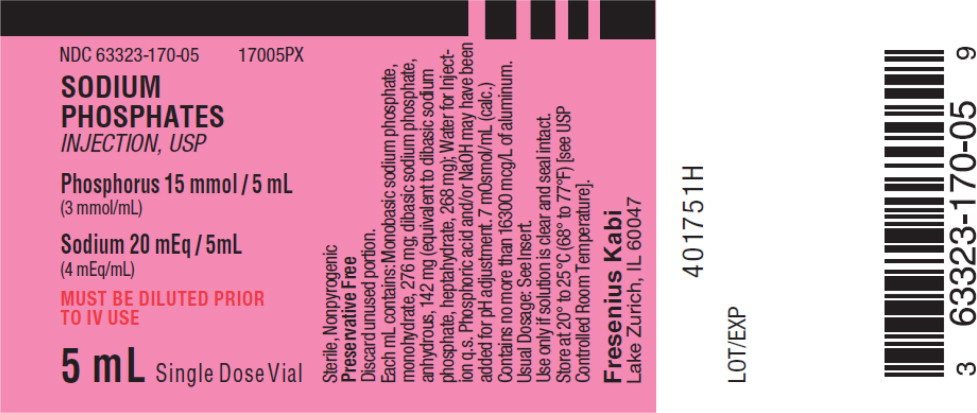
Sodium Phosphates SODIUM PHOSPHATE, MONOBASIC, MONOHYDRATE 276 mg/mL; 142 mg/mL Injection, Solution — NDC 63323-170-05 (Billing 63323-0170-05)
This is a package of Sodium Phosphates SODIUM PHOSPHATE, MONOBASIC, MONOHYDRATE 276 mg/mL; 142 mg/mL Injection, Solution from Fresenius Kabi USA, LLC, marketed since Sep 2000 and currently FDA-listed. It is the main listing for this product, which comes in 2 package sizes.
NDC database record
One package, one record: these facts belong to NDC 63323-170-05 alone.
- Record
- FDA NDC Directory package listing · Human prescription drug
- Code segments
- 63323 labeler · 170 product · 05 package
- Package marketed since
- Sep 6, 2000
- Sample package
- No — commercial package
- Listing certified through
- Dec 31, 2026
- Barcode (UPC)
- 0363323170158, 0363323170059
- FDA record last changed
- Aug 27, 2026
Identity & classification
Regulatory identifiers FDA, NLM and CMS codes for this package
Drug-database identifiers Medi-Span GPI and First Databank GCN / HICL / AHFS classification
- GSN (GCN sequence number): 001233
- GCN: 03170
- GPI-14 (Medi-Span): 79600020102020
- HICL (First Databank): 000540
- AHFS class code: 40:12.00.00
- RxCUI (RxNorm): 1872384
Where does this data come from?
- FDA openFDA NDC Directory · synced Oct 1, 2026
- FDA label on DailyMed · label index refreshed Oct 5, 2026
- RxNorm (NLM RxNav) · catalog refreshed Oct 1, 2026
- Medi-Span GPI (licensed)
- First Databank (licensed) · refreshed Oct 1, 2026
Clinical
This is an intravenous injection solution containing sodium phosphate salts (monobasic monohydrate and dibasic anhydrous forms). Sodium phosphates are mineral compounds typically used to supply phosphate and help correct electrolyte imbalances in the bloodstream, particularly in patients who cannot take oral supplements or have depleted phosphate levels. This product is marketed without an approved FDA application.
Patient education
Supplement & herbal interactions
Where does this data come from?
- MedlinePlus (NLM) · refreshed Oct 1, 2026
- FDA label on DailyMed · label index refreshed Oct 5, 2026
Ask a licensed pharmacist directly — free, answered by our team.
Pricing
A drug doesn't have one price. Each row is a different public payment system, and none is what you'd pay at the counter — that depends on your insurance. The ⓘ on each row explains what it measures.
| Price system | Per mL | Per package |
|---|---|---|
| Retail pharmacies payNADAC · weekly | Not in the retail survey — common for institutional, discontinued, or low-volume packs. | |
| Medicaid paysCMS SDUD · 12 mo | No recent Medicaid claims on file for this NDC — rare and low-volume NDCs are suppressed in the public data. | |
| Medicare drug plans payPart D · quarterly | No Part D plan price is available for this NDC in our data. | |
Where does this data come from?
- CMS NADAC weekly file
- CMS ASP pricing files · refreshed Sep 20, 2026
- CMS Medicaid State Drug Utilization Data · refreshed Oct 5, 2026
- CMS Part D plan pricing files · refreshed Sep 24, 2026
- VA National Acquisition Center price file
Packaging — all sizes for this product
| Package NDC | Description | Marketing start | Marketing end | Status |
|---|---|---|---|---|
| 63323-0170-05 You're viewing this Main listing | 25 VIAL, SINGLE-DOSE in 1 TRAY / 5 mL in 1 VIAL, SINGLE-DOSE | 2000-09-06 | — | Active |
| 63323-0170-15 63323-170-15 | 25 VIAL, SINGLE-DOSE in 1 TRAY / 15 mL in 1 VIAL, SINGLE-DOSE | 2000-09-06 | — | Active |
Pack size FAQ
What quantity is in this package?
What NDC number is used to bill for this package of Sodium Phosphates SODIUM PHOSPHATE, MONOBASIC, MONOHYDRATE 276 mg/mL; 142 mg/mL Injection, Solution?
Therapeutic equivalents
| Product | Labeler | Pack | NADAC/unit | TE | Status | Price vs. this |
|---|---|---|---|---|---|---|
| Sodium Phosphates 276 mg/mL; 142 mg/mLthis 63323-0170-05 | Fresenius | 25 vials | — | — | FDA listed | — |
Where does this data come from?
- FDA openFDA NDC Directory · synced Oct 1, 2026
- FDA Orange Book · refreshed Oct 3, 2026
- CMS NADAC weekly file
Availability & generic status
We did not find an FDA-approved generic match for this exact strength, form and route.
Where does this data come from?
- FDA Orange Book · refreshed Oct 3, 2026
Inactive Ingredients / Excipients
Inactive ingredients, also called excipients, are components of the drug product other than the active ingredient. They may include fillers, dyes, coatings, preservatives, flavors, or other formulation ingredients.
💡 Tap an ingredient (hover on desktop) to see what it is and why it’s used.
-
UNII E4GA8884NN
Phosphoric acid is a weak mineral acid used in medicines as a buffer and pH adjuster. It helps stabilize the product and control its acidity level.
-
UNII 55X04QC32I
A strong alkaline chemical used to adjust and maintain the pH balance of liquid medicines. It helps keep the medicine stable and ensures it stays effective during storage.
2 inactive ingredients listed in the exact product block matched to this NDC.
Where does this data come from?
ingredient classCode="IACT" elements from the exact product block matched by this NDC. Label-section narrative from DailyMed / the openFDA label index is shown separately when available.- FDA label on DailyMed · label index refreshed Oct 5, 2026
- FDA openFDA NDC Directory · synced Oct 1, 2026
Inactive ingredient FAQ
Are inactive ingredients the same for every manufacturer?
Why might an inactive ingredient be missing?
Can inactive ingredients matter?
Manufacturer & labeler
More NDCs from Fresenius Kabi USA, LLC labeler code 63323
- Ifosfamide 1 g Injection, Powder, Lyophilized, For Solution NDC 63323-142-10
- Floxuridine 500 mg/5mL Injection, Powder, Lyophilized, For Solution NDC 63323-145-07
- Ketorolac Tromethamine 15 mg/mL Injection, Solution NDC 63323-161-01
- Ketorolac Tromethamine 30 mg/mL Injection, Solution NDC 63323-162-01
- LACTATED RINGERS SODIUM CHLORIDE, SODIUM LACTATE, POTASSIUM CHLORIDE, CALCIUM CHLORIDE 600 mg/100mL; 310 mg/100mL; 30 mg/100mL; 20 mg/100mL Injection, Solution NDC 63323-164-74
- Dexamethasone Sodium Phosphate 4 mg/mL Injection, Solution NDC 63323-165-01
- Carboplatin 10 mg/mL Injection, Solution NDC 63323-172-60
- Gentamicin 10 mg/mL Injection, Solution NDC 63323-173-02
- Sterile Water 1000 mL/1000mL Injection, Solution NDC 63323-178-76
- Pyridoxine Hydrochloride 100 mg/mL Injection, Solution NDC 63323-180-01
- Folic Acid 5 mg/mL Injection, Solution NDC 63323-184-10
- Sterile Water 1 mL/mL Injection NDC 63323-185-05
Where does this data come from?
- FDA openFDA NDC Directory · synced Oct 1, 2026
- Drugs@FDA
Full prescribing information FDA SPL
🎯 Indications and Usage ▾
INDICATIONS AND USAGE Sodium Phosphates Injection, USP is indicated as a source of phosphate, for addition to large volume intravenous fluids, to prevent or correct hypophosphatemia in patients with restricted or no oral intake. It is also useful as an additive for preparing specific parenteral fluid formulas when the needs of the patient cannot be met by standard electrolyte or nutrient solutions. The concomitant amount of sodium (4 mEq/mL) must be calculated into total electrolyte dose of such prepared solutions.
⏱️ Dosage and Administration ▾
DOSAGE AND ADMINISTRATION Sodium Phosphates Injection is administered intravenously only after dilution and thorough mixing in a larger volume of fluid. The dose and rate of administration are dependent upon the individual needs of the patient. Serum sodium, inorganic phosphorus and calcium levels should be monitored as a guide to dosage.
Using aseptic technique, all or part of the contents of one or more vials may be added to other intravenous fluids to provide any desired number of millimoles of phosphate and milliequivalents of sodium. In patients on TPN, approximately 10 to 15 mmol of phosphorus (equivalent to 310 to 465 mg elemental phosphorus) per liter bottle of TPN solution is usually adequate to maintain normal serum phosphate, though larger amounts may be required in hypermetabolic states. The amount of sodium which accompanies the addition of phosphate also should be kept in mind, and if necessary, serum sodium levels should be monitored.
The suggested dose of phosphorus for infants receiving TPN is 1.5 to 2 mmol/kg/day. Parenteral drug products should be inspected visually for particulate matter and discoloration prior to administration, whenever solution and container permit.
⛔ Contraindications ▾
CONTRAINDICATIONS Sodium phosphate is contraindicated in diseases where high phosphate or low calcium levels may be encountered, and in patients with hypernatremia.
⚠️ Warnings ▾
WARNINGS WARNING: This product contains aluminum that may be toxic. Aluminum may reach toxic levels with prolonged parenteral administration if kidney function is impaired. Premature neonates are particularly at risk because their kidneys are immature, and they require large amounts of calcium and phosphate solutions, which contain aluminum.
Research indicates that patients with impaired kidney function, including premature neonates, who receive parenteral levels of aluminum at greater than 4 to 5 mcg/kg/day accumulate aluminum at levels associated with central nervous system and bone toxicity. Tissue loading may occur at even lower rates of administration. Sodium Phosphates Injection must be diluted and thoroughly mixed before use.
To avoid phosphate intoxication, infuse solutions containing sodium phosphate slowly. Infusing high concentrations of phosphate may result in a reduction of serum calcium and symptoms of hypocalcemic tetany. Calcium levels should be monitored.
Solutions containing sodium ion should be used with great care, if at all, in patients with congestive heart failure, severe renal insufficiency and in clinical states in which there exists edema with sodium retention. In patients with diminished renal function, administration of solutions containing sodium ions may result in sodium retention.
🤒 Adverse Reactions ▾
ADVERSE REACTIONS Adverse reactions involve the possibility of phosphate intoxication. Phosphate intoxication results in a reduction of serum calcium and the symptoms are those of hypocalcemic tetany (see WARNINGS ).
🆘 Overdosage ▾
OVERDOSAGE In the event of overdosage, discontinue infusions containing sodium phosphate immediately and institute corrective therapy to restore depressed serum calcium and to reduce elevated serum sodium levels. (see WARNINGS , PRECAUTIONS and ADVERSE REACTIONS )
🧬 Clinical Pharmacology ▾
CLINICAL PHARMACOLOGY Phosphorus in the form of organic and inorganic phosphate has a variety of important biochemical functions in the body and is involved in many significant metabolic and enzyme reactions in almost all organs and tissues. It exerts a modifying influence on the steady state of calcium levels, a buffering effect on acid-base equilibrium and a primary role in the renal excretion of hydrogen ion. Phosphorus is present in plasma and other extracellular fluid, in cell membranes and intracellular fluid, as well as in collagen and bone tissues.
Phosphate in the extracellular fluid is primarily in inorganic form and plasma levels may vary somewhat with age. The ratio of disodium phosphate and monosodium phosphate in the extracellular fluid is 4 to 1 (80% to 20%) at the normal pH of 7.4. This buffer ratio varies with the pH, but owing to its relatively low concentration, it contributes little to the buffering capacity of the extracellular fluid.
Phosphate, present in large amounts in erythrocytes and other tissue cells, plays a significant intracellular role in the synthesis of high energy organic phosphates. It has been shown to be essential to maintain red cell glucose utilization, lactate production, and the concentration of both erythrocyte adenosine triphosphate (ATP) and 2,3 diphosphoglycerate (DPG), and must be deemed as important to other tissue cells. Hypophosphatemia should be avoided during periods of total parenteral nutrition (TPN), or other lengthy periods of intravenous infusions.
It has been suggested that patients receiving TPN receive 20 mEq phosphate (13 mmol phosphate)/1000 kcal from dextrose. Serum phosphate levels should be regularly monitored and appropriate amounts of phosphate should be added to the infusions to maintain normal serum phosphate levels. Intravenous infusion of inorganic phosphate may be accompanied by a decrease in the serum level and urinary excretion of calcium.
The normal level of serum inorganic phosphate is 3 to 4.5 mg/100 mL in adults; 4 to 7 mg/100 mL in children. Intravenously infused phosphate not taken up by the tissues is excreted almost entirely in the urine. Plasma phosphate is believed to be filterable by the renal glomeruli, and the major portion of filtered phosphate (greater than 80%) is actively reabsorbed by the tubules.
Many modifying influences tend to alter the amount excreted in the urine. Sodium is the principal cation of extracellular fluid. It comprises more than 90% of the total cations at its normal plasma concentration of approximately 142 mEq/L.
While the sodium ion can diffuse across cell membranes, intracellular sodium is maintained at a much lower concentration than extracellular sodium through the expenditure of energy by the cell (so-called ‘‘sodium cation pump’’). Loss of intracellular potassium ion is usually accompanied by an increase in intracellular sodium ion. When serum sodium concentration is low, the secretion of antidiuretic hormone (ADH) by the pituitary is inhibited, thereby preventing water reabsorption by the distal renal tubules.
On the other hand, adrenal secretion of aldosterone increases renal tubular reabsorption of sodium in an effort to re-establish normal serum sodium concentration.
📦 How Supplied / Storage and Handling ▾
HOW SUPPLIED Product No. NDC No. Volume 17005PX 63323-170-05 5 mL in a 10 mL vial 17015PX 63323-170-15 15 mL in a 30 mL vial 11850 63323-118-50 50 mL in a 50 mL vial These vials are flip-top, Single Dose Vials, packaged 25 vials per tray.
The vials marked with ‘‘PX’’ are partially filled to facilitate transfer of the contents. Do not administer unless solution is clear and seal intact. Discard unused portion.
Store at 20° to 25°C (68° to 77°F) [see USP Controlled Room Temperature].
📋 Description ▾
DESCRIPTION Sodium Phosphates Injection, USP, 3 mmol/mL (millimoles/mL), is a sterile, nonpyrogenic, concentrated solution containing a mixture of monobasic sodium phosphate and dibasic sodium phosphate in Water for Injection. The solution is administered after dilution by the intravenous route as an electrolyte replenisher. It must not be administered undiluted.
Each mL contains: Monobasic sodium phosphate, monohydrate, 276 mg; dibasic sodium phosphate, anhydrous, 142 mg (equivalent to dibasic sodium phosphate, heptahydrate, 268 mg); Water for Injection q.s. In the 5 mL and 15 mL product, phosphoric acid and/or NaOH may have been added for pH adjustment. Each mL provides 3 mmol of phosphorus and 4 mEq sodium.
It contains no bacteriostat, antimicrobial agent or added buffer. The pH is 5.7 (approx.). The osmolar concentration is 7 mOsmol/mL (calc.) The solution is intended as an alternative to potassium phosphate to provide phosphate ion (PO 4 3- ) for addition to large volume infusion fluids for intravenous use.
Sodium Phosphates, USP, monohydrate monobasic is chemically designated NaH 2 PO 4 • H 2 O. Occurs as white, odorless crystals or granules freely soluble in water. Dibasic Sodium Phosphate, USP, anhydrous, is chemically designated Na 2 HPO 4 .
Occurs as a colorless or white granular salt freely soluble in water.
⚠️ Precautions ▾
PRECAUTIONS General Use with caution in patients with renal impairment, cirrhosis, cardiac failure or in conjunction with other edematous medications. It should not be used with sodium-retaining medications. Caution must be exercised in the administration of parenteral fluids especially those containing sodium ion, to patients receiving corticosteroids or corticotropin.
Laboratory Tests Phosphate replacement therapy with sodium phosphate should be guided primarily by serum inorganic phosphate levels and the limits imposed by the accompanying sodium (Na + ) ion. Frequent monitoring of serum calcium and sodium as well as renal function is recommended. Drug Interactions Concurrent use with thiazides may cause renal damage.
Pregnancy Category C Animal reproduction studies have not been conducted with sodium phosphate. It is also not known whether sodium phosphate can cause fetal harm when administered to a pregnant woman or can affect reproduction capacity. Sodium phosphate should be given to a pregnant woman only if clearly needed.
Nursing Mothers It is not known whether this drug is excreted in human milk. Because many drugs are excreted in human milk, caution should be exercised when sodium phosphate is administered to a nursing woman. Geriatric Use An evaluation of current literature revealed no clinical experience identifying differences in response between elderly and younger patients.
In general, dose selection for an elderly patient should be cautious, usually starting at the low end of the dosing range, reflecting the greater frequency of decreased hepatic, renal, or cardiac function, and of concomitant disease or other drug therapy. Sodium ions and phosphorus ions are known to be substantially excreted by the kidney, and the risk of toxic reactions may be greater in patients with impaired renal function. Because elderly patients are more likely to have decreased renal function, care should be taken in dose selection, and it may be useful to monitor renal function.
General Use with caution in patients with renal impairment, cirrhosis, cardiac failure or in conjunction with other edematous medications. It should not be used with sodium-retaining medications. Caution must be exercised in the administration of parenteral fluids especially those containing sodium ion, to patients receiving corticosteroids or corticotropin.
Laboratory Tests Phosphate replacement therapy with sodium phosphate should be guided primarily by serum inorganic phosphate levels and the limits imposed by the accompanying sodium (Na + ) ion. Frequent monitoring of serum calcium and sodium as well as renal function is recommended.
Drug Interactions Concurrent use with thiazides may cause renal damage.
Pregnancy Category C Animal reproduction studies have not been conducted with sodium phosphate. It is also not known whether sodium phosphate can cause fetal harm when administered to a pregnant woman or can affect reproduction capacity. Sodium phosphate should be given to a pregnant woman only if clearly needed.
Nursing Mothers It is not known whether this drug is excreted in human milk. Because many drugs are excreted in human milk, caution should be exercised when sodium phosphate is administered to a nursing woman.
Geriatric Use An evaluation of current literature revealed no clinical experience identifying differences in response between elderly and younger patients. In general, dose selection for an elderly patient should be cautious, usually starting at the low end of the dosing range, reflecting the greater frequency of decreased hepatic, renal, or cardiac function, and of concomitant disease or other drug therapy. Sodium ions and phosphorus ions are known to be substantially excreted by the kidney, and the risk of toxic reactions may be greater in patients with impaired renal function.
Because elderly patients are more likely to have decreased renal function, care should be taken in dose selection, and it may be useful to monitor renal functi… [Excerpted — this section continues on DailyMed.]
📄 Package Label / Principal Display Panel ▾
PACKAGE LABEL – PRINCIPAL DISPLAY PANEL – Sodium Phosphates 5 mL Single Dose Vial Label NDC 63323-170-05 17005PX SODIUM PHOSPHATES INJECTION, USP Phosphorus 15 mmol / 5 mL (3 mmol/mL) Sodium 20 mEq / 5mL (4 mEq/mL) MUST BE DILUTED PRIOR TO IV USE 5 mL Single Dose Vial PACKAGE LABEL – PRINCIPAL DISPLAY PANEL – Sodium Phosphates 5 mL Single Dose Vial Label
PACKAGE LABEL – PRINCIPAL DISPLAY PANEL – Sodium Phosphates 5 mL Single Dose Vial Tray Label NDC 63323-170-05 17005PX SODIUM PHOSPHATES INJECTION, USP Phosphorus 15 mmol / 5 mL (3 mmol/mL) Sodium 20 mEq / 5mL (4 mEq/mL) MUST BE DILUTED PRIOR TO IV USE 25 x 5 mL Single Dose Vials PACKAGE LABEL – PRINCIPAL DISPLAY PANEL – Sodium Phosphates 5 mL Single Dose Vial Tray Label
PACKAGE LABEL – PRINCIPAL DISPLAY PANEL – Sodium Phosphates 15 mL Single Dose Vial Label NDC 63323-170-15 17015PX SODIUM PHOSPHATES INJECTION, USP Phosphorus 45 mmol / 15 mL (3 mmol/mL) Sodium 60 mEq / 15mL (4 mEq/mL) MUST BE DILUTED PRIOR TO IV USE 15 mL Rx only Single Dose Vial PACKAGE LABEL – PRINCIPAL DISPLAY PANEL – Sodium Phosphates 15 mL Single Dose Vial Label
PACKAGE LABEL – PRINCIPAL DISPLAY PANEL – Sodium Phosphates 15 mL Single Dose Vial Tray Label NDC 63323-170-15 17015PX SODIUM PHOSPHATES INJECTION, USP Phosphorus 45 mmol / 15 mL (3 mmol/mL) Sodium 60 mEq / 15mL (4 mEq/mL) MUST BE DILUTED PRIOR TO IV USE 25 x 15 mL Rx only Single Dose Vials PACKAGE LABEL – PRINCIPAL DISPLAY PANEL – Sodium Phosphates 15 mL Single Dose Vial Tray Label
Reported adverse events (FAERS)
Top reported reactions
Reporter sex
Serious outcomes
Where does this data come from?
About this NDC listing & data coverage
Listed without an FDA application
This product's marketing category indicates it is marketed without an approved FDA application (no NDA, ANDA, or BLA on file). Having an NDC does not by itself establish FDA approval — the NDC Directory is a listing system, not an approval decision. Approval-linked data such as Orange Book therapeutic-equivalence ratings therefore does not apply.
What data is (and isn’t) available for this NDC — tap to expand
| NDC identity (package / product / labeler codes) | ✓ Available |
| Labeler | ✓ Available |
| Product & package description | ✓ Available |
| Marketing category & status | ✓ Available |
| Active ingredient / dosage form / route | ✓ Available |
| FDA label (SPL via DailyMed) | ✓ Available |
| Package photos | ✓ Available |
| Inactive ingredients (structured) | ✓ Available |
| NADAC pharmacy acquisition price (CMS) | — Not published for this NDC CMS publishes NADAC only for NDCs reported in its retail-pharmacy survey. |
| Orange Book / therapeutic-equivalence data | — Not published for this NDC Applies only to products approved under an NDA/ANDA; many listings are out of scope. |
| HCPCS J-code billing crosswalk | — Not published for this NDC Most self-administered / retail products have no J-code — that is normal. |
| Medicaid utilization (CMS SDUD) | — Not published for this NDC CMS reports utilization only for NDCs with Medicaid claims above its privacy threshold. |