
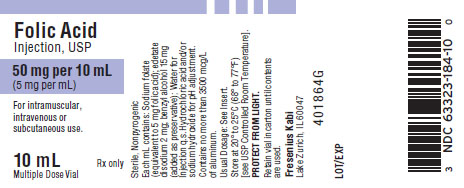
Folic Acid 5 mg/mL Injection, Solution — NDC 63323-184-10 (Billing 63323-0184-10)
This is a package of Folic Acid 5 mg/mL Injection, Solution from Fresenius Kabi USA, LLC, marketed since Sep 2000 and currently FDA-listed. It is this product's only package size.
NDC database record
One package, one record: these facts belong to NDC 63323-184-10 alone.
- Record
- FDA NDC Directory package listing · Human prescription drug
- Code segments
- 63323 labeler · 184 product · 10 package
- Package marketed since
- Sep 5, 2000
- Sample package
- No — commercial package
- Listing certified through
- Dec 31, 2026
- Barcode (UPC-A, from the NDC)
- 3 6332318410 0
- Medicaid fills, this package
- 10,149 prescriptions in the last four reported quarters
- FDA record last changed
- Jul 24, 2026
Identity & classification
Regulatory identifiers FDA, NLM and CMS codes for this package
Drug-database identifiers Medi-Span GPI and First Databank GCN / HICL / AHFS classification
- GSN (GCN sequence number): 002362
- GCN: 94801
- GPI-14 (Medi-Span): 82200010002005
- HICL (First Databank): 001062
- AHFS class code: 88:08.00.00
- RxCUI (RxNorm): 237786
Where does this data come from?
- FDA openFDA NDC Directory · synced Oct 1, 2026
- FDA label on DailyMed · label index refreshed Oct 5, 2026
- RxNorm (NLM RxNav) · catalog refreshed Oct 1, 2026
- Medi-Span GPI (licensed)
- First Databank (licensed) · refreshed Oct 1, 2026
RxNorm drug class
This medicine belongs to the Folic acid and derivatives class.
Where does this data come from?
- RxClass (NLM) · catalog refreshed Oct 1, 2026
Clinical
- It treats megaloblastic anemia caused by low folic acid. This is anemia where your bone marrow makes oversized, immature red blood cells. Replacing the missing folate lets your bod...
- Take it as your prescriber directs, usually once a day. The oral solutions can be taken with or without food, and you should measure them with an oral dosing syringe from us. Injec...
- Yes, this matters. Folic acid can hide pernicious anemia, a B12 deficiency anemia, so your blood counts may improve while nerve damage keeps getting worse. Your doctor should rule...
- It's well tolerated, and side effects are mostly reported at much higher doses. These include nausea, bloating, gas, poor appetite and a bitter taste. Call your doctor right away f...
Patient education
Supplement & herbal interactions
Where does this data come from?
- MedlinePlus (NLM) · refreshed Oct 1, 2026
- FDA label on DailyMed · label index refreshed Oct 5, 2026
Ask a licensed pharmacist directly — free, answered by our team.
Pricing
A drug doesn't have one price. Each row is a different public payment system, and none is what you'd pay at the counter — that depends on your insurance. The ⓘ on each row explains what it measures.
| Price system | Per mL | Per package |
|---|---|---|
| Retail pharmacies payNADAC · weekly | Not in the retail survey — common for institutional, discontinued, or low-volume packs. | |
| Medicaid paysCMS SDUD · 12 mo | $6.71 | $67.14 / 10 ml |
| Medicare drug plans payPart D · quarterly | No Part D plan price is available for this NDC in our data. | |
| Medicare Part B allowsASP · J1808 | $0.051 / J1808 unit | — |
Where does this data come from?
- CMS NADAC weekly file
- CMS ASP pricing files · refreshed Sep 20, 2026
- CMS Medicaid State Drug Utilization Data · through Q1 2026
- CMS Part D plan pricing files · refreshed Sep 24, 2026
- VA National Acquisition Center price file
Billing & reimbursement
Where does this data come from?
- CMS ASP NDC-HCPCS crosswalk · refreshed Sep 22, 2026
- DMEPDAC NDC-HCPCS crosswalk
- openFDA NSDE billing units · refreshed Sep 7, 2026
Packaging — all sizes for this product
| Package NDC | Description | Marketing start | Marketing end | Status |
|---|---|---|---|---|
| 63323-0184-10 You're viewing this Main listing | 1 VIAL, MULTI-DOSE in 1 CARTON / 10 mL in 1 VIAL, MULTI-DOSE | 2000-09-05 | — | Active |
Therapeutic equivalents
| Product | Labeler | Pack | NADAC/unit | TE | Status | Price vs. this |
|---|---|---|---|---|---|---|
| Folic Acid 5 mg/mL 39822-1100-01 | XGen | 1 vial | — | AP | FDA listed | — |
| Folic Acid 5 mg/mLthis 63323-0184-10 | Fresenius | 1 vial | — | AP | FDA listed | — |
Where does this data come from?
- FDA openFDA NDC Directory · synced Oct 1, 2026
- FDA Orange Book · refreshed Oct 3, 2026
- CMS NADAC weekly file
Availability & generic status
This product is an FDA-approved generic. Other versions of the same drug are listed under Therapeutic equivalents, least expensive first.
Where does this data come from?
- FDA Orange Book · refreshed Oct 3, 2026
Inactive Ingredients / Excipients
Inactive ingredients, also called excipients, are components of the drug product other than the active ingredient. They may include fillers, dyes, coatings, preservatives, flavors, or other formulation ingredients.
🧪 Avoiding an ingredient? See Folic Acid inactive ingredients by manufacturer: every current product's list side by side, so you can ask your pharmacy for the version that does not list it.
💡 Tap an ingredient (hover on desktop) to see what it is and why it’s used.
-
15 mg / 1 mL
UNII LKG8494WBH
Benzyl alcohol is a clear liquid used as a preservative and solvent in medicines. It helps prevent bacterial and fungal growth and dissolves other ingredients to create uniform liquid formulations.
-
2 mg / 1 mL
UNII MP1J8420LU
A salt derived from edetic acid that binds to trace metals in medicines. It serves as a chelating agent and preservative to prevent metal-catalyzed breakdown of the drug and extend shelf life.
-
UNII QTT17582CB
A strong acid used to adjust and maintain the proper pH level in liquid medicines, ensuring stability and preventing breakdown of active ingredients.
-
UNII 55X04QC32I
A strong alkaline chemical used to adjust and maintain the pH balance of liquid medicines. It helps keep the medicine stable and ensures it stays effective during storage.
4 inactive ingredients listed in the exact product block matched to this NDC.
Where does this data come from?
ingredient classCode="IACT" elements from the exact product block matched by this NDC. Label-section narrative from DailyMed / the openFDA label index is shown separately when available.- FDA label on DailyMed · label index refreshed Oct 5, 2026
- FDA openFDA NDC Directory · synced Oct 1, 2026
Inactive ingredient FAQ
Are inactive ingredients the same for every manufacturer?
Why might an inactive ingredient be missing?
Can inactive ingredients matter?
Manufacturer & labeler
More NDCs from Fresenius Kabi USA, LLC labeler code 63323
- Dexamethasone Sodium Phosphate 4 mg/mL Injection, Solution NDC 63323-165-01
- Sodium Phosphates SODIUM PHOSPHATE, MONOBASIC, MONOHYDRATE 276 mg/mL; 142 mg/mL Injection, Solution NDC 63323-170-05
- Carboplatin 10 mg/mL Injection, Solution NDC 63323-172-60
- Gentamicin 10 mg/mL Injection, Solution NDC 63323-173-02
- Sterile Water 1000 mL/1000mL Injection, Solution NDC 63323-178-76
- Pyridoxine Hydrochloride 100 mg/mL Injection, Solution NDC 63323-180-01
- Sterile Water 1 mL/mL Injection NDC 63323-185-05
- Sodium Chloride 9 mg/mL Injection NDC 63323-186-00
- Fludarabine 25 mg/mL Injection, Solution NDC 63323-192-02
- Irinotecan Hydrochloride 20 mg/mL Injection, Solution NDC 63323-193-52
- Lidocaine 10 mg/mL Injection, Solution NDC 63323-201-02
- Lidocaine 20 mg/mL Injection, Solution NDC 63323-202-02
Where does this data come from?
- FDA openFDA NDC Directory · synced Oct 1, 2026
- Drugs@FDA
Full prescribing information FDA SPL
🎯 Indications and Usage ▾
INDICATIONS AND USAGE: Folic Acid Injection, USP alone is effective in the treatment of megaloblastic anemias due to a deficiency of folic acid as may be seen in tropical or nontropical sprue, in anemias of nutritional origin, pregnancy, infancy or childhood.
⏱️ Dosage and Administration ▾
DOSAGE AND ADMINISTRATION: Parenteral Administration : IM, IV and SC routes may be used if the disease is exceptionally severe or if gastrointestinal absorption may be, or is known to be, impaired. Usual Therapeutic Dosage — In adults and children (regardless of age): up to 1 mg daily.Resistant cases may require larger doses. Maintenance Level : When clinical symptoms have subsided and the blood picture has become normal, a maintenance level should be used, i.e., 0.1 mg for infants and up to 0.3 mg for children under four years of age, 0.4 mg for adults and children four or more years of age and 0.8 mg for pregnant and lactating women, per day, but never less than 0.1 mg per day.
Patient should be kept under close supervision and adjustment of the maintenance level made if relapse appears imminent. In the presence of alcoholism, hemolytic anemia, anticonvulsant therapy or chronic infection, the maintenance level may need to be increased. Parenteral drug products should be inspected visually for particulate matter and discoloration prior to administration, whenever solution and container permit.
⚠️ Warnings ▾
WARNINGS: WARNING: This product contains aluminum that may be toxic. Aluminum may reach toxic levels with prolonged parenteral administration if kidney function is impaired. Premature neonates are particularly at risk because their kidneys are immature, and they require large amounts of calcium and phosphate solutions, which contain aluminum.
Research indicates that patients with impaired kidney function, including premature neonates, who receive parenteral levels of aluminum at greater than 4 to 5 mcg/kg/day accumulate aluminum at levels associated with central nervous system and bone toxicity. Tissue loading may occur at even lower rates of administration. Folic acid alone is improper therapy in the treatment of pernicious anemia and other megaloblastic anemias where Vitamin B 12 is deficient.
This product contains benzyl alcohol. Benzyl alcohol has been reported to be associated with a fatal “Gasping Syndrome” in premature infants.
🤒 Adverse Reactions ▾
ADVERSE REACTIONS: Allergic sensitization has been reported following both oral and parenteral administration of folic acid.
🧬 Clinical Pharmacology ▾
CLINICAL PHARMACOLOGY: In man, an exogenous source of folate is required for nucleoprotein synthesis and maintenance of normal erythropoiesis. Folic acid, whether given by mouth or parenterally, stimulates specifically the production of red blood cells, white blood cells and platelets in persons suffering from certain megaloblastic anemias.
📦 How Supplied / Storage and Handling ▾
HOW SUPPLIED: Folic Acid Injection, USP 50 mg per 10 mL (5 mg per mL) is available as: Product No. NDC No. 18410 63323-184-10 50 mg per 10 mL (5 mg per mL), 10 mL Multiple Dose, in a flip-top vial packaged individually.
18411 63323-184-11 50 mg per 10 mL (5 mg per mL), 10 mL Multiple Dose, in a flip-top vial, 10 vials per tray. Store at 20° to 25°C (68° to 77°F) [see USP Controlled Room Temperature]. PROTECT FROM LIGHT.
Retain vial in carton until contents are used.
📋 Description ▾
DESCRIPTION: Folic Acid Injection, USP is a sterile, nonpyrogenic solution of sodium folate (prepared by the addition of sodium hydroxide to folic acid) in Water for Injection intended for intramuscular (IM), intravenous (IV) or subcutaneous (SC) use. Folic Acid is a complex organic compound present in liver, yeast and other substances, which may be prepared synthetically. It is a yellow or yellowish orange, odorless crystalline powder.
It is very slightly soluble in water, insoluble in alcohol, chloroform, ether; readily dissolves in dilute solutions of alkali hydroxides and carbonates. It is chemically designated as: L-Glutamic acid, N -[4-[[(2-amino-1-4-dihydro-4-oxo-6-pteridinyl) methyl] amino]benzoyl]-, and has the following structural formula. C 19 H 19 N 7 O 6 M.W.
441.40 Each mL contains: Sodium folate (equivalent to 5 mg folic acid); edetate disodium 2 mg; benzyl alcohol 15 mg (added as preservative); Water for Injection q.s. Hydrochloric acid and/or sodium hydroxide for pH adjustment (8.0 to 11.0). folic acid structure
⚠️ Precautions ▾
PRECAUTIONS: Folic acid in doses above 0.1 mg daily may obscure pernicious anemia in that hematologic remission can occur while neurological manifestations remain progressive.
📄 Package Label / Principal Display Panel ▾
PACKAGE LABEL - PRINCIPAL DISPLAY - Folic Acid 10 mL Vial Label Folic Acid Injection, USP 50 mg per 10 mL (5 mg/mL) For intramuscular, intravenous or subcutaneous use. 10 mL Multiple Dose Vial Rx only PACKAGE LABEL - PRINCIPAL DISPLAY - Folic Acid 10 mL Vial Carton Label Folic Acid Injection, USP 50 mg per 10 mL (5 mg per mL) For intramuscular, intravenous or subcutaneous use. 10 mL Multiple Dose Vial Rx only vial carton
Medicaid utilization & spend
Medicare Part D spend CMS · PART D · 2026 (Q1)
About this NDC listing & data coverage
What data is (and isn’t) available for this NDC — tap to expand
| NDC identity (package / product / labeler codes) | ✓ Available |
| Labeler | ✓ Available |
| Product & package description | ✓ Available |
| Marketing category & status | ✓ Available |
| Active ingredient / dosage form / route | ✓ Available |
| FDA label (SPL via DailyMed) | ✓ Available |
| Package photos | ✓ Available |
| Inactive ingredients (structured) | ✓ Available |
| NADAC pharmacy acquisition price (CMS) | — Not published for this NDC CMS publishes NADAC only for NDCs reported in its retail-pharmacy survey. |
| Orange Book / therapeutic-equivalence data | ✓ Available |
| HCPCS J-code billing crosswalk | ✓ Available |
| Medicaid utilization (CMS SDUD) | ✓ Available |