
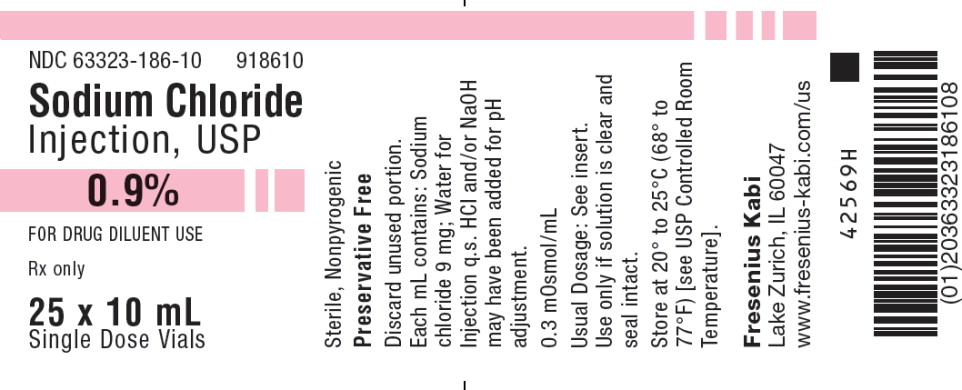
Sodium Chloride 9 mg/mL Injection — NDC 63323-186-10 (Billing 63323-0186-10)
This is a package of Sodium Chloride 9 mg/mL Injection from Fresenius Kabi USA, LLC, currently FDA-listed; retail pharmacies pay about $0.0888 per mL (NADAC). It is the main listing for this product, which comes in 4 package sizes.
NDC database record
One package, one record: these facts belong to NDC 63323-186-10 alone.
- Record
- FDA NDC Directory package listing · Human prescription drug
- Code segments
- 63323 labeler · 186 product · 10 package
- Package marketed since
- Aug 10, 2000
- Sample package
- No — commercial package
- Listing certified through
- Dec 31, 2026
- Barcode (UPC-A, from the NDC)
- 3 6332318610 4
- Medicaid fills, this package
- 5,237 prescriptions in the last four reported quarters
- FDA record last changed
- Jul 17, 2026
Other active recalls for Sodium Chloride (different manufacturers) — 6 · tap to view
Identity & classification
Regulatory identifiers FDA, NLM and CMS codes for this package
Drug-database identifiers Medi-Span GPI and First Databank GCN / HICL / AHFS classification
- GSN (GCN sequence number): 001221
- GCN: 03034
- GPI-14 (Medi-Span): 79750010002018
- HICL (First Databank): 008255
- AHFS class code: 40:12.00.00
Where does this data come from?
- FDA openFDA NDC Directory · synced Oct 1, 2026
- FDA label on DailyMed · label index refreshed Oct 5, 2026
- RxNorm (NLM RxNav) · catalog refreshed Oct 1, 2026
- Medi-Span GPI (licensed)
- First Databank (licensed) · refreshed Oct 1, 2026
Clinical
- It depends on the product. IV forms replace fluid and salt, while injection diluents dissolve other drugs. Other forms are used for rinsing, nasal congestion and nasal care, or to...
- Follow the directions on your product. Many are used as often as needed by adults and children 4 and over. Do not share the bottle, because that can spread infection.
- Some people get fever, irritation or infection at the IV site, or too much fluid in the body. Tell your nurse right away if the IV site hurts or looks red.
- What side effects should I expect with IV sodium chloride?
Patient education
Supplement & herbal interactions
Some supplements/herbs that may interact with Sodium Chloride — tap one for details:
Where does this data come from?
- MedlinePlus (NLM) · refreshed Oct 1, 2026
- FDA label on DailyMed · label index refreshed Oct 5, 2026
Ask a licensed pharmacist directly — free, answered by our team.
Pricing
A drug doesn't have one price. Each row is a different public payment system, and none is what you'd pay at the counter — that depends on your insurance. The ⓘ on each row explains what it measures.
| Price system | Per mL | Per package |
|---|---|---|
| Retail pharmacies payNADAC · weekly | $0.089 | $22.20 / 250 ml |
| Medicaid paysCMS SDUD · 12 mo | $0.5525 | $138.13 / 250 ml |
| Medicare drug plans payPart D · quarterly | No Part D plan price is available for this NDC in our data. | |
| Medicare Part B allowsASP · A4216 | No ASP payment limit on file for A4216 this quarter. | |
Where does this data come from?
- CMS NADAC weekly file · file of Sep 30, 2026
- CMS ASP pricing files · refreshed Sep 20, 2026
- CMS Medicaid State Drug Utilization Data · through Q1 2026
- CMS Part D plan pricing files · refreshed Sep 24, 2026
- VA National Acquisition Center price file
Billing & reimbursement
Where does this data come from?
- CMS ASP NDC-HCPCS crosswalk · refreshed Sep 22, 2026
- DMEPDAC NDC-HCPCS crosswalk
- openFDA NSDE billing units · refreshed Sep 7, 2026
Packaging — all sizes for this product
| Package NDC | Description | Per unit | Per pack | Marketing start | Marketing end | Status |
|---|---|---|---|---|---|---|
| 63323-0186-02 63323-186-02 | 25 VIAL, SINGLE-DOSE in 1 TRAY / 2 mL in 1 VIAL, SINGLE-DOSE | — | — | 2000-08-10 | — | Active |
| 63323-0186-10 You're viewing this Main listing | 25 VIAL, SINGLE-DOSE in 1 TRAY / 10 mL in 1 VIAL, SINGLE-DOSE | $0.0888 / mL | $22.19 | 2000-08-10 | — | Active |
| 63323-0186-20 63323-186-20 | 25 VIAL, SINGLE-DOSE in 1 TRAY / 20 mL in 1 VIAL, SINGLE-DOSE | — | — | 2000-08-10 | — | Active |
| 63323-0186-00 63323-186-00 | 25 VIAL, SINGLE-DOSE in 1 TRAY / 100 mL in 1 VIAL, SINGLE-DOSE | — | — | 2000-08-10 | — | Discontinued by firm |
In Medicaid, this is the most-dispensed pack of this product — about 79% of fills over the last four reported quarters. See all packs ↓
Pack size FAQ
What quantity is in this package?
What NDC number is used to bill for this package of Sodium Chloride 9 mg/mL Injection?
Prices are the latest CMS NADAC pharmacy acquisition cost per NDC; per-pack figures are per-unit × pack quantity, shown only when the pack is denominated in the same measure NADAC prices.
Therapeutic equivalents
| Product | Labeler | Pack | NADAC/unit | TE | Status | Price vs. this |
|---|---|---|---|---|---|---|
| Sodium Chloride 9 mg/mLthis 63323-0186-10 | Fresenius | 25 vials | $0.089 | — | Availability likely | — |
Where does this data come from?
- FDA openFDA NDC Directory · synced Oct 1, 2026
- FDA Orange Book · refreshed Oct 3, 2026
- CMS NADAC weekly file · file of Sep 30, 2026
Availability & generic status
We did not find an FDA-approved generic match for this exact strength, form and route.
Where does this data come from?
- FDA Orange Book · refreshed Oct 3, 2026
Inactive Ingredients / Excipients
Inactive ingredients, also called excipients, are components of the drug product other than the active ingredient. They may include fillers, dyes, coatings, preservatives, flavors, or other formulation ingredients.
🧪 Avoiding an ingredient? See Sodium Chloride inactive ingredients by manufacturer: every current product's list side by side, so you can ask your pharmacy for the version that does not list it.
💡 Tap an ingredient (hover on desktop) to see what it is and why it’s used.
-
UNII QTT17582CB
A strong acid used to adjust and maintain the proper pH level in liquid medicines, ensuring stability and preventing breakdown of active ingredients.
-
UNII 55X04QC32I
A strong alkaline chemical used to adjust and maintain the pH balance of liquid medicines. It helps keep the medicine stable and ensures it stays effective during storage.
2 inactive ingredients listed in the exact product block matched to this NDC.
Where does this data come from?
ingredient classCode="IACT" elements from the exact product block matched by this NDC. Label-section narrative from DailyMed / the openFDA label index is shown separately when available.- FDA label on DailyMed · label index refreshed Oct 5, 2026
- FDA openFDA NDC Directory · synced Oct 1, 2026
Inactive ingredient FAQ
Are inactive ingredients the same for every manufacturer?
Why might an inactive ingredient be missing?
Can inactive ingredients matter?
Manufacturer & labeler
More NDCs from Fresenius Kabi USA, LLC labeler code 63323
- Carboplatin 10 mg/mL Injection, Solution NDC 63323-172-60
- Gentamicin 10 mg/mL Injection, Solution NDC 63323-173-02
- Sterile Water 1000 mL/1000mL Injection, Solution NDC 63323-178-76
- Pyridoxine Hydrochloride 100 mg/mL Injection, Solution NDC 63323-180-01
- Folic Acid 5 mg/mL Injection, Solution NDC 63323-184-10
- Sterile Water 1 mL/mL Injection NDC 63323-185-05
- Fludarabine 25 mg/mL Injection, Solution NDC 63323-192-02
- Irinotecan Hydrochloride 20 mg/mL Injection, Solution NDC 63323-193-52
- Lidocaine 10 mg/mL Injection, Solution NDC 63323-201-02
- Lidocaine 20 mg/mL Injection, Solution NDC 63323-202-02
- VANCOMYCIN HYDROCHLORIDE 750 mg/15mL Injection, Powder, Lyophilized, For Solution NDC 63323-203-20
- Omegaven Fish oil .1 g/mL Injection, Emulsion NDC 63323-205-00
Where does this data come from?
- FDA openFDA NDC Directory · synced Oct 1, 2026
- Drugs@FDA
Full prescribing information FDA SPL
🎯 Indications and Usage ▾
INDICATIONS AND USAGE: This parenteral preparation is indicated only for diluting or dissolving drugs for intravenous, intramuscular, or subcutaneous injection, according to instructions of the manufacturer of the drug to be administered.
⏱️ Dosage and Administration ▾
DOSAGE AND ADMINISTRATION: The volume of the preparation to be used for diluting or dissolving any drug for injection, is dependent on the vehicle concentration, dose and route of administration as recommended by the manufacturer. This parenteral should be inspected visually for particulate matter and discoloration prior to administration, whenever solution and container permit. See PRECAUTIONS .
🤒 Adverse Reactions ▾
ADVERSE REACTIONS: Reactions which may occur because of this solution, added drugs or the technique of reconstitution or administration include febrile response, local tenderness, abscess, tissue necrosis or infection at the site of injection, venous thrombosis or phlebitis extending from the site of injection and extravasation. If an adverse reaction does occur, discontinue the infusion, evaluate the patient, institute appropriate countermeasures and, if possible, retrieve and save the remainder of the unused vehicle for examination.
🔄 Drug Interactions ▾
Drug Interactions Some drugs for injection may be incompatible in a given vehicle, or when combined in the same vehicle or in a vehicle containing benzyl alcohol. Consult with pharmacist, if available. Use aseptic technique for single or multiple entry and withdrawal from all containers.
When diluting or dissolving drugs, mix thoroughly and use promptly. Do not store reconstituted solutions of drugs for injection unless otherwise directed by the manufacturer of the solute. Do not use unless the solution is clear and seal intact.
Do not reuse single dose containers, discard unused portion.
🤰 Pregnancy ▾
Pregnancy Animal reproduction studies have not been conducted with Sodium Chloride Injection, USP, 0.9%. It is also not known whether Sodium Chloride Injection containing additives can cause fetal harm when administered to a pregnant woman or can affect reproduction capacity. Sodium Chloride Injection, USP, 0.9% containing additives should be given to a pregnant woman only if clearly needed.
🧒 Pediatric Use ▾
Pediatric Use The safety and effectiveness in the pediatric population are based on the similarity of the clinical conditions of the pediatric and adult populations. In neonates or very small infants the volume of fluid may affect fluid and electrolyte balance.
🆘 Overdosage ▾
OVERDOSAGE: Use only as a diluent or solvent. This parenteral preparation is unlikely to pose a threat of carbohydrate, sodium chloride or fluid overload except possibly in neonates or very small infants. In the event these should occur, reevaluate the patient and institute appropriate corrective measures. (See PRECAUTIONS and ADVERSE REACTIONS ).
🧬 Clinical Pharmacology ▾
CLINICAL PHARMACOLOGY: Sodium chloride in water dissociates to provide sodium (Na + ) and chloride (Cl — ) ions. These ions are normal constituents of the body fluids (principally extracellular) and are essential for maintaining electrolyte balance. The distribution and excretion of sodium (Na + ) and chloride (Cl — ) are largely under the control of the kidney which maintains a balance between intake and output.
The small volume of fluid and amount of sodium chloride provided by Sodium Chloride Injection, USP, 0.9%, when used only as an isotonic vehicle for parenteral injection of drugs, is unlikely to exert a significant effect on fluid and electrolyte balance except possibly in neonates and very small infants. Water is an essential constituent of all body tissues and accounts for approximately 70% of total body weight. Average normal adult daily requirement ranges from two to three liters (1 to 1.5 liters each for insensible water loss by perspiration and urine production).
Water balance is maintained by various regulatory mechanisms. Water distribution depends primarily on the concentration of electrolytes in the body compartments and sodium (Na + ) plays a major role in maintaining physiologic equilibrium.
📦 How Supplied / Storage and Handling ▾
HOW SUPPLIED: Sodium Chloride Injection, USP, 0.9%, preservative free, is available as follows: Product Code Unit of Sale Each 918602 63323-186-02 Unit of 25 NDC 63323-186-04 2 mL fill, in a 3 mL Single Dose vial 918610 63323-186-10 Unit of 25 NDC 63323-186-01 10 mL Single Dose vial 918620 63323-186-20 Unit of 25 NDC 63323-186-03 20 mL Single Dose vial Preservative Free. Discard unused portion. Use only if solution is clear and seal intact.
Store at 20º to 25ºC (68º to 77ºF) [see USP Controlled Room Temperature] www.fresenius-kabi.com/us 45764F Revised: November 2020 Fresenius Kabi Logo
📋 Description ▾
DESCRIPTION: This preparation is designed solely for parenteral use only after addition of drugs that require dilution or must be dissolved in an aqueous vehicle prior to injection. Sodium Chloride Injection, USP, 0.9% is a sterile, nonpyrogenic solution. The osmolarity is 0.300 mOsmol/mL (calculated).
Each mL contains: Sodium chloride 9 mg; Water for Injection q.s. It contains no bacteriostat, antimicrobial agent or added buffer and is supplied only in single dose containers. Hydrochloric acid and/or sodium hydroxide may have been added for pH adjustment (pH 4.5-7.0).
Sodium chloride occurs as colorless cubic crystals or white crystalline powder and has a saline taste. Sodium chloride is freely soluble in water. It is soluble in glycerin and slightly soluble in alcohol.
The empirical formula for sodium chloride is NaCl and the molecular weight is 58.44.
⚠️ Precautions ▾
PRECAUTIONS: Consult the manufacturer's instructions for choice of vehicle, appropriate dilution or volume for dissolving the drugs to be injected, including the route and rate of injection. Inspect reconstituted (diluted or dissolved) drugs for clarity (if soluble) and freedom from unexpected precipitation or discoloration prior to administration. Pregnancy Animal reproduction studies have not been conducted with Sodium Chloride Injection, USP, 0.9%.
It is also not known whether Sodium Chloride Injection containing additives can cause fetal harm when administered to a pregnant woman or can affect reproduction capacity. Sodium Chloride Injection, USP, 0.9% containing additives should be given to a pregnant woman only if clearly needed. Pediatric Use The safety and effectiveness in the pediatric population are based on the similarity of the clinical conditions of the pediatric and adult populations.
In neonates or very small infants the volume of fluid may affect fluid and electrolyte balance. Drug Interactions Some drugs for injection may be incompatible in a given vehicle, or when combined in the same vehicle or in a vehicle containing benzyl alcohol. Consult with pharmacist, if available.
Use aseptic technique for single or multiple entry and withdrawal from all containers. When diluting or dissolving drugs, mix thoroughly and use promptly. Do not store reconstituted solutions of drugs for injection unless otherwise directed by the manufacturer of the solute.
Do not use unless the solution is clear and seal intact. Do not reuse single dose containers, discard unused portion.
📄 Package Label / Principal Display Panel ▾
PACKAGE LABEL - PRINCIPAL DISPLAY - Sodium Chloride 2 mL Single Dose Vial Label NDC 63323-186-04 918602 Sodium Chloride Injection, USP 0.9% 2 mL Single Dose Vial FOR DRUG DILUENT USE Preservative Free Rx only Discard unused portion. PACKAGE LABEL - PRINCIPAL DISPLAY - Sodium Chloride 2 mL Single Dose Vial Label
PACKAGE LABEL - PRINCIPAL DISPLAY - Sodium Chloride 2 mL Single Dose Vial Tray Label NDC 63323-186-02 918602 Sodium Chloride Injection, USP 0.9% FOR DRUG DILUENT USE Rx only 25 x 2 mL Single Dose Vials PACKAGE LABEL - PRINCIPAL DISPLAY - Sodium Chloride 2 mL Single Dose Vial Tray Label
PACKAGE LABEL – PRINCIPAL DISPLAY – Sodium Chloride 10 mL Single Dose Vial Label NDC 63323-186-01 918610 Sodium Chloride Injection, USP 0.9% FOR DRUG DILUENT USE Rx only 10 mL Single Dose Vial PACKAGE LABEL – PRINCIPAL DISPLAY – Sodium Chloride 10 mL Single Dose Vial Label
PACKAGE LABEL – PRINCIPAL DISPLAY – Sodium Chloride 10 mL Single Dose Vial Tray Label NDC 63323-186-10 918610 Sodium Chloride Injection, USP 0.9% FOR DRUG DILUENT USE Rx only 25 x 10 mL Single Dose Vials PACKAGE LABEL – PRINCIPAL DISPLAY – Sodium Chloride 10 mL Single Dose Vial Tray Label
PACKAGE LABEL – PRINCIPAL DISPLAY – Sodium Chloride 20 mL Single Dose Vial Label NDC 63323-186-03 918620 Sodium Chloride Injection, USP 0.9% FOR DRUG DILUENT USE Rx only 20 mL Single Dose Vial PACKAGE LABEL – PRINCIPAL DISPLAY – Sodium Chloride 20 mL Single Dose Vial Label
PACKAGE LABEL – PRINCIPAL DISPLAY – Sodium Chloride 20 mL Single Dose Vial Tray Label NDC 63323-186-20 918620 Sodium Chloride Injection, USP 0.9% FOR DRUG DILUENT USE Rx only 25 x 20 mL Single Dose Vials PACKAGE LABEL – PRINCIPAL DISPLAY – Sodium Chloride 20 mL Single Dose Vial Tray Label
Medicaid utilization & spend
Medicaid utilization by pack size
Medicare Part D spend CMS · PART D · 2026 (Q1)
About this NDC listing & data coverage
Listed without an FDA application
This product's marketing category indicates it is marketed without an approved FDA application (no NDA, ANDA, or BLA on file). Having an NDC does not by itself establish FDA approval — the NDC Directory is a listing system, not an approval decision. Approval-linked data such as Orange Book therapeutic-equivalence ratings therefore does not apply.
What data is (and isn’t) available for this NDC — tap to expand
| NDC identity (package / product / labeler codes) | ✓ Available |
| Labeler | ✓ Available |
| Product & package description | ✓ Available |
| Marketing category & status | ✓ Available |
| Active ingredient / dosage form / route | ✓ Available |
| FDA label (SPL via DailyMed) | ✓ Available |
| Package photos | ✓ Available |
| Inactive ingredients (structured) | ✓ Available |
| NADAC pharmacy acquisition price (CMS) | ✓ Available |
| Orange Book / therapeutic-equivalence data | — Not published for this NDC Applies only to products approved under an NDA/ANDA; many listings are out of scope. |
| HCPCS J-code billing crosswalk | ✓ Available |
| Medicaid utilization (CMS SDUD) | ✓ Available |