
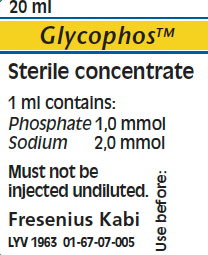
Glycophos SODIUM GLYCOLATE 216 mg/mL Injection, Solution
🆔 Identity & classification
Where does this data come from?
🏭 Manufacturer & labeler
Where does this data come from?
🩺 Clinical
Patient education
Supplement & herbal interactions
Where does this data come from?
Ask a licensed pharmacist directly — free, answered by our team.
🧪 Inactive Ingredients / Excipients
Inactive ingredients, also called excipients, are components of the drug product other than the active ingredient. They may include fillers, dyes, coatings, preservatives, flavors, or other formulation ingredients.
💡 Tap an ingredient (hover on desktop) to see what it is and why it’s used.
-
UNII QTT17582CB
A strong acid used to adjust and maintain the proper pH level in liquid medicines, ensuring stability and preventing breakdown of active ingredients.
1 inactive ingredient listed in the exact product block matched to this NDC.
Where does this data come from?
ingredient classCode="IACT" elements from the exact product block matched by this NDC. Label-section narrative from DailyMed / the openFDA label index is shown separately when available.Inactive ingredient FAQ
Are inactive ingredients the same for every manufacturer?
Why might an inactive ingredient be missing?
Can inactive ingredients matter?
💲 Pricing
A drug doesn't have one price. Each row is a different public payment system, and none is what you'd pay at the counter — that depends on your insurance. The ⓘ on each row explains what it measures.
| Price system | Per mL | Per package |
|---|---|---|
| Retail pharmacies payNADAC · weekly | Not in the retail survey — common for institutional, discontinued, or low-volume packs. | |
| Medicaid paysCMS SDUD · 12 mo | No recent Medicaid claims on file for this NDC — rare and low-volume NDCs are suppressed in the public data. | |
| Medicare drug plans payPart D · quarterly | No Part D plan price is available for this NDC in our data. | |
Where does this data come from?
🔁 Therapeutic equivalents
| Product | Labeler | Pack | NADAC/unit | TE | Status | Price vs. this |
|---|---|---|---|---|---|---|
| Glycophos 216 mg/mLthis 63323-0241-20 | Fresenius | 10 vials | — | — | Discontinued | — |
Where does this data come from?
⏳ Availability & generic status
We did not find an FDA-approved generic match for this exact strength, form and route.
Where does this data come from?
📦 Packaging — all sizes for this product
| Package NDC | Description | Marketing start | Status |
|---|---|---|---|
| 63323-0241-20 You're viewing this | 10 VIAL, PLASTIC in 1 CARTON (63323-241-20) / 20 mL in 1 VIAL, PLASTIC | 2013-05-13 | Inactivated by FDA |
🧭 About this NDC listing & data coverage
Listed without an FDA application
This product's marketing category indicates it is marketed without an approved FDA application (no NDA, ANDA, or BLA on file). Having an NDC does not by itself establish FDA approval — the NDC Directory is a listing system, not an approval decision. Approval-linked data such as Orange Book therapeutic-equivalence ratings therefore does not apply.
What data is (and isn’t) available for this NDC — tap to expand
| NDC identity (package / product / labeler codes) | ✓ Available |
| Labeler | ✓ Available |
| Product & package description | ✓ Available |
| Marketing category & status | ✓ Available |
| Active ingredient / dosage form / route | ✓ Available |
| FDA label (SPL via DailyMed) | ✓ Available |
| Package photos | ✓ Available |
| Inactive ingredients (structured) | ✓ Available |
| NADAC pharmacy acquisition price (CMS) | — Not published for this NDC CMS publishes NADAC only for NDCs reported in its retail-pharmacy survey. |
| Orange Book / therapeutic-equivalence data | — Not published for this NDC Applies only to products approved under an NDA/ANDA; many listings are out of scope. |
| HCPCS J-code billing crosswalk | — Not published for this NDC Most self-administered / retail products have no J-code — that is normal. |
| Medicaid utilization (CMS SDUD) | — Not published for this NDC CMS reports utilization only for NDCs with Medicaid claims above its privacy threshold. |
Questions about this listing
Is this NDC FDA-approved?
Why is there no price listed?
What does the discontinued status mean for this NDC?
Is the NDC printed on the package the same as the 11-digit billing NDC?
What do the three segments of this NDC mean?
Who lists this product with the FDA?
Do I need a prescription for this product?
Where does this data come from?
📄 Full prescribing information FDA SPL
💬 Medication Guide ▾
1. QUALITATIVE AND QUANTITATIVE COMPOSITION 1 ml of Glycophos contains Active ingredient Quantity Sodium glycerophosphate pentahydrate 306.1 mg* *Corresponds to 216 mg sodium glycerophosphate The active ingredient in 1 ml of Glycophos correspond to Phosphate 1 mmol Sodium 2 mmol For excipients, see
5.1PRODUCT PROPERTIES • Osmolality: 2760 mosm/kg water • pH: 7.4 2. PHARMACEUTICAL FORM Concentrate for solution for infusion. 3. CLINICAL PARTICULARS
3.1Therapeutic indications Glycophos is indicated in adult patients and infants as a supplement in intravenous nutrition to meet the requirements of phosphate.
3.2Posology and method of administration Glycophos must not be given undiluted. Adults: The recommended dosage is individual. The recommended daily dosage of phosphate during intravenous nutrition would normally be 10-20 mmol.
This can be met by using 10-20 ml of Glycophos added to the infusion solution or to the admixture for which compatibility has been proved. Infants: The recommended dosage is individual. The recommended dose for infants and neonates is 1.0-1.5 mmol/Kg body weight/day.
3.3Contra-indications Glycophos should not be given to patients in a state of dehydration or with hypernatraemia, hyperphosphataemia, severe renal insufficiency or shock.
3.4Special warnings and special precautions for use Glycophos should be used with caution in patients with impaired renal function. The phosphate status of all patients should be monitored regularly. Glycophos must not be given undiluted.
3.5Interaction with other medicaments and other forms of interaction No interactions with other drugs have been observed, but a moderate fall in serum phosphate can be seen during carbohydrate infusions.
3.6Pregnancy and lactation Animal reproduction studies or clinical investigations during pregnancy have not been carried out with Glycophos. However, the requirements of phosphate in a pregnant woman are slightly increased compared to non-pregnant women. No adverse events are to be expected when Glycophos is administered during pregnancy.
3.7Effects on ability to drive and use machines No effects on the ability to drive and use machines are to be expected.
3.8Undesirable effects No adverse effects related to glycerophosphate have been reported.
3.9Overdose No adverse effects of an overdose have been reported. Most patients in need of intravenous nutrition have an increased capacity to handle glycerophosphate. See also 3.3 "Contra-indications". 4. PHARMACOLOGICAL PROPERTIES
4.1Pharmacodynamic properties Glycerophosphate is a metabolic intermediate in fat metabolism and any pharmacodynamic effects other than maintaining the normal metabolic pathways are unlikely.
4.2Pharmacokinetic properties To become available it is necessary for the phosphate group to be hydrolysed from the glycerophosphate molecule. The hydrolysis occurs maximally at a plasma concentration of >0.7 mmol/l. Assuming that all hydrolysis of glycerophosphate takes place in plasma, about 12-15 mmol of sodium glycerophosphate will be hydrolysed each day in individuals with normal serum alkaline phosphatase.
No pharmacokinetical data is available for infants, however with the recommended dosage hyperphosphataemia is unlikely.
4.3Preclinical safety data Preclinical safety studies on Glycophos demonstrated good tolerance. 5. PHARMACEUTICAL PARTICULARS
5.1 List of excipients Hydrochloric acid Water for Injections
5.2Incompatibilities Glycophos may only be added to or mixed with other medicinal products for which compatibility has been documented. See 5.6.
5.3 Shelf life 3 years
5.4Special precautions for storage Do not store above 25°C. Do not freeze.
5.5Nature and contents of container Polypropylene vial. Pack size: 10 x 20 ml
5.6Instructions for use/handling Glycophos must not be given undiluted. Compatibility Additions should be made aseptically. Up to 120 ml of Glycophos and 48 mmol of calcium (as CaCl 2 ) can be added to 1000 ml Vamin Glucose, Vamin 9 Electroly…