
HomeNDC LookupIngredientsPotassium Chloride › 63323-0967-30
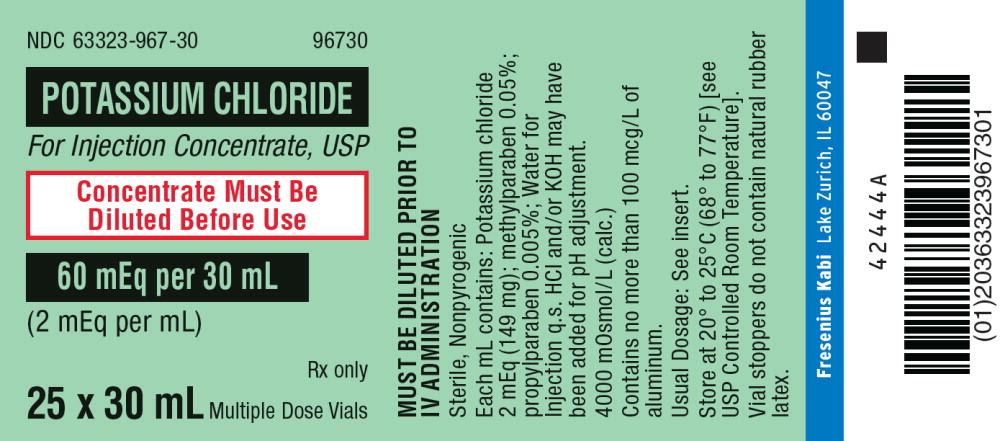
Potassium Chloride 2 meq/mL Injection, Solution, Concentrate — NDC 63323-0967-30 package photo

Potassium Chloride 2 meq/mL Injection, Solution, Concentrate

by Fresenius Kabi USA, LLC · 25 VIAL, MULTI-DOSE in 1 TRAY (63323-967-30) / 30 mL in 1 VIAL, MULTI-DOSE (63323-967-01)
NDC 63323-0967-30
🏷️ FDA NDC (as labeled) 63323-967-30 billing pads the product segment with a zero
Rx only Generic On market Non-controlled
🗂️ Data synced Jul 24, 2026 · sources: openFDA · FDA label (DailyMed) · FDA Orange & Purple Book · First Databank · CMS NADAC, ASP, Medicare & Medicaid · RxNorm
📋 All sources & update times →
⚠️
Other active recalls for Potassium Chloride (different manufacturers) — 6 · tap to view
These affect other manufacturers’ products for the same ingredient — not necessarily the exact NDC on this page.
Class I · Oct 29, 2025 — Labeling: Label Error on Declared Strength-The overwrap label may incorrectly identify the product as POTASSIUM CHLORIDE Inj. 10 mEq instead of POTASSIUM CHLORIDE Inj. 20 mEq (Otsuka ICU Medical LLC) · FDA recall D-0181-2026
Class I · Oct 29, 2025 — Labeling: Label Error on Declared Strength-The overwrap label may incorrectly identify the product as POTASSIUM CHLORIDE Inj. 10 mEq instead of POTASSIUM CHLORIDE Inj. 20 mEq (Otsuka ICU Medical LLC) · FDA recall D-0180-2026
Class I · Feb 13, 2025 — Labeling: Label Error on Declared Strength. Overwrap labeled as Potassium Chloride Inj 10 mEq may contain flexible containers of Potassium Chloride Inj 20 mEq (ICU Medical, Inc.) · FDA recall D-0268-2025
Class I · Feb 13, 2025 — Labeling: Label Error on Declared Strength. Cases labeled POTASSIUM CHLORIDE 20 mEq, may contain flexible containers with overwrap mislabeled as 10 mEq. The correct dosage strength of 20 mEq is printed on the labeling affixed to the product flexible container. (ICU Medical, Inc.) · FDA recall D-0267-2025
Class II · Jan 30, 2025 — Failed Dissolution Specifications. (The Harvard Drug Group LLC dba Major Pharmaceuticals and Rugby Laboratories) · FDA recall D-0221-2025
Class I · Jun 25, 2024 — Failed Dissolution Specifications (Amerisource Health Services LLC) · FDA recall D-0619-2024
Each entry is an official FDA enforcement report — look up any recall number in the FDA recall database ↗

🆔 Identity & classification

FDA NDC (as labeled) 63323-967-30
Product NDC 63323-967
11-digit billing NDC 63323096730
NCPDP billing unit ML — per mL (volume)
UNII 660YQ98I10
UPC 0363323967017, 0363323965020, 0363323965013
Application # ANDA088908
SPL Set ID fcd4f458-ce27-417e-9bb6-de1cc49d44b9
Established class (EPC) Osmotic Laxative; Potassium Salt
Mechanism of action Osmotic Activity
Physiologic effect Increased Large Intestinal Motility; Inhibition Large Intestine Fluid/Electrolyte Absorption
Chemical class Potassium Compounds
DEA schedule Non-controlled
Marketing category ANDA
Marketing status On market
FDA listing status Listed (active directory)
Marketing start 2000-09-05
Route INTRAVENOUS
Dosage form INJECTION, SOLUTION, CONCENTRATE
Substance POTASSIUM CHLORIDE
GPI-14 79700030002005
GPI class Potassium Chloride
GCN Seq No 001255
GCN 03350
HICL code 000549
Ingredient (HICL) Potassium Chloride
HIC1 code C
Therapeutic class — broad (HIC1) Electrolyte Balance/Metabolism/Nutrition
HIC2 code C1
Therapeutic class — intermediate (HIC2) Drugs Affecting Electrolyte Balance
HIC3 code C1D
Therapeutic class — specific (HIC3) Potassium Replacement
AHFS code 40:12.00.00
AHFS class Replacement Preparations
FDB label name POTASSIUM CL 60 MEQ/30 ML CONC
FDB brand name Potassium Chloride
Legend status F — Federal legend — prescription drug or device
TE code (Orange Book) AP · RLD · RS
Why two NDCs? The FDA registers this code as 63323-967-30 — a 5-3-2 layout, and that's what's printed on the package and shown on DailyMed. For insurance claims, every NDC is standardized to a uniform 11-digit 5-4-2 format by adding a zero to the product segment → 63323-0967-30. Same drug, same package — only the format differs.
Where does this data come from?
Identifiers from the FDA openFDA NDC Directory and Structured Product Labeling; RxCUI from RxNorm (NLM); GPI from Medi-Span; GCN / HIC / AHFS / legend from First Databank.

🏷️ RxNorm drug class

This medicine belongs to the Potassium class.

Drug family (ATC) Potassium, Electrolyte solutions
Where does this data come from?
Therapeutic classes from RxNorm RxClass (U.S. National Library of Medicine) — Established Pharmacologic Class (FDA), ATC drug family (WHO) and mechanism of action, matched by this product’s RxCUI.

🏭 Manufacturer & labeler

LabelerFresenius Kabi USA, LLC
Application holderFRESENIUS KABI USA LLC
FDA applicationANDA088908 (ANDA)
Labeler code63323
First marketedSep 2000
Product typeHuman Prescription Drug
Portfolio554 products on file
The labeler markets the product; the application holder owns the FDA approval. They’re often the same company but can differ (e.g. a repackager or an authorized generic). A mailing address / phone appears here when the manufacturer includes it in the product’s FDA label (not all do).
Where does this data come from?
Labeler, application holder and registered establishment from the FDA openFDA NDC Directory and Drugs@FDA; address/contact from the product’s FDA label.

🩺 Clinical

Label name POTASSIUM CL 60 MEQ/30 ML CONC Ingredient Potassium Chloride
📗 Our plain-language guide HelloPharmacist
  • You're right that food is the first line — bananas, potatoes, and leafy greens are all rich in potassium. But sometimes diet alone isn't enough, especially if you're taking a diure...
  • Why did my doctor prescribe potassium chloride? I thought potassium just came from bananas.
  • Yes — always take oral tablets or capsules with a meal or right after eating. Taking them on an empty stomach can irritate or even ulcerate the lining of your stomach or intestines...
  • Do I have to take it with food? What happens if I forget?
📖 Read our full Potassium Chloride guide →
Where does this data come from?
Plain-language summary from MedlinePlus (U.S. National Library of Medicine); supplement & herbal interactions and nutrient depletion data from the Natural Medicines database; our full guide is HelloPharmacist editorial content.

🧪 Inactive Ingredients / Excipients

Inactive ingredients, also called excipients, are components of the drug product other than the active ingredient. They may include fillers, dyes, coatings, preservatives, flavors, or other formulation ingredients.

Loading inactive ingredients from the official FDA label in the background. No external source is being called by this page request.
Where does this data come from?
Source: official FDA Structured Product Labeling (SPL) via DailyMed and the openFDA label index. Structured IACT rows and label-wide narrative are kept separate; availability and product-level specificity depend on the submitted label.

Inactive ingredient FAQ

Are inactive ingredients the same for every manufacturer?
No. Inactive ingredients can differ by manufacturer, dosage form, strength, and package / product version.
Why might an inactive ingredient be missing?
Some SPLs do not provide a complete structured inactive-ingredient list, and older or unusual labels may only include the information in narrative text.
Can inactive ingredients matter?
Yes. They can matter for allergies, intolerances, dyes, gluten / lactose concerns, preservatives, and formulation differences — but confirm with a pharmacist or the manufacturer when it’s clinically important.

💲 Pricing

A drug doesn't have one price. Each row is a different public payment system, and none is what you'd pay at the counter — that depends on your insurance. The ⓘ on each row explains what it measures.

Price systemPer mLPer package
Retail pharmacies payNADAC · weekly Not in the retail survey — common for institutional, discontinued, or low-volume packs.
Medicaid paysCMS SDUD · 12 mo $0.6702 $502.65 / 750 ml
Medicare drug plans payPart D · Q2 2026 $0.1236 $92.70 / 750 ml
Medicare Part B allowsASP · J3480 $0.136 / J3480 unit
Where does this data come from?
NADAC (National Average Drug Acquisition Cost) is the CMS weekly pharmacy-acquisition-cost survey — what pharmacies pay. ASP (Average Sales Price) is the CMS Medicare Part B drug-payment file, published quarterly. Medicaid pays is computed by us from CMS State Drug Utilization Data (total reimbursed ÷ units, trailing 12 months) — gross of rebates and inclusive of dispensing fees, so it reflects what Medicaid paid, not an acquisition cost. Medicare drug plans pay is the median negotiated point-of-sale unit cost across plans listing this NDC in the CMS quarterly Prescription Drug Plan pricing files, before rebates. The VA pays is the federal contract price (FSS, and the statutory Big 4 ceiling where listed) from the VA National Acquisition Center pharmaceutical price file. All are free public government data; each measures a different payer, so the figures are not directly comparable.

🧾 Billing & reimbursement

FDA NDC (as labeled)63323-967-30
11-digit billing NDC63323-0967-30
Format5-3-2 as registered → padded to 5-4-2 for billing (zero added to the product segment)
HCPCS J-codeJ3480
DescriptorINJECTION, POTASSIUM CHLORIDE, PER 2 MEQ
Billing units / pkg1 units
Crosswalk sourcePDAC NDC-HCPCS crosswalk (DME MAC / DMEPOS)
Where does this data come from?
The HCPCS J-code crosswalk comes from the CMS ASP NDC-HCPCS crosswalk and the DMEPDAC (DME MAC) NDC-HCPCS crosswalk — free public CMS data. Billing units are derived from the code’s descriptor and the package amount.

🔁 Therapeutic equivalents

ProductLabelerPackNADAC/unitTEStatusPrice vs. this
Potassium Chloride 14.9 g/100mL 00264-1944-20 B. 250 ml AP Discontinued
Potassium Chloride 2 meq/mLthis 63323-0967-30 Fresenius 25 vials AP FDA listed
Potassium Chloride 2 meq/mL 63323-0965-05 Fresenius 25 vials AP FDA listed
Potassium Chloride 2 meq/mL 00404-9936-10 Henry 1 vial AP FDA listed
About this product: this is a generic version of the medicine. FDA equivalence ratings are shown when available, and other versions are listed above, least expensive first.
Where does this data come from?
Equivalents are other NDCs of the same ingredient, form and route from the openFDA NDC Directory, ranked least-expensive-first by NADAC. Therapeutic-equivalence (AB) ratings come from the FDA Orange Book; biologics use the FDA Purple Book for biosimilar & interchangeable status.

Availability & generic status

🏛️
2000
On the market since
Sep 2000
📍
2026
Currently FDA-listed
26 years listed
🔓
·
Generic on the market
this product is a generic
This is a generic drug

This product is an FDA-approved generic. Other versions of the same drug are listed under Therapeutic equivalents, least expensive first.

Where does this data come from?
Patents and exclusivity from the FDA Orange Book (small-molecule drugs), refreshed from public FDA data. Generic launch timing is an estimate, not a guarantee.

🗺️ Medicaid utilization & spend

📍 This exact package only: Medicaid data is reported per full 11-digit NDC — labeler, product and pack size — so every number here is for 63323-0967-30, not the drug overall. Other pack sizes report separately.
💊 Pharmacy benefit only: These are Medicaid outpatient pharmacy claims, billed by NDC. They exclude the medical benefit — clinic- or hospital-administered drugs billed under HCPCS J-codes — so drugs used mostly that way (e.g. Avastin, Lucentis, Keytruda) can look low or missing here. That’s expected, not an error.
📅 Q1 2025 – Q1 2026 · 5 quarters of data
ⓘ The newest quarter is usually incomplete when first published; states restate recent quarters in later CMS releases, so the latest figures typically revise upward. State coverage-policy changes can also shift quarter-to-quarter totals.
Prescriptions last 4 qtrs
1.3K
Units reimbursed last 4 qtrs
142.2K
Gross reimbursed last 4 qtrs
$95.3K
Avg / prescription
$70.77
Avg / unit
$0.6702
Latest quarter Q1 2026
308Rx
Fee-for-service vs managed care
69% FFS 31% MCO
Fee-for-service · 936 Rx Managed care · 411 Rx
State Medicaid map
Alaska: no data reported AK Maine: 115 units · 8.2 per 100k residents ME Washington: 272 units · 3.5 per 100k residents WA Idaho: no data reported ID Montana: no data reported MT North Dakota: no data reported ND Minnesota: no data reported MN Wisconsin: 13,624 units · 231 per 100k residents WI Michigan: no data reported MI New York: no data reported NY Vermont: no data reported VT New Hampshire: no data reported NH Oregon: no data reported OR Nevada: no data reported NV Wyoming: no data reported WY South Dakota: no data reported SD Iowa: no data reported IA Illinois: 3,531 units · 28.1 per 100k residents IL Indiana: no data reported IN Ohio: 5,214 units · 44.2 per 100k residents OH Pennsylvania: 719 units · 5.5 per 100k residents PA New Jersey: no data reported NJ Massachusetts: no data reported MA California: 15,189 units · 39.0 per 100k residents CA Utah: 10,888 units · 319 per 100k residents UT Colorado: no data reported CO Nebraska: no data reported NE Missouri: 1,585 units · 25.6 per 100k residents MO Kentucky: no data reported KY West Virginia: no data reported WV Virginia: no data reported VA Maryland: 1,882 units · 30.5 per 100k residents MD Connecticut: 43,787 units · 1,211 per 100k residents CT Rhode Island: no data reported RI Arizona: no data reported AZ New Mexico: no data reported NM Kansas: 8 units · 0.3 per 100k residents KS Arkansas: no data reported AR Tennessee: no data reported TN North Carolina: 39,462 units · 364 per 100k residents NC South Carolina: no data reported SC Delaware: no data reported DE Oklahoma: no data reported OK Louisiana: no data reported LA Mississippi: no data reported MS Alabama: no data reported AL Georgia: 1,215 units · 11.0 per 100k residents GA D.C.: no data reported DC Hawaii: 170 units · 11.8 per 100k residents HI Texas: no data reported TX Florida: 4,584 units · 20.3 per 100k residents FL
Units reimbursed · per 100k residents
0.31,211
gray = no data reported
Colors are per 100,000 residents, so big states don’t automatically dominate. Tap or hover a state for its actual totals.
Tap or hover a state
…for its Medicaid breakdown
🏆 Top states by units · per 100k residents
1 Connecticut 1,211 /100k
2 North Carolina 364 /100k
3 Utah 319 /100k
4 Wisconsin 231 /100k
5 Ohio 44.2 /100k
6 California 39.0 /100k
7 Maryland 30.5 /100k
8 Illinois 28.1 /100k
National units — by quarter
💵 About the dollar figures: “reimbursed” is what Medicaid paid pharmacies before confidential manufacturer rebates, so the program’s real net cost is lower than these numbers. Fee-for-service and managed-care claims are combined unless split above. Source: CMS State Drug Utilization Data; per-100k rates use 2023 Census population estimates.

📊 Medicare Part D spend CMS · PART D · 2026 (Q1)

Medicare Part D (outpatient prescription) spending for Potassium Chloride — the program that covers self-administered drugs. 42 manufacturers.
⚠️ Drug-level data: CMS publishes Part D spending by drug, not by NDC — these figures combine every manufacturer, strength and package size sold under the name Potassium Chloride. That’s a different level of aggregation than the Medicaid card above, which is specific to this exact 11-digit NDC (pack size included), so the two aren’t directly comparable.
Period
Total Part D spend
$78.71M
Claims incl. refills
3.7M
Beneficiaries
2.4M
Spend / beneficiary
$33.46
Spend / claim
$21.47
Trend by period
💵 About the dollar figures: spending is what Part D plans paid before confidential manufacturer rebates, so the program’s real net cost is lower. A blank patient count means fewer than 11 people — CMS hides counts that small to protect privacy. Source: CMS Medicare Quarterly Part D Spending by Drug (data.cms.gov), updated quarterly.

🔬 Reported adverse events (FAERS)

Read carefully: FAERS reports are voluntary and unverified. Counts are not incidence, do not establish causation, are subject to reporting bias, and cannot be used to compare one drug to another. Shown for signal context only. Reports for Potassium Chloride — the ingredient across all brands.

Top reported reactions

Nausea9,006
Diarrhoea8,604
Dyspnoea8,414
Fatigue8,118
Vomiting6,603
Death5,805
Pneumonia5,556

Reporter sex

120,818 reports
Male · 37%
Female · 63%
Unknown · 0%

Serious outcomes

Death16,417
Life-threatening6,633
Disabling2,798
Reports over time (by year) — tap or hover for the count & year
2019 2021 2023 2026 8,102 0
Most recent year is provisional (FAERS lags ~3 months).
Where does this data come from?
Adverse-event reports from the FDA Adverse Event Reporting System (FAERS) via openFDA. FAERS reports are voluntary and unverified — counts are not incidence and don’t establish causation.

📦 Packaging — all sizes for this product

Package NDCDescription Marketing startStatus
63323-0967-30 You're viewing this 25 VIAL, MULTI-DOSE in 1 TRAY (63323-967-30) / 30 mL in 1 VIAL, MULTI-DOSE (63323-967-01) 2000-09-05 Active

🧭 About this NDC listing & data coverage

Finished prescription product
What data is (and isn’t) available for this NDC — tap to expand
NDC identity (package / product / labeler codes) ✓ Available
Labeler ✓ Available
Product & package description ✓ Available
Marketing category & status ✓ Available
Active ingredient / dosage form / route ✓ Available
FDA label (SPL via DailyMed) ✓ Available
Package photos ✓ Available
Inactive ingredients (structured) — Not published for this NDC The labeler did not submit a structured excipient list, or no SPL is available.
NADAC pharmacy acquisition price (CMS) — Not published for this NDC CMS publishes NADAC only for NDCs reported in its retail-pharmacy survey.
Orange Book / therapeutic-equivalence data ✓ Available
HCPCS J-code billing crosswalk ✓ Available
Medicaid utilization (CMS SDUD) ✓ Available
“Not published” reflects what the public FDA / CMS / NLM sources provide for this exact package code — it is a property of the data feeds, not a judgment about the product.

Questions about this listing

Why is there no price listed?
The pricing shown on our NDC pages comes from CMS NADAC, a voluntary survey of retail community pharmacy invoices. CMS does not publish a NADAC for every NDC — packages outside the retail survey (institutional and hospital products, bulk packages, discontinued items, and many OTC items) may never receive one. A missing price reflects the survey's scope, not this product's actual cost, and does not mean the product is free or unavailable.
Is the NDC printed on the package the same as the 11-digit billing NDC?
Yes, they identify this exact package in different formats. The FDA registers it as 63323-967-30, which is what is printed on the packaging and shown on DailyMed. Insurance claims use a fixed 11-digit 5-4-2 format, so the short segment is padded with a leading zero: 63323-0967-30, written without dashes as 63323096730. The Identity section at the top of this page lists every form of this code.
What do the three segments of this NDC mean?
In 63323-0967-30, the first segment (63323) is the labeler code FDA assigned to Fresenius Kabi USA, LLC; the middle segment (0967) identifies this specific product — its ingredient, strength, and dosage form; and the last segment (30) identifies this exact package size and type. Together they name one specific package of one specific product.
Is this package still being marketed?
Yes, per the latest FDA NDC Directory data on this page: this package is listed as actively marketed, with no marketing end date reported by Fresenius Kabi USA, LLC. Listing status can change — the directory data on this page refreshes weekly.
Who lists this product with the FDA?
Fresenius Kabi USA, LLC is the labeler of record for this NDC — the company under whose FDA-assigned code the package is listed. The labeler may be the manufacturer itself or a distributor marketing the product under its own code.
Do I need a prescription for this product?
This NDC is listed with FDA as a prescription product, so it is dispensed under a prescriber's order. Your pharmacist can tell you whether any over-the-counter forms of the same medication exist.
Does this product have a billing J-code?
Yes — this NDC cross-references HCPCS code J3480 for medical-claim billing (typically used when a product is administered in a clinical setting rather than dispensed at a retail pharmacy). See the Billing section on this page.
This page identifies an FDA-listed package (the NDC) and reports public regulatory and pricing data about the listing. It is reference information, not a medical recommendation — talk to your pharmacist or prescriber about your own medication.
Where does this data come from?
Listing facts (marketing category, packager status, marketing dates) from the FDA openFDA NDC Directory; label availability from DailyMed; pricing coverage from CMS NADAC; equivalence scope from the FDA Orange Book.

📄 Full prescribing information FDA SPL

The complete FDA label for this product — the official prescribing information, verbatim, section by section. Jump with a chip, search within the label, or expand everything.
🎯 Indications and Usage 24 words

INDICATIONS AND USAGE: Potassium Chloride for Injection Concentrate, USP is indicated in the treatment of potassium deficiency states when oral replacement is not feasible.

⏱️ Dosage and Administration 210 words

DOSAGE AND ADMINISTRATION: Potassium Chloride for Injection Concentrate must be diluted before administration. Care must be taken to ensure there is complete mixing of the potassium chloride with the large volume fluid, particularly if soft or bag type containers are used. The dose and rate of administration are dependent upon the specific condition of each patient.

If the serum potassium level is greater than 2.5 mEq/L, potassium can be given at a rate not to exceed 10 mEq/hour and in a concentration of up to 40 mEq/L. The 24 hour total dose should not exceed 200 mEq. If urgent treatment is indicated (serum potassium level less than 2 mEq/L and electrocardiographic changes and/or muscle paralysis), potassium chloride may be infused very cautiously at a rate of up to 40 mEq/hour.

In such cases, continuous cardiac monitoring is essential. As much as 400 mEq may be administered in a 24 hour period. In critical conditions, potassium chloride may be administered in saline (unless contraindicated) rather than in dextrose containing fluids, as dextrose may lower serum potassium levels.

Prior to entering a vial, cleanse the rubber closure with a suitable antiseptic agent. Parenteral drug products should be inspected visually for particulate matter and discoloration prior to administration whenever solution and container permit.

Contraindications 33 words

CONTRAINDICATIONS: Potassium Chloride for Injection Concentrate is contraindicated in diseases where high potassium levels may be encountered, and in patients with hyperkalemia, renal failure and in conditions in which potassium retention is present.

⚠️ Warnings ~1 min read

WARNINGS: Potentially Fatal Cardiac Adverse Reactions with Undiluted Intravenous Administration Direct patient injection of potassium chloride at this concentration may be instantaneously fatal. Potassium Chloride for Injection Concentrate must be diluted before administration. Fatal cardiac arrhythmia and cardiac arrest have occurred when potassium chloride was administered in an undiluted form.

To avoid potassium intoxication, do not infuse these solutions rapidly. In patients with renal insufficiency, administration of potassium chloride may cause potassium intoxication and life-threatening hyperkalemia. The administration of intravenous solutions can cause fluid and/or solute overload resulting in dilution of serum electrolyte concentrations, overhydration, congested states or pulmonary edema.

The risk of dilutional states is inversely proportional to the electrolyte concentration. The risk of solute overload causing congested states with peripheral and pulmonary edema is directly proportional to the electrolyte concentration. In patients with diminished renal function, administration of solutions containing potassium ions may result in potassium retention.

This product contains aluminum that may be toxic. Aluminum may reach toxic levels with prolonged parenteral administration if kidney function is impaired. Premature neonates are particularly at risk because their kidneys are immature, and they require large amounts of calcium and phosphate solutions, which contain aluminum.

Research indicates that patients with impaired kidney function, including premature neonates, who receive parenteral levels of aluminum at greater than 4 to 5 mcg/kg/day accumulate aluminum at levels associated with central nervous system and bone toxicity. Tissue loading may occur at even lower rates of administration.

🤒 Adverse Reactions 165 words

ADVERSE REACTIONS: To report SUSPECTED ADVERSE REACTIONS, contact Fresenius Kabi USA, LLC at 1-800-551-7176 or FDA at 1-800-FDA-1088 or www.fda.gov/medwatch. Reactions which may occur because of the solution or the technique of administration include febrile response, infection at the site of injection, venous thrombosis or phlebitis extending from the site of injection, extravasation, hypervolemia, and hyperkalemia. Too rapid infusion of hypertonic solutions may cause local pain and, rarely, vein irritation.

Rate of administration should be adjusted according to tolerance. Reactions reported with the use of potassium-containing solutions include nausea, vomiting, abdominal pain and diarrhea. The signs and symptoms of potassium intoxication include paresthesias of the extremities, areflexia, muscular or respiratory paralysis, mental confusion, weakness, hypotension, cardiac arrhythmias, heart block, electrocardiographic abnormalities and cardiac arrest.

Potassium deficits result in disruption of neuromuscular function, and intestinal ileus and dilatation. If an adverse reaction does occur, discontinue the infusion, evaluate the patient, institute appropriate therapeutic countermeasures and save the remainder of the fluid for examination if deemed necessary.

🆘 Overdosage 118 words

OVERDOSAGE: In the event of fluid overload during parenteral therapy, reevaluate the patient's condition, and institute appropriate corrective treatment. In the event of overdosage with potassium-containing solutions, discontinue the infusion immediately and institute corrective therapy to reduce serum potassium levels. Treatment of hyperkalemia includes the following: Dextrose Injection, USP, 10% or 25%, containing 10 units of crystalline insulin per 20 grams of dextrose administered intravenously, 300 to 500 mL/hour.

Absorption and exchange of potassium using sodium or ammonium cycle cation exchange resin, orally and as retention enema. Hemodialysis and peritoneal dialysis. The use of potassium-containing foods or medications must be eliminated.

However, in cases of digitalization, too rapid a lowering of plasma potassium concentration can cause digitalis toxicity.

🧬 Clinical Pharmacology 150 words

CLINICAL PHARMACOLOGY: Potassium is the chief cation of body cells (160 mEq/L of intracellular water) and is concerned with the maintenance of body fluid composition and electrolyte balance. Potassium participates in carbohydrate utilization and protein synthesis, and is critical in the regulation of nerve conduction and muscle contraction, particularly in the heart. Chloride, the major extracellular anion, closely follows the metabolism of sodium, and changes in the acid-base balance of the body are reflected by changes in the chloride concentration.

Normally about 80 to 90% of the potassium intake is excreted in the urine, the remainder in the stools and to a small extent, in the perspiration. The kidney does not conserve potassium well, so that during fasting, or in patients on a potassium-free diet, potassium loss from the body continues resulting in potassium depletion. A deficiency of either potassium or chloride will lead to a deficit of the other.

📦 How Supplied / Storage and Handling 184 words

HOW SUPPLIED: The following are packaged in plastic vials. Product Code Unit of Sale Total Potassium Ion Potassium Chloride per mL Each 96505 NDC 63323-965-05 Unit of 25 10 mEq (0.39 g) 149 mg NDC 63323-965-01 5 mL in a 10 mL Single Dose Vial 96510 NDC 63323-965-10 Unit of 25 20 mEq (0.78 g) 149 mg NDC 63323-965-03 10 mL Single Dose Vial 96520 NDC 63323-965-20 Unit of 25 40 mEq (1.56 g) 149 mg NDC 63323-965-02 20 mL Single Dose Vial These are Single Dose Vials, no preservative added, packaged 25 vials per tray. Unused portion of vial should be discarded.

Product Code Unit of Sale Total Potassium Ion Potassium Chloride per mL Each 96730 NDC 63323-967-30 Unit of 25 60 mEq (2.35 g) 149 mg NDC 63323-967-01 30 mL Multiple Dose Vial This is a Multiple Dose Vial, preserved with 0.05% methylparaben and 0.005% propylparaben, packaged 25 vials per tray. Store at 20° to 25°C (68° to 77°F) [see USP Controlled Room Temperature]. Use only if solution is clear, seal intact and undamaged.

Vial stoppers do not contain natural rubber latex.

📋 Description 164 words

DESCRIPTION: Potassium Chloride for Injection Concentrate, USP is a sterile, nonpyrogenic concentrated solution of Potassium Chloride, USP in Water for Injection to be administered by intravenous infusion only after dilution in a larger volume of fluid. Each mL of Potassium Chloride for Injection Concentrate contains 2 mEq of K + and Cl – equivalent to 149 mg of potassium chloride and has an osmolarity of 4000 mOsmol/L (calc). A more concentrated Potassium Chloride for Injection Concentrate is also available.

Each mL of this injection contains 3 mEq of K + and Cl – equivalent to 224 mg of potassium chloride and has an osmolarity of 6000 mOsmol/L(calc). pH (4.0-8.0) may have been adjusted with hydrochloric acid and if necessary, potassium hydroxide. Some packages are intended for multiple dose use and contain preservatives (0.05% methylparaben and 0.005% propylparaben). A summary of the available products is presented in the HOW SUPPLIED section.

Potassium Chloride for Injection Concentrate (appropriately diluted) is a parenteral fluid and electrolyte replenisher.

Source: FDA Structured Product Labeling, mirrored from DailyMed / openFDA. Prefer the government’s original formatting? View this label on DailyMed ↗
For educational and professional reference only — not medical advice. Pricing reflects published NADAC and CMS ASP (free public data) and may differ from your acquisition cost; always verify before billing or dispensing.