
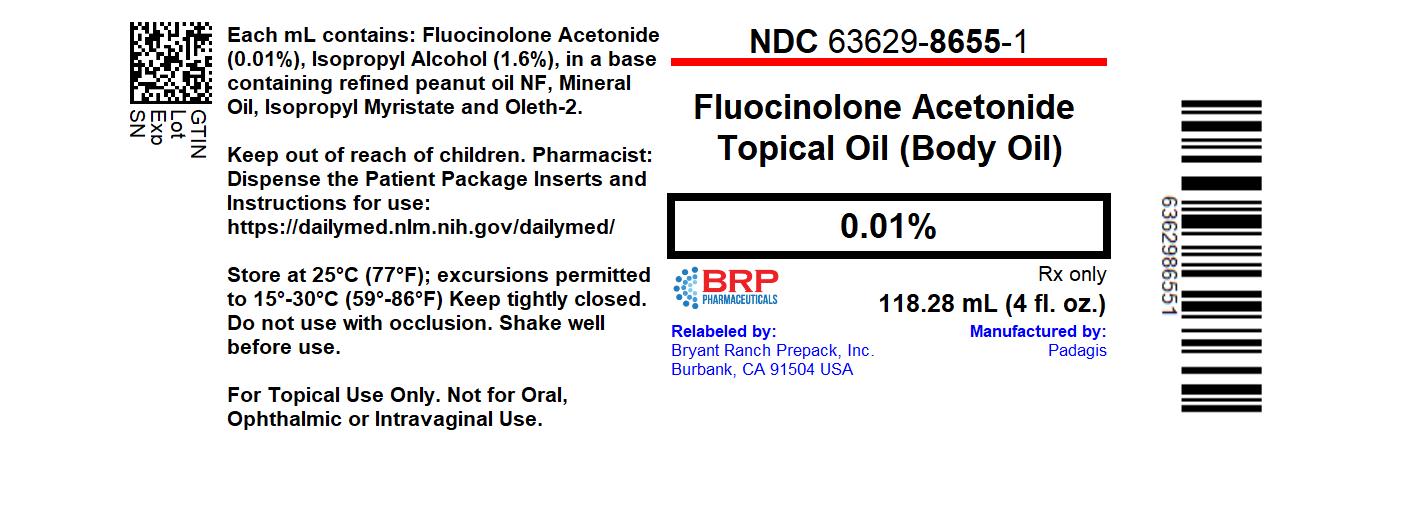
fluocinolone acetonide .01 mg/100mL Oil, 1 bottle — NDC 63629-8655-1 (Billing 63629-8655-01)
This is a package of 1 bottle of fluocinolone acetonide .01 mg/100mL Oil from Bryant Ranch Prepack, marketed since Jun 2017 and currently FDA-listed. It is this product's only package size.
NDC database record
One package, one record: these facts belong to NDC 63629-8655-1 alone.
- Record
- FDA NDC Directory package listing · Human prescription drug
- Code segments
- 63629 labeler · 8655 product · 1 package
- Package marketed since
- Jun 14, 2017
- Sample package
- No — commercial package
- Listing certified through
- Dec 31, 2026
- Barcode (UPC-A, from the NDC)
- 3 6362986551 2
- FDA record last changed
- Jul 24, 2026
Other active recalls for Fluocinolone Acetonide (different manufacturers) — 1 · tap to view
Identity & classification
Regulatory identifiers FDA, NLM and CMS codes for this package
Drug-database identifiers Medi-Span GPI and First Databank GCN / HICL / AHFS classification
- GSN (GCN sequence number): 007507
- GCN: 85080
- HICL (First Databank): 002896
- AHFS class code: 52:08.08.00
Where does this data come from?
- FDA openFDA NDC Directory · synced Oct 8, 2026
- FDA label on DailyMed · label index refreshed Oct 8, 2026
- RxNorm (NLM RxNav) · catalog refreshed Oct 1, 2026
- Medi-Span GPI (licensed)
- First Databank (licensed) · refreshed Oct 8, 2026
Clinical
- It depends on the product. Creams, ointments and solutions calm itchy, inflamed skin. The oils treat atopic dermatitis or, for ear oil, chronic eczematous external otitis. Eye impl...
- Use the smallest amount that covers the area. Creams and ointments are usually a thin film a few times a day, and the oils follow their own schedule. If there's no improvement in 2...
- Tilt your head, gently pull your ear lobe back and up, and use the dropper to put in 5 drops. Stay tilted for about a minute, then pat away extra oil with a cotton ball. It's usual...
- Not the oil, unless your provider tells you to. Skin folds, armpits and groin carry a higher risk of side effects. Keep it out of your eyes, mouth and vagina.
Patient education
Supplement & herbal interactions
Where does this data come from?
- MedlinePlus (NLM) · refreshed Oct 8, 2026
- FDA label on DailyMed · label index refreshed Oct 8, 2026
Ask a licensed pharmacist directly — free, answered by our team.
Pricing
A drug doesn't have one price. Each row is a different public payment system, and none is what you'd pay at the counter — that depends on your insurance. The ⓘ on each row explains what it measures.
| Price system | Per each | Per package |
|---|---|---|
| Retail pharmacies payNADAC · weekly | Not in the retail survey — common for institutional, discontinued, or low-volume packs. | |
| Medicaid paysCMS SDUD · 12 mo | No recent Medicaid claims on file for this NDC — rare and low-volume NDCs are suppressed in the public data. | |
| Medicare drug plans payPart D · quarterly | No Part D plan price is available for this NDC in our data. | |
Where does this data come from?
- CMS NADAC weekly file
- CMS ASP pricing files · refreshed Sep 20, 2026
- CMS Medicaid State Drug Utilization Data · refreshed Oct 8, 2026
- CMS Part D plan pricing files · refreshed Sep 24, 2026
- VA National Acquisition Center price file
Packaging — all sizes for this product
| Package NDC | Description | Marketing start | Marketing end | Status |
|---|---|---|---|---|
| 63629-8655-01 You're viewing this Main listing | 1 BOTTLE in 1 CARTON / 118.28 mL in 1 BOTTLE | 2017-06-14 | — | Active |
Therapeutic equivalents
| Product | Labeler | Pack | NADAC/unit | TE | Status | Price vs. this |
|---|---|---|---|---|---|---|
| Fluocinolone acetonide .01 mg/100mL 45802-0485-26 | Padagis | 1 bottle | $0.171 | AT | Availability likely | — |
| Fluocinolone Acetonide .11 mg/118.28mL 51672-1357-08 | Sun | 1 bottle | $0.171 | AT | Availability likely | — |
| FLUOCINOLONE ACETONIDE Oil .11 mg/mL 64980-0330-04 | RISING | 118.28 ml | $0.171 | AT | Availability likely | — |
| Fluocinolone Acetonide .11 mg/mL 70752-0158-06 | Quagen | 1 bottle | $0.171 | AT | Availability likely | — |
| fluocinolone acetonide .01 mg/100mL 45802-0887-26 | Padagis | 1 bottle | $0.175 | AT | Availability likely | — |
| Fluocinolone Acetonide .11 mg/118.28mL 51672-1356-08 | Sun | 1 bottle | $0.175 | AT | Availability likely | — |
| Fluocinolone Acetonide Oil .11 mg/mL 64980-0331-04 | Rising | 118.28 ml | $0.175 | AT | Availability likely | — |
| Fluocinolone Acetonide .11 mg/mL 70752-0156-06 | Quagen | 1 bottle | $0.175 | AT | Availability likely | — |
| Fluocinolone Acetonide .11 mg/118.28mL 65162-0703-86 | Amneal | 1 bottle | $0.222 | — | Discontinued | — |
| Fluocinolone Acetonide .11 mg/mL 68462-0590-89 | Glenmark | 1 bottle | $0.222 | — | FDA listed | — |
| Derma-Smoothe/Fs .11 mg/mL 68791-0102-04 | Royal | 1 bottle | $0.242 | AT | Availability likely | — |
| Derma-Smoothe/FS .11 mg/mL 68791-0101-04 | Royal | 1 bottle | $0.243 | AT | Availability likely | — |
| Fluocinolone Acetonide Oil .11 mg/mL 50090-6780-00 | A-S | 118.28 ml | — | AT | FDA listed | — |
| Fluocinolone acetonide .01 mg/100mL 50090-7958-00 | A-S | 1 bottle | — | AT | FDA listed | — |
| fluocinolone acetonide .01 mg/100mLthis 63629-8655-01 | Bryant | 1 bottle | — | AT | FDA listed | — |
| Fluocinolone acetonide .01 mg/100mL 63629-8656-01 | Bryant | 1 bottle | — | AT | FDA listed | — |
| Fluocinolone Acetonide .11 mg/mL 71335-2883-01 | Bryant | 1 bottle | — | AT | FDA listed | — |
| Fluocinolone Acetonide .11 mg/mL 71335-2884-01 | Bryant | 1 bottle | — | AT | FDA listed | — |
| Fluocinolone acetonide .01 mg/100mL 72162-1412-02 | Bryant | 1 bottle | — | AT | FDA listed | — |
| fluocinolone acetonide .01 mg/100mL 72162-1434-02 | Bryant | 1 bottle | — | AT | FDA listed | — |
| Fluocinolone Acetonide .11 mg/mL 72162-2319-02 | Bryant | 1 bottle | — | AT | FDA listed | — |
| Fluocinolone Acetonide .11 mg/mL 72162-2321-02 | Bryant | 1 bottle | — | AT | FDA listed | — |
Where does this data come from?
- FDA openFDA NDC Directory · synced Oct 8, 2026
- FDA Orange Book · refreshed Oct 3, 2026
- CMS NADAC weekly file
Availability & generic status
This product is an FDA-approved generic. Other versions of the same drug are listed under Therapeutic equivalents, least expensive first.
Where does this data come from?
- FDA Orange Book · refreshed Oct 3, 2026
Inactive Ingredients / Excipients
Inactive ingredients, also called excipients, are components of the drug product other than the active ingredient. They may include fillers, dyes, coatings, preservatives, flavors, or other formulation ingredients.
🧪 Avoiding an ingredient? See Fluocinolone inactive ingredients by manufacturer: every current product's list side by side, so you can ask your pharmacy for the version that does not list it.
💡 Tap an ingredient (hover on desktop) to see what it is and why it’s used.
-
UNII ND2M416302
Isopropyl alcohol is a clear liquid solvent derived from petroleum. In medicines, it dissolves active ingredients and other components, helps the product flow smoothly, and aids in sterilization during manufacturing.
-
UNII 0RE8K4LNJS
Isopropyl myristate is an oily liquid made from coconut or palm oil. It's used in medicines as an emollient and penetration enhancer to help the medicine absorb through skin or improve spreadability in topical products.
-
UNII N6K5787QVP
Light mineral oil is a clear, odorless liquid derived from petroleum. In medicines, it acts as a lubricant and emollient to help the product spread smoothly and improve texture.
-
UNII 7L6R1SQ6M0
Oleth-2 is a synthetic chemical made by combining ethylene oxide with oleyl alcohol. It works as an emulsifier and surfactant, helping mix oil and water-based ingredients together in medicines and allowing better absorption through the skin.
4 inactive ingredients listed in the exact product block matched to this NDC.
Where does this data come from?
ingredient classCode="IACT" elements from the exact product block matched by this NDC. Label-section narrative from DailyMed / the openFDA label index is shown separately when available.- FDA label on DailyMed · label index refreshed Oct 8, 2026
- FDA openFDA NDC Directory · synced Oct 8, 2026
Inactive ingredient FAQ
Are inactive ingredients the same for every manufacturer?
Why might an inactive ingredient be missing?
Can inactive ingredients matter?
Manufacturer & labeler
More NDCs from Bryant Ranch Prepack labeler code 63629
- Econazole Nitrate 10 mg/g Cream NDC 63629-8646-1
- Econazole Nitrate 10 mg/g Cream NDC 63629-8647-1
- Ery Erythromycin 20 mg/mL Swab NDC 63629-8648-1
- Erythromycin 20 mg/g Gel NDC 63629-8652-1
- Erythromycin 20 mg/g Gel NDC 63629-8653-1
- Estradiol Vaginal .1 mg/g Cream NDC 63629-8654-1
- Fluocinolone acetonide .01 mg/100mL Oil NDC 63629-8656-1
- Flurandrenolide .5 mg/mL Lotion NDC 63629-8657-1
- Fluticasone Propionate .5 mg/g Cream NDC 63629-8658-1
- Fluticasone Propionate .5 mg/g Cream NDC 63629-8659-1
- Fluticasone Propionate .5 mg/g Cream NDC 63629-8660-1
- Fluticasone Propionate .05 mg/g Ointment NDC 63629-8661-1
Where does this data come from?
- FDA openFDA NDC Directory · synced Oct 8, 2026
- Drugs@FDA
Full prescribing information FDA SPL
🎯 Indications and Usage ▾
1 INDICATIONS AND USAGE Fluocinolone Acetonide Topical Oil, 0.01% is a corticosteroid indicated for the topical treatment of atopic dermatitis in adult patients ( 1.1 ) topical treatment of moderate to severe atopic dermatitis in pediatric patients 3 months and older for up to 4 weeks ( 1.2 ) Limitations of Use: Apply the least amount to cover affected areas. Discontinue when disease is controlled. ( 1.3 ) Do not use in the diaper area.
( 1.3 ) Do not use on the face, axillae, or groin. ( 1.3 , 6.2 , 8.4 )
1.1Adult Patients with Atopic Dermatitis Fluocinolone Acetonide Topical Oil, 0.01% is indicated for the topical treatment of atopic dermatitis in adult patients.
1.2Pediatric Patients with Atopic Dermatitis Fluocinolone Acetonide Topical Oil, 0.01% is indicated for the topical treatment of moderate to severe atopic dermatitis in pediatric patients, 3 months and older for up to 4 weeks. Safety and effectiveness in pediatric patients younger than 3 months of age have not been established.
1.3Limitations of Use Apply the least amount of Fluocinolone Acetonide Topical Oil, 0.01% needed to cover the affected areas. As with other corticosteroids, Fluocinolone Acetonide Topical Oil, 0.01% should be discontinued when control of disease is achieved. Contact the physician if no improvement is seen within 2 weeks.
Fluocinolone Acetonide Topical Oil, 0.01% should not be applied to the diaper area; diapers or plastic pants may constitute occlusive use. Fluocinolone Acetonide Topical Oil, 0.01% should not be used on the face, axillae, or groin unless directed by the physician. Application to intertriginous areas should be avoided due to the increased risk of local adverse reactions. [see Adverse Reactions ( 6 ) and Use in Specific Populations ( 8.4 )] .
⏱️ Dosage and Administration ▾
2 DOSAGE AND ADMINISTRATION Fluocinolone Acetonide Topical Oil, 0.01% is not for oral, ophthalmic, or intravaginal use. The dosing of Fluocinolone Acetonide Topical Oil, 0.01% is different for adult and pediatric patients. Fluocinolone Acetonide Topical Oil, 0.01% is not for oral, ophthalmic, or intravaginal use.
( 2 ) Adult patients: Apply to affected areas 3 times daily. ( 2.1 ) Pediatric patients: Moisten skin and apply to affected areas twice daily for up to 4 weeks. ( 2.2 )
2.1Adult Patients with Atopic Dermatitis Apply Fluocinolone Acetonide Topical Oil, 0.01% as a thin film to the affected areas three times daily .
2.2Pediatric Patients with Atopic Dermatitis Moisten skin and apply Fluocinolone Acetonide Topical Oil, 0.01% as a thin film to the affected areas twice daily for up to four weeks .
💊 Dosage Forms and Strengths ▾
3 DOSAGE FORM AND STRENGTHS Fluocinolone Acetonide Topical Oil, 0.01% (Body Oil) is supplied in bottles containing 4 fluid ounces. Fluocinolone Acetonide Topical Oil, 0.01% (Body Oil) is supplied in bottles containing 4 fluid ounces. ( 3 )
⛔ Contraindications ▾
4 CONTRAINDICATIONS None None ( 4 ).
⚠️ Warnings and Cautions ▾
5 WARNINGS AND PRECAUTIONS Topical corticosteroids can produce reversible HPA axis suppression, Cushing's syndrome, hyperglycemia, and glucosuria. ( 5.1 ) Systemic absorption may require evaluation for hypothalamic-pituitary-adrenal (HPA) axis suppression. ( 5.1 ) Modify use should HPA axis suppression develop.
( 5.1 ) Potent corticosteroids, use on large areas, prolonged use or occlusive use may increase systemic absorption. ( 5.1 ) Local adverse reactions may include atrophy, striae irritation, acneiform eruptions, hypopigmentation, and allergic contact dermatitis and may be more likely with occlusive use or more potent corticosteroids ( 5.2 , 5.3 , 6.1 ) Children may be more susceptible to systemic toxicity from equivalent doses. ( 5.1 , 8.4 )
5.1Hypothalamic-Pituitary-Adrenal Axis Suppression Systemic absorption of topical corticosteroids can produce reversible hypothalamic-pituitaryadrenal (HPA) axis suppression with the potential for glucocorticosteroid insufficiency. Cushing's syndrome, hyperglycemia, and glucosuria can also be produced by systemic absorption of topical corticosteroids. Because of the potential for systemic absorption, use of topical corticosteroids may require that patients be periodically evaluated for HPA axis suppression.
The ACTH stimulation test may be helpful in evaluating patients for HPA axis suppression. If HPA axis suppression is documented, an attempt should be made to withdraw the drug, to reduce the frequency of application, or to substitute a less potent corticosteroid. Recovery of HPA axis function is generally prompt upon discontinuation of topical corticosteroids.
Conditions which increase systemic absorption include the use of more potent corticosteroids, use over large surface areas, use over prolonged periods, and use of occlusive dressings. Manifestations of adrenal insufficiency may require supplemental systemic corticosteroids. Children may be more susceptible to systemic toxicity from equivalent doses due to their larger skin surface to body mass ratios. [See Use in Specific Populations ( 8.4 )]
5.2Local Adverse Reactions with Topical Corticosteroids Local adverse reactions may occur with use of topical corticosteroids and may be more likely to occur with occlusive use, prolonged use or use of higher potency corticosteroids. Some local adverse reactions may be irreversible. Reactions may include atrophy, striae, telangiectasias, burning, itching, irritation, dryness, folliculitis, acneiform eruptions, hypopigmentation, perioral dermatitis, allergic contact dermatitis, secondary infection, and miliaria. [See Adverse Reactions ( 6.1 )]
5.3Allergic Contact Dermatitis with Topical Corticosteroids Allergic contact dermatitis to any component of topical corticosteroids is usually diagnosed by a failure to heal rather than a clinical exacerbation. Clinical diagnosis of allergic contact dermatitis can be confirmed by patch testing.
5.4Concomitant Skin Infections Concomitant skin infections should be treated with an appropriate antimicrobial agent. If the infection persists unchanged, Fluocinolone Acetonide Topical Oil, 0.01% should be discontinued until the infection has been adequately treated.
5.5Use in Peanut-Sensitive Individuals Physicians should use caution in prescribing Fluocinolone Acetonide Topical Oil, 0.01% for peanut-sensitive individuals. [See Description ( 11 )] Should signs of hypersensitivity present (wheal and flare reactions, pruritus, or other manifestations), or should disease exacerbations occur, Fluocinolone Acetonide Topical Oil, 0.01% should be discontinued immediately and appropriate therapy instituted.
🤒 Adverse Reactions ▾
6 ADVERSE REACTIONS Because clinical trials are conducted under widely varying conditions, adverse reaction rates observed in the clinical trials of a drug cannot be directly compared to rates in the clinical trials of another drug and may not reflect the rates observed in practice. The most common adverse reactions (≥ 5%) were cough (20%), rhinorrhea (13%), pyrexia (10%), telangiectasia (7%), nasopharyngitis (7%), and hypopigmentation (7%). To report SUSPECTED ADVERSE REACTIONS, contact Perrigo at 1-866-634-9120 or FDA at 1-800-FDA-1088 or www.fda.gov/medwatch .
6.1Clinical Studies Experience: Evaluation of Facial Use in Pediatric Subjects An open-label study was conducted in 58 children with moderate to severe atopic dermatitis (2 to 12 years old) to evaluate the safety of fluocinolone acetonide topical oil, 0.01% when applied to the face twice daily for 4 weeks. The following adverse reactions were reported: Incidence of Adverse Events (%) N=58 Adverse Reaction (AR)* # of subjects (%) Day 14 Day 28** Day 56*** Any AE 15 (26) 6 (10) 7 (12) 7 (12) Telangiectasia 5 (9) 3 (5) 4 (7) 2 (4) Erythema 3 (5) 3 (5) Itching 3 (5) 3 (5) Irritation 3 (5) 3 (5) Burning 3 (5) 3 (5) Hypopigmentation 2 (4) 2 (4) Shiny skin 1 (2) 1 (2) Secondary atopic dermatitis 1 (2) 1 (2) Papules and pustules 1 (2) 1 (2) Keratosis pilaris 1 (2) 1 (2) Folliculitis 1 (2) 1 (2) Facial herpes simplex 1 (2) 1 (2) Acneiform eruption 1 (2) 1 (2) Ear infection 1 (2) 1 (2) *The number of individual adverse reactions reported does not necessarily reflect the number of individual subjects, since one subject could have multiple reporting of an adverse reaction. **End of Treatment ***Four Weeks Post Treatment
6.2Clinical Studies Experience: Evaluation in Pediatric Subjects 3 months to 2 years old An open-label safety study was conducted in 29 children to assess the HPA axis by ACTH stimulation testing following use of fluocinolone acetonide topical oil, 0.01% twice daily for 4 weeks. The following adverse reactions were reported in the study [See Use in Specific Populations ( 8.4 )] : Adverse Reactions (%) N=30* Adverse Reaction # of subjects (%) Diarrhea 1 (3) Vomiting 1 (3) Pyrexia 3 (10) Abscess 1 (3) Molluscum 1 (3) Nasopharyngitis 2 (7) URI 1 (3) Otitis media 1 (3) Cough 6 (20) Rhinorrhea 4 (13) Atopic dermatitis 1 (3) Eczema 1 (3) Hyperpigmentation 1 (3) Hypopigmentation 2 (7) Rash 1 (3) *Includes one subject who withdrew at Week 2
👥 Use in Specific Populations ▾
8 USE IN SPECIFIC POPULATIONS
8.1Pregnancy Pregnancy Category C: Corticosteroids have been shown to be teratogenic in laboratory animals when administered systemically at relatively low dosage levels. Some corticosteroids have been shown to be teratogenic after dermal application in laboratory animals. There are no adequate and well-controlled studies in pregnant women on teratogenic effects from fluocinolone acetonide topical oil, 0.01%.
Therefore, Fluocinolone Acetonide Topical Oil, 0.01% should be used during pregnancy only if the potential benefit justifies the potential risk to the fetus.
8.3Nursing Mothers Systemically administered corticosteroids appear in human milk and could suppress growth, interfere with endogenous corticosteroid production, or cause other untoward effects. It is not known whether topical administration of corticosteroids could result in sufficient systemic absorption to produce detectable quantities in human milk. Because many drugs are excreted in human milk, caution should be exercised when Fluocinolone Acetonide Topical Oil, 0.01% is administered to a nursing woman.
8.4Pediatric Use 8.4.1 Systemic Adverse Reactions in Pediatric Patients HPA axis suppression, Cushing's syndrome, and intracranial hypertension have been reported in children receiving topical corticosteroids. Manifestations of adrenal suppression in children include linear growth retardation, delayed weight gain, low plasma cortisol levels, and subnormal response to ACTH stimulation. Manifestations of intracranial hypertension include bulging fontanelles, headaches, and bilateral papilledema.
Because of a higher ratio of skin surface area to body mass, children are at a greater risk for systemic adverse reactions than are adults when treated with topical corticosteroids. [See Warnings and Precautions ( 5.1 )] 8.4.2 Evaluation in Peanut-Sensitive Pediatric Subjects A clinical study was conducted to assess the safety of fluocinolone acetonide topical oil, 0.01%, which contains refined peanut oil, on subjects with known peanut allergies. The study enrolled 13 subjects with atopic dermatitis, 6 to 17 years of age.
Of the 13 subjects, 9 were Radioallergosorbent Test (RAST) positive to peanuts and 4 had no peanut sensitivity (controls). The study evaluated the subjects’ responses to both prick test and patch test utilizing peanut oil NF, fluocinolone acetonide topical oil, 0.01% and histamine/saline controls. Subjects were also treated with fluocinolone acetonide topical oil, 0.01% twice daily for 7 days.
Prick test and patch test results for all 13 patients were negative to fluocinolone acetonide topical oil, 0.01% and the refined peanut oil. One of the 9 peanut-sensitive patients experienced an exacerbation of atopic dermatitis after 5 days of fluocinolone acetonide topical oil, 0.01%. The bulk peanut oil NF, used in fluocinolone acetonide topical oil, 0.01% is heated just below 450°F for at least 30 minutes, which should provide for adequate decomposition of allergenic proteins. [See Description ( 11 )] 8.4.3 Evaluation in Pediatric Subjects 2 to 6 years old Open-label safety studies were conducted on 33 children (20 subjects ages 2 to 6 years, 13 subjects ages 7 to 12 years) with moderate to severe stable atopic dermatitis.
Subjects were treated with fluocinolone acetonide topical oil, 0.01% twice daily for 4 weeks. Baseline body surface area involvement was 50% to 75% in 15 subjects and greater than 75% in 18 subjects. Morning pre-stimulation cortisol and post-ACTH stimulation cortisol levels were obtained in each subject at the beginning of the trial and at the end of 4 weeks of treatment.
At the end of treatment, 4 out of 18 subjects aged 2 to 5 years showed low pre-stimulation cortisol levels (3.2 to 6.6 μg/dL; normal: cortisol > 7μg/dL) but all had normal responses to 0.25 mg of ACTH stimulation (cortisol > 18 μg/dL). 8.4.4 Evaluation in Pediatric Subjects 3 months to 2 years old An open-label safety study was conducted in 29… [Excerpted — this section continues on DailyMed.]
🤰 Pregnancy ▾
8.1Pregnancy Pregnancy Category C: Corticosteroids have been shown to be teratogenic in laboratory animals when administered systemically at relatively low dosage levels. Some corticosteroids have been shown to be teratogenic after dermal application in laboratory animals. There are no adequate and well-controlled studies in pregnant women on teratogenic effects from fluocinolone acetonide topical oil, 0.01%.
Therefore, Fluocinolone Acetonide Topical Oil, 0.01% should be used during pregnancy only if the potential benefit justifies the potential risk to the fetus.
🧒 Pediatric Use ▾
8.4Pediatric Use 8.4.1 Systemic Adverse Reactions in Pediatric Patients HPA axis suppression, Cushing's syndrome, and intracranial hypertension have been reported in children receiving topical corticosteroids. Manifestations of adrenal suppression in children include linear growth retardation, delayed weight gain, low plasma cortisol levels, and subnormal response to ACTH stimulation. Manifestations of intracranial hypertension include bulging fontanelles, headaches, and bilateral papilledema.
Because of a higher ratio of skin surface area to body mass, children are at a greater risk for systemic adverse reactions than are adults when treated with topical corticosteroids. [See Warnings and Precautions ( 5.1 )] 8.4.2 Evaluation in Peanut-Sensitive Pediatric Subjects A clinical study was conducted to assess the safety of fluocinolone acetonide topical oil, 0.01%, which contains refined peanut oil, on subjects with known peanut allergies. The study enrolled 13 subjects with atopic dermatitis, 6 to 17 years of age.
Of the 13 subjects, 9 were Radioallergosorbent Test (RAST) positive to peanuts and 4 had no peanut sensitivity (controls). The study evaluated the subjects’ responses to both prick test and patch test utilizing peanut oil NF, fluocinolone acetonide topical oil, 0.01% and histamine/saline controls. Subjects were also treated with fluocinolone acetonide topical oil, 0.01% twice daily for 7 days.
Prick test and patch test results for all 13 patients were negative to fluocinolone acetonide topical oil, 0.01% and the refined peanut oil. One of the 9 peanut-sensitive patients experienced an exacerbation of atopic dermatitis after 5 days of fluocinolone acetonide topical oil, 0.01%. The bulk peanut oil NF, used in fluocinolone acetonide topical oil, 0.01% is heated just below 450°F for at least 30 minutes, which should provide for adequate decomposition of allergenic proteins. [See Description ( 11 )] 8.4.3 Evaluation in Pediatric Subjects 2 to 6 years old Open-label safety studies were conducted on 33 children (20 subjects ages 2 to 6 years, 13 subjects ages 7 to 12 years) with moderate to severe stable atopic dermatitis.
Subjects were treated with fluocinolone acetonide topical oil, 0.01% twice daily for 4 weeks. Baseline body surface area involvement was 50% to 75% in 15 subjects and greater than 75% in 18 subjects. Morning pre-stimulation cortisol and post-ACTH stimulation cortisol levels were obtained in each subject at the beginning of the trial and at the end of 4 weeks of treatment.
At the end of treatment, 4 out of 18 subjects aged 2 to 5 years showed low pre-stimulation cortisol levels (3.2 to 6.6 μg/dL; normal: cortisol > 7μg/dL) but all had normal responses to 0.25 mg of ACTH stimulation (cortisol > 18 μg/dL). 8.4.4 Evaluation in Pediatric Subjects 3 months to 2 years old An open-label safety study was conducted in 29 children (7 subjects ages 3 to 6 months, 7 subjects ages > 6 to 12 months and 15 subjects ages > 12 months to 2 years of age) to assess the HPA axis by ACTH stimulation testing following use of fluocinolone acetonide topical oil, 0.01% twice daily for 4 weeks.
All subjects had moderate to severe atopic dermatitis with disease involvement on at least 20% body surface area. Baseline body surface area involvement was 50% to 75% in 11 subjects and greater than 75% in 7 subjects. Morning pre-stimulation and post-ACTH stimulation cortisol levels were obtained in each subject at the beginning of the trial and at the end of 4 weeks of treatment.
All subjects had normal responses to 0.125 mg of ACTH stimulation (cortisol > 18 μg/dL).
🆘 Overdosage ▾
10 OVERDOSAGE Topically applied corticosteroids can be absorbed in sufficient amounts to produce systemic effects, including under conditions of normal use. [See Warnings and Precautions ( 5.1 ) and Use in Specific Populations ( 8.4 )] .
🧬 Clinical Pharmacology ▾
12 CLINICAL PHARMACOLOGY
12.1Mechanism of Action Like other topical corticosteroids, fluocinolone acetonide has anti-inflammatory, antipruritic, and vasoconstrictive properties. The mechanism of the anti-inflammatory activity of the topical steroids, in general, is unclear. However, corticosteroids are thought to act by the induction of phospholipase A 2 inhibitory proteins, collectively called lipocortins.
It is postulated that these proteins control the biosynthesis of potent mediators of inflammation such as prostaglandins and leukotrienes by inhibiting the release of their common precursor arachidonic acid. Arachidonic acid is released from membrane phospholipids by phospholipase A 2 .
12.3Pharmacokinetics Topical corticosteroids can be absorbed from intact healthy skin. The extent of percutaneous absorption of topical corticosteroids is determined by many factors, including the product formulation and the integrity of the epidermal barrier. Occlusion, inflammation and/or other disease processes in the skin may increase percutaneous absorption.
The use of pharmacodynamic endpoints for assessing the systemic exposure of topical corticosteroids may be necessary due to the fact that circulating levels are often below the level of detection. Once absorbed through the skin, topical corticosteroids are metabolized, primarily in the liver, and are then excreted by the kidneys. Some corticosteroids and their metabolites are also excreted in the bile.
Fluocinolone Acetonide Topical Oil, 0.01% is in the low to medium range of potency as compared with other topical corticosteroids in vasoconstrictor studies.
🧬 Mechanism of Action ▾
12.1Mechanism of Action Like other topical corticosteroids, fluocinolone acetonide has anti-inflammatory, antipruritic, and vasoconstrictive properties. The mechanism of the anti-inflammatory activity of the topical steroids, in general, is unclear. However, corticosteroids are thought to act by the induction of phospholipase A 2 inhibitory proteins, collectively called lipocortins.
It is postulated that these proteins control the biosynthesis of potent mediators of inflammation such as prostaglandins and leukotrienes by inhibiting the release of their common precursor arachidonic acid. Arachidonic acid is released from membrane phospholipids by phospholipase A 2 .
📦 How Supplied / Storage and Handling ▾
16 HOW SUPPLIED / STORAGE AND HANDLING Fluocinolone Acetonide Topical Oil, 0.01% (Body Oil) is supplied in bottles containing 4 fluid ounces. It is labeled as Body Oil (NDC 63629-8655-1). Storage: Store at 25°C (68°-77°F); excursions permitted to 15-30°C (59-86°F) [See USP Controlled Room Temperature]. Repackaged/Relabeled by: Bryant Ranch Prepack, Inc. Burbank, CA 91504
📋 Description ▾
11 DESCRIPTION Fluocinolone Acetonide Topical Oil, 0.01% (Body Oil) contains fluocinolone acetonide [(6α, 11β, 16α)-6,9-difluoro-11,21-dihydroxy-16,17[(1-methylethylidene) bis(oxy)]-pregna-1,4-diene-3,20-dione, cyclic 16,17 acetal with acetone], a synthetic corticosteroid for topical dermatologic use. This formulation is also marketed as Fluocinolone Acetonide Topical Oil, 0.01% (Scalp Oil) for use with shower caps for treatment of scalp psoriasis in adults and as Fluocinolone Acetonide Oil, 0.01% (Ear Drops) for treatment of chronic eczematous external otitis.
Chemically, fluocinolone acetonide is C 24 H 30 F 2 O 6 . It has the following structural formula: Fluocinolone acetonide in Fluocinolone Acetonide Topical Oil, 0.01% has a molecular weight of 452.50. It is a white crystalline powder that is odorless, stable in light, and melts at 270°C with decomposition; soluble in alcohol, acetone and methanol; slightly soluble in chloroform; insoluble in water.
Each gram of Fluocinolone Acetonide Topical Oil, 0.01% contains approximately 0.11 mg of fluocinolone acetonide in a blend of oils, which contains isopropyl alcohol, isopropyl myristate, light mineral oil, oleth-2 and refined peanut oil NF. Fluocinolone Acetonide Topical Oil, 0.01% is formulated with 48% refined peanut oil NF. Physicians should use caution in prescribing Fluocinolone Acetonide Topical Oil, 0.01% for peanut-sensitive individuals.
Structural Formula
💬 Information for Patients ▾
17 PATIENT COUNSELING INFORMATION
17.1Instructions Fluocinolone Acetonide Topical Oil, 0.01% should be used as directed by the physician. It is for external use only. Avoid contact with the eyes.
In case of contact, wash eyes liberally with water. Fluocinolone Acetonide Topical Oil, 0.01% should not be used for any disorder other than that for which it was prescribed. Patients should report any worsening of their skin condition to their physician promptly.
Fluocinolone Acetonide Topical Oil, 0.01% should not be applied under occlusion unless directed by the physician. Fluocinolone Acetonide Topical Oil, 0.01% should not be applied to the diaper area as diapers or plastic pants may constitute occlusive use. Fluocinolone Acetonide Topical Oil, 0.01% should not be used on the face, axillae, or groin unless directed by the physician.
As with other corticosteroids, therapy should be discontinued when control of disease is achieved. Contact the physician if no improvement is seen within 2 weeks. Do not use other corticosteroid-containing products while using Fluocinolone Acetonide Topical Oil, 0.01% without first consulting your physician.
🍼 Nursing Mothers ▾
8.3Nursing Mothers Systemically administered corticosteroids appear in human milk and could suppress growth, interfere with endogenous corticosteroid production, or cause other untoward effects. It is not known whether topical administration of corticosteroids could result in sufficient systemic absorption to produce detectable quantities in human milk. Because many drugs are excreted in human milk, caution should be exercised when Fluocinolone Acetonide Topical Oil, 0.01% is administered to a nursing woman.
🧬 Pharmacokinetics ▾
12.3Pharmacokinetics Topical corticosteroids can be absorbed from intact healthy skin. The extent of percutaneous absorption of topical corticosteroids is determined by many factors, including the product formulation and the integrity of the epidermal barrier. Occlusion, inflammation and/or other disease processes in the skin may increase percutaneous absorption.
The use of pharmacodynamic endpoints for assessing the systemic exposure of topical corticosteroids may be necessary due to the fact that circulating levels are often below the level of detection. Once absorbed through the skin, topical corticosteroids are metabolized, primarily in the liver, and are then excreted by the kidneys. Some corticosteroids and their metabolites are also excreted in the bile.
Fluocinolone Acetonide Topical Oil, 0.01% is in the low to medium range of potency as compared with other topical corticosteroids in vasoconstrictor studies.
🧪 Nonclinical Toxicology ▾
13 NONCLINICAL TOXICOLOGY
13.1Carcinogenesis, mutagenesis, impairment of fertility: Long-term animal studies have not been performed to evaluate the carcinogenic potential or the effect on fertility of Fluocinolone Acetonide Topical Oil, 0.01%. Studies have not been performed to evaluate the mutagenic potential of fluocinolone acetonide, the active ingredient in Fluocinolone Acetonide Topical Oil, 0.01%. Some corticosteroids have been found to be genotoxic in various genotoxicity tests (i.e. the in vitro human peripheral blood lymphocyte chromosome aberration assay with metabolic activation, the in vivo mouse bone marrow micronucleus assay, the Chinese hamster micronucleus test and the in vitro mouse lymphoma gene mutation assay).
📄 Carcinogenesis, Mutagenesis, Impairment of Fertility ▾
13.1Carcinogenesis, mutagenesis, impairment of fertility: Long-term animal studies have not been performed to evaluate the carcinogenic potential or the effect on fertility of Fluocinolone Acetonide Topical Oil, 0.01%. Studies have not been performed to evaluate the mutagenic potential of fluocinolone acetonide, the active ingredient in Fluocinolone Acetonide Topical Oil, 0.01%. Some corticosteroids have been found to be genotoxic in various genotoxicity tests (i.e. the in vitro human peripheral blood lymphocyte chromosome aberration assay with metabolic activation, the in vivo mouse bone marrow micronucleus assay, the Chinese hamster micronucleus test and the in vitro mouse lymphoma gene mutation assay).
📄 Recent Major Changes ▾
Indication and Usage, Pediatric Patients with Atopic Dermatitis ( 1.2 ) 11/2007
📄 Package Label / Principal Display Panel ▾
Fluocino Acetonide 0.01% BodyOil, #118ml Extended Label Label Extended Label
Medicare Part D spend CMS · PART D · 2026 (Q1)
About this NDC listing & data coverage
What data is (and isn’t) available for this NDC — tap to expand
| NDC identity (package / product / labeler codes) | ✓ Available |
| Labeler | ✓ Available |
| Product & package description | ✓ Available |
| Marketing category & status | ✓ Available |
| Active ingredient / dosage form / route | ✓ Available |
| FDA label (SPL via DailyMed) | ✓ Available |
| Package photos | ✓ Available |
| Inactive ingredients (structured) | ✓ Available |
| NADAC pharmacy acquisition price (CMS) | — Not published for this NDC CMS publishes NADAC only for NDCs reported in its retail-pharmacy survey. |
| Orange Book / therapeutic-equivalence data | ✓ Available |
| HCPCS J-code billing crosswalk | — Not published for this NDC Most self-administered / retail products have no J-code — that is normal. |
| Medicaid utilization (CMS SDUD) | — Not published for this NDC CMS reports utilization only for NDCs with Medicaid claims above its privacy threshold. |