
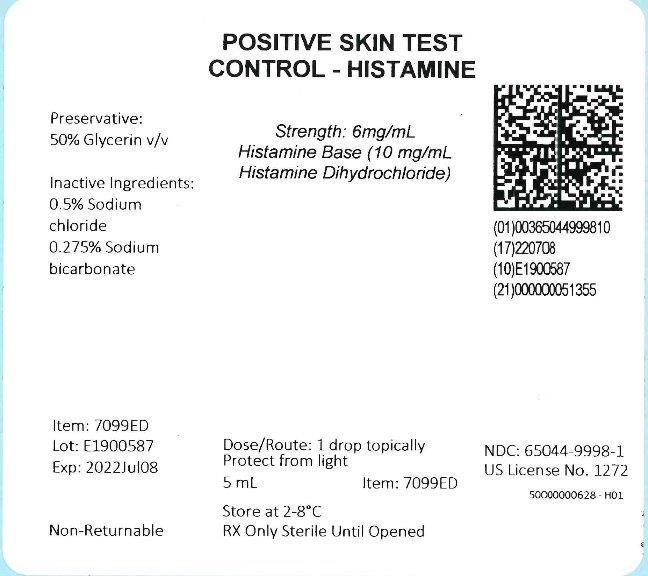
Positive Skin Test Control - Histamine 6 mg/mL Injection, 5 mL — NDC 65044-9998-1 (Billing 65044-9998-01)
This is a package of 5 mL of Positive Skin Test Control - Histamine 6 mg/mL Injection from Jubilant HollisterStier LLC, marketed since Jun 1995 and currently FDA-listed. It is this product's only package size.
NDC database record
One package, one record: these facts belong to NDC 65044-9998-1 alone.
- Record
- FDA NDC Directory package listing · Human prescription drug
- Code segments
- 65044 labeler · 9998 product · 1 package
- Package marketed since
- Jun 15, 1995
- Sample package
- No — commercial package
- Listing certified through
- Dec 31, 2027
- Billing quantity
- 5 mL per package
- Barcode (UPC-A, from the NDC)
- 3 6504499981 0
- FDA record last changed
- Jul 24, 2026
Identity & classification
Regulatory identifiers FDA, NLM and CMS codes for this package
Drug-database identifiers Medi-Span GPI and First Databank GCN / HICL / AHFS classification
- GSN (GCN sequence number): 071751
- GCN: 35714
- GPI-14 (Medi-Span): 94200050052030
- HICL (First Databank): 013420
- AHFS class code: 36:00.00.00
Where does this data come from?
- FDA openFDA NDC Directory · synced Oct 8, 2026
- FDA label on DailyMed · label index refreshed Oct 6, 2026
- RxNorm (NLM RxNav) · catalog refreshed Oct 1, 2026
- Medi-Span GPI (licensed)
- First Databank (licensed) · refreshed Oct 8, 2026
Clinical
Patient education
Supplement & herbal interactions
Where does this data come from?
- MedlinePlus (NLM) · refreshed Oct 1, 2026
- FDA label on DailyMed · label index refreshed Oct 6, 2026
Ask a licensed pharmacist directly — free, answered by our team.
Pricing
A drug doesn't have one price. Each row is a different public payment system, and none is what you'd pay at the counter — that depends on your insurance. The ⓘ on each row explains what it measures.
| Price system | Per each | Per package |
|---|---|---|
| Retail pharmacies payNADAC · weekly | Not in the retail survey — common for institutional, discontinued, or low-volume packs. | |
| Medicaid paysCMS SDUD · 12 mo | No recent Medicaid claims on file for this NDC — rare and low-volume NDCs are suppressed in the public data. | |
| Medicare drug plans payPart D · quarterly | No Part D plan price is available for this NDC in our data. | |
Where does this data come from?
- CMS NADAC weekly file
- CMS ASP pricing files · refreshed Sep 20, 2026
- CMS Medicaid State Drug Utilization Data · refreshed Oct 8, 2026
- CMS Part D plan pricing files · refreshed Sep 24, 2026
- VA National Acquisition Center price file
Packaging — all sizes for this product
| Package NDC | Description | Marketing start | Marketing end | Status |
|---|---|---|---|---|
| 65044-9998-01 You're viewing this Main listing | 5 mL in 1 VIAL | 1995-06-15 | — | Active |
Therapeutic equivalents
| Product | Labeler | Pack | NADAC/unit | TE | Status | Price vs. this |
|---|---|---|---|---|---|---|
| Positive Skin Test Control - Histamine 6 mg/mLthis 65044-9998-01 | Jubilant | 5 ml | — | — | FDA listed | — |
Where does this data come from?
- FDA openFDA NDC Directory · synced Oct 8, 2026
- FDA Purple Book · refreshed Oct 5, 2026
- CMS NADAC weekly file
Availability & biosimilar status
Biologics have no small-molecule generics; biosimilar competition is tracked in the FDA Purple Book.
Why the date isn’t exact: Biosimilar timing can change because patents may be challenged, settled, licensed, added or removed, and litigation can move the real date earlier or later.
🛈 What do these terms mean?
- Biologic patent
- A patent the reference product’s maker has publicly listed. A biosimilar generally can’t launch until these expire — unless they’re invalidated or resolved in a settlement.
- Reference-product exclusivity
- A flat 12 years of FDA market protection from the biologic’s first licensure (the BPCIA). No biosimilar can be licensed before it ends, regardless of patents.
- Interchangeable exclusivity
- The first interchangeable biosimilar can earn a period as the only interchangeable version (pharmacists can substitute it without the prescriber).
- Earliest biosimilar (LOE)
- The latest of all the dates above — the soonest a biosimilar can realistically reach the market. Litigation and settlements can move it earlier.
Biologics have no small-molecule “generics” — competition comes from FDA-licensed biosimilars, tracked in the FDA Purple Book.
| Code | What it grants | Expires |
|---|---|---|
| RefProduct | Reference-product exclusivity (12-year, BPCIA) — no biosimilar can be licensed before this date | Mar 13, 2036 |
Is there a biosimilar for POSITIVE SKIN TEST CTRL-HISTMN?
Why do different websites show different biosimilar dates?
Can a biosimilar launch before the last patent expires?
What does “current Purple Book estimate” mean?
What does “FDA listed” mean?
What does a patent or protection date mean here?
Where does this data come from?
- FDA Purple Book · refreshed Oct 5, 2026
Inactive Ingredients / Excipients
Inactive ingredients, also called excipients, are components of the drug product other than the active ingredient. They may include fillers, dyes, coatings, preservatives, flavors, or other formulation ingredients.
💡 Tap an ingredient (hover on desktop) to see what it is and why it’s used.
-
UNII PDC6A3C0OX
Glycerin is a clear, thick liquid derived from plant oils or fats. It acts as a humectant to retain moisture, a sweetener, and a solvent in medications.
-
UNII 8MDF5V39QO
A white powder form of baking soda that acts as a buffer and pH regulator in medicines. It helps maintain the right acid-base balance and may aid tablet disintegration.
-
UNII 451W47IQ8X
Sodium chloride is common table salt. It's used in medicines as a buffer to maintain proper pH, as a filler to add bulk, or to adjust the osmotic balance in liquid formulations.
3 inactive ingredients listed in the exact product block matched to this NDC.
Where does this data come from?
ingredient classCode="IACT" elements from the exact product block matched by this NDC. Label-section narrative from DailyMed / the openFDA label index is shown separately when available.- FDA label on DailyMed · label index refreshed Oct 6, 2026
- FDA openFDA NDC Directory · synced Oct 8, 2026
Inactive ingredient FAQ
Are inactive ingredients the same for every manufacturer?
Why might an inactive ingredient be missing?
Can inactive ingredients matter?
Manufacturer & labeler
More NDCs from Jubilant HollisterStier LLC labeler code 65044
- Mixed Vespid Hymenoptera Venom Venomil Maintenance Kit NDC 65044-9975-1
- Honey Bee Hymenoptera Venom Venomil Diagnostic Kit NDC 65044-9986-1
- White Faced Hornet Hymenoptera Venom Venomil Diagnostic Kit NDC 65044-9987-1
- Yellow Hornet Hymenoptera Venom Venomil Diagnostic Kit NDC 65044-9988-1
- Wasp Hymenoptera Venom Venomil Diagnostic Kit NDC 65044-9989-1
- Yellow Jacket Hymenoptera Venom Venomil Diagnostic Kit NDC 65044-9994-1
Where does this data come from?
- FDA openFDA NDC Directory · synced Oct 8, 2026
- Drugs@FDA
Full prescribing information FDA SPL
🚨 Boxed Warning ▾
POSITIVE SKIN TEST CONTROL - HISTAMINE For Percutaneous (Scratch, Prick or Puncture) Administration Histamine Base: 6mg/mL (Histamine Dihydrochloride: 10mg/mL) This product is to be used by a physician or under the supervision of a physician.
🎯 Indications and Usage ▾
INDICATIONS AND USAGE Positive Skin Test Control - Histamine is indicated as an adjunct in allergy skin test for diagnosis, as a positive control to test wheal-flare response of skin for evaluation of skin test response to allergenic extracts.
⏱️ Dosage and Administration ▾
DOSAGE AND ADMINISTRATION (1) General Parenteral drug products should be inspected visually for particulate matter and discoloration prior to administration, whenever solution and container permit. Prior to testing, clean the skin area with ether or alcohol and allow to dry. The back or the volar surface of the arms are the most satisfactory sites for testing.
Skin of the posterior thighs or abdomen may be used if necessary. Avoid very hairy areas where possible, since the reactions will be smaller and more difficult to interpret there. The most satisfactory areas of the back are from the posterior axillary fold to 2.5 cm from the spinal column, and from the top of the scapula to the lower rib margins.
The best areas of the arms are the volar surfaces from the axilla to 2.5 or 5 cm above the wrist, skipping the anti-cubital space. The histamine test should be applied in the same test area as other allergenic extracts tests, but spaced no closer than 4 to 5 cm from adjacent test sites. Use the same technique or procedure that you use for allergen testing.
The negative control is the diluent used in the extract to be tested (e.g. 50% glycerin, Sterile Albumin Saline with Phenol, Sterile Buffered Saline with Phenol). With each skin testing method, in order for the reaction to Positive Skin Test Control-Histamine (6 mg/mL Histamine Base) to be considered valid, erythema must be present which exceeds the respective negative control by 4 mm (∑E).
A wheal reaction does not have to be elicited unless there is a wheal reaction to the respective negative control. In this case, the wheal of the positive control must exceed the negative control by 4 mm (∑W) in order to be considered appropriate. Record measurement of erythema and wheal diameters.
Tables 1 and 2 summarize skin testing results with histamine base and controls in atopic and non-atopic subjects using four different devices and methods. (2) Scratch, Prick or Puncture Test: Positive Skin Test Control-Histamine, 6.0 mg/mL Histamine Base. The Scratch, Prick or Puncture test should be read in 15 minutes.
If a large wheal reaction occurs before that time, wipe excess histamine solution from test site. a) Use a sterile scarifier for each patient. Hold the scarifier between the thumb and index finger, press the sharp edge of the instrument against the skin and twirl instrument rapidly. The scratch should disrupt the outer layers of epidermis down to the germinal layer, but should not produce immediate oozing of blood.
The amount of pressure needed to produce a satisfactory scratch will vary between patients according to the thickness or fragility of their skin. Apply one drop of Positive Skin Test Control-Histamine to the scratch test site. b) Prick or Puncture Test: Prick tests are performed by placing a drop of extract on the skin and piercing through the drop into the skin with a slight lifting motion. Puncture tests are performed by placing a drop of extract on the skin and piercing through the drop perpendicular to the skin with a device such as a Prick Lancetter.
After about 1 minute the extract may be wiped away with a dry sponge.
⛔ Contraindications ▾
CONTRAINDICATIONS Positive Skin Test Control - Histamine is contraindicated in patients with a history of hypersensitivity to histamine products, and in patients with hypotension, severe hypertension, vasomotor instability, severe cardiac, pulmonary or renal disease.
⚠️ Warnings ▾
WARNINGS Attacks of severe asthma or other serious allergic conditions may be precipitated by the administration of Histamine Dihydrochloride in patients with bronchial disease. Caution is advised in using histamine in such patients and in those with a history of bronchial asthma. Histamine Dihydrochloride has not been approved for unlabeled use as gastric acid stimulus or for detecting bronchial hyperactivity.
🤒 Adverse Reactions ▾
ADVERSE REACTIONS Large doses of histamine may precipitate systemic reactions. These reactions may include flushing, dizziness, headache, bronchial constriction, urticaria, asthma, marked hypotension or hypertension, abdominal cramps, vomiting, metallic taste, local or generalized allergic manifestations. An antihistamine preparation may be given orally, I.M. or I.V. to prevent or ameliorate systemic reactions to the drug.
If a systemic or anaphylactic reaction does occur, apply a tourniquet above the site of injection and inject 1:1000 epinephrine-hydrochloride intramuscularly or subcutaneously into the opposite arm. Loosen the tourniquet at least every 10 minutes. Do not obstruct arterial blood flow with the tourniquet.
Epinephrine Dosage: ADULT: 0.3 to 0.5 mL should be injected. Repeat in 5 to 10 minutes if necessary. PEDIATRIC: The usual initial dose is 0.01 mg (mL) per kg body weight or 0.3 mg(mL) per square meter of body surface area.
Suggested dosage for infants to 2 years of age is 0.05 mL to 0.1 mL; for children 2 to 6 years, 0.15 mL; and children 6 to 12 years, 0.2 mL. Single pediatric doses should not exceed 0.3 mg (mL). Doses may be repeated as frequently as every 20 minutes, depending on the severity of the condition and the response of the patient.
After administration of epinephrine, profound shock or vasomotor collapse should be treated with intravenous fluids, and possibly vasoactive drugs. Oxygen should be given by mask. Aminophylline or adrenal corticosteroids may be used if necessary after adequate epinephrine and circulatory support has been given.
Emergency resuscitation measures and personnel trained in their use should be available immediately in the event of a serious systemic or anaphylactic reaction not responsive to the above measures (Ref. J. ALLERGY AND CLINICAL IMMUNOLOGY 77s (2): p.
271-273, 1986). 16 Rarely are all of the above measures necessary, the tourniquet and epinephrine usually producing prompt responses. However, the physician should be prepared in advance for all contingencies.
Promptness in beginning emergency treatment measures is of utmost importance. Adverse Event Reporting Report all adverse events to Jubilant HollisterStier LLC Customer Technical Services Department at 1 (800) 992-1120. A voluntary adverse event reporting system for health professionals is available through the FDA MEDWATCH program.
Preprinted forms (FDA Form 3500) are available from the FDA by calling 1 (800) FDA-1088. Completed forms should be mailed to MEDWATCH, 5600 Fisher Lane, Rockville, MD 20852-9787 or Fax to: 1 (800) FDA-0178.
🔄 Drug Interactions ▾
(2) Drug Interactions: Certain medications may lessen the skin test wheal and erythema responses elicited by histamine for varying time periods. Conventional antihistamines should be discontinued at least 5 days before skin testing. Long acting antihistamines should be discontinued for at least 3 weeks prior to skin testing.
7 Topical steroids should be discontinued at the skin test site for at least 2-3 weeks before skin testing. 7,8 Tricyclic antidepressants such as Doxepin should be withheld for at least 7 days before skin testing. 9 The physician must determine whether the risk of severe depression occurring in patients who discontinue their medication outweighs the benefits that could be obtained from skin testing.
Topical local anesthetics may suppress the flare responses and should be avoided in skin test sites. 10
🤰 Pregnancy ▾
(4) Pregnancy: Positive Skin Test Control-Histamine. Animal reproduction studies have not been conducted on Histamine Dihydrochloride. It is also not known whether Histamine Dihydrochloride can cause fetal harm when administered to a pregnant woman or can affect reproduction capacity. Histamine Dihydrochloride should be given to a pregnant woman only if clearly needed.
🧒 Pediatric Use ▾
(6) Pediatric Use: Indications and dosage for the pediatric population are the same as for adults; however, the reactions to histamine are smaller. Studies have shown that the use of histamine solutions for skin test is safe in infants and young children. 4,5,6
🆘 Overdosage ▾
OVERDOSAGE Overdosage may cause severe symptoms, including circulatory collapse, shock, and even death. Intravenous administration of histamine in normal volunteers at doses of up to 1.0 µg/kg/min produced flushing, headaches, tachycardia and decreased diastolic blood pressure. 1,2,3 See ADVERSE REACTIONS Section for emergency treatment steps.
🧬 Clinical Pharmacology ▾
CLINICAL PHARMACOLOGY Pharmacological actions of histamine include the increase of capillary and post capillary venular permeability. This vascular change leads to the wheal-flare response. Large reactions can cause an amplification of a reaction to a nearby skin test.
Histamine is degraded either by oxidative deamination or by methylation and oxidative deamination so that the principal excretion products are imidazoleacetic acid-riboside and 1-methyl imidazoleacetic acid respectively. 2 10 atopic subjects and 10 non-atopics were tested with Positive Skin Test Control - Histamine Solutions, and two negative control solutions. Thirteen females (35-49 years old; mean age 36.5) and 7 males (23-45 years old; mean age 36.4) were tested.
This study included 19 Caucasian subjects and 1 African American subject. Different skin test devices produce different skin test responses. (14,15) Study results are summarized in Table 1 and Table 2.
Atopic and non-atopic subject information was combined, as there were no significant differences in their skin responses. Summation of wheal (∑W) or summation of erythema (∑E) was determined by measuring the longest diameter and the mid-point orthoganol diameter of the wheal or erythema response and summing the two measurements. Malling tested 25 subjects using a straight needle prick technique with Histamine Dihydrochloride 10mg/mL and found wheal single diameters of 5.4-8.5mm (mean 7 mm).
13 Histamine Dihydrochloride at 10mg/mL has been shown to elicit fewer false negative and false positive reactions than Histamine Dihydrochloride at 1mg/mL. 12 10mg/mL Histamine Dihydrochloride has been shown to be the appropriate strength to perform biological standardization using skin reactivity to histamine as a standard of comparison. 11,13 Histamine Table1 Histamine Table2
📦 How Supplied / Storage and Handling ▾
HOW SUPPLIED SCRATCH, PRICK or PUNCTURE TEST: Positive Skin Test Control-Histamine (6.0 mg/mL Histamine Base), 5 mL sterile amber vial with dropper assembly.
📦 Storage and Handling ▾
STORAGE Store at 2°- 8°C. Protect from light when not in use.
📋 Description ▾
DESCRIPTION Histamine Dihydrochloride contains histamine, a potent vasodilator having the chemical name 2-(4-Imidazolyl) ethylamine. Histamine has an empirical formula of C 5 H 9 N 3 , a molecular weight of 111.15, and the following chemical structure: Histamine Dihydrochloride is available in the following strengths: 1. SCRATCH, PRICK or PUNCTURE TEST CONTROL: Positive Skin Test Control - Histamine contains 6.0 mg/mL Histamine Base and is a clear, colorless, sterile solution.
It consists of Histamine Dihydrochloride 10mg/mL, Sodium Chloride 0.5%, Sodium Bicarbonate 0.275%, and Glycerin 50.0% (v/v) as a preservative. Histamine Chemical
⚠️ Precautions ▾
PRECAUTIONS (1) General: It is necessary that scarifiers, syringes, and needles be properly sterilized before use on each patient to prevent the possibility of accidental transfer of serum hepatitis and other infectious agents from one person to another. Disposable products may also be used. Always have injectable epinephrine and a tourniquet available when any skin tests are being made.
(See ADVERSE REACTIONS Section) Patients should be observed in the office for 30 minutes after administration of the test and instructed to return to the office promptly if symptoms of an allergic reaction or shock occur. (2) Drug Interactions: Certain medications may lessen the skin test wheal and erythema responses elicited by histamine for varying time periods. Conventional antihistamines should be discontinued at least 5 days before skin testing.
Long acting antihistamines should be discontinued for at least 3 weeks prior to skin testing. 7 Topical steroids should be discontinued at the skin test site for at least 2-3 weeks before skin testing. 7,8 Tricyclic antidepressants such as Doxepin should be withheld for at least 7 days before skin testing.
9 The physician must determine whether the risk of severe depression occurring in patients who discontinue their medication outweighs the benefits that could be obtained from skin testing. Topical local anesthetics may suppress the flare responses and should be avoided in skin test sites. 10 (3) Carcinogenesis, Mutagenesis, Impairment of Fertility: Studies have not been performed on Positive Skin Test Control-Histamine.
(4) Pregnancy: Positive Skin Test Control-Histamine. Animal reproduction studies have not been conducted on Histamine Dihydrochloride. It is also not known whether Histamine Dihydrochloride can cause fetal harm when administered to a pregnant woman or can affect reproduction capacity.
Histamine Dihydrochloride should be given to a pregnant woman only if clearly needed. (5) Nursing Mothers: It is unknown whether Histamine Dihydrochloride affects lactation or is excreted in human milk. Because many drugs are excreted in human milk, caution should be exercised when Positive Skin Test Control-Histamine is administered to a nursing woman.
(6) Pediatric Use: Indications and dosage for the pediatric population are the same as for adults; however, the reactions to histamine are smaller. Studies have shown that the use of histamine solutions for skin test is safe in infants and young children. 4,5,6
🍼 Nursing Mothers ▾
(5) Nursing Mothers: It is unknown whether Histamine Dihydrochloride affects lactation or is excreted in human milk. Because many drugs are excreted in human milk, caution should be exercised when Positive Skin Test Control-Histamine is administered to a nursing woman.
📄 Carcinogenesis, Mutagenesis, Impairment of Fertility ▾
(3) Carcinogenesis, Mutagenesis, Impairment of Fertility: Studies have not been performed on Positive Skin Test Control-Histamine.
📚 References ▾
REFERENCES 1. Lawlor, Glenn Jr., Thomas J. Fischer, ed., Immediate hypersensitivity: approach to diagnosis.
Manual of Allergy and Immunology Diagnosis and Therapy. Little Brown and Company, Boston, 19, 95, 1981. 2.
Samter, Max, K. Frank Austin, ed.. Histamine and other mediators of allergic reactions.
Immunological Diseases. Little, Brown and Company, Boston, pp. 332-335, 1971.
3. Summers, Richard, Robert Sigler, James H. Schelhamer, and Michael Kaliner.
Effects of infused histamine on asthmatic and normal subjects: comparison of skin test responses. J. Allergy Clin.
Immunol. 67 (6): 456-464, June 1981. 4.
Gary, T.N., L.N. Gay. Skin reactions in infants: Susceptibility of the skin of the newborn to positive atopic sensitization, comparison with reaction to histamine.
J. Allergy. 5:488, 1934.
5. Kaliner, M., J. H.
Shelhamer, and E.A. Ottesen. Effects of infused histamine: Correlation of plasma histamine levels and symptoms.
J. Allergy Clin. Immunol.
69 (3): 283-289. 6. Smith, M.A., L.E.
Mansfeld, R. deShazo and H.S. Nelson. An evaluation of the pharmacologic inhibition of the immediate and late cutaneous effect to allergen.
J. Allergy Clin. Immunol.
65: 188, 1980. 7. Pipkorn, Ulf.
Pharmacological influence of anti-allergic medication on In Vivo allergen testing. Allergy. 43: 81-86, 1988.
8. Andersson, M. and U. Pipkorn.
Inhibition of the dermal immediate allergic reaction through prolonged treatment with topical glucocorticosteroids. J. Allergy Clinical Immunology.
79(2): 345-349, February 1987. 9. Rao, Kamineni S., et al.
Duration of suppressive effect of tricyclic anti-depressants on histamine induced wheal and flare reactions on human skin. J. Allergy Clinical Immunology.
82: 752-757, November 1988. 10. Pipkorn, Ulf, and M.
Andersson. Topical dermal anesthesia inhibits the flare but not the wheal response to allergen and histamine in the skin prick test. Clinical Allergy.
17: 307-311, 1987. 11. Harris, R.I., M.A.
Stern, H.K. Watson. Dose response curve of allergen and histamine in skin prick tests.
Allergy. 43(8): 565-572, 1988. 12.
Berkowitz, R.B., D.G. Tinkleman, C. Lutz, et al.
Evaluation of the multi test device for immediate hypersensitivity skin testing. J. Allergy Clin.
Immunol. 90:979-985, 1992. 13.
Malling, H. J. Skin prick testing and the use of histamine references.
Allergy. 39:596-601, 1984. 14.
Demoly, P., J. Bousquet, J.C. Manderscheid, et al.
Precision of skin prick and puncture tests with nine methods. J. Allergy Clin.
Immunol. 88(5):758-762, Nov. 1991.
15. Nelson, H.S., D.M. Rosloniec, L.L.
McCall, D. Ikle. Comparative performance of five commercial prick skin test devices.
J. Allergy Clin. Immunol.
92:750-756, 1993. 16. Personnel and equipment to treat systemic reactions caused by immunotherapy with allergenic extracts.
J. Allergy Clin. Immunol.
77(2):271-273, February 1986.
📄 Package Label / Principal Display Panel ▾
PRINCIPAL DISPLAY PANEL 5mL Positive Skin Test Control-Histamine, Carton 7099ED – 5mL 10 mg/mL Positive Skin Test Control-Histamine, Carton Label 7099ED – 5mL 10 mg/mL Positive Skin Test Control-Histamine, Container Label 5mL Positive Skin Test Control-Histamine, Carton 7099ED – 5mL 10 mg/mL Positive Skin Test Control-Histamine, Carton Label 7099ED – 5mL 10 mg/mL Positive Skin Test Control-Histamine, Container Label
Reported adverse events (FAERS)
Top reported reactions
Age at onset
Reporter sex
Serious outcomes
Where does this data come from?
About this NDC listing & data coverage
What data is (and isn’t) available for this NDC — tap to expand
| NDC identity (package / product / labeler codes) | ✓ Available |
| Labeler | ✓ Available |
| Product & package description | ✓ Available |
| Marketing category & status | ✓ Available |
| Active ingredient / dosage form / route | ✓ Available |
| FDA label (SPL via DailyMed) | ✓ Available |
| Package photos | ✓ Available |
| Inactive ingredients (structured) | ✓ Available |
| NADAC pharmacy acquisition price (CMS) | — Not published for this NDC CMS publishes NADAC only for NDCs reported in its retail-pharmacy survey. |
| Orange Book / therapeutic-equivalence data | ✓ Available |
| HCPCS J-code billing crosswalk | — Not published for this NDC Most self-administered / retail products have no J-code — that is normal. |
| Medicaid utilization (CMS SDUD) | — Not published for this NDC CMS reports utilization only for NDCs with Medicaid claims above its privacy threshold. |