
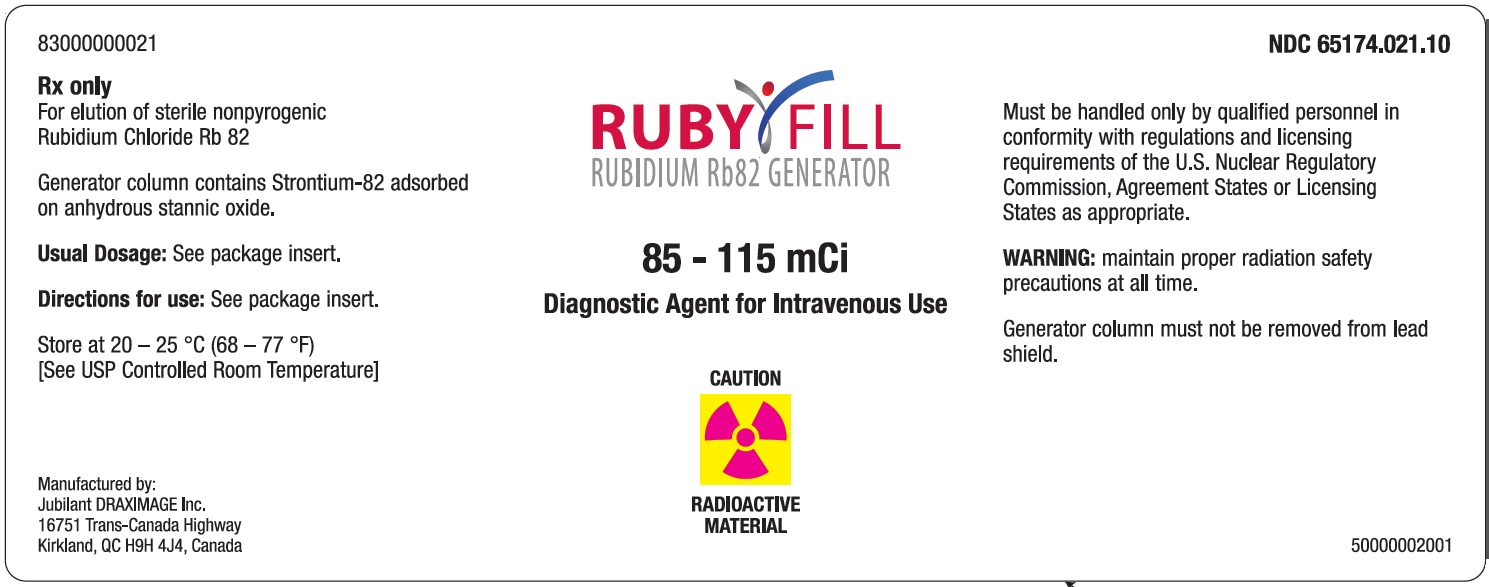
RUBY-FILL Rubidium Rb 82 100 mCi Injection, Solution, 1 injection
🆔 Identity & classification
Where does this data come from?
🏭 Manufacturer & labeler
Where does this data come from?
🩺 Clinical
Patient education
Supplement & herbal interactions
Where does this data come from?
Ask a licensed pharmacist directly — free, answered by our team.
🧪 Inactive Ingredients / Excipients
Inactive ingredients, also called excipients, are components of the drug product other than the active ingredient. They may include fillers, dyes, coatings, preservatives, flavors, or other formulation ingredients.
Where does this data come from?
IACT rows and label-wide narrative are kept separate; availability and product-level specificity depend on the submitted label.Inactive ingredient FAQ
Are inactive ingredients the same for every manufacturer?
Why might an inactive ingredient be missing?
Can inactive ingredients matter?
💲 Pricing
A drug doesn't have one price. Each row is a different public payment system, and none is what you'd pay at the counter — that depends on your insurance. The ⓘ on each row explains what it measures.
| Price system | Per mL | Per package |
|---|---|---|
| Retail pharmacies payNADAC · weekly | Not in the retail survey — common for institutional, discontinued, or low-volume packs. | |
| Medicaid paysCMS SDUD · 12 mo | No recent Medicaid claims on file for this NDC — rare and low-volume NDCs are suppressed in the public data. | |
| Medicare drug plans payPart D · quarterly | No Part D plan price is available for this NDC in our data. | |
Where does this data come from?
🔁 Therapeutic equivalents
| Product | Labeler | Pack | NADAC/unit | TE | Status | Price vs. this |
|---|---|---|---|---|---|---|
| Ruby-Fill 100 mCithis 65174-0021-10 | Jubilant | 1 injection | — | — | FDA listed | — |
Where does this data come from?
⏳ Availability & generic status
We did not find an FDA-approved generic match for this exact strength, form and route.
Where does this data come from?
🔬 Reported adverse events (FAERS)
Top reported reactions
Age at onset
Reporter sex
Where does this data come from?
📦 Packaging — all sizes for this product
| Package NDC | Description | Marketing start | Status |
|---|---|---|---|
| 65174-0021-10 You're viewing this | 1 INJECTION, SOLUTION in 1 CONTAINER (65174-021-10) | 2016-09-30 | Active |
🧭 About this NDC listing & data coverage
What data is (and isn’t) available for this NDC — tap to expand
| NDC identity (package / product / labeler codes) | ✓ Available |
| Labeler | ✓ Available |
| Product & package description | ✓ Available |
| Marketing category & status | ✓ Available |
| Active ingredient / dosage form / route | ✓ Available |
| FDA label (SPL via DailyMed) | ✓ Available |
| Package photos | ✓ Available |
| Inactive ingredients (structured) | — Not published for this NDC The labeler did not submit a structured excipient list, or no SPL is available. |
| NADAC pharmacy acquisition price (CMS) | — Not published for this NDC CMS publishes NADAC only for NDCs reported in its retail-pharmacy survey. |
| Orange Book / therapeutic-equivalence data | — Not published for this NDC Applies only to products approved under an NDA/ANDA; many listings are out of scope. |
| HCPCS J-code billing crosswalk | — Not published for this NDC Most self-administered / retail products have no J-code — that is normal. |
| Medicaid utilization (CMS SDUD) | — Not published for this NDC CMS reports utilization only for NDCs with Medicaid claims above its privacy threshold. |
Questions about this listing
Why is there no price listed?
Is the NDC printed on the package the same as the 11-digit billing NDC?
What do the three segments of this NDC mean?
Is this package still being marketed?
Who lists this product with the FDA?
Do I need a prescription for this product?
Where does this data come from?
📄 Full prescribing information FDA SPL
🚨 Boxed Warning ▾
WARNING: HIGH LEVEL RADIATION EXPOSURE WITH USE OF INCORRECT ELUENT AND FAILURE TO FOLLOW QUALITY CONTROL TESTING PROCEDURE High Level Radiation Exposure with Use of Incorrect Eluent Patients are exposed to high radiation levels when the generator is eluted with the incorrect eluent due to high Sr 82 and Sr 85 breakthrough levels [see Warnings and Precautions ( 5.1 )] Use only additive-free 0.9% Sodium Chloride Injection USP to elute the generator [see Dosage and Administration ( 2.5 )] Immediately stop the patient infusion and discontinue the use of the affected RUBY-FILL (Rb 82) generator, if the incorrect solution is used to elute the generator [see Contraindications ( 4 )].
Evaluate the patient’s radiation absorbed dose and monitor for the effects of radiation to critical organs such as bone marrow [(see Dosage and Administration ( 2.9 )] . Excess Radiation Exposure with Failure to Follow Quality Control Testing Procedure Excess radiation exposure occurs when the levels of Sr 82 or Sr 85 in the rubidium Rb 82 chloride injection exceed specified limits [see Warnings and Precautions ( 5.2 )]. The system automatically generates a record and saves the data for each generator eluate volume, including flushing and test volumes.
Total cumulative eluate volumes are also recorded and saved for the life of the generator [see Dosage and Administration ( 2.5 )] . Strictly adhere to the generator quality control testing procedure, to minimize the risk of excess radiation exposure, including daily testing and additional testing at Alert Limits [see Dosage and Administration ( 2.6 )] Stop use of a generator at any of the following Expiration Limits. Expiry Limits are: o 30 L for the generator's cumulative eluate volume, or o Expiration date of the generator (60 days post-calibration) o An eluate Sr 82 level of 0.01 mcCi /mCi (kBq/MBq) Rb 82, or o An eluate Sr 85 level of 0.1 mcCi /mCi (kBq/MBq) Rb 82 [see Dosage and Administration ( 2.7 )].
WARNING: HIGH LEVEL RADIATION EXPOSURE WITH USE OF INCORRECT ELUENT AND FAILURE TO FOLLOW QUALITY CONTROL TESTING PROCEDURE Please see full prescribing information for complete boxed warning High Level Radiation Exposure with Use of Incorrect Eluent Using the incorrect eluent can cause high Strontium (Sr 82) and (Sr 85) breakthrough levels ( 5.1 ) Use only additive-free 0.9% Sodium Chloride Injection USP to elute the generator ( 2.5 ) Immediately stop the patient infusion and discontinue the use of the affected RUBY-FILL generator if the incorrect solution is used to elute the generator ( 4 ) Evaluate the patient’s radiation absorbed dose and monitor for the effects of radiation to critical organs such as bone marrow ( 2.9 ) Excess Radiation Exposure with Failure to Follow the Quality Control Testing Procedure Excess-radiation exposure occurs when the levels of Sr 82 or Sr 85 in the Rubidium Rb 82 Chloride injection exceed specific limits.
( 5.2 ) Strictly adhere to the generator quality control testing procedure ( 2.6 ) Stop using the generator if it reaches any of its Expiration Limit ( 2.7 )
🎯 Indications and Usage ▾
1 INDICATIONS AND USAGE RUBY-FILL is a closed system used to produce rubidium Rb 82 chloride injection for intravenous administration. Rubidium Rb 82 chloride injection is indicated for Positron Emission Tomography (PET) imaging of the myocardium under rest or pharmacologic stress conditions to evaluate regional myocardial perfusion in adult patients with suspected or existing coronary artery disease. RUBY-FILL is a closed system used to produce rubidium Rb 82 chloride injection for intravenous use.
Rubidium Rb 82 chloride injection is a radioactive diagnostic agent indicated for Positron Emission Tomography (PET) imaging of the myocardium under rest or pharmacologic stress conditions to evaluate regional myocardial perfusion in adult patients with suspected or existing coronary artery disease. (1)
⏱️ Dosage and Administration ▾
2 DOSAGE AND ADMINISTRATION Use RUBY-FILL with a specific Elution System. ( 2.4) • Use only additive-free 0.9% Sodium Chloride Injection USP to elute the generator. ( 2.5 ) • The recommended weight-based dose of rubidium Rb 82 is between 10 to 30 Megabecquerels (MBq)/kg [0.27 to 0.81 millicuries (mCi)/kg].
( 2.2 ) • Do not exceed a single dose of 2220 MBq (60 mCi) per rest or stress component of a procedure. (2.2) • Administer the single dose at a rate of 15 to 30 mL/minute through a catheter inserted into a large peripheral vein; do not exceed an infusion volume of 60 mL. ( 2.2 ) • Use the lowest dose necessary to obtain adequate cardiac visualization and individualize the dose depending on multiple factors, including, patient weight, imaging equipment and acquisition type used to perform the procedure.
( 2.2 ) • Start imaging acquisition 60 to 90 seconds after completion of the infusion; if a longer circulation time is anticipated, wait for 120 seconds. Acquisition may be started immediately post-injection if dynamic imaging is needed. Image acquisition is typically 3 to 7 minutes long.
( 2.3 ) • To obtain rest and stress images, wait 10 minutes after completion of the rest image acquisition then administer the pharmacologic stress agent in accordance with its prescribing information. After administration of the pharmacologic stress agent, infuse the second dose of Rb 82, at the time interval according to the prescribing information of the pharmacological stress agent and complete the stress image acquisition. ( 2.3 )
2.1Radiation Safety - Drug Handling Rubidium Rb 82 is a radioactive drug and should be handled with appropriate safety measures to minimize radiation exposure during administration [see Warnings and Precautions ( 5.3 ] ). Use only additive-free 0.9% Sodium Chloride Injection USP to elute the generator [ see Boxed Warning, Contraindications (4) , Warnings and Precautions ( 5.1 ) ]. Use waterproof gloves and effective shielding when handling rubidium Rb 82 chloride injection and the RUBY Rubidium Elution System.
Use aseptic techniques in all drug handling. Visually inspect the drug for particulate matter and discoloration prior to administration whenever solution and container permit. Do not administer eluate from the generator if there is any evidence of foreign matter.
2.2Recommended Dose and Administration Instructions The recommended weight-based dose of rubidium Rb 82 chloride to be administered per rest or stress component of a PET myocardial perfusion imaging (MPI) procedure is between 10 to 30 Megabecquerels (MBq)/kg [0.27 to 0.81 millicuries (mCi)/kg]. Do not exceed a single dose of 2220 MBq (60 mCi). Use the lowest dose necessary to obtain adequate cardiac visualization and individualize the weight-based dose depending on multiple factors, including, patient weight, imaging equipment and acquisition type used to perform the procedure.
For example, 3D imaging acquisition may require doses at the lower end of the recommended range compared to 2D imaging. Administer the single dose at a rate of 15 to 30 mL/minute through a catheter inserted into a large peripheral vein; do not exceed an infusion volume of 60 mL. Instruct patients to void as soon as a study is completed and as often as possible thereafter for at least one hour.
The maximum available activity (delivery limit) will decrease as the generator ages [see Dosage and Administration ( 2.8 )] .
2.3Image Acquisition Guidelines For Rest Imaging: Administer a single (“rest”) rubidium Rb 82 chloride dose; Start imaging 60 to 90 seconds after completion of the infusion of the rest dose and acquire images for 3 to 7 minutes. For Stress Imaging: Begin the study 10 minutes after completion of the resting dose infusion, to allow for sufficient Rb 82 decay; Administer a pharmacologic stress agent in accordance with its prescribing information; After administration of the pharmacologic stress agent, administer the second dose of Rb 82 at the time interval ac…
💊 Dosage Forms and Strengths ▾
3 DOSAGE FORMS AND STRENGTHS RUBY-FILL is a closed system used to produce rubidium Rb 82 chloride injection for intravenous use. RUBY-FILL consists of Sr 82 adsorbed on a hydrous stannic oxide column with an activity of 3145 to 4255 MBq (85 to 115 mCi) Sr 82 at calibration time. RUBY-FILL consists of Sr 82 adsorbed on a hydrous stannic oxide column with an activity of 3145 to 4255 MBq (85 to 115 mCi) Sr 82 at calibration time. ( 3 )
⛔ Contraindications ▾
4 CONTRAINDICATIONS RUBY-FILL is contraindicated for use if a solution other than additive-free 0.9% Sodium Chloride Injection USP has been used to elute the generator at any time. Immediately stop the patient infusion and permanently discontinue the use of the affected RUBY-FILL generator whenever the incorrect eluent is used [ see Boxed Warning, Contraindications ( 4 ), Warnings and Precautions ( 5.1 ) ]. RUBY-FILL is contraindicated if a solution other than additive-free 0.9% Sodium Chloride Injection USP has been used to elute the generator at any time.
( 4 )
⚠️ Warnings and Cautions ▾
5 WARNINGS AND PRECAUTIONS •Pharmacologic induction of cardiovascular stress: May be associated with serious adverse reactions such as myocardial infarction, arrhythmia, hypotension, bronchoconstriction, and cerebrovascular events. Perform testing only in setting where cardiac resuscitation equipment and trained staff are readily available. ( 5.3 )
5.1High Level Radiation Exposure with Use of Incorrect Eluent Use only additive-free 0.9% Sodium Chloride Injection USP to elute the generator. Apply the provided saline confirmation label to the additive-free 0.9% Sodium Chloride Injection USP bag before use. Additives present in other solutions (particularly calcium ions) expose patients to high levels of radiation by causing the release of large amounts of Sr 82 and Sr 85 into the eluate regardless of the generator’s age or prior use [Dosage and Administration ( 2.1 , 2.5 , 2.6 )] .
Immediately stop the patient infusion and discontinue use of the affected RUBY-FILL generator if the incorrect eluent is used and evaluate the patient’s radiation absorbed dose and monitor for the effects of radiation to critical organs such as bone marrow. When solutions containing calcium ions are used to elute the generator, high levels of radioactivity are present in the eluate, even with the subsequent use of additive-free 0.9% Sodium Chloride Injection USP [see Boxed Warning, Dosage and Administration ( 2.9 ), and Contraindications ( 4 )].
5.2Excess Radiation Exposure with Failure to Follow the Quality Control Testing Procedure Excess radiation exposure occurs when the Sr 82 and Sr 85 levels in rubidium Rb 82 chloride injections exceed the specified generator eluate limits. Strictly adhere to the quality control testing procedure to minimize radiation exposure to the patient. Stop using the rubidium generator when the expiration limits are reached [see Dosage and Administration ( 2.6 ) and ( 2.7 )].
5.3Risks Associated with Pharmacologic Stress Pharmacologic induction of cardiovascular stress may be associated with serious adverse reactions such as myocardial infarction, arrhythmia, hypotension, bronchoconstriction, and cerebrovascular events. Perform pharmacologic stress testing in accordance with the pharmacologic stress agent’s prescribing information and only in the setting where cardiac resuscitation equipment and trained staff are readily available.
5.4Radiation Risks RUBY-FILL use contributes to a patient’s overall long-term cumulative radiation exposure. Long-term cumulative radiation exposure is associated with an increased risk for cancer. Ensure safe handling to minimize radiation exposure to the patient and health care providers.
Encourage patients to void as soon as a study is completed and as often as possible thereafter for at least one hour [see Dosage and Administration ( 2.1 ) and ( 2.2 )] .
🤒 Adverse Reactions ▾
6 ADVERSE REACTIONS To report SUSPECTED ADVERSE REACTIONS, contact Jubilant DraxImage Inc., dba Jubilant Radiopharma TM at 1-888-633-5343 or FDA at 1-800-FDA-1088 or www.fda.gov/medwatch. The following serious adverse reaction associated with the use of rubidium Rb 82 chloride was identified in clinical trials or post marketing reports. Because these reactions are reported voluntarily from a population of uncertain size, it is not always possible to reliably estimate their frequency or establish a causal relationship to drug exposure.
Radiation Exposure High level radiation exposure to the bone marrow has occurred in some patients due to Sr 82 and Sr 85 breakthrough in the eluate when an incorrect solution was used to elute the rubidium Rb 82 generator [see Boxed Warning, Warnings and Precautions ( 5.1 )] . Excess radiation exposure has occurred in some patients who received rubidium Rb 82 chloride injection at clinical sites where generator eluate testing appeared insufficient [see Boxed Warning, Warnings and Precautions ( 5.2 ), Dosage and Administration ( 2.6 )] .
👥 Use in Specific Populations ▾
8 USE IN SPECIFIC POPULATIONS • Lactation: Do not resume breastfeeding until at least one hour after completion of RUBY-FILL infusion. ( 8.2 )
8.1Pregnancy Risk Summary There are no data available on the use of rubidium Rb 82 in pregnant women. Animal reproduction studies with rubidium Rb 82 chloride have not been conducted. However, all radiopharmaceuticals have the potential to cause fetal harm depending on the fetal stage of development and the magnitude of the radiation dose.
If considering rubidium Rb 82 chloride injection administration to a pregnant woman, inform the patient about the potential for adverse pregnancy outcomes based on the radiation dose from Rb 82 and the gestational timing of exposure. The estimated background risk of major birth defects and miscarriage for the indicated population is unknown. In the U.S. general population, the estimated background risk of major birth defects and miscarriage in clinically recognized pregnancies is 2 to 4% and 15 to 20%, respectively.
8.2Lactation Risk Summary There is no information regarding the presence of Rb 82 chloride in human milk, the effects on the breastfed infant or the effects on milk production. Due to the short half-life of Rb 82 chloride (75 seconds), exposure of a breast fed infant through breast milk can be minimized by temporary discontinuation of breastfeeding [See Clinical Considerations] . The developmental and health benefits of breastfeeding should be considered along with the mother’s clinical need for Rb 82, any potential adverse effects on the breastfed child from Rb 82 or from the underlying maternal condition.
Clinical Considerations Minimizing Exposure Exposure to Rb 82 chloride through breast milk can be minimized if breastfeeding is discontinued when Rb 82 chloride injection is administered. Do not resume breastfeeding until at least one hour after completion of RUBY-FILL infusion.
8.4Pediatric Use The safety and effectiveness of rubidium Rb 82 chloride injection in pediatric patients have not been established.
8.5Geriatric Use In elderly patients with a clinically important decrease in cardiac function, lengthen the delay between infusion and image acquisition [see Dosage and Administration ( 2.3 )] . Observe for the possibility of fluid overload from the infusion.
🤰 Pregnancy ▾
8.1Pregnancy Risk Summary There are no data available on the use of rubidium Rb 82 in pregnant women. Animal reproduction studies with rubidium Rb 82 chloride have not been conducted. However, all radiopharmaceuticals have the potential to cause fetal harm depending on the fetal stage of development and the magnitude of the radiation dose.
If considering rubidium Rb 82 chloride injection administration to a pregnant woman, inform the patient about the potential for adverse pregnancy outcomes based on the radiation dose from Rb 82 and the gestational timing of exposure. The estimated background risk of major birth defects and miscarriage for the indicated population is unknown. In the U.S. general population, the estimated background risk of major birth defects and miscarriage in clinically recognized pregnancies is 2 to 4% and 15 to 20%, respectively.
🧒 Pediatric Use ▾
8.4Pediatric Use The safety and effectiveness of rubidium Rb 82 chloride injection in pediatric patients have not been established.
🧓 Geriatric Use ▾
8.5Geriatric Use In elderly patients with a clinically important decrease in cardiac function, lengthen the delay between infusion and image acquisition [see Dosage and Administration ( 2.3 )] . Observe for the possibility of fluid overload from the infusion.
🧬 Clinical Pharmacology ▾
12 CLINICAL PHARMACOLOGY
12.1Mechanism of Action Rb 82 is analogous to potassium ion (K + ) in its biochemical behavior and is rapidly extracted by the myocardium proportional to the blood flow. Rb + participates in the sodium-potassium (Na + /K + ) ion exchange pumps that are present in cell membranes. The intracellular uptake of Rb 82 requires maintenance of ionic gradient across cell membranes.
Rb 82 radioactivity in viable myocardium is higher than in infarcted tissue, reflecting intracellular retention.
12.2Pharmacodynamics In human studies, myocardial activity was noted within the first minute after peripheral intravenous injection of Rb 82. When areas of infarction or ischemia are present in the myocardium, they are visualized within 2 to 7 minutes after injection as photon-deficient, or “cold”, areas on the myocardial perfusion scan. In patients with reduced cardiac function, transit of the injected dose from the peripheral infusion site to the myocardium may be delayed.
Blood flow brings Rb 82 to all areas of the body during the first pass of circulation. Accordingly, visible uptake is observed in highly vascularized organs, such as the kidneys, liver, spleen and lungs.
12.3Pharmacokinetics With a physical half-life of 75 seconds, Rb 82 is converted by radioactive decay into stable Kr 82 gas, which is passively expired by the lungs.
🧬 Mechanism of Action ▾
12.1Mechanism of Action Rb 82 is analogous to potassium ion (K + ) in its biochemical behavior and is rapidly extracted by the myocardium proportional to the blood flow. Rb + participates in the sodium-potassium (Na + /K + ) ion exchange pumps that are present in cell membranes. The intracellular uptake of Rb 82 requires maintenance of ionic gradient across cell membranes.
Rb 82 radioactivity in viable myocardium is higher than in infarcted tissue, reflecting intracellular retention.
📦 How Supplied / Storage and Handling ▾
16 HOW SUPPLIED/STORAGE AND HANDLING
16.1How Supplied RUBY-FILL Rubidium Rb 82 Generator consists of Sr 82 adsorbed on a hydrous stannic oxide column with an activity of 3145 to 4255 MBq (85 to 115 mCi) Sr 82 at calibration time. A lead shield encases the generator. The container label provides complete assay data for each generator.
Use RUBY-FILL Rubidium Rb 82 Generator only with an appropriate, properly calibrated Elution System (RUBY Rubidium Elution System) labeled for use with the generator.
16.2Storage and Handling Store the generator at 20 to 25 ºC (68 to 77 ºF). Receipt, transfer, possession, storage, disposal or use of this product is subject to the radioactive material regulations and licensing requirements of the U.S. Nuclear Regulatory Commission (NRC), Agreement States or Licensing States as appropriate.
Do not dispose of the generator in regular refuse systems. For questions about the disposal of the RUBY-FILL Rubidium Rb 82 Generator, contact Jubilant Radiopharma at 1-888-633-5343.
📋 Description ▾
11 DESCRIPTION
11.1Chemical Characteristics RUBY-FILL Rubidium Rb 82 Generator contains accelerator-produced Sr 82 adsorbed on stannic oxide in a lead-shielded column and provides a means for obtaining sterile non-pyrogenic solutions of rubidium Rb 82 chloride injection. The chemical form of Rb 82 is 82 RbCl. The amount (mCi) of Rb 82 obtained in each elution will depend on the potency of the generator.
When used with the RUBY Rubidium Elution System, the generator provides ± 10% accuracy for rubidium Rb 82 chloride doses between 370 to 2220 MBq (10 to 60 mCi). When eluted at a rate of 15 to 30 mL/minute, each generator eluate at the end of elution should not contain more than 0.02 mcCi (0.74 kBq) of Sr 82 and not more than 0.2 mcCi (7.4 kBq) of Sr 85 per mCi of rubidium Rb 82 chloride injection, and not more than 1 mcg of tin per mL of eluate.
11.2Physical Characteristics Rb 82 decays by positron emission and associated gamma emission with a physical half-life of 75 seconds. Table 5 shows the annihilation photons released following positron emission which are useful for detection and imaging studies. The decay modes of Rb 82 are: 95.5% by positron emission, resulting in the production of annihilation radiation, i.e., two 511 keV gamma rays; and 4.5% by electron capture, resulting in the emission of “prompt” gamma rays of predominantly 776.5 keV.
Both decay modes lead directly to the formation of stable Kr 82. TABLE 5 Principal Radiation Emission Data Radiation Mean Percent Per Disintegration Mean Energy (keV) Annihilation photons (2) 191.01 511 (each) Gamma rays 13 to 15 776.5 The specific gamma ray constant for Rb 82 is
6.33R cm 2 / mCi h (1.23 × 10 -12 C m 2 / kg MBq s). The first half-value layer is 0.53 cm of lead (Pb). Table 6 shows a range of values for the relative attenuation of the radiation emitted by this radionuclide that results from interposition of various thicknesses of Pb.
For example, the use of a 6.15 cm thickness of Pb will attenuate the radiation emitted by a factor of about 1,000. TABLE 6 Radiation Attenuation by Lead Shielding Shield Thickness (Pb) cm Attenuation Factor 0.53 0.5 1.68 10 -1 3.55 10 -2 6.15 10 -3 9.3 10 -4 Sr 82 (half-life of 25 days; 600 hrs.) decays to Rb 82. To correct for physical decay of Sr 82, Table 7 shows the fractions that remain at selected intervals after the time of calibration.
TABLE 7 Physical Decay Chart: Sr 82 half-life 25 days Days Fraction Remaining Days Fraction Remaining Days Fraction Remaining 0* 1.000 21 0.559 41 0.321 1 0.973 22 0.543 42 0.312 2 0.946 23 0.529 43 0.304 3 0.920 24 0.514 44 0.295 4 0.895 25 0.500 45 0.287 5 0.871 26 0.486 46 0.279 6 0.847 27 0.473 47 0.272 7 0.824 28 0.460 48 0.264 8 0.801 29 0.448 49 0.257 9 0.779 30 0.435 50 0.250 10 0.758 31 0.423 51 0.243 11 0.737 32 0.412 52 0.237 12 0.717 33 0.401 53 0.230 13 0.697 34 0.390 54 0.224 14 0.678 35 0.379 55 0.218 15 0.660 36 0.369 56 0.212 16 0.642 37 0.358 57 0.206 17 0.624 38 0.349 58 0.200 18 0.607 39 0.339 59 0.195 19 0.591 40 0.330 60 0.189 20 0.574 * Calibration time To correct for physical decay of Rb 82, Table 1 shows the fraction of Rb 82 remaining in all 15 second intervals up to 300 seconds after time of calibration [see Dosage and Administration ( 2.6 )].
💬 Information for Patients ▾
17 PATIENT COUNSELING INFORMATION Pregnancy Advise a pregnant woman of the potential risk to a fetus. Lactation Advise lactating women that exposure to Rb 82 chloride through breast milk can be minimized if breastfeeding is discontinued when Rb 82 chloride injection is administered. Advise lactating women not to resume breastfeeding for at least one hour after completion of rubidium Rb 82 infusion.
General Safety Precautions Advise patients to void after completion of each image acquisition session and as often as possible for one hour after completion of the PET scan. Manufactured by: Jubilant DraxImage Inc., dba Jubilant Radiopharma TM 16 751 TransCanada Highway Kirkland, Quebec H9H 4J4 Canada 1-888-633-5343 www.jubilantradiopharma.com Version:
5.1Jubilant Radiopharma TM is a trademark used under license by Jubilant DraxImage Inc. logo