
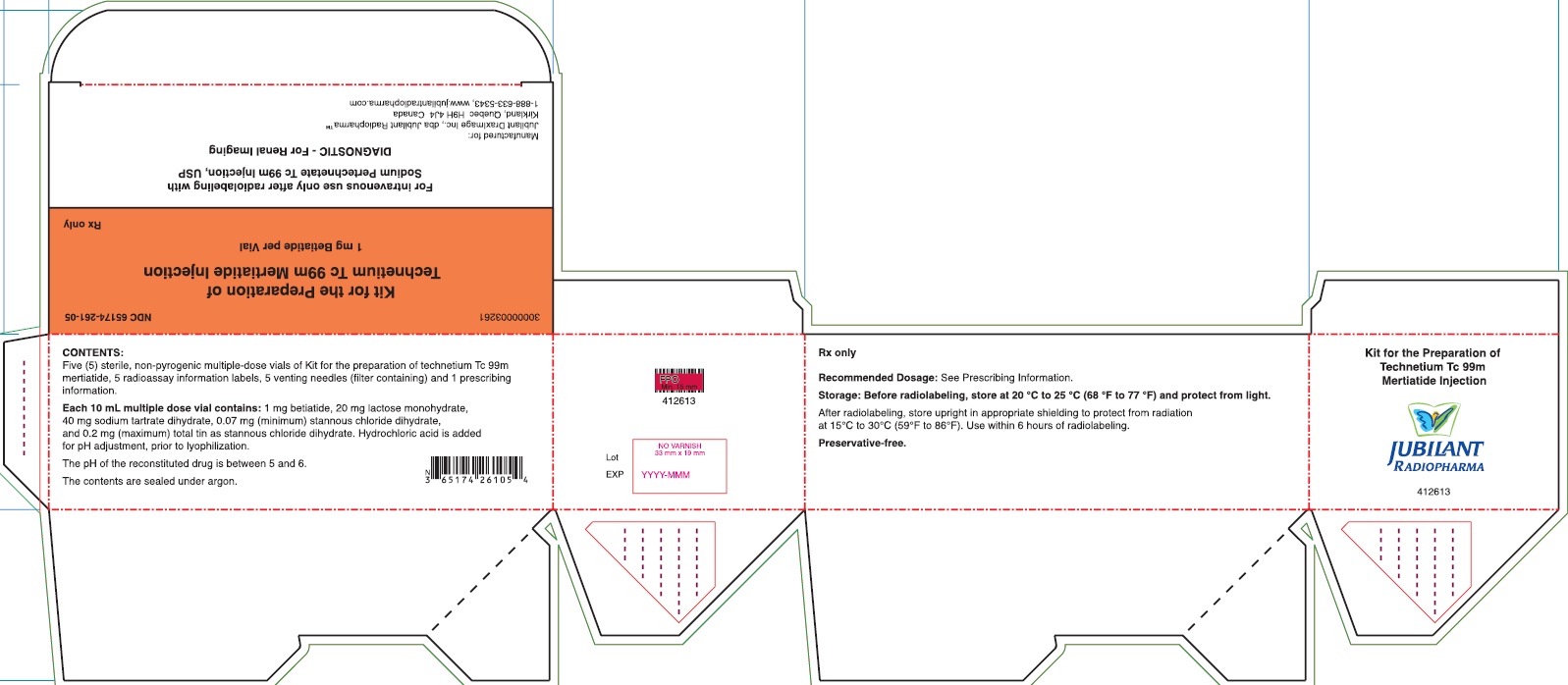
TECHNETIUM Tc 99m MERTIATIDE 1 mg Injection, Powder, Lyophilized, For Solution, 5 vials — NDC 65174-261-05 (Billing 65174-0261-05)
This is a package of 5 vials of TECHNETIUM Tc 99m MERTIATIDE 1 mg Injection, Powder, Lyophilized, For Solution from Jubilant DraxImage Inc., dba Jubilant Radiopharma, marketed since Mar 2023 and currently FDA-listed. It is this product's only package size.
NDC database record
One package, one record: these facts belong to NDC 65174-261-05 alone.
- Record
- FDA NDC Directory package listing · Human prescription drug
- Code segments
- 65174 labeler · 261 product · 05 package
- Package marketed since
- Mar 31, 2023
- Sample package
- No — commercial package
- Listing certified through
- Dec 31, 2026
- Barcode (UPC)
- 0365174261016
- FDA record last changed
- Jul 24, 2026
Identity & classification
Regulatory identifiers FDA, NLM and CMS codes for this package
Drug-database identifiers Medi-Span GPI and First Databank GCN / HICL / AHFS classification
- GSN (GCN sequence number): 078220
- GCN: 44506
- HICL (First Databank): 024553
- AHFS class code: 36:40.00.00
Where does this data come from?
- FDA openFDA NDC Directory · synced Oct 1, 2026
- FDA label on DailyMed · label index refreshed Oct 3, 2026
- RxNorm (NLM RxNav) · catalog refreshed Oct 1, 2026
- Medi-Span GPI (licensed)
- First Databank (licensed) · refreshed Oct 1, 2026
Clinical
Patient education
Supplement & herbal interactions
Where does this data come from?
- MedlinePlus (NLM) · refreshed Oct 1, 2026
- FDA label on DailyMed · label index refreshed Oct 3, 2026
Ask a licensed pharmacist directly — free, answered by our team.
Pricing
A drug doesn't have one price. Each row is a different public payment system, and none is what you'd pay at the counter — that depends on your insurance. The ⓘ on each row explains what it measures.
| Price system | Per mL | Per package |
|---|---|---|
| Retail pharmacies payNADAC · weekly | Not in the retail survey — common for institutional, discontinued, or low-volume packs. | |
| Medicaid paysCMS SDUD · 12 mo | No recent Medicaid claims on file for this NDC — rare and low-volume NDCs are suppressed in the public data. | |
| Medicare drug plans payPart D · quarterly | No Part D plan price is available for this NDC in our data. | |
Where does this data come from?
- CMS NADAC weekly file
- CMS ASP pricing files · refreshed Sep 20, 2026
- CMS Medicaid State Drug Utilization Data · refreshed Oct 4, 2026
- CMS Part D plan pricing files · refreshed Sep 24, 2026
- VA National Acquisition Center price file
Packaging — all sizes for this product
| Package NDC | Description | Marketing start | Marketing end | Status |
|---|---|---|---|---|
| 65174-0261-05 You're viewing this Main listing | 5 VIAL in 1 CARTON / 1 INJECTION, POWDER, LYOPHILIZED, FOR SOLUTION in 1 VIAL | 2023-03-31 | — | Active |
Therapeutic equivalents
| Product | Labeler | Pack | NADAC/unit | TE | Status | Price vs. this |
|---|---|---|---|---|---|---|
| TECHNETIUM Tc 99m MERTIATIDE 1 mgthis 65174-0261-05 | Jubilant | 5 vials | — | — | FDA listed | — |
Where does this data come from?
- FDA openFDA NDC Directory · synced Oct 1, 2026
- FDA Orange Book · refreshed Oct 3, 2026
- CMS NADAC weekly file
Availability & generic status
We did not find an FDA-approved generic match for this exact strength, form and route.
Where does this data come from?
- FDA Orange Book · refreshed Oct 3, 2026
Inactive Ingredients / Excipients
Inactive ingredients, also called excipients, are components of the drug product other than the active ingredient. They may include fillers, dyes, coatings, preservatives, flavors, or other formulation ingredients.
💡 Tap an ingredient (hover on desktop) to see what it is and why it’s used.
-
UNII QTT17582CB
A strong acid used to adjust and maintain the proper pH level in liquid medicines, ensuring stability and preventing breakdown of active ingredients.
-
20 mg
UNII EWQ57Q8I5X
Lactose monohydrate is a natural sugar derived from milk. It serves as a filler and binder in tablets and capsules, helping create the proper size, texture, and consistency of the medicine.
-
40 mg
UNII DIA7C37AOW
Sodium tartrate dihydrate is a salt derived from tartaric acid, a naturally occurring compound found in grapes. It acts as a buffer and pH regulator in medicines, helping maintain the proper acidity level for stability and effectiveness.
-
0.2 mg
UNII 1BQV3749L5
Stannous chloride is a tin-based chemical compound used as a reducing agent and antioxidant in pharmaceuticals. It helps prevent oxidation of active ingredients and stabilizes certain formulations, particularly in products requiring preservation of potency.
4 inactive ingredients listed in the exact product block matched to this NDC.
Where does this data come from?
ingredient classCode="IACT" elements from the exact product block matched by this NDC. Label-section narrative from DailyMed / the openFDA label index is shown separately when available.- FDA label on DailyMed · label index refreshed Oct 3, 2026
- FDA openFDA NDC Directory · synced Oct 1, 2026
Inactive ingredient FAQ
Are inactive ingredients the same for every manufacturer?
Why might an inactive ingredient be missing?
Can inactive ingredients matter?
Manufacturer & labeler
More NDCs from Jubilant DraxImage Inc., dba Jubilant Radiopharm... labeler code 65174
- RUBY-FILL Rubidium Rb 82 100 mCi Injection, Solution NDC 65174-021-10
- Kit for the Preparation of Technetium Tc 99m Sulfur Colloid Kit NDC 65174-179-01
- Drax Exametazime Kit for the Preparation of Technetium Tc 99m Exametazime for Leukocyte Labeling .5 mg Injection, Powder, Lyophilized, For Solution NDC 65174-200-05
- DRAXIMAGE MAA Kit for the preparation of Technetium Tc 99m Albumin aggregated 2.5 mg Injection, Powder, For Solution NDC 65174-270-30
- DRAXIMAGE DTPA Kit for the preparation of Technetium Tc 99m Pentetate 20 mg Injection, Powder, Lyophilized, For Solution NDC 65174-288-30
- Sodium Iodide I 131 Diagnostic 100 mCi Capsule NDC 65174-461-05
- Technetium Tc 99m Medronate 25 mg Injection, Powder, For Solution NDC 65174-660-30
- HICON Sodium Iodide I 131 1000 mCi/mL Solution NDC 65174-880-00
Where does this data come from?
- FDA openFDA NDC Directory · synced Oct 1, 2026
- Drugs@FDA
Full prescribing information FDA SPL
🎯 Indications and Usage ▾
1 INDICATIONS AND USAGE Kit for the Preparation of Technetium Tc 99m Mertiatide Injection, after radiolabeling with technetium-99m, is indicated for use in the diagnosis of congenital and acquired renal abnormalities, renal failure, urinary tract obstruction, and calculi in adults and pediatric patients aged 30 days and older. The product is a diagnostic aid in providing renal function, split function, renal angiograms, and renogram curves for whole kidney and renal cortex. Kit for the Preparation of Technetium Tc 99m Mertiatide Injection, after radiolabeling with technetium-99m, is a radioactive diagnostic agent indicated for use in the diagnosis of congenital and acquired renal abnormalities, renal failure, urinary tract obstruction, and calculi in adults and pediatric patients aged 30 days and older.
The product is a diagnostic aid in providing renal function, split function, renal angiograms, and renogram curves for whole kidney and renal cortex. ( 1 )
⏱️ Dosage and Administration ▾
2 DOSAGE AND ADMINISTRATION Instruct patients to drink a sufficient amount of water before administration and continue to drink and to void frequently following administration. ( 2.2 ) Recommended dose in adult patients:185 MBq to 370 MBq (5 mCi to 10 mCi) as an intravenous bolus injection. ( 2.3 ) Recommended dose in pediatric patients aged 30 days and older:
2.6 MBq/kg to
5.2MBq/kg (0.07 mCi/kg to 0.14 mCi/kg) with a minimum dose of 37 MBq (1 mCi) as an intravenous bolus injection. ( 2.3 ) See Full Prescribing Information for radiation safety, drug preparation, administration, and radiation dosimetry information. ( 2.1 , 2.4 , 2.5 , 2.6 , 2.7 )
2.1Radiation Safety – Drug Handling After radiolabeling, the kit produces Technetium Tc 99m Mertiatide Injection. Handle Technetium Tc 99m Mertiatide Injection with appropriate safety measures to minimize radiation exposure [see Warnings and Precautions ( 5.1 )] . Use waterproof gloves, effective radiation shielding, and other appropriate safety measures when preparing and handling Technetium Tc 99m Mertiatide Injection.
Radiopharmaceuticals should be used by or under the control of healthcare providers who are qualified by specific training and experience in the safe use and handling of radionuclides, and whose experience and training have been approved by the appropriate governmental agency authorized to license the use of radionuclides.
2.2Patient Preparation Instruct patients to drink a sufficient amount of water to ensure adequate hydration prior to administration of Technetium Tc 99m Mertiatide Injection and to continue to drink and void frequently following administration to reduce radiation exposure.
2.3Recommended Dosage Adult The recommended dose in adult patients is 185 MBq to 370 MBq (5 mCi to 10 mCi) as an intravenous bolus injection. Pediatric The recommended dose in pediatric patients aged 30 days and older is
2.6 MBq/kg to
5.2MBq/kg (0.07 mCi/kg to 0.14 mCi/kg) of actual body weight with a minimum dose of 37 MBq (1 mCi) as an intravenous bolus injection.
2.4Drug Preparation and Handling Procedural Precautions Contents of the vials are intended only for use in the preparation of Technetium Tc 99m Mertiatide Injection, and are NOT to be administered directly to the patient. Do not use Sodium Pertechnetate Tc 99m Injection USP more than 6 hours after its elution from the generator. Use aseptic techniques for all transfers and vial stopper entries.
Wear waterproof gloves during the procedure, particularly during the heating of the sample with boiling water. Use suitable shielding to reduce radiation exposure. Use one lead shield for incubation with a water bath and another lead shield for dispensing as described in the Procedure for the Preparation of Technetium Tc 99m Mertiatide Injection section below.
Make all transfers of sodium pertechnetate Tc 99m solution during the preparation procedure with an adequately shielded syringe. Procedure for the Preparation of Technetium Tc 99m Mertiatide Injection Prepare a rolling boil water bath containing a lead incubation vial shield with openings cut in it to allow the water to circulate through the shield. Orient the openings of the lead incubation shield to prevent radiation leakage.
Note: The vial should be in direct contact with the rolling boil water of the bath, and the level of the bath must be at least even with the level of the contents of the vial. Ensure the temperature of the water bath used for heating the reaction vial is at boiling temperature and the temperature of the lead incubation vial shield is equilibrated to the temperature of the water bath before proceeding with the preparation procedure below. Place the reaction vial in a lead dispensing shield fitted with a lid and with a minimum wall thickness of 0.32 cm.
Swab the rubber stopper of the reaction vial with an appropriate antiseptic wipe. Insert a filter-containing venting needle (provided) through the vial stopper. Add 4 mL to 10 mL of Sodium Pertec… [Excerpted — this section continues on DailyMed.]
💊 Dosage Forms and Strengths ▾
3 DOSAGE FORMS AND STRENGTHS Kit for the Preparation of Technetium Tc 99m Mertiatide Injection contains 1 mg betiatide supplied as a white lyophilized powder packaged in 10 mL glass multiple-dose vials. Radiolabeling with sodium pertechnetate Tc 99m injection provides a clear, colorless solution containing up to 3,700 MBq (100 mCi) technetium Tc 99m mertiatide in approximately 10 mL volume at calibration time.. Kit for the Preparation of Technetium Tc 99m Mertiatide Injection: 1 mg betiatide as a lyophilized powder in 10 ml glass multiple-dose vial.
Upon radiolabeling with technetium-99m, it contains up to 3,700 MBq (100 mCi) technetium Tc 99m mertiatide in approximately 10 mL volume at calibration time.
⛔ Contraindications ▾
4 CONTRAINDICATIONS None. None. (4)
⚠️ Warnings and Cautions ▾
5 WARNINGS AND PRECAUTIONS Radiation risks: Ensure safe handling to minimize radiation exposure to patients and healthcare providers. ( 5.1 )
5.1Radiation Risks Technetium Tc 99m Mertiatide Injection contributes to a patient’s overall long-term cumulative radiation exposure. Long-term cumulative radiation exposure is associated with an increased risk for cancer. Ensure safe handling to minimize radiation exposure to the patient and healthcare providers.
Advise patients to hydrate before and after administration and to void frequently after administration [ see Dosage and Administration ( 2.2 ) ] .
🤒 Adverse Reactions ▾
6 ADVERSE REACTIONS The following adverse reactions associated with the use of Technetium Tc 99m Mertiatide Injection were identified in clinical studies or postmarketing reports. Because some of these reactions are voluntarily reported from a population of uncertain size, it is not always possible to reliably estimate their frequency or establish a causal relationship to drug exposure. Cardiac disorders : tachycardia.
Gastrointestinal disorders : nausea, vomiting. General disorders and administration site conditions : shaking chills, fever. Nervous system disorders : seizure.
Respiratory, thoracic and mediastinal disorders : wheezing, dyspnea. Skin and subcutaneous tissue disorders : itching, rash. Vascular disorders : elevation in blood pressure.
Reported adverse reactions are: tachycardia, nausea, vomiting, shaking chills, fever, seizure, wheezing, dyspnea, itching, rash, and elevation in blood pressure. ( 6 ) To report SUSPECTED ADVERSE REACTIONS, contact Jubilant DraxImage Inc. at 1-888-633-5343 or FDA at 1-800-FDA-1088 or www.fda.gov/medwatch.
👥 Use in Specific Populations ▾
8 USE IN SPECIFIC POPULATIONS Lactation: Temporarily discontinue breastfeeding. A lactating woman should pump and discard breast milk for at least 24 hours after Technetium Tc99m Mertiatide administration. ( 8.2 )
8.1Pregnancy Risk Summary There are no data with technetium Tc 99m mertiatide use in pregnant women to determine a drug-associated risk for major birth defects, miscarriage, or other adverse maternal or fetal outcomes. No animal reproductive studies have been conducted with technetium Tc 99m mertiatide. Although all radiopharmaceuticals have the potential to cause fetal harm depending on the fetal stage of development and the magnitude of the radiation dose, the radiation exposure to the fetus from technetium Tc 99m mertiatide is expected to be low (see Data).
The background risk of major birth defects and miscarriage for the indicated population is unknown. All pregnancies have a background risk of birth defects, loss, or other adverse outcomes. In the U.S. general population, the estimated background risk of major birth defects and miscarriage in clinically recognized pregnancies are 2% to 4% and 15% to 20%, respectively.
Data Human Data No adverse fetal effects of radiation risks have been identified for diagnostic procedures involving less than 50 mGy, which represents less than 10 mGy fetal doses.
8.2Lactation Risk Summary There are no data on the presence of technetium Tc 99m mertiatide in breast milk, however, published case reports describe the presence of technetium Tc 99m in breast milk. There are no data on the effects of technetium Tc 99m mertiatide on the breastfed infant or the effects on milk production. Based on clinical guidelines, exposure of technetium Tc 99m mertiatide to a breastfed infant may be minimized by advising a lactating woman to temporarily discontinue breastfeeding and to pump and discard breast milk for a minimum of 24 hours after administration of Technetium Tc 99m Mertiatide Injection.
The developmental and health benefits of breastfeeding should be considered along with a mother’s clinical need for Technetium Tc 99m Mertiatide Injection and any potential adverse effects on the breastfed child from technetium Tc 99m mertiatide or from the underlying maternal condition.
8.4Pediatric Use Kit for the Preparation of Technetium Tc 99m Mertiatide Injection, after radiolabeling with technetium-99m, is indicated for use in the diagnosis of congenital and acquired renal abnormalities, renal failure, urinary tract obstruction, and calculi in pediatric patients aged 30 days and older. The safety and effectiveness of Kit for the Preparation of Technetium Tc 99m Mertiatide Injection have not been established in pediatric patients younger than 30 days old.
8.5Geriatric Use No formal studies of Technetium Tc 99m Mertiatide Injection in subjects aged 65 and over were performed to determine whether they respond differently than younger adult subjects.
🤰 Pregnancy ▾
8.1Pregnancy Risk Summary There are no data with technetium Tc 99m mertiatide use in pregnant women to determine a drug-associated risk for major birth defects, miscarriage, or other adverse maternal or fetal outcomes. No animal reproductive studies have been conducted with technetium Tc 99m mertiatide. Although all radiopharmaceuticals have the potential to cause fetal harm depending on the fetal stage of development and the magnitude of the radiation dose, the radiation exposure to the fetus from technetium Tc 99m mertiatide is expected to be low (see Data).
The background risk of major birth defects and miscarriage for the indicated population is unknown. All pregnancies have a background risk of birth defects, loss, or other adverse outcomes. In the U.S. general population, the estimated background risk of major birth defects and miscarriage in clinically recognized pregnancies are 2% to 4% and 15% to 20%, respectively.
Data Human Data No adverse fetal effects of radiation risks have been identified for diagnostic procedures involving less than 50 mGy, which represents less than 10 mGy fetal doses.
🧒 Pediatric Use ▾
8.4Pediatric Use Kit for the Preparation of Technetium Tc 99m Mertiatide Injection, after radiolabeling with technetium-99m, is indicated for use in the diagnosis of congenital and acquired renal abnormalities, renal failure, urinary tract obstruction, and calculi in pediatric patients aged 30 days and older. The safety and effectiveness of Kit for the Preparation of Technetium Tc 99m Mertiatide Injection have not been established in pediatric patients younger than 30 days old.
🧓 Geriatric Use ▾
8.5Geriatric Use No formal studies of Technetium Tc 99m Mertiatide Injection in subjects aged 65 and over were performed to determine whether they respond differently than younger adult subjects.
🆘 Overdosage ▾
10 OVERDOSAGE In the event of an overdose of technetium Tc 99m mertiatide, hydration and frequent micturition should be encouraged to minimize the absorbed radiation dose to patient. A diuretic might also be considered. If possible, an estimate of the radiation effective dose given to the patient should be made.
🧬 Clinical Pharmacology ▾
12 CLINICAL PHARMACOLOGY
12.1Mechanism of Action Following intravenous administration for renal imaging, Technetium Tc 99m Mertiatide is rapidly cleared from the blood. It is cleared by the kidneys and excreted in the urine.
12.2Pharmacodynamics Following intravenous injection of technetium Tc 99m mertiatide, the uptake, concentration, and excretion of the tracer by the kidney can be monitored to assess renal function.
12.3Pharmacokinetics Distribution After an intravenous administration in healthy adult subjects, 89% of technetium Tc 99m mertiatide was plasma-protein bound. The protein binding is reversible. Elimination Excretion In healthy subjects, the plasma clearance was approximately 0.3 liters/minute and the amount of technetium Tc 99m mertiatide excreted in the urine in 3 hours was nearly 90% of the injected dose.
Specific Populations Patients with Renal Impairment In a study performed in three patients with renal impairment (serum creatinine greater than 6.3 mg/dL), 78% of the tracer was plasma protein bound after intravenous injection. The mean plasma clearance of technetium Tc 99m mertiatide was 0.03 liters/minute and 21.3% was excreted in 3 hours on average. In both healthy subjects and patients with renal impairment, the plasma concentration-time profile showed a biexponential decline.
🧬 Mechanism of Action ▾
12.1Mechanism of Action Following intravenous administration for renal imaging, Technetium Tc 99m Mertiatide is rapidly cleared from the blood. It is cleared by the kidneys and excreted in the urine.
📦 How Supplied / Storage and Handling ▾
16 HOW SUPPLIED/STORAGE AND HANDLING How Supplied Kit for the Preparation of Technetium Tc 99m Mertiatide Injection containing 1 mg betiatide, is supplied as a white lyophilized powder packaged in a sterile, multiple-dose 10 mL vial as a carton of 5 vials (NDC 65174-261-05). The carton also contains: - 5 venting needles with filter. - 5 radioassay information labels for the radiolabeled product. The radionuclide is not part of Kit for the Preparation of Technetium Tc 99m Mertiatide Injection.
Storage and Handling Before radiolabeling, store at controlled room temperature 20°C to 25°C (68°F to 77°F) [see USP Controlled Room Temperature] and protect from light. After radiolabeling with sodium pertechnetate Tc 99m injection, store vial upright in shielding to protect from radiation at room temperature 15°C to 30°C (59°F to 86°F). Use within 6 hours of radiolabeling.
Dispose of unused Technetium Tc 99m Mertiatide Injection in compliance with the regulations of the government agency authorized to license the use of this radionuclide. This preparation is approved for use by persons under license by the Nuclear Regulatory Commission or the relevant regulatory authority of an Agreement State.
📋 Description ▾
11 DESCRIPTION
11.1Chemical Characteristics Kit for the Preparation of Technetium Tc 99m Mertiatide Injection is a sterile, multiple-dose kit for the preparation of technetium Tc 99m mertiatide injection, a radioactive diagnostic agent for intravenous use. The active ingredient, betiatide, is N-[N-[N-[(benzoylthio) acetyl]glycyl]glycyl]-glycine and has a molecular weight of 367.38 g/mol. After reconstitution with sodium pertechnetate Tc 99m injection, the radioactive agent technetium Tc 99m mertiatide (disodium[N-[N-[N- (mercaptoacetyl) glycyl]glycyl] glycinato (2-) - N,N′,N″,S′]oxotechnetate (2-)) is formed in situ.
Each 10 mL vial contains 1 mg betiatide, 20 mg lactose monohydrate, 40 mg sodium tartrate dihydrate, 0.07 mg (minimum) stannous chloride dihydrate and 0.2 mg (maximum) total tin expressed as stannous chloride dihydrate. Prior to lyophilization, hydrochloric acid is added for pH adjustment. The vial contents are sealed under argon.
After radiolabeling with sodium pertechnetate Tc 99m injection, each vial contains up to 3,700 MBq (100 mCi) of technetium Tc 99m mertiatide in 0.9% sodium chloride injection in approximately 10 mL volume as a sterile, clear, and colorless solution with a pH between 5 and 6. betiatide-chem-stuct tc-99m-mertiatide
11.2Physical Characteristics Technetium Tc 99m decays by isomeric transition with a physical half-life of 6.02 hours. The principal photon that is useful for detection and imaging is listed in Table 2. Table 2.
Principal Radiation Emission Data Radiation M Mean % per Disintegration Energy (keV) Gamma-2 89.07 140.5 To correct for physical decay of the radionuclide, the fractions that remain at selected time intervals after the time of calibration are shown in Table 3. Table 3. Physical Decay Chart: Technetium Tc 99m, Half-life
6.02Hours Hours Fraction Remaining Hours Fraction Remaining 0* 1.000 7 0.447 1 0.891 8 0.398 2 0.794 9 0.355 3 0.708 10 0.316 4 0.631 11 0.282 5 0.562 12 0.251 6 0.501 * Calibration Time
11.3 External Radiation The specific gamma ray constant for technetium-99m is
0.78R/mCi-hr at 1 cm. The first half-value thickness of lead (Pb) for technetium-99m is 0.017 cm. The use of 0.25 cm of Pb, for example, will decrease the external radiation exposure by a factor of about 1,000. Table 4 displays the radiation attenuation by lead shielding. Table 4. Radiation Attenuation by Lead Shielding Shield Thickness (Pb) cm Coefficient of Attenuation 0.017 0.5 0.08 10 -1 0.16 10 -2 0.25 10 -3 0.33 10 -4
💬 Information for Patients ▾
17 PATIENT COUNSELING INFORMATION Adequate Hydration Advise patients to drink sufficient amount of water to ensure adequate hydration before administration of Technetium Tc 99m Mertiatide Injection and to continue to drink and void frequently following administration to minimize radiation dose [see Dosage and Administration ( 2.2 ) and Warning and Precautions ( 5.1 )] . Pregnancy: Advise pregnant women of the risk of fetal exposure to radiation doses if they undergo a radionuclide procedure [see Use in Specific Populations ( 8.1 )] .
Lactation: Advise a lactating woman to temporarily discontinue breastfeeding and to pump and discard breast milk for at least 24 hours after Technetium Tc 99m Mertiatide Injection administration to minimize radiation exposure to a breastfed infant [see Use in Specific Populations (8.2) ] . Manufactured for: Jubilant DraxImage Inc., dba Jubilant Radiopharma™ 16 751 TransCanada Highway Kirkland, Quebec H9H 4J4 Canada 1-888-633-5343 www.jubilantradiopharma.com Art Rev.:
3.0Sep-Pak™ is a trademark of Waters Technologies Corporation. Jubilant Radiopharma™ is a trademark used under license by Jubilant DraxImage Inc. jbl-logo
🧬 Pharmacokinetics ▾
12.3Pharmacokinetics Distribution After an intravenous administration in healthy adult subjects, 89% of technetium Tc 99m mertiatide was plasma-protein bound. The protein binding is reversible. Elimination Excretion In healthy subjects, the plasma clearance was approximately 0.3 liters/minute and the amount of technetium Tc 99m mertiatide excreted in the urine in 3 hours was nearly 90% of the injected dose.
Specific Populations Patients with Renal Impairment In a study performed in three patients with renal impairment (serum creatinine greater than 6.3 mg/dL), 78% of the tracer was plasma protein bound after intravenous injection. The mean plasma clearance of technetium Tc 99m mertiatide was 0.03 liters/minute and 21.3% was excreted in 3 hours on average. In both healthy subjects and patients with renal impairment, the plasma concentration-time profile showed a biexponential decline.
🧬 Pharmacodynamics ▾
12.2Pharmacodynamics Following intravenous injection of technetium Tc 99m mertiatide, the uptake, concentration, and excretion of the tracer by the kidney can be monitored to assess renal function.
🧪 Nonclinical Toxicology ▾
13 NONCLINICAL TOXICOLOGY
13.1Carcinogenesis, Mutagenesis, Impairment of Fertility No long term animal studies have been performed to evaluate carcinogenic or mutagenic potential, or whether this drug affects fertility in males or females.
📄 Carcinogenesis, Mutagenesis, Impairment of Fertility ▾
13.1Carcinogenesis, Mutagenesis, Impairment of Fertility No long term animal studies have been performed to evaluate carcinogenic or mutagenic potential, or whether this drug affects fertility in males or females.
📄 Package Label / Principal Display Panel ▾
PACKAGE/LABEL PRINCIPAL DISPLAY PANEL - 5 VIAL BOX NDC 65174-261-05 Kit for the Preparation of Technetium Tc 99m Mertiatide 1 mg Betiatide per Vial Rx only For intravenous use only after radiolabeling with Sodium Pertechnetate Tc 99m Injection, USP DIAGNOSTIC - For Renal Imaging Manufactured for: Jubilant DraxImage Inc., dba Jubilant Radiopharma™ Kirkland, Quebec H9H 4J4 Canada 1-888-633-5343, www.jubilantradiopharma.com CONTENTS: Five (5) sterile, non-pyrogenic multiple-dose vials of Kit for the preparation of technetium Tc 99m mertiatide, 5 radioassay information labels, 5 venting needles (filter containing) and 1 prescribing information.
Each 10 mL multiple dose vial contains: 1 mg betiatide, 20 mg lactose monohydrate, 40 mg tartrate dihydrate, 0.07 (minimum) stannous chloride dihydrate, and 0.2 mg (maximum) total tin as stannous chloride dihydrate. Hydrochloric acid is added for pH adjustment, prior to lyophilization. The pH of the reconstituted drug is between 5 and 6.
The contents are sealed under argon. Rx only Recommended Dosage: See Prescrbing Information. Storage: Before radiolabeling, store at 20 °C to 25 °C (68 °F to 77 °F) and protect from light.
After radiolabeling, store upright inappropriate shielding to protect from radiation at 15°C to 30°C (59°F to 86°F). Use within 6 hours of radiolabeling. Preservative-free. outer-carton-label
PACKAGE/LABEL PRINCIPAL DISPLAY PANEL - VIAL CONTAINER (10 mL Multi-Dose Reaction Vial) Sterile NDC 65174-261-01 Kit for the Preparation of Technetium Tc 99m Mertiatide Injection 1 mg Betiatide per Vial Rx only Multiple-dose reaction vial For intravenous use only after radiolabeling with Sodium Pertechnetate Tc 99m Injection USP. Recommended Dosage: See Prescribing information. Store at 20 °C to 25 °C (68 °F to 77 °F) and protect from light.
Use within 6 hours of radiolabeling. Manufactured for: Jubilant DraxImage Inc. Kirkland, Quebec, Canada H9H 4J4 multi-dose-reaction-vial
Reported adverse events (FAERS)
Top reported reactions
Reporter sex
Where does this data come from?
About this NDC listing & data coverage
What data is (and isn’t) available for this NDC — tap to expand
| NDC identity (package / product / labeler codes) | ✓ Available |
| Labeler | ✓ Available |
| Product & package description | ✓ Available |
| Marketing category & status | ✓ Available |
| Active ingredient / dosage form / route | ✓ Available |
| FDA label (SPL via DailyMed) | ✓ Available |
| Package photos | ✓ Available |
| Inactive ingredients (structured) | ✓ Available |
| NADAC pharmacy acquisition price (CMS) | — Not published for this NDC CMS publishes NADAC only for NDCs reported in its retail-pharmacy survey. |
| Orange Book / therapeutic-equivalence data | — Not published for this NDC Applies only to products approved under an NDA/ANDA; many listings are out of scope. |
| HCPCS J-code billing crosswalk | — Not published for this NDC Most self-administered / retail products have no J-code — that is normal. |
| Medicaid utilization (CMS SDUD) | — Not published for this NDC CMS reports utilization only for NDCs with Medicaid claims above its privacy threshold. |