
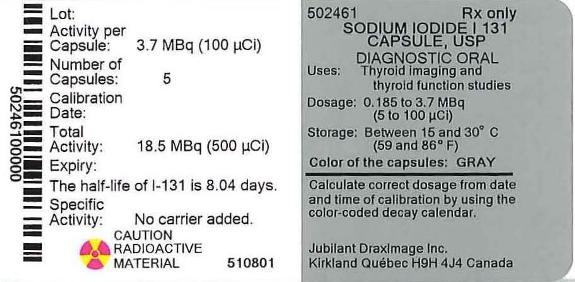
Sodium Iodide I 131 Diagnostic 100 mCi Capsule, 5-count — NDC 65174-461-05 (Billing 65174-0461-05)
This is a package of 5 capsules of Sodium Iodide I 131 Diagnostic 100 mCi Capsule from Jubilant DraxImage Inc., dba Jubilant Radiopharma, marketed since May 2006 and currently FDA-listed. It is this product's only package size.
NDC database record
One package, one record: these facts belong to NDC 65174-461-05 alone.
- Record
- FDA NDC Directory package listing · Human prescription drug
- Code segments
- 65174 labeler · 461 product · 05 package
- Package marketed since
- May 1, 2006
- Sample package
- No — commercial package
- Listing certified through
- Dec 31, 2026
- Billing quantity
- 5 EA per package
- Barcode (UPC-A, from the NDC)
- 3 6517446105 8
- FDA record last changed
- Jul 24, 2026
Identity & classification
Regulatory identifiers FDA, NLM and CMS codes for this package
Drug-database identifiers Medi-Span GPI and First Databank GCN / HICL / AHFS classification
- GSN (GCN sequence number): 080026
- GCN: 46687
- HICL (First Databank): 020665
- AHFS class code: 36:60.00.00
Where does this data come from?
- FDA openFDA NDC Directory · synced Oct 1, 2026
- FDA label on DailyMed · label index refreshed Oct 6, 2026
- RxNorm (NLM RxNav) · catalog refreshed Oct 1, 2026
- Medi-Span GPI (licensed)
- First Databank (licensed) · refreshed Oct 1, 2026
Clinical
Patient education
Supplement & herbal interactions
Where does this data come from?
- MedlinePlus (NLM) · refreshed Oct 1, 2026
- FDA label on DailyMed · label index refreshed Oct 6, 2026
Ask a licensed pharmacist directly — free, answered by our team.
Pricing
A drug doesn't have one price. Each row is a different public payment system, and none is what you'd pay at the counter — that depends on your insurance. The ⓘ on each row explains what it measures.
| Price system | Per each | Per package |
|---|---|---|
| Retail pharmacies payNADAC · weekly | Not in the retail survey — common for institutional, discontinued, or low-volume packs. | |
| Medicaid paysCMS SDUD · 12 mo | No recent Medicaid claims on file for this NDC — rare and low-volume NDCs are suppressed in the public data. | |
| Medicare drug plans payPart D · quarterly | No Part D plan price is available for this NDC in our data. | |
Where does this data come from?
- CMS NADAC weekly file
- CMS ASP pricing files · refreshed Sep 20, 2026
- CMS Medicaid State Drug Utilization Data · refreshed Oct 6, 2026
- CMS Part D plan pricing files · refreshed Sep 24, 2026
- VA National Acquisition Center price file
Packaging — all sizes for this product
| Package NDC | Description | Marketing start | Marketing end | Status |
|---|---|---|---|---|
| 65174-0461-05 You're viewing this Main listing | 5 CAPSULE in 1 VIAL | 2006-05-01 | — | Active |
Therapeutic equivalents
| Product | Labeler | Pack | NADAC/unit | TE | Status | Price vs. this |
|---|---|---|---|---|---|---|
| Sodium Iodide I 131 Diagnostic 100 mCithis 65174-0461-05 | Jubilant | 5 capsules | — | AA | FDA listed | — |
Where does this data come from?
- FDA openFDA NDC Directory · synced Oct 1, 2026
- FDA Orange Book · refreshed Oct 3, 2026
- CMS NADAC weekly file
Availability & generic status
The FDA lists approved generic versions of this medicine, but that does not always mean a pharmacy can get one today. Patent rules, launch agreements, supply and pricing can affect when generics actually arrive.
Where does this data come from?
- FDA Orange Book · refreshed Oct 3, 2026
What it looks like
Where does this data come from?
- FDA label on DailyMed · label index refreshed Oct 6, 2026
Inactive Ingredients / Excipients
Inactive ingredients, also called excipients, are components of the drug product other than the active ingredient. They may include fillers, dyes, coatings, preservatives, flavors, or other formulation ingredients.
💡 Tap an ingredient (hover on desktop) to see what it is and why it’s used.
-
UNII 7FLD91C86K
Edetate disodium is a chemical compound that binds and removes certain metal ions. In medicines, it acts as a preservative and stabilizer by preventing metals like calcium from interfering with the product's shelf life and consistency.
-
UNII 22ADO53M6F
A mineral salt derived from phosphoric acid, used as a buffer to maintain the pH balance of the medication and help stabilize the active ingredients.
-
UNII HX1032V43M
Sodium thiosulfate is a salt compound used in medicines as a buffer and pH regulator. It helps stabilize the medication and may also serve as a preservative or antioxidant to maintain product quality.
3 inactive ingredients listed in the exact product block matched to this NDC.
Where does this data come from?
ingredient classCode="IACT" elements from the exact product block matched by this NDC. Label-section narrative from DailyMed / the openFDA label index is shown separately when available.- FDA label on DailyMed · label index refreshed Oct 6, 2026
- FDA openFDA NDC Directory · synced Oct 1, 2026
Inactive ingredient FAQ
Are inactive ingredients the same for every manufacturer?
Why might an inactive ingredient be missing?
Can inactive ingredients matter?
Manufacturer & labeler
More NDCs from Jubilant DraxImage Inc., dba Jubilant Radiopharm... labeler code 65174
- RUBY-FILL Rubidium Rb 82 100 mCi Injection, Solution NDC 65174-021-10
- Kit for the Preparation of Technetium Tc 99m Sulfur Colloid Kit NDC 65174-179-01
- Drax Exametazime Kit for the Preparation of Technetium Tc 99m Exametazime for Leukocyte Labeling .5 mg Injection, Powder, Lyophilized, For Solution NDC 65174-200-05
- TECHNETIUM Tc 99m MERTIATIDE 1 mg Injection, Powder, Lyophilized, For Solution NDC 65174-261-05
- DRAXIMAGE MAA Kit for the preparation of Technetium Tc 99m Albumin aggregated 2.5 mg Injection, Powder, For Solution NDC 65174-270-30
- DRAXIMAGE DTPA Kit for the preparation of Technetium Tc 99m Pentetate 20 mg Injection, Powder, Lyophilized, For Solution NDC 65174-288-30
- Technetium Tc 99m Medronate 25 mg Injection, Powder, For Solution NDC 65174-660-30
- HICON Sodium Iodide I 131 1000 mCi/mL Solution NDC 65174-880-00
Where does this data come from?
- FDA openFDA NDC Directory · synced Oct 1, 2026
- Drugs@FDA
Full prescribing information FDA SPL
🎯 Indications and Usage ▾
1 INDICATIONS AND USAGE Sodium Iodide I 131 Capsules Diagnostic is indicated for use in adults for: Assessment of thyroid function using radioactive iodine (RAI) uptake test Imaging the thyroid (scintigraphy) Sodium Iodide I 131 Capsules Diagnostic is a radioactive diagnostic agent indicated for the assessment of thyroid function and for thyroid imaging.
⏱️ Dosage and Administration ▾
2 DOSAGE AND ADMINISTRATION Use careful handling with appropriate safety measures to minimize radiation exposure to patients and healthcare workers. ( 2.1 , 5.2 ) Follow suitable radioactivity calibration prior to administration. ( 2.1 ) In an adult patient, recommended doses are ( 2.2 ): Thyroid Function: 0.185 to 1.1 megabecquerels (MBq) [5 to 30 microcuries (microCi)] Thyroid Imaging: 1.85 to
3.70 MBq (50 to 100 microCi)
2.1Radiation Safety Sodium Iodide I 131 Capsules Diagnostic is a radioactive drug and should be handled with appropriate safety measures to minimize radiation exposure to the patient and healthcare worker [see Warnings and Precautions ( 5.2 ) ]. Use waterproof gloves during the entire handling and administration procedure. Maintain adequate shielding during the life of the product.
Open the capsule-containing vial in a well ventilated hood to avoid exposure to trace levels of volatile I-131 which may be present. Measure patient dose by a suitable radioactivity calibration system immediately prior to administration.
2.2Recommended Dosage and Administration Instructions Administer Sodium Iodide I 131 Capsules Diagnostic orally prior to scanning. The recommended dose of Sodium Iodide I 131 Capsules Diagnostic for an adult patient is the following: Thyroid Function: 0.185 to 1.1 megabecquerels (MBq) [5 to 30 microcuries (microCi)]. Administer 24 hours before uptake measurement. Thyroid Imaging (Scintigraphy): 1.85 to
3.70MBq (50 to 100 microCi). Administer 16 -24 hours before imaging. Consult the color-coded decay calendar that is updated in January of every year to determine which colored capsule(s) correspond to the prescribed dose: https://www.draximage.com/products/us/draximage-i-131-diagnostic-capsules/ or calculate the correct dose from the date and time of calibration provided on the container label.
Prior to Sodium Iodide I 131 Capsules Diagnostic Administration Obtain a pregnacy test in females of reproductive potential prior to administration to verify the absence of pregnancy [see Contraindications ( 4 ) and Use in Specific Populations ( 8.1, 8.3 ) ]. Advise patients to maintain a low-iodine diet two weeks prior to radioiodine administration and continue for several days during the uptake or imaging process [see Drug Interactions ( 7 ) ]. Advise patients to fast at least 2 hours before and 2 hours after administration to ensure absorption.
Advise patients to hydrate before and after administration of radioiodine and void frequently to ensure rapid excretion.
2.3Radiation Dosimetry The biokinetic and radiation dose distributions associated with thyroid uptake of iodide I 131 depend on dietary intake of stable iodine. A range of uptake percentages in an average adult (73.7 kg) are shown in Table 1. For a thyroid blocked from iodide uptake in the production of hormones, the effective half-life of iodide I 131 is approximately 1.4 hours; for "low" to "high" uptake, the effective half-life of I 131 ranges from approximately 80 to 90 hours.
Table 1 Absorbed dose per unit activity sodium iodide I 131 administered orally (mGy/MBq) in adult (73.7-kg reference model) Organ Thyroid uptake of I 131 (% administered activity A 0 ) 24 h after oral administration Blocked thyroid (0% A 0 ) Low uptake (16% A 0 ) Medium uptake (26% A 0 ) High uptake (36% A 0 ) Adrenals 0.044 0.051 0.055 0.059 Bone surfaces 0.030 0.089 0.12
0.16Brain 0.021 0.093 0.13
0.17Breast 0.020 0.038 0.048 0.058 Gallbladder wall 0.037 0.043 0.046 0.049 Gastrointestinal tract Stomach wall 0.87 0.77 0.71
0.66Small intestine wall 0.035 0.033 0.032 0.032 Colon wall 0.14 0.14 0.14 0.14 (Upper large intestine wall) 0.12 0.12 0.12 0.12 (Lower large intestine wall) 0.17 0.17 0.17
0.16Heart wall 0.062 0.089 0.10
0.12Kidneys 0.27 0.27 0.27
0.27Liver 0.050 0.093 0.12
0.14Lungs 0.053 0.10 0.13
0.15Muscles 0.026 0.084 0.12
0.15Oesophagus 0.024 0.10 0.14
0.19Ovaries 0.038 0.037 0.036 0.035 Pancreas 0.060 0.064 0.066 0.068 Red marrow 0.031 0.072 0.… [Excerpted — this section continues on DailyMed.]
💊 Dosage Forms and Strengths ▾
3 DOSAGE FORMS AND STRENGTHS Capsules: Each capsule contains
3.70MBq (100 microCi) at time of calibration. Half of each capsule is white, while the other half is either pink, yellow, orange, grey or green according to the manufactured lot. The capsule will yield 2.03, 1.11, 0.61, or
0.33MBq (55, 30, 16.5, or 9 microCi) according to the color-coded decay calendar which assigns a color and capsule activity for each week of the year. https://www.draximage.com/products/us/draximage-i-131-diagnostic-capsules/ Table 2 below displays the (5) weeks activity of the capsule starting from the calibration day. Table 2 Weekly Activity (MBq and microCi) of Each Capsule Starting from the Calibration Day Week Activity (MBq) Activity (microCi) 1 3.70 100.0 2 2.03 54.9 3 1.11 30.0 4 0.61 16.5 5 0.33
8.9 Capsules:
3.70 MBq (100 microCi) at the time of calibration
⛔ Contraindications ▾
4 CONTRAINDICATIONS Sodium Iodide I 131 Capsules Diagnostic is contraindicated in pregnancy [see Warnings and Precautions ( 5.1 ) , Use in Specific Populations ( 8.1 ) ]. Pregnancy
⚠️ Warnings and Cautions ▾
5 WARNINGS AND PRECAUTIONS Fetal Toxicity – I 131 can cause severe and irreversible hypothyroidism in the neonate. Verify absence of pregnancy before administering the product. ( 4 , 5.1 , 8.1, 8.3 ) Radiation Risk – I 131 contributes to patients’s long-term cumulative radiation exposure, which is associated with an increased risk of cancer. Ensure safe handling to minimize radiation exposure. ( 5.2 )
5.1Fetal Toxicity Sodium Iodide I 131 Capsules Diagnostic is contraindicated in pregnancy because sodium iodide I 131 crosses the placenta and can cause severe and irreversible hypothyroidism in the neonate. Multiple reports in the literature describe neonatal hypothryroidism following in utero exposure to sodium iodide I 131. Some of these cases were severe and irreversible.
Verify pregnancy status of females of reproductive potential prior to administering Sodium Iodide I 131 Capsules Diagnostic [see Use in Specific Populations ( 8.1, 8.3 ) ].
5.2Radiation Exposure Sodium Iodide I 131 Capsules Diagnostic contributes to a patient’s overall long-term cumulative radiation exposure, which is associated with an increased risk of cancer. Follow safe administration instructions to minimize radiation exposure to the patient and healthcare providers [see Dosage and Administration ( 2.1 ) ].
5.3Risk of Radioactive Uptake Measurement and Imaging Misinterpretation The recent intake of stable iodine in any form, or the use of thyroid or anti-thyroid drugs will affect the uptake of sodium iodide I 131. Question the patient carefully regarding their exposure to these drugs or procedures involving radiographic contrast media [see Drug Interactions ( 7 ) ].
5.4Hypersensitivity Reactions Hypersensitivity reactions including anaphylaxis may occur in patients who receive sodium iodide I 131. Although iodine is not considered an allergen, hypersensitivity reactions may occur in relation with excipients or chemical component of the capsule, such as sodium thiosulfate. Obtain and document an allergy history, particularly a sulfite allergy.
Emergency resuscitation equipment and personnel should be immediately available [see Adverse Reactions ( 6 ) ].
🤒 Adverse Reactions ▾
6 ADVERSE REACTIONS The following adverse reaction has been described elsewhere in the labeling: Hypersensitivity Reactions [see Warnings and Precautions ( 5.4 ) ] The following adverse reactions have been identified during post-approval use from Sodium Iodide I 131 Capsules Diagnostic. Because these reactions are voluntarily reported from a population of uncertain size, it is not always possible to reliably estimate their frequency or establish a causal relationship to drug exposure. Adverse reactions associated with the administration of Sodium Iodide I 131 Capsules Diagnostic are: Gastrointestinal disorders: vomiting, nausea, and diarrhea General disorders and administration site conditions: local thyroid swelling Immune system disorders: hypersensitivity reactions Skin and subcutaneous tissue disorders: itching, rash, hives, and erythema Common adverse reactions reported with diagnostic doses of sodium iodide I 131 include nausea, vomiting, itching, rash and hives.
( 6 ) To report SUSPECTED ADVERSE REACTIONS, contact Jubilant DraxImage Inc. at 1-888-633-5343 or FDA at 1-800-FDA-1088 or www.fda.gov/medwatch.
🔄 Drug Interactions ▾
7 DRUG INTERACTIONS Certain drugs and iodine-containing foods interfere with the accumulation of radioiodide by the thyroid. Review the patients history, current medications, and recent diagnostic tests prior to the administration of Sodium Iodide I-131 Capsules Diagnostic. Advise patients to maintain a low-iodine diet two weeks prior to radioiodine administration and continue for several days during the uptake or imaging process and to discontinue the following products before they undergo the procedure as shown in Table 3: Table 3 Pharmaceuticals/OTCs/Agents Blocking Radioiodine Uptake Products Recommended duration of withdrawal Thionamide medications (e.g., propylthiouracil, methimazole carbimazole) 3 days Multivitamins containing iodide 10 days Natural or synthetic thyroid hormones triiodothyronine thyroxine 2 weeks 4 weeks Iodine containing foods: iodinized salt, dairy products, egg yolks, seafood, turkey, and liver 2 weeks Kelp, agar, carrageenan, Lugol solution 3 weeks Saturated solution of potassium iodide 3 weeks Topical iodine (e.g., surgical skin preparation) 3 weeks Radiographic contrast agents Water soluble Lipophilic 2 months 6 months Amiodarone 6 months The recent intake of iodine in any form or the use of thyroid or anti-thyroid drugs will affect the uptake of sodium iodide I 131.
( 5.3 , 7 )
👥 Use in Specific Populations ▾
8 USE IN SPECIFIC POPULATIONS Lactation: Discontinue breastfeeding. ( 8.2 ) Renal Impairment: Increases radiation exposure. ( 8.6 )
8.1Pregnancy Risk Summary Sodium Iodide I 131 Capsules Diagnostic is contraindicated in pregnancy because fetal exposure can lead to neonatal hypothyroidism, which in some cases is severe and irreversible. Data from the published literature describe reports of neonatal thyroid abnormalities after fetal exposure, including agenesis of the thyroid and hypothyroidism (see Clinical Considerations, Data ). No animal reproductive studies have been conducted.
The estimated background risk of major birth defects and miscarriage for the indicated population is unknown. In the U.S. general population, the estimated background risk of major birth defects and miscarriage in clinically recognized pregnancies are 2-4% and 15-20%, respectively. Clinical Considerations Fetal/Neonatal Adverse Reactions A fetus exposed to sodium iodide I 131 can develop neonatal hypothyroidism.
Delay in diagnosis of neonatal hypothyroidism after exposure to sodium iodide I 131 in utero can result in severe sequelae such as decreased mental capacity and delayed skeletal maturation. Monitor thyroid function in any infant born after in utero exposure to sodium iodide I 131. Data Human Data Literature reports of maternal exposures to sodium iodide I 131 at doses of 330-8300 MBq during 4-26 weeks estimated gestational age.
There were various adverse pregnancy outcomes; the most common was hypothyroidism in infants and children.
8.2Lactation Risk Summary Advise women to discontinue breastfeeding after administration of Sodium Iodide I 131 Capsules Diagnostic. Infant exposure to sodium iodide I 131 via breast milk is expected and may lead to hypothyroidism in the infant because sodium iodide I 131 in breast milk may reach concentrations equal to or greater than concentrations in maternal plasma (see Data ). Data Published studies show that sodium iodide I 131 is transferred into breast milk and is taken up by the thyroid of the breastfed infant.
8.3Females and Males of Reproductive Potential Sodium Iodide I 131 is contraindicated in pregnancy because it causes fetal hypothyroidism [see Use in Specific Populations ( 8.1 ) and Warnings and Precautions ( 5.1 ) ]. Pregnancy Testing Obtain a pregnancy test in females of reproductive potential and verify the absence of pregnancy before administering Sodium Iodide I 131 Capsules Diagnostic [see Dosage and Administration ( 2.2 ) ].
8.4Pediatric use Safety and efficacy in pediatric patients have not been established. Published reports suggest that the thyroid gland of pediatric patients is more sensitive to the adverse effects of sodium iodide I 131 (e.g., increased risk of radiation absorption).
8.5Geriatric Use Clinical experience has not identified differences in safety or effectiveness in geriatric patients compared to younger patients. However, elderly patients are more likely to have decreased renal function and radiation exposure is greater in patients with impaired renal function [see Use in Specific Populations ( 8.6 ) , Clinical Pharmacology ( 12.3 ) ].
8.6Renal Impairment Radiation exposure following Sodium Iodide I 131 Capsules Diagnostic is greater in patients with impaired renal function compared to patients with normal renal function [see Clinical Pharmacology ( 12.3 ) ].
🤰 Pregnancy ▾
8.1Pregnancy Risk Summary Sodium Iodide I 131 Capsules Diagnostic is contraindicated in pregnancy because fetal exposure can lead to neonatal hypothyroidism, which in some cases is severe and irreversible. Data from the published literature describe reports of neonatal thyroid abnormalities after fetal exposure, including agenesis of the thyroid and hypothyroidism (see Clinical Considerations, Data ). No animal reproductive studies have been conducted.
The estimated background risk of major birth defects and miscarriage for the indicated population is unknown. In the U.S. general population, the estimated background risk of major birth defects and miscarriage in clinically recognized pregnancies are 2-4% and 15-20%, respectively. Clinical Considerations Fetal/Neonatal Adverse Reactions A fetus exposed to sodium iodide I 131 can develop neonatal hypothyroidism.
Delay in diagnosis of neonatal hypothyroidism after exposure to sodium iodide I 131 in utero can result in severe sequelae such as decreased mental capacity and delayed skeletal maturation. Monitor thyroid function in any infant born after in utero exposure to sodium iodide I 131. Data Human Data Literature reports of maternal exposures to sodium iodide I 131 at doses of 330-8300 MBq during 4-26 weeks estimated gestational age.
There were various adverse pregnancy outcomes; the most common was hypothyroidism in infants and children.
🧒 Pediatric Use ▾
8.4Pediatric use Safety and efficacy in pediatric patients have not been established. Published reports suggest that the thyroid gland of pediatric patients is more sensitive to the adverse effects of sodium iodide I 131 (e.g., increased risk of radiation absorption).
🧓 Geriatric Use ▾
8.5Geriatric Use Clinical experience has not identified differences in safety or effectiveness in geriatric patients compared to younger patients. However, elderly patients are more likely to have decreased renal function and radiation exposure is greater in patients with impaired renal function [see Use in Specific Populations ( 8.6 ) , Clinical Pharmacology ( 12.3 ) ].
🆘 Overdosage ▾
10 OVERDOSAGE In the event of an overdosage of Sodium Iodide I 131 Capsules Diagnostic, monitor for thyroid suppression and consider administering a thyroid blocking agent (e.g. potassium iodide (KI) or perchlorate). Promote frequent voiding and encourage patients to maintain hydration to minimize radiation exposure.
🧬 Clinical Pharmacology ▾
12 CLINICAL PHARMACOLOGY
12.1Mechanism of Action Iodine is actively transported by the sodium-iodide symporter (NIS) protein, in thyroid follicular cells. Iodide is concentrated in follicular cells up to 50 times higher than in the plasma. Iodide is metabolically oxidized by thyroid peroxidase to iodinium (I + ) which in turn iodinates tyrosine residues of thyroglobulin (tri or tetra-iodinated tyrosine). The gamma emission of Iodine I 131 is imaged or counted.
12.3Pharmacokinetics Absorption Following oral administration of Sodium Iodide I 131 Capsules Diagnostic, 90% of the administered radioactivity of sodium iodide I 131 is systemically absorbed in the first 60 minutes. Distribution Following absorption, sodium iodide I 131 is distributed within the extra-cellular space. It is actively transported by the sodium-iodide symporter (NIS) protein and binds to thyroglobulin resulting in accumulation in the thyroid.
The thyroid uptake of iodide is usually increased in hyperthyroidism and in goiter, and is decreased in hypothyroidism. Sodium iodide I 131 also accumulates in the stomach, choroid plexus, salivary glands breast, liver, gall bladder, and kidneys. Elimination Metabolism In thyroid follicular cells, iodide is oxidized through the action of thyroid peroxidase to iodinium (I + ) which in turn iodinates tyrosine residues of thyroglobulin.
Excretion Sodium iodide I 131 is excreted in urine and feces. The normal range of urinary excretion is 37% to 75% of the administered dose, varying with the thyroid and renal function of the patient. Fecal excretion is about 10%.
🧬 Mechanism of Action ▾
12.1Mechanism of Action Iodine is actively transported by the sodium-iodide symporter (NIS) protein, in thyroid follicular cells. Iodide is concentrated in follicular cells up to 50 times higher than in the plasma. Iodide is metabolically oxidized by thyroid peroxidase to iodinium (I + ) which in turn iodinates tyrosine residues of thyroglobulin (tri or tetra-iodinated tyrosine). The gamma emission of Iodine I 131 is imaged or counted.
📦 How Supplied / Storage and Handling ▾
16 HOW SUPPLIED/STORAGE AND HANDLING
16.1How Supplied Each capsule contains 3.70 megabecquerels (100 microCi) at time of calibration. Half of each capsule is white, while the other half is either pink, yellow, orange, grey or green according to the manufactured lot. The capsules are packaged in plastic vials containing 5 capsules of the same strength and same color.
(NDC 65174-461-05). Consult the color-coded decay calendar that is updated in January of each year to help you establish which colored capsules correspond to your prescribed dose: https://www.draximage.com/products/us/draximage-i-131-diagnostic-capsules/ or calculate the correct dosage from the date and time of calibration provided on the container label. The calibration date and expiration date are indicated on the vial container label.
16.2Storage and Handling Store Sodium Iodide I 131 Capsules Diagnostic between 15 °C and 30 °C (59 °F and 86 °F). Store and dispose of Sodium Iodide I 131 Capsules Diagnostic in compliance with the appropriate regulations of the government agency authorized to license the use of this radionuclide. This radiopharmaceutical is approved for use by persons under license by the Nuclear Regulatory Commission or the relevant regulatory authority of an Agreement State.
📋 Description ▾
11 DESCRIPTION
11.1Chemical Characteristics Sodium Iodide I 131 Capsules Diagnostic is a radiodioactive diagnostic agent containing sodium iodide I 131 and supplied for oral administration in a gelatin capsule. Each capsule contains no-carrier-added sodium iodide I 131, disodium edetate dihydrate USP as a stabilizer, sodium thiosulfate pentahydrate USP as a reducing agent, and dibasic sodium phosphate anhydrous USP. Sodium Iodide I 131 is designated chemically as Na131I and has a molecular weight of 153.99.
11.2Physical Characteristics Iodine I 131 decays by beta emission and associated gamma emission with a physical half-life of 8.04 days. The principal radiation emissions are listed in Table 4. Table 4 Principal Radiation Emission Data from Decay of Sodium Iodide I 131 Radiation Mean % per Disintegration Mean Energy (keV) Beta-1 2.13%
69.4Beta-3 7.20%
96.6Beta-4 89.4% 191.6 Gamma-7 6.14% 284.3 Gamma-14 81.2% 364.5 Gamma-18 7.12% 637.0
11.3External Radiation The specific gamma-ray constant for iodine I 131 is 4.26 x 10 -13 C•m 2 •kg -1 •MBq -1 •s -1 (2.2 R•cm 2 /mCi•hr). The first half-value thickness of lead (Pb) for iodine I 131 is 0.27 cm. A range of values for the relative attenuation of the radiation emitted by iodine I 131 that results from interposition of various thicknesses of Pb is shown in Table 5.
For example, the use of 2.59 cm of Pb will decrease the external radiation exposure by a factor of about 100. Table 5 Radiation Attenuation of Iodine I 131 by Lead Shielding Shield Thickness (Pb) cm Coefficient of Attenuation 0.27 0.5 0.56 0.25 0.99 10 -1 2.59 10 -2 4.53 10 -3 To correct for physical decay of iodine I 131, the fractions that remain at selected intervals after the time of calibration are shown in Table 6. Table 6 Physical Decay Chart: Iodine I 131, Half-Life 8.04 days Days Fraction Remaining Days Fraction Remaining Days Fraction Remaining 0 Calibration Time 1.000 11 0.388 22 0.151 1 0.918 12 0.356 23 0.138 2 0.842 13 0.327 24 0.127 3 0.773 14 0.300 25 0.116 4 0.709 15 0.275 26 0.107 5 0.651 16 0.253 27 0.098 6 0.597 17 0.232 28 0.090 7 0.548 18 0.213 29 0.083 8 0.503 19 0.195 30 0.076 9 0.461 20 0.179 10 0.423 21 0.164
💬 Information for Patients ▾
17 PATIENT COUNSELING INFORMATION Administration Instructions Advise patients to hydrate before and after administration of Sodium Iodide I 131 Capsules Diagnostic and void frequently to ensure rapid excretion [see Dosage and Administration ( 2.2 ) ]. Advise patients to fast at least 2 hours before and 2 hours after administration to ensure absorption [see Dosage and Administration ( 2.2 ) ]. Advise patients to maintain a low-iodine diet two weeks prior to radioiodine administration and continue for several days during the uptake or imaging process [See Dosage and Administration ( 2.2 ) and Drug Interactions ( 7 ) ].
Fetal Toxicity Advise female patients of reproductive potential of the risk of neonatal hypothyroidism with fetal exposure [see Contraindications ( 4 ) , Warnings and Precautions ( 5.1 ) and Use in Specific Populations ( 8.1, 8.3 ) ]. Lactation Advise women to discontinue breastfeeding after Sodium Iodide I 131 Capsules Diagnostic administration [see Use in Specific Populations ( 8.2 ) ].
🧬 Pharmacokinetics ▾
12.3Pharmacokinetics Absorption Following oral administration of Sodium Iodide I 131 Capsules Diagnostic, 90% of the administered radioactivity of sodium iodide I 131 is systemically absorbed in the first 60 minutes. Distribution Following absorption, sodium iodide I 131 is distributed within the extra-cellular space. It is actively transported by the sodium-iodide symporter (NIS) protein and binds to thyroglobulin resulting in accumulation in the thyroid.
The thyroid uptake of iodide is usually increased in hyperthyroidism and in goiter, and is decreased in hypothyroidism. Sodium iodide I 131 also accumulates in the stomach, choroid plexus, salivary glands breast, liver, gall bladder, and kidneys. Elimination Metabolism In thyroid follicular cells, iodide is oxidized through the action of thyroid peroxidase to iodinium (I + ) which in turn iodinates tyrosine residues of thyroglobulin.
Excretion Sodium iodide I 131 is excreted in urine and feces. The normal range of urinary excretion is 37% to 75% of the administered dose, varying with the thyroid and renal function of the patient. Fecal excretion is about 10%.
📄 Recent Major Changes ▾
Indications and Use. ( 1 ) 6/2016
📄 Package Label / Principal Display Panel ▾
PRINCIPAL DISPLAY PANEL - Capsule
3.7 MBq (Gray) capsule
3.7
PRINCIPAL DISPLAY PANEL - Capsule
3.7 MBq (Yellow) capsule
3.7
PRINCIPAL DISPLAY PANEL - Capsule
3.7 MBq (Orange) capsule
3.7
PRINCIPAL DISPLAY PANEL - Capsule
3.7 MBq (Pink) capsule
3.7
PRINCIPAL DISPLAY PANEL - Capsule
3.7MBq (Green) capsule 3.7
Reported adverse events (FAERS)
Top reported reactions
Reporter sex
Serious outcomes
Where does this data come from?
About this NDC listing & data coverage
What data is (and isn’t) available for this NDC — tap to expand
| NDC identity (package / product / labeler codes) | ✓ Available |
| Labeler | ✓ Available |
| Product & package description | ✓ Available |
| Marketing category & status | ✓ Available |
| Active ingredient / dosage form / route | ✓ Available |
| FDA label (SPL via DailyMed) | ✓ Available |
| Package photos | ✓ Available |
| Inactive ingredients (structured) | ✓ Available |
| NADAC pharmacy acquisition price (CMS) | — Not published for this NDC CMS publishes NADAC only for NDCs reported in its retail-pharmacy survey. |
| Orange Book / therapeutic-equivalence data | ✓ Available |
| HCPCS J-code billing crosswalk | — Not published for this NDC Most self-administered / retail products have no J-code — that is normal. |
| Medicaid utilization (CMS SDUD) | — Not published for this NDC CMS reports utilization only for NDCs with Medicaid claims above its privacy threshold. |