
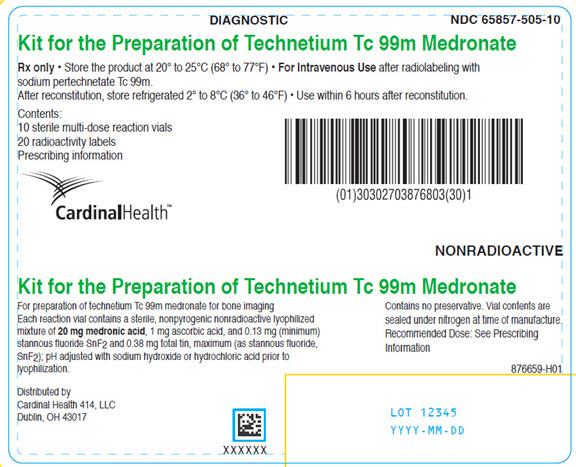
Kit for the Preparation of Technetium Tc 99m Medronate 20 mg Injection, Powder, Lyophilized, For Solution, 10-count
🆔 Identity & classification
Where does this data come from?
🏭 Manufacturer & labeler
Where does this data come from?
🩺 Clinical
Patient education
Supplement & herbal interactions
Where does this data come from?
Ask a licensed pharmacist directly — free, answered by our team.
🧪 Inactive Ingredients / Excipients
Inactive ingredients, also called excipients, are components of the drug product other than the active ingredient. They may include fillers, dyes, coatings, preservatives, flavors, or other formulation ingredients.
💡 Tap an ingredient (hover on desktop) to see what it is and why it’s used.
-
UNII PQ6CK8PD0R
Ascorbic acid, also known as vitamin C, is a white crystalline powder. It serves as an antioxidant to prevent degradation of other ingredients and may also function as a preservative in the formulation.
-
UNII QTT17582CB
A strong acid used to adjust and maintain the proper pH level in liquid medicines, ensuring stability and preventing breakdown of active ingredients.
-
UNII 55X04QC32I
A strong alkaline chemical used to adjust and maintain the pH balance of liquid medicines. It helps keep the medicine stable and ensures it stays effective during storage.
-
UNII 3FTR44B32Q
Stannous fluoride is a tin-based chemical compound used in oral medications and toothpastes. In medicines, it acts as an active therapeutic agent for tooth sensitivity and cavity prevention, and may serve as a buffer or stabilizer in the formulation.
4 inactive ingredients listed in the exact product block matched to this NDC.
Where does this data come from?
ingredient classCode="IACT" elements from the exact product block matched by this NDC. Label-section narrative from DailyMed / the openFDA label index is shown separately when available.Inactive ingredient FAQ
Are inactive ingredients the same for every manufacturer?
Why might an inactive ingredient be missing?
Can inactive ingredients matter?
💲 Pricing
A drug doesn't have one price. Each row is a different public payment system, and none is what you'd pay at the counter — that depends on your insurance. The ⓘ on each row explains what it measures.
| Price system | Per mL | Per package |
|---|---|---|
| Retail pharmacies payNADAC · weekly | Not in the retail survey — common for institutional, discontinued, or low-volume packs. | |
| Medicaid paysCMS SDUD · 12 mo | No recent Medicaid claims on file for this NDC — rare and low-volume NDCs are suppressed in the public data. | |
| Medicare drug plans payPart D · quarterly | No Part D plan price is available for this NDC in our data. | |
Where does this data come from?
🔁 Therapeutic equivalents
| Product | Labeler | Pack | NADAC/unit | TE | Status | Price vs. this |
|---|---|---|---|---|---|---|
| Kit for the Preparation of Technetium Tc 99m Medronate 20 mgthis 65857-0505-10 | Cardinal | 10 injections | — | AP | FDA listed | — |
Where does this data come from?
⏳ Availability & generic status
We did not find an FDA-approved generic match for this exact strength, form and route.
Where does this data come from?
🔬 Reported adverse events (FAERS)
Top reported reactions
Reporter sex
Serious outcomes
Where does this data come from?
📦 Packaging — all sizes for this product
| Package NDC | Description | Marketing start | Status |
|---|---|---|---|
| 65857-0505-10 You're viewing this | 10 INJECTION, POWDER, LYOPHILIZED, FOR SOLUTION in 1 CARTON (65857-505-10) | 2020-12-01 | Active |
🧭 About this NDC listing & data coverage
What data is (and isn’t) available for this NDC — tap to expand
| NDC identity (package / product / labeler codes) | ✓ Available |
| Labeler | ✓ Available |
| Product & package description | ✓ Available |
| Marketing category & status | ✓ Available |
| Active ingredient / dosage form / route | ✓ Available |
| FDA label (SPL via DailyMed) | ✓ Available |
| Package photos | ✓ Available |
| Inactive ingredients (structured) | ✓ Available |
| NADAC pharmacy acquisition price (CMS) | — Not published for this NDC CMS publishes NADAC only for NDCs reported in its retail-pharmacy survey. |
| Orange Book / therapeutic-equivalence data | ✓ Available |
| HCPCS J-code billing crosswalk | — Not published for this NDC Most self-administered / retail products have no J-code — that is normal. |
| Medicaid utilization (CMS SDUD) | — Not published for this NDC CMS reports utilization only for NDCs with Medicaid claims above its privacy threshold. |
Questions about this listing
Why is there no price listed?
Is the NDC printed on the package the same as the 11-digit billing NDC?
What do the three segments of this NDC mean?
Is this package still being marketed?
Who lists this product with the FDA?
Do I need a prescription for this product?
Where does this data come from?
📄 Full prescribing information FDA SPL
🎯 Indications and Usage ▾
INDICATIONS AND USAGE Technetium Tc 99m medronate may be used as a bone imaging agent to delineate areas of altered osteogenesis.
⏱️ Dosage and Administration ▾
DOSAGE AND ADMINISTRATION After preparation with oxidant-free sodium pertechnetate Tc 99m injection the suggested dose range of technetium Tc 99m medronate injection in the average patient (70 kg) is 370 MBq to 740 MBq (10 mCi to 20 mCi) given intravenously. Imaging post injection is optimal at 1 to 4 hours. The patient dose should be measured by a suitable radioactivity calibration system immediately prior to administration.
Parenteral drug products should be inspected visually for particulate matter and discoloration prior to administration whenever solution and container permit. Shielding should be utilized when preparing the technetium Tc 99m medronate injection. Radiation Dosimetry The effective half-life was assumed to be the physical half-life for all calculated values.
The estimated radiation absorbed doses to an average patient (70 kg) from an intravenous injection of a maximum dose of 740 MBq (20 mCi) of technetium Tc 99m medronate are shown in Table 4 . Table 4 Absorbed Radiation Dose Organ mGy/740 MBq rads/20 mCi Total Body 1.3
0.13Bone Total 7.0
0.70Red Marrow 5.6
0.56Kidneys 8.0
0.80Liver 0.6
0.06Bladder Wall 2-hr. void 26.0 2.60 4.8-hr. void 62.0
6.20Ovaries 2-hr. void 2.4 0.24 4.8-hr. void 3.4
0.34Testes 2-hr. void 1.6 0.16 4.8-hr. void 2.2
0.22Method of Calculation: “S” Absorbed Dose per Unit Cumulated Activity for Selected Radionuclides and Organs, MIRD Pamphlet No. 11, 1975
⛔ Contraindications ▾
CONTRAINDICATIONS None known.
⚠️ Warnings ▾
WARNINGS This class of compounds is known to complex cations such as calcium. Particular caution should be used with patients who have or who may be predisposed to hypocalcemia (i.e., alkalosis). Preliminary reports indicate interference with brain scans using sodium pertechnetate Tc 99m injection which have been preceded by a bone scan using an agent containing stannous ions.
This interference may result in false-positive or false-negative brain scans. It is recommended, where feasible, that brain scans precede bone imaging procedures. The biodistribution of technetium Tc 99m medronate may be altered in the presence of high levels of certain cations (iron, calcium, and aluminum).
This may result in reduced uptake of radionuclide in the skeleton and increased extraosseal uptake, which may potentially degrade imaging quality. High levels of these cations may be caused by concomitant medications or medical conditions (e.g., iron overload, hypercalcemia, etc.). Most cases were observed after iron infusion.
(See PRECAUTIONS, Drug Interactions .)
🤒 Adverse Reactions ▾
ADVERSE REACTIONS Several adverse reactions due to technetium Tc 99m medronate have been reported. These were usually hypersensitivity reactions characterized by itching, various skin rashes, hypotension, chills, nausea and vomiting. There have also been rare cases of dizziness and asthenia associated with the use of technetium Tc 99m medronate.
🔄 Drug Interactions ▾
Drug Interactions The biodistribution of technetium Tc 99m medronate may be altered in the presence of high levels of certain cations (iron, calcium, and aluminum). This may result in reduced uptake of radionuclide in the skeleton and increased extraosseal uptake, which may potentially degrade imaging quality. In patients with high levels of these cations caused by concomitant medications, particularly patients receiving iron infusions, consider performing an imaging study with technetium Tc 99m medronate injection once the cation levels have normalized (e.g., after 3 to 5 half-lives of the cation).
(See WARNINGS .)
🤰 Pregnancy ▾
Pregnancy Animal reproduction studies have not been conducted with technetium Tc 99m medronate. It is also not known whether technetium Tc 99m medronate can cause fetal harm when administered to a pregnant woman or can affect reproductive capacity. Technetium Tc 99m medronate should be given to a pregnant woman only if clearly needed.
🧒 Pediatric Use ▾
Pediatric Use Safety and effectiveness in children have not been established.
🧬 Clinical Pharmacology ▾
CLINICAL PHARMACOLOGY During the initial 24 hours following intravenous injection of technetium Tc 99m medronate, about 50 percent of the dose is retained in the skeleton, and about 50 percent is excreted in the urine. A minimum amount of uptake has been observed in soft-tissue organs, most notably the kidneys. Clearance of radioactivity from the blood is quite rapid, with about 10 percent of the injected dose remaining at one hour, and less than 5 and 2 percent at two and four hours, respectively.
The rapid blood clearance (T ½: 38 to 75 minutes) provides bone to non-osseous tissue ratios favoring early imaging. Following intravenous administration of technetium Tc 99m medronate, skeletal uptake occurs as a function of blood flow to bone and bone efficiency in extracting the complex. Bone mineral crystals are generally considered to be hydroxyapatite, and the complex appears to have an affinity for the hydroxyapatite crystals in bone.
Deposition of radioactivity in bone is rapid and appears to be related to osteogenic activity as well as the aforementioned skeletal blood perfusion. Skeletal uptake is bilaterally uniform, with larger concentrations in the axial structure and in the long bones. Increased accumulation of radioactivity may be seen, generally, in any bone disease state in which there is increased osteogenesis or a localized increase in osseous blood perfusion; consequently, bone imaging agents generally are not effective in detecting chronic bone diseases.
📦 How Supplied / Storage and Handling ▾
HOW SUPPLIED Kit for the Preparation of Technetium Tc 99m Medronate is supplied as kits of 10 reaction vials (NDC 65857-505-10). Each reaction vial contains a sterile, nonpyrogenic, nonradioactive lyophilized mixture of 20 mg medronic acid, 1 mg ascorbic acid, 0.13 mg (minimum) stannous fluoride, SnF 2 and 0.38 mg total tin, maximum (as stannous fluoride, SnF 2 ). The pH is adjusted with sodium hydroxide or hydrochloric acid prior to lyophilization.
The vial does not contain a preservative. The contents of the vial are lyophilized and sealed under nitrogen at the time of manufacture. The pH of the reconstituted product is 5.4 to 6.8.
Kit Contents 10 sterile reaction vials 20 pressure-sensitive labels for technetium Tc 99m medronate 1 package insert Storage Store the product as supplied at 20° to 25°C (68° to 77°F). After reconstitution store refrigerated at 2° to 8°C (36° to 46°F). Do not use and discard radiolabeled technetium Tc 99m medronate 6 hours after reconstitution.
📦 Storage and Handling ▾
Storage Store the product as supplied at 20° to 25°C (68° to 77°F). After reconstitution store refrigerated at 2° to 8°C (36° to 46°F). Do not use and discard radiolabeled technetium Tc 99m medronate 6 hours after reconstitution.
📋 Description ▾
DESCRIPTION Each reaction vial contains a sterile, nonpyrogenic, nonradioactive lyophilized mixture of 20 mg medronic acid, 1 mg ascorbic acid, 0.13 mg (minimum) stannous fluoride, SnF 2 and 0.38 mg total tin, maximum (as stannous fluoride, SnF 2 ). The pH is adjusted with sodium hydroxide or hydrochloric acid to 6.5 (6.3 to 6.7) prior to lyophilization. The vial does not contain a preservative.
The contents of the vial are lyophilized and sealed under nitrogen at the time of manufacture. The pH of the reconstituted product is 5.4 to 6.8. The structure of medronic acid is given below: The precise structure of technetium Tc 99m medronate is unknown at this time.
When sterile, pyrogen-free sodium pertechnetate Tc 99m injection is added to the vial, the diagnostic agent technetium Tc 99m medronate is formed for administration by intravenous injection. Structure of Medronic Acid