
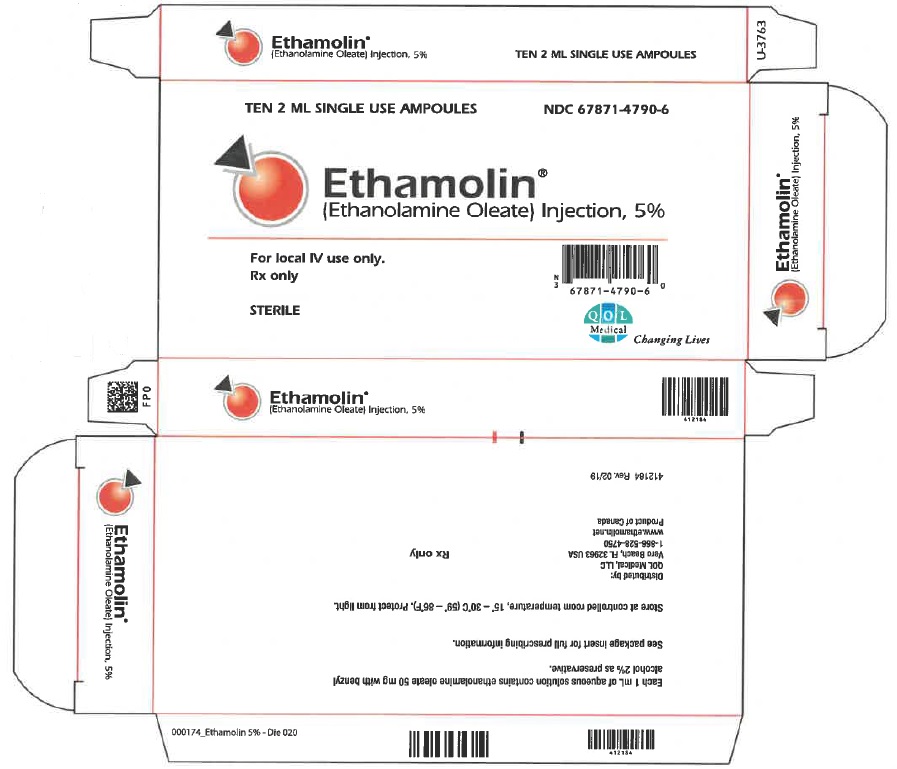
Ethamolin Ethanolamine Oleate 50 mg/mL Injection, Solution — NDC 67871-479-06 (Billing 67871-0479-06)
This is a package of Ethamolin Ethanolamine Oleate 50 mg/mL Injection, Solution from QOL Medical, LLC., marketed since Dec 1998 and currently FDA-listed. It is this product's only package size.
NDC database record
One package, one record: these facts belong to NDC 67871-479-06 alone.
- Record
- FDA NDC Directory package listing · Human prescription drug
- Code segments
- 67871 labeler · 479 product · 06 package
- Package marketed since
- Dec 22, 1998
- Sample package
- No — commercial package
- Listing certified through
- Dec 31, 2026
- Barcode (UPC-A, from the NDC)
- 3 6787147906 0
- FDA record last changed
- Jul 24, 2026
Identity & classification
Regulatory identifiers FDA, NLM and CMS codes for this package
Drug-database identifiers Medi-Span GPI and First Databank GCN / HICL / AHFS classification
- GPI-14 (Medi-Span): 99650015002010
- RxCUI (RxNorm): 106675
Where does this data come from?
- FDA openFDA NDC Directory · synced Oct 8, 2026
- FDA label on DailyMed · label index refreshed Oct 8, 2026
- RxNorm (NLM RxNav) · catalog refreshed Oct 1, 2026
- Medi-Span GPI (licensed)
- First Databank (licensed) · refreshed Oct 8, 2026
RxNorm drug class
This medicine belongs to the Sclerosing agents for local injection class.
Where does this data come from?
- RxClass (NLM) · catalog refreshed Oct 1, 2026
Clinical
Patient education
Supplement & herbal interactions
Where does this data come from?
- MedlinePlus (NLM) · refreshed Oct 8, 2026
- FDA label on DailyMed · label index refreshed Oct 8, 2026
Ask a licensed pharmacist directly — free, answered by our team.
Pricing
A drug doesn't have one price. Each row is a different public payment system, and none is what you'd pay at the counter — that depends on your insurance. The ⓘ on each row explains what it measures.
| Price system | Per mL | Per package |
|---|---|---|
| Retail pharmacies payNADAC · weekly | Not in the retail survey — common for institutional, discontinued, or low-volume packs. | |
| Medicaid paysCMS SDUD · 12 mo | No recent Medicaid claims on file for this NDC — rare and low-volume NDCs are suppressed in the public data. | |
| Medicare drug plans payPart D · quarterly | No Part D plan price is available for this NDC in our data. | |
Where does this data come from?
- CMS NADAC weekly file
- CMS ASP pricing files · refreshed Sep 20, 2026
- CMS Medicaid State Drug Utilization Data · refreshed Oct 8, 2026
- CMS Part D plan pricing files · refreshed Sep 24, 2026
- VA National Acquisition Center price file
Packaging — all sizes for this product
| Package NDC | Description | Marketing start | Marketing end | Status |
|---|---|---|---|---|
| 67871-0479-06 You're viewing this Main listing | 10 AMPULE in 1 BOX / 2 mL in 1 AMPULE | 1998-12-22 | — | Active |
Therapeutic equivalents
| Product | Labeler | Pack | NADAC/unit | TE | Status | Price vs. this |
|---|---|---|---|---|---|---|
| Ethamolin 50 mg/mLthis 67871-0479-06 | QOL | 10 ampules | — | — | FDA listed | — |
Where does this data come from?
- FDA openFDA NDC Directory · synced Oct 8, 2026
- FDA Orange Book · refreshed Oct 3, 2026
- CMS NADAC weekly file
Availability & generic status
We did not find an FDA-approved generic match for this exact strength, form and route.
Where does this data come from?
- FDA Orange Book · refreshed Oct 3, 2026
Inactive Ingredients / Excipients
Inactive ingredients, also called excipients, are components of the drug product other than the active ingredient. They may include fillers, dyes, coatings, preservatives, flavors, or other formulation ingredients.
💡 Tap an ingredient (hover on desktop) to see what it is and why it’s used.
-
UNII LKG8494WBH
Benzyl alcohol is a clear liquid used as a preservative and solvent in medicines. It helps prevent bacterial and fungal growth and dissolves other ingredients to create uniform liquid formulations.
-
UNII 059QF0KO0R
Water is a liquid solvent that dissolves and mixes ingredients together in liquid medicines, syrups, and injections. It helps distribute the active drug evenly throughout the product.
2 inactive ingredients listed in the exact product block matched to this NDC.
Where does this data come from?
ingredient classCode="IACT" elements from the exact product block matched by this NDC. Label-section narrative from DailyMed / the openFDA label index is shown separately when available.- FDA label on DailyMed · label index refreshed Oct 8, 2026
- FDA openFDA NDC Directory · synced Oct 8, 2026
Inactive ingredient FAQ
Are inactive ingredients the same for every manufacturer?
Why might an inactive ingredient be missing?
Can inactive ingredients matter?
Manufacturer & labeler
More NDCs from QOL Medical, LLC. labeler code 67871
Where does this data come from?
- FDA openFDA NDC Directory · synced Oct 8, 2026
- Drugs@FDA
Full prescribing information FDA SPL
🎯 Indications and Usage ▾
INDICATIONS AND USAGE ETHAMOLIN Injection is indicated for the treatment of patients with esophageal varices that have recently bled, to prevent rebleeding. ETHAMOLIN is not indicated for the treatment of patients with esophageal varices that have not bled. There is no evidence that treatment of this population decreases the likelihood of bleeding.
Sclerotherapy with ETHAMOLIN has no beneficial effect upon portal hypertension, the cause of esophageal varices, so that recanalization and collateralization may occur, necessitating reinjection.
⏱️ Dosage and Administration ▾
DOSAGE AND ADMINISTRATION Local ETHAMOLIN Injection sclerotherapy of esophageal varices should be performed by physicians who are famillar with an acceptable technique. The usual intravenous dose is 1.5 to 5.0 mL per varix. The maximum dose per treatment session should not exceed 20 mL.
Patients with significant liver dysfunction (Child Class C) or concomitant cardiopulmonary disease should usually receive less than the recommended maximum dose. Submucosal injections are not recommended as they reportedly are more likely to result in ulceration at the site of injection. To obliterate the varix, injections may be made at the time of the acute bleeding episode and then after one week, six weeks, three months, and six months, as indicated.
Note: Parenteral drug products should be inspected visually for particulate matter and discoloration before administration whenever solution and container permit.
⛔ Contraindications ▾
CONTRAINDICATIONS ETHAMOLIN Injection should not be administered to subjects with a known hypersensitivity to ethanolamine, oleic acid, or ethanolamine oleate.
⚠️ Warnings ▾
WARNINGS ETHAMOLlN Injection should be used in pregnant women only when clearly needed (see PRECAUTIONS). The practice of injecting varicosities of the leg with ETHAMOLlN Injection is not supported by adequately controlled clinical trials. Therefore, such use is not recommended.
🤒 Adverse Reactions ▾
ADVERSE REACTIONS The reported frequency of complications/adverse events per injection session was 13%. The most common complications were pleural effusion/infiltration (2.1%), esophageal ulcer (2.1 %), pyrexia (1.8%), retrosternal pain (1.6%), esophageal stricture (1.3%), and pneumonia (1.2%). Other adverse local esophageal reactions have also been reported at rates of 0.1 to 0.4%, including esophagitis, tearing of the esophagus, sloughing of the mucosa overlying the injected varix, ulceration, stricture, necrosis, periesophageal abscess and perforation (see PRECAUTIONS).
These complications appear to be dependent upon the dose and the patient's clinical state. Bacteremia has been observed in patients following injection of esophageal varices with ETHAMOLlN. Pyrexia and retrosternal pain are not infrequently observed during the post-injection period.
Fatal aspiration pneumonia has occurred in patients with esophageal varices who underwent ETHAMOLIN Injection Sclerotherapy (see PRECAUTIONS). Anaphylactic shock and acute renal failure with spontaneous recovery have occurred (see PRECAUTIONS). A case of disseminated intravascular coagulation has been reported.
Spinal cord paralysis due to occlusion of the anterior spinal artery has been reported in one child eight hours after ETHAMOLIN sclerotherapy.
🤰 Pregnancy ▾
Pregnancy: (Teratogenic Effects: Pregnancy Category C) Animal reproduction studies have not been conducted with ETHAMOLlN Injection. It is also not known whether ETHAMOLIN Injection can cause fetal harm when administered to a pregnant woman or can affect reproduction capacity. ETHAMOLIN Injection should be given to a pregnant woman only if clearly needed.
🧒 Pediatric Use ▾
Pediatric Use Safety and effectiveness in pediatric patients have not been established
🆘 Overdosage ▾
OVERDOSAGE Overdosage of ETHAMOLIN Injection can result in severe intramural necrosis of the esophagus. Complications resulting from such overdosage have resulted in death.
🧬 Clinical Pharmacology ▾
CLINICAL PHARMACOLOGY When injected intravenously, ETHAMOLIN Injection acts primarily by irritation of the intimal endothelium of the vein and produces a sterile dose-related inflammatory response. This results in fibrosis and possible occlusion of the vein. ETHAMOLIN Injection also rapidly diffuses through the venous wall and produces a dose-related extravascular inflammatory reaction.
The oleic acid component of ETHAMOLIN Injection is responsible for the inflammatory response, and may also activate coagulation in vivo by release of tissue factor and activation of Hageman factor. The ethanolamine component, however, may inhibit fibrin clot formation by chelating calcium, so that a procoagulant action of ETHAMOLIN has not been demonstrated. After injection, ETHAMOLIN disappears from the injection site within five minutes via the portal vein.
When volumes larger than 20 mL are injected, some ETHAMOLIN also flows into the azygos vein through the periesophageal vein. In human autopsy studies it was found that within four days after injection there is neutrophil infiltration of the esophageal wall and hemorrhage within six days. Granulation tissue is first seen at ten days, red thrombi obliterating the varices by twenty days, and sclerosis of the varices by two and a half months.
The time course of these findings suggests that sclerosis of esophageal varices will be a delayed rather than an immediate effect of the drug. The minimum lethal dose of ETHAMOLIN Injection administered intravenously to rabbits is 130 mg/kg. In dogs, ETHAMOLIN injected into the right atrium at a dose of 1 mL/kg over one minute has been shown to increase extravascular lung water.
The maximum recommended human dose is 20 mL, or 0.4 mL/kg for a 50-kg person. The concentration of ETHAMOLIN reaching the lung in human treatment will be less than in the dog studies, but pleural effusions, pulmonary edema, pulmonary infiltration and pneumonitis have been reported in clinical trials, and minimizing the total per-session dose, especially in patients with concomitant cardiopulmonary disease, is recommended (see PRECAUTIONS ).
📦 How Supplied / Storage and Handling ▾
HOW SUPPLIED NDC SIZE 67871-4790-6 2 mL ampule ETHAMOLIN® (Ethanolamine Oleate) Injection, 5% is available in 2 mL, sterile, single-use glass ampules supplied as boxes of 10 ampules. Storage Store at controlled room temperature, 15°- 30°C (59°- 86°F). Protect from light.
📦 Storage and Handling ▾
Storage Store at controlled room temperature, 15°- 30°C (59°- 86°F). Protect from light.
📋 Description ▾
DESCRIPTION ETHAMOLIN ® (Ethanolamine Oleate) Injection is a mild sclerosing agent. Chemically it is C 17 H 33 COOH•NH 2 CH 2 CH 2 OH. It has the following structure: The empirical formula is C 20 H 41 NO 3 , representing a molecular weight of 343.55.
ETHAMOLIN Injection consists of ethanolamine, a basic substance, which when combined with oleic acid, forms a clear pale-yellow to straw-colored, deliquescent oleate. The pH ranges from 8.2 to 9.2. ETHAMOLIN Injection is a sterile, apyrogenic, aqueous solution containing in each mL approximately 50 mg of ethanolamine oleate with benzyl alcohol 2% by volume as preservative.
Ethamolin Structure
⚠️ Precautions ▾
PRECAUTIONS Fatal anaphylactic shock was reported following injection of a larger than normal volume of ETHAMOLlN Injection into a male who had a known allergic disposition. Although there are only three known reports of anaphylaxis, the possibility of an anaphylactic reaction should be kept in mind, and the physician should be prepared to treat it appropriately. In extreme emergencies, 0.25 mL of a 1:1,000 intravenous solution of epinephrine (0.25 mg) should be used, and allergic reactions should be controlled with antihistamines.
Acute renal failure with spontaneous recovery followed injection of 15 to 20 mL of ETHAMOLIN Injection into two women. The physician should bear in mind that severe injection necrosis may result from direct injection of sclerosing agents, especially if excessive volumes are used. At least one fatal case of extensive esophageal necrosis and death has been reported.
The drug should be administered by physicians who are familiar with an acceptable injection technique. Patients in Child Class C are more likely to develop esophageal ulceration than those in Classes A and B. Complications of ulceration, necrosis, and delayed esophageal perforation appear to occur more frequently when ETHAMOLIN Injection is injected submucosally.
This route is not recommended. In patients with concomitant cardiorespiratory disease, careful monitoring and minimization of the total dose per session is recommended. Fatal aspiration pneumonia has occurred in elderly patients undergoing esophageal variceal sclerotherapy with ETHAMOLIN Injection.
This adverse event appears to be procedure-related, rather than drug-related; but as aspiration of blood and/or stomach contents is not uncommon in patients with bleeding esophageal varices, special precautions should be taken to prevent its occurrence, especially in elderly and critically-ill subjects. Pregnancy: (Teratogenic Effects: Pregnancy Category C) Animal reproduction studies have not been conducted with ETHAMOLlN Injection. It is also not known whether ETHAMOLIN Injection can cause fetal harm when administered to a pregnant woman or can affect reproduction capacity.
ETHAMOLIN Injection should be given to a pregnant woman only if clearly needed. Nursing Mothers It is not known whether this drug is excreted in human milk. Because many drugs are excreted in human milk, caution should be exercised when ETHAMOLlN Injection is administered to a nursing woman.
Pediatric Use Safety and effectiveness in pediatric patients have not been established
🍼 Nursing Mothers ▾
Nursing Mothers It is not known whether this drug is excreted in human milk. Because many drugs are excreted in human milk, caution should be exercised when ETHAMOLlN Injection is administered to a nursing woman.
🔒 Drug Abuse and Dependence ▾
DRUG ABUSE AND DEPENDENCE There is no potential for drug abuse or drug dependence.
📄 Package Label / Principal Display Panel ▾
Carton carton
Label label
About this NDC listing & data coverage
What data is (and isn’t) available for this NDC — tap to expand
| NDC identity (package / product / labeler codes) | ✓ Available |
| Labeler | ✓ Available |
| Product & package description | ✓ Available |
| Marketing category & status | ✓ Available |
| Active ingredient / dosage form / route | ✓ Available |
| FDA label (SPL via DailyMed) | ✓ Available |
| Package photos | ✓ Available |
| Inactive ingredients (structured) | ✓ Available |
| NADAC pharmacy acquisition price (CMS) | — Not published for this NDC CMS publishes NADAC only for NDCs reported in its retail-pharmacy survey. |
| Orange Book / therapeutic-equivalence data | — Not published for this NDC Applies only to products approved under an NDA/ANDA; many listings are out of scope. |
| HCPCS J-code billing crosswalk | — Not published for this NDC Most self-administered / retail products have no J-code — that is normal. |
| Medicaid utilization (CMS SDUD) | — Not published for this NDC CMS reports utilization only for NDCs with Medicaid claims above its privacy threshold. |