
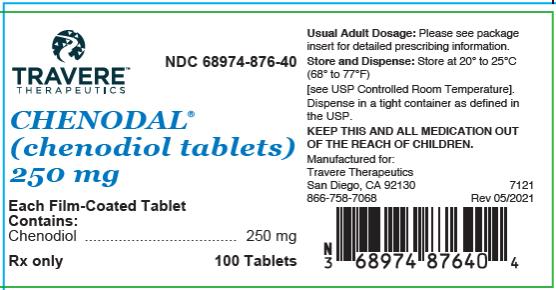
Chenodal Chenodiol 250 mg Tablet, Film Coated, 100-count — NDC 68974-876-40 (Billing 68974-0876-40)
This is a package of 100 tablets of Chenodal Chenodiol 250 mg Tablet, Film Coated from Travere Therapeutics, marketed since Dec 2015 and currently FDA-listed, this package's marketing is listed to end Nov 2026. It is this product's only package size.
NDC database record
One package, one record: these facts belong to NDC 68974-876-40 alone.
- Record
- FDA NDC Directory package listing · Human prescription drug
- Code segments
- 68974 labeler · 876 product · 40 package
- Package marketed since
- Dec 28, 2015
- Package marketing ended
- Nov 30, 2026
- Sample package
- No — commercial package
- Billing quantity
- 100 EA per package
- Barcode (UPC-A, from the NDC)
- 3 6897487640 4
- Medicaid fills, this package
- 63 prescriptions in the last four reported quarters
- FDA record last changed
- Jul 24, 2026
Identity & classification
Regulatory identifiers FDA, NLM and CMS codes for this package
Drug-database identifiers Medi-Span GPI and First Databank GCN / HICL / AHFS classification
- GSN (GCN sequence number): 003088
- GCN: 02040
- GPI-14 (Medi-Span): 52100010000305
- HICL (First Databank): 001364
- AHFS class code: 56:14.00.00
- RxCUI (RxNorm): 618469
Where does this data come from?
- FDA openFDA NDC Directory · synced Oct 8, 2026
- FDA label on DailyMed · label index refreshed Oct 6, 2026
- RxNorm (NLM RxNav) · catalog refreshed Oct 1, 2026
- Medi-Span GPI (licensed)
- First Databank (licensed) · refreshed Oct 8, 2026
RxNorm drug class
This medicine belongs to the Bile acids and derivatives class.
Where does this data come from?
- RxClass (NLM) · catalog refreshed Oct 1, 2026
Clinical
Patient education
Supplement & herbal interactions
Some supplements/herbs that may interact with Chenodiol — tap one for details:
Where does this data come from?
- MedlinePlus (NLM) · refreshed Oct 1, 2026
- FDA label on DailyMed · label index refreshed Oct 6, 2026
Ask a licensed pharmacist directly — free, answered by our team.
Pricing
A drug doesn't have one price. Each row is a different public payment system, and none is what you'd pay at the counter — that depends on your insurance. The ⓘ on each row explains what it measures.
| Price system | Per each | Per package |
|---|---|---|
| Retail pharmacies payNADAC · weekly | Not in the retail survey — common for institutional, discontinued, or low-volume packs. | |
| Medicaid paysCMS SDUD · 12 mo | $508.94 | $50,893.62 / 100 tablets |
| Medicare drug plans payPart D · quarterly | No Part D plan price is available for this NDC in our data. | |
Where does this data come from?
- CMS NADAC weekly file
- CMS ASP pricing files · refreshed Sep 20, 2026
- CMS Medicaid State Drug Utilization Data · through Q4 2025
- CMS Part D plan pricing files · refreshed Sep 24, 2026
- VA National Acquisition Center price file
Packaging — all sizes for this product
| Package NDC | Description | Marketing start | Marketing end | Status |
|---|---|---|---|---|
| 68974-0876-40 You're viewing this Main listing | 100 TABLET, FILM COATED in 1 BOTTLE, PLASTIC | 2015-12-28 | Nov 30, 2026 | Active |
Therapeutic equivalents
| Product | Labeler | Pack | NADAC/unit | TE | Status | Price vs. this |
|---|---|---|---|---|---|---|
| Chenodal 250 mgthis 68974-0876-40 | Travere | 100 tablets | — | — | FDA listed | — |
| Ctexli 250 mg 79378-0310-90 | Mirum | 100 tablets | — | — | FDA listed | — |
Where does this data come from?
- FDA openFDA NDC Directory · synced Oct 8, 2026
- FDA Orange Book · refreshed Oct 3, 2026
- CMS NADAC weekly file
Availability & generic status
This product is an FDA-approved generic. Other versions of the same drug are listed under Therapeutic equivalents, least expensive first.
Where does this data come from?
- FDA Orange Book · refreshed Oct 3, 2026
Inactive Ingredients / Excipients
Inactive ingredients, also called excipients, are components of the drug product other than the active ingredient. They may include fillers, dyes, coatings, preservatives, flavors, or other formulation ingredients.
💡 Tap an ingredient (hover on desktop) to see what it is and why it’s used.
-
UNII OP1R32D61U
Microcrystalline cellulose is a purified form of cellulose, a natural fiber from plant sources. It acts as a binder and filler in tablets and capsules, helping hold ingredients together and give the medicine its shape and size.
-
UNII PDC6A3C0OX
Glycerin is a clear, thick liquid derived from plant oils or fats. It acts as a humectant to retain moisture, a sweetener, and a solvent in medications.
-
UNII 70097M6I30
Magnesium stearate is a salt made from magnesium and stearic acid, a fatty substance. It's used in tablets and capsules as a lubricant and glidant to help ingredients flow smoothly during manufacturing and prevent sticking.
-
UNII 4GFU244C4J
Methylcellulose is a plant-based thickening agent made from cellulose. It acts as a binder to hold pill ingredients together and as a bulking agent to add texture and consistency to liquid or semi-solid medicines.
-
UNII ETJ7Z6XBU4
Silicon dioxide is a naturally occurring mineral used as a glidant and anti-caking agent. It helps powder ingredients flow smoothly and prevents clumping during manufacturing and storage.
-
UNII 368GB5141J
A detergent and foaming agent derived from coconut or palm oil. In medications, it helps break down and mix oil and water-based ingredients, aids in tablet disintegration, and improves how the drug dissolves and spreads in the mouth or digestive system.
-
UNII 5856J3G2A2
A starch-based powder made from potatoes and processed with sodium. It acts as a disintegrant, helping the tablet or capsule break apart quickly in the stomach so the medicine can be absorbed.
7 inactive ingredients listed in the exact product block matched to this NDC.
Where does this data come from?
ingredient classCode="IACT" elements from the exact product block matched by this NDC. Label-section narrative from DailyMed / the openFDA label index is shown separately when available.- FDA label on DailyMed · label index refreshed Oct 6, 2026
- FDA openFDA NDC Directory · synced Oct 8, 2026
Inactive ingredient FAQ
Are inactive ingredients the same for every manufacturer?
Why might an inactive ingredient be missing?
Can inactive ingredients matter?
Manufacturer & labeler
More NDCs from Travere Therapeutics labeler code 68974
Where does this data come from?
- FDA openFDA NDC Directory · synced Oct 8, 2026
- Drugs@FDA
Full prescribing information FDA SPL
🚨 Boxed Warning ▾
SPECIAL NOTE Because of the potential hepatoxicity of chenodiol, poor response rate in some subgroups of chenodiol treated patients, and an increased rate of a need for cholecystectomy in other chenodiol treated subgroups, chenodiol is not an appropriate treatment for many patients with gallstones. Chenodiol should be reserved for carefully selected patients and treatment must be accompanied by systematic monitoring for liver function alterations. Aspects of patient selection, response rates and risks versus benefits are given in the insert.
🎯 Indications and Usage ▾
INDICATIONS AND USAGE Chenodiol is indicated for patients with radiolucent stones in well-opacifying gallbladders, in whom selective surgery would be undertaken except for the presence of increased surgical risk due to systemic disease or age. The likelihood of successful dissolution is far greater if the stones are floatable or small. For patients with nonfloatable stones, dissolution is less likely and added weight should be given to the risk that more emergent surgery might result form a delay due to unsuccessful treatment.
Safety of use beyond 24 months is not established. Chenodiol will not dissolve calcified (radiopaque) or radiolucent bile pigment stones.
⏱️ Dosage and Administration ▾
DOSAGE AND ADMINISTRATION The recommended dose range for Chenodiol is 13 to 16 mg/kg/day in two divided doses, morning and night, starting with 250 mg b.i.d. the first two weeks and increasing by 250 mg/day each week thereafter until the recommended or maximum tolerated dose is reached. If diarrhea occurs during dosage buildup or later in treatment, it usually can be controlled by temporary dosage adjustment until symptoms abate, after which the previous dosage usually is tolerated. Dosage less than 10 mg/kg usually is ineffective and may be associated with increased risk of cholecystectomy, so is not recommended.
Body Weight Recommended Tablets/Day Dose Range mg/kg lb kg 100-130 45-58 3 17-13 131-185 59-75 4 17-13 186-200 76-90 5 18-14 201-235 91-107 6 18-14 236-275 108-125 7 18-14 The optimal frequency of monitoring liver function tests is not known. It is suggested that serum aminotransferase levels should be monitored monthly for the first three months and every three months thereafter during Chenodiol administration. Under NCGS guidelines, if a minor, usually transient elevations (1 ½ to3 three times the upper limit of normal) persisted longer than three to six months.
Chenodiol was discontinued and resumed only after the aminotransferase level returned to normal; however, allowing the elevations to persist over such an interval is not know to be safe. Elevations over three times the upper limit of normal require immediate discontinuation of Chenodiol and usually reoccur on challenge. Serum cholesterol should be monitored at six months intervals.
It may be advisable to discontinue Chenodiol if cholesterol rises above the acceptable age-adjusted limit for given patient. Oral cholecystograms or ultrasonograms are recommend at six to nine month intervals to monitor response. Complete dissolutions should be confirmed by a repeat test after one to three months continued Chenodiol administration.
Most patients who eventually achieve complete dissolution will show partial (or complete) dissolution at the first on-treatment test. If partial dissolution is not seen by nine to 12 months, the likelihood of success of treating loner is greatly reduced; Chenodiol should be discontinued if there is no response by 18 months. Safety of use beyond 24 months is not established.
Stone recurrence can be expected within five years in 50% of cases. After confirmed dissolution, treatment generally should be stopped. Serial cholecystograms or ultrasonograms are recommended to monitor for recurrence, keeping in mind that radiolucency and gallbladder function should be established before starting another course of Chenodiol.
A prophylactic doses is not established; reduced doses cannot be recommended; stones have recurred on 500 mg/day. Low cholesterol or carbohydrate diets, and dietary bran, have been reported to reduce biliary cholesterol; maintenance of reduced weight is recommended to forestall stone recurrence.
⛔ Contraindications ▾
CONTRAINDICATIONS Chenodiol is contraindicated in the presence of know hepatocyte dysfunction or bile ductal abnormalities such as intrahepatic cholestasis, primary biliary cirrhosis or sclerosing cholangitits (see Warnings); a gallbladder confirmed as nonvisualizing after two consecutive single doses of dye; radiopaque stones; or gallstone complications or compelling reasons for gallbladder surgery including unremitting acute cholecystitis, cholangitis, biliary obstruction, gallstone pancreatitis, or biliary gastrointestinal fistula.
Pregnancy Category X: Chenodiol may cause fetal harm when administered to a pregnant woman. Serious hepatic, renal and adrenal lesions occurred in fetuses of female Rhesus monkeys given 60 to 90 mg/kg/day (4 to 6 times the maximum recommended human dose, MRHD) from day 21 to day 45 of pregnancy. Hepatic lesions also occurred in neonatal baboons whose mothers had received 18 to 38 mg/kg ( 1 to 2 times the MRHD), all during pregnancy.
Fetal malformations were not observed. Neither fetal liver damage nor fetal abnormalities occurred in reproduction studies in rats and hamsters. No human data are available at this time.
Chenodiol is contraindicated in women who are or may become pregnant. If this drug is used during pregnancy, or if the patient becomes pregnant while taking this drug, the patient should be apprised of the potential hazard to the fetus.
⚠️ Warnings ▾
WARNINGS Safe use of chenodiol depends upon selection of patients without pre-existing liver disease and upon faithful monitoring of serum aminotransferase levels to detect drug-induced liver toxicity. Aminotransferase elevations over three times the upper limit of normal have required discontinuation of chenodiol in 2% to 3% of patients. Although clinical and biopsy studies have not shown fulminant lesions, the possibility remains that an occasional patient may develop serious hepatic disease.
Three patients with biochemical and histologic pictures of chronic active hepatitis while on chenodiol, 375 mg/day or 750 mg/day, have been reported. The biochemical abnormalities returned spontaneously to normal in two of the patients within 13 and 17 months; and after 17 months’ treatment with prednisone in the third. Follow-up biopsies were not done; and the causal relationship of the drug could not be determined.
Another biopsied patient was terminated from therapy because of elevated aminotransferase levels and a liver biopsy was interpreted as showing active drug hepatitis. One patient with sclerosing cholangitis, biliary cirrhosis and history of jaundice died during chenodiol treatment for hepatic duct stones. Before treatment, serum aminotransferase and alkaline phosphate levels were over twice the upper limit of normal; within one month they rose to over 10 time normal.
Chenodiol was discontinued at seven weeks, when the patient was hospitalized with advanced hepatic failure and E. coli peritonitis; death ensued at the eight week. A contribution of chenodiol to the fatal outcome could not be ruled out. Epidemiologic studies suggest that bile acids might contribute to human colon cancer, but direct evidence is lacking.
Bile acids, including chenodiol and lithocholic acid, have no carcinogenic potential in animal models, but have been shown to increase the number of tumors when administered with certain know carcinogens. The possibility that chenodiol therapy might contribute to colon cancer in otherwise susceptible individuals cannot be ruled out.
🤒 Adverse Reactions ▾
ADVERSE REACTIONS Hepatobiliary: Dose-related serum aminotransferase (mainly SGPT) elevations, usually not accompanied by rises in alkaline phosphatase or bilirubin, occurred in 30% or more of patients treated with the recommended dose of Chenodiol. In most cases, these elevations were minor (1 ½ to 3 times the upper limit of laboratory normal) and transient, returning to within the normal range within six months despite continued administration of the drug. In 2% to 3% of patients, SGPT levels rose to over three times the upper limit of laboratory normal, recurred on rechallenge with the drug, and required discontinuation of chenodiol treatment.
Enzyme levels have returned to normal following withdrawal of chenodiol ( see WARNINGS ). Morphologic studies of liver biopsies taken before and after 9 and 24 months of treatment with chenodiol have shown that 63% of the patients prior to chenodiol treatment had evidence of intrahepatic cholestasis. Almost all pretreatment patients had electron microscopic abnormalities.
By the ninth month of treatment, reexamination of two-thirds of the patients showed an 89% incidence of the signs of intrahepatic cholestasis. Two of 89 patients at the ninth month had lithocholate-like lesions in the canalicular membrane, although there were not clinical enzyme abnormalities in the face of continued treatment and no change in Type 2 light microscopic parameters. Increased Cholecystectomy Rate : NCGS patients with a history of biliary pain prior to treatment had higher cholecystectomy rates during the study if assigned to low dosage chenodiol (375 mg/day) than if assigned to either placebo or high dosage chenodiol (750 mg/day).
The association with low dosage chenodiol though not clearly a causal one, suggests that patients unable to take higher doses of chenodiol may be at greater risk of cholecystectomy. Gastrointestinal: Dose-related diarrhea has been encountered in 30% to 40% of chenodiol-treated patients and may occur at any time during treatment, but is most commonly encountered when treatment is initiated. Usually, the diarrhea is mild, translucent, well-tolerated and does not interfere with therapy.
Dose reduction has been required in 10% to 15% of patients, and in a controlled trial about half of these required a permanent reduction in dose. Anti-diarrhea agents have proven useful in some patients. Discontinuation of chenodiol because of failure to control diarrhea is to be expected in approximately 3% of patients treated.
Steady epigastric pain with nausea typical of lithiasis (biliary colic) usually is easily distinguishable from the crampy abdominal pain of drug-induced diarrhea. Other less frequent, gastrointestinal side effects reported include urgency, cramps, heartburn, constipation, nausea, and vomiting, anorexic, epigastric distress, dyspepsis, flatulence and nonspecific abdominal pain. Serum Lipids: Serum total cholesterol and low-density lipoprotein (LDL) cholesterol may rise 10% or more during administration of chenodiol: no change has been seen in the high-density lipoprotein (HDL) fraction; small decreases in serum triglyceride levels for females have been reported.
Hematologic: Decreases in white cell count, never below 3000, have been noted in a few patients treated with chenodiol; the drug was continued in all patients without incident.
🔄 Drug Interactions ▾
Drug Interactions Bile acid sequestering agents, such as cholestyramine and colestipol, may interfere with the action of Chenodiol by reducing its absorption. Aluminum-based antacids have been shown to absorb bile acids in vitro and may be expected to interfere with Chenodiol in the same manner as the sequestering agents. Estrogen, oral contraceptive and collaborate (and perhaps other lipid-lowering drugs) increase biliary cholesterol secretion, and the incidence of cholesterol gallstones hence may counteract the effectiveness of Chenodiol.
Due to its hepatotoxicity, chenodiol can affect the pharmacodynamics of coumarin and its derivatives, causing unexpected prolongation of the prothrombin time and hemorrahages. Patients on concommitant therapy with chenodiol and coumarin or its derivatives should be monitored carefully. If prolongation of prothrombin time is observed, the coumarin dosage should be readjusted to give a prothrombin time 1½ to 2 times normal.
If necessary chenodiol should be discontinued
🤰 Pregnancy ▾
Pregnancy Pregnancy Category X: See CONTRAINDICATIONS .
🧒 Pediatric Use ▾
Pediatric Use The safety and effectiveness of chenodiol in children have not been established.
🆘 Overdosage ▾
O verdosage Accidental or intentional overdoses of chenodiol have not been reported. One patient tolerated 4 gm/day (58 mg/kg/day) for six months without incident.
🧬 Clinical Pharmacology ▾
CLINICAL PHARMACOLOGY At therapeutic doses, chenodiol suppresses hepatic synthesis of both cholesterol and cholic acid, gradually replacing the latter and its metabolite, deoxycholic acid in an expanded bile acid pool. These actions contribute to biliary cholesterol desaturation and gradual dissolution of radiolucent cholesterol gallstones in the presence of a gall-bladder visualized by oral cholecystography. Chenodiol has no effect on radiopaque (calcified) gallstones or on radiolucent bile pigment stones.
Chenodiol is well absorbed from the small intestine and taken up by the liver where it is converted to its taurine and glycine conjugates and secreted in bile. Owing to 60 % to 80% first-pass hepatic clearance, the body pool of chenodiol resides mainly in the enterohepatic circulation; serum and urinary bile acid levels are not significantly affected during chenodiol therapy. At steady-state, an amount of chenodiol near the daily dose escapes to the colon and is converted by bacterial action to lithocholic acid.
About 80% of the lithocholate is excreted in the feces; the remainder is absorbed and converted in the liver to its poorly absorbed sulfolithocholyl conjugates. During chenodiol therapy there is only a minor increase in biliary lithocholate, while fecal bile acids are increased three- to fourfold. Chenodiol is unequivocally hepatotoxic in many animal species, including sub-human primates at doses close to the human dose.
Although the theoretical cause is the metabolite, lithocholic acid, an established hepatotoxin, and man has an efficient mechanism for sulfating and eliminating this substance, there is some evidence that the demonstrated hepatotoxicity is partly due to chenodiol per se . The hepatotoxicity of lithocholic acid is characterized biochemically and morphologically as cholestatic. Man has the capacity to form sulfate conjugates of lithocholic acid.
Variation in this capacity among individuals has not been well established and a recent published report suggests that patients who develop chenodiol-induced serum aminotransferase elevations are poor sulfators of lithocholic acid ( see ADVERSE REACTIONS and WARNINGS ) . General Clinical Results: Both the desaturation of bile and the clinical dissolution of cholesterol gallstones are dose-related. In the National Cooperative Gallstone Study (NCGS) involving 305 patients in each treatment group, placebo and chenodiol dosages of 375 mg and 750 mg per day were associated with complete stone dissolution in 0.8%, 5.2% and 13.5%, respectively, of enrolled subjects over 24 months of treatment.
Uncontrolled clinical trials using higher doses than those used in the NCGS have shown complete dissolution rates of 28 to 38% of enrolled patients receiving body weight doses of from 13 to 16 mg/kg/day for up to 24 months. In a prospective trial using 15 mg/kg/day, 31% enrolled surgical-risk patients treated more than six months (n = 86) achieved complete confirmed dissolutions. Observed stone dissolution rates achieved with chenodiol treatment are higher in subgroups having certain pretreatment characteristics.
In the NCGS, patients with small {less than 15 mm in diameter} radiolucent stones, the observed rate of complete dissolution was approximately 20% on 750 mg/day. In the uncontrolled trails using 13 to 16 mg/kg/day doses of chenodiol, the rates of complete dissolution for small radiolucent stones ranged from 42% to 60%. Even higher dissolution rates have been observed in patients with small floatable stones.
(See Floatable versus Nonfloatable Stones , below). Some obese patients and occasional normal weight patients fail to achieve bile desaturation even with doses of chenodiol up to 19 mg/kg/day for unknown reasons. Although dissolution is generally higher with increased dosage of chenodiol, doses that are too low are associated with increased cholecystectomy rates (see ADVERSE REACTIONS ).
Stones have recurred within five years in about 50% of patients following compl… [Excerpted — this section continues on DailyMed.]
📦 How Supplied / Storage and Handling ▾
HOW SUPPLIED Chenodal® (chenodiol tablets) is available as white film-coated 250 mg tablets imprinted “MP” on one side and "250" on the other in bottles of 100, NDC 68974-876-40. Store at 20 o C to 25 o C (68 o F to 77 o F) [see USP Controlled Room Temperature]. Dispense in a tight container. Manufactured for: Retrophin, Inc. San Diego, CA 92130 866-758-7068 Rev. 06/15
📋 Description ▾
DESCRIPTION Chenodiol is the non-proprietary name for chenodeoxycholic acid, a naturally occurring human bile acid. It is a bitter-tasting white powder consisting of crystalline and amorphous particles freely soluble in methanol, acetone and acetic acid and practically insoluble in water. Its chemical name is 3α, 7α-dihydroxy-5β-cholan-24-oic acid (C 24 H 40 O 4 ), it has a molecular weight of 392.58, and its structure is shown below; Chenodiol film-coated tablets for oral administration contain 250 mg of chenodiol.
Inactive ingredients: pregelatinized starch; silicon dioxide; microcrystalline cellulose, sodium starch glycollate; and magnesium stearate; the thin-film coating contains: opadry YS-2-7035 [consisting of methylcellulose and glycerin] and sodium lauryl sulfate Its chemical name is 3α, 7α-dihydroxy-5β-cholan-24-oic acid (C24H40O4), it has a molecular weight of 392.58, and its structure is shown below;
💬 Information for Patients ▾
Information for Patients Patients should be counseled on the importance of periodic visits for liver function tests and oral cholecystograms (or ultrasonograms) for monitoring stone dissolution; they should be made aware of the symptoms of gallstone complications and be warned to report immediately such symptoms to the physician. Patients should be instructed on ways to facilitate faithful compliance with the dosage regimen throughout the usual long term of therapy, and on temporary doses reduction if episodes of diarrhea occur.
⚠️ Precautions ▾
PRECAUTIONS Information for Patients Patients should be counseled on the importance of periodic visits for liver function tests and oral cholecystograms (or ultrasonograms) for monitoring stone dissolution; they should be made aware of the symptoms of gallstone complications and be warned to report immediately such symptoms to the physician. Patients should be instructed on ways to facilitate faithful compliance with the dosage regimen throughout the usual long term of therapy, and on temporary doses reduction if episodes of diarrhea occur.
Drug Interactions Bile acid sequestering agents, such as cholestyramine and colestipol, may interfere with the action of Chenodiol by reducing its absorption. Aluminum-based antacids have been shown to absorb bile acids in vitro and may be expected to interfere with Chenodiol in the same manner as the sequestering agents. Estrogen, oral contraceptive and collaborate (and perhaps other lipid-lowering drugs) increase biliary cholesterol secretion, and the incidence of cholesterol gallstones hence may counteract the effectiveness of Chenodiol.
Due to its hepatotoxicity, chenodiol can affect the pharmacodynamics of coumarin and its derivatives, causing unexpected prolongation of the prothrombin time and hemorrahages. Patients on concommitant therapy with chenodiol and coumarin or its derivatives should be monitored carefully. If prolongation of prothrombin time is observed, the coumarin dosage should be readjusted to give a prothrombin time 1½ to 2 times normal.
If necessary chenodiol should be discontinued Carcinogenesis, Mutagenesis, Impairment of Fertility A two-year oral study of chenodiol in rats failed to show a carcinogenic potential at the tested levels of 15 to 60 mg/kg/day (1 to 4 times the maximum recommended human dose, MRHD). It has been reported that chenodiol given in long-term studies at oral doses up to 600 mg/kg/day (40 times the MRHD) to rats and 1000 mg/kg/day (65 times the MRHD) to mice induced benign and malignant liver cell tumors in female rats and cholangiomata in female rats and male mice.
Two-year studies of lithocholic acid ( a major metabolite of chenodiol) in mice (125 to 250 mg/kg/day) and rats (250 and 500 mg/kg/day) found it not to be carcinogenic. The dietary administration of Lithocholic acid to chickens is reported to cause hepatic adenomatous hyperplasia. Pregnancy Pregnancy Category X: See CONTRAINDICATIONS .
Nursing Mothers It is not known whether chenodiol is excreted in human mild. Because many drugs are excreted in human milk, caution should be exercised when chenodiol is administered to a nursing mother. Pediatric Use The safety and effectiveness of chenodiol in children have not been established.
🍼 Nursing Mothers ▾
Nursing Mothers It is not known whether chenodiol is excreted in human mild. Because many drugs are excreted in human milk, caution should be exercised when chenodiol is administered to a nursing mother.
🔒 Drug Abuse and Dependence ▾
DRUG ABUSE AND DEPENDENCE O verdosage Accidental or intentional overdoses of chenodiol have not been reported. One patient tolerated 4 gm/day (58 mg/kg/day) for six months without incident.
📄 Carcinogenesis, Mutagenesis, Impairment of Fertility ▾
Carcinogenesis, Mutagenesis, Impairment of Fertility A two-year oral study of chenodiol in rats failed to show a carcinogenic potential at the tested levels of 15 to 60 mg/kg/day (1 to 4 times the maximum recommended human dose, MRHD). It has been reported that chenodiol given in long-term studies at oral doses up to 600 mg/kg/day (40 times the MRHD) to rats and 1000 mg/kg/day (65 times the MRHD) to mice induced benign and malignant liver cell tumors in female rats and cholangiomata in female rats and male mice. Two-year studies of lithocholic acid ( a major metabolite of chenodiol) in mice (125 to 250 mg/kg/day) and rats (250 and 500 mg/kg/day) found it not to be carcinogenic.
The dietary administration of Lithocholic acid to chickens is reported to cause hepatic adenomatous hyperplasia.
📄 Package Label / Principal Display Panel ▾
PRINCIPAL DISPLAY PANEL NDC 68974-876-40 Chenodal 250 mg 100 Tablets Rx Only PRINCIPAL DISPLAY PANEL NDC 68974-876-40 Chenodal 250 mg 100 Tablets Rx Only
Medicaid utilization & spend
Medicare Part D spend CMS · PART D · 2025 (Q1-Q4)
Reported adverse events (FAERS)
Top reported reactions
Age at onset
Reporter sex
Serious outcomes
Where does this data come from?
About this NDC listing & data coverage
What data is (and isn’t) available for this NDC — tap to expand
| NDC identity (package / product / labeler codes) | ✓ Available |
| Labeler | ✓ Available |
| Product & package description | ✓ Available |
| Marketing category & status | ✓ Available |
| Active ingredient / dosage form / route | ✓ Available |
| FDA label (SPL via DailyMed) | ✓ Available |
| Package photos | ✓ Available |
| Inactive ingredients (structured) | ✓ Available |
| NADAC pharmacy acquisition price (CMS) | — Not published for this NDC CMS publishes NADAC only for NDCs reported in its retail-pharmacy survey. |
| Orange Book / therapeutic-equivalence data | — Not published for this NDC Applies only to products approved under an NDA/ANDA; many listings are out of scope. |
| HCPCS J-code billing crosswalk | — Not published for this NDC Most self-administered / retail products have no J-code — that is normal. |
| Medicaid utilization (CMS SDUD) | ✓ Available |