
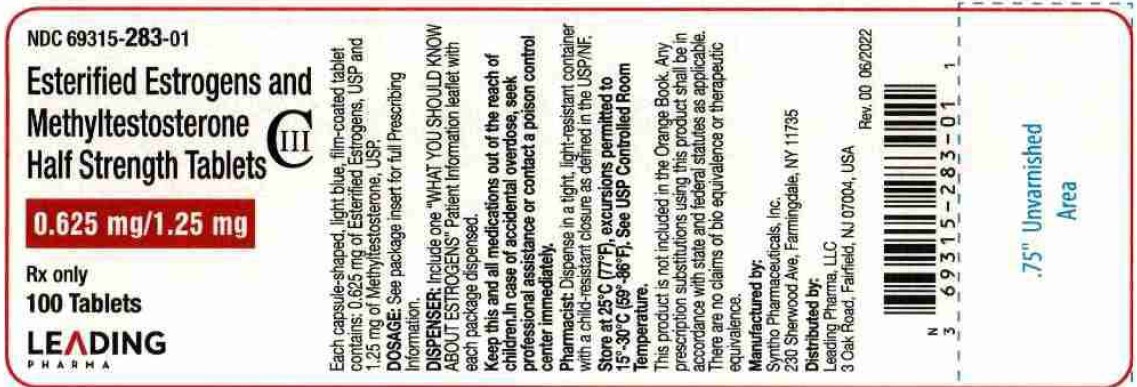
Esterified Estrogens and Methyltestosterone .625 mg; 1.25 mg Tablet, 100-count — NDC 69315-283-01 (Billing 69315-0283-01)
This is a package of 100 tablets of Esterified Estrogens and Methyltestosterone .625 mg; 1.25 mg Tablet from Leading Pharmaceuticals, LLC, marketed since Oct 2022 and currently FDA-listed. It is this product's only package size.
NDC database record
One package, one record: these facts belong to NDC 69315-283-01 alone.
- Record
- FDA NDC Directory package listing · Human prescription drug
- Code segments
- 69315 labeler · 283 product · 01 package
- Package marketed since
- Oct 1, 2022
- Sample package
- No — commercial package
- Listing certified through
- Dec 31, 2026
- Billing quantity
- 100 EA per package
- Barcode (UPC)
- 0369315284018, 0369315283011
- FDA record last changed
- Oct 8, 2026
Identity & classification
Regulatory identifiers FDA, NLM and CMS codes for this package
Drug-database identifiers Medi-Span GPI and First Databank GCN / HICL / AHFS classification
- GSN (GCN sequence number): 003257
- GCN: 68030
- GPI-14 (Medi-Span): 24991002300305
- HICL (First Databank): 001438
- AHFS class code: 68:08.00.00
- RxCUI (RxNorm): 197670
Where does this data come from?
- FDA openFDA NDC Directory · synced Oct 8, 2026
- FDA label on DailyMed · label index refreshed Oct 8, 2026
- RxNorm (NLM RxNav) · catalog refreshed Oct 1, 2026
- Medi-Span GPI (licensed)
- First Databank (licensed) · refreshed Oct 8, 2026
Clinical
This is an oral tablet containing esterified estrogens and methyltestosterone. Esterified estrogens are a form of estrogen typically used in hormone therapy, while methyltestosterone is an androgen (male hormone) commonly used to address low testosterone levels. This combination product is marketed without an FDA-approved application and is a prescription medication.
Patient education
Supplement & herbal interactions
Some supplements/herbs that may interact with Esterified Estrogens, Methyltestosterone — tap one for details:
Esterified Estrogens, Methyltestosterone may be associated with lower levels of 5 nutrients — worth a chat with your pharmacist, not a cause for alarm.
Where does this data come from?
- MedlinePlus (NLM) · refreshed Oct 8, 2026
- FDA label on DailyMed · label index refreshed Oct 8, 2026
Ask a licensed pharmacist directly — free, answered by our team.
Pricing
A drug doesn't have one price. Each row is a different public payment system, and none is what you'd pay at the counter — that depends on your insurance. The ⓘ on each row explains what it measures.
| Price system | Per each | Per package |
|---|---|---|
| Retail pharmacies payNADAC · weekly | Not in the retail survey — common for institutional, discontinued, or low-volume packs. | |
| Medicaid paysCMS SDUD · 12 mo | No recent Medicaid claims on file for this NDC — rare and low-volume NDCs are suppressed in the public data. | |
| Medicare drug plans payPart D · quarterly | No Part D plan price is available for this NDC in our data. | |
Where does this data come from?
- CMS NADAC weekly file
- CMS ASP pricing files · refreshed Sep 20, 2026
- CMS Medicaid State Drug Utilization Data · refreshed Oct 8, 2026
- CMS Part D plan pricing files · refreshed Sep 24, 2026
- VA National Acquisition Center price file
Packaging — all sizes for this product
| Package NDC | Description | Marketing start | Marketing end | Status |
|---|---|---|---|---|
| 69315-0283-01 You're viewing this Main listing | 100 TABLET in 1 BOTTLE | 2022-10-01 | — | Active |
Therapeutic equivalents
Where does this data come from?
- FDA openFDA NDC Directory · synced Oct 8, 2026
- FDA Orange Book · refreshed Oct 3, 2026
- CMS NADAC weekly file
Availability & generic status
We did not find an FDA-approved generic match for this exact strength, form and route.
Where does this data come from?
- FDA Orange Book · refreshed Oct 3, 2026
What it looks like
Where does this data come from?
- FDA label on DailyMed · label index refreshed Oct 8, 2026
Inactive Ingredients / Excipients
Inactive ingredients, also called excipients, are components of the drug product other than the active ingredient. They may include fillers, dyes, coatings, preservatives, flavors, or other formulation ingredients.
💡 Tap an ingredient (hover on desktop) to see what it is and why it’s used.
-
UNII 35SW5USQ3G
A synthetic yellow dye used to color medicines. It helps make tablets, capsules, and liquids visually distinct so patients can easily identify their medication.
-
UNII H3R47K3TBD
FD&C Blue No. 1 is a synthetic blue dye approved for use in foods and medicines. It serves as a colorant to give the medication its distinctive appearance and help with product identification.
-
UNII EWQ57Q8I5X
Lactose monohydrate is a natural sugar derived from milk. It serves as a filler and binder in tablets and capsules, helping create the proper size, texture, and consistency of the medicine.
-
UNII 70097M6I30
Magnesium stearate is a salt made from magnesium and stearic acid, a fatty substance. It's used in tablets and capsules as a lubricant and glidant to help ingredients flow smoothly during manufacturing and prevent sticking.
-
UNII OP1R32D61U
Microcrystalline cellulose is a purified form of cellulose, a natural fiber from plant sources. It acts as a binder and filler in tablets and capsules, helping hold ingredients together and give the medicine its shape and size.
-
UNII 15FIX9V2JP
Titanium dioxide is a bright white mineral powder commonly used as a colorant and opacifying agent. It makes pills and tablets white or lighter in color and helps make coatings non-transparent.
-
UNII 059QF0KO0R
Water is a liquid solvent that dissolves and mixes ingredients together in liquid medicines, syrups, and injections. It helps distribute the active drug evenly throughout the product.
7 inactive ingredients listed in the exact product block matched to this NDC.
Where does this data come from?
ingredient classCode="IACT" elements from the exact product block matched by this NDC. Label-section narrative from DailyMed / the openFDA label index is shown separately when available.- FDA label on DailyMed · label index refreshed Oct 8, 2026
- FDA openFDA NDC Directory · synced Oct 8, 2026
Inactive ingredient FAQ
Are inactive ingredients the same for every manufacturer?
Why might an inactive ingredient be missing?
Can inactive ingredients matter?
Manufacturer & labeler
More NDCs from Leading Pharmaceuticals, LLC labeler code 69315
- Ketorolac Tromethamine 10 mg Tablet, Film Coated NDC 69315-260-01
- Prochlorperazine Maleate 5 mg Tablet, Film Coated NDC 69315-265-01
- Prochlorperazine Maleate 10 mg Tablet, Film Coated NDC 69315-266-01
- Diclofenac Potassium 25 mg Capsule, Liquid Filled NDC 69315-275-20
- Fenofibric Acid 45 mg Capsule, Delayed Release NDC 69315-281-09
- Fenofibric Acid 135 mg Capsule, Delayed Release NDC 69315-282-09
- Esterified Estrogens and Methyltestosterone 1.25 mg; 2.5 mg Tablet NDC 69315-284-01
- Etravirine 100 mg Tablet NDC 69315-285-20
- Etravirine 200 mg Tablet NDC 69315-286-06
- fenofibrate 48 mg Tablet NDC 69315-287-09
- fenofibrate 145 mg Tablet NDC 69315-288-05
- Fenofibrate 54 mg Tablet, Film Coated NDC 69315-289-09
Where does this data come from?
- FDA openFDA NDC Directory · synced Oct 8, 2026
- Drugs@FDA
Full prescribing information FDA SPL
🚨 Boxed Warning ▾
WARNINGS 1. ESTROGENS HAVE BEEN REPORTED TO INCREASE THE RISK OF ENDOMETRIAL CARCINOMA Three independent case control studies have reported an increased risk of endometrial cancer in postmenopausal women exposed to exogenous estrogens for prolonged periods.1-3 This risk was independent of the other known risk factors for endometrial cancer. These studies are further supported by the finding that incidence rates of endometrial cancer have increased sharply since 1969 in eight different areas of the United States with population-based cancer reporting systems, an increase which may be related to the rapidly expanding use of estrogens during the last decade.
4 The three case control studies reported that the risk of endometrial cancer in estrogen users was about 4.5 to 13.9 times greater than in nonusers. The risk appears to depend on both duration of treatment1 and on estrogen dose. 3 In view of these findings, when estrogens are used for the treatment of menopausal symptoms, the lowest dose that will control symptoms should be utilized and medication should be discontinued as soon as possible.
When prolonged treatment is medically indicated, the patient should be reassessed on at least a semiannual basis to determine the need for continued therapy. Although the evidence must be considered preliminary, one study suggests that cyclic administration of low doses of estrogen may carry less risk than continuous administration, 3 it therefore appears prudent to utilize such a regimen. Close clinical surveillance of all women taking estrogens is important.
In all cases of undiagnosed persistent or recurring abnormal vaginal bleeding, adequate diagnostic measures should be undertaken to rule out malignancy. There is no evidence at present that "natural" estrogens are more or less hazardous than "synthetic" estrogens at equiestrogenic doses. 2.
ESTROGENS SHOULD NOT BE USED DURING PREGNANCY The use of female sex hormones, both estrogens and progestogens, during early pregnancy may seriously damage the offspring. It has been shown that females exposed in utero to diethylstilbestrol, a non-steroidal estrogen, have an increased risk of developing in later life a form of vaginal or cervical cancer that is ordinarily extremely rare. 5,6 This risk has been estimated as not greater than 4 per 1000 exposures.
7 Furthermore, a high percentage of such exposed women (from 30 to 90 percent) have been found to have vaginal adenosis, 8-12 epithelial changes of the vagina and cervix. Although these changes are histologically benign, it is not known whether they are precursors of malignancy. Although similar data are not available with the use of other estrogens, it cannot be presumed they would not induce similar changes.
Several reports suggest an association between intrauterine exposure to female sex hormones and congenital anomalies, including congenital heart defects and limb reduction defects.13-16 One case control study16 estimated a 4.7 fold increased risk of limb reduction defects in infants exposed in utero to sex hormones (oral contraceptives, hormone withdrawal tests for pregnancy, or attempted treatment for threatened abortion). Some of these exposures were very short and involved only a few days of treatment. The data suggest that the risk of limb reduction defects in exposed fetuses is somewhat less than 1 per 1000.
In the past, female sex hormones have been used during pregnancy in an attempt to treat threatened or habitual abortion. There is considerable evidence that estrogens are ineffective for these indications, and there is no evidence from well controlled studies that progesterones are effective for these uses. IF ESTERIFIED ESTROGENS AND METHYLTESTOSTERONE FULL STRENGTH or ESTERIFIED ESTROGENS AND METHYLTESTOSTERONE HALF STRENGTH is used during pregnancy, or if the patient becomes pregnant while taking this drug, she should be apprised of the potential risks to the fetus, and the advisability of pregnancy continuation.
🎯 Indications and Usage ▾
INDICATIONS AND USAGE ESTERIFIED ESTROGENS AND METHYLTESTOSTERONE FULL STRENGTH and ESTERIFIED ESTROGENS AND METHYLTESTOSTERONE HALF STRENGTH are indicated in the treatment of: Moderate to severe vasomotor symptoms associated with the menopause in those patients not improved by estrogens alone. (There is no evidence that estrogens are effective for nervous symptoms or depression without associated vasomotor symptoms, and they should not be used to treat such conditions.) ESTERIFIED ESTROGENS AND METHYLTESTOSTERONE FULL STRENGTH and ESTERIFIED ESTROGENS AND METHYLTESTOSTERONE HALF STRENGTH HAVE NOT BEEN SHOWN TO BE EFFECTIVE FOR ANY PURPOSE DURING PREGNANCY AND ITS USE MAY CAUSE SEVERE HARM TO THE FETUS (SEE BOXED WARNING ).
⏱️ Dosage and Administration ▾
DOSAGE AND ADMINISTRATION 1. Given cyclically for short-term use only: For treatment of moderate to severe vasomotor symptoms associated with the menopause in patients not improved by estrogen alone. The lowest dose that will control symptoms should be chosen and medication should be discontinued as promptly as possible.
Administration should be cyclic (e.g., three weeks on and one week off). Attempts to discontinue or taper medication should be made at three to six month intervals. Usual Dosage Range 1 tablet of ESTERIFIED ESTROGENS AND METHYLTESTOSTERONE FULL STRENGTH or 1 to 2 tablets of ESTERIFIED ESTROGENS AND METHYLTESTOSTERONE HALF STRENGTH daily as recommended by the physician.
Treated patients with an intact uterus should be monitored closely for signs of endometrial cancer and appropriate diagnostic measures should be taken to rule out malignancy in the event of persistent or recurring abnormal vaginal bleeding.
⚠️ Warnings ▾
WARNINGS Associated with Estrogens Induction of malignant neoplasms . Long term continuous administration of natural and synthetic estrogens in certain animal species increases this frequency of carcinomas of the breast, cervix, vagina, and liver. There is now evidence that estrogens increase the risk of carcinoma of the endometrium in humans (See Boxed Warning ).
At the present time there is no satisfactory evidence that estrogens given to postmenopausal women increase the risk of cancer of the breast, 18 although a recent long-term follow-up of a single physician's practice has raised this possibility. 18a Because of the animal data, there is a need for caution in prescribing estrogens for women with a strong family history of breast cancer or who have breast nodules, fibrocystic disease, or abnormal mammograms. 2.
Gallbladder disease . A recent study has reported a 2 to 3-fold increase in the risk of surgically confirmed gallbladder disease in women receiving postmenopausal estrogens, 18 similar to the 2-fold increase previously noted in users of oral contraceptives. 19-24a In the case of oral contraceptives the increased risk appeared after two years of use.
24 3. Effects similar to those caused by estrogen-progesterone oral contraceptives . There are several serious adverse effects of oral contraceptives, most of which have not, up to now, been documented as consequences of postmenopausal estrogen therapy.
This may reflect the comparatively low doses of estrogen used in postmenopausal women. It would be expected that the larger doses of estrogen used to treat prostatic or breast cancer or postpartum breast engorgement are more likely to result in these adverse effects, and, in fact, it has been shown that there is an increased risk of thrombosis in men receiving estrogens for prostatic cancer and women for postpartum breast engorgement. 20-23 a.
Thromboembolic disease. It is now well established that users of oral contraceptives have an increased risk of various thromboembolic and thrombotic vascular diseases, such as thrombophlebitis, pulmonary embolism, stroke, and myocardial infarction. 24-31 Cases of retinal thrombosis, mesenteric thrombosis, and optic neuritis have been reported in oral contraceptive users.
There is evidence that the risk of several of these adverse reactions is related to the dose of the drug. 32-33 An increased risk of postsurgery thromboembolic complications has also been reported in users of oral contraceptives. 34-35 If feasible, estrogen should be discontinued at least 4 weeks before surgery of the type associated with an increased risk of thromboembolism, or during periods of prolonged immobilization.
While an increased rate of thromboembolic and thrombotic disease in postmenopausal users of estrogens has not been found, 18-36 this does not rule out the possibility that such an increase may be present or that subgroups of women who have underlying risk factors or who are receiving relatively large doses of estrogens may have increased risk. Therefore estrogens should not be used in persons with active thrombophlebitis or thromboembolic disorders, and they should not be used (except in treatment of malignancy) in persons with a history of such disorders in association with estrogen use.
They should be used with caution in patients with cerebral vascular or coronary artery disease and only for those in whom estrogens are clearly needed. Large doses of estrogen (5 mg esterified estrogens per day), comparable to those used to treat cancer of the prostate and breast, have been shown in a large prospective clinical trial in men 37 to increase the risk of nonfatal myocardial infarction, pulmonary embolism and thrombophlebitis. When estrogen doses of this size are used, any of the thromboembolic and thrombotic adverse effects associated with oral contraceptive use should be considered a clear risk. b.
Hepatic adenoma. Benign hepatic adenomas appear to be associated with the use of oral contraceptives.… [Excerpted — this section continues on DailyMed.]
🔄 Drug Interactions ▾
D. Drug Interactions 1. Anticoagulants C-17 substituted derivatives of testosterone, such as methandrostenolone, have been reported to decrease the anticoagulant requirements of patients receiving oral anticoagulants.
Patients receiving oral anticoagulant therapy require close monitoring, especially when androgens are started or stopped. 2. Oxyphenbutazone .
Concurrent administration of oxyphenbutazone and androgens may result in elevated serum levels of oxyphenbutazone. 3. Insulin .
In diabetic patients the metabolic effects of androgens may decrease blood glucose and insulin requirements.
🤰 Pregnancy ▾
G. Pregnancy Teratogenic Effects . Pregnancy Category X (see CONTRAINDICATIONS ).
🧬 Clinical Pharmacology ▾
CLINICAL PHARMACOLOGY Estrogens Estrogens are important in the development and maintenance of the female reproductive system and secondary sex characteristics. They promote growth and development of the vagina, uterus, and fallopian tubes, and enlargement of the breasts. Indirectly, they contribute to the shaping of the skeleton, maintenance of tone and elasticity of urogenital structures, changes in the epiphyses of the long bones that allow for the pubertal growth spurt and its termination, growth of axillary and pubic hair, and pigmentation of the nipples and genitals.
Decline of estrogenic activity at the end of the menstrual cycle can bring on menstruation, although the cessation of progesterone secretion is the most important factor in the mature ovulatory cycle. However, in the preovulatory or nonovulatory cycle, estrogen is the primary determinant in the onset of menstruation. Estrogens also affect the release of pituitary gonadotropins.
The pharmacologic effects of esterified estrogens are similar to those of endogenous estrogens. They are soluble in water and are well absorbed from the gastrointestinal tract. In responsive tissues (female genital organs, breasts, hypothalamus, pituitary) estrogens enter the cell and are transported into the nucleus.
As a result of estrogen action, specific RNA and protein synthesis occurs. Estrogen Pharmacokinetics Metabolism and inactivation occur primarily in the liver. Some estrogens are excreted into the bile; however they are reabsorbed from the intestine and returned to the liver through the portal venous system.
Water soluble esterified estrogens are strongly acidic and are ionized in body fluids, which favor excretion through the kidneys since tubular reabsorption is minimal. Androgens Endogenous androgens are responsible for the normal growth and development of the male sex organs and for maintenance of secondary sex characteristics. These effects include the growth and maturation of prostate, seminal vesicles, penis, and scrotum; the development of male hair distribution, such as beard, pubic, chest and axillary hair, laryngeal enlargement, vocal cord thickening, alterations in body musculature, and fat distribution.
Drugs in this class also cause retention of nitrogen, sodium, potassium, phosphorus, and decreased urinary excretion of calcium. Androgens have been reported to increase protein anabolism and decrease protein catabolism. Nitrogen balance is improved only when there is sufficient intake of calories and protein.
Androgens are responsible for the growth spurt of adolescence and for the eventual termination of linear growth centers. In children, exogenous androgens accelerate linear growth rates, but may cause a disproportionate advancement in bone maturation. Use over long periods may result in fusion of the epiphyseal growth centers and termination of growth process.
Androgens have been reported to stimulate the production of red blood cells by enhancing the production of erythropoietic stimulating factor. Androgen Pharmacokinetics Testosterone given orally is metabolized by the gut and 44 percent is cleared by the liver in the first pass. Oral doses as high as 400 mg per day are needed to achieve clinically effective blood levels for full replacement therapy.
The synthetic androgens (methyltestosterone and fluoxymesterone) are less extensively metabolized by the liver and have longer half-lives. They are more suitable than testosterone for oral administration. Testosterone in plasma is 98 percent bound to a specific testosterone estradiol binding globulin, and about 2 percent is free.
Generally, the amount of this sex-hormone binding globulin in the plasma will determine the distribution of testosterone between free and bound forms, and the free testosterone concentration will determine its half-life. About 90 percent of a dose of testosterone is excreted in the urine as glucuronic and sulfuric acid conjugates of testosterone and its metabolites; about 6 percent… [Excerpted — this section continues on DailyMed.]
⚠️ Precautions ▾
PRECAUTIONS Associated with Estrogens A. General Precautions 1. A complete medical and family history should be taken prior to the initiation of any estrogen therapy.
The pretreatment and periodic physical examinations should include special reference to blood pressure, breasts, abdomen, and pelvic organs, and should include a Papanicolaou smear. As a general rule, estrogen should not be prescribed for longer than one year without another physical examination being performed. 2.
Fluid retention– Because estrogens may cause some degree of fluid retention, conditions which might be influenced by this factor such as asthma, epilepsy, migraine, and cardiac or renal dysfunction, require careful observation. 3. Certain patients may develop undesirable manifestations of excessive estrogenic stimulation, such as abnormal or excessive uterine bleeding, mastodynia, etc.
4. Oral contraceptives appear to be associated with an increased incidence of mental depression.24 Although it is not clear whether this is due to the estrogenic or progestogenic component of the contraceptive, patients with a history of depression should be carefully observed. 5.
Preexisting uterine leiomyomata may increase in size during estrogen use. 6. The pathologist should be advised of estrogen therapy when relevant specimens are submitted.
7. Patients with a past history of jaundice during pregnancy have an increased risk of recurrence of jaundice while receiving estrogen-containing oral contraceptive therapy. If jaundice develops in any patient receiving estrogen, the medication should be discontinued while the cause is investigated.
8. Estrogens may be poorly metabolized in patients with impaired liver function and they should be administered with caution in such patients. 9.
Because estrogens influence the metabolism of calcium and phosphorus, they should be used with caution in patients with metabolic bone diseases that are associated with hypercalcemia or in patients with renal insufficiency. 10. Because of the effects of estrogens on epiphyseal closure, they should be used judiciously in young patients in whom bone growth is not complete.
11. Certain endocrine and liver function tests may be affected by estrogen-containing oral contraceptives. The following similar changes may be expected with larger doses of estrogen: a.
Increased sulfobromophthalein retention. b. Increased prothrombin and factors VII, VIII, IX and X; decreased antithrombin 3: increased norepinephrine induced platelet aggregability. c. Increased thyroid binding globulin (TBG) leading to increased circulating total thyroid hormone, as measured by PBI, T4 by column, or T4 by radioimmunoassay.
Free T3 resin uptakes is decreased, reflecting the elevated TBG; free T4 concentration is unaltered. d. Impaired glucose tolerance. e. Decreased pregnanediol excretion. f.
Reduced response to metyrapone test. g. Reduced serum folate concentration. h. Increased serum triglyceride and phospholipid concentration.
B. Information for the Patient See text of Patient Package Insert which appears after the REFERENCES. C.
Pregnancy Category X See CONTRAINDICATIONS and Boxed WARNING . D. Nursing Mothers As a general principle, the administration of any drug to nursing mothers should be done only when clearly necessary since many drugs are excreted in human milk.
Associated with Methyltestosterone A. General Precautions 1. Women should be observed for signs of virilization (deepening of the voice, hirsutism, acne, clitoromegaly, and menstrual irregularities).
Discontinuation of drug therapy at the time of evidence of mild virilism is necessary to prevent irreversible virilization. Such virilization is usual following androgen use at high doses. 2.
Prolonged dosage of androgen may result in sodium and fluid retention. This may present a problem, especially in patients with compromised cardiac reserve or renal disease. 3.
Hypersensitivity may occur rarely. 4. PBI may be decreased in patients taking androgens.
5. Hyp… [Excerpted — this section continues on DailyMed.]
🍼 Nursing Mothers ▾
H. Nursing Mothers It is not known whether androgens are excreted in human milk. Because many drugs are excreted in human milk and because of the potential for serious adverse reactions in nursing infants from androgens, a decision should be made whether to discontinue nursing or to discontinue the drug, taking into account the importance of the drug to the mother.
📄 Carcinogenesis, Mutagenesis, Impairment of Fertility ▾
F. Carcinogenesis Animal Data . Testosterone has been tested by subcutaneous injection and implantation in mice and rats.
The implant induced cervical-uterine tumors in mice, which metastasized in some cases. There is suggestive evidence that injection of testosterone into some strains of female mice increases their susceptibility to hepatoma. Testosterone is also known to increase the number of tumors and decrease the degree of differentiation of chemically induced carcinomas of the liver in rats.
Human Data . There are rare reports of hepatocellular carcinoma in patients receiving long-term therapy with androgens in high doses. Withdrawal of the drugs did not lead to regression of the tumors in all cases.
Geriatric Patients treated with androgens may be at an increased risk for the development of prostatic hypertrophy and prostatic carcinoma.
📚 References ▾
REFERENCES 1. Ziel, H.K. et al.: N. Engl.
J. Med. 293: 1167-1170, 1975.
2. Smith, D.C., et al.: N. Engl.
J. Med. 293: 1164-1167, 1975.
3. Mack, T.M., et al.: N. Engl.
J. Med. 294: 1262-1267, 1976.
4. Weiss, N.S. et al.: N. Engl.
J. Med. 294: 1259-1262, 1976.
5. Herbst, A.L. et al.: N. Engl.
J. Med. 284: 878-881, 1971.
6. Greenwald, P., et al.: N. Engl.
J. Med. 285: 390-392, 1971.
7. Lanier, A., et al.: Mayo Clin. Proc.
48: 793-799, 1973. 8. Herbst, A., et al.: Obstet.
Gynecol. 40: 287-298, 1972. 9.
Herbst, A., et al.: Am. J. Obstet.
Gynecol. 118: 607-615, 1974. 10.
Herbst, A., et al.: N. Engl. J.
Med. 292: 334-339, 1975. 11.
Stafl, A., et al.: Obstet. Gynecol. 43: 118-128, 1974.
12. Sherman, A.I., et al.: Obstet. Gynecol.
44: 531-545, 1974. 13. Gal, I., et al.: Nature 216: 83, 1967.
14. Levy, E.P., et al.: Lancet 1: 611, 1973. 15.
Nora, J., et al.: Lancet 1: 941-942, 1973. 16. Janerich, D.T., et al.: N.
Engl. J. Med.
291: 697-700, 1974. 17. Estrogens for Oral or Parenteral Use: Federal Register 40: 8212, 1975.
18. Boston Collaborative Drug Surveillance Program: N. Engl.
J. Med. 290: 15-19.
1974. 18a. Hoover, R. et al.: N.
Engl. J. Med.
295: 401-405, 1976. 19. Boston Collaborative Drug Surveillance Program: Lancet 1: 1399-1404, 1973.
20. Daniel, D.G., et al.: Lancet 2: 287-289, 1967. 21.
The Veterans Administration Cooperative Urological Research Group: J. Urol, 98: 516-522, 1967. 22.
Bailar, J.C.: Lancet 2: 560, 1967. 23. Blackard, C., et al.: Cancer 26: 249-256, 1970.
24. Royal College of General Practitioners: J.R. Coll, Gen.
Pract. 13: 267-279, 1967. 25.
Inman, W.H.W., et al.: Br. Med. J.
2: 193-199, 1968. 26. Vessey, M.P., et al.: Br.
Med. J. 2: 651-657, 1969.
27. Sartwell, P.E., et al.: Am. J.
Epidemiol, 90: 365-380, 1969. 28. Collaborative Group for the Study of Stroke in Young Women: N.
Engl. J. Med.
288: 871-878, 1973. 29. Collaborative Group for the Study of Stroke in Young Women: J.A.M.A 231: 718-722, 1975.
30. Mann, J.I., et al.: Br. Med.
J. 2: 245-248, 1975. 31.
Mann, J.I., et al.: Br. Med. J.
2: 241-245, 1975. 32. Inman, W.H.W., et al.: Br.
Med. J. 2: 203-209, 1970.
33. Stolley, P.D., et al.: Am. J.
Epidemiol. 102: 197-208, 1975. 34.
Vessey, M.P., et al.: Br. Med. J.
3: 123-126, 1970. 35. Greene, G.R., et al.: Am.
J. Public Health 62: 680-685, 1972. 36.
Rosenberg, L., et al.: N. Engl. J.
Med. 294: 1256-1259, 1976. 37.
Coronary Drug Project Research Group: J.A.M.A. 214: 1303-1313, 1970. 38.
Baum, J., et al.: Lancet 2: 926-928, 1973. 39. Mays, E.T., et al.: J.A.M.A 235: 730-732, 1976.
40. Edmondson, H.A., et al.: N. Engl.
J. Med. 294: 470-472, 1976.
41. Pfeffer, R.I., et al.: Am. J.
Epidemiol. 103: 445-456, 1976. Rx only Manufactured By: Syntho Pharmaceuticals, Inc.
230 Sherwood Ave. Farmingdale, NY 11735 USA Distributed By: Leading Pharmaceuticals, LLC 3 Oak Road Fairfield. NJ 07004, USA Rev.
00 06/2022 PATIENT INFORMATION WHAT YOU SHOULD KNOW ABOUT ESTERIFIED ESTROGENS AND METHYLTESTOSTERONE FULL STRENGTH and ESTERIFIED ESTROGENS AND METHYLTESTOSTERONE HALF STRENGTH WHAT YOU SHOULD KNOW ABOUT ESTROGENS Estrogens are female hormones produced by the ovaries. The ovaries make several different kinds of estrogens. In addition, scientists have been able to make a variety of synthetic estrogens.
As far as we know, all these estrogens have similar properties and therefore much the same usefulness, side effects, and risks. This leaflet is intended to help you understand what estrogens are used for, the risks involved in their use, and how to use them as safely as possible. This leaflet includes the most important information about estrogens, but not all the information.
If you want to know more, you can ask your doctor or pharmacist to let you read the package insert prepared for the doctor. USES OF ESTROGEN Estrogens are prescribed by doctors for a number of purposes, including: To provide estrogen during a period of adjustment when a woman’s ovaries no longer produce it, in order to prevent certain uncomfortable symptom… [Excerpted — this section continues on DailyMed.]
📄 Package Label / Principal Display Panel ▾
PACKAGE LABEL-PRINCIPAL DISPLAY PANEL Esterified Estrogen and Methyltestosterone, 0.625 mg/1.25 mg - NDC 69315-283-01 - 100 Tablets Label Esterified Estrogen and Methyltestosterone , 1.25 mg/2.5 mg - NDC 69315-284-01 - 100 Tablets Label Esterified Estrogen and Methyltestosterone, 0.625 mg/1.25 mg - NDC 69315-283-01 - 100 Tablets Label Esterified Estrogen and Methyltestosterone , 1.25 mg/2.5 mg - NDC 69315-284-01 - 100 Tablets Label
About this NDC listing & data coverage
Listed without an FDA application
This product's marketing category indicates it is marketed without an approved FDA application (no NDA, ANDA, or BLA on file). Having an NDC does not by itself establish FDA approval — the NDC Directory is a listing system, not an approval decision. Approval-linked data such as Orange Book therapeutic-equivalence ratings therefore does not apply.
What data is (and isn’t) available for this NDC — tap to expand
| NDC identity (package / product / labeler codes) | ✓ Available |
| Labeler | ✓ Available |
| Product & package description | ✓ Available |
| Marketing category & status | ✓ Available |
| Active ingredient / dosage form / route | ✓ Available |
| FDA label (SPL via DailyMed) | ✓ Available |
| Package photos | ✓ Available |
| Inactive ingredients (structured) | ✓ Available |
| NADAC pharmacy acquisition price (CMS) | — Not published for this NDC CMS publishes NADAC only for NDCs reported in its retail-pharmacy survey. |
| Orange Book / therapeutic-equivalence data | — Not published for this NDC Applies only to products approved under an NDA/ANDA; many listings are out of scope. |
| HCPCS J-code billing crosswalk | — Not published for this NDC Most self-administered / retail products have no J-code — that is normal. |
| Medicaid utilization (CMS SDUD) | — Not published for this NDC CMS reports utilization only for NDCs with Medicaid claims above its privacy threshold. |