
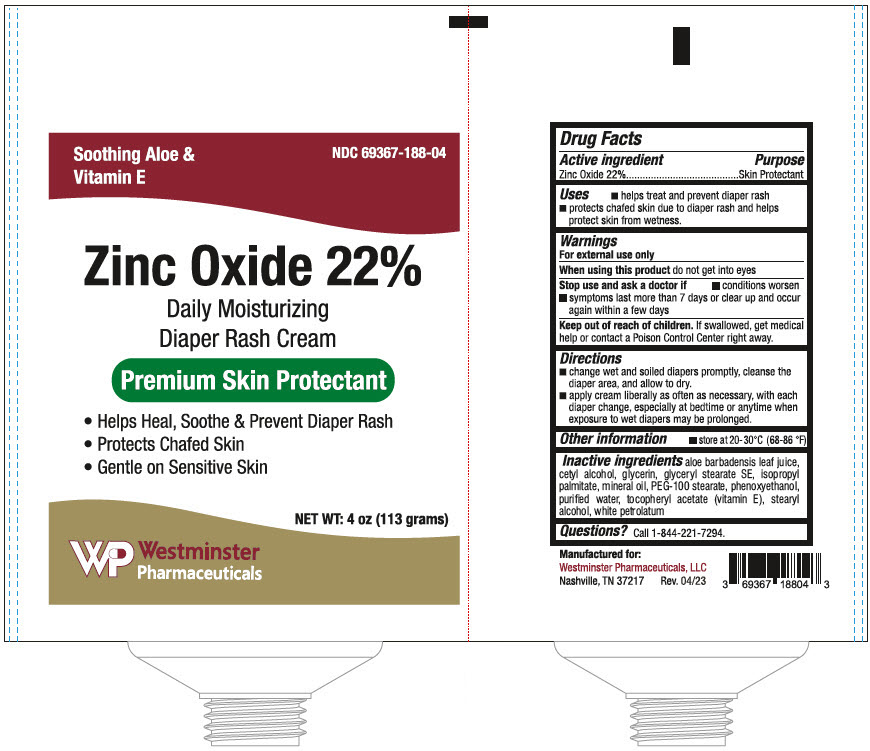
Zinc Oxide 22 g/100g Cream, 113 g — NDC 69367-188-04 (Billing 69367-0188-04)
This is a package of 113 g of Zinc Oxide 22 g/100g Cream from Westminster Pharmaceuticals, LLC, marketed since Jul 2021 and currently FDA-listed; retail pharmacies pay about $0.3676 per g (NADAC). It is this product's only package size.
NDC database record
One package, one record: these facts belong to NDC 69367-188-04 alone.
- Record
- FDA NDC Directory package listing · Human OTC drug
- Code segments
- 69367 labeler · 188 product · 04 package
- Package marketed since
- Jul 29, 2021
- Sample package
- No — commercial package
- Listing certified through
- Dec 31, 2026
- Billing quantity
- 113 g per package
- Barcode (UPC-A, from the NDC)
- 3 6936718804 3
- Medicaid fills, this package
- 7,962 prescriptions in the last four reported quarters
- FDA record last changed
- Jul 24, 2026
Other active recalls for Zinc Oxide (different manufacturers) — 6 · tap to view
Identity & classification
Regulatory identifiers FDA, NLM and CMS codes for this package
Drug-database identifiers Medi-Span GPI and First Databank GCN / HICL / AHFS classification
- GSN (GCN sequence number): 076316
- GCN: 41746
- GPI-14 (Medi-Span): 90971020003722
- HICL (First Databank): 002361
- AHFS class code: 84:24.12.00
- RxCUI (RxNorm): 1734937
Where does this data come from?
- FDA openFDA NDC Directory · synced Oct 8, 2026
- FDA label on DailyMed · label index refreshed Oct 8, 2026
- RxNorm (NLM RxNav) · catalog refreshed Oct 8, 2026
- Medi-Span GPI (licensed)
- First Databank (licensed) · refreshed Oct 8, 2026
Clinical
This is a topical cream containing zinc oxide, an over-the-counter monograph product. Zinc oxide is commonly used in skin care products as a protective barrier ingredient and is typically included in formulations meant to shield skin from moisture loss and irritation. This cream is applied directly to the skin surface and is often found in diaper rash products, skin protectants, and cosmetic formulations.
Patient education
Supplement & herbal interactions
Some supplements/herbs that may interact with Zinc oxide (OTC drug) — tap one for details:
Where does this data come from?
- MedlinePlus (NLM) · refreshed Oct 8, 2026
- FDA label on DailyMed · label index refreshed Oct 8, 2026
Ask a licensed pharmacist directly — free, answered by our team.
Pricing
A drug doesn't have one price. Each row is a different public payment system, and none is what you'd pay at the counter — that depends on your insurance. The ⓘ on each row explains what it measures.
| Price system | Per g | Per package |
|---|---|---|
| Retail pharmacies payNADAC · weekly | $0.368 | $41.54 / 113 g |
| Medicaid paysCMS SDUD · 12 mo | $0.2581 | $29.17 / 113 g |
| Medicare drug plans payPart D · quarterly | No Part D plan price is available for this NDC in our data. | |
Where does this data come from?
- CMS NADAC weekly file · file of Oct 7, 2026
- CMS ASP pricing files · refreshed Sep 20, 2026
- CMS Medicaid State Drug Utilization Data · through Q1 2026
- CMS Part D plan pricing files · refreshed Sep 24, 2026
- VA National Acquisition Center price file
Packaging — all sizes for this product
| Package NDC | Description | Marketing start | Marketing end | Status |
|---|---|---|---|---|
| 69367-0188-04 You're viewing this Main listing | 113 g in 1 CARTON | 2021-07-29 | — | Active |
Therapeutic equivalents
Where does this data come from?
- FDA openFDA NDC Directory · synced Oct 8, 2026
- FDA Orange Book · refreshed Oct 3, 2026
- CMS NADAC weekly file · file of Oct 7, 2026
Availability & generic status
We did not find an FDA-approved generic match for this exact strength, form and route.
Where does this data come from?
- FDA Orange Book · refreshed Oct 3, 2026
Inactive Ingredients / Excipients
Inactive ingredients, also called excipients, are components of the drug product other than the active ingredient. They may include fillers, dyes, coatings, preservatives, flavors, or other formulation ingredients.
💡 Tap an ingredient (hover on desktop) to see what it is and why it’s used.
-
UNII 9E8X80D2L0
A synthetic form of vitamin E used as an antioxidant and preservative in medications. It helps prevent the active ingredients from degrading when exposed to oxygen or light.
-
UNII ZY81Z83H0X
Aloe vera leaf is a plant extract derived from the aloe plant. It is used in medicines as a natural moisturizer and skin-soothing agent in topical formulations.
-
UNII 936JST6JCN
Cetyl alcohol is a waxy, fatty substance derived from plant or animal sources. It acts as an emulsifier and thickener in medicines, helping blend oil and water components and giving products a smooth, creamy texture.
-
UNII PDC6A3C0OX
Glycerin is a clear, thick liquid derived from plant oils or fats. It acts as a humectant to retain moisture, a sweetener, and a solvent in medications.
-
UNII FCZ5MH785I
A waxy substance made from glycerin and stearic acid. It works as an emulsifier to help mix oil and water ingredients together, and as a thickener to give the medicine its proper texture and consistency.
-
UNII 8CRQ2TH63M
Isopropyl palmitate is an oily liquid derived from palm oil. It acts as an emollient and lubricant in medicines, helping soften the skin or improve how the product spreads and flows.
-
UNII T5L8T28FGP
Mineral oil is a clear, odorless liquid derived from crude oil. It acts as a lubricant and emollient in medications, helping pills slide smoothly during manufacturing and aiding moisture retention in topical products.
-
UNII YD01N1999R
A waxy substance made from polyethylene glycol and stearic acid. It helps mix oil and water-based ingredients together and serves as an emulsifier and solubilizer in liquid and semi-solid medicines.
-
UNII 4T6H12BN9U
Petrolatum is a purified mineral oil-based jelly derived from petroleum. In medicines, it acts as an emollient, lubricant, and moisture barrier to soften skin, reduce friction, and help prevent water loss from formulations.
-
UNII HIE492ZZ3T
Phenoxyethanol is a synthetic preservative and antimicrobial agent used to prevent bacterial and fungal growth in medicines and cosmetic products, extending shelf life and maintaining product safety.
-
UNII 2KR89I4H1Y
Stearyl alcohol is a waxy, fatty substance derived from natural oils or made synthetically. It acts as an emulsifier and thickener in medicines, helping mix ingredients together and give the product the right texture.
-
UNII 059QF0KO0R
Water is a liquid solvent that dissolves and mixes ingredients together in liquid medicines, syrups, and injections. It helps distribute the active drug evenly throughout the product.
12 inactive ingredients listed in the exact product block matched to this NDC.
Label-section wording can be broader than the structured product block and may mention additional formulation ingredients.
Where does this data come from?
ingredient classCode="IACT" elements from the exact product block matched by this NDC. Label-section narrative from DailyMed / the openFDA label index is shown separately when available.- FDA label on DailyMed · label index refreshed Oct 8, 2026
- FDA openFDA NDC Directory · synced Oct 8, 2026
Inactive ingredient FAQ
Are inactive ingredients the same for every manufacturer?
Why might an inactive ingredient be missing?
Can inactive ingredients matter?
Manufacturer & labeler
More NDCs from Westminster Pharmaceuticals, LLC labeler code 69367
- Acyclovir 800 mg Tablet NDC 69367-138-01
- Hydroquinone 40 mg/g Cream NDC 69367-174-01
- Metformin Hydrochloride 500 mg Tablet, Film Coated NDC 69367-180-01
- Metformin Hydrochloride 850 mg Tablet, Film Coated NDC 69367-181-01
- Metformin Hydrochloride 1000 mg Tablet, Film Coated NDC 69367-182-01
- DEXTROMETHORPHAN HYDROBROMIDE, Guaifenesin, and PHENYLEPHRINE HYDROCHLORIDE 18 mg/15mL; 200 mg/15mL; 10 mg/15mL Liquid NDC 69367-184-08
- Zoledronic Acid 4 mg/5mL Injection NDC 69367-190-50
- Clopidogrel 300 mg Tablet, Film Coated NDC 69367-194-05
- Omeprazole/Bicarbonate 40 mg; 1100 mg Capsule, Gelatin Coated NDC 69367-196-30
- Clopidogrel 75 mg Tablet, Film Coated NDC 69367-200-05
- Lidocaine hydrochloride 30 mg/g Cream NDC 69367-202-01
- Butalbital, Acetaminophen, Caffeine 50 mg; 325 mg; 40 mg Tablet NDC 69367-203-01
Where does this data come from?
- FDA openFDA NDC Directory · synced Oct 8, 2026
- Drugs@FDA
FDA label — Drug Facts FDA SPL
🎯 Indications and Usage ▾
Uses helps treat and prevent diaper rash protects chafed skin due to diaper rash and helps protect skin from wetness.
⏱️ Dosage and Administration ▾
Directions change wet and soiled diapers promptly, cleanse the diaper area, and allow to dry. apply cream liberally as often as necessary, with each diaper change, especially at bedtime or anytime when exposure to wet diapers may be prolonged.
⚠️ Warnings ▾
Warnings For external use only When using this product do not get into eyes Stop use and ask a doctor if conditions worsen symptoms last more than 7 days or clear up and occur again within a few days Keep out of reach of children. If swallowed, get medical help or contact a Poison Control Center right away.
📦 Storage and Handling ▾
Other information store at 20-30°C (68-86 °F)
🧪 Active Ingredient ▾
Active ingredient Zinc Oxide 22%
🧪 Inactive Ingredients ▾
Inactive ingredients aloe barbadensis leaf juice, cetyl alcohol, glycerin, glyceryl stearate SE, isopropyl palmitate, mineral oil, PEG-100 stearate, phenoxyethanol, purified water, tocopheryl acetate (vitamin E), stearyl alcohol, white petrolatum
🎯 Purpose ▾
Purpose Skin Protectant
📄 When Using This Product ▾
When using this product do not get into eyes
📄 Stop Use and Ask a Doctor If ▾
Stop use and ask a doctor if conditions worsen symptoms last more than 7 days or clear up and occur again within a few days
📄 Keep Out of Reach of Children ▾
Keep out of reach of children. If swallowed, get medical help or contact a Poison Control Center right away.
📄 Questions or Comments ▾
Questions? Call 1-844-221-7294.
📄 Package Label / Principal Display Panel ▾
PRINCIPAL DISPLAY PANEL - 113 gram Tube Label Soothing Aloe & Vitamin E NDC 69367-188-04 Zinc Oxide 22% Daily Moisturizing Diaper Rash Cream Premium Skin Protectant Helps Heal, Soothe & Prevent Diaper Rash Protects Chafed Skin Gentle on Sensitive Skin NET WT: 4 oz (113 grams) Westminster Pharmaceuticals PRINCIPAL DISPLAY PANEL - 113 gram Tube Label