
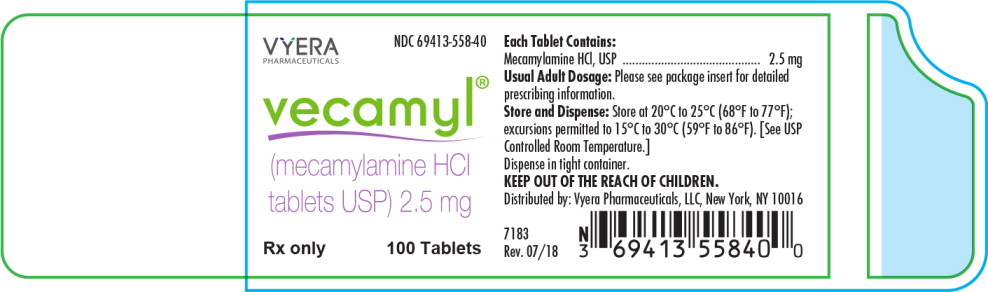
Vecamyl Mecamylamine Hydrochloride 2.5 mg Tablet, 100-count
🆔 Identity & classification
Where does this data come from?
🏷️ RxNorm drug class
This medicine belongs to the Autonomic Ganglionic Blocker class.
Where does this data come from?
🏭 Manufacturer & labeler
Where does this data come from?
🩺 Clinical
Patient education
Supplement & herbal interactions
Mecamylamine may be associated with lower levels of 1 nutrient — worth a chat with your pharmacist, not a cause for alarm.
Where does this data come from?
Ask a licensed pharmacist directly — free, answered by our team.
🧪 Inactive Ingredients / Excipients
Inactive ingredients, also called excipients, are components of the drug product other than the active ingredient. They may include fillers, dyes, coatings, preservatives, flavors, or other formulation ingredients.
💡 Tap an ingredient (hover on desktop) to see what it is and why it’s used.
-
UNII O7TSZ97GEP
A mineral compound that serves as a filler and binding agent in tablets and capsules. It adds bulk to the medicine and helps hold ingredients together during manufacturing.
-
UNII 35SW5USQ3G
A synthetic yellow dye used to color medicines. It helps make tablets, capsules, and liquids visually distinct so patients can easily identify their medication.
-
UNII H77VEI93A8
A synthetic yellow dye used to color medications. It helps identify the drug and make it visually distinctive, with no effect on how the medicine works.
-
UNII EWQ57Q8I5X
Lactose monohydrate is a natural sugar derived from milk. It serves as a filler and binder in tablets and capsules, helping create the proper size, texture, and consistency of the medicine.
-
UNII 70097M6I30
Magnesium stearate is a salt made from magnesium and stearic acid, a fatty substance. It's used in tablets and capsules as a lubricant and glidant to help ingredients flow smoothly during manufacturing and prevent sticking.
-
UNII O8232NY3SJ
A plant-based carbohydrate derived from corn kernels. It acts as a filler to add bulk, a binder to hold ingredients together, and a disintegrant to help the tablet break apart in your stomach for absorption.
-
UNII 7SEV7J4R1U
A powder made from a naturally occurring mineral. In medicines, talc works as a glidant and anti-caking agent, helping tablets and capsules flow smoothly during manufacturing and preventing clumping.
-
UNII 059QF0KO0R
Water is a liquid solvent that dissolves and mixes ingredients together in liquid medicines, syrups, and injections. It helps distribute the active drug evenly throughout the product.
8 inactive ingredients listed in the exact product block matched to this NDC.
Where does this data come from?
ingredient classCode="IACT" elements from the exact product block matched by this NDC. Label-section narrative from DailyMed / the openFDA label index is shown separately when available.Inactive ingredient FAQ
Are inactive ingredients the same for every manufacturer?
Why might an inactive ingredient be missing?
Can inactive ingredients matter?
💲 Pricing
A drug doesn't have one price. Each row is a different public payment system, and none is what you'd pay at the counter — that depends on your insurance. The ⓘ on each row explains what it measures.
| Price system | Per each | Per package |
|---|---|---|
| Retail pharmacies payNADAC · weekly | Not in the retail survey — common for institutional, discontinued, or low-volume packs. | |
| Medicaid paysCMS SDUD · 12 mo | No recent Medicaid claims on file for this NDC — rare and low-volume NDCs are suppressed in the public data. | |
| Medicare drug plans payPart D · Q2 2026 | $60.43 | $6,042.64 / 100 tablets |
Where does this data come from?
🔁 Therapeutic equivalents
| Product | Labeler | Pack | NADAC/unit | TE | Status | Price vs. this |
|---|---|---|---|---|---|---|
| Vecamyl 2.5 mgthis 69413-0558-40 | Vyera | 100 tablets | — | — | FDA listed | — |
| Vecamyl 2.5 mg 83649-0558-01 | TILDE | 100 tablets | — | — | FDA listed | — |
Where does this data come from?
⏳ Availability & generic status
This product is an FDA-approved generic. Other versions of the same drug are listed under Therapeutic equivalents, least expensive first.
Where does this data come from?
🔬 Reported adverse events (FAERS)
Top reported reactions
Reporter sex
Serious outcomes
Where does this data come from?
📦 Packaging — all sizes for this product
| Package NDC | Description | Marketing start | Status |
|---|---|---|---|
| 69413-0558-40 You're viewing this | 100 TABLET in 1 BOTTLE (69413-558-40) | 2013-03-19 | Active |
🧭 About this NDC listing & data coverage
What data is (and isn’t) available for this NDC — tap to expand
| NDC identity (package / product / labeler codes) | ✓ Available |
| Labeler | ✓ Available |
| Product & package description | ✓ Available |
| Marketing category & status | ✓ Available |
| Active ingredient / dosage form / route | ✓ Available |
| FDA label (SPL via DailyMed) | ✓ Available |
| Package photos | ✓ Available |
| Inactive ingredients (structured) | ✓ Available |
| NADAC pharmacy acquisition price (CMS) | — Not published for this NDC CMS publishes NADAC only for NDCs reported in its retail-pharmacy survey. |
| Orange Book / therapeutic-equivalence data | — Not published for this NDC Applies only to products approved under an NDA/ANDA; many listings are out of scope. |
| HCPCS J-code billing crosswalk | — Not published for this NDC Most self-administered / retail products have no J-code — that is normal. |
| Medicaid utilization (CMS SDUD) | — Not published for this NDC CMS reports utilization only for NDCs with Medicaid claims above its privacy threshold. |
Questions about this listing
Why is there no price listed?
Is the NDC printed on the package the same as the 11-digit billing NDC?
What do the three segments of this NDC mean?
Is this package still being marketed?
Who lists this product with the FDA?
Do I need a prescription for this product?
Where does this data come from?
📄 Full prescribing information FDA SPL
🎯 Indications and Usage ▾
INDICATIONS AND USAGE For the management of moderately severe to severe essential hypertension and in uncomplicated cases of malignant hypertension.
⏱️ Dosage and Administration ▾
DOSAGE AND ADMINISTRATION Therapy is usually started with one 2.5 mg tablet of Mecamylamine HCl twice a day. This initial dosage should be modified by increments of one 2.5 mg tablet at intervals of not less than 2 days until the desired blood pressure response occurs (the criterion being a dosage just under that which causes signs of mild postural hypotension). The average total daily dosage of Mecamylamine HCl is 25 mg, usually in three divided doses.
However, as little as 2.5 mg daily may be sufficient to control hypertension in some patients. A range of two to four or even more doses may be required in severe cases when smooth control is difficult to obtain. In severe or urgent cases, larger increments at smaller intervals may be needed.
Partial tolerance may develop in certain patients, requiring an increase in the daily dosage of Mecamylamine HCl. Administration of Mecamylamine HCl after meals may cause a more gradual absorption and smoother control of excessively high blood pressure. The timing of doses in relation to meals should be consistent.
Since the blood pressure response to antihypertensive drugs is increased in the early morning, the larger dose should be given at noontime and perhaps in the evening. The morning dose, as a rule, should be relatively small and in some instances may even be omitted. The initial regulation of dosage should be determined by blood pressure readings in the erect position at the time of maximal effect of the drug, as well as by other signs and symptoms of orthostatic hypotension.
The effective maintenance dosage should be regulated by blood pressure readings in the erect position and by limitation of dosage to that which causes slight faintness or dizziness in this position. If the patient or a relative can use a sphygmomanometer, instructions may be given to reduce or omit a dose if readings fall below a designated level or if faintness or lightheadedness occurs. However, no change should be instituted without the knowledge of the physician.
Close supervision and education of the patient, as well as critical adjustment of dosage, are essential to successful therapy. Other Antihypertensive Agents When Mecamylamine HCl is given with other antihypertensive drugs, the dosage of these other agents, as well as that of Mecamylamine HCl, should be reduced to avoid excessive hypotension. However, thiazides should be continued in their usual dosage, while that of Mecamylamine HCl is decreased by at least 50 percent.
⛔ Contraindications ▾
CONTRAINDICATIONS Mecamylamine HCl should not be used in mild, moderate, labile hypertension and may prove unsuitable in uncooperative patients. It is contraindicated in coronary insufficiency or recent myocardial infarction. Mecamylamine HCl should be given with great discretion, if at all, when renal insufficiency is manifested by a rising or elevated BUN.
The drug is contraindicated in uremia. Patients receiving antibiotics and sulfonamides should generally not be treated with ganglion blockers. Other contraindications are glaucoma, organic pyloric stenosis or hypersensitivity to the product.
⚠️ Warnings ▾
WARNINGS Mecamylamine, a secondary amine, readily penetrates into the brain and thus may produce central nervous system effects. Tremor, choreiform movements, mental aberrations, and convulsions may occur rarely. These have occurred most often when large doses of Mecamylamine HCl were used, especially in patients with cerebral or renal insufficiency.
When ganglion blockers or other potent antihypertensive drugs are discontinued suddenly, hypertensive levels return. In patients with malignant hypertension and others, this may occur abruptly and may cause fatal cerebral vascular accidents or acute congestive heart failure. When Mecamylamine HCl is withdrawn, this should be done gradually and other antihypertensive therapy usually must be substituted.
On the other hand, the effects of Mecamylamine HCl sometimes may last from hours to days after therapy is discontinued.
🤒 Adverse Reactions ▾
ADVERSE REACTIONS The following adverse reactions have been reported and within each category are listed in order of decreasing severity. Gastrointestinal: Ileus, constipation (sometimes preceded by small, frequent liquid stools), vomiting, nausea, anorexia, glossitis and dryness of mouth. Cardiovascular: Orthostatic dizziness and syncope, postural hypotension.
Nervous System/Psychiatric: Convulsions, choreiform movements, mental aberrations, tremor, and paresthesias (see WARNINGS ). Respiratory: Interstitial pulmonary edema and fibrosis. Urogenital: Urinary retention, impotence, decreased libido.
Special Senses: Blurred vision, dilated pupils. Miscellaneous: Weakness, fatigue, sedation.
🔄 Drug Interactions ▾
Drug Interactions Patients receiving antibiotics and sulfonamides generally should not be treated with ganglion blockers. The action of Mecamylamine HCl may be potentiated by anesthesia, other antihypertensive drugs and alcohol.
🤰 Pregnancy ▾
Pregnancy Pregnancy Category C. Animal reproduction studies have not been conducted with Mecamylamine HCl. It is not known whether Mecamylamine HCl can cause fetal harm when given to a pregnant woman or can affect reproductive capacity. Mecamylamine HCl should be given to a pregnant woman only if clearly needed.
🧒 Pediatric Use ▾
Pediatric Use Safety and effectiveness in pediatric patients have not been established.
🆘 Overdosage ▾
OVERDOSAGE Signs of overdosage include: hypotension (which may progress to peripheral vascular collapse), postural hypotension, nausea, vomiting, diarrhea, constipation, paralytic ileus, urinary retention, dizziness, anxiety, dry mouth, mydriasis, blurred vision, or palpitations. A rise in intraocular pressure may occur. Pressor amines may be used to counteract excessive hypotension.
Since patients being treated with ganglion blockers are more than normally reactive to pressor amines, small doses of the latter are recommended to avoid excessive response. The oral LD 50 of Mecamylamine HCl in the mouse is 92 mg/kg.
🧬 Clinical Pharmacology ▾
CLINICAL PHARMACOLOGY Mecamylamine HCl reduces blood pressure in both normotensive and hypertensive individuals. It has a gradual onset of action (1/2 to 2 hours) and a long-lasting effect (usually 6 to 12 hours or more). A small oral dosage often produces a smooth and predictable reduction of blood pressure.
Although this antihypertensive effect is predominantly orthostatic, the supine blood pressure is also significantly reduced. Pharmacokinetics and Metabolism Mecamylamine HCl is almost completely absorbed from the gastrointestinal tract, resulting in consistent lowering of blood pressure in most patients with hypertensive cardiovascular disease. Mecamylamine HCl is excreted slowly in the urine in the unchanged form.
The rate of its renal elimination is influenced markedly by urinary pH. Alkalinization of the urine reduces, and acidification promotes, renal excretion of mecamylamine. Mecamylamine HCl crosses the blood-brain and placental barriers.
📦 How Supplied / Storage and Handling ▾
HOW SUPPLIED Vecamyl® (MECAMYLAMINE Hydrochloride Tablets, USP) are slightly yellow, round, compressed tablets, coded MP on one side and 2.5 on the other side. They are supplied as follows: NDC 69413-558-40 in bottles of 100. STORAGE CONDITION Store at 20°C to 25°C (68°F to 77°F) excursions permitted to 15°C to 30°C (59°F to 86°F) [see USP Controlled Room Temperature.] Distributed by: Vyera Pharmaceuticals, LLC New York, NY 10016 7183 Rev. 07/18
📋 Description ▾
DESCRIPTION Mecamylamine HCl is a potent, oral antihypertension agent and ganglion blocker, and is a secondary amine. It is N,2,3,3-tetramethyl-bicyclo [2.2.1] heptan- 2 -amine hydrochloride. Its empirical formula is C 11 H 21 N • HCl and its structural formula is: It is a white, odorless, or practically odorless, crystalline powder, is highly stable, soluble in water and has a molecular weight of 203.75.
Mecamylamine HCl is supplied as tablets for oral use, each containing 2.5 mg mecamylamine HCl. Inactive ingredients are calcium phosphate, D&C Yellow 10, FD&C Yellow 6, lactose, magnesium stearate, cornstarch, and talc. Mecamylamine HCl MF
💬 Information for Patients ▾
Information for Patients Mecamylamine HCl may cause dizziness, lightheadedness, or fainting, especially when rising from a lying or sitting position. This effect may be increased by alcoholic beverages, exercise, or during hot weather. Getting up slowly may help alleviate such a reaction.