
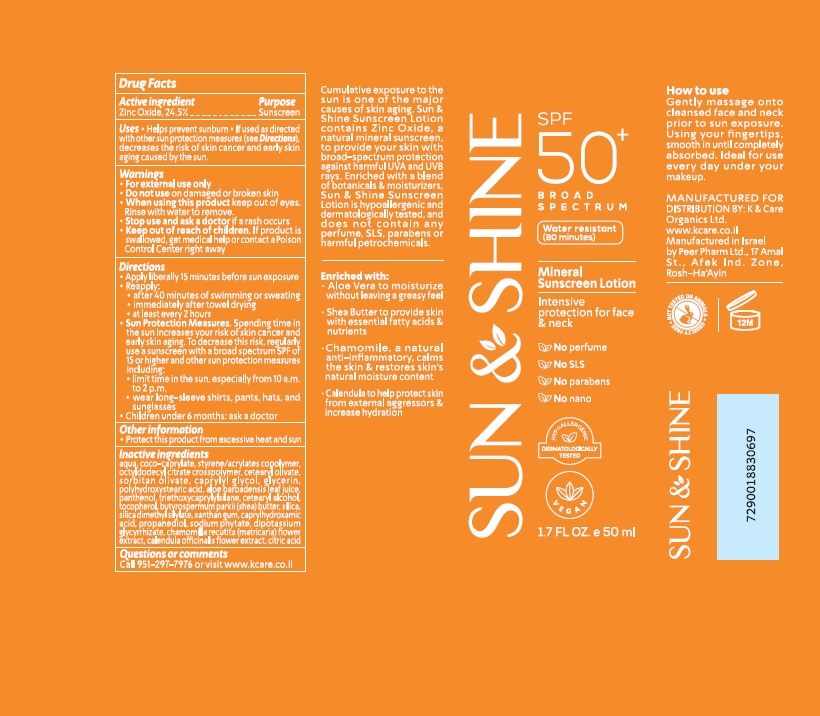
SUN and SHINE MINERAL SUNSCREEN ZINC OXIDE 24.5 g/100mL Cream — NDC 69435-1505-1 (Billing 69435-1505-01)
This is a package of SUN and SHINE MINERAL SUNSCREEN ZINC OXIDE 24.5 g/100mL Cream from Peer Pharm Ltd., no longer marketed (first marketed May 2022), no longer in the FDA NDC Directory. It is this product's only package size.
NDC database record
One package, one record: these facts belong to NDC 69435-1505-1 alone.
- Record
- FDA NDC Directory package listing · Human OTC drug
- Code segments
- 69435 labeler · 1505 product · 1 package
- Package marketed since
- May 19, 2022
- Sample package
- No — commercial package
- Listing certified through
- Dec 31, 2027
- Barcode (UPC-A, from the NDC)
- 3 6943515051 4
- FDA record last changed
- Jul 24, 2026
Other active recalls for Zinc Oxide (different manufacturers) — 6 · tap to view
Identity & classification
Regulatory identifiers FDA, NLM and CMS codes for this package
Where does this data come from?
- FDA openFDA NDC Directory · synced Oct 1, 2026
- FDA label on DailyMed · label index refreshed Oct 6, 2026
- RxNorm (NLM RxNav) · catalog refreshed Oct 1, 2026
- Medi-Span GPI (licensed)
- First Databank (licensed) · refreshed Oct 1, 2026
Clinical
Sun and Shine Mineral Sunscreen is a topical cream containing zinc oxide, an inorganic mineral ingredient typically used in sunscreen products to protect skin from ultraviolet (UV) radiation. Zinc oxide functions as a physical or mineral UV filter that works by reflecting and scattering UV rays away from the skin surface. This product is marketed as an over-the-counter monograph drug, meaning it follows established FDA guidelines for sunscreen ingredients and formulations rather than being individually reviewed and approved.
Patient education
Supplement & herbal interactions
Some supplements/herbs that may interact with Zinc oxide (OTC drug) — tap one for details:
Where does this data come from?
- MedlinePlus (NLM) · refreshed Oct 1, 2026
- FDA label on DailyMed · label index refreshed Oct 6, 2026
Ask a licensed pharmacist directly — free, answered by our team.
Pricing
A drug doesn't have one price. Each row is a different public payment system, and none is what you'd pay at the counter — that depends on your insurance. The ⓘ on each row explains what it measures.
| Price system | Per g | Per package |
|---|---|---|
| Retail pharmacies payNADAC · weekly | Not in the retail survey — common for institutional, discontinued, or low-volume packs. | |
| Medicaid paysCMS SDUD · 12 mo | No recent Medicaid claims on file for this NDC — rare and low-volume NDCs are suppressed in the public data. | |
| Medicare drug plans payPart D · quarterly | No Part D plan price is available for this NDC in our data. | |
Where does this data come from?
- CMS NADAC weekly file
- CMS ASP pricing files · refreshed Sep 20, 2026
- CMS Medicaid State Drug Utilization Data · refreshed Oct 6, 2026
- CMS Part D plan pricing files · refreshed Sep 24, 2026
- VA National Acquisition Center price file
Packaging — all sizes for this product
| Package NDC | Description | Marketing start | Marketing end | Status |
|---|---|---|---|---|
| 69435-1505-01 You're viewing this Main listing | 1 TUBE in 1 CARTON / 50 mL in 1 TUBE | 2022-05-19 | — | Discontinued by firm |
Therapeutic equivalents
| Product | Labeler | Pack | NADAC/unit | TE | Status | Price vs. this |
|---|---|---|---|---|---|---|
| Illuminating SPF 50 plus drops Broad Spectrum Sunscreen 24.5 g/100mL 56152-0253-01 | Cosmetic | 50 ml | — | — | FDA listed | — |
| SUN and SHINE MINERAL SUNSCREEN 24.5 g/100mLthis 69435-1505-01 | Peer | 1 tube | — | — | Discontinued | — |
| BeautyBarrier 24.5 g/100mL 81104-0282-02 | NAKED | 50 ml | — | — | FDA listed | — |
Where does this data come from?
- FDA openFDA NDC Directory · synced Oct 1, 2026
- FDA Orange Book · refreshed Oct 3, 2026
- CMS NADAC weekly file
Availability & generic status
We did not find an FDA-approved generic match for this exact strength, form and route.
Where does this data come from?
- FDA Orange Book · refreshed Oct 3, 2026
Inactive Ingredients / Excipients
Inactive ingredients, also called excipients, are components of the drug product other than the active ingredient. They may include fillers, dyes, coatings, preservatives, flavors, or other formulation ingredients.
💡 Tap an ingredient (hover on desktop) to see what it is and why it’s used.
-
UNII 7JD227IUMC
A synthetic chemical compound used primarily as a reducing agent and antioxidant in pharmaceutical formulations. It helps protect the medicine's active ingredients from degradation during storage and manufacturing.
-
UNII 4SOS6O9G2X
An organic compound containing sulfur atoms, used as a flavoring agent and odor modifier in medicines. It contributes taste and smell characteristics to the final product.
-
UNII GEV2EL4D9G
A synthetic polymer made from acrylic compounds that form a network structure. It works as a thickener and gelling agent in topical products to create the right texture and consistency.
-
UNII V5VD430YW9
A plant-derived substance from the aloe vera leaf. Used in medicines as a natural flavor, skin-soothing agent in topical products, and sometimes as a mild laxative ingredient in oral formulations.
-
UNII 9JS8DS42SV
Calendula officinalis seed oil is a plant-derived oil from marigold seeds. It's used in medicines as an emollient to soften and smooth the product texture, and sometimes as a natural fragrance or skin-conditioning agent in topical formulations.
-
UNII UPY805K99W
A synthetic compound derived from caprylic acid that works as a preservative and antimicrobial agent to help prevent bacterial and fungal growth in the medicine.
-
UNII 00YIU5438U
Caprylyl glycol is a clear liquid derived from coconut oil. In medicines, it acts as a humectant to retain moisture, a preservative booster to prevent microbial growth, and a solvent to help dissolve or mix other ingredients.
-
UNII D5340Y2I9G
Castor oil is a natural plant-based oil used in medicines as a lubricant, laxative agent, and solvent. It helps medicine ingredients dissolve or flow smoothly and can aid bowel movement in formulations designed for that purpose.
-
UNII 9M64UO4C25
A synthetic oily substance used as an emollient and texture enhancer in medicines. It helps soften formulations, improves how the medicine spreads or feels on skin, and can act as a lubricant in tablets or capsules.
-
UNII 58B69Q84JO
A plant-derived emulsifier made from olive oil and fatty alcohols. It helps blend oil and water ingredients together and stabilizes the product's texture in creams, lotions, and similar formulations.
-
UNII FGL3685T2X
Chamomile is a plant extract used in medications as a flavoring agent and for its mild soothing properties in formulations. It helps improve taste and aroma of the medicine.
-
UNII 4828G836N6
A plant-derived oil mixture from coconut that acts as an emollient and solvent. It helps dissolve or carry active ingredients and improves how the medicine spreads or absorbs in topical formulations.
-
UNII ZZW95F4360
A naturally occurring compound derived from glucose metabolism. It functions as a buffer and stabilizer in formulations, helping maintain pH balance and protect the active ingredient from degradation.
-
UNII PDC6A3C0OX
Glycerin is a clear, thick liquid derived from plant oils or fats. It acts as a humectant to retain moisture, a sweetener, and a solvent in medications.
-
UNII ZBX50UG81V
A salt derived from phytic acid, a natural compound found in plants. In medications, it functions as a chelating agent and buffering substance, helping to stabilize formulations and control pH levels.
-
UNII BXR49TP611
Isobutane is a liquefied gas used as a propellant in aerosol inhalers and sprays. It helps push the medicine out of the container so you can breathe or spray it as directed.
-
UNII WV9CM0O67Z
Panthenol is a humectant and skin-conditioning agent derived from pantothenic acid. It's added to medicines to help retain moisture and soothe skin irritation.
-
UNII YXH47AOU0F
A synthetic fatty acid used as a thickener and stabilizer in medicines. It helps create the right texture and prevents separation of ingredients in liquid or semi-solid formulations.
-
UNII 48G71659RB
A synthetic compound derived from propane that contains a phosphate group. It functions as a buffer and pH regulator in medicines, helping maintain stable acidity levels within the product.
-
UNII K49155WL9Y
Shea butter is a fat extracted from shea tree nuts. It's used in medicines as an emollient and lubricant to soften the product, improve texture, and help ingredients blend smoothly together.
-
UNII EU2PSP0G0W
Silica dimethyl silylate is a silicon-based powder that acts as a glidant and anti-caking agent. It reduces friction between particles and helps powders flow smoothly during manufacturing and tablet compression.
-
UNII N30934870L
A synthetic polymer made from sodium acrylate and styrene sulfonate. It acts as a super-absorbent material and binder that helps the medicine hold together and absorb moisture in the formulation.
-
UNII MDL271E3GR
Sorbitan olivate is an emulsifier derived from sorbitol and olive oil. It helps blend water and oil ingredients together to maintain consistent texture and appearance throughout the medicine.
-
UNII R0ZB2556P8
Tocopherol is a form of vitamin E derived from plant oils. It acts as an antioxidant in medicines to prevent oils and fats from breaking down and spoiling during storage.
-
UNII LDC331P08E
A silicone-based compound that acts as a glidant and flow agent in solid medications. It reduces friction between powder particles, helping the medicine flow smoothly during manufacturing and tablet compression.
-
UNII 35X8CT063R
A plasticizer derived from citric acid and alcohol compounds. It's added to coatings and flexible formulations to improve flexibility and workability of the medicine's outer layer or structure.
-
UNII 059QF0KO0R
Water is a liquid solvent that dissolves and mixes ingredients together in liquid medicines, syrups, and injections. It helps distribute the active drug evenly throughout the product.
-
UNII TTV12P4NEE
Xanthan gum is a thickening and stabilizing ingredient made from fermented corn or other sugars. It's added to medicines to improve texture, prevent separation of liquids and solids, and help the product stay consistent.
28 inactive ingredients listed in the exact product block matched to this NDC.
Label-section wording can be broader than the structured product block and may mention additional formulation ingredients.
Where does this data come from?
ingredient classCode="IACT" elements from the exact product block matched by this NDC. Label-section narrative from DailyMed / the openFDA label index is shown separately when available.- FDA label on DailyMed · label index refreshed Oct 6, 2026
- FDA openFDA NDC Directory · synced Oct 1, 2026
Inactive ingredient FAQ
Are inactive ingredients the same for every manufacturer?
Why might an inactive ingredient be missing?
Can inactive ingredients matter?
Manufacturer & labeler
More NDCs from Peer Pharm Ltd. labeler code 69435
- FRE PLUMP ME PEPTIDE LIP TINT PAMPELONNE SPF 30 ZINC OXIDE 150 mg/mL Liquid NDC 69435-1410-1
- FRE PLUMP ME PEPTIDE LIP TINT CASSIS SPF 30 ZINC OXIDE 150 mg/mL Liquid NDC 69435-1411-1
- FRE PROTECT BODY Ultra-Light Gel Cream SPF 50 ZINC OXIDE 24 g/100mL Jelly NDC 69435-1412-1
- FRE BRONZE ME Sun-Kissed Mineral Sunscreen SPF 50 ZINC OXIDE 24 g/100mL Cream NDC 69435-1413-1
- Botao Baby Diaper Rash Cream ZINC OXIDE 9 g/71g Cream NDC 69435-1501-2
- Botao Baby Mineral Sunscreen L ZINC OXIDE 17 g/66g Lotion NDC 69435-1504-1
- Botao - Grow Naturally Mineral Sunscreen Clear Facial Stick For Babies and Kids SPF 50 ZINC OXIDE 24.5 g/100g Stick NDC 69435-1508-1
- Sun and Shine - Mineral Sunscreen Clear Facial Stick SPF 50 Zinc Oxide 24.5 g/100g Stick NDC 69435-1509-1
Where does this data come from?
- FDA openFDA NDC Directory · synced Oct 1, 2026
- Drugs@FDA
FDA label — Drug Facts FDA SPL
🎯 Indications and Usage ▾
Uses Helps prevent sunburn if used as directed with other sun protection measures (see Directions ), decreases the risk of skin cancer and early skin aging caused by the sun.
⏱️ Dosage and Administration ▾
Directions Apply liberally 15 minutes before sun exposure • Reapply: • after 40 minutes of swimming or sweating • immediately after towel drying • at least every 2 hours • Sun Protection Measures. Spending time in the sun increases your risk of skin cancer and early skin aging. To decrease this risk, regularly use a sunscreen with a broad-spectrum SPF of 15 or higher and other sun protection measures including: • limit time in the sun, especially from 10 am to 2 p.m. • wear long-sleeve shirts, pants, hats, and sunglasses • Children under 6 months: ask a doctor
⚠️ Warnings ▾
Warnings For external use only Do not use on damaged or broken skin. When using this product , Keep out of eyes. Rinse with water to remove. Stop use and ask a doctor if rash or irritation develops and lasts. Keep out of reach of children. If swallowed, call a poison control center or get medical help right away.
🧪 Active Ingredient ▾
Active Ingredients Zinc Oxide 24.5% Purpose Sunscreen
🧪 Inactive Ingredients ▾
Inactive Ingredients aqua, coco-caprylate, styrene/acrylates copolymer, octyldodecyl citrate crosspolymer, cetearyl olivate, sorbitan olivate, caprylyl glycol, glycerin, polyhydroxystearic acid, aloe barbadensis leaf juice, panthenol, triethoxycaprylylsilane, cetearyl alcohol, tocopherol, butyrospermum parkii (shea) butter, silica, silica dimethyl silylate, xanthan gum, caprylhydroxamic acid, propanediol, sodium phytate, dipotassium glycyrrhizate, chamomilla recutita (matricaria) flower extract, calendula officinalis flower extract, citric acid
🎯 Purpose ▾
Purpose Sunscreen
📄 Keep Out of Reach of Children ▾
Keep out of reach of children. If swallowed, call a poison control center or get medical help right away.
📄 Package Label / Principal Display Panel ▾
Product label image description image description
About this NDC listing & data coverage
What data is (and isn’t) available for this NDC — tap to expand
| NDC identity (package / product / labeler codes) | ✓ Available |
| Labeler | ✓ Available |
| Product & package description | ✓ Available |
| Marketing category & status | ✓ Available |
| Active ingredient / dosage form / route | ✓ Available |
| FDA label (SPL via DailyMed) | ✓ Available |
| Package photos | ✓ Available |
| Inactive ingredients (structured) | ✓ Available |
| NADAC pharmacy acquisition price (CMS) | — Not published for this NDC CMS publishes NADAC only for NDCs reported in its retail-pharmacy survey. |
| Orange Book / therapeutic-equivalence data | — Not published for this NDC Applies only to products approved under an NDA/ANDA; many listings are out of scope. |
| HCPCS J-code billing crosswalk | — Not published for this NDC Most self-administered / retail products have no J-code — that is normal. |
| Medicaid utilization (CMS SDUD) | — Not published for this NDC CMS reports utilization only for NDCs with Medicaid claims above its privacy threshold. |