
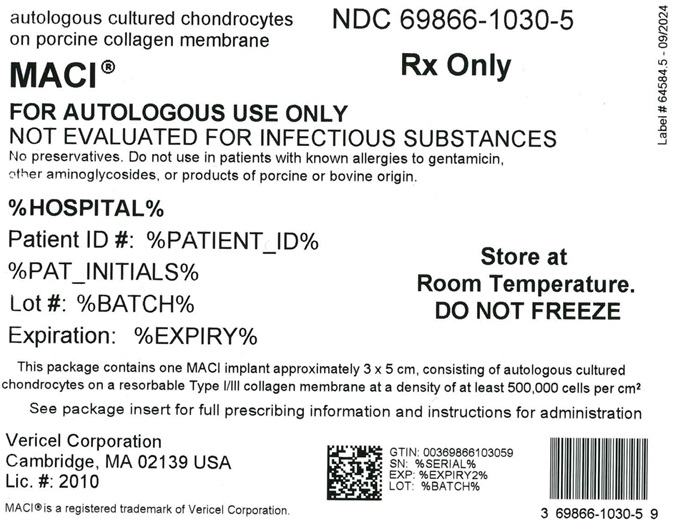
Maci autologous cultured chondrocytes 15000000 1/1; 15 cm2/1 Implant, 1 implant — NDC 69866-1030-5 (Billing 69866-1030-05)
This is a package of 1 implant of Maci autologous cultured chondrocytes 15000000 1/1; 15 cm2/1 Implant from Vericel Corporation, marketed since Jun 2017 and currently FDA-listed. It is the main listing for this product, which comes in 2 package sizes.
NDC database record
One package, one record: these facts belong to NDC 69866-1030-5 alone.
- Record
- FDA NDC Directory package listing · Cellular therapy
- Code segments
- 69866 labeler · 1030 product · 5 package
- Package marketed since
- Jun 9, 2017
- Sample package
- No — commercial package
- Listing certified through
- Dec 31, 2027
- Billing quantity
- 1 EA per package
- Barcode (UPC-A, from the NDC)
- 3 6986610305 9
- FDA record last changed
- Jul 24, 2026
Identity & classification
Regulatory identifiers FDA, NLM and CMS codes for this package
Drug-database identifiers Medi-Span GPI and First Databank GCN / HICL / AHFS classification
- GSN (GCN sequence number): 076989
- GCN: 42853
- GPI-14 (Medi-Span): 75840015209100
- HICL (First Databank): 044023
- AHFS class code: 92:92.00.00
Where does this data come from?
- FDA openFDA NDC Directory · synced Oct 8, 2026
- FDA label on DailyMed · label index refreshed Oct 8, 2026
- RxNorm (NLM RxNav) · catalog refreshed Oct 1, 2026
- Medi-Span GPI (licensed)
- First Databank (licensed) · refreshed Oct 8, 2026
Clinical
Patient education
Supplement & herbal interactions
Where does this data come from?
- MedlinePlus (NLM) · refreshed Oct 8, 2026
- FDA label on DailyMed · label index refreshed Oct 8, 2026
Ask a licensed pharmacist directly — free, answered by our team.
Pricing
A drug doesn't have one price. Each row is a different public payment system, and none is what you'd pay at the counter — that depends on your insurance. The ⓘ on each row explains what it measures.
| Price system | Per each | Per package |
|---|---|---|
| Retail pharmacies payNADAC · weekly | Not in the retail survey — common for institutional, discontinued, or low-volume packs. | |
| Medicaid paysCMS SDUD · 12 mo | No recent Medicaid claims on file for this NDC — rare and low-volume NDCs are suppressed in the public data. | |
| Medicare drug plans payPart D · quarterly | No Part D plan price is available for this NDC in our data. | |
Where does this data come from?
- CMS NADAC weekly file
- CMS ASP pricing files · refreshed Sep 20, 2026
- CMS Medicaid State Drug Utilization Data · refreshed Oct 8, 2026
- CMS Part D plan pricing files · refreshed Sep 24, 2026
- VA National Acquisition Center price file
Packaging — all sizes for this product
| Package NDC | Description | Marketing start | Marketing end | Status |
|---|---|---|---|---|
| 69866-1030-05 You're viewing this Main listing | 1 BAG in 1 BOX / 1 BOTTLE, PLASTIC in 1 BAG / 1 IMPLANT in 1 BOTTLE, PLASTIC | 2017-06-09 | — | Active |
| 69866-1030-08 69866-1030-8 | 2 BAG in 1 BOX / 1 BOTTLE, PLASTIC in 1 BAG / 1 IMPLANT in 1 BOTTLE, PLASTIC | 2017-06-09 | — | Active |
Pack size FAQ
What quantity is in this package?
What NDC number is used to bill for this package of Maci autologous cultured chondrocytes 15000000 1/1; 15 cm2/1 Implant?
Therapeutic equivalents
| Product | Labeler | Pack | NADAC/unit | TE | Status | Price vs. this |
|---|---|---|---|---|---|---|
| Maci 15000000 1/1; 15 cm2this 69866-1030-05 | Vericel | 1 implant | — | — | FDA listed | — |
Where does this data come from?
- FDA openFDA NDC Directory · synced Oct 8, 2026
- FDA Purple Book · refreshed Oct 5, 2026
- CMS NADAC weekly file
Availability & biosimilar status
Biologics have no small-molecule generics; biosimilar competition is tracked in the FDA Purple Book.
Why the date isn’t exact: Biosimilar timing can change because patents may be challenged, settled, licensed, added or removed, and litigation can move the real date earlier or later.
🛈 What do these terms mean?
- Biologic patent
- A patent the reference product’s maker has publicly listed. A biosimilar generally can’t launch until these expire — unless they’re invalidated or resolved in a settlement.
- Reference-product exclusivity
- A flat 12 years of FDA market protection from the biologic’s first licensure (the BPCIA). No biosimilar can be licensed before it ends, regardless of patents.
- Interchangeable exclusivity
- The first interchangeable biosimilar can earn a period as the only interchangeable version (pharmacists can substitute it without the prescriber).
- Earliest biosimilar (LOE)
- The latest of all the dates above — the soonest a biosimilar can realistically reach the market. Litigation and settlements can move it earlier.
Biologics have no small-molecule “generics” — competition comes from FDA-licensed biosimilars, tracked in the FDA Purple Book.
| Code | What it grants | Expires |
|---|---|---|
| RefProduct | Reference-product exclusivity (12-year, BPCIA) — no biosimilar can be licensed before this date | Dec 13, 2028 |
Is there a biosimilar for MACI 3CM X 5CM IMPLANT SHEET?
Why do different websites show different biosimilar dates?
Can a biosimilar launch before the last patent expires?
What does “current Purple Book estimate” mean?
What does “FDA listed” mean?
What does a patent or protection date mean here?
Where does this data come from?
- FDA Purple Book · refreshed Oct 5, 2026
Inactive Ingredients / Excipients
Inactive ingredients, also called excipients, are components of the drug product other than the active ingredient. They may include fillers, dyes, coatings, preservatives, flavors, or other formulation ingredients.
Where does this data come from?
IACT rows and label-wide narrative are kept separate; availability and product-level specificity depend on the submitted label.- FDA label on DailyMed · label index refreshed Oct 8, 2026
- FDA openFDA NDC Directory · synced Oct 8, 2026
Inactive ingredient FAQ
Are inactive ingredients the same for every manufacturer?
Why might an inactive ingredient be missing?
Can inactive ingredients matter?
Manufacturer & labeler
More NDCs from Vericel Corporation labeler code 69866
Where does this data come from?
- FDA openFDA NDC Directory · synced Oct 8, 2026
- Drugs@FDA
Full FDA label FDA SPL
🎯 Indications and Usage ▾
1 INDICATIONS AND USAGE MACI ® (autologous cultured chondrocytes on porcine collagen membrane) is an autologous cellularized scaffold product indicated for the repair of single or multiple symptomatic, full-thickness cartilage defects of the knee with or without bone involvement in adults. Limitations of Use Effectiveness of MACI in joints other than the knee has not been established. Safety and effectiveness of MACI in patients over the age of 55 years have not been established.
MACI ® is an autologous cellularized scaffold product indicated for the repair of symptomatic, single or multiple full-thickness cartilage defects of the knee with or without bone involvement in adults. ( 1 ) Limitations of Use Effectiveness of MACI in joints other than the knee has not been established. Safety and effectiveness of MACI in patients over the age of 55 years have not been established.
⏱️ Dosage and Administration ▾
2 DOSAGE AND ADMINISTRATION For Autologous Implantation Only. Contact Vericel at 1-800-453-6948 or www.MACI.com regarding training materials for surgical implantation of MACI. For autologous implantation only.
Contact Vericel at 1-800-453-6948 or www.MACI.com regarding training materials for surgical implantation of MACI. ( 2 ) The amount of MACI implanted depends on the size (surface area in cm 2 ) of the cartilage defect. ( 2.1 ) MACI should be cut to the size and shape of the defect and implanted with the cell-side down.
( 2.2 )
2.1Dosage The amount of MACI implanted depends on the size (surface area in cm 2 ) of the cartilage defect. The surgeon should cut the MACI implant to the size and shape of the defect, to ensure the damaged area is completely covered. MACI implant is for single-use. Multiple implants may be used if there is more than one defect. The size of MACI is adjusted for the size of each cartilage defect.
2.2Preparation and Implantation Procedure Collection of Autologous Cartilage Biopsy The procedure may be performed arthroscopically. Using a ring curette or curved notchplasty gouge, harvest at least two (2) healthy full-thickness cartilage specimens from a lesser load-bearing area of the damaged knee, such as the lateral intercondylar notch, the superior lateral trochlear ridge, or the superior medial trochlear ridge. The specimens should measure approximately 5 x 8 mm each (200-300 mg total).
The biopsy must be full-thickness and should include a small amount of subchondral bone, which will be removed prior to processing the biopsy. Some punctate bleeding may occur at the site of biopsy harvest. Using sterile technique, place the biopsy into transport medium bottle.
Pre-Operative Preparation Confirm that the patient’s identity matches the patient identifiers on the MACI labels. Inspect the sealed MACI shipping box for any evidence of damage. Open the MACI shipping box and inspect the internal packaging for leaks (liquid) in the outer bag or self-seal pouch containing the bottle holding the MACI implant or for any evidence of damage or contamination.
DO NOT USE if the patient identifiers do not match, or there are signs of leaking or damage to the packaging. Contact MACI representative immediately or call Vericel Customer Care at 1-800-453-6948. After inspection, keep MACI in its original packaging and store at room temperature until the surgical site has been prepared.
Arthroscopic delivery is for lesions that are a maximum of 4 cm 2 in size and are accessible using an arthroscopic approach. Implantation Procedure Perform implantation procedure during arthrotomy or arthroscopy using sterile surgical techniques. Follow the implantation with an appropriate, physician-prescribed rehabilitation program [see Dosage and Administration ( 2.3 )].
NOTE: The MACI Surgical Implantation Kit may be used to assist with MACI knee surgery via arthrotomy. The MACI Arthroscopic Instruments may be used to assist with arthroscopic delivery. Ensure instruments selected are appropriately matched to the defect size.
Preparing Defect Arthroscopic Delivery: Create an appropriately placed portal to to visualize the defect to be treated athroscopically. Under direct arthroscopic vision insert a spinal needle directly over the center of the cartilage defect. Use the location determined by the spinal needle to create a second portal for the cannula (e.g., MACI Cannula Assembly) directly perpendicular to the defect.
Measure the length and width of the defect using a measurement probe (e.g., measurement device) as shown in Figure 1 . Figure 1: Measure defect size – Arthroscopic Method Select and insert the appropriate size cannula (e.g., MACI Cannula Assembly) in this second portal directly over the center of the cartilage defect. Remove trocar from cannula assembly.
Select the appropriate size cutter (e.g., MACI Arthroscopic Cutter) based on the defect size. Insert the cutter through the cannula and position over the cartilage defect… [Excerpted — this section continues on DailyMed.]
💊 Dosage Forms and Strengths ▾
3 DOSAGE FORMS AND STRENGTHS MACI implant is available as a cellular sheet, 3 x 5 cm, with a 0.5-cm 2 section removed from the lower left-hand corner, consisting of autologous cultured chondrocytes on a resorbable Type I/III collagen membrane at a density of at least 500,000 cells per cm 2 . Each 3 x 5 cm cellular sheet (MACI implant) consists of autologous cultured chondrocytes on a resorbable porcine Type I/III collagen membrane, at a density of at least 500,000 cells per cm 2 . ( 3 )
⛔ Contraindications ▾
4 CONTRAINDICATIONS MACI is contraindicated in patients with the following conditions: Known history of hypersensitivity to gentamicin, other aminoglycosides, or products of porcine or bovine origin. [see Description ( 11 )] Severe osteoarthritis of the knee (Kellgren-Lawrence grade 3 or 4). Inflammatory arthritis, inflammatory joint disease, or uncorrected congenital blood coagulation disorders. Prior knee surgery (6 months), excluding surgery to procure a biopsy or a concomitant procedure to prepare the knee for a MACI implant.
Inability to cooperate with a physician-prescribed post-surgical rehabilitation program [See Dosage and Administration ( 2.3 )]. Known history of hypersensitivity to gentamicin, other aminoglycosides, or products of porcine or bovine origin. ( 4 ) Severe osteoarthritis of the knee.
( 4 ) Inflammatory arthritis, inflammatory joint disease, or uncorrected congenital blood coagulation disorders. ( 4 ) Prior knee surgery (within 6 months), excluding surgery to procure a biopsy or a concomitant procedure to prepare the knee for a MACI implant. ( 4 ) Inability to cooperate with a physician-prescribed post-surgical rehabilitation program.
( 4 )
⚠️ Warnings and Cautions ▾
5 WARNINGS AND PRECAUTIONS Malignancy: The risk of malignancy in the area of cartilage biopsy or implant is unknown. Expansion of malignant or dysplastic cells present in biopsy tissue during manufacture and subsequent implantation may be possible. ( 5.1 ) Transmissible infectious diseases: Because patients undergoing procedures associated with MACI are not routinely tested for transmissible infectious diseases, cartilage biopsy and MACI implant may carry risk of transmitting infectious diseases.
( 5.2 ) Presurgical Comorbidities: Local inflammation or active infection in the bone, joint, and surrounding soft tissue, meniscal pathology, cruciate ligament instability, and misalignment should be assessed and treated prior to or concurrent with MACI implantation. ( 5.3 ) Product Sterility: Final sterility test results are not available at the time of shipping. ( 5.4 )
5.1Malignancy The safety of MACI used in patients with malignancy in the area of cartilage biopsy or implant is unknown. The potential exists for expansion of malignant or dysplastic cells present in biopsy tissue during manufacture and subsequent implantation. In addition, implantation of normal autologous chondrocytes could theoretically stimulate growth of malignant cells in the area of the implant, although there have been no such incidents reported in humans or animals.
5.2Transmissible Infectious Diseases MACI is intended solely for autologous use. Patients undergoing the surgical procedures associated with MACI are not routinely tested for transmissible infectious diseases. Therefore, the cartilage biopsy and the MACI implant may carry the risk of transmitting infectious diseases to personnel handling these tissues.
Accordingly, healthcare providers should employ universal precautions in handling the biopsy samples and the MACI product. Product manufacture includes reagents derived from animal materials. All animal-derived reagents are tested for viruses, retroviruses, bacteria, fungi, yeast, and mycoplasma before use.
Bovine materials are sourced to minimize the risk of transmitting a prion protein that causes bovine spongiform encephalopathy and may cause a rare fatal condition in humans called variant Creutzfeldt-Jakob disease. These measures do not totally eliminate the risk of transmitting these or other transmissible infectious diseases and disease agents. Report the occurrence of a transmitted infection to Vericel Corporation at 1-800-453-6948.
5.3Presurgical Assessment of Comorbidities To create a favorable environment for healing, assess and treat the following conditions prior to or concurrent with implantation with MACI: Local inflammation or active infection in the bone, joint, and surrounding soft tissue : patients should be deferred until complete recovery. Meniscal pathology : presence of an unstable or torn meniscus requires partial resection, repair, or replacement prior to or concurrent with MACI implantation. MACI is not recommended in patients with a total meniscectomy.
Cruciate ligament instability : the joint should not possess excessive laxity, which may create excessive shear and rotational forces across the joint. Both anterior and posterior cruciate ligaments should be stable or undergo reconstruction prior to or concurrent with MACI implantation. Misalignment : the tibio-femoral joint should be properly aligned, and patella tracking should be normalized.
Varus or valgus misalignment of the tibio-femoral joint and abnormal patella tracking may abnormally load joint surfaces and jeopardize the implant. Misalignment and patella tracking should be addressed with a corrective osteotomy or similar corrective procedure prior to or concurrent with MACI implantation.
5.4Product Sterility MACI is shipped after passing preliminary test results from in-process microbial tests. A final sterility test is initiated prior to shipping, but the result will not be available prior to implantation. If microbial contamination is detected after the pr… [Excerpted — this section continues on DailyMed.]
🤒 Adverse Reactions ▾
6 ADVERSE REACTIONS The most frequently occurring adverse reactions (≥5%) reported for MACI were arthralgia, tendonitis, back pain, joint swelling, and joint effusion. Serious adverse reactions reported for MACI were arthralgia, cartilage injury, meniscus injury, treatment failure, and osteoarthritis. The most frequently occurring adverse reactions (≥5%) reported for MACI were arthralgia, tendonitis, back pain, joint swelling, and joint effusion.
( 6 ) Serious adverse reactions reported for MACI were arthralgia, cartilage injury, meniscus injury, treatment failure, and osteoarthritis. ( 6 ) To report SUSPECTED ADVERSE REACTIONS, contact Vericel at 1-800-453-6948 or FDA at 1-800-FDA-1088 or www.fda.gov/medwatch for voluntary reporting of adverse reactions.
6.1Clinical Trials Experience Because clinical trials are conducted under widely varying conditions, adverse reaction rates observed in the clinical trials of a product cannot be directly compared to rates in the clinical trials of another product and may not reflect the rates observed in practice. In a 2-year prospective, multicenter, randomized, open-label, parallel-group clinical trial, 144 patients, ages 18 to 54 years, were randomized to receive a 1-time treatment with MACI or microfracture (1:1, 72 patients in each treatment group).
Demographic characteristics of patients in the trial were similar in both treatment groups. The majority of patients were male (62.5% MACI, 66.7% microfracture), and the mean ages were 34.8 (MACI) and 32.9 (microfracture) years. Overall, 70 patients in the MACI group and 67 patients in the microfracture group completed 2 years of follow-up.
In addition, all 144 subjects from the 2-year clinical trial had the option to enroll in a 3-year follow-up study (extension study). Safety and efficacy assessments were performed at yearly scheduled visits. The demographic characteristics of patients (N = 128) enrolled in the extension study were similar in both treatment groups and consistent with the overall population of the 2-year clinical trial.
The proportion of patients with at least one (1) subsequent surgical procedure (any surgical procedure performed on the treated knee joint, including arthroscopy, arthrotomy, or manipulation under anesthesia) in the 2 years following study treatment was comparable between treatment groups (8.3% in the MACI group and 9.7% in the microfracture group). Adverse reactions reported in ≥5% of patients in either treatment group in the 2-year clinical trial are provided in Table 1 . Table 1.
Adverse Reactions in ≥5% of Patients in Any Treatment Group in the 2-Year Clinical Trial System Organ Class MACI n = 72 n (%) Microfracture n = 72 n (%) Musculoskeletal and Connective Tissue Disorders Arthralgia 37 (51.4) 46 (63.9) Back pain 8 (11.1) 7 (9.7) Joint swelling 7 (9.7) 4 (5.6) Joint effusion 5 (6.9) 4 (5.6) Injury, Poisoning and Procedural Complications Cartilage injury 3 (4.2) 9 (12.5) Ligament sprain 3 (4.2) 5 (6.9) Procedural pain 3 (4.2) 4 (5.6) General Disorders and Administration Site Conditions Treatment failure 1 (1.4) 4 (5.6) In the 3-year extension study, adverse reactions reported in ≥5% of patients were (MACI vs microfracture): arthralgia (46.2% vs 50.8%), tendonitis (6.2% vs 1.6%), back pain (4.6% vs 6.3%), osteoarthritis (4.6% vs 7.9%), joint effusion (3.1% vs 7.9%), cartilage injury (6.2% vs 15.9%), procedural pain (3.1% vs 7.9%), ligament sprain (1.5% vs 7.9%), and treatment failure (4.6% vs 7.9%).
Serious adverse reactions reported in patients in either treatment group for integrated data across the 2-year clinical trial and the 3-year extension study are provided in Table 2 . Table 2. Serious Adverse Reactions in Patients in Any Treatment Group Across the 2-Year Clinical Trial and the 3-Year Extension Study System Organ Class MACI n = 72 n (%) Microfracture n = 72 n (%) Musculoskeletal and Connective Tissue Disorders Arthralgia 1 (1.4) 7 (9.7) Back pain 0 3 (4.2) Joint swelling 3 (4.2) 0 Joint effus… [Excerpted — this section continues on DailyMed.]
👥 Use in Specific Populations ▾
8 USE IN SPECIFIC POPULATIONS Pregnancy: Because MACI implantation requires invasive surgical procedures, use in pregnancy is not recommended. ( 8.1 )
8.1Pregnancy Risk Summary MACI implantation requires invasive surgical procedures; therefore use during pregnancy is not recommended. Limited clinical data on patients exposed to MACI during pregnancy are available. There are insufficient data with MACI use in pregnant women to inform a product-associated risk.
Animal reproduction studies have not been conducted with MACI. In the U.S. general population, the estimated background risk of major birth defects and miscarriage in clinically recognized pregnancies is 2-4% and 15-20%, respectively.
8.2Lactation Risk Summary There is no information regarding the presence of MACI in human milk, the effects on the breastfed infant, or the effects on milk production. The developmental and health benefits of breastfeeding should be considered along with the mother’s clinical need for MACI and any potential adverse effects on the breastfed infant from MACI or from the underlying maternal condition.
8.4Pediatric Use The safety and effectiveness of MACI in pediatric patients have not been established.
8.5Geriatric Use The safety and effectiveness of MACI in patients over 65 years of age have not been established. Clinical trials of MACI did not include subjects over the age of 55.
🤰 Pregnancy ▾
8.1Pregnancy Risk Summary MACI implantation requires invasive surgical procedures; therefore use during pregnancy is not recommended. Limited clinical data on patients exposed to MACI during pregnancy are available. There are insufficient data with MACI use in pregnant women to inform a product-associated risk.
Animal reproduction studies have not been conducted with MACI. In the U.S. general population, the estimated background risk of major birth defects and miscarriage in clinically recognized pregnancies is 2-4% and 15-20%, respectively.
🧒 Pediatric Use ▾
8.4Pediatric Use The safety and effectiveness of MACI in pediatric patients have not been established.
🧓 Geriatric Use ▾
8.5Geriatric Use The safety and effectiveness of MACI in patients over 65 years of age have not been established. Clinical trials of MACI did not include subjects over the age of 55.
🧬 Clinical Pharmacology ▾
12 CLINICAL PHARMACOLOGY
12.1Mechanism of Action No clinical pharmacology studies have been conducted with MACI and a mechanism of action has not been established.
12.3Pharmacokinetics Clinical pharmacokinetic studies have not been performed with MACI. Studies in rabbits and horses indicated that the membrane is resorbed over a period of at least 6 months following implantation.
🧬 Mechanism of Action ▾
12.1Mechanism of Action No clinical pharmacology studies have been conducted with MACI and a mechanism of action has not been established.
📦 How Supplied / Storage and Handling ▾
16 HOW SUPPLIED/STORAGE AND HANDLING How Supplied A single patient order may contain one (1) or two (2) implants, each in its own bottle and shipper, depending on lesion size and number of lesions. MACI - One (1) Implant MACI, NDC69866-1030-5 (outer box), contains one (1) implant supplied ready for use as a single cellular sheet approximately 3 x 5 cm, in a sterile, sealed, translucent perfluoroalkoxy (PFA) resin bottle and cap. Each bottle contains one 3 x 5 cm implant with a 0.5-cm 2 section removed from the lower left-hand corner.
MACI - Two (2) Implant MACI, NDC69866-1030-8 (outer box), contains two (2) implants supplied ready for use as cellular sheets approximately 3 x 5 cm, in a sterile, sealed, translucent perfluoroalkoxy (PFA) resin bottle and cap. Each bottle contains one 3 x 5 cm implant with a 0.5 cm 2 section removed from the lower left-hand corner. Each bottle is individually sealed in a clear self-seal pouch.
Each self-seal pouch is placed into a 95kPa outer bag with absorbent material. These bags are enclosed in an outer box insulated with ambient temperature gel packs. Storage and Handling Store MACI at room temperature in its original packaging (outer box) until ready to use.
DO NOT REFRIGERATE or FREEZE, or sterilize MACI. DO NOT USE if the bottle is damaged, has been compromised, or has leaked. Use MACI prior to 11:59 PM EST on the date of expiration printed on the package.
Dispose of unused MACI or waste material as surgical biohazardous waste in accordance with local requirements.
📋 Description ▾
11 DESCRIPTION MACI, autologous cultured chondrocytes on porcine collagen membrane, is a cellular sheet that consists of autologous chondrocytes seeded on a 3 x 5 cm, resorbable porcine Type I/III collagen membrane, for implantation into cartilage defects of the knee. The active ingredients of MACI are the autologous cultured chondrocytes and porcine Type I/III collagen. The autologous chondrocytes are propagated in cell culture and are seeded on the collagen at a density of 500,000 to 1,000,000 cells per cm 2 .
The final MACI implant contains at least 500,000 cells per cm 2 and does not contain any preservative. The product manufacture also uses reagents derived from animal materials. The resorbable, Type I/III, collagen membrane, which is a component of MACI, is porcine-derived.
Fetal bovine serum is a component in the culture medium used to propagate the autologous chondrocytes; therefore, trace quantities of bovine-derived proteins may be present in MACI. These animal-derived reagents are tested for viruses, retroviruses, bacteria, fungi, yeast, and mycoplasma before use. MACI may contain residual gentamicin because it is included during manufacture.
Gentamicin is not included in the transport medium used to maintain product stability. Studies determined an average of 9.2 μg residual gentamicin per MACI implant. A final sterility test is initiated prior to shipping, but the result will not be available prior to implantation.
Passing results from preliminary in-process microbial tests are required for release of MACI for shipping.
💬 Information for Patients ▾
17 PATIENT COUNSELING INFORMATION Advise the patient that: A cartilage biopsy is needed to manufacture MACI. The biopsy is typically performed as an arthroscopic procedure at the time of diagnosis confirmation. The length of time between the biopsy and the implantation of MACI may vary depending on many factors, including the quality and number of cells obtained from the biopsy.
Cells can be held in storage until a convenient date for surgery is agreed upon between the patient and the surgeon. Even if the surgeon has taken a biopsy needed to produce MACI, it may be possible that the patient cannot be treated with MACI, (e.g., in case the biopsy is of insufficient quality to produce MACI, if the cells cannot be grown in the laboratory, or if the expanded cells do not meet all the quality requirements). Advise the patient on the risk of graft complications, subsequent surgical procedures, and treatment failure. [See Adverse Reactions ( 6 )] Advise the patient on general complications related to knee surgery, which may include deep vein thrombosis and pulmonary embolism.
Advise the patient to closely follow the physician-prescribed rehabilitation program, which will include limitations and allowances for beginning specific physical activities. [See Dosage and Administration ( 2.3 )] Inform patient about the possible risk of transmission of infectious diseases with MACI implantation. [See Warnings and Precautions ( 5.2 )] Manufactured by: Vericel Corporation, 64 Sidney Street, Cambridge, MA 02139 MACI ® is a registered trademark of Vericel Corporation. Patents: www.vcel.com/research-and-development © 2025 Vericel Corporation.
65628 Revision 4 09/2025 Manufactured by: Vericel Corporation, 25 Blue Sky Drive, Burlington, MA 01803 MACI ® is a registered trademark of Vericel Corporation. Patents: www.vcel.com/research-and-development © 2026 Vericel Corporation. 65655 Revision 1 03/2026
🧬 Pharmacokinetics ▾
12.3Pharmacokinetics Clinical pharmacokinetic studies have not been performed with MACI. Studies in rabbits and horses indicated that the membrane is resorbed over a period of at least 6 months following implantation.
🔬 Clinical Studies ▾
14 CLINICAL STUDIES The effectiveness of MACI implant was evaluated in a 2-year prospective, multicenter, randomized, open-label, parallel-group study, SUMMIT ( Su periority of M ACI implant versus M icrofracture T reatment in patients with symptomatic articular cartilage defects in the knee), which enrolled a total of 144 subjects, ages 18 to 54 years, with at least one symptomatic Outerbridge Grade III or IV focal cartilage defect on the medial femoral condyle, lateral femoral condyle, and/or the trochlea. Failure of a prior cartilage surgery was not required for study entry.
The subjects were randomized to receive either a 1-time treatment with MACI or microfracture. The co-primary efficacy endpoint was change from baseline to Week 104 for the subject’s Knee injury and Osteoarthritis Outcome Score (KOOS) in two subscales: Pain and Function (Sports and Recreational Activities [SRA]) ¹ . Safety also was evaluated through Week 104 [see Adverse Reactions ( 6.1 )].
Of the 72 subjects randomized to MACI, 70 completed the study and two (2) discontinued prematurely (one (1) due to an adverse event [AE] and one (1) wished to withdraw). Of the 72 subjects randomized to microfracture, 67 completed the study and five (5) discontinued prematurely (one (1) due to an AE, one (1) wished to withdraw, and three (3) due to lack of clinical benefit). At Week 104, KOOS pain and function (SRA) had improved from baseline in both treatment groups, but the improvement was statistically significantly (p = 0.001) greater in the MACI group compared with the microfracture group ( Table 3 ).
Table 3. Change in KOOS Pain and Function (SRA) Scores in the 2-Year Study LS = least squares; KOOS = Knee injury and Osteoarthritis Outcome Score; SD = standard deviation; SRA = Sports and Recreational Activities. MACI Mean (SD) Microfracture Mean (SD) N Pain Function N Pain Function Baseline 72 37.0 (13.5) 14.9 (14.7) 71 35.4 (12.1) 12.6 (16.7) Week 104 72 82.4 (16.2) 60.9 (27.8) 70 70.9 (24.2) 48.7 (30.3) Change From Baseline to Week 104 72 45.4 (21.1) 46.0 (28.4) 69 35.2 (23.9) 35.8 (31.6) LS Means (Week 104) 44.1 46.1 32.4
34.6Difference Difference in least squares mean values at Week 104 [MACI – Microfracture]. [MACI – Microfracture] 11.8 11.4 p-value p-value for difference in co-primary endpoints assessed jointly at Week 104 based on multivariate analysis of variance. 0.001 In a responder analysis, the proportion of subjects with at least a 10-point improvement in both KOOS pain and function (SRA) was greater in the MACI group (63/72=87.5%; 95% CI [77.6%, 94.1%]) compared with the microfracture group (49/72=68.1%; 95% CI [56.0%, 78.6%]).
All subjects from the 2-year study had the option to enroll in a 3-year follow-up study (extension study), in which 128 subjects participated. All 65 subjects (100%, 65/65) in the MACI group and 59 subjects (93.7%, 59/63) in the microfracture group completed the extension study. The mean 2-year KOOS pain and function scores remained stable for the additional 3-year period in both treatment groups ( Table 4 ).
Table 4. KOOS Pain and Function (SRA) Scores in the 3-Year Extension Study Visit MACI Microfracture N Pain mean (SD) Function mean (SD) N Pain mean (SD) Function mean (SD) Baseline 65/65 37.1 (13.1) 15.4 (14.8) 63/63 35.2 (12.3) 11.9 (16.2) 2 Years 63/63 82.2 (15.8) 60.5 (26.5) 60/60 71.8 (23.9) 48.9 (30.6) 5 Years 65/64 82.2 (20.1) 61.9 (30.9) 59/59 74.8 (21.7) 50.3 (32.3)
🧪 Nonclinical Toxicology ▾
13 NONCLINICAL TOXICOLOGY
13.1Carcinogenesis, Mutagenesis, Impairment of Fertility Studies to evaluate the carcinogenicity or impairment of fertility potential of MACI have not been performed. In vitro studies have shown that the expansion process for chondrocytes does not induce changes to the cellular karyotype. Four studies ( in vitro and in vivo ) were conducted to assess the genotoxic potential of the collagen membrane.
The results from these studies demonstrated that the collagen membrane was non-mutagenic.
13.2Animal Toxicology and/or Pharmacology Implantation of analogous products in critical-size defects in the hind limbs of rabbits and horses did not reveal any serious safety concerns. The products consisted of the same membrane as MACI with rabbit or horse cells, respectively. Non-clinical testing has shown that the collagen membrane is not toxic and is compatible with biological tissue.
📄 Carcinogenesis, Mutagenesis, Impairment of Fertility ▾
13.1Carcinogenesis, Mutagenesis, Impairment of Fertility Studies to evaluate the carcinogenicity or impairment of fertility potential of MACI have not been performed. In vitro studies have shown that the expansion process for chondrocytes does not induce changes to the cellular karyotype. Four studies ( in vitro and in vivo ) were conducted to assess the genotoxic potential of the collagen membrane.
The results from these studies demonstrated that the collagen membrane was non-mutagenic.
📚 References ▾
15 REFERENCES Roos EM, Lohmander LS. The Knee injury and Osteoarthritis Outcome Score (KOOS): from joint injury to osteoarthritis. Health Qual Life Outcomes. 2003;1:64.
📄 Package Label / Principal Display Panel ▾
PRINCIPAL DISPLAY PANEL - NDC: 69866-1030-3 - Bottle Label
PRINCIPAL DISPLAY PANEL - NDC: 69866-1030-4 - Outer Pouch Label
PRINCIPAL DISPLAY PANEL - NDC: 69866-1030-5 - Shipper Label
PRINCIPAL DISPLAY PANEL - NDC: 69866-1030-6 - Bottle Label
PRINCIPAL DISPLAY PANEL - NDC: 69866-1030-7 - Outer Pouch Label
PRINCIPAL DISPLAY PANEL - NDC: 69866-1030-8 - Shipper Label
Reported adverse events (FAERS)
Top reported reactions
Age at onset
Reporter sex
Serious outcomes
Where does this data come from?
About this NDC listing & data coverage
What data is (and isn’t) available for this NDC — tap to expand
| NDC identity (package / product / labeler codes) | ✓ Available |
| Labeler | ✓ Available |
| Product & package description | ✓ Available |
| Marketing category & status | ✓ Available |
| Active ingredient / dosage form / route | ✓ Available |
| FDA label (SPL via DailyMed) | ✓ Available |
| Package photos | ✓ Available |
| Inactive ingredients (structured) | — Not published for this NDC The labeler did not submit a structured excipient list, or no SPL is available. |
| NADAC pharmacy acquisition price (CMS) | — Not published for this NDC CMS publishes NADAC only for NDCs reported in its retail-pharmacy survey. |
| Orange Book / therapeutic-equivalence data | ✓ Available |
| HCPCS J-code billing crosswalk | — Not published for this NDC Most self-administered / retail products have no J-code — that is normal. |
| Medicaid utilization (CMS SDUD) | — Not published for this NDC CMS reports utilization only for NDCs with Medicaid claims above its privacy threshold. |