
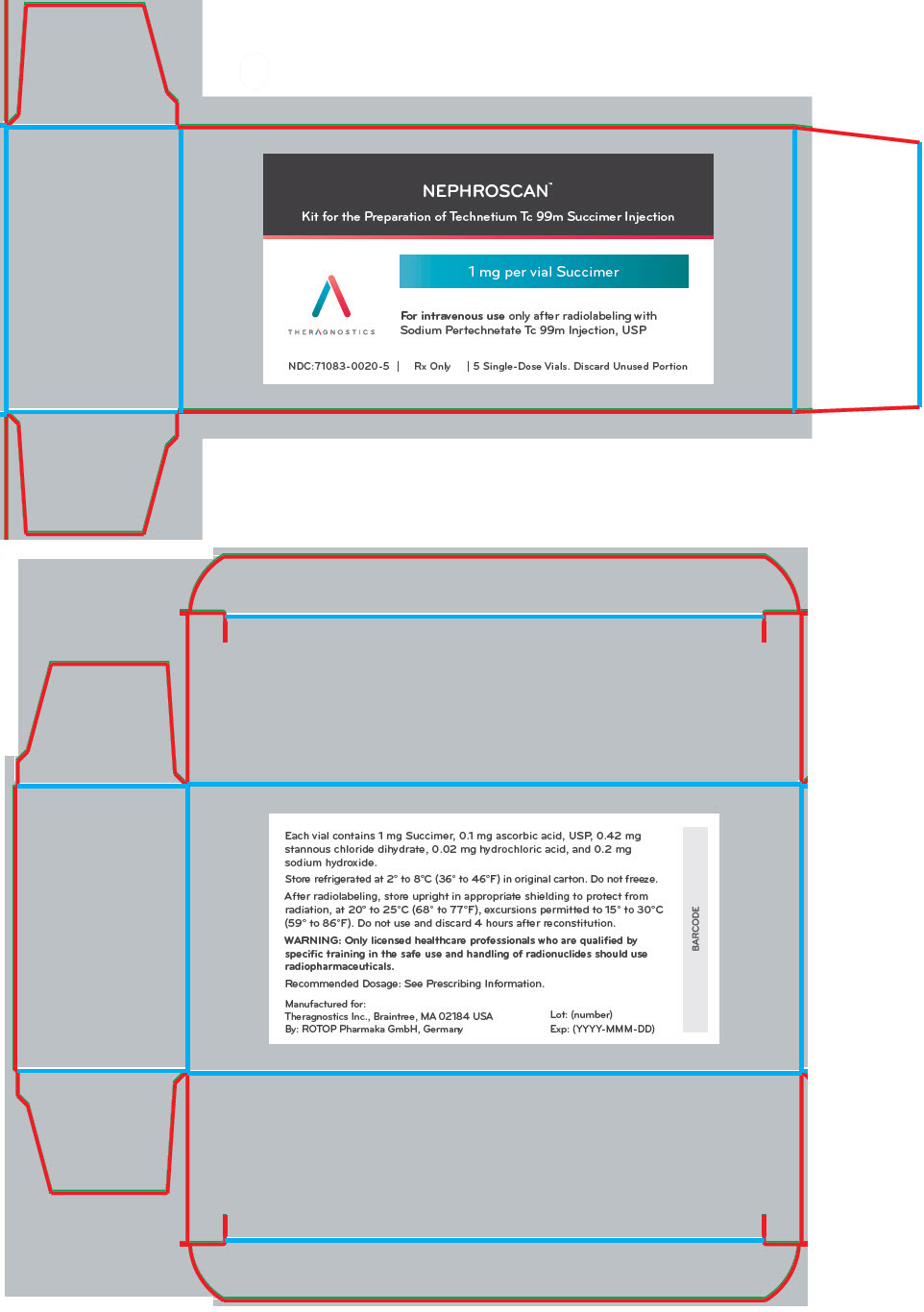
NephroScan SUCCIMER 1 mg Injection, Powder, Lyophilized, For Solution, 5 vials — NDC 71083-0020-5 (Billing 71083-0020-05)
This is a package of 5 vials of NephroScan SUCCIMER 1 mg Injection, Powder, Lyophilized, For Solution from Theragnostics Inc, marketed since Feb 2022 and currently FDA-listed. It is this product's only package size.
NDC database record
One package, one record: these facts belong to NDC 71083-0020-5 alone.
- Record
- FDA NDC Directory package listing · Human prescription drug
- Code segments
- 71083 labeler · 0020 product · 5 package
- Package marketed since
- Feb 18, 2022
- Sample package
- No — commercial package
- Listing certified through
- Dec 31, 2026
- Barcode (UPC-A, from the NDC)
- 3 7108300205 3
- FDA record last changed
- Jul 24, 2026
Identity & classification
Regulatory identifiers FDA, NLM and CMS codes for this package
Drug-database identifiers Medi-Span GPI and First Databank GCN / HICL / AHFS classification
- GSN (GCN sequence number): 051314
- GCN: 18515
- HICL (First Databank): 024542
- AHFS class code: 36:40.00.00
Where does this data come from?
- FDA openFDA NDC Directory · synced Oct 1, 2026
- FDA label on DailyMed · label index refreshed Oct 5, 2026
- RxNorm (NLM RxNav) · catalog refreshed Oct 1, 2026
- Medi-Span GPI (licensed)
- First Databank (licensed) · refreshed Oct 1, 2026
Clinical
Patient education
Supplement & herbal interactions
Some supplements/herbs that may interact with Succimer — tap one for details:
Where does this data come from?
- MedlinePlus (NLM) · refreshed Oct 1, 2026
- FDA label on DailyMed · label index refreshed Oct 5, 2026
Ask a licensed pharmacist directly — free, answered by our team.
Pricing
A drug doesn't have one price. Each row is a different public payment system, and none is what you'd pay at the counter — that depends on your insurance. The ⓘ on each row explains what it measures.
| Price system | Per mL | Per package |
|---|---|---|
| Retail pharmacies payNADAC · weekly | Not in the retail survey — common for institutional, discontinued, or low-volume packs. | |
| Medicaid paysCMS SDUD · 12 mo | No recent Medicaid claims on file for this NDC — rare and low-volume NDCs are suppressed in the public data. | |
| Medicare drug plans payPart D · quarterly | No Part D plan price is available for this NDC in our data. | |
Where does this data come from?
- CMS NADAC weekly file
- CMS ASP pricing files · refreshed Sep 20, 2026
- CMS Medicaid State Drug Utilization Data · refreshed Oct 5, 2026
- CMS Part D plan pricing files · refreshed Sep 24, 2026
- VA National Acquisition Center price file
Packaging — all sizes for this product
| Package NDC | Description | Marketing start | Marketing end | Status |
|---|---|---|---|---|
| 71083-0020-05 You're viewing this Main listing | 5 VIAL, SINGLE-DOSE in 1 CARTON / 1 INJECTION, POWDER, LYOPHILIZED, FOR SOLUTION in 1 VIAL, SINGLE-DOSE | 2022-02-18 | — | Active |
Therapeutic equivalents
| Product | Labeler | Pack | NADAC/unit | TE | Status | Price vs. this |
|---|---|---|---|---|---|---|
| NephroScan 1 mgthis 71083-0020-05 | Theragnostics | 5 vials | — | — | FDA listed | — |
Where does this data come from?
- FDA openFDA NDC Directory · synced Oct 1, 2026
- FDA Orange Book · refreshed Oct 3, 2026
- CMS NADAC weekly file
Availability & generic status
We did not find an FDA-approved generic match for this exact strength, form and route.
Where does this data come from?
- FDA Orange Book · refreshed Oct 3, 2026
Inactive Ingredients / Excipients
Inactive ingredients, also called excipients, are components of the drug product other than the active ingredient. They may include fillers, dyes, coatings, preservatives, flavors, or other formulation ingredients.
💡 Tap an ingredient (hover on desktop) to see what it is and why it’s used.
-
UNII PQ6CK8PD0R
Ascorbic acid, also known as vitamin C, is a white crystalline powder. It serves as an antioxidant to prevent degradation of other ingredients and may also function as a preservative in the formulation.
-
UNII QTT17582CB
A strong acid used to adjust and maintain the proper pH level in liquid medicines, ensuring stability and preventing breakdown of active ingredients.
-
UNII 55X04QC32I
A strong alkaline chemical used to adjust and maintain the pH balance of liquid medicines. It helps keep the medicine stable and ensures it stays effective during storage.
-
UNII 1BQV3749L5
Stannous chloride is a tin-based chemical compound used as a reducing agent and antioxidant in pharmaceuticals. It helps prevent oxidation of active ingredients and stabilizes certain formulations, particularly in products requiring preservation of potency.
4 inactive ingredients listed in the exact product block matched to this NDC.
Where does this data come from?
ingredient classCode="IACT" elements from the exact product block matched by this NDC. Label-section narrative from DailyMed / the openFDA label index is shown separately when available.- FDA label on DailyMed · label index refreshed Oct 5, 2026
- FDA openFDA NDC Directory · synced Oct 1, 2026
Inactive ingredient FAQ
Are inactive ingredients the same for every manufacturer?
Why might an inactive ingredient be missing?
Can inactive ingredients matter?
Manufacturer & labeler
Where does this data come from?
- FDA openFDA NDC Directory · synced Oct 1, 2026
- Drugs@FDA
Full prescribing information FDA SPL
🎯 Indications and Usage ▾
1 INDICATIONS AND USAGE NEPHROSCAN, after radiolabeling with technetium Tc 99m, is indicated for use as an aid in the scintigraphic evaluation of renal parenchymal disorders in adult and pediatric patients including term neonates. NEPHROSCAN, after radiolabeling with technetium Tc 99m, is a radioactive diagnostic agent indicated for use as an aid in the scintigraphic evaluation of renal parenchymal disorders in adults and pediatric patients including term neonates. ( 1 )
⏱️ Dosage and Administration ▾
2 DOSAGE AND ADMINISTRATION Instruct patients to drink a sufficient amount of water before administration and to continue to drink and to void frequently following administration ( 2.2 ) The recommended amount of radioactivity by intravenous injection (bolus) is: For adults: 74 MBq to 222 MBq (2 mCi to 6 mCi) ( 2.3 ) For pediatric patients:
1.85MBq/kg (0.05 mCi/kg) of body weight with a range of 19 MBq to 74 MBq (0.5 mCi to 2 mCi). ( 2.3 ) Begin image acquisition 1 hour to 4 hours after administration ( 2.7 ) Delay imaging up to 6 hours to 24 hours in patients with severely reduced eGFR ( 2.7 ) See Full Prescribing Information for radiation safety, drug preparation, administration, and radiation dosimetry information ( 2.1 , 2.4 , 2.5 , 2.6 , 2.8 )
2.1Radiation Safety – Drug Handling After radiolabeling, handle Technetium Tc 99m Succimer Injection with appropriate safety measures to minimize radiation exposure [see Warnings and Precautions (5.2) ] . Use waterproof gloves, effective radiation shielding, and other appropriate safety measures when preparing and handling Technetium Tc 99m Succimer Injection. Radiopharmaceuticals should be used by or under the control of physicians who are qualified by specific training and experience in the safe use and handling of radionuclides, and whose experience and training have been approved by the appropriate governmental agency authorized to license the use of radionuclides.
2.2Patient Preparation Instruct patients to drink a sufficient amount of water to ensure adequate hydration prior to administration of Technetium Tc 99m Succimer Injection and to continue to drink and void frequently following administration to reduce radiation exposure [see Warnings and Precautions (5.2) ].
2.3Recommended Dosage Adults The recommended amount of radioactivity of Technetium Tc 99m Succimer Injection for renal parenchymal imaging in adults is 74 MBq to 222 MBq (2 mCi to 6 mCi) by intravenous injection (bolus). Pediatric Patients The recommended amount of radioactivity of Technetium Tc 99m Succimer Injection for renal parenchymal imaging in pediatric patients is
1.85MBq/kg (0.05 mCi/kg) of body weight with a range of 19 MBq to 74 MBq (0.5 mCi to 2 mCi) by intravenous injection (bolus). Weight based pediatric dosing is shown in Table 1. Table 1 Recommended Radioactivity of Technetium Tc 99m Succimer Injection for Pediatric Patients by Body Weight Body Weight (kg) Recommended Radioactivity MBq (mCi) Body Weight (kg) Recommended Radioactivity MBq (mCi) less than 11 kg 19 MBq (0.5 mCi) 25 to 26 49 MBq (1.3 mCi) 11 to 12 21 MBq (0.6 mCi) 27 to 28 52 MBq (1.4 mCi) 13 to 14 26 MBq (0.7 mCi) 29 to 30 56 MBq (1.5 mCi) 15 to 16 30 MBq (0.8 mCi) 31 to 32 59 MBq (1.6 mCi) 17 to 18 33 MBq (0.9 mCi) 33 to 34 63 MBq (1.7 mCi) 19 to 20 37 MBq (1 mCi) 35 to 36 67 MBq (1.8 mCi) 21 to 22 41 MBq (1.1 mCi) 37 to 38 70 MBq (1.9 mCi) 23 to 24 44 MBq (1.2 mCi) 39 or greater 74 MBq (2 mCi)
2.4Drug Preparation Prepare Technetium Tc 99m Succimer Injection according to the following procedure using asceptic technique: Wear waterproof gloves. Place the kit vial in lead shielding and disinfect the stopper (allow disinfectant to dry). Use a sterile syringe to transfer 5 mL sodium pertechnetate Tc 99m injection obtained from a technetium Tc 99m generator with a maximum activity of 1,480 MBq (40 mCi) to the vial.
The volume of sodium pertechnetate Tc 99m injection may be adjusted to 5 mL prior to adding to the kit vial using 0.9% sodium chloride injection, USP. Use the same syringe to withdraw the appropriate gas volume from the vial for pressure compensation. Lightly shake the vial to completely dissolve the powder.
Ensure the stopper is well moistened. Incubate the vial for 10 minutes at controlled room temperature 20°C to 25°C (68°F to 77°F). Measure the product activity in a dose calibrator; complete the radiolabeled product vial label and affix to the vial shield.
Check radiochemical purity according to the method in
2.5Radi… [Excerpted — this section continues on DailyMed.]
💊 Dosage Forms and Strengths ▾
3 DOSAGE FORMS AND STRENGTHS For Injection: NEPHROSCAN contains 1 mg succimer as a white-yellowish to off-white lyophilized powder in a single-dose vial. Upon radiolabeling with technetium Tc 99m, it provides up to 1,480 MBq (40 mCi) Technetium Tc 99m Succimer Injection as a clear, colorless solution in approximately 5 mL volume at calibration date and time. For Injection: NEPHROSCAN contains 1 mg succimer as a white-yellowish to off-white lyophilized powder in a single dose vial.
Upon radiolabeling with technetium Tc 99m, it provides a clear, colorless solution containing up to 1,480 MBq (40 mCi) technetium Tc 99m succimer in approximately 5 mL volume at calibration time. ( 3 )
⛔ Contraindications ▾
4 CONTRAINDICATIONS None None ( 4 )
⚠️ Warnings and Cautions ▾
5 WARNINGS AND PRECAUTIONS Hypersensitivity Reactions: Have appropriate instruments and medications necessary for immediate treatment of allergic reactions and monitor patients for hypersensitivity reactions during and after administration ( 5.1 ) Radiation risks: Ensure safe handling to minimize radiation exposure to patients and health care workers ( 5.2 ) Risk in Patients with Advanced Renal Failure: Image interpretation may be affected as the kidneys may not absorb technetium Tc 99m succimer. ( 5.3 )
5.1Hypersensitivity Reactions Hypersensitivity reactions, including urticaria, rash, pruritus, and erythema have been reported with the use of technetium Tc 99m succimer injection in adults and pediatric patients. The time of onset of the reactions varied within 2 hours to several hours after the injection. Have appropriate instruments and medications necessary for immediate treatment of hypersensitivity reactions and monitor patients for reactions during and after administration [see Adverse Reactions (6) ] .
5.2Radiation Risks Technetium Tc 99m succimer injection contributes to a patient's overall long-term cumulative radiation exposure. Long-term cumulative radiation exposure is associated with an increased risk for cancer. Ensure safe handling to minimize radiation exposure to the patient and health care workers.
Advise patients to hydrate before and after administration and to void frequently after administration [see Dosage and Administration (2.1 , 2.2) ] .
5.3Risk in Patients with Advanced Renal Failure The use of technetium Tc 99m succimer injection in patients with severely reduced estimated glomerular filtration (eGFR) may have an effect on image interpretation as the kidneys may not absorb the technetium Tc 99m succimer and thus the Tc 99m succimer may distribute to organs or parts of the body other than the kidneys. It has been reported that satisfactory images may be obtained in some of these patients by delaying imaging between 6 hours to 24 hours [see Dosage and Administration (2.7) ] .
🤒 Adverse Reactions ▾
6 ADVERSE REACTIONS The following clinically significant adverse reactions are discussed elsewhere in the labeling: Hypersensitivity Reactions [see Warnings and Precautions (5.1) ] The following adverse reactions associated with the use of NEPHROSCAN were identified in clinical studies or postmarketing reports. Because some of these reactions were reported voluntarily from a population of uncertain size, it is not always possible to reliably estimate their frequency or establish a causal relationship to drug exposure.
Immune System Disorders : Hypersensitivity including urticaria, rash, pruritus, and erythema General Disorders : syncope, fever, and nausea. The following adverse reactions have been reported: urticaria, rash, pruritus, erythema, syncope, fever, and nausea. ( 6 ) To report SUSPECTED ADVERSE REACTIONS, contact Theragnostics, Inc., at 1-888-286-3848 or FDA at 1-800-FDA-1088 or www.fda.gov/medwatch.
👥 Use in Specific Populations ▾
8 USE IN SPECIFIC POPULATIONS Lactation : Temporarily discontinue breastfeeding. A lactating woman should pump and discard breastmilk for at least 24 hours after Technetium Tc 99m Succimer Injection administration. ( 8.2 )
8.1Pregnancy Risk Summary Available data with technetium Tc 99m succimer use in pregnant women are insufficient to evaluate for a drug-associated risk of major birth defects and miscarriage. Animal reproduction studies with technetium Tc 99m succimer have not been conducted. Although all radiopharmaceuticals have the potential to cause fetal harm depending on the fetal stage of development and the magnitude of the radiation dose, the radiation exposure to the fetus from technetium Tc 99m succimer is expected to be low (less than 0.50 mGy) (see Data ) .
The estimated background risk of major birth defects and miscarriage for the indicated population is unknown. All pregnancies have a background risk of birth defects, loss, or other adverse outcomes. In the U.S. general population the estimated background risk of major birth defects and miscarriage in clinically recognized pregnancies are 2% to 4% and 15% to 20%, respectively.
Data Human Data No adverse fetal effects of radiation risks have been identified for diagnostic procedures involving less than 50 mGy, which represents less than 10mGy fetal doses.
8.2Lactation Risk Summary Technetium Tc 99m succimer is present in breast milk. There are no data on the effects of technetium Tc 99m succimer on the breastfed infant or the effects on milk production. NEPHROSCAN is used for imaging in infants with renal disease; exposure to technetium Tc 99m succimer via breast milk is expected to be lower.
Based on clinical guidelines, exposure of technetium Tc 99m succimer to a breastfed infant may be minimized by advising a lactating woman to temporarily discontinue breastfeeding and to pump and discard breast milk for a minimum of at least 24 hours after administration of Technetium Tc 99m Succimer Injection. The developmental and health benefits of breastfeeding should be considered along with a mother's clinical need for NEPHROSCAN, any potential adverse effects on the breastfed child from technetium Tc 99m succimer or from the underlying maternal condition.
8.4Pediatric Use NEPHROSCAN, after radiolabeling with technetium Tc 99m, is indicated for use as an aid in the scintigraphic evaluation of renal parenchymal disorders in pediatric patients, including term neonates. Use of NEPHROSCAN in this age group for this indication is supported by evidence from effectiveness established in adult studies and data from published pediatric studies supporting the safety and effectiveness of weight-based dosing of Technetium Tc 99m Succimer Injection in renal parenchymal imaging in pediatric patients including term neonates [see Dosage and Administration (2.3) ] .
The recommended amount of radioactivity in pediatric patients,
1.85MBq/kg (0.05 mCi/kg) with a range of 19 MBq to 74 MBq (0.5 mCi to 2 mCi), is based on published studies that used technetium Tc 99m succimer for the evaluation of acute pyelonephritis, renal scarring, and split renal function in pediatric patients [see Dosage and Administration (2.2) ] . Hypersensitivity reactions, including urticaria, rash, pruritus, and erythema have been reported with the use of technetium Tc 99m succimer in pediatric patients [see Warnings and Precautions (5.1) and Adverse Reactions (6) ] .
8.5Geriatric Use Clinical studies of technetium Tc 99m succimer did not include sufficient numbers of subjects 65 years of age and over to determine whether they respond differently from younger patients. Other reported clinical experience has not identified differences in responses between the elderly and younger patients. In general, dose selection for an elderly patient should be cautious usually administering the low end of the dosing range, reflecting the greater frequency of decreased hepatic, renal or cardiac function, and of concomitant… [Excerpted — this section continues on DailyMed.]
🤰 Pregnancy ▾
8.1Pregnancy Risk Summary Available data with technetium Tc 99m succimer use in pregnant women are insufficient to evaluate for a drug-associated risk of major birth defects and miscarriage. Animal reproduction studies with technetium Tc 99m succimer have not been conducted. Although all radiopharmaceuticals have the potential to cause fetal harm depending on the fetal stage of development and the magnitude of the radiation dose, the radiation exposure to the fetus from technetium Tc 99m succimer is expected to be low (less than 0.50 mGy) (see Data ) .
The estimated background risk of major birth defects and miscarriage for the indicated population is unknown. All pregnancies have a background risk of birth defects, loss, or other adverse outcomes. In the U.S. general population the estimated background risk of major birth defects and miscarriage in clinically recognized pregnancies are 2% to 4% and 15% to 20%, respectively.
Data Human Data No adverse fetal effects of radiation risks have been identified for diagnostic procedures involving less than 50 mGy, which represents less than 10mGy fetal doses.
🧒 Pediatric Use ▾
8.4Pediatric Use NEPHROSCAN, after radiolabeling with technetium Tc 99m, is indicated for use as an aid in the scintigraphic evaluation of renal parenchymal disorders in pediatric patients, including term neonates. Use of NEPHROSCAN in this age group for this indication is supported by evidence from effectiveness established in adult studies and data from published pediatric studies supporting the safety and effectiveness of weight-based dosing of Technetium Tc 99m Succimer Injection in renal parenchymal imaging in pediatric patients including term neonates [see Dosage and Administration (2.3) ] .
The recommended amount of radioactivity in pediatric patients,
1.85MBq/kg (0.05 mCi/kg) with a range of 19 MBq to 74 MBq (0.5 mCi to 2 mCi), is based on published studies that used technetium Tc 99m succimer for the evaluation of acute pyelonephritis, renal scarring, and split renal function in pediatric patients [see Dosage and Administration (2.2) ] . Hypersensitivity reactions, including urticaria, rash, pruritus, and erythema have been reported with the use of technetium Tc 99m succimer in pediatric patients [see Warnings and Precautions (5.1) and Adverse Reactions (6) ] .
🧓 Geriatric Use ▾
8.5Geriatric Use Clinical studies of technetium Tc 99m succimer did not include sufficient numbers of subjects 65 years of age and over to determine whether they respond differently from younger patients. Other reported clinical experience has not identified differences in responses between the elderly and younger patients. In general, dose selection for an elderly patient should be cautious usually administering the low end of the dosing range, reflecting the greater frequency of decreased hepatic, renal or cardiac function, and of concomitant disease or other drug therapy.
This drug is known to be substantially excreted by the kidney, and the risk of toxic reactions to this drug may be greater in patients with decreased renal function. Because elderly patients are more likely to have decreased renal function, care should be taken in dose selection, and it may be useful to monitor renal function.
🆘 Overdosage ▾
10 OVERDOSAGE In the event of an overdose of technetium Tc 99m succimer, reduce the radiation absorbed dose to the patient where possible by increasing the elimination of the drug from the body using hydration and frequent bladder voiding. A diuretic might also be considered. If possible, an estimate of the radiation effective dose given to the patient should be made.
🧬 Clinical Pharmacology ▾
12 CLINICAL PHARMACOLOGY
12.1Mechanism of Action Technetium Tc 99m succimer binds to the cortical region of kidneys and in conjunction with gamma scintigraphy or single photon emission computed tomography (SPECT) is used to image the renal cortices.
12.2Pharmacodynamics Technetium Tc 99m succimer only stays bound to viable cortical tissue for >24 hours following administration. The relationship between technetium Tc 99m succimer plasma concentrations and successful imaging is not known.
12.3Pharmacokinetics Distribution Technetium Tc 99m succimer is distributed in the plasma, bound to plasma proteins following intravenous administration. In humans, 53% to 70% of the intravenously administered technetium Tc 99m is protein bound. There is negligible activity in the red blood cells.
At 6 hours about 20% of the dose is concentrated in each kidney. Elimination Approximately 16% of the technetium Tc 99m succimer activity is excreted in the urine within 2 hours.
🧬 Mechanism of Action ▾
12.1Mechanism of Action Technetium Tc 99m succimer binds to the cortical region of kidneys and in conjunction with gamma scintigraphy or single photon emission computed tomography (SPECT) is used to image the renal cortices.
📦 How Supplied / Storage and Handling ▾
16 HOW SUPPLIED/STORAGE AND HANDLING How Supplied NEPHROSCAN (kit for the preparation of technetium Tc 99m succimer injection), containing 1 mg succimer, is supplied as a white-yellowish to off-white lyophilized powder packaged in a sterile, single-dose vial as a carton of 5 vials (NDC 71083-0020-5). Storage and Handling Before radiolabeling, store NEPHROSCAN in a refrigerator at 2°C to 8°C (36°F to 46°F) in original carton. Do not freeze.
After radiolabeling, store Technetium Tc 99m Succimer Injection upright, shielded, for up to 4 hours, at controlled room temperature 20°C to 25°C (68°F to 77°F); excursions permitted to 15°C to 30°C (59°F to 86°F) [see Dosage and Administration (2.4) ]. This preparation is approved for use by persons under license by the Nuclear Regulatory Commission or the relevant regulatory authority of an Agreement State.
📦 Storage and Handling ▾
Storage and Handling Before radiolabeling, store NEPHROSCAN in a refrigerator at 2°C to 8°C (36°F to 46°F) in original carton. Do not freeze. After radiolabeling, store Technetium Tc 99m Succimer Injection upright, shielded, for up to 4 hours, at controlled room temperature 20°C to 25°C (68°F to 77°F); excursions permitted to 15°C to 30°C (59°F to 86°F) [see Dosage and Administration (2.4) ].
This preparation is approved for use by persons under license by the Nuclear Regulatory Commission or the relevant regulatory authority of an Agreement State.
📋 Description ▾
11 DESCRIPTION
11.1Chemical Characteristics NEPHROSCAN is a sterile, single-dose kit for the preparation of Technetium Tc 99m Succimer Injection a radioactive diagnostic agent, for intravenous use. The active ingredient, succimer is meso-2,3-dimercaptosuccinic acid with a molecular weight of 182.22 g/mol. The chemical structure of succimer is shown below.
Subsequent to radiolabeling with sodium pertechnetate Tc 99m, the active moiety technetium Tc 99m succimer is obtained in situ. Each vial contains 1 mg succimer, 0.1 mg ascorbic acid, 0.42 mg stannous (tin) chloride dihydrate, 0.02 mg hydrochloric acid and 0.2 mg sodium hydroxide as a white-yellowish to off-white lyophilized powder. In addition, after radiolabeling with sodium pertechnetate Tc 99m injection, each vial contains up to 1,480 MBq (40 mCi) of technetium Tc 99m succimer in 0.9% sodium chloride injection as a sterile, clear, and colorless solution. pH of the final solution is between 3 and 3.5.
FDA approved pH specifications differ from USP. Chemical Structure
11.2Physical Characteristics Technetium Tc 99m decays by isomeric transition with a physical half-life of 6.02 hours. The principal photon that is useful for detection and imaging studies is listed in Table 3. Table 3 Principal Radiation Emission Data for Technetium Tc 99m Radiation/ Emission Mean % / Disintegration Mean Energy (keV) Gamma 2 89.07 140.5 To correct for physical decay of this radionuclide, the fractions that remain at selected intervals after the time of calibration are shown in Table 4.
Table 4 Physical Decay Chart for Tc 99m, half-life 6.02 hours Hours Fraction Remaining Hours Fraction Remaining 0 Calibration time 1.000 7 0.447 1 0.891 8 0.398 2 0.794 9 0.355 3 0.708 10 0.316 4 0.631 11 0.282 5 0.562 12 0.251 6 0.501
11.3 External Radiation The specific gamma ray constant for technetium Tc 99m is
0.78R/hr-mCi at 1 cm. The first half value layer is 0.017 cm of Pb. To facilitate control of the radiation exposure from millicurie amounts of this radionuclide, the use of a 0.25 cm thickness of Pb will attenuate the radiation emitted by a factor of about 1,000.
Table 5 displays the radiation attenuation by lead shielding. Table 5 Radiation Attenuation by Lead (Pb) Shielding Shield Thickness (Pb) mm Coefficient of Attenuation 0.02 0.5 0.08 0.1 0.16 0.01 0.25 0.001 0.33 0.0001
💬 Information for Patients ▾
17 PATIENT COUNSELING INFORMATION Adequate Hydration Instruct patients to drink a sufficient amount of water to ensure adequate hydration before their imaging and urge them to drink and urinate as often as possible during the first hours following the administration of Technetium Tc 99m Succimer Injection, in order to reduce radiation exposure [see Dosage and Administration (2.2) and Warnings and Precautions (5.2) ] . Lactation Advise a lactating woman to temporarily discontinue breastfeeding and to pump and discard breast milk for at least 24 hours after Technetium Tc 99m Succimer Injection administration in order to minimize radiation exposure to a breastfed infant [see Use in Specific Populations (8.2) ] .
🧬 Pharmacokinetics ▾
12.3Pharmacokinetics Distribution Technetium Tc 99m succimer is distributed in the plasma, bound to plasma proteins following intravenous administration. In humans, 53% to 70% of the intravenously administered technetium Tc 99m is protein bound. There is negligible activity in the red blood cells.
At 6 hours about 20% of the dose is concentrated in each kidney. Elimination Approximately 16% of the technetium Tc 99m succimer activity is excreted in the urine within 2 hours.
🧬 Pharmacodynamics ▾
12.2Pharmacodynamics Technetium Tc 99m succimer only stays bound to viable cortical tissue for >24 hours following administration. The relationship between technetium Tc 99m succimer plasma concentrations and successful imaging is not known.
🧪 Nonclinical Toxicology ▾
13 NONCLINICAL TOXICOLOGY
13.1Carcinogenesis, Mutagenesis, Impairment of Fertility No long-term animal studies were performed to evaluate the carcinogenicity potential of technetium Tc 99m succimer.
📄 Carcinogenesis, Mutagenesis, Impairment of Fertility ▾
13.1Carcinogenesis, Mutagenesis, Impairment of Fertility No long-term animal studies were performed to evaluate the carcinogenicity potential of technetium Tc 99m succimer.
📄 Package Label / Principal Display Panel ▾
PRINCIPAL DISPLAY PANEL - 1 mg Vial Carton NEPHROSCAN ® Kit for the Preparation of Technetium Tc 99m Succimer Injection 1 mg per vial Succimer For intravenous use only after radiolabeling with Sodium Pertechnetate Tc 99m Injection, USP THERAGNOSTICS NDC:71083-0020-5 Rx Only 5 Single-Dose Vials. Discard Unused Portion PRINCIPAL DISPLAY PANEL - 1 mg Vial Carton
Medicare Part D spend CMS · PART D · 2026 (Q1)
Reported adverse events (FAERS)
Top reported reactions
Age at onset
Reporter sex
Where does this data come from?
About this NDC listing & data coverage
What data is (and isn’t) available for this NDC — tap to expand
| NDC identity (package / product / labeler codes) | ✓ Available |
| Labeler | ✓ Available |
| Product & package description | ✓ Available |
| Marketing category & status | ✓ Available |
| Active ingredient / dosage form / route | ✓ Available |
| FDA label (SPL via DailyMed) | ✓ Available |
| Package photos | ✓ Available |
| Inactive ingredients (structured) | ✓ Available |
| NADAC pharmacy acquisition price (CMS) | — Not published for this NDC CMS publishes NADAC only for NDCs reported in its retail-pharmacy survey. |
| Orange Book / therapeutic-equivalence data | — Not published for this NDC Applies only to products approved under an NDA/ANDA; many listings are out of scope. |
| HCPCS J-code billing crosswalk | — Not published for this NDC Most self-administered / retail products have no J-code — that is normal. |
| Medicaid utilization (CMS SDUD) | — Not published for this NDC CMS reports utilization only for NDCs with Medicaid claims above its privacy threshold. |