
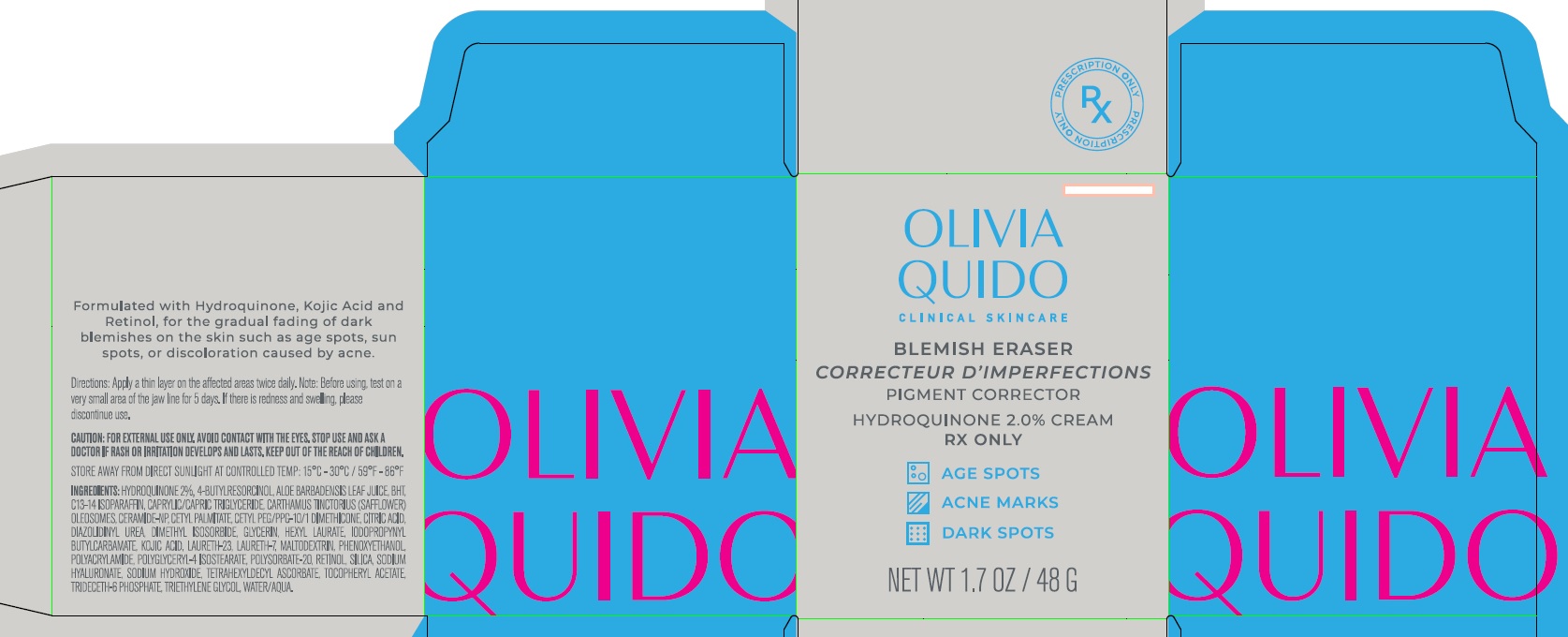
OLIVIA QUIDO BLEMISH ERASER Hydroquinone .02 g/g Cream
🆔 Identity & classification
Where does this data come from?
🏭 Manufacturer & labeler
Where does this data come from?
🩺 Clinical
This is a topical cream containing hydroquinone 0.02% (2 milligrams per gram). Hydroquinone is a melanin synthesis inhibitor typically used in dermatology to lighten areas of darkened or discolored skin. This product is marketed as an unapproved drug and does not have an FDA-approved application.
Patient education
Supplement & herbal interactions
Where does this data come from?
Ask a licensed pharmacist directly — free, answered by our team.
🧪 Inactive Ingredients / Excipients
Inactive ingredients, also called excipients, are components of the drug product other than the active ingredient. They may include fillers, dyes, coatings, preservatives, flavors, or other formulation ingredients.
💡 Tap an ingredient (hover on desktop) to see what it is and why it’s used.
-
UNII 2IK4UQ3ZGA
A synthetic chemical compound used in topical formulations as an antioxidant and stabilizer. It helps prevent degradation of active ingredients and maintains product consistency during storage.
-
UNII ZY81Z83H0X
Aloe vera leaf is a plant extract derived from the aloe plant. It is used in medicines as a natural moisturizer and skin-soothing agent in topical formulations.
-
UNII XF417D3PSL
Anhydrous citric acid is a sour, crystalline powder derived from citric acid with water removed. In medicines, it acts as a buffer to control pH, adds tartness to improve taste, and helps tablets disintegrate.
-
UNII 1P9D0Z171K
BHT is a synthetic antioxidant that prevents fats and oils in medicines from breaking down and becoming rancid. It helps keep the product stable and effective during storage.
-
UNII E4F12ROE70
A refined mineral oil derived from crude petroleum containing 13 to 14 carbon chains. It acts as a solvent, emollient, and carrier in topical formulations to help dissolve active ingredients and improve product texture and spreadability.
-
UNII 9S60Q72309
A plant-derived ingredient made from safflower seed components. It acts as an emulsifier and carrier to help distribute oils and active ingredients evenly throughout the medicine.
-
UNII 4370DF050B
Ceramide NP is a waxy, lipid-based substance that mimics natural skin oils. It's used in topical formulations as an emollient and skin-conditioning agent to help soften, smooth, and protect the skin barrier.
-
UNII 5ZA2S6B08X
Cetyl palmitate is a waxy substance made from natural fats. It works as a binder and thickener to help hold the medicine together and control how it dissolves in your body.
-
UNII V2W71V8T0X
A silicone-based compound that mixes oil and water together. Used in formulations as an emulsifier to help blend ingredients and improve texture and stability of creams, lotions, and other topical products.
-
UNII H5RIZ3MPW4
A chemical preservative used to prevent bacterial and fungal growth in medicines. It helps extend shelf life and maintain product safety during storage and use.
-
UNII SA6A6V432S
Dimethyl isosorbide is a clear liquid solvent derived from natural sugar sources. It helps dissolve active ingredients and improve their absorption in liquid medicines and topical products.
-
UNII PDC6A3C0OX
Glycerin is a clear, thick liquid derived from plant oils or fats. It acts as a humectant to retain moisture, a sweetener, and a solvent in medications.
-
UNII 4CG9F9W01Q
A synthetic fatty acid ester used as an emollient and skin-conditioning agent in topical medicines. It helps soften the product texture and improves how it spreads and absorbs into the skin.
-
UNII S270N0TRQY
Hyaluronic acid is a naturally occurring substance found in skin and joints. In medicines, it acts as a moisturizer and thickening agent to improve texture and help the product spread smoothly.
-
UNII 603P14DHEB
A synthetic antimicrobial chemical used as a preservative in topical and cosmetic formulations. It prevents bacterial and fungal growth in products to maintain stability and safety during storage and use.
-
UNII 6K23F1TT52
Kojic acid is a naturally derived compound used as a preservative and antioxidant in medicines. It helps prevent spoilage and maintain product stability during storage.
-
UNII Z95S6G8201
A synthetic surfactant derived from lauryl alcohol and ethylene oxide. It helps dissolve and mix oily and watery ingredients in liquid formulations, and may improve how the medicine spreads or is absorbed.
-
UNII 7CVR7L4A2D
A starch-derived carbohydrate produced by breaking down corn, potato, or tapioca starch. It functions as a filler and binder to give the medicine bulk and texture, and sometimes as a mild sweetener or texture enhancer in powders and tablets.
-
UNII HIE492ZZ3T
Phenoxyethanol is a synthetic preservative and antimicrobial agent used to prevent bacterial and fungal growth in medicines and cosmetic products, extending shelf life and maintaining product safety.
-
UNII 5D6TC4BRWV
Polyacrylamide is a synthetic polymer used as a thickener and stabilizer in medicines. It helps maintain consistent texture and prevents separation of ingredients in liquid or semi-solid formulations.
-
UNII 820DPX33S7
A synthetic emulsifier derived from glycerin and fatty acids. It helps mix oil and water-based ingredients together and keeps them evenly blended throughout the product.
-
UNII 7T1F30V5YH
A synthetic emulsifier derived from sorbitol and oleic acid. It helps mix oil and water-based ingredients together and keeps them from separating in liquid formulations.
-
UNII G2SH0XKK91
Retinol is a form of vitamin A derived from animal sources or synthesized in a lab. In medicines, it may serve as an active therapeutic ingredient in some formulations, though when listed as an excipient it functions as a skin-conditioning agent or antioxidant to help stabilize the product.
-
UNII 9LBV3F07AZ
A synthetic, oil-soluble form of vitamin C used as an antioxidant to prevent degradation of the medicine and maintain its stability during storage.
-
UNII NKT96BX1OC
A synthetic ingredient derived from plant oils, used as an emulsifier and surfactant. It helps blend water and oil components together and improves how the medicine spreads or absorbs in the formulation.
-
UNII 3P5SU53360
Triethylene glycol is a synthetic liquid that acts as a solvent and humectant in medicines. It helps dissolve active ingredients and keeps liquid formulations from drying out.
-
UNII 059QF0KO0R
Water is a liquid solvent that dissolves and mixes ingredients together in liquid medicines, syrups, and injections. It helps distribute the active drug evenly throughout the product.
27 inactive ingredients listed in the exact product block matched to this NDC.
Where does this data come from?
ingredient classCode="IACT" elements from the exact product block matched by this NDC. Label-section narrative from DailyMed / the openFDA label index is shown separately when available.Inactive ingredient FAQ
Are inactive ingredients the same for every manufacturer?
Why might an inactive ingredient be missing?
Can inactive ingredients matter?
💲 Pricing
A drug doesn't have one price. Each row is a different public payment system, and none is what you'd pay at the counter — that depends on your insurance. The ⓘ on each row explains what it measures.
| Price system | Per g | Per package |
|---|---|---|
| Retail pharmacies payNADAC · weekly | Not in the retail survey — common for institutional, discontinued, or low-volume packs. | |
| Medicaid paysCMS SDUD · 12 mo | No recent Medicaid claims on file for this NDC — rare and low-volume NDCs are suppressed in the public data. | |
| Medicare drug plans payPart D · quarterly | No Part D plan price is available for this NDC in our data. | |
Where does this data come from?
🔁 Therapeutic equivalents
| Product | Labeler | Pack | NADAC/unit | TE | Status | Price vs. this |
|---|---|---|---|---|---|---|
| Olivia Quido Blemish Eraser .02 g/gthis 71421-0801-30 | O | 1 bottle | — | — | FDA listed | — |
Where does this data come from?
⏳ Availability & generic status
We did not find an FDA-approved generic match for this exact strength, form and route.
Where does this data come from?
📦 Packaging — all sizes for this product
| Package NDC | Description | Marketing start | Status |
|---|---|---|---|
| 71421-0801-30 You're viewing this | 1 BOTTLE, DISPENSING in 1 BOX (71421-801-30) / 48 g in 1 BOTTLE, DISPENSING | 2022-05-04 | Active |
🧭 About this NDC listing & data coverage
Listed without an FDA application
This product's marketing category indicates it is marketed without an approved FDA application (no NDA, ANDA, or BLA on file). Having an NDC does not by itself establish FDA approval — the NDC Directory is a listing system, not an approval decision. Approval-linked data such as Orange Book therapeutic-equivalence ratings therefore does not apply.
What data is (and isn’t) available for this NDC — tap to expand
| NDC identity (package / product / labeler codes) | ✓ Available |
| Labeler | ✓ Available |
| Product & package description | ✓ Available |
| Marketing category & status | ✓ Available |
| Active ingredient / dosage form / route | ✓ Available |
| FDA label (SPL via DailyMed) | ✓ Available |
| Package photos | ✓ Available |
| Inactive ingredients (structured) | ✓ Available |
| NADAC pharmacy acquisition price (CMS) | — Not published for this NDC CMS publishes NADAC only for NDCs reported in its retail-pharmacy survey. |
| Orange Book / therapeutic-equivalence data | — Not published for this NDC Applies only to products approved under an NDA/ANDA; many listings are out of scope. |
| HCPCS J-code billing crosswalk | — Not published for this NDC Most self-administered / retail products have no J-code — that is normal. |
| Medicaid utilization (CMS SDUD) | — Not published for this NDC CMS reports utilization only for NDCs with Medicaid claims above its privacy threshold. |
Questions about this listing
Is this NDC FDA-approved?
Why is there no price listed?
Is the NDC printed on the package the same as the 11-digit billing NDC?
What do the three segments of this NDC mean?
Is this package still being marketed?
Who lists this product with the FDA?
Do I need a prescription for this product?
Where does this data come from?
📄 Full prescribing information FDA SPL
🎯 Indications and Usage ▾
INDICATIONS AND USAGE 1.1Indication BLEMISH ERASER is a combination of hydrocortisone (a corticosteroid), hydroquinone (a melanin synthesis inhibitor), and a tretinoin (a retinoid) that is indicated for the gradual bleaching of hyperpigmented skin conditions age and liver spots, freckles, and other unwanted areas of melanin hyperpigmentation, in the presence of measures for sun avoidance, including the use of sunscreen.
1.2Limitations of Use The safety and efficacy of BLEMISH ERASER in pregnant women and nursing mothers have not been established. BLEMISH ERASER is a hydroquinone (a melanin synthesis inhibitor) that is indicated for the gradual bleaching of hyperpigmented skin conditions age and liver spots, freckles, and other unwanted areas of melanin hyperpigmentation, in the presence of measures for sun avoidance, including the use of sunscreen. (1)
⏱️ Dosage and Administration ▾
2 DOSAGE AND ADMINISTRATION Gently wash the face and neck with a mild cleanser. Rinse and pat the skin dry. Apply a thin film of BLEMISH ERASER to the affected area once daily at night or as directed by a doctor.
During the day, use O Skin Sunscreen SPF-50, and wear protective clothing. Avoid sunlight exposure to prevent repigmentation. BLEMISH ERASER is for topical use only.
It is not for oral, ophthalmic, or intravaginal use. 2 DOSAGE AND ADMINISTRATION Gently wash the face and neck with a mild cleanser. Rinse and pat the skin dry.
Apply a thin film of BLEMISH ERASER to the affected area once daily at night or as directed by a doctor. During the day, use O Skin Sunscreen SPF-50, and wear protective clothing. Avoid sunlight exposure to prevent repigmentation.
BLEMISH ERASER is for topical use only. It is not for oral, ophthalmic, or intravaginal use.
💊 Dosage Forms and Strengths ▾
3 DOSAGE FORMS AND STRENGTHS Cream, 2%. Each gram of BLEMISH ERASER contains 20.0 mg of hydroquinone in a cream base. (3) Cream, 2%. Each gram of BLEMISH ERASER contains 20.0 mg of hydroquinone in a cream base. (3)
⛔ Contraindications ▾
BLEMISH ERASER is contraindicated in individuals with a history of hypersensitivity to this product or any of its components.. (4) BLEMISH ERASER is contraindicated in individuals with a history of hypersensitivity to this product or any of its components.. (4)
⚠️ Warnings and Cautions ▾
5 WARNINGS AND PRECAUTIONS
5.1Hypersensitivity If anaphylaxis, asthma or other clinically significantly hypersensitivity reactions occur, institute appropriate therapy and discontinue BLEMISH ERASER. Allergic contact dermatitis may also occur. Since this product contains no sunscreen, an effective broad spectrum sun blocking agent should be used and unnecessary solar exposure avoided, or protective clothing should be worn to cover bleached skin in order to prevent repigmentation from occurring.
5.2Exogenous Ochronosis BLEMISH ERASER contains hydroquinone, which may produce exogenous ochronosis, a gradual blue-black darkening of the skin, the occurrence of which should prompt discontinuation of therapy. Most patients developing this condition are Black, but it may also occur in Caucasians and Hispanics. 5.3.
Effects on Endocrine System Manifestations of Cushing’s syndrome, hyperglycemia, and glucosuria can also be produced by systemic absorption of topical corticosteroid while treatment. If HPA axis suppression is noted, the use of BLEMISH ERASER should be discontinued. Recovery of HPA axis function generally occurs upon discontinuation of topical corticosteroids.
5.4Cutaneous Reactions BLEMISH ERASER contains hydroquinone that may cause mild to moderate irritation. Local irritation, such as skin reddening, peeling, mild burning sensation, dryness, and pruritus may be expected at the site of application. Transient skin reddening or mild burning sensation does not preclude treatment.
If a reaction suggests hypersensitivity or chemical irritation, discontinue use of the medication and call a doctor. Patients should avoid medicated or abrasive soaps and cleansers, soaps and cosmetics with drying effects, products with high concentrations of alcohol and astringents, and other irritants or keratolytic drugs while on BLEMISH ERASER treatment. Avoid use of medications that are known to be photosensitizing.
If anaphylaxis, asthma or other clinically significantly hypersensitivity reactions occur, institute appropriate therapy and discontinue BLEMISH ERASER. Allergic contact dermatitis may also occur. (5.1) BLEMISH ERASER contains hydroquinone, which may produce exogenous ochronosis, a gradual blue-black darkening of the skin, the occurrence of which should prompt discontinuation of therapy.
(5.2)
🤒 Adverse Reactions ▾
No systemic adverse reactions have been reported. Occasional hypersensitivity (localized contact dermatitis) may occur, in which case the medication should be discontinued and the physician notified immediately. In case of adverse reaction, call a doctor. (6) To report SUSPECTED ADVERSE REACTIONS, contact FDA at 1-800-FDA-1088 or www.fda.gov/medwatch.
🔄 Drug Interactions ▾
7 DRUG INTERACTIONS Patients should avoid medicated or abrasive soaps and cleansers, soaps and cosmetics with drying effects, products with high concentration of alcohol and astringent, and other irritants or keratolytic drugs while on BLEMISH ERASER Cream treatment. Patients are cautioned on concomitant use of medications that are known to be photosensitizing.
👥 Use in Specific Populations ▾
8 USE IN SPECIFIC POPULATIONS
8.1Pregnancy Teratogenic Effects: Pregnancy Category C In general, use of drugs should be reduced to a minimum in pregnancy. If a patient has been inadvertently exposed to BLEMISH ERASER in pregnancy, she should be counseled on the risk of teratogenesis due to this exposure. The risk of teratogenesis due to topical exposure to BLEMISH ERASER may be considered low.
However, exposure during the period of organogenesis in the first trimester is theoretically more likely to produce adverse outcome than in later pregnancy.
8.3Nursing Mothers Corticosteroids, when systemically administered, appear in human milk. It is not known whether topical application of BLEMISH ERASER could result in sufficient systemic absorption to produce detectable quantities of hydroquinone in human milk. Because many drugs are secreted in human milk, caution should be exercised when BLEMISH ERASER is administered to a nursing woman.
Care should be taken to avoid contact between the infant being nursed and BLEMISH ERASER.
8.4Pediatric Use Safety and effectiveness of BLEMISH ERASER in pediatric patients have not been established.
8.5Geriatric Use In general, dose selection for an elderly patient should be cautious, usually starting at the low end of the dosing range, reflecting the greater frequency of decreased hepatic, renal or cardiac function, and of concomitant disease or other drug therapy. BLEMISH ERASER should be used during pregnancy only if the potential benefit justifies the potential risk to the fetus. (8.1)
🆘 Overdosage ▾
10 OVERDOSAGE There have been no systemic reactions reported from the use of topical hydroquinone. However, treatment should be limited to relatively small areas of the body at one time, since some patients experience a transient skin reddening and a mild burning sensation which does not preclude treatment.
🧬 Clinical Pharmacology ▾
12 CLINICAL PHARMACOLOGY
12.1Mechanism of Action The mechanism of action of the active ingredients in BLEMISH ERASER in the treatment of melasma is unknown.
📦 How Supplied / Storage and Handling ▾
16 HOW SUPPLIED BLEMISH ERASER is light yellow in color, and supplied in 48 g jar, NDC 71421-801-30.
📦 Storage and Handling ▾
Storage: Keep tightly closed. Store at 25°C (77°F); excursions permitted to 15°C – 30°C (59°F – 86°F) away from direct sunlight. KEEP REFRIGERATED.
📋 Description ▾
11 DESCRIPTION BLEMISH ERASER contains 2% of hydroquinone, USP, in a cream base for topical application. Hydroquinone is a melanin synthesis inhibitor. It is prepared from the reduction of p-benzoquinone with sodium bisulfite.
It occurs as fine white needles that darken on exposure to air. The chemical name for hydroquinone is: 1,4-benzenediol. The molecular formula is C6H6O2 and molecular weight is 110.11.
Hydroquinone has the following structural formula: BLEMISH ERASER contains Active: 2% (20 mg) Hydroquinone. Inactive: 4-Butylresorcinol, Aloe Barbadensis Leaf Juice, BHT, C13-14 Isoparaffin, Caprylic/Capric Triglyceride, Carthamus Tinctorius (Safflower) Oleosomes, Ceramide-NP, Cetyl Palmitate, Cetyl PEG/PPG-10/1 Dimethicone, Citric Acid, Diazolidinyl Urea, Dimethyl Isosorbide, Glycerin, Hexyl Laurate, Iodopropynyl Butylcarbamate, Kojic Acid, Laureth-23, Laureth-7, Maltodextrin, Phenoxyethanol, Polyacrylamide, Polyglyceryl-4 Isostearate, Polysorbate 20, Retinol, Silica, Sodium Hyaluronate, Sodium Hydroxide, Tetrahexyldecyl Ascorbate, Tocopheryl Acetate, Trideceth-6 Phosphate, Triethylene Glycol, Water/Aqua.