
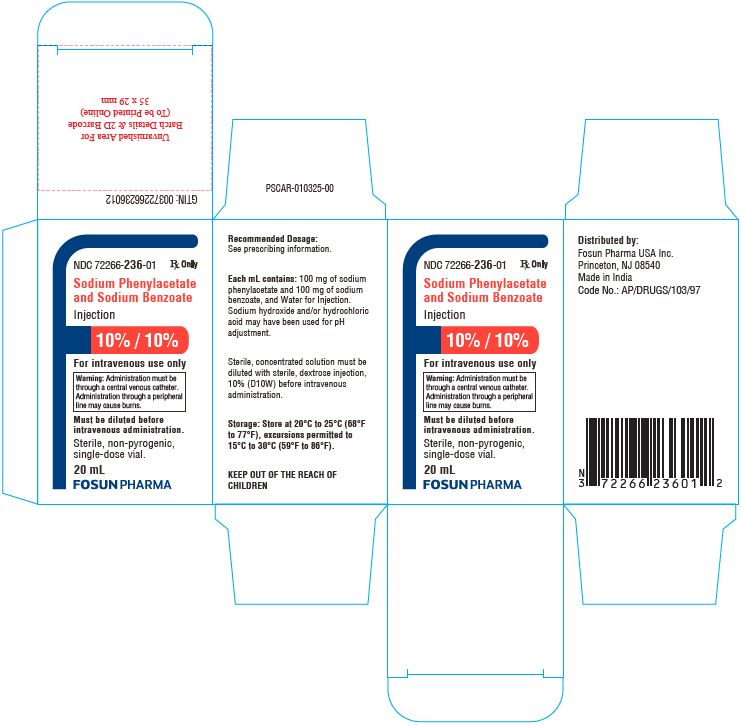
Sodium Phenylacetate and Sodium Benzoate 100 mg/mL; 100 mg/mL Injection — NDC 72266-236-01 (Billing 72266-0236-01)
This is a package of Sodium Phenylacetate and Sodium Benzoate 100 mg/mL; 100 mg/mL Injection from FOSUN PHARMA USA INC, marketed since Nov 2021 and currently FDA-listed. It is this product's only package size.
NDC database record
One package, one record: these facts belong to NDC 72266-236-01 alone.
- Record
- FDA NDC Directory package listing · Human prescription drug
- Code segments
- 72266 labeler · 236 product · 01 package
- Package marketed since
- Nov 14, 2021
- Sample package
- No — commercial package
- Listing certified through
- Dec 31, 2026
- Barcode (UPC-A, from the NDC)
- 3 7226623601 2
- FDA record last changed
- Jul 24, 2026
Identity & classification
Regulatory identifiers FDA, NLM and CMS codes for this package
Drug-database identifiers Medi-Span GPI and First Databank GCN / HICL / AHFS classification
- GSN (GCN sequence number): 058808
- GCN: 24322
- GPI-14 (Medi-Span): 30908050102060
- HICL (First Databank): 001398
- AHFS class code: 40:10.00.00
- RxCUI (RxNorm): 2560228
Where does this data come from?
- FDA openFDA NDC Directory · synced Oct 8, 2026
- FDA label on DailyMed · label index refreshed Oct 8, 2026
- RxNorm (NLM RxNav) · catalog refreshed Oct 1, 2026
- Medi-Span GPI (licensed)
- First Databank (licensed) · refreshed Oct 8, 2026
RxNorm drug class
This medicine belongs to the Nitrogen Binding Agent class.
Where does this data come from?
- RxClass (NLM) · catalog refreshed Oct 1, 2026
Clinical
Patient education
Supplement & herbal interactions
Where does this data come from?
- MedlinePlus (NLM) · refreshed Oct 8, 2026
- FDA label on DailyMed · label index refreshed Oct 8, 2026
Ask a licensed pharmacist directly — free, answered by our team.
Pricing
A drug doesn't have one price. Each row is a different public payment system, and none is what you'd pay at the counter — that depends on your insurance. The ⓘ on each row explains what it measures.
| Price system | Per each | Per package |
|---|---|---|
| Retail pharmacies payNADAC · weekly | Not in the retail survey — common for institutional, discontinued, or low-volume packs. | |
| Medicaid paysCMS SDUD · 12 mo | No recent Medicaid claims on file for this NDC — rare and low-volume NDCs are suppressed in the public data. | |
| Medicare drug plans payPart D · quarterly | No Part D plan price is available for this NDC in our data. | |
Where does this data come from?
- CMS NADAC weekly file
- CMS ASP pricing files · refreshed Sep 20, 2026
- CMS Medicaid State Drug Utilization Data · refreshed Oct 8, 2026
- CMS Part D plan pricing files · refreshed Sep 24, 2026
- VA National Acquisition Center price file
Packaging — all sizes for this product
| Package NDC | Description | Marketing start | Marketing end | Status |
|---|---|---|---|---|
| 72266-0236-01 You're viewing this Main listing | 1 VIAL, SINGLE-DOSE in 1 CARTON / 20 mL in 1 VIAL, SINGLE-DOSE | 2021-11-14 | — | Active |
Therapeutic equivalents
Where does this data come from?
- FDA openFDA NDC Directory · synced Oct 8, 2026
- FDA Orange Book · refreshed Oct 3, 2026
- CMS NADAC weekly file
Availability & generic status
The FDA lists approved generic versions of this medicine, but that does not always mean a pharmacy can get one today. Patent rules, launch agreements, supply and pricing can affect when generics actually arrive.
Where does this data come from?
- FDA Orange Book · refreshed Oct 3, 2026
Inactive Ingredients / Excipients
Inactive ingredients, also called excipients, are components of the drug product other than the active ingredient. They may include fillers, dyes, coatings, preservatives, flavors, or other formulation ingredients.
💡 Tap an ingredient (hover on desktop) to see what it is and why it’s used.
-
UNII QTT17582CB
A strong acid used to adjust and maintain the proper pH level in liquid medicines, ensuring stability and preventing breakdown of active ingredients.
-
UNII 55X04QC32I
A strong alkaline chemical used to adjust and maintain the pH balance of liquid medicines. It helps keep the medicine stable and ensures it stays effective during storage.
-
UNII 059QF0KO0R
Water is a liquid solvent that dissolves and mixes ingredients together in liquid medicines, syrups, and injections. It helps distribute the active drug evenly throughout the product.
3 inactive ingredients listed in the exact product block matched to this NDC.
Where does this data come from?
ingredient classCode="IACT" elements from the exact product block matched by this NDC. Label-section narrative from DailyMed / the openFDA label index is shown separately when available.- FDA label on DailyMed · label index refreshed Oct 8, 2026
- FDA openFDA NDC Directory · synced Oct 8, 2026
Inactive ingredient FAQ
Are inactive ingredients the same for every manufacturer?
Why might an inactive ingredient be missing?
Can inactive ingredients matter?
Manufacturer & labeler
More NDCs from FOSUN PHARMA USA INC labeler code 72266
- Dorzolamide Hydrochloride 20 mg/mL Solution NDC 72266-197-01
- Timolol Maleate Ophthalmic Gel Forming Solution 2.5 mg/mL Solution, Gel Forming / Drops NDC 72266-199-01
- Timolol Maleate Ophthalmic Gel Forming Solution 5 mg/mL Solution, Gel Forming / Drops NDC 72266-200-01
- Prochlorperazine Edisylate 5 mg/mL Injection NDC 72266-204-10
- ketorolac tromethamine 15 mg/mL Injection, Solution NDC 72266-234-25
- Dexrazoxane 250 mg/25mL Injection, Powder, Lyophilized, For Solution NDC 72266-235-01
- DOXYCYCLINE 100 mg/10mL Injection, Powder, Lyophilized, For Solution NDC 72266-237-05
- Bimatoprost .3 mg/mL Solution/ Drops NDC 72266-241-01
- Lacosamide 10 mg/mL Injection NDC 72266-242-05
- Sincalide 5 ug/5mL Injection, Powder, Lyophilized, For Solution NDC 72266-248-05
- Polymyxin B 500000 [USP'U]/1 Injection, Powder, Lyophilized, For Solution NDC 72266-249-10
- Calcitriol 1 ug/mL Injection NDC 72266-251-10
Where does this data come from?
- FDA openFDA NDC Directory · synced Oct 8, 2026
- Drugs@FDA
Full prescribing information FDA SPL
🎯 Indications and Usage ▾
1 INDICATIONS AND USAGE Sodium Phenylacetate and Sodium Benzoate Injection is indicated as adjunctive therapy in pediatric and adult patients for the treatment of acute hyperammonemia and associated encephalopathy in patients with deficiencies in enzymes of the urea cycle. During acute hyperammonemic episodes, arginine supplementation, caloric supplementation, dietary protein restriction, hemodialysis, and other ammonia lowering therapies should be considered [ see Warnings and Precautions (5) ]. Sodium Phenylacetate and Sodium Benzoate Injection is a nitrogen binding agent indicated as adjunctive therapy for the treatment of acute hyperammonemia and associated encephalopathy in pediatric and adult patients with deficiencies in enzymes of the urea cycle.
⏱️ Dosage and Administration ▾
2 DOSAGE AND ADMINISTRATION Sodium Phenylacetate and Sodium Benzoate Injection must be diluted with sterile 10% Dextrose Injection (D10W) before administration. Administration must be through a central venous catheter. Administration through a peripheral line may cause burns.
(2) Sodium Phenylacetate and Sodium Benzoate Injection is administered intravenously as a loading dose infusion administered over 90 to 120 minutes, followed by an equivalent maintenance dose infusion administered over 24 hours. (2) See Full Prescribing Information for complete dosing recommendations.
2.1Recommended Dosage Sodium Phenylacetate and Sodium Benzoate Injection must be diluted with sterile 10% Dextrose Injection (D10W) before administration. The dilution and dosage of Sodium Phenylacetate and Sodium Benzoate Injection are determined by weight for neonates, infants and young children, and by body surface area for larger patients, including older children, adolescents, and adults (Table 1). Table 1
2.2Administration Sodium Phenylacetate and Sodium Benzoate Injection is a concentrated solution and must be diluted before intravenous administration via a central venous catheter. Administration through a peripheral intravenous catheter may cause burns. Sodium Phenylacetate and Sodium Benzoate Injection may not be administered by any other route.
Sodium Phenylacetate and Sodium Benzoate Injection should be administered as a loading dose infusion over 90 to 120 minutes, followed by the same dose repeated as a maintenance infusion administered over 24 hours. Because of prolonged plasma levels achieved by phenylacetate in pharmacokinetic studies, repeat loading doses of Sodium Phenylacetate and Sodium Benzoate Injection should not be administered. Maintenance infusions may be continued until elevated plasma ammonia levels have been normalized or the patient can tolerate oral nutrition and medications.
An antiemetic may be administered during Sodium Phenylacetate and Sodium Benzoate Injection infusion to aid control of infusion-associated nausea and vomiting. Administration of analogous oral drugs, such as sodium phenylbutyrate, should be terminated prior to Sodium Phenylacetate and Sodium Benzoate Injection infusion. Sodium Phenylacetate and Sodium Benzoate Injection infusion should be started as soon as the diagnosis of hyperammonemia is made.
Treatment of hyperammonemia also requires caloric supplementation and restriction of dietary protein. Non-protein calories should be supplied principally as glucose (8 to 10 mg/kg/min) with an intravenous fat emulsion added. Attempts should be made to maintain a caloric intake of greater than 80 kcal/kg/day.
During and after infusion of Sodium Phenylacetate and Sodium Benzoate Injection, ongoing monitoring of the following clinical laboratory values is crucial: plasma ammonia, glutamine, quantitative plasma amino acids, blood glucose, electrolytes, venous or arterial blood gases, AST and ALT. On-going monitoring of the following clinical responses is also crucial to assess patient response to treatment: neurological status, Glasgow Coma Scale, tachypnea, CT or MRI scan or fundoscopic evidence of cerebral edema, and/or of gray matter and white matter damage.
Hemodialysis should be considered in patients with severe hyperammonemia or who are not responsive to Sodium Phenylacetate and Sodium Benzoate Injection administration [ see Warnings and Precautions (5.1) ]. In the non-neonatal study patient population treated with Sodium Phenylacetate and Sodium Benzoate Injection, dialysis was required in 13% of hyperammonemic episodes. Standard hemodialysis was the most frequently used dialysis method.
High levels of ammonia can be reduced quickly when Sodium Phenylacetate and Sodium Benzoate Injection is used with hemodialysis, as the ammonia-scavenging of Sodium Phenylacetate and Sodium Benzoate Injection suppresses the production of ammonia from catabolism of endogenous protein and hemodialysis eliminates the ammonia a… [Excerpted — this section continues on DailyMed.]
💊 Dosage Forms and Strengths ▾
3 DOSAGE FORMS AND STRENGTHS Sodium Phenylacetate and Sodium Benzoate Injection 10% per 10% is a sterile, clear and almost colorless concentrated, aqueous solution of sodium phenylacetate and sodium benzoate. Injection: 10% per 10% sterile, concentrated, aqueous solution of sodium phenylacetate and sodium benzoate.
⛔ Contraindications ▾
4 CONTRAINDICATIONS None None.
⚠️ Warnings and Cautions ▾
5 WARNINGS AND PRECAUTIONS Decreased Potassium Levels : Plasma potassium levels should be carefully monitored and appropriate treatment given when necessary. (5.1) Conditions Associated with Fluid Overload : Sodium Phenylacetate and Sodium Benzoate Injection contains 30.5 mg of sodium per mL of undiluted product. Caution should be used if Sodium Phenylacetate and Sodium Benzoate Injection is administered to patients with congestive heart failure, severe renal insufficiency, or with conditions in which there is sodium retention with edema.
(5.2) Extravasation : Extravasation of Sodium Phenylacetate and Sodium Benzoate Injection into the perivenous tissues during high flow bolus infusion may lead to skin necrosis, especially in infants. The infusion site must be monitored closely for possible tissue infiltration during drug administration. (5.3) Neurotoxicity of Phenylacetate: Because of prolonged plasma levels achieved by phenylacetate in pharmacokinetic studies, repeat loading doses should not be administered.
Additionally, neurotoxicity related to phenylacetate has been reported in cancer patients. Monitor patients for symptoms of acute neurotoxicity. (5.4) Hyperventilation and Metabolic Acidosis: Sodium Phenylacetate and Sodium Benzoate Injection may cause side effects typically associated with salicylate overdose, such as hyperventilation and metabolic acidosis.
Monitor patient blood chemistry profiles and perform frequent blood pH and pCO2 measurements. (5.5)
5.1Decreased Potassium Levels Because urine potassium loss is enhanced by the excretion of the non-reabsorbable anions, phenylacetylglutamine and hippurate, plasma potassium levels should be carefully monitored and appropriate treatment given when necessary.
5.2Conditions Associated with Fluid Overload Sodium Phenylacetate and Sodium Benzoate Injection contains 30.5 mg of sodium per mL of undiluted product. Thus, Sodium Phenylacetate and Sodium Benzoate Injection should be used with great care, if at all, in patients with congestive heart failure or severe renal insufficiency, and in clinical states in which there is sodium retention with edema. Discontinue administration of Sodium Phenylacetate and Sodium Benzoate Injection, evaluate the patient, and institute appropriate therapeutic countermeasures if an adverse event occurs.
5.3Extravasation Administration must be through a central venous catheter. Administration through a peripheral line may cause burns . Bolus infusion flow rates are relatively high, especially for infants [see Dosage and Administration (2)] .
Extravasation of Sodium Phenylacetate and Sodium Benzoate Injection into the perivenous tissues may lead to skin necrosis. If extravasation is suspected, discontinue the infusion and resume at a different infusion site, if necessary. The infusion site must be monitored closely for possible infiltration during drug administration.
Do not administer undiluted product.
5.4Neurotoxicity of Phenylacetate Because of prolonged plasma levels achieved by phenylacetate in pharmacokinetic studies, repeat loading doses of Sodium Phenylacetate and Sodium Benzoate Injection should not be administered. Additionally, neurotoxicity was reported in cancer patients receiving intravenous phenylacetate, 250 to 300 mg/kg/day for 14 days, repeated at 4-week intervals. Manifestations were predominantly somnolence, fatigue, and lightheadedness, with less frequent headaches, dysgeusia, hypoacusis, disorientation, impaired memory, and exacerbation of a pre- existing neuropathy.
The acute onset of symptoms upon initiation of treatment and reversibility of symptoms when the phenylacetate was discontinued suggest a drug effect [ see Animal Toxicology and/or Pharmacology (13.2) ].
5.5Hyperventilation and Metabolic Acidosis Due to structural similarities between phenylacetate and benzoate to salicylate, Sodium Phenylacetate and Sodium Benzoate Injection may cause side effects typically associated with salicylate overdose, such as hyp… [Excerpted — this section continues on DailyMed.]
🤒 Adverse Reactions ▾
6 ADVERSE REACTIONS The most frequently reported adverse reactions (incidence ≥6%) are vomiting, hyperglycemia, hypokalemia, convulsions, and mental impairment To report SUSPECTED ADVERSE REACTIONS, contact Fosun Pharma USA Inc. at 1-866-611-3762 or FDA at 1-800-FDA-1088 or www.fda.gov/medwatch.
6.1Clinical Trials Experience Because clinical trials are conducted under widely varying conditions, adverse reaction rates observed in the clinical trials of a drug cannot be directly compared to rates in the clinical trials of another drug and may not reflect the rates observed in practice. The safety data were obtained from 316 patients who received Sodium Phenylacetate and Sodium Benzoate Injection as emergency (rescue) or prospective treatment for hyperammonemia as part of an uncontrolled, open-label study. The study population included patients between the ages of 0 to 53 years with a mean (SD) of 6.2 (8.54) years; 51% were male and 49% were female who had the following diagnoses: OTC (46%), ASS (22%), CPS (12%), ASL (2%), ARG (<1%), THN (<1%), and other (18%).
Adverse reactions were reported with similar frequency in patients with OTC, ASS, CPS, and diagnoses categorized as "other." Nervous system disorders were more frequent in patients with OTC and CPS, compared with patients with ASS and patients with "other" diagnoses. Convulsions and mental impairment were reported in patients with OTC and CPS. These observations are consistent with literature reports that patients with enzyme deficiencies occurring earlier in the urea cycle (i.e., OTC and CPS) tend to be more severely affected.
Adverse reactions profiles differed by age group. Patients ≤30 days of age had more blood and lymphatic system disorders and vascular disorders (specifically hypotension), while patients >30 days of age had more gastrointestinal disorders (specifically nausea, vomiting and diarrhea). Less common adverse reactions (<3% of patients) that are characterized as severe are listed below by body system.
BLOOD AND LYMPHATIC SYSTEM DISORDERS: coagulopathy, pancytopenia, thrombocytopenia CARDIAC DISORDERS: atrial rupture, bradycardia, cardiac or cardiopulmonary arrest/failure, cardiogenic shock, cardiomyopathy, pericardial effusion EYE DISORDERS: blindness GASTROINTESTINAL DISORDERS: abdominal distension, gastrointestinal hemorrhage GENERAL DISORDERS AND ADMINISTRATION-SITE CONDITIONS: asthenia, brain death, chest pain, multiorgan failure, edema HEPATOBILIARY DISORDERS: cholestasis, hepatic artery stenosis, hepatic failure/hepatotoxicity, jaundice INFECTIONS AND INFESTATIONS: sepsis/septic shock INJURY, POISONING AND PROCEDURAL COMPLICATIONS: brain herniation, subdural hematoma, overdose INVESTIGATIONS: blood carbon dioxide changes, blood glucose changes, blood pH increased, cardiac output decreased, pCO2 changes, respiratory rate increased METABOLISM AND NUTRITION DISORDERS: alkalosis, dehydration, fluid overload/retention, hypoglycemia, hyperkalemia, hypernatremia, alkalosis, tetany NEOPLASMS BENIGN, MALIGNANT AND UNSPECIFIED: hemangioma acquired NERVOUS SYSTEM DISORDERS: areflexia, ataxia, brain infarction, brain hemorrhage, cerebral atrophy, clonus, depressed level of consciousness, encephalopathy, nerve paralysis, intracranial pressure increased, subdural hematoma, tremor PSYCHIATRIC DISORDERS: acute psychosis, aggression, confusional state, hallucinations RENAL AND URINARY DISORDERS: anuria, renal failure, urinary retention RESPIRATORY, THORACIC AND MEDIASTINAL DISORDERS: acute respiratory distress syndrome, dyspnea, hypercapnia, hyperventilation, Kussmaul respiration, pneumonia aspiration, pneumothorax, pulmonary hemorrhage, pulmonary edema, respiratory acidosis or alkalosis, respiratory arrest/failure SKIN AND SUBCUTANEOUS TISSUE DISORDERS: alopecia, blister, pruritus generalized, rash, urticaria VASCULAR DISORDERS: flushing, hemorrhage, hypertension, phlebothrombosis/thrombosis Table 2
🔄 Drug Interactions ▾
7 DRUG INTERACTIONS Formal drug interaction studies have not been performed with Sodium Phenylacetate and Sodium Benzoate Injection. Some antibiotics such as penicillin may compete with phenylacetylglutamine and hippurate for active secretion by renal tubules, which may affect the overall disposition of the infused drug. Probenecid is known to inhibit the renal transport of many organic compounds, including aminohippuric acid, and may affect renal excretion of phenylacetylglutamine and hippurate.
There have been reports that valproic acid can induce hyperammonemia through inhibition of the synthesis of N-acetylglutamate, a co-factor for carbamyl phosphate synthetase. Therefore, administration of valproic acid to patients with urea cycle disorders may exacerbate their condition and antagonize the efficacy of Sodium Phenylacetate and Sodium Benzoate Injection. Use of corticosteroids may cause a protein catabolic state and, thereby, potentially increase plasma ammonia levels in patients with impaired ability to form urea.
Some antibiotics such as penicillin may affect the overall disposition of the infused drug. (7) Probenecid may affect renal excretion of phenylacetylglutamine and hippurate. (7) Valproic acid given to patients with urea cycle disorders may exacerbate their condition and antagonize the efficacy of Sodium Phenylacetate and Sodium Benzoate Injection through inhibition of the synthesis of N-acetylglutamate, a co-factor for carbamyl phosphate synthetase.
(7) Use of corticosteroids may cause the breakdown of body protein and potentially increase plasma ammonia levels in patients with impaired ability to form urea. (7)
👥 Use in Specific Populations ▾
8 USE IN SPECIFIC POPULATIONS
8.1Pregnancy Risk Summary Available data on the combination use of sodium phenylacetate and sodium benzoate in pregnant women are insufficient to identify a drug associated risk of major birth defects, miscarriage or adverse maternal or fetal outcomes. Animal reproduction studies have not been conducted with Sodium Phenylacetate and Sodium Benzoate Injection. The estimated background risk of major birth defects and miscarriage for the indicated population is unknown.
All pregnancies have a background risk of birth defect, loss or other adverse outcomes. In the U.S. general population, the estimated background risk of major birth defects and miscarriage in clinically recognized pregnancies is 2 to 5% and 15 to 20%, respectively.
8.2Lactation Risk Summary There are no data on the presence of sodium phenylacetate, sodium benzoate in either human or animal milk, the effects on the breastfed infant, or the effects on milk production. The developmental and health benefits of breastfeeding should be considered along with the mother's clinical need for Sodium Phenylacetate and Sodium Benzoate Injection and any potential adverse effects on the breastfed infant from Sodium Phenylacetate and Sodium Benzoate Injection or from the underlying maternal condition.
8.4Pediatric Use Sodium Phenylacetate and Sodium Benzoate Injection has been used as a treatment for acute hyperammonemia in pediatric patients including patients in the early neonatal period [ see Dosage and Administration (2) ].
8.5Geriatric Use Clinical studies of Sodium Phenylacetate and Sodium Benzoate Injection did not include any patients aged 65 and over to determine whether they respond differently from younger patients. Urea cycle disorders are presently diseases of the pediatric and younger adult populations. No pharmacokinetic studies of Sodium Phenylacetate and Sodium Benzoate Injection have been performed in geriatric patients.
In general, dose selection for an elderly patient should be cautious, usually starting at the low end of the dosing range, reflecting the greater frequency of decreased hepatic, renal, or cardiac function, and concomitant disease or other drug therapy in this patient population.
8.6Gender Pharmacokinetic parameters of Sodium Phenylacetate and Sodium Benzoate Injection were compared in healthy males and females. Bioavailability of both benzoate and phenylacetate was slightly higher in females than in males. However, conclusions cannot be drawn due to the limited number of subjects in this study.
8.7Hepatic Insufficiency Limited information is available on the metabolism and excretion of sodium phenylacetate and sodium benzoate in patients with impaired hepatic function. However, metabolic conjugation of sodium phenylacetate and sodium benzoate is known to take place in the liver and kidney. Therefore, caution should be used in administering Sodium Phenylacetate and Sodium Benzoate Injection to patients with hepatic insufficiency.
8.8Renal Impairment The drug metabolites of Sodium Phenylacetate and Sodium Benzoate Injection (phenylacetylglutamine and hippurate) and subsequently ammonia are primarily excreted by the kidney. Therefore, use caution and closely monitor patients with impaired renal function who receive Sodium Phenylacetate and Sodium Benzoate Injection.
🤰 Pregnancy ▾
8.1Pregnancy Risk Summary Available data on the combination use of sodium phenylacetate and sodium benzoate in pregnant women are insufficient to identify a drug associated risk of major birth defects, miscarriage or adverse maternal or fetal outcomes. Animal reproduction studies have not been conducted with Sodium Phenylacetate and Sodium Benzoate Injection. The estimated background risk of major birth defects and miscarriage for the indicated population is unknown.
All pregnancies have a background risk of birth defect, loss or other adverse outcomes. In the U.S. general population, the estimated background risk of major birth defects and miscarriage in clinically recognized pregnancies is 2 to 5% and 15 to 20%, respectively.
🧒 Pediatric Use ▾
8.4Pediatric Use Sodium Phenylacetate and Sodium Benzoate Injection has been used as a treatment for acute hyperammonemia in pediatric patients including patients in the early neonatal period [ see Dosage and Administration (2) ].
🧓 Geriatric Use ▾
8.5Geriatric Use Clinical studies of Sodium Phenylacetate and Sodium Benzoate Injection did not include any patients aged 65 and over to determine whether they respond differently from younger patients. Urea cycle disorders are presently diseases of the pediatric and younger adult populations. No pharmacokinetic studies of Sodium Phenylacetate and Sodium Benzoate Injection have been performed in geriatric patients.
In general, dose selection for an elderly patient should be cautious, usually starting at the low end of the dosing range, reflecting the greater frequency of decreased hepatic, renal, or cardiac function, and concomitant disease or other drug therapy in this patient population.
🆘 Overdosage ▾
10 OVERDOSAGE Overdosage has been reported during Sodium Phenylacetate and Sodium Benzoate Injection treatment in urea cycle-deficient patients. All patients in the uncontrolled open-label study were to be treated with the same dose of Sodium Phenylacetate and Sodium Benzoate Injection. However, some patients received more than the dose level specified in the protocol.
In 16 of the 64 deaths, the patient received a known overdose of Sodium Phenylacetate and Sodium Benzoate Injection. Causes of death in these patients included cardiorespiratory failure/arrest (6 patients), hyperammonemia (3 patients), increased intracranial pressure (2 patients), pneumonitis with septic shock and coagulopathy (1 patient), error in dialysis procedure (1 patient), respiratory failure (1 patient), intractable hypotension and probable sepsis (1 patient), and unknown (1 patient). Additionally, other signs of intoxication may include obtundation (in the absence of hyperammonemia), hyperventilation, a severe compensated metabolic acidosis, perhaps with a respiratory component, large anion gap, hypernatremia and hyperosmolarity, progressive encephalopathy, cardiovascular collapse, and death.
In case of overdose of Sodium Phenylacetate and Sodium Benzoate Injection, discontinue the drug and institute appropriate emergency medical monitoring and procedures. In severe cases, the latter may include hemodialysis (procedure of choice) or peritoneal dialysis (when hemodialysis is unavailable
🧬 Clinical Pharmacology ▾
12 CLINICAL PHARMACOLOGY
12.1Mechanism of Action Urea cycle disorders can result from decreased activity of any of the following enzymes: N -acetylglutamate synthetase (NAGS), carbamyl phosphate synthetase (CPS), argininosuccinate synthetase (ASS), ornithine transcarbamylase (OTC), argininosuccinate lyase (ASL), or arginase (ARG). Sodium phenylacetate and sodium benzoate are metabolically active compounds that can serve as alternatives to urea for the excretion of waste nitrogen. Figure 2 is a schematic illustrating how the components of Sodium Phenylacetate and Sodium Benzoate Injection, phenylacetate and benzoate, provide an alternative pathway for nitrogen disposal in patients without a fully functioning urea cycle.
Phenylacetate conjugates with glutamine in the liver and kidneys to form phenylacetylglutamine, via acetylation. Phenylacetylglutamine is excreted by the kidneys via glomerular filtration and tubular secretion. The nitrogen content of phenylacetylglutamine per mole is identical to that of urea (both contain two moles of nitrogen).
Two moles of nitrogen are removed per mole of phenylacetate when it is conjugated with glutamine. Similarly, preceded by acylation, benzoate conjugates with glycine to form hippuric acid, which is rapidly excreted by the kidneys by glomerular filtration and tubular secretion. One mole of hippuric acid contains one mole of waste nitrogen.
Thus, one mole of nitrogen is removed per mole of benzoate when it is conjugated with glycine. Figure 2
12.2Pharmacodynamics In patients with hyperammonemia due to deficiencies in enzymes of the urea cycle, Sodium Phenylacetate and Sodium Benzoate Injection has been shown to decrease elevated plasma ammonia levels. These effects are considered to be the result of reduction in nitrogen overload through glutamine and glycine scavenging by Sodium Phenylacetate and Sodium Benzoate Injection in combination with appropriate dietary and other supportive measures.
12.3Pharmacokinetics The pharmacokinetics of intravenously administered Sodium Phenylacetate and Sodium Benzoate Injection was characterized in healthy adult volunteers. Both benzoate and phenylacetate exhibited nonlinear kinetics. Following 90 minute intravenous infusion mean AUC last for benzoate was 20.3, 114.9, 564.6, 562.8, and 1599.1 mcg/mL following doses of 1, 2, 3.75, 4, and 5.5 g/m 2 , respectively. The total clearance decreased from 5.19 to
3.62L/h/m 2 at the 3.75 and 5.5 g/m 2 doses, respectively. Similarly, phenylacetate exhibited nonlinear kinetics following the priming dose regimens. AUC last was 175.6, 713.8, 2040.6, 2181.6, and 3829.2 mcg·h/mL following doses of 1, 2, 3.75, 4, and 5.5 g/m 2 , respectively.
The total clearance decreased from 1.82 to 0.89 mcg·h/mL with increasing dose (3.75 and 4 g/m 2 , respectively). During the sequence of 90-minute priming infusion followed by a 24-hour maintenance infusion, phenylacetate was detected in the plasma at the end of infusion (T max of 2 hr at 3.75 g/m 2 ) whereas, benzoate concentrations declined rapidly (T max of 1.5 hr at 3.75 g/m 2 ) and were undetectable at 14 and 26 hours following the 3.75 and 4 g/m 2 dose, respectively. A difference in the metabolic rates for phenylacetate and benzoate was noted.
The formation of hippurate from benzoate occurred more rapidly than that of phenylacetylglutamine from phenylacetate, and the rate of elimination for hippurate appeared to be more rapid than that for phenylacetylglutamine. Pharmacokinetic observations have also been reported from twelve episodes of hyperammonemic encephalopathy in seven children diagnosed (age 3 to 26 months) with urea cycle disorders who had been administered Sodium Phenylacetate and Sodium Benzoate Injection intravenously. These data showed peak plasma levels of phenylacetate and benzoate at approximately the same times as were observed in healthy adults.
As in healthy adults, the plasma levels of phenylacetate were higher than benzoate and were present for a longe… [Excerpted — this section continues on DailyMed.]
🧬 Mechanism of Action ▾
12.1Mechanism of Action Urea cycle disorders can result from decreased activity of any of the following enzymes: N -acetylglutamate synthetase (NAGS), carbamyl phosphate synthetase (CPS), argininosuccinate synthetase (ASS), ornithine transcarbamylase (OTC), argininosuccinate lyase (ASL), or arginase (ARG). Sodium phenylacetate and sodium benzoate are metabolically active compounds that can serve as alternatives to urea for the excretion of waste nitrogen. Figure 2 is a schematic illustrating how the components of Sodium Phenylacetate and Sodium Benzoate Injection, phenylacetate and benzoate, provide an alternative pathway for nitrogen disposal in patients without a fully functioning urea cycle.
Phenylacetate conjugates with glutamine in the liver and kidneys to form phenylacetylglutamine, via acetylation. Phenylacetylglutamine is excreted by the kidneys via glomerular filtration and tubular secretion. The nitrogen content of phenylacetylglutamine per mole is identical to that of urea (both contain two moles of nitrogen).
Two moles of nitrogen are removed per mole of phenylacetate when it is conjugated with glutamine. Similarly, preceded by acylation, benzoate conjugates with glycine to form hippuric acid, which is rapidly excreted by the kidneys by glomerular filtration and tubular secretion. One mole of hippuric acid contains one mole of waste nitrogen.
Thus, one mole of nitrogen is removed per mole of benzoate when it is conjugated with glycine. Figure 2
📦 How Supplied / Storage and Handling ▾
16 HOW SUPPLIED/STORAGE AND HANDLING Sodium Phenylacetate and Sodium Benzoate Injection 10% per 10% is clear and almost colorless solution supplied in a sterile, non-pyrogenic, single-dose glass vial. NDC 72266-236-01 single-dose vial containing 20 mL of Sodium Phenylacetate and Sodium Benzoate Injection 10% per 10%. Storage: Store at 20°C to 25°C (77°F); excursions permitted to 15°C to 30°C (59°F to 86°F).
📋 Description ▾
11 DESCRIPTION Sodium Phenylacetate and Sodium Benzoate Injection 10% per 10% (a nitrogen binding agent) is a sterile, concentrated, aqueous solution of sodium phenylacetate and sodium benzoate. The pH of the solution is between 7.5 and 8.3. Sodium phenylacetate is a white to off-white powder.
It is soluble in water. Sodium benzoate is a white to off-white and powder that is readily soluble in water. Figure 1 Sodium Phenylacetate has a molecular weight of 158.14 and the molecular formula C 8 H 5 NaO 2 . Sodium benzoate has molecular weight of 144.10 and the molecular formula C 7 H 5 NaO 2 Each mL of Sodium Phenylacetate and Sodium Benzoate Injection contains 100 mg of sodium phenylacetate and 100 mg of sodium benzoate, and Water for Injection.
Sodium hydroxide and/or hydrochloric acid may have been used for pH adjustment. Sodium Phenylacetate and Sodium Benzoate Injection is a sterile, concentrated solution intended for intravenous administration via a central catheter only after dilution [see Dosage and Administration (2)] figure 1
🧬 Pharmacokinetics ▾
12.3Pharmacokinetics The pharmacokinetics of intravenously administered Sodium Phenylacetate and Sodium Benzoate Injection was characterized in healthy adult volunteers. Both benzoate and phenylacetate exhibited nonlinear kinetics. Following 90 minute intravenous infusion mean AUC last for benzoate was 20.3, 114.9, 564.6, 562.8, and 1599.1 mcg/mL following doses of 1, 2, 3.75, 4, and 5.5 g/m 2 , respectively. The total clearance decreased from 5.19 to
3.62L/h/m 2 at the 3.75 and 5.5 g/m 2 doses, respectively. Similarly, phenylacetate exhibited nonlinear kinetics following the priming dose regimens. AUC last was 175.6, 713.8, 2040.6, 2181.6, and 3829.2 mcg·h/mL following doses of 1, 2, 3.75, 4, and 5.5 g/m 2 , respectively.
The total clearance decreased from 1.82 to 0.89 mcg·h/mL with increasing dose (3.75 and 4 g/m 2 , respectively). During the sequence of 90-minute priming infusion followed by a 24-hour maintenance infusion, phenylacetate was detected in the plasma at the end of infusion (T max of 2 hr at 3.75 g/m 2 ) whereas, benzoate concentrations declined rapidly (T max of 1.5 hr at 3.75 g/m 2 ) and were undetectable at 14 and 26 hours following the 3.75 and 4 g/m 2 dose, respectively. A difference in the metabolic rates for phenylacetate and benzoate was noted.
The formation of hippurate from benzoate occurred more rapidly than that of phenylacetylglutamine from phenylacetate, and the rate of elimination for hippurate appeared to be more rapid than that for phenylacetylglutamine. Pharmacokinetic observations have also been reported from twelve episodes of hyperammonemic encephalopathy in seven children diagnosed (age 3 to 26 months) with urea cycle disorders who had been administered Sodium Phenylacetate and Sodium Benzoate Injection intravenously. These data showed peak plasma levels of phenylacetate and benzoate at approximately the same times as were observed in healthy adults.
As in healthy adults, the plasma levels of phenylacetate were higher than benzoate and were present for a longer time. The pharmacokinetics of intravenous phenylacetate have been reported following administration to adult patients with advanced solid tumors. The decline in serum phenylacetate concentrations following a loading infusion of 150 mg/kg was consistent with saturable enzyme kinetics.
Ninety-nine percent of administered phenylacetate was excreted as phenylacetylglutamine.
🧬 Pharmacodynamics ▾
12.2Pharmacodynamics In patients with hyperammonemia due to deficiencies in enzymes of the urea cycle, Sodium Phenylacetate and Sodium Benzoate Injection has been shown to decrease elevated plasma ammonia levels. These effects are considered to be the result of reduction in nitrogen overload through glutamine and glycine scavenging by Sodium Phenylacetate and Sodium Benzoate Injection in combination with appropriate dietary and other supportive measures.
🔬 Clinical Studies ▾
14 CLINICAL STUDIES The efficacy of Sodium Phenylacetate and Sodium Benzoate Injection in improving patient survival of acute hyperammonemic episodes was demonstrated in an analysis of 316 patients (1,045 episodes of hospitalization) treated between 1981 and 2003. The demographic characteristics and diagnoses of the patient population are shown in Table 3. On admission to the hospital, patients with hyperammonemia and a suspected or confirmed urea cycle disorder (UCD) diagnosis were treated with a bolus dose of 0.25 g/kg (or 5.5 g/m 2 ) sodium phenylacetate + 0.25 g/kg (or 5.5 g/m 2 ) sodium benzoate over a period of 90 minutes to 6 hours, depending on the specific UCD.
Infusions also contained arginine; the dose of arginine depended on the specific UCD. After completion of the bolus dose, maintenance infusions of the same dose over 24 hours were continued until the patient was no longer hyperammonemic or oral therapy could be tolerated. The mean (SD) duration of treatment was 4.6 (6.45) days per episode, and ranged from 1 to 72 days.
Survival was substantially improved after Sodium Phenylacetate and Sodium Benzoate Injection treatment compared with historical values (estimated 14% 1-year survival rate with dietary therapy alone) and with dialysis (estimated 43% survival of acute hyperammonemia). Eighty percent of patients (252 of 316) survived their last episode. Of the 64 patients who died, 53 (83%) died during their first hyperammonemic episode.
Of the 104 neonates (<30d) treated with Sodium Phenylacetate and Sodium Benzoate Injection, 34 (33%) died during the first hyperammonemic episode. Ammonia levels decreased from very high levels (>4 times the upper limit of normal [ULN]) to lower levels in 91% of episodes after treatment. In patients responding to therapy, mean ammonia concentrations decreased from 200.9 µmol/L at hour zero to 101.6 µmol/L within four hours of initiation of Sodium Phenylacetate and Sodium Benzoate Injection therapy and were maintained.
Hemodialysis is recommended for those patients whose plasma ammonia levels fail to fall below 150 µmol/L or by more than 40% within 4 to 8 hours after receiving Sodium Phenylacetate and Sodium Benzoate Injection. A shift from high (≤4 times ULN) to very high (>4 times ULN) levels was observed in only 4% of the episodes. Overall, investigators rated neurological status as improved, much improved, or the same in 93% of episodes, and overall status in response to treatment as improved, much improved, or the same in 97% of episodes.
Recovery from coma was observed in 97% of episodes where coma was present at admission (111 of 114 episodes). Table 3
🧪 Nonclinical Toxicology ▾
13 NONCLINICAL TOXICOLOGY
13.1Carcinogenesis, Mutagenesis, Impairment of Fertility Long-term studies in animals have not been performed to evaluate the carcinogenic potential of Sodium Phenylacetate and Sodium Benzoate Injection. Studies to evaluate the possible impairment of fertility or mutagenic potential of Sodium Phenylacetate and Sodium Benzoate Injection have not been performed. Results indicate that sodium benzoate is not mutagenic or carcinogenic and does not impair fertility.
13.2Animal Toxicology and/or Pharmacology In animal studies, subcutaneous administration to rat pups of 190 to 474 mg/kg of phenylacetate caused decreased proliferation and increased loss of neurons, and reduced central nervous system (CNS) myelin. Cerebral synapse maturation was retarded, and the number of functioning nerve terminals in the cerebrum was reduced, which resulted in impaired brain growth. Pregnant rats were given phenylacetate at 3.5 µmol/g/day subcutaneously from gestation day 7 through normal delivery.
Prenatal exposure of rat pups to phenylacetate produced lesions in layer 5 cortical pyramidal cells; dendritic spines were longer and thinner than normal and reduced in number.
📄 Carcinogenesis, Mutagenesis, Impairment of Fertility ▾
13.1Carcinogenesis, Mutagenesis, Impairment of Fertility Long-term studies in animals have not been performed to evaluate the carcinogenic potential of Sodium Phenylacetate and Sodium Benzoate Injection. Studies to evaluate the possible impairment of fertility or mutagenic potential of Sodium Phenylacetate and Sodium Benzoate Injection have not been performed. Results indicate that sodium benzoate is not mutagenic or carcinogenic and does not impair fertility.
📄 Package Label / Principal Display Panel ▾
Principal Display Panel Carton Vial Carton Label Vial Label
About this NDC listing & data coverage
What data is (and isn’t) available for this NDC — tap to expand
| NDC identity (package / product / labeler codes) | ✓ Available |
| Labeler | ✓ Available |
| Product & package description | ✓ Available |
| Marketing category & status | ✓ Available |
| Active ingredient / dosage form / route | ✓ Available |
| FDA label (SPL via DailyMed) | ✓ Available |
| Package photos | ✓ Available |
| Inactive ingredients (structured) | ✓ Available |
| NADAC pharmacy acquisition price (CMS) | — Not published for this NDC CMS publishes NADAC only for NDCs reported in its retail-pharmacy survey. |
| Orange Book / therapeutic-equivalence data | ✓ Available |
| HCPCS J-code billing crosswalk | — Not published for this NDC Most self-administered / retail products have no J-code — that is normal. |
| Medicaid utilization (CMS SDUD) | — Not published for this NDC CMS reports utilization only for NDCs with Medicaid claims above its privacy threshold. |