
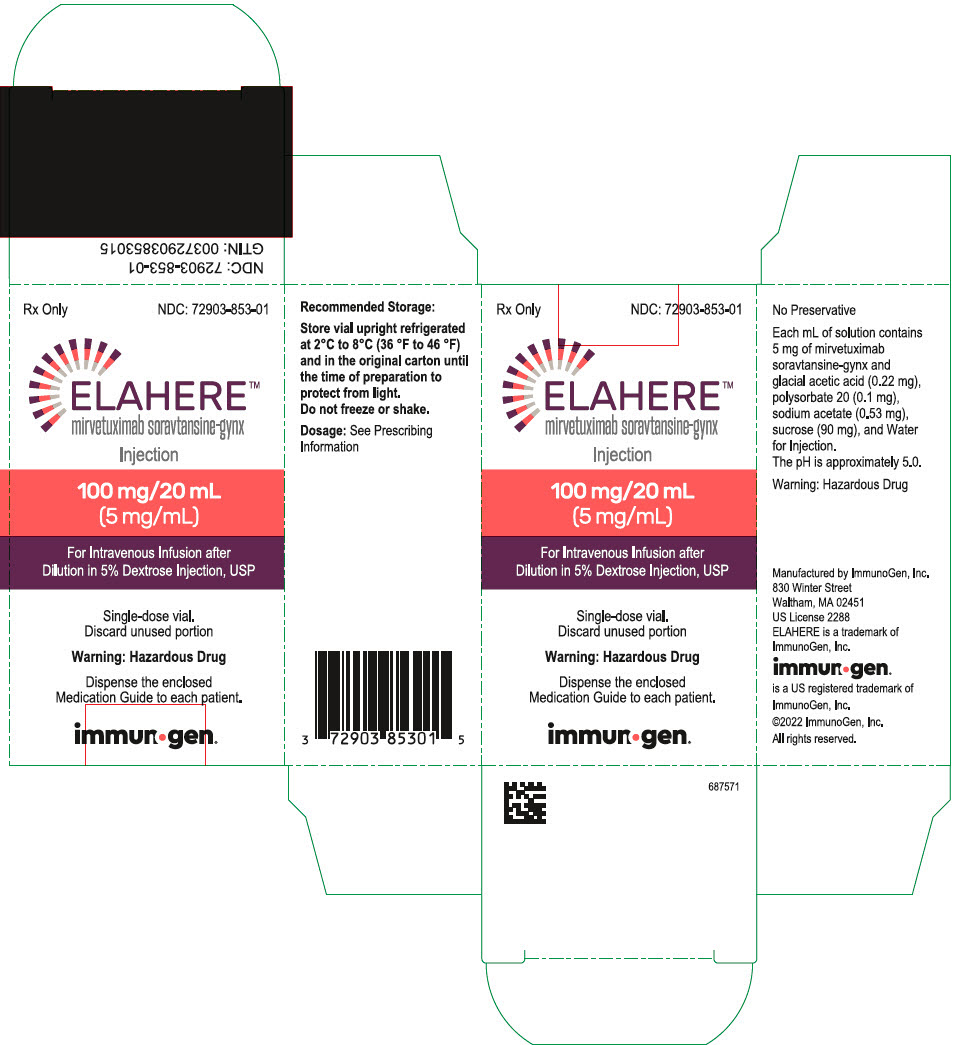
ELAHERE MIRVETUXIMAB SORAVTANSINE 5 mg/mL Injection, Solution — NDC 72903-853-01 (Billing 72903-0853-01)
This is a package of ELAHERE MIRVETUXIMAB SORAVTANSINE 5 mg/mL Injection, Solution from ImmunoGen, Inc., marketed since Nov 2022 and currently FDA-listed. It is this product's only package size.
NDC database record
One package, one record: these facts belong to NDC 72903-853-01 alone.
- Record
- FDA NDC Directory package listing · Human prescription drug
- Code segments
- 72903 labeler · 853 product · 01 package
- Package marketed since
- Nov 14, 2022
- Sample package
- No — commercial package
- Listing certified through
- Dec 31, 2027
- Barcode (UPC-A, from the NDC)
- 3 7290385301 5
- Medicaid fills, this package
- 380 prescriptions in the last four reported quarters
- FDA record last changed
- Jul 24, 2026
Identity & classification
Regulatory identifiers FDA, NLM and CMS codes for this package
Drug-database identifiers Medi-Span GPI and First Databank GCN / HICL / AHFS classification
- GSN (GCN sequence number): 084041
- GCN: 53168
- GPI-14 (Medi-Span): 21355030202030
- HICL (First Databank): 048453
- AHFS class code: 10:00.00.00
- RxCUI (RxNorm): 2621553
Where does this data come from?
- FDA openFDA NDC Directory · synced Oct 8, 2026
- FDA label on DailyMed · label index refreshed Oct 6, 2026
- RxNorm (NLM RxNav) · catalog refreshed Oct 1, 2026
- Medi-Span GPI (licensed)
- First Databank (licensed) · refreshed Oct 8, 2026
RxNorm drug class
This medicine belongs to the Other monoclonal antibodies and antibody drug conjugates class.
Where does this data come from?
- RxClass (NLM) · catalog refreshed Oct 1, 2026
Clinical
Patient education
Supplement & herbal interactions
Where does this data come from?
- MedlinePlus (NLM) · refreshed Oct 1, 2026
- FDA label on DailyMed · label index refreshed Oct 6, 2026
Ask a licensed pharmacist directly — free, answered by our team.
Pricing
A drug doesn't have one price. Each row is a different public payment system, and none is what you'd pay at the counter — that depends on your insurance. The ⓘ on each row explains what it measures.
| Price system | Per mL | Per package |
|---|---|---|
| Retail pharmacies payNADAC · weekly | Not in the retail survey — common for institutional, discontinued, or low-volume packs. | |
| Medicaid paysCMS SDUD · 12 mo | $319.50 | $6,390.02 / 20 ml |
| Medicare drug plans payPart D · quarterly | No Part D plan price is available for this NDC in our data. | |
| Medicare Part B allowsASP · J9063 | $71.991 / J9063 unit | — |
Where does this data come from?
- CMS NADAC weekly file
- CMS ASP pricing files · refreshed Sep 20, 2026
- CMS Medicaid State Drug Utilization Data · through Q1 2026
- CMS Part D plan pricing files · refreshed Sep 24, 2026
- VA National Acquisition Center price file
Billing & reimbursement
Where does this data come from?
- CMS ASP NDC-HCPCS crosswalk · refreshed Sep 22, 2026
- DMEPDAC NDC-HCPCS crosswalk
- openFDA NSDE billing units · refreshed Oct 7, 2026
Packaging — all sizes for this product
| Package NDC | Description | Marketing start | Marketing end | Status |
|---|---|---|---|---|
| 72903-0853-01 You're viewing this Main listing | 1 VIAL, SINGLE-USE in 1 CARTON / 20 mL in 1 VIAL, SINGLE-USE | 2022-11-14 | — | Active |
Therapeutic equivalents
| Product | Labeler | Pack | NADAC/unit | TE | Status | Price vs. this |
|---|---|---|---|---|---|---|
| Elahere 5 mg/mLthis 72903-0853-01 | ImmunoGen, | 1 vial | — | — | FDA listed | — |
Where does this data come from?
- FDA openFDA NDC Directory · synced Oct 8, 2026
- FDA Purple Book · refreshed Oct 5, 2026
- CMS NADAC weekly file
Availability & biosimilar status
Biologics have no small-molecule generics; biosimilar competition is tracked in the FDA Purple Book.
Why the date isn’t exact: Biosimilar timing can change because patents may be challenged, settled, licensed, added or removed, and litigation can move the real date earlier or later.
🛈 What do these terms mean?
- Biologic patent
- A patent the reference product’s maker has publicly listed. A biosimilar generally can’t launch until these expire — unless they’re invalidated or resolved in a settlement.
- Reference-product exclusivity
- A flat 12 years of FDA market protection from the biologic’s first licensure (the BPCIA). No biosimilar can be licensed before it ends, regardless of patents.
- Interchangeable exclusivity
- The first interchangeable biosimilar can earn a period as the only interchangeable version (pharmacists can substitute it without the prescriber).
- Earliest biosimilar (LOE)
- The latest of all the dates above — the soonest a biosimilar can realistically reach the market. Litigation and settlements can move it earlier.
Biologics have no small-molecule “generics” — competition comes from FDA-licensed biosimilars, tracked in the FDA Purple Book.
| Code | What it grants | Expires |
|---|---|---|
| RefProduct | Reference-product exclusivity (12-year, BPCIA) — no biosimilar can be licensed before this date | Nov 14, 2034 |
Is there a biosimilar for ELAHERE 100 MG/20 ML VIAL?
Why do different websites show different biosimilar dates?
Can a biosimilar launch before the last patent expires?
What does “current Purple Book estimate” mean?
What does “FDA listed” mean?
What does a patent or protection date mean here?
Where does this data come from?
- FDA Purple Book · refreshed Oct 5, 2026
Inactive Ingredients / Excipients
Inactive ingredients, also called excipients, are components of the drug product other than the active ingredient. They may include fillers, dyes, coatings, preservatives, flavors, or other formulation ingredients.
💡 Tap an ingredient (hover on desktop) to see what it is and why it’s used.
-
0.22 mg / 1 mL
UNII Q40Q9N063P
Acetic acid is a weak organic acid commonly used in medicines as a buffer and pH adjuster. It helps maintain the proper acidity level to ensure the drug remains stable and effective in its formulation.
-
0.1 mg / 1 mL
UNII 7T1F30V5YH
A synthetic emulsifier derived from sorbitol and oleic acid. It helps mix oil and water-based ingredients together and keeps them from separating in liquid formulations.
-
0.53 mg / 1 mL
UNII 4550K0SC9B
Sodium acetate is a salt derived from acetic acid. It acts as a buffer to help maintain the medicine's pH stability and may serve as a preservative or solubilizer in liquid formulations.
-
90 mg / 1 mL
UNII C151H8M554
A natural sugar derived from sugar cane or sugar beets. It's used as a sweetener, filler, and binder to improve taste, add bulk, and help hold tablet or capsule ingredients together.
-
UNII 059QF0KO0R
Water is a liquid solvent that dissolves and mixes ingredients together in liquid medicines, syrups, and injections. It helps distribute the active drug evenly throughout the product.
5 inactive ingredients listed in the exact product block matched to this NDC.
Where does this data come from?
ingredient classCode="IACT" elements from the exact product block matched by this NDC. Label-section narrative from DailyMed / the openFDA label index is shown separately when available.- FDA label on DailyMed · label index refreshed Oct 6, 2026
- FDA openFDA NDC Directory · synced Oct 8, 2026
Inactive ingredient FAQ
Are inactive ingredients the same for every manufacturer?
Why might an inactive ingredient be missing?
Can inactive ingredients matter?
Manufacturer & labeler
Where does this data come from?
- FDA openFDA NDC Directory · synced Oct 8, 2026
- Drugs@FDA
Full prescribing information FDA SPL
🚨 Boxed Warning ▾
WARNING: OCULAR TOXICITY ELAHERE can cause severe ocular toxicities, including visual impairment, keratopathy, dry eye, photophobia, eye pain, and uveitis [see Warnings and Precautions ( 5.1 ) and Adverse Reactions ( 6.1 )] . Conduct an ophthalmic exam including visual acuity and slit lamp exam prior to initiation of ELAHERE, every other cycle for the first 8 cycles, and as clinically indicated [see Dosage and Administration ( 2.3 )] . Administer prophylactic artificial tears and ophthalmic topical steroids [see Dosage and Administration ( 2.3 ) and Warnings and Precautions ( 5.1 )] .
Withhold ELAHERE for ocular toxicities until improvement and resume at the same or reduced dose [see Dosage and Administration ( 2.4 ) and Warnings and Precautions ( 5.1 )] . Discontinue ELAHERE for Grade 4 ocular toxicities [see Dosage and Administration ( 2.4 ) and Warnings and Precautions ( 5.1 )] . WARNING: OCULAR TOXICITY See full prescribing information for complete boxed warning.
ELAHERE can cause severe ocular toxicities, including visual impairment, keratopathy, dry eye, photophobia, eye pain, and uveitis. ( 5.1 , 6.1 ) Conduct an ophthalmic exam including visual acuity and slit lamp exam prior to initiation of ELAHERE, every other cycle for the first 8 cycles, and as clinically indicated. ( 2.3 ) Administer prophylactic artificial tears and ophthalmic topical steroids.
( 2.3 , 5.1 ) Withhold ELAHERE for ocular toxicities until improvement and resume at the same or reduced dose. ( 2.4 , 5.1 ) Discontinue ELAHERE for Grade 4 ocular toxicities. ( 2.4 , 5.1 )
🎯 Indications and Usage ▾
1 INDICATIONS AND USAGE ELAHERE ® is indicated for the treatment of adult patients with folate receptor-alpha (FRα) positive, platinum-resistant epithelial ovarian, fallopian tube, or primary peritoneal cancer, who have received one to three prior systemic treatment regimens. Select patients for therapy based on an FDA-approved test [see Dosage and Administration ( 2.1 )]. ELAHERE is a folate receptor alpha (FRα)-directed antibody and microtubule inhibitor conjugate indicated for the treatment of adult patients with FRα positive, platinum-resistant epithelial ovarian, fallopian tube, or primary peritoneal cancer, who have received one to three prior systemic treatment regimens.
Select patients for therapy based on an FDA-approved test. ( 1 , 2.1 )
⏱️ Dosage and Administration ▾
2 DOSAGE AND ADMINISTRATION Administer ELAHERE as an intravenous infusion only after dilution in 5% Dextrose Injection, USP. ELAHERE is incompatible with normal saline. ( 2.5 ) The recommended dose of ELAHERE is 6 mg/kg adjusted ideal body weight administered as an intravenous infusion every 3 weeks until disease progression or unacceptable toxicity.
( 2.2 ) Premedicate with a corticosteroid, antihistamine, and antipyretic. ( 2.3 ) Premedicate with an antiemetic, ophthalmic topical steroids, and lubricating eye drops. ( 2.3 , 5.1 ) See full Prescribing Information for preparation and administration instructions and dose modifications for adverse reactions.
( 2 )
2.1Patient Selection Select patients for the treatment of platinum-resistant epithelial ovarian, fallopian tube, or primary peritoneal cancer with ELAHERE based on the presence of FRα tumor expression [see Indications & Usage ( 1 ) and Clinical Studies ( 14 )] using an FDA-approved test. Information on FDA-approved tests for the measurement of FRα tumor expression is available at http://www.fda.gov/CompanionDiagnostics .
2.2Recommended Dosage The recommended dosage of ELAHERE is 6 mg/kg adjusted ideal body weight (AIBW) administered once every 3 weeks (21-day cycle) as an intravenous infusion until disease progression or unacceptable toxicity [see Dosage and Administration ( 2.5 )]. Dosing based on AIBW reduces exposure variability for patients who are either under or overweight. The total dose of ELAHERE is calculated based on each patient’s AIBW using the following formula: AIBW = Ideal Body Weight (IBW [kg]) + 0.4*(Actual weight [kg] – IBW) Female IBW [kg] = 0.9*height[cm] – 92
2.3Premedication and Required Eye Care Premedica tion Administer the premedications in Table 1 prior to each infusion of ELAHERE to reduce the incidence and severity of infusion related reactions (IRRs), nausea, and vomiting. Table 1: Premedication Prior to Each ELAHERE Infusion Premedication Route of Administration Examples (or equivalent) Administration Time Prior to ELAHERE Infusion Corticosteroid intravenous dexamethasone 10 mg Antihistamine oral or intravenous diphenhydramine 25 mg to 50 mg At least 30 minutes prior Antipyretic oral or intravenous acetaminophen 325 mg to 650 mg Antiemetic oral or intravenous 5-HT 3 serotonin receptor antagonist or appropriate alternatives Before each dose and thereafter as needed Consider additional premedications including corticosteroids the day prior to ELAHERE administration for patients who experienced IRRs.
Ophthalmic Exams and Premedication Ophthalmic E xam : Conduct an ophthalmic exam including visual acuity and slit lamp exam prior to initiation of ELAHERE, every other cycle for the first 8 cycles, and as clinically indicated. Ophthalmic Topical Steroids: The use of ophthalmic topical steroids is recommended. The initial prescription and renewals of any corticosteroid medication should be made only after examination with a slit lamp.
Administer one drop of ophthalmic topical steroids in each eye 6 times daily starting the day prior to each infusion until day 4; then administer one drop in each eye 4 times daily for days 5-8 of each cycle of ELAHERE [see Warnings and Precautions ( 5.1 )]. Lubricating Eye Drops : The use of lubricating eye drops at least four times daily and as needed is recommended during treatment with ELAHERE. Instruct patients to use lubricating eye drops and advise to wait at least 10 minutes after ophthalmic topical steroid administration before instilling lubricating eye drops [see Warnings and Precautions ( 5.1 )] .
2.4Dosage Modifications Table 2 provides dose reduction levels and Table 3 provides dosage modifications for ELAHERE due to adverse reactions. Table 2: Dosage Reduction Schedule ELAHERE Dose Levels First Dose Reduction 5 mg/kg AIBW once every 3 weeks (21-day cycle) Second Dose Reduction 4 mg/kg AIBW once every 3 weeks (21-day cycle) * * Permanently discontinue in patients who cannot tolerate 4 mg/kg AIBW. T… [Excerpted — this section continues on DailyMed.]
💊 Dosage Forms and Strengths ▾
3 DOSAGE FORMS AND STRENGTHS Injection: 100 mg/20 mL (5 mg/mL) clear to slightly opalescent, colorless solution in a single-dose vial. Injection: 100 mg/20 mL (5 mg/mL) in a single-dose vial. ( 3 )
⛔ Contraindications ▾
4 CONTRAINDICATIONS None. None. ( 4 )
⚠️ Warnings and Cautions ▾
5 WARNINGS AND PRECAUTIONS Pneumonitis: Withhold ELAHERE for persistent or recurrent Grade 2 pneumonitis and consider dose reduction. Permanently discontinue ELAHERE for Grade 3 or 4 pneumonitis. ( 2.4 , 5.2 ) Peripheral Neuropathy: Monitor patients for new or worsening peripheral neuropathy.
Withhold dosage, dose reduce, or permanently discontinue ELAHERE based on the severity of peripheral neuropathy. ( 2.4 , 5.3 ) Embryo-Fetal Toxicity: ELAHERE can cause fetal harm. Advise of the potential risk to a fetus and to use effective contraception.
( 5.4 , 8.1 , 8.3 )
5.1Ocular Disorders ELAHERE can cause severe ocular adverse reactions, including visual impairment, keratopathy (corneal disorders), dry eye, photophobia, eye pain, and uveitis. Ocular adverse reactions occurred in 59% of patients with ovarian cancer treated with ELAHERE. Eleven percent (11%) of patients experienced Grade 3 ocular adverse reactions, including blurred vision, keratopathy (corneal disorders), dry eye, cataract, photophobia, and eye pain; two patients (0.3%) experienced Grade 4 events (keratopathy and cataract).
The most common (≥5%) ocular adverse reactions were blurred vision (48%), keratopathy (36%), dry eye (27%), cataract (16%), photophobia (14%), and eye pain (10%). [see Adverse Reactions ( 6.1 )]. The median time to onset for first ocular adverse reaction was 5.1 weeks (range: 0.1 to 68.6). Of the patients who experienced ocular events, 53% had complete resolution; 38% had partial improvement (defined as a decrease in severity by one or more grades from the worst grade) at last follow up.
Ocular adverse reactions led to permanent discontinuation of ELAHERE in 1% of patients. Premedication and use of lubricating and ophthalmic topical steroid eye drops during treatment with ELAHERE are recommended [see Dosage and Administration ( 2.3 )]. Advise patients to avoid use of contact lenses during treatment with ELAHERE unless directed by a healthcare provider.
Refer patients to an eye care professional for an ophthalmic exam including visual acuity and slit lamp exam prior to treatment initiation, every other cycle for the first 8 cycles, and as clinically indicated. Promptly refer patients to an eye care professional for any new or worsening ocular signs and symptoms. Monitor for ocular toxicity and withhold, reduce, or permanently discontinue ELAHERE based on severity and persistence of ocular adverse reactions. [see Dosage and Administration ( 2.4 )].
5.2Pneumonitis Severe, life-threatening, or fatal interstitial lung disease (ILD), including pneumonitis, can occur in patients treated with ELAHERE. Pneumonitis occurred in 10% of patients treated with ELAHERE, including 1% with Grade 3 events and 1 patient (0.1%) with a Grade 4 event. One patient (0.1%) died due to respiratory failure in the setting of pneumonitis and lung metastases.
One patient (0.1%) died due to respiratory failure of unknown etiology. Pneumonitis led to permanent discontinuation of ELAHERE in 3% of patients. Monitor patients for pulmonary signs and symptoms of pneumonitis, which may include hypoxia, cough, dyspnea, or interstitial infiltrates on radiologic exams.
Infectious, neoplastic, and other causes for such symptoms should be excluded through appropriate investigations. Withhold ELAHERE for patients who develop persistent or recurrent Grade 2 pneumonitis until symptoms resolve to ≤ Grade 1 and consider dose reduction. Permanently discontinue ELAHERE in all patients with Grade 3 or 4 pneumonitis [see Dosage and Administration ( 2.4 )] .
Patients who are asymptomatic may continue dosing of ELAHERE with close monitoring.
5.3Peripheral Neuropathy Peripheral neuropathy occurred in 36% of patients with ovarian cancer treated with ELAHERE across clinical trials; 3% of patients experienced Grade 3 peripheral neuropathy. Peripheral neuropathy adverse reactions included peripheral neuropathy (20%), peripheral sensory neuropathy (9%), paraesthesia (6%), neurotoxicity (3%), hypoesthesi… [Excerpted — this section continues on DailyMed.]
🤒 Adverse Reactions ▾
6 ADVERSE REACTIONS The following adverse reactions are discussed elsewhere in the labeling: Ocular Disorders [see Warnings and Precautions ( 5.1 )] . Pneumonitis [see Warnings and Precautions ( 5.2 )] . Peripheral Neuropathy [see Warnings and Precautions ( 5.3 )] .
The most common (≥20 %) adverse reactions, including lab abnormalities, were increased aspartate aminotransferase, fatigue, increased alanine aminotransferase, blurred vision, nausea, increased alkaline phosphatase, diarrhea, abdominal pain, keratopathy, peripheral neuropathy, musculoskeletal pain, decreased lymphocytes, decreased platelets, decreased magnesium, decreased hemoglobin, dry eye, constipation, decreased leukocytes, vomiting, decreased albumin, decreased appetite, and decreased neutrophils. ( 6.1 ) To report SUSPECTED ADVERSE REACTIONS, contact AbbVie at 1-800-633-9110 or FDA at 1-800-FDA-1088 or www.fda.gov/medwatch.
6.1Clinical Trials Experience Because clinical trials are conducted under widely varying conditions, adverse reaction rates observed in the clinical trials of a drug cannot be directly compared to rates in the clinical trials of another drug and may not reflect the rates observed in practice. The pooled safety population described in Warnings and Precautions reflect exposure to ELAHERE in 682 patients with epithelial ovarian, fallopian tube, or primary peritoneal cancer at 6 mg/kg AIBW administered intravenously once every 3 weeks until disease progression or unacceptable toxicity in Study 0416, Study 0417, Study 0403 (NCT02631876), and Study 0401 (NCT01609556).
The median duration of treatment was 4.4 months (range: 1.0 to 30.0). In the pooled safety population, the most common (≥20%) adverse reactions, including laboratory abnormalities, were increased aspartate aminotransferase, fatigue, increased alanine aminotransferase, blurred vision, nausea, increased alkaline phosphatase, diarrhea, abdominal pain, keratopathy, peripheral neuropathy, musculoskeletal pain, decreased lymphocytes, decreased platelets, decreased magnesium, decreased hemoglobin, dry eye, constipation, decreased leukocytes, vomiting, decreased albumin, decreased appetite, and decreased neutrophils.
Epithelial Ovarian, Fallopian Tube, or Primary Peritoneal Cancer Study 0416 The safety of ELAHERE was evaluated in Study 0416, a multicenter, open-label, active-controlled, randomized, two-arm, study in patients (n=453) with platinum-resistant epithelial ovarian, fallopian tube, or primary peritoneal cancer [see Clinical Studies ( 14 )] . Patients received ELAHERE 6 mg/kg AIBW once every 3 weeks until disease progression or unacceptable toxicity. The median duration of treatment was 5 months (range: 0.69 to 27.4).
Serious adverse reactions occurred in 24% of patients treated with ELAHERE. The most common (≥2%) serious adverse reactions were intestinal obstruction (5%), abdominal pain (3%), and pleural effusion (3%). Fatal adverse reactions occurred in 3% of patients, including intestinal obstruction, dyspnea in the setting of subileus, neutropenic sepsis, cardiopulmonary failure, respiratory failure, ischemic stroke, and pulmonary embolus.
Permanent discontinuation of ELAHERE due to adverse reactions occurred in 9% of patients. The most common (≥1%) adverse reactions leading to permanent discontinuation were pneumonitis (2%), blurred vision (1%), and peripheral neuropathy (1%). Dosage delays of ELAHERE due to an adverse reaction occurred in 54% of patients treated with ELAHERE.
Adverse reactions which required dosage delays in ≥3% of patients included blurred vision (22%), keratopathy (19%), dry eye (7%), neutropenia (6%), pneumonitis (6%), photophobia (5%), cataract (4%), and peripheral neuropathy (4%). Dose reductions of ELAHERE due to an adverse reaction occurred in 34% of patients. Adverse reactions which required dose reductions in ≥3% of patients included blurred vision (14%), keratopathy (10%), peripheral neuropathy (6%), and dry eye (5%).
Tables 4 and 5 summarize adve… [Excerpted — this section continues on DailyMed.]
🔄 Drug Interactions ▾
7 DRUG INTERACTIONS Strong CYP3A4 Inhibitors: Closely monitor for ELAHERE adverse reactions. ( 7.1 )
7.1Effects of Other Drugs on ELAHERE Strong CYP3A4 Inhibitors DM4 is a CYP3A4 substrate. Concomitant use of ELAHERE with strong CYP3A4 inhibitors may increase unconjugated DM4 exposure [see Clinical Pharmacology ( 12.3 )] , which may increase the risk of ELAHERE adverse reactions [see Adverse Reactions ( 6 )] . Closely monitor patients for adverse reactions with ELAHERE when used concomitantly with strong CYP3A4 inhibitors [ see Warnings and Precautions ( 5 ) ] .
👥 Use in Specific Populations ▾
8 USE IN SPECIFIC POPULATIONS Lactation: Advise not to breastfeed. ( 8.2 ) Moderate or severe hepatic impairment: Avoid use. ( 8.7 )
8.1Pregnancy Risk Summary Based on its mechanism of action, ELAHERE can cause embryo-fetal harm when administered to a pregnant woman because it contains a genotoxic compound (DM4) and affects actively dividing cells [see Clinical Pharmacology ( 12.1 ), Nonclinical Toxicology ( 13.1 )] . Human immunoglobulin G (IgG) is known to cross the placental barrier; therefore, ELAHERE has the potential to be transmitted from the mother to the developing fetus. There are no available human data on ELAHERE use in pregnant women to inform a drug-associated risk.
No reproductive or developmental animal toxicity studies were conducted with mirvetuximab soravtansine-gynx. Advise patients of the potential risk to a fetus. The estimated background risk of major birth defects and miscarriage for the indicated population is unknown.
In the U.S. general population, the estimated background risk of major birth defects and miscarriage in clinically recognized pregnancies is 2-4% and 15-20%, respectively. Data Animal Data: No reproductive or developmental animal toxicity studies have been conducted with mirvetuximab soravtansine-gynx. The cytotoxic component of ELAHERE, DM4, disrupts microtubule function, is genotoxic, and can be toxic to actively dividing cells, suggesting it has the potential to cause embryotoxicity and teratogenicity.
8.2Lactation Risk Summary There are no data on the presence of mirvetuximab soravtansine-gynx in human milk or the effects on the breastfed child or milk production. Because of the potential for serious adverse reactions in a breastfed child, advise women not to breastfeed during treatment with ELAHERE and for 1 month after the last dose.
8.3Females and Males of Reproductive Potential ELAHERE can cause embryo-fetal harm when administered to a pregnant woman [see Use in Specific Populations ( 8.1 )] . Pregnancy Testing Verify pregnancy status in females of reproductive potential prior to initiating ELAHERE. Contraception Females: Advise females of reproductive potential to use effective contraception during treatment with ELAHERE and for 7 months after the last dose.
8.4Pediatric Use Safety and effectiveness of ELAHERE have not been established in pediatric patients.
8.5Geriatric Use Of the 682 patients with epithelial ovarian cancer who were treated with ELAHERE across studies, 44% of patients were ≥65 years old. Grade ≥3 adverse reactions occurred in 51% of patients ≥65 years and in 45% <65 years. No clinically meaningful differences in efficacy or safety were observed between patients ≥65 years of age compared to younger patients.
Age does not have a clinically meaningful effect on the pharmacokinetics of ELAHERE [see Clinical Pharmacology ( 12.3 )] .
8.6Renal Impairment No dosage adjustment of ELAHERE is recommended for patients with mild to moderate renal impairment (CLcr 30 to 89 mL/min). The effect of severe renal impairment (CLcr 15 to < 30 mL/min) or end-stage renal disease on ELAHERE is unknown [see Clinical Pharmacology ( 12.3 )] .
8.7Hepatic Impairment Avoid use of ELAHERE in patients with moderate or severe hepatic impairment (total bilirubin >1.5 ULN). No dosage adjustment of ELAHERE is recommended for patients with mild hepatic impairment (total bilirubin ≤ULN and AST >ULN or total bilirubin >1 to 1.5 times ULN and any AST) [see Clinical Pharmacology ( 12.3 )] .
🤰 Pregnancy ▾
8.1Pregnancy Risk Summary Based on its mechanism of action, ELAHERE can cause embryo-fetal harm when administered to a pregnant woman because it contains a genotoxic compound (DM4) and affects actively dividing cells [see Clinical Pharmacology ( 12.1 ), Nonclinical Toxicology ( 13.1 )] . Human immunoglobulin G (IgG) is known to cross the placental barrier; therefore, ELAHERE has the potential to be transmitted from the mother to the developing fetus. There are no available human data on ELAHERE use in pregnant women to inform a drug-associated risk.
No reproductive or developmental animal toxicity studies were conducted with mirvetuximab soravtansine-gynx. Advise patients of the potential risk to a fetus. The estimated background risk of major birth defects and miscarriage for the indicated population is unknown.
In the U.S. general population, the estimated background risk of major birth defects and miscarriage in clinically recognized pregnancies is 2-4% and 15-20%, respectively. Data Animal Data: No reproductive or developmental animal toxicity studies have been conducted with mirvetuximab soravtansine-gynx. The cytotoxic component of ELAHERE, DM4, disrupts microtubule function, is genotoxic, and can be toxic to actively dividing cells, suggesting it has the potential to cause embryotoxicity and teratogenicity.
🧒 Pediatric Use ▾
8.4Pediatric Use Safety and effectiveness of ELAHERE have not been established in pediatric patients.
🧓 Geriatric Use ▾
8.5Geriatric Use Of the 682 patients with epithelial ovarian cancer who were treated with ELAHERE across studies, 44% of patients were ≥65 years old. Grade ≥3 adverse reactions occurred in 51% of patients ≥65 years and in 45% <65 years. No clinically meaningful differences in efficacy or safety were observed between patients ≥65 years of age compared to younger patients.
Age does not have a clinically meaningful effect on the pharmacokinetics of ELAHERE [see Clinical Pharmacology ( 12.3 )] .
🧬 Clinical Pharmacology ▾
12 CLINICAL PHARMACOLOGY
12.1Mechanism of Action Mirvetuximab soravtansine-gynx is an antibody-drug conjugate (ADC). The antibody is a chimeric IgG1 directed against folate receptor alpha (FRα). The small molecule, DM4, is a microtubule inhibitor attached to the antibody via a cleavable linker.
Upon binding to FRα, mirvetuximab soravtansine-gynx is internalized followed by intracellular release of DM4 via proteolytic cleavage. DM4 disrupts the microtubule network within the cell, resulting in cell cycle arrest and apoptotic cell death.
12.2Pharmacodynamics Exposure-Response Relationships Higher exposure to mirvetuximab soravtansine-gynx was associated with higher overall response rates and longer median PFS and OS; higher exposure to mirvetuximab soravtansine-gynx was also associated with higher incidence of ocular adverse reactions as well as marginally increased peripheral neuropathy. Cardiac Electrophysiology At the approved recommended dose, ELAHERE did not cause large mean increases (>10 msec) in the QTc interval.
12.3Pharmacokinetics The pharmacokinetics were characterized in patients who received mirvetuximab soravtansine-gynx 0.16 mg/kg to 8.7 mg/kg adjusted ideal body weight (AIBW) (0.03 times to 1.4 times the approved recommended dose of 6 mg/kg AIBW), unless otherwise noted. Table 8 summarizes the exposure parameters of mirvetuximab soravtansine-gynx, unconjugated DM4, and its metabolite S-methyl-DM4 following administration after the first cycle (3-weeks). Peak mirvetuximab soravtansine-gynx concentrations were observed near the end of intravenous infusion, while peak unconjugated DM4 concentrations were observed on the second day after administration and the peak S-methyl-DM4 concentrations were observed approximately 3 days after administration.
Steady state concentrations of mirvetuximab soravtansine-gynx, DM4, and S-methyl-DM4 were reached after one 3-week cycle. Accumulation of the mirvetuximab soravtansine-gynx, DM4, and S-methyl-DM4 was minimal following multiple cycles. Table 8: Exposure Parameters of Mirvetuximab Soravtansine-gynx, Unconjugated DM4, and S-methyl DM4 After First Cycle at a Dosage of 6 mg/kg Mirvetuximab Soravtansine-gynx Mean (±SD) Unconjugated DM4 Mean (±SD) S-methyl-DM4 Mean (±SD) C max 137.3 (±62.3) µg/mL 4.1 (±2.3) ng/mL 7.0 (±6.8) ng/mL AUC tau 20.6 (±6.8) h*mg/mL 530 (±245) h*ng/mL 1848 (±1585) h*ng/mL C max = maximum concentration, AUC tau = area under the concentration vs. time curve over the dosing interval (21 days).
Distribution The mean (±SD) steady state volume of distribution of mirvetuximab soravtansine-gynx was 2.6 (±2.9) L. Human plasma protein binding of DM4 and S-methyl DM4 was >99%, in vitro. Elimination For mirvetuximab soravtansine-gynx, total plasma clearance (mean [CV%]) of was 19 mL/hour (52%) and the mean terminal phase half-life after the first dose was 4.8 days leading to a steady state at approximately 24 days.
For the unconjugated DM4, the total plasma clearance (mean [CV%]) was 14 L/hour (31%) and the mean terminal phase half-life was 2.8 days. For S-methyl-DM4, the total plasma clearance (mean [CV%]) was
4.3L/hour (64%) and the mean terminal phase half-life was 5 days. Metabolism The monoclonal antibody portion of mirvetuximab soravtansine-gynx is expected to be metabolized into small peptides by catabolic pathways. Unconjugated DM4 and S-methyl-DM4 undergo metabolism by CYP3A4.
In human plasma, DM4 and S-methyl DM4 were identified as the main circulating metabolites, accounting for approximately 0.4% and 1.4% of mirvetuximab soravtansine-gynx AUC, respectively. Excretion S-methyl DM4 and DM4-sulfo-SPDB-lysine were detected in urine within 24 hours of infusion as the main metabolites. Specific Populations No clinically significant differences in the pharmacokinetics of mirvetuximab soravtansine-gynx were observed based on age (32 to 89 years), race (White, Black, or Asian), body weight (36 to 136 kg), mild hepatic impairment (total bilirubin ≤ULN and any… [Excerpted — this section continues on DailyMed.]
🧬 Mechanism of Action ▾
12.1Mechanism of Action Mirvetuximab soravtansine-gynx is an antibody-drug conjugate (ADC). The antibody is a chimeric IgG1 directed against folate receptor alpha (FRα). The small molecule, DM4, is a microtubule inhibitor attached to the antibody via a cleavable linker.
Upon binding to FRα, mirvetuximab soravtansine-gynx is internalized followed by intracellular release of DM4 via proteolytic cleavage. DM4 disrupts the microtubule network within the cell, resulting in cell cycle arrest and apoptotic cell death.
📦 How Supplied / Storage and Handling ▾
16 HOW SUPPLIED/STORAGE AND HANDLING How Supplied Each ELAHERE (mirvetuximab soravtansine-gynx) injection carton (NDC 72903-853-01) contains: One single-dose vial containing 100 mg of mirvetuximab soravtansine-gynx in 20 mL (5 mg/mL) of clear to slightly opalescent, colorless sterile solution. Storage and Handling Store ELAHERE vials upright in a refrigerator at 2°C to 8°C (36°F to 46°F) until the time of preparation in the original carton to protect from light. Do not freeze or shake.
ELAHERE is a hazardous drug. Follow applicable special handling and disposal procedures 1 .
📋 Description ▾
11 DESCRIPTION Mirvetuximab soravtansine-gynx is a folate receptor alpha (FRα)-directed antibody-drug conjugate (ADC) consisting of three components: 1) an anti-FRα monoclonal antibody of IgG1 subtype 2) the small molecule anti-tubulin agent DM4 (a maytansine derivative) and 3) a linker, sulfo-SPDB (1-(2,5-dioxopyrrolidin-1-yl)oxy-1-oxo-4-(pyridin-2-yldisulfanyl)butane-2-sulfonic acid) that covalently attaches DM4 to the mirvetuximab antibody. Mirvetuximab soravtansine-gynx has an approximate molecular weight of 150 kDa.
An average of 3.4 molecules of DM4 are attached to each antibody molecule. Mirvetuximab soravtansine-gynx is produced by chemical conjugation of the antibody and small molecule components. The antibody is produced by mammalian (Chinese hamster ovary) cells, and the small molecule components are produced by chemical synthesis.
Mirvetuximab soravtansine-gynx has the following structure: ELAHERE (mirvetuximab soravtansine-gynx) injection is supplied as a sterile, preservative-free, clear to slightly opalescent, colorless solution containing 100 mg/20 mL of mirvetuximab soravtansine-gynx in single-dose vials. Each mL of solution contains 5 mg of mirvetuximab soravtansine-gynx, and glacial acetic acid (0.22 mg), polysorbate 20 (0.1 mg), sodium acetate (0.53 mg), sucrose (90 mg), and Water for Injection. The pH is approximately 5.0.
The ELAHERE vial stoppers are not made with natural rubber latex. Mirvetuximab soravtansine-gynx has the following structure:
💬 Information for Patients ▾
17 PATIENT COUNSELING INFORMATION Advise the patient to read the FDA-approved patient labeling ( Medication Guide ). Ocular Disorders Inform patients about the need for eye exams before and during treatment with ELAHERE. Advise patients to contact their healthcare provider promptly if they experience any visual changes.
Advise patients to use steroid eye drops and artificial tear substitutes [see Dosage and Administration ( 2.3 ) and Warnings and Precautions ( 5.1 )] . Pneumonitis Advise patients to immediately report new or worsening respiratory symptoms [see Dosage and Administration ( 2.3 ) and Warnings and Precautions ( 5.2 )] . Embryo-Fetal Toxicity Advise pregnant women and females of reproductive potential of the potential risk to a fetus.
Advise female patients to inform their healthcare provider of a known or suspected pregnancy [see Use in Specific Populations ( 5.4 , 8.1 , 8.3 )] . Advise females of reproductive potential to use effective contraception during treatment with ELAHERE and for 7 months after the last dose [see Use in Specific Populations ( 8.1 , 8.3 )]. Lactation Advise women not to breastfeed during treatment with ELAHERE and for 1 month after the last dose [see Use in Specific Populations ( 8.2 )] .
Manufactured by: AbbVie Inc. North Chicago, IL 60064, USA U.S. License 1889 © 2025 AbbVie Inc.
All rights reserved. ELAHERE and its design are trademarks of ImmunoGen, Inc., an AbbVie company. 752962-02
💬 Medication Guide ▾
MEDICATION GUIDE ELAHERE ® ( el-ah-HERE ) (mirvetuximab soravtansine-gynx) injection, for intravenous use What is the most important information I should know about ELAHERE? ELAHERE can cause serious side effects, including: Eye problems . Eye problems are common with ELAHERE and can also be severe.
Tell your healthcare provider right away if you develop any eye problems during treatment with ELAHERE, including blurred vision, dry eyes, sensitivity to light, eye pain, eye redness, or new or worsening vision changes. Your healthcare provider will send you to see an eye care professional to check your eyes before you start treatment with ELAHERE, during treatment with ELAHERE, and as needed for any worsening signs and symptoms of eye problems. Your healthcare provider will prescribe steroid eye drops and lubricating eye drops before you start and during your treatment with ELAHERE.
You should use eye drops as directed by your healthcare provider. Do not wear contact lenses throughout your treatment with ELAHERE unless you are told to use them by your healthcare provider. See “What are the possible side effects of ELAHERE?” for more information about side effects.
What is ELAHERE? ELAHERE is a prescription medicine used to treat adults with folate receptor-alpha positive ovarian cancer, fallopian tube cancer, or primary peritoneal cancer who: have not responded to or are no longer responding to treatment with platinum-based chemotherapy, and have received 1 to 3 prior types of chemotherapy. Your healthcare provider will perform a test to make sure that ELAHERE is right for you.
It is not known if ELAHERE is safe and effective in children. Before receiving ELAHERE, tell your healthcare provider about all of your medical conditions, including if you: have vision or eye problems. have numbness or tingling in your hands or feet. have liver problems. are pregnant or plan to become pregnant. ELAHERE can harm your unborn baby.
Tell your healthcare provider right away if you become pregnant or think you may be pregnant during treatment with ELAHERE. Patients who are able to become pregnant: Your healthcare provider should do a pregnancy test before you start treatment with ELAHERE. You should use an effective birth control (contraception) during treatment and for 7 months after your last dose of ELAHERE. are breastfeeding or plan to breastfeed.
It is not known if ELAHERE passes into your breast milk. Do not breastfeed during treatment and for 1 month after your last dose of ELAHERE. Tell your healthcare provider about all the medicines you take, including prescription and over-the-counter medicines, vitamins, and herbal supplements.
Taking certain other medicines during treatment with ELAHERE may cause side effects. How will I receive ELAHERE? ELAHERE will be given to you by infusion into your vein (intravenous or IV).
Before each dose of ELAHERE you will receive medicines to help prevent infusion related reactions, nausea, and vomiting. ELAHERE is usually given every 3 weeks (21-day cycle). Your healthcare provider will decide how many cycles you need.
What are the possible side effects of ELAHERE? ELAHERE can cause serious side effects, including: See “What is the most important information I should know about ELAHERE?” Lung problems (pneumonitis) . ELAHERE can cause severe or life-threatening inflammation of the lungs that may lead to death.
Tell your healthcare provider right away if you get new or worsening symptoms, including trouble breathing, shortness of breath, cough, or chest pain. Peripheral neuropathy . Nerve problems called peripheral neuropathy are common with ELAHERE and can also be severe.
Your healthcare provider will monitor you for signs and symptoms of nerve problems. Tell your healthcare provider if you get new or worsening numbness, tingling, burning sensation or pain in your hands or feet or muscle weakness. The most common side effects and abnormal labs of ELAHERE include: increased liver enzymes in the blood dec… [Excerpted — this section continues on DailyMed.]
🧬 Pharmacokinetics ▾
12.3Pharmacokinetics The pharmacokinetics were characterized in patients who received mirvetuximab soravtansine-gynx 0.16 mg/kg to 8.7 mg/kg adjusted ideal body weight (AIBW) (0.03 times to 1.4 times the approved recommended dose of 6 mg/kg AIBW), unless otherwise noted. Table 8 summarizes the exposure parameters of mirvetuximab soravtansine-gynx, unconjugated DM4, and its metabolite S-methyl-DM4 following administration after the first cycle (3-weeks). Peak mirvetuximab soravtansine-gynx concentrations were observed near the end of intravenous infusion, while peak unconjugated DM4 concentrations were observed on the second day after administration and the peak S-methyl-DM4 concentrations were observed approximately 3 days after administration.
Steady state concentrations of mirvetuximab soravtansine-gynx, DM4, and S-methyl-DM4 were reached after one 3-week cycle. Accumulation of the mirvetuximab soravtansine-gynx, DM4, and S-methyl-DM4 was minimal following multiple cycles. Table 8: Exposure Parameters of Mirvetuximab Soravtansine-gynx, Unconjugated DM4, and S-methyl DM4 After First Cycle at a Dosage of 6 mg/kg Mirvetuximab Soravtansine-gynx Mean (±SD) Unconjugated DM4 Mean (±SD) S-methyl-DM4 Mean (±SD) C max 137.3 (±62.3) µg/mL 4.1 (±2.3) ng/mL 7.0 (±6.8) ng/mL AUC tau 20.6 (±6.8) h*mg/mL 530 (±245) h*ng/mL 1848 (±1585) h*ng/mL C max = maximum concentration, AUC tau = area under the concentration vs. time curve over the dosing interval (21 days).
Distribution The mean (±SD) steady state volume of distribution of mirvetuximab soravtansine-gynx was 2.6 (±2.9) L. Human plasma protein binding of DM4 and S-methyl DM4 was >99%, in vitro. Elimination For mirvetuximab soravtansine-gynx, total plasma clearance (mean [CV%]) of was 19 mL/hour (52%) and the mean terminal phase half-life after the first dose was 4.8 days leading to a steady state at approximately 24 days.
For the unconjugated DM4, the total plasma clearance (mean [CV%]) was 14 L/hour (31%) and the mean terminal phase half-life was 2.8 days. For S-methyl-DM4, the total plasma clearance (mean [CV%]) was
4.3L/hour (64%) and the mean terminal phase half-life was 5 days. Metabolism The monoclonal antibody portion of mirvetuximab soravtansine-gynx is expected to be metabolized into small peptides by catabolic pathways. Unconjugated DM4 and S-methyl-DM4 undergo metabolism by CYP3A4.
In human plasma, DM4 and S-methyl DM4 were identified as the main circulating metabolites, accounting for approximately 0.4% and 1.4% of mirvetuximab soravtansine-gynx AUC, respectively. Excretion S-methyl DM4 and DM4-sulfo-SPDB-lysine were detected in urine within 24 hours of infusion as the main metabolites. Specific Populations No clinically significant differences in the pharmacokinetics of mirvetuximab soravtansine-gynx were observed based on age (32 to 89 years), race (White, Black, or Asian), body weight (36 to 136 kg), mild hepatic impairment (total bilirubin ≤ULN and any AST >ULN or total bilirubin >1 to 1.5 times ULN and any AST), or mild to moderate renal impairment (CLcr 30 to 89 mL/min).
The pharmacokinetics of mirvetuximab soravtansine-gynx in patients with moderate to severe hepatic impairment (total bilirubin >1.5 ULN with any AST) or severe renal impairment (CLcr 15 to 30 mL/min) is unknown. Drug Interaction Studies Clinical S tudies and M odel I nformed A pproaches No clinical studies to evaluate the drug-drug interaction potential of mirvetuximab soravtansine-gynx were conducted. There were no differences in exposure between patients who received concomitant weak or moderate CYP3A4 inhibitors or P-glycoprotein (P-gp) inhibitors and those who did not.
In Vitro Studies Cytochrome P450 (CYP) Enzymes: Unconjugated DM4 is a time-dependent inhibitor of CYP3A4. Unconjugated DM4 and S-methyl DM4 are not inhibitors of CYP1A2, CYP2B6, CYP2C8, CYP2C9, CYP2C19, CYP2D6, or CYP3A. DM4 and S-methyl DM4 are not inducers of CYP1A2, CYP2B6, or CYP3A4.
Transporter Systems: Unconjugated DM4 and S-m… [Excerpted — this section continues on DailyMed.]
🧬 Pharmacodynamics ▾
12.2Pharmacodynamics Exposure-Response Relationships Higher exposure to mirvetuximab soravtansine-gynx was associated with higher overall response rates and longer median PFS and OS; higher exposure to mirvetuximab soravtansine-gynx was also associated with higher incidence of ocular adverse reactions as well as marginally increased peripheral neuropathy. Cardiac Electrophysiology At the approved recommended dose, ELAHERE did not cause large mean increases (>10 msec) in the QTc interval.
🔬 Clinical Studies ▾
14 CLINICAL STUDIES Study 0416 The efficacy of ELAHERE was evaluated in Study 0416 (MIRASOL, NCT04209855), a multicenter, open-label, active-controlled, randomized, two-arm, trial in patients (n=453) with FRα positive, platinum-resistant epithelial ovarian, fallopian tube, or primary peritoneal cancer. Patients were permitted to receive up to three prior lines of systemic therapy. The trial enrolled patients whose tumors were positive for FRα expression as determined by the VENTANA FOLR1 (FOLR1-2.1) RxDx Assay.
Patients were excluded if they had corneal disorders, ocular conditions requiring ongoing treatment, Grade >1 peripheral neuropathy, or noninfectious interstitial lung disease. Patients were randomized (1:1) to receive ELAHERE 6 mg/kg (based on adjusted ideal body weight) as an intravenous infusion every 3 weeks or investigator’s choice of chemotherapy (paclitaxel, pegylated liposomal doxorubicin [PLD], or topotecan) until disease progression or unacceptable toxicity. Tumor response assessments occurred every 6 weeks for the first 36 weeks and every 12 weeks thereafter.
Randomization was stratified by the following factors: number of prior lines of therapy (1 vs. 2 vs. 3) and chemotherapy (paclitaxel vs.
PLD vs. topotecan) chosen prior to randomization. The major efficacy outcome measures were investigator-assessed progression-free survival (PFS), confirmed overall response rate (ORR), and overall survival (OS). PFS and ORR were evaluated according to Response Evaluation Criteria in Solid Tumors (RECIST), version 1.1.
The median age was 63 years (range: 29 to 88); 66% were White, 12% were Asian, 3% were Black or African American, and 18% did not have race reported. Six percent of patients were Hispanic or Latino. Nearly all patients had an ECOG PS of 0 (55%) or 1 (44%).
Fourteen percent of patients had received 1 prior line of systemic therapy, 39% of patients had received 2 prior lines of systemic therapy, and 47% of patients had received 3 prior lines of systemic therapy. Thirty-seven percent of patients received prior systemic therapy for platinum-resistant disease. Sixty-two percent of patients received prior bevacizumab and 55% had received a prior PARP inhibitor.
ELAHERE demonstrated a statistically significant improvement in PFS, ORR, and OS for patients randomized to ELAHERE as compared with chemotherapy. Efficacy results for Study 0416 are summarized in Table 9 and Figures 1 and 2 . Table 9: Efficacy Results in Study 0416 ELAHERE n=227 Chemotherapy* n=226 Progression-free survival (PFS) Number (%) of patients with events 176 (78) 166 (73) Median, months (95% CI) 5.6 (4.3, 5.9) 4.0 (2.9, 4.5) Hazard ratio (95% CI) 0.65 (0.52, 0.81) p-value a <0.0001 Overall Survival (OS) Number (%) of patients with events 90 (40) 114 (50) Median, months (95% CI) 16.5 (14.5, 24.6) 12.7 (10.9, 14.4) Hazard Ratio (95% CI) 0.67 (0.50, 0.88) p-value a 0.0046 Confirmed overall response rate (ORR) Number of patients with measurable disease at baseline 225 224 ORR (95% CI) 42% (36, 49) 16% (12, 22) Complete response 5% 0% Partial response 37% 16% p-value b <0.0001 * Chemotherapy: paclitaxel, PLD, or topotecan. a Two-sided p-value based on stratified log-rank test. b Two-sided p-value based upon Cochran-Mantel-Haenszel (CMH) test.
Figure 1 : Kaplan-Meier Curve for Progression-free Survival in Study 0416 Figure 2 : Kaplan-Meier Curve for Overall Survival in Study 0416 Study 0417 The efficacy of ELAHERE was evaluated in Study 0417 (SORAYA, NCT04296890), a single-arm trial of patients with FRα positive, platinum-resistant epithelial ovarian, fallopian tube, or primary peritoneal cancer (n=106). Patients were permitted to receive up to three prior lines of systemic therapy. All patients were required to have received prior bevacizumab.
The trial enrolled patients whose tumors were positive for FRα expression as determined by the VENTANA FOLR1 (FOLR1-2.1) RxDx Assay. Patients were excluded if they had corneal disorders, ocular conditions requ… [Excerpted — this section continues on DailyMed.]
🧪 Nonclinical Toxicology ▾
13 NONCLINICAL TOXICOLOGY
13.1Carcinogenesis, Mutagenesis, Impairment of Fertility Carcinogenicity studies have not been conducted with mirvetuximab soravtansine-gynx or DM4. DM4 and the metabolite, S-methyl DM4, were clastogenic in the in vivo rat bone marrow micronucleus study. DM4 and S-methyl DM4 were not mutagenic in the bacterial reverse mutation (Ames) assay. Fertility studies have not been conducted with mirvetuximab soravtansine-gynx or DM4.
📄 Carcinogenesis, Mutagenesis, Impairment of Fertility ▾
13.1Carcinogenesis, Mutagenesis, Impairment of Fertility Carcinogenicity studies have not been conducted with mirvetuximab soravtansine-gynx or DM4. DM4 and the metabolite, S-methyl DM4, were clastogenic in the in vivo rat bone marrow micronucleus study. DM4 and S-methyl DM4 were not mutagenic in the bacterial reverse mutation (Ames) assay. Fertility studies have not been conducted with mirvetuximab soravtansine-gynx or DM4.
📚 References ▾
15 REFERENCES 1 “OSHA Hazardous Drugs.” OSHA. http://www.osha.gov/SLTC/hazardousdrugs/index.html
📄 Recent Major Changes ▾
Dosage and Administration ( 2.5 ) 07/2025
📄 Package Label / Principal Display Panel ▾
NDC: 72903-853-01 Rx Only ELAHERE ® mirvetuximab soravtansine-gynx Injection 100mg/20ml (5mg/ml) For Intravenous Infusion after Dilution in 5% Dextrose Injection, USP Single-dose vial. Discard unused portion Warning: Hazardous Drug Dispense the enclosed Medication Guide to each patient. abbvie NDC: 72903-853-01 Rx Only ELAHERE® mirvetuximab soravtansine-gynx Injection 100mg/20ml (5mg/ml) For Intravenous Infusion after Dilution in 5% Dextrose Injection, USP Single-dose vial. Discard unused portion Warning: Hazardous Drug Dispense the enclosed Medication Guide to each patient. abbvie
Medicaid utilization & spend
Medicare Part D spend CMS · PART D · 2026 (Q1)
About this NDC listing & data coverage
What data is (and isn’t) available for this NDC — tap to expand
| NDC identity (package / product / labeler codes) | ✓ Available |
| Labeler | ✓ Available |
| Product & package description | ✓ Available |
| Marketing category & status | ✓ Available |
| Active ingredient / dosage form / route | ✓ Available |
| FDA label (SPL via DailyMed) | ✓ Available |
| Package photos | ✓ Available |
| Inactive ingredients (structured) | ✓ Available |
| NADAC pharmacy acquisition price (CMS) | — Not published for this NDC CMS publishes NADAC only for NDCs reported in its retail-pharmacy survey. |
| Orange Book / therapeutic-equivalence data | ✓ Available |
| HCPCS J-code billing crosswalk | ✓ Available |
| Medicaid utilization (CMS SDUD) | ✓ Available |