
calcium gluconate 98 mg/mL Injection, Solution
🆔 Identity & classification
Where does this data come from?
🏭 Manufacturer & labeler
Where does this data come from?
🩺 Clinical
Calcium injection is used in children and adults to treat low levels of calcium in the body. Calcium is in a class of medications called minerals. It works by increasing the supply of calcium necessary for many of the body's functions.
Read the full MedlinePlus article ↗- Calcium gluconate injection is used to treat a sudden, serious drop in blood calcium levels — called acute symptomatic hypocalcemia. When your calcium gets too low, it can cause mu...
- What is calcium gluconate actually used for?
- It's given through an IV line — either as a slow, controlled injection (bolus) or as a continuous drip over a longer period. The method depends on how severe your symptoms are and...
- How is it given — is it a shot or a drip?
Patient education
Supplement & herbal interactions
Where does this data come from?
Ask a licensed pharmacist directly — free, answered by our team.
🧪 Inactive Ingredients / Excipients
Inactive ingredients, also called excipients, are components of the drug product other than the active ingredient. They may include fillers, dyes, coatings, preservatives, flavors, or other formulation ingredients.
💡 Tap an ingredient (hover on desktop) to see what it is and why it’s used.
-
UNII 6AP9J91K4V
A calcium compound derived from sugar, used as a binder and filler in tablets and capsules to help hold ingredients together and add bulk to the medicine.
-
UNII QTT17582CB
A strong acid used to adjust and maintain the proper pH level in liquid medicines, ensuring stability and preventing breakdown of active ingredients.
-
UNII 55X04QC32I
A strong alkaline chemical used to adjust and maintain the pH balance of liquid medicines. It helps keep the medicine stable and ensures it stays effective during storage.
3 inactive ingredients listed in the exact product block matched to this NDC.
Where does this data come from?
ingredient classCode="IACT" elements from the exact product block matched by this NDC. Label-section narrative from DailyMed / the openFDA label index is shown separately when available.Inactive ingredient FAQ
Are inactive ingredients the same for every manufacturer?
Why might an inactive ingredient be missing?
Can inactive ingredients matter?
💲 Pricing
A drug doesn't have one price. Each row is a different public payment system, and none is what you'd pay at the counter — that depends on your insurance. The ⓘ on each row explains what it measures.
| Price system | Per mL | Per package |
|---|---|---|
| Retail pharmacies payNADAC · weekly | Not in the retail survey — common for institutional, discontinued, or low-volume packs. | |
| Medicaid paysCMS SDUD · 12 mo | No recent Medicaid claims on file for this NDC — rare and low-volume NDCs are suppressed in the public data. | |
| Medicare drug plans payPart D · quarterly | No Part D plan price is available for this NDC in our data. | |
| Medicare Part B allowsASP · J0612 | $0.027 / J0612 unit | — |
Where does this data come from?
🧾 Billing & reimbursement
Where does this data come from?
🔁 Therapeutic equivalents
| Product | Labeler | Pack | NADAC/unit | TE | Status | Price vs. this |
|---|---|---|---|---|---|---|
| calcium gluconate 98 mg/mL 00143-9180-25 | Hikma | 25 vials | — | AP | FDA listed | — |
| Calcium Gluconate 98 mg/mL 00404-9764-10 | Henry | 1 vial | — | AP | FDA listed | — |
| Calcium Gluconate 98 mg/mL 51662-1312-01 | HF | 10 ml | — | AP | FDA listed | — |
| Calcium Gluconate 100 mg/mL 63323-0360-19 | Fresenius | 25 vials | — | AP | FDA listed | — |
| Calcium Gluconate 100 mg/mL 65145-0170-25 | Caplin | 25 vials | — | AP | FDA listed | — |
| Calcium Gluconate 98 mg/mL 65219-0630-19 | Fresenius | 25 vials | — | AP | FDA listed | — |
| Calcium Gluconate 100 mg/mL 68462-0789-25 | GLENMARK | 25 vials | — | AP | FDA listed | — |
| Calcium Gluconate 98 mg/mL 70518-4178-00 | REMEDYREPACK | 25 vials | — | AP | FDA listed | — |
| calcium gluconate 98 mg/mL 70518-4355-00 | REMEDYREPACK | 25 vials | — | AP | FDA listed | — |
| Calcium Gluconate 98 mg/mL 71872-7222-01 | Medical | 1 vial | — | AP | FDA listed | — |
| calcium gluconate 98 mg/mL 80830-1672-02 | Amneal | 10 vials | — | AP | FDA listed | — |
| Calcium Gluconate 98 mg/mL 84549-0360-19 | ProPharma | 10 ml | — | AP | FDA listed | — |
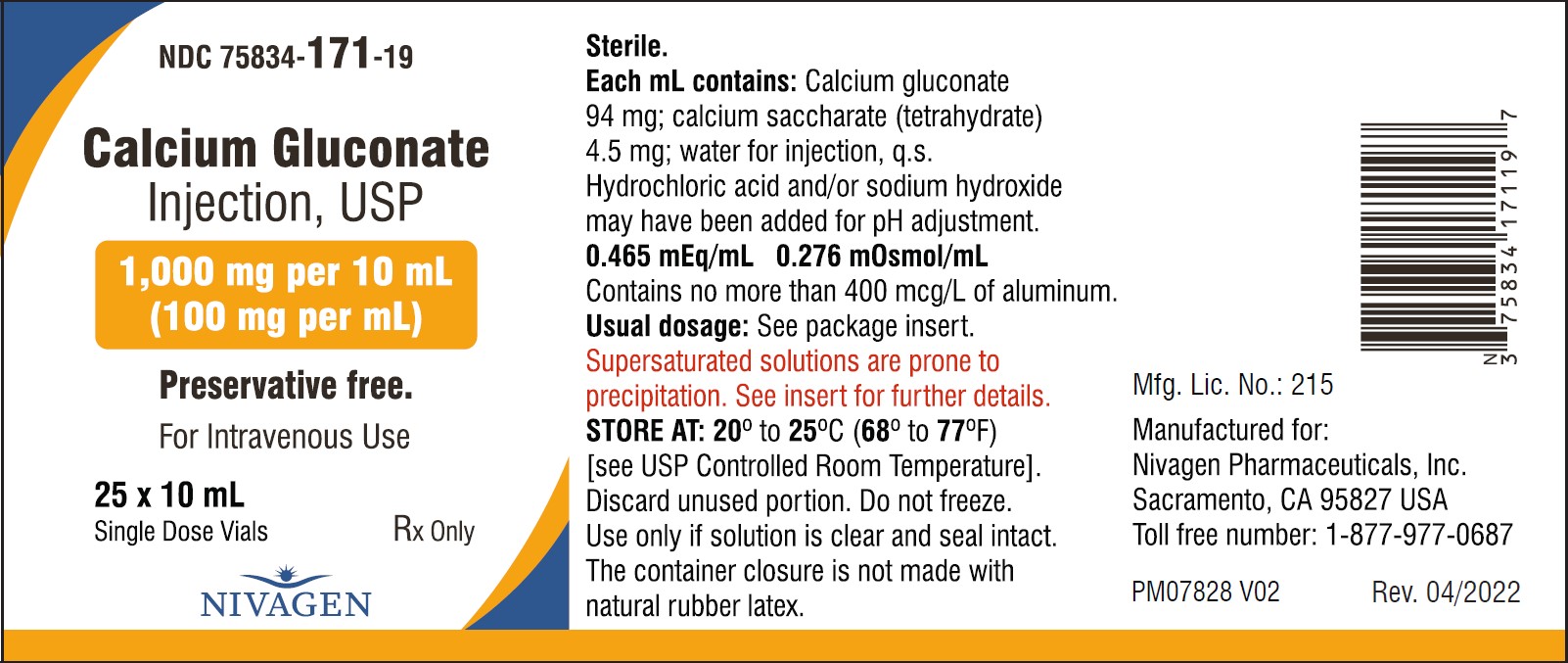
| calcium gluconate 98 mg/mLthis 75834-0171-19 | Nivagen | 25 vials | — | AP | Discontinued | — |
Where does this data come from?
⏳ Availability & generic status
This product is an FDA-approved generic. Other versions of the same drug are listed under Therapeutic equivalents, least expensive first.
Where does this data come from?
📊 Medicare Part D spend CMS · PART D · 2026 (Q1)
🔬 Reported adverse events (FAERS)
Top reported reactions
Age at onset
Reporter sex
Serious outcomes
Where does this data come from?
📦 Packaging — all sizes for this product
| Package NDC | Description | Marketing start | Status |
|---|---|---|---|
| 75834-0171-19 You're viewing this | 25 VIAL in 1 CARTON (75834-171-19) / 10 mL in 1 VIAL (75834-171-01) | 2022-10-24 | Inactivated by FDA |
🧭 About this NDC listing & data coverage
What data is (and isn’t) available for this NDC — tap to expand
| NDC identity (package / product / labeler codes) | ✓ Available |
| Labeler | ✓ Available |
| Product & package description | ✓ Available |
| Marketing category & status | ✓ Available |
| Active ingredient / dosage form / route | ✓ Available |
| FDA label (SPL via DailyMed) | ✓ Available |
| Package photos | ✓ Available |
| Inactive ingredients (structured) | ✓ Available |
| NADAC pharmacy acquisition price (CMS) | — Not published for this NDC CMS publishes NADAC only for NDCs reported in its retail-pharmacy survey. |
| Orange Book / therapeutic-equivalence data | ✓ Available |
| HCPCS J-code billing crosswalk | ✓ Available |
| Medicaid utilization (CMS SDUD) | — Not published for this NDC CMS reports utilization only for NDCs with Medicaid claims above its privacy threshold. |
Questions about this listing
Why is there no price listed?
What does the discontinued status mean for this NDC?
Is the NDC printed on the package the same as the 11-digit billing NDC?
What do the three segments of this NDC mean?
Who lists this product with the FDA?
Do I need a prescription for this product?
Does this product have a billing J-code?
Where does this data come from?
📄 Full prescribing information FDA SPL
🎯 Indications and Usage ▾
1 INDICATIONS AND USAGE Calcium Gluconate Injection is indicated for pediatric and adult patients for the treatment of acute symptomatic hypocalcemia. Limitations of Use The safety of Calcium Gluconate Injection for long term use has not been established. Calcium Gluconate Injection is a form of calcium indicated for pediatric and adult patients for the treatment of acute symptomatic hypocalcemia.
( 1 ) Limitations of Use: The safety of Calcium Gluconate Injection for long term use has not been established. ( 1 )
⏱️ Dosage and Administration ▾
2 DOSAGE AND ADMINISTRATION Contains 100 mg of calcium gluconate per mL which contains 9.3 mg (0.465 mEq) of elemental calcium ( 2.1 ) Administer intravenously (bolus or continuous infusion) via a secure intravenous line ( 2.1 ) See Full Prescribing Information (FPI) for dilution instructions, administration rates, and appropriate monitoring ( 2.1 ) Individualize the dose within the recommended range in adults and pediatric patients depending on the severity of symptoms of hypocalcemia, the serum calcium level, and the acuity of onset of hypocalcemia.
See Table 1 in the FPI for dosing recommendations in mg of calcium gluconate for neonates, pediatric and adult patients. ( 2.2 ) Measure serum calcium during intermittent infusions every 4 to 6 hours and during continuous infusion every 1 to 4 hours. ( 2.3 ) Calcium Gluconate Injection is not physically compatible with fluids containing phosphate or bicarbonate.
Precipitation may result if mixed. See FPI for all drug incompatibilities. ( 2.5 ) Supplied in a single-dose vial.
2.1Important Administration Instructions Calcium Gluconate Injection contains 100 mg of calcium gluconate per mL which contains 9.3 mg (i.e., 0.465 mEq) of elemental calcium. Dilute Calcium Gluconate Injection prior to use in 5% dextrose or normal saline and assess for potential drug or IV fluid incompatibilities [see Dosage and Administration (2.5) ] . Inspect Calcium Gluconate Injection visually prior to administration.
The solution should appear clear and colorless to slightly yellow. Do not administer if there is particulate matter or discoloration. Use the diluted solution immediately after preparation.
Administer Calcium Gluconate Injection intravenously via a secure intravenous line to avoid calcinosis cutis and tissue necrosis [see Warnings and Precautions (5.3) ]. Administer Calcium Gluconate Injection by bolus administration or continuous infusion: For bolus intravenous administration : Dilute the dose [see Dosage and Administration (2.2) ] of Calcium Gluconate Injection in 5% dextrose or normal saline to a concentration of 10-50 mg/mL prior to administration. Administer the dose slowly and DO NOT exceed an infusion rate of 200 mg/minute in adults or 100 mg/minute in pediatric patients, including neonates.
Monitor patients, vitals and electrocardiograph (ECG) during administration [see Warnings and Precautions (5.4) ]. For continuous intravenous infusion : Dilute Calcium Gluconate Injection in 5% dextrose or normal saline to a concentration of 5.8-10 mg/mL prior to administration. Administer at the rate recommended in Table 1 [see Dosage and Administration (2.2) ] and monitor patients, vitals, calcium and ECG during the infusion [see Warnings and Precautions (5.4) ].
Calcium Gluconate Injection is supplied in single-dose vials.
2.2Recommended Dosage Individualize the dose of Calcium Gluconate Injection within the recommended range depending on the severity of symptoms of hypocalcemia, the serum calcium level, and the acuity of onset of hypocalcemia. Table 1 provides dosing recommendations for Calcium Gluconate Injection in mg of calcium gluconate for neonates, pediatric and adult patients. Table 1.
Dosing Recommendations in mg of Calcium Gluconate for Neonate, Pediatric, and Adult Patients Patient Population Initial Dose Subsequent Doses (if needed) Bolus Continuous Infusion Neonate (≤ 1 month) 100 – 200 mg/kg 100 - 200 mg/kg every 6 hours Initiate at 17-33 mg/kg/hour Pediatric (> 1 month to < 17 years) 29 - 60 mg/kg 29 - 60 mg/kg every 6 hours Initiate at 8-13 mg/kg/hour Adult 1000 - 2000 mg 1000 - 2000 mg every 6 hours Initiate at 5.4 - 21.5 mg/kg/hour For bolus administration, DO NOT exceed an infusion rate of: 200 mg/minute in adult patients 100 mg/minute in pediatric patients For continuous infusions, adjust rate as needed based on serum calcium levels
2.3Serum Calcium Monitoring Measure serum calcium every 4 to 6 hours during intermittent infusions with Calcium Gluconate Injection and measu…
💊 Dosage Forms and Strengths ▾
3 DOSAGE FORMS AND STRENGTHS Calcium Gluconate Injection, USP is a clear, colorless to slightly yellow, solution free from visible particles available in the following: Single dose vial: 1,000 mg per 10 mL (100 mg per mL) Each mL of Calcium Gluconate Injection, USP contains 9.3 mg (0.465 mEq) of elemental calcium. Injection: Single-dose vial: 1,000 mg per 10 mL (100 mg per mL)
⛔ Contraindications ▾
4 CONTRAINDICATIONS Calcium Gluconate Injection is contraindicated in: Hypercalcemia Neonates (28 days of age or younger) receiving ceftriaxone [see Warnings and Precautions (5.2) ] Hypercalcemia ( 4 ) Neonates (28 days of age or younger) receiving ceftriaxone ( 4 )
⚠️ Warnings and Cautions ▾
5 WARNINGS AND PRECAUTIONS Arrhythmias with Concomitant Cardiac Glycoside Use: If concomitant therapy is necessary, Calcium Gluconate Injection should be given slowly in small amounts and close ECG monitoring is recommended ( 5.1 ) End-Organ Damage due to Intravascular Ceftriaxone-Calcium Precipitates: Concurrent use of intravenous ceftriaxone may cause life-threatening precipitates. Cases of fatal outcomes in neonates have occurred. ( 4 , 5.2 ) Tissue Necrosis and Calcinosis: Calcinosis cutis can occur with or without extravasation of Calcium Gluconate Injection.
Tissue necrosis, ulceration, and secondary infection are the most serious complications. If extravasation occurs or clinical manifestations of calcinosis cutis are noted, immediately discontinue intravenous administration at that site and treat as needed. ( 5.3 ) Hypotension, Bradycardia, and Cardiac Arrhythmias with Rapid Administration: To avoid adverse reactions that may follow rapid intravenous administration, Calcium Gluconate Injection should be diluted with 5% dextrose or normal saline and infused slowly, with careful ECG monitoring for cardiac arrhythmias.
( 5.4 ) Aluminum Toxicity: This product contains aluminum, up to 400 mcg per liter, that may be toxic. ( 5.5 )
5.1Arrhythmias with Concomitant Cardiac Glycoside Use Cardiac arrhythmias may occur if calcium and cardiac glycosides are administered together. Hypercalcemia increases the risk of digoxin toxicity. Administration of Calcium Gluconate Injection should be avoided in patients receiving cardiac glycosides.
If concomitant therapy is necessary, Calcium Gluconate Injection should be given slowly in small amounts and with close ECG monitoring [see Drug Inte ractions (7.1) ] .
5.2End-Organ Damage due to Intravascular Ceftriaxone-Calcium Precipitates Concomitant use of ceftriaxone and Calcium Gluconate Injection is contraindicated in neonates (28 days of age or younger) due to cases of fatal outcomes in neonates in which a crystalline material was observed in the lungs and kidneys at autopsy after ceftriaxone and calcium were administrated simultaneously through the same intravenous line. Concomitant administration can lead to the formation of ceftriaxone-calcium precipitates that may act as emboli, resulting in vascular spasm or infarction [see Contraindications (4) ].
In patients older than 28 days of age, ceftriaxone and Calcium Gluconate Injection may be administered sequentially, provided the infusion lines are thoroughly flushed between infusions with a compatible fluid. Do not administer Ceftriaxone simultaneously with Calcium Gluconate Injection via a Y-site in any age group.
5.3Tissue Necrosis and Calcinosis Intravenous administration of Calcium Gluconate Injection and local trauma may result in calcinosis cutis due to transient increase in local calcium concentration. Calcinosis cutis can occur with or without extravasation of Calcium Gluconate Injection, is characterized by abnormal dermal deposits of calcium salts, and clinically manifests as papules, plaques, or nodules that may be associated with erythema, swelling, or induration. Tissue necrosis, ulceration, and secondary infection are the most serious complications.
If extravasation occurs or clinical manifestations of calcinosis cutis are noted, immediately discontinue intravenous administration at that site and treat as needed.
5.4Hypotension, Bradycardia, and Cardiac Arrhythmias with Rapid Administration Rapid injection of Calcium Gluconate Injection may cause vasodilation, decreased blood pressure, bradycardia, cardiac arrhythmias, syncope and cardiac arrest. To avoid adverse reactions that may follow rapid intravenous administration, Calcium Gluconate Injection should be diluted with 5% dextrose or normal saline and infused slowly. If rapid intravenous bolus of Calcium Gluconate Injection is required, the rate of intravenous administration should not exceed 200 mg/minute in adults and 100 mg/minute in pediatric patients and ECG moni…
🤒 Adverse Reactions ▾
6 ADVERSE REACTIONS The following serious adverse reactions are also described elsewhere in the labeling: Arrhythmias with Concomitant Cardiac Glycoside Use [see Warnings and Precautions (5.1) ] End-Organ Damage due to Intravascular Ceftriaxone-Calcium Precipitates [see Warnings and Precautions (5.2) ] Tissue Necrosis and Calcinosis [see Warnings and Precautions (5.3) ] Hypotension, Bradycardia, and Cardiac Arrhythmias [see Warnings and Precautions (5.4) ] Aluminum toxicity [see Warnings and Precautions (5.5) ] The following adverse reactions associated with the use of calcium gluconate were identified in the literature.
Because these reactions are reported voluntarily from a population of uncertain size, it is not always possible to estimate their frequency reliably or to establish a causal relationship to drug exposure. Cardiovascular : Vasodilation, decreased blood pressure, bradycardia, cardiac arrhythmia, syncope, cardiac arrest Administration site reactions : Local soft tissue inflammation, local necrosis, calcinosis cutis and calcification due to extravasation The most common adverse events with Calcium Gluconate Injection are local soft tissue inflammation and necrosis, calcinosis cutis and calcification that are related to extravasation.
Other adverse events include vasodilation, decreased blood pressure, bradycardia, cardiac arrhythmia, syncope, and cardiac arrest. ( 6 ) To report SUSPECTED ADVERSE REACTIONS, contact Nivagen Pharmaceuticals, Inc. at 1-877-977-0687 or FDA at 1-800-FDA-1088 or www.fda.gov/medwatch.
🔄 Drug Interactions ▾
7 DRUG INTERACTIONS Cardiac Glycoside : Synergistic arrhythmias may occur if calcium and cardiac glycosides are administered together. ( 7.1 ) Calcium Channel Blockers : Administration of calcium may reduce the response. ( 7.2 ) Drugs that may cause hypercalcemia: Vitamin D, vitamin A, thiazide diuretics, estrogen, calcipotriene and teriparatide administration may cause hypercalcemia.
Monitor plasma calcium concentrations in patients taking these drugs concurrently. ( 7.3 )
7.1Cardiac Glycosides Hypercalcemia increases the risk of digoxin toxicity, while digoxin may be therapeutically ineffective in the presence of hypocalcemia. Synergistic arrhythmias may occur if calcium and cardiac glycosides are administered together. Avoid administration of Calcium Gluconate Injection in patients receiving cardiac glycosides; if considered necessary, administer Calcium Gluconate Injection slowly in small amounts and monitor ECG closely during administration.
7.2Calcium Channel Blockers Administration of calcium may reduce the response to calcium channel blockers.
7.3Drugs that may cause Hypercalcemia Vitamin D, vitamin A, thiazide diuretics, estrogen, calcipotriene and teriparatide administration may cause hypercalcemia. Monitor plasma calcium concentrations in patients taking these drugs concurrently.
👥 Use in Specific Populations ▾
8 USE IN SPECIFIC POPULATIONS Geriatric use : Dosing in elderly patients should be cautious, usually starting at the low end of the dosage range. ( 8.5 ) Renal impairment: Initiate with the lower limit of the dosage range and monitor serum calcium levels every 4 hours. ( 8.6 , 2.4 )
8.1Pregnancy Risk summary Limited available data with Calcium Gluconate Injection use in pregnant women are insufficient to inform a drug associated risk of adverse developmental outcomes. There are risks to the mother and the fetus associated with hypocalcemia in pregnancy [see Clinical Considerations ] . The estimated background risk of major birth defects and miscarriage for the indicated population is unknown.
In the U.S. general population, the estimated background risk of major birth defects and miscarriage in clinically recognized pregnancies is 2-4% and 15-20%, respectively. Clinical Considerations Disease-associated maternal risk Maternal hypocalcemia can result in an increased rate of spontaneous abortion, premature and dysfunctional labor, and possibly preeclampsia. Fetal/Neonatal adverse reactions Infants born to mothers with hypocalcemia can have associated fetal and neonatal hyperparathyroidism, which in turn can cause fetal and neonatal skeletal demineralization, subperiosteal bone resorption, osteitis fibrosa cystica and neonatal seizures.
Infants born to mothers with hypocalcemia should be carefully monitored for signs of hypocalcemia or hypercalcemia, including neuromuscular irritability, apnea, cyanosis and cardiac rhythm disorders.
8.2Lactation Risk summary Calcium is present in human milk as a natural component of human milk. It is not known whether intravenous administration of Calcium Gluconate Injection can alter calcium concentration in human milk. There are no data on the effects of Calcium Gluconate Injection on the breastfed infant, or on milk production.
The developmental and health benefits of breastfeeding should be considered along with the mother’s clinical need for Calcium Gluconate Injection and any potential adverse effects on the breastfed child from Calcium Gluconate Injection or from the underlying maternal condition.
8.4Pediatric Use The safety and effectiveness of Calcium Gluconate Injection have been established in pediatric patients for the treatment of acute, symptomatic hypocalcemia. Pediatric approval for Calcium Gluconate Injection, including doses, is not based on adequate and well-controlled clinical studies. Safety and dosing recommendations in pediatric patients are based on published literature and clinical experience [ see Dosage and Administration (2.2) ].
Concomitant use of ceftriaxone and Calcium Gluconate Injection is contraindicated in neonates (28 days of age or younger) due to reports of fatal outcomes associated with the presence of lung and kidney ceftriaxone-calcium precipitates. In patients older than 28 days of age, ceftriaxone and Calcium Gluconate Injection may be administered sequentially, provided the infusion lines are thoroughly flushed between infusions with a compatible fluid [see Contraindications (4) and Warnings and Precautions (5.2) ]. This product contains up to 400 mcg/L aluminum which may be toxic, particularly for premature neonates due to immature renal function.
Parenteral administration of aluminum greater than 4 to 5 mcg/kg/day is associated with central nervous system and bone toxicity [see Warnings and Precautions (5.5) ].
8.5Geriatric Use In general dose selection for an elderly patient should start at the lowest dose of the recommended dose range, reflecting the greater frequency of decreased hepatic, renal, or cardiac function, and of concomitant disease or other drug therapy.
8.6Renal Impairment For patients with renal impairment, initiate Calcium Gluconate Injection at the lowest dose of the recommended dose ranges across all age groups. Monitor serum calcium levels every 4 hours [see Dosage and Administration (2.4) ].
8.7 Hepatic Impairment Hepatic fun…
🤰 Pregnancy ▾
8.1Pregnancy Risk summary Limited available data with Calcium Gluconate Injection use in pregnant women are insufficient to inform a drug associated risk of adverse developmental outcomes. There are risks to the mother and the fetus associated with hypocalcemia in pregnancy [see Clinical Considerations ] . The estimated background risk of major birth defects and miscarriage for the indicated population is unknown.
In the U.S. general population, the estimated background risk of major birth defects and miscarriage in clinically recognized pregnancies is 2-4% and 15-20%, respectively. Clinical Considerations Disease-associated maternal risk Maternal hypocalcemia can result in an increased rate of spontaneous abortion, premature and dysfunctional labor, and possibly preeclampsia. Fetal/Neonatal adverse reactions Infants born to mothers with hypocalcemia can have associated fetal and neonatal hyperparathyroidism, which in turn can cause fetal and neonatal skeletal demineralization, subperiosteal bone resorption, osteitis fibrosa cystica and neonatal seizures.
Infants born to mothers with hypocalcemia should be carefully monitored for signs of hypocalcemia or hypercalcemia, including neuromuscular irritability, apnea, cyanosis and cardiac rhythm disorders.
🧒 Pediatric Use ▾
8.4Pediatric Use The safety and effectiveness of Calcium Gluconate Injection have been established in pediatric patients for the treatment of acute, symptomatic hypocalcemia. Pediatric approval for Calcium Gluconate Injection, including doses, is not based on adequate and well-controlled clinical studies. Safety and dosing recommendations in pediatric patients are based on published literature and clinical experience [ see Dosage and Administration (2.2) ].
Concomitant use of ceftriaxone and Calcium Gluconate Injection is contraindicated in neonates (28 days of age or younger) due to reports of fatal outcomes associated with the presence of lung and kidney ceftriaxone-calcium precipitates. In patients older than 28 days of age, ceftriaxone and Calcium Gluconate Injection may be administered sequentially, provided the infusion lines are thoroughly flushed between infusions with a compatible fluid [see Contraindications (4) and Warnings and Precautions (5.2) ]. This product contains up to 400 mcg/L aluminum which may be toxic, particularly for premature neonates due to immature renal function.
Parenteral administration of aluminum greater than 4 to 5 mcg/kg/day is associated with central nervous system and bone toxicity [see Warnings and Precautions (5.5) ].
🧓 Geriatric Use ▾
8.5Geriatric Use In general dose selection for an elderly patient should start at the lowest dose of the recommended dose range, reflecting the greater frequency of decreased hepatic, renal, or cardiac function, and of concomitant disease or other drug therapy.
🆘 Overdosage ▾
10 OVERDOSAGE Overdosage of Calcium Gluconate Injection may result in hypercalcemia. Symptoms of hypercalcemia typically develop when the total serum calcium concentration is ≥12 mg/dL. Neurologic symptoms include depression, weakness, fatigue, and confusion at lower levels, with patients experiencing hallucinations, disorientation, hypotonicity, seizures, and coma.
Effects on the kidney include diminished ability to concentrate urine and diuresis. If overdose of Calcium Gluconate Injection occurs immediately discontinue administration and provide supportive treatments to restore intravascular volume as well as promote calcium excretion in the urine if necessary.
🧬 Clinical Pharmacology ▾
12 CLINICAL PHARMACOLOGY
12.1Mechanism of Action Intravenous administration of calcium gluconate increases serum ionized calcium level. Calcium gluconate dissociates into ionized calcium in plasma. Ionized calcium and gluconate are normal constituents of body fluids.
12.3Pharmacokinetics Absorption Calcium Gluconate Injection is 100% bioavailable following intravenous injection. Metabolism Calcium itself does not undergo direct metabolism. The release of ionized calcium from intravenous administration of calcium gluconate is direct and does not seem to be affected by the first pass through the liver.
Distribution Calcium in the body is distributed mainly in skeleton (99%). Only 1% of the total body calcium is distributed within the extracellular fluids and soft tissues. About 50% of total serum calcium is in the ionized form and represents the biologically active part.
8% to 10% serum calcium is bound to organic and inorganic acid and approximately 40% is protein-bound (primarily to albumin). Elimination Studies have shown a relationship between urinary calcium excretion and the intravenous administration of calcium gluconate, with a significant increase in urinary calcium excretion observed after the intravenous administration of calcium gluconate.
🧬 Mechanism of Action ▾
12.1Mechanism of Action Intravenous administration of calcium gluconate increases serum ionized calcium level. Calcium gluconate dissociates into ionized calcium in plasma. Ionized calcium and gluconate are normal constituents of body fluids.
📦 How Supplied / Storage and Handling ▾
16 HOW SUPPLIED/STORAGE AND HANDLING Calcium Gluconate Injection, USP is a clear, colorless to slightly yellow solution free from visible particles supplied as follows: NDC Strength/Vial Size (mL) 75834-171-01 1,000 mg calcium gluconate per 10 mL (100 mg per mL), in a 10 mL plastic, single-dose vial. 75834-171-19 1,000 mg calcium gluconate per 10 mL (100 mg per mL), in a 10 mL plastic, single-dose vial, packaged in a carton of 25. Store at 20° to 25°C (68° to 77°F) [see USP Controlled Room Temperature].
Do not freeze. Preservative Free. Discard any unused portion in the single-dose vial immediately.
The diluted solution must be used immediately. NOTE: Supersaturated solutions are prone to precipitation. The precipitate, if present, may be dissolved by warming the vial to 60° to 80°C, with occasional agitation, until the solution becomes clear.
Shake vigorously. Allow to cool to room temperature before dispensing. Use injection only if clear immediately prior to use.
📋 Description ▾
11 DESCRIPTION Calcium Gluconate Injection, USP is a clear, colorless to slightly yellow, sterile, preservative-free, nonpyrogenic, supersaturated solution of calcium gluconate, a form of calcium, for intravenous use. Calcium Gluconate is calcium D-gluconate (1:2) monohydrate. The structural formula is: Molecular formula: C 12 H 22 CaO 14 • H 2 O Molecular weight: 448.39 Solubility in water: 3.5 g/100 mL at 25°C Calcium Gluconate Injection, USP is available as 1,000 mg per 10 mL (100 mg per mL) in a single-dose vial.
Each mL of Calcium Gluconate Injection, USP contains 100 mg of calcium gluconate (equivalent to 94 mg of calcium gluconate and 4.5 mg of calcium saccharate tetrahydrate), hydrochloric acid and/or sodium hydroxide for pH adjustment (6.0 to 8.2) and water for injection, q.s. It contains no antimicrobial agent. Each mL of Calcium Gluconate Injection, USP contains 9.3 mg (0.465 mEq) of elemental calcium. structure.jpg
💬 Information for Patients ▾
17 PATIENT COUNSELING INFORMATION Advise the patient that the risks associated with infusion including local tissue inflammation, local necrosis and calcinosis. [see Warnings and Precautions (5.3) ] . Manufactured for: Nivagen Pharmaceuticals, Inc. Sacramento, CA 95827 USA Toll free number: 1-877-977-0687 Rev. 10/2022