
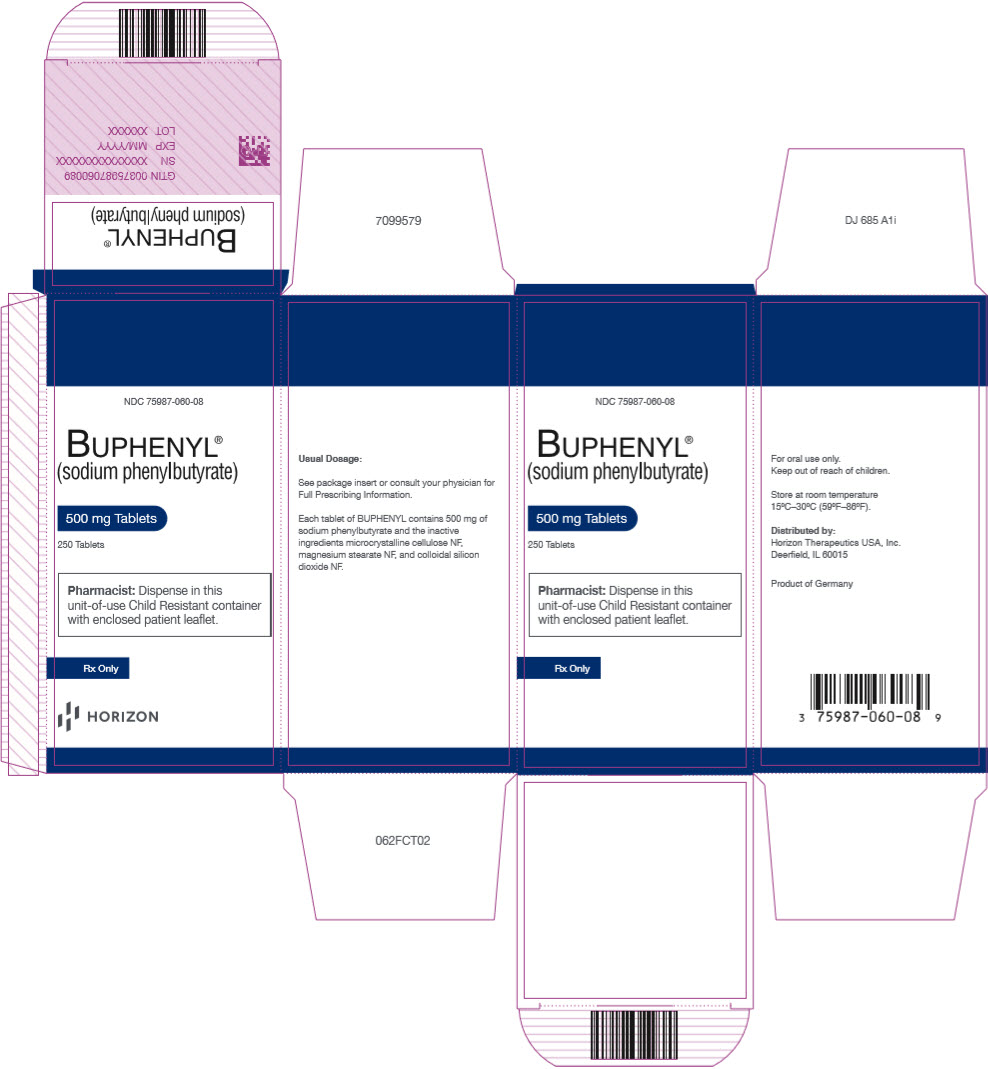
Buphenyl sodium phenylbutyrate 500 mg Tablet, 250-count — NDC 75987-060-08 (Billing 75987-0060-08)
This is a package of 250 tablets of Buphenyl sodium phenylbutyrate 500 mg Tablet from Horizon Therapeutics USA, Inc., marketed since May 1996 and currently FDA-listed. It is this product's only package size.
NDC database record
One package, one record: these facts belong to NDC 75987-060-08 alone.
- Record
- FDA NDC Directory package listing · Human prescription drug
- Code segments
- 75987 labeler · 060 product · 08 package
- Package marketed since
- May 13, 1996
- Sample package
- No — commercial package
- Listing certified through
- Dec 31, 2026
- Billing quantity
- 250 EA per package
- Barcode (UPC-A, from the NDC)
- 3 7598706008 9
- FDA record last changed
- Jul 24, 2026
Identity & classification
Regulatory identifiers FDA, NLM and CMS codes for this package
Drug-database identifiers Medi-Span GPI and First Databank GCN / HICL / AHFS classification
- GSN (GCN sequence number): 026624
- GCN: 43371
- GPI-14 (Medi-Span): 30908060000320
- HICL (First Databank): 011317
- AHFS class code: 40:10.00.00
- RxCUI (RxNorm): 199369
Where does this data come from?
- FDA openFDA NDC Directory · synced Oct 8, 2026
- FDA label on DailyMed · label index refreshed Oct 6, 2026
- RxNorm (NLM RxNav) · catalog refreshed Oct 1, 2026
- Medi-Span GPI (licensed)
- First Databank (licensed) · refreshed Oct 8, 2026
RxNorm drug class
This medicine belongs to the Nitrogen Binding Agent class.
Where does this data come from?
- RxClass (NLM) · catalog refreshed Oct 1, 2026
Clinical
Patient education
Supplement & herbal interactions
Some supplements/herbs that may interact with Sodium Phenylbutyrate — tap one for details:
Where does this data come from?
- MedlinePlus (NLM) · refreshed Oct 1, 2026
- FDA label on DailyMed · label index refreshed Oct 6, 2026
Ask a licensed pharmacist directly — free, answered by our team.
Pricing
A drug doesn't have one price. Each row is a different public payment system, and none is what you'd pay at the counter — that depends on your insurance. The ⓘ on each row explains what it measures.
| Price system | Per each | Per package |
|---|---|---|
| Retail pharmacies payNADAC · weekly | Not in the retail survey — common for institutional, discontinued, or low-volume packs. | |
| Medicaid paysCMS SDUD · 12 mo | No recent Medicaid claims on file for this NDC — rare and low-volume NDCs are suppressed in the public data. | |
| Medicare drug plans payPart D · quarterly | No Part D plan price is available for this NDC in our data. | |
Where does this data come from?
- CMS NADAC weekly file
- CMS ASP pricing files · refreshed Sep 20, 2026
- CMS Medicaid State Drug Utilization Data · refreshed Oct 8, 2026
- CMS Part D plan pricing files · refreshed Sep 24, 2026
- VA National Acquisition Center price file
Packaging — all sizes for this product
| Package NDC | Description | Marketing start | Marketing end | Status |
|---|---|---|---|---|
| 75987-0060-08 You're viewing this Main listing | 1 BOTTLE in 1 CARTON / 250 TABLET in 1 BOTTLE | 1996-05-13 | — | Active |
Therapeutic equivalents
| Product | Labeler | Pack | NADAC/unit | TE | Status | Price vs. this |
|---|---|---|---|---|---|---|
| Sodium Phenylbutyrate 500 mg 49884-0170-04 | Par | 250 tablets | — | AB | FDA listed | — |
| sodium phenylbutyrate 500 mg 68462-0853-20 | GLENMARK | 250 tablets | — | AB | FDA listed | — |
| Sodium phenylbutyrate 500 mg 70710-2180-08 | Zydus | 250 tablets | — | AB | FDA listed | — |
| Buphenyl 500 mgthis 75987-0060-08 | Horizon | 250 tablets | — | — | FDA listed | — |
| Sodium phenylbutyrate 500 mg 68475-0011-01 | Navinta | 250 tablets | — | AB | FDA listed | — |
Where does this data come from?
- FDA openFDA NDC Directory · synced Oct 8, 2026
- FDA Orange Book · refreshed Oct 3, 2026
- CMS NADAC weekly file
Availability & generic status
The FDA lists approved generic versions of this medicine, but that does not always mean a pharmacy can get one today. Patent rules, launch agreements, supply and pricing can affect when generics actually arrive.
Where does this data come from?
- FDA Orange Book · refreshed Oct 3, 2026
What it looks like
Where does this data come from?
- FDA label on DailyMed · label index refreshed Oct 6, 2026
Inactive Ingredients / Excipients
Inactive ingredients, also called excipients, are components of the drug product other than the active ingredient. They may include fillers, dyes, coatings, preservatives, flavors, or other formulation ingredients.
Where does this data come from?
IACT rows and label-wide narrative are kept separate; availability and product-level specificity depend on the submitted label.- FDA label on DailyMed · label index refreshed Oct 6, 2026
- FDA openFDA NDC Directory · synced Oct 8, 2026
Inactive ingredient FAQ
Are inactive ingredients the same for every manufacturer?
Why might an inactive ingredient be missing?
Can inactive ingredients matter?
Manufacturer & labeler
More NDCs from Horizon Therapeutics USA, Inc. labeler code 75987
- Ravicti glycerol phenylbutyrate 1.1 g/mL Liquid NDC 75987-050-06
- Krystexxa pegloticase 8 mg/50mL Injection, Solution NDC 75987-058-01
- Buphenyl sodium phenylbutyrate .94 g/g Powder NDC 75987-070-09
- Krystexxa pegloticase 8 mg/mL Injection, Solution NDC 75987-080-10
- PROCYSBI Cysteamine bitartrate 25 mg Capsule, Delayed Release Pellets NDC 75987-100-04
- PROCYSBI Cysteamine bitartrate 75 mg Capsule, Delayed Release Pellets NDC 75987-101-08
- ACTIMMUNE Interferon gamma-1b 100 ug/.5mL Injection, Solution NDC 75987-111-11
- Tepezza teprotumumab 500 mg Injection, Powder, Lyophilized, For Solution NDC 75987-130-15
Where does this data come from?
- FDA openFDA NDC Directory · synced Oct 8, 2026
- Drugs@FDA
Full prescribing information FDA SPL
🎯 Indications and Usage ▾
INDICATIONS AND USAGE BUPHENYL is indicated as adjunctive therapy in the chronic management of patients with urea cycle disorders involving deficiencies of carbamoyl phosphate synthetase (CPS), ornithine transcarbamylase (OTC), or argininosuccinic acid synthetase (AS). It is indicated in all patients with neonatal-onset deficiency (complete enzymatic deficiency, presenting within the first 28 days of life). It is also indicated in patients with late-onset disease (partial enzymatic deficiency, presenting after the first month of life) who have a history of hyperammonemic encephalopathy.
It is important that the diagnosis be made early and treatment initiated immediately to improve survival. Any episode of acute hyperammonemia should be treated as a life-threatening emergency. BUPHENYL must be combined with dietary protein restriction and, in some cases, essential amino acid supplementation.
(See Nutritional Supplementation subsection of the DOSAGE AND ADMINISTRATION section.) Previously, neonatal-onset disease was almost universally fatal within the first year of life, even when treated with peritoneal dialysis and essential amino acids or their nitrogen-free analogs. However, with hemodialysis, use of alternative waste nitrogen excretion pathways (sodium phenylbutyrate, sodium benzoate, and sodium phenylacetate), dietary protein restriction, and, in some cases, essential amino acid supplementation, the survival rate in newborns diagnosed after birth but within the first month of life is almost 80%.
Most deaths have occurred during an episode of acute hyperammonemic encephalopathy. Patients with neonatal-onset disease have a high incidence of mental retardation. Those who had IQ tests administered had an incidence of mental retardation as follows: ornithine transcarbamylase deficiency, 100% (14/14 patients tested); argininosuccinic acid synthetase deficiency, 88% (15/17 patients tested); and carbamoyl phosphate synthetase deficiency, 57% (4/7 patients tested).
Retardation was severe in the majority of the retarded patients. In patients diagnosed during gestation and treated prior to any episode of hyperammonemic encephalopathy, survival is 100%, but even in these patients, most subsequently demonstrate cognitive impairment or other neurologic deficits. In late-onset deficiency patients, including females heterozygous for ornithine transcarbamylase deficiency, who recover from hyperammonemic encephalopathy and are then treated chronically with sodium phenylbutyrate and dietary protein restriction, the survival rate is 98%.
The two deaths in this group of patients occurred during episodes of hyperammonemic encephalopathy. However, compliance with the therapeutic regimen has not been adequately documented to allow evaluation of the potential for BUPHENYL and dietary protein restriction to prevent mental deterioration and recurrence of hyperammonemic encephalopathy if carefully adhered to. The majority of these patients tested (30/46 or 65%) have IQ's in the average to low average/borderline mentally retarded range.
Reversal of preexisting neurologic impairment is not likely to occur with treatment and neurologic deterioration may continue in some patients. Even on therapy, acute hyperammonemic encephalopathy recurred in the majority of patients for whom the drug is indicated. BUPHENYL may be required lifelong unless orthotopic liver transplantation is elected.
(See CLINICAL PHARMACOLOGY, Pharmacodynamics subsection for the biochemical effects of BUPHENYL).
⏱️ Dosage and Administration ▾
DOSAGE AND ADMINISTRATION For oral use only. The use of BUPHENYL Tablets is indicated for children weighing more than 20 kg and for adults. The usual total daily dose of BUPHENYL Tablets and Powder for patients with urea cycle disorders is 450–600 mg/kg/day in patients weighing less than 20 kg, or 9.9–13.0 g/m2/day in larger patients.
The tablets and powder are to be taken in equally divided amounts with each meal or feeding (i.e., three to six times per day). BUPHENYL Powder is indicated for oral use (via mouth, gastrostomy, or nasogastric tube) only. The powder is to be mixed with food (solid or liquid) for immediate use; however, when dissolved in water, BUPHENYL Powder has been shown to be stable for up to one week at room temperature or refrigerated.
Sodium phenylbutyrate is very soluble in water (5 grams per 10 mL). When BUPHENYL Powder is added to a liquid, only sodium phenylbutyrate will dissolve, the excipients will not. The effect of food on sodium phenylbutyrate has not been determined.
Each level teaspoon (enclosed) dispenses 3.2 grams of powder and 3.0 grams of sodium phenylbutyrate. Each level tablespoon (enclosed) dispenses 9.1 grams of powder and 8.6 grams of sodium phenylbutyrate. Shake lightly before use.
The safety or efficacy of doses in excess of 20 grams (40 tablets) per day has not been established. NUTRITIONAL MANAGEMENT To promote growth and development, plasma levels of ammonia, arginine, branched-chain amino acids, and serum protein should be maintained within normal limits while plasma glutamine is maintained at levels less than 1,000 µmol/L. Minimum daily protein intake for a patient of a particular age should be taken from, for example, "Recommended Dietary Allowances", 10th ed., Food and Nutrition Board, National Academy of Sciences, 1989.
The allocation of dietary nitrogen into natural protein and essential amino acids is a function of age, residual urea cycle enzyme activity, and the dose of sodium phenylbutyrate. At the recommended dose of sodium phenylbutyrate, it is suggested that infants with neonatal-onset CPS and OTC deficiencies initially receive a daily dietary protein intake limited to approximately 1.6 g/kg/day for the first 4 months of life. If tolerated, the daily protein intake may be increased to 1.9 g/kg/day during this period.
Protein tolerance will decrease as the growth rate decreases, requiring a reduction in dietary nitrogen intake. From 4 months to 1 year of age, it is recommended that the infant receive at least 1.4 g/kg/day, but 1.7 g/kg/day is advisable. From 1 to 3 years of age, the protein intake should not be less than 1.2 g/kg/day; 1.4 g/kg/day is advisable during this period.
For neonatal-onset patients with carbamoyl phosphate synthetase deficiency or ornithine transcarbamylase deficiency who are at least 6 months of age, it is recommended that the daily protein intake be equally divided between natural protein and supplemental essential amino acids. Patients with argininosuccinic acid synthetase deficiency and those with late-onset disease (partial deficiencies, including females heterozygous for ornithine transcarbamylase), initially may receive a diet containing the age-determined minimal daily natural protein allowance.
The protein intake may be increased as tolerated and determined by plasma glutamine and other amino acid levels. However, many patients with partial deficiencies avoid dietary protein. Citrulline supplementation is required and recommended for patients diagnosed with neonatal-onset deficiency of carbamoyl phosphate synthetase or ornithine transcarbamylase; citrulline daily intake is recommended at 0.17 g/kg/day or 3.8 g/m 2 /day.
The free-base form of arginine may be used instead of citrulline in patients with milder forms of carbamoyl phosphate synthetase and ornithine transcarbamylase deficiency (daily intake is recommended at 0.17 g/kg/day or 3.8 g/m 2 /day). Arginine supplementation is needed for patients diagnosed with deficiency of argin… [Excerpted — this section continues on DailyMed.]
⛔ Contraindications ▾
CONTRAINDICATIONS BUPHENYL should not be used to manage acute hyperammonemia, which is a medical emergency.
⚠️ Warnings ▾
WARNINGS Each BUPHENYL Tablet contains 62 mg of sodium (9.2% w/w) (corresponding to 124 mg of sodium per gram of sodium phenylbutyrate [12.4% w/w]) and BUPHENYL Powder contains 11.7 grams of sodium per 100 grams of powder, corresponding to 125 mg of sodium per gram of sodium phenylbutyrate (12.4% w/w). BUPHENYL should be used with great care, if at all, in patients with congestive heart failure or severe renal insufficiency, and in clinical states in which there is sodium retention with edema. Because BUPHENYL is metabolized in the liver and kidney, and phenylacetylglutamine is primarily excreted by the kidney, use caution when administering the drug to patients with hepatic or renal insufficiency or inborn errors of beta oxidation.
Probenecid is known to inhibit the renal transport of many organic compounds, including hippuric acid, and may affect renal excretion of the conjugated product of BUPHENYL as well as its metabolite. Use of corticosteroids may cause the breakdown of body protein and increase plasma ammonia levels.
🤒 Adverse Reactions ▾
ADVERSE REACTIONS The assessment of clinical adverse events came from 206 patients treated with sodium phenylbutyrate. Adverse events (both clinical and laboratory) were not collected systematically in these patients, but were obtained from patient visit reports by the 65 co-investigators. Causality of adverse effects is sometimes difficult to determine in this patient population because they may result from either the underlying disease, the patient's restricted diet, intercurrent illness, or BUPHENYL.
Furthermore, the rates may be underestimated because they were reported primarily by parent or guardian and not the patient. Clinical Adverse Events In female patients, the most common clinical adverse event reported was amenorrhea/menstrual dysfunction (irregular menstrual cycles), which occurred in 23% of the menstruating patients. Decreased appetite occurred in 4% of all patients.
Body odor (probably caused by the metabolite, phenylacetate) and bad taste or taste aversion were each reported in 3% of patients. Other adverse events reported in 2% or fewer patients were: Gastrointestinal : abdominal pain, gastritis, nausea and vomiting; constipation, rectal bleeding, peptic ulcer disease, and pancreatitis each occurred in one patient. Hematologic : aplastic anemia and ecchymoses each occurred in one patient.
Cardiovascular : arrhythmia and edema each occurred in one patient. Renal : renal tubular acidosis Psychiatric : depression Skin : rash Miscellaneous : headache, syncope, and weight gain Neurotoxicity was reported in cancer patients receiving intravenous phenylacetate, 250–300 mg/kg/day for 14 days, repeated at 4-week intervals. Manifestations were predominately somnolence, fatigue, and lightheadedness; with less frequent headache, dysgeusia, hypoacusis, disorientation, impaired memory, and exacerbation of a pre-existing neuropathy.
These adverse events were mainly mild in severity. The acute onset and reversibility when the phenylacetate infusion was discontinued suggest a drug effect. Laboratory Adverse Events In patients with urea cycle disorders, the frequency of laboratory adverse events by body system were: Metabolic : acidosis (14%), alkalosis and hyperchloremia (each 7%), hypophosphatemia (6%), hyperuricemia and hyperphosphatemia (each 2%), and hypernatremia and hypokalemia (each 1%).
Nutritional : hypoalbuminemia (11%) and decreased total protein (3%). Hepatic : increased alkaline phosphatase (6%), increased liver transaminases (4%), and hyperbilirubinemia (1%). Hematologic : anemia (9%), leukopenia and leukocytosis (each 4%), thrombocytopenia (3%), and thrombocytosis (1%).
The clinician is advised to routinely perform urinalysis, blood chemistry profiles, and hematologic tests.
🤰 Pregnancy ▾
Pregnancy Animal reproduction studies have not been conducted with BUPHENYL. It is also not known whether BUPHENYL can cause fetal harm when administered to a pregnant woman or can affect reproduction capacity. BUPHENYL should be given to a pregnant woman only if clearly needed.
🧒 Pediatric Use ▾
Pediatric Use The use of tablets for neonates, infants and children to the weight of 20 kg is not recommended. (See Dosage and Administration .)
🆘 Overdosage ▾
OVERDOSAGE Overdoses of BUPHENYL exceeding ten-fold the maximum recommended dosage may produce emesis, CNS depression, metabolic acidosis with or without respiratory alkalosis, hypernatremia, hypokalemia, and hypophosphatemia. Symptoms of overdose overlap with those of acute hyperammonemia. If overdose occurs, discontinue BUPHENYL, monitor plasma phenylacetate and ammonia levels closely, and institute appropriate emergency management, which may include hemodialysis, continuous veno-venous hemofiltration (CVVH), or extracorporeal membrane oxygenation (ECMO).
🧬 Clinical Pharmacology ▾
CLINICAL PHARMACOLOGY Sodium phenylbutyrate is a pro-drug and is rapidly metabolized to phenylacetate. Phenylacetate is a metabolically active compound that conjugates with glutamine via acetylation to form phenylacetylglutamine. Phenylacetylglutamine then is excreted by the kidneys.
On a molar basis, it is comparable to urea (each containing two moles of nitrogen). Therefore, phenylacetylglutamine provides an alternate vehicle for waste nitrogen excretion.
📦 How Supplied / Storage and Handling ▾
HOW SUPPLIED BUPHENYL Tablets are available in 250 cc bottles which contain 250 sodium phenylbutyrate tablets (NDC 75987-060-08). The bottles are equipped with child-resistant caps. Each tablet is off-white, oval, and embossed with "UCY 500".
Each tablet contains 500 mg of sodium phenylbutyrate. STORE AT ROOM TEMPERATURE 15°C–30°C (59°F–86°F). AFTER OPENING, KEEP BOTTLE TIGHTLY CLOSED.
BUPHENYL Powder is available in 500 cc bottles, which hold 266 grams of powder, containing 250 grams of sodium phenylbutyrate (NDC 75987-070-09). The bottles are equipped with child-resistant caps. Measurers are provided.
Each level teaspoon (enclosed) dispenses 3.2 grams of powder and 3.0 grams of sodium phenylbutyrate. Each level tablespoon (enclosed) dispenses 9.1 grams of powder and 8.6 grams of sodium phenylbutyrate. STORE AT ROOM TEMPERATURE 15ºC–30ºC (59ºF–86ºF).
AFTER OPENING, KEEP BOTTLE TIGHTLY CLOSED.
📋 Description ▾
DESCRIPTION BUPHENYL (sodium phenylbutyrate) Tablets for oral administration and BUPHENYL (sodium phenylbutyrate) Powder for oral, nasogastric, or gastrostomy tube administration contain sodium phenylbutyrate. Sodium phenylbutyrate is an off-white crystalline substance which is soluble in water and has a strong salty taste. Sodium phenylbutyrate also is freely soluble in methanol and practically insoluble in acetone and diethyl ether.
It is known chemically as 4-phenylbutyric acid, sodium salt with a molecular weight of 186 and the molecular formula C 10 H 11 O 2 Na. Chemical Structure: Each tablet of BUPHENYL contains 500 mg of sodium phenylbutyrate and the inactive ingredients microcrystalline cellulose NF, magnesium stearate NF, and colloidal silicon dioxide NF. Each gram of BUPHENYL Powder contains 0.94 grams of sodium phenylbutyrate and the inactive ingredients calcium stearate NF, and colloidal silicon dioxide NF.
Chemical Structure
💬 Information for Patients ▾
Information for Patients The full text of the separate insert of information for patients is reprinted at the end of the labeling.
⚠️ Precautions ▾
PRECAUTIONS General BUPHENYL should not be administered to patients with known hypersensitivity to sodium phenylbutyrate or any component of this preparation. There have been published reports of hyperammonemia being induced by haloperidol and by valproic acid. Neurotoxicity of phenylacetate in animals When given subcutaneously to rat pups, 190–474 mg/kg phenylacetate caused decreased proliferation and increased loss of neurons, and it reduced CNS myelin.
Cerebral synapse maturation was retarded, and the number of functioning nerve terminals in the cerebrum was reduced, which resulted in impaired brain growth. Prenatal exposure of rat pups to phenylacetate produced lesions in layer 5 of the cortical pyramidal cells; dendritic spines were longer and thinner than normal and reduced in number. Information for Patients The full text of the separate insert of information for patients is reprinted at the end of the labeling.
Laboratory Tests Plasma levels of ammonia, arginine, branched-chain amino acids, and serum proteins should be maintained within normal limits, and plasma glutamine should be maintained at levels less than 1,000 µmol/L. Serum drug levels of phenylbutyrate and its metabolites, phenylacetate and phenylacetylglutamine, should be monitored periodically. Carcinogenesis, Mutagenesis, Impairment of Fertility Carcinogenicity, mutagenicity, and fertility studies of sodium phenylbutyrate have not been conducted.
Pregnancy Animal reproduction studies have not been conducted with BUPHENYL. It is also not known whether BUPHENYL can cause fetal harm when administered to a pregnant woman or can affect reproduction capacity. BUPHENYL should be given to a pregnant woman only if clearly needed.
Nursing Mothers It is not known whether this drug is excreted in human milk. Because many drugs are excreted in human milk, caution should be exercised when BUPHENYL is administered to a nursing woman. Pediatric Use The use of tablets for neonates, infants and children to the weight of 20 kg is not recommended.
(See Dosage and Administration .)
🍼 Nursing Mothers ▾
Nursing Mothers It is not known whether this drug is excreted in human milk. Because many drugs are excreted in human milk, caution should be exercised when BUPHENYL is administered to a nursing woman.
🧬 Pharmacokinetics ▾
PHARMACOKINETICS General Pharmacokinetic studies have not been conducted in the primary patient population (neonates, infants, and children), but pharmacokinetic data were obtained from normal adult subjects. Absorption Peak plasma levels of phenylbutyrate occur within 1 hour after a single dose of 5 grams of sodium phenylbutyrate tablet with a C max of 218 µg/mL under fasting conditions; peak plasma levels of phenylbutyrate occur within 1 hour after a single dose of 5 grams of sodium phenylbutyrate powder with a C max of 195 µg/mL under fasting conditions.
The effect of food on phenylbutyrate's absorption is unknown. Disposition The overall disposition of sodium phenylbutyrate and its metabolites has not been characterized fully. However, the drug is known to be metabolized to phenylacetate and subsequently to phenylacetylglutamine.
Following oral administration of 5 grams (tablets), measurable plasma levels of phenylbutyrate and phenylacetate were detected 15 and 30 minutes after dosing, respectively, and phenylacetylglutamine was detected shortly thereafter. The pharmacokinetic parameters for phenylbutyrate for C max (µg/mL), T max (hours), and elimination half-life (hours) were 218, 1.35, and 0.77, respectively, and for phenylacetate were 48.5, 3.74, and 1.15, respectively. Following oral administration of 5 grams of the powder, measurable plasma levels of phenylbutyrate and phenylacetate were detected 15 and 30 minutes after dosing, respectively, and phenylacetylglutamine was detected shortly thereafter.
The pharmacokinetic parameters for phenylbutyrate for C max (µg/mL), T max (hours), and elimination half-life (hours) were 195, 1.00, and 0.76, respectively, and for phenylacetate were 45.3, 3.55, and 1.29, respectively. The major sites for metabolism of sodium phenylbutyrate are the liver and kidney. Excretion A majority of the administered compound (approximately 80–100%) was excreted by the kidneys within 24 hours as the conjugation product, phenylacetylglutamine.
For each gram of sodium phenylbutyrate administered, it is estimated that between 0.12–0.15 grams of phenylacetylglutamine nitrogen are produced. Pharmacodynamics In patients with urea cycle disorders, BUPHENYL decreased elevated plasma ammonia glutamine levels. It increases waste nitrogen excretion in the form of phenylacetylglutamine.
Special Populations Gender Significant gender differences were found in the pharmacokinetics of phenylbutyrate and phenylacetate, but not for phenylacetylglutamine. The pharmacokinetic parameters (AUC and C max ), for both plasma phenylbutyrate and phenylacetate were about 30 to 50 percent greater in females than in males. Hepatic insufficiency In patients who did not have urea cycle disorders but had impaired hepatic function, the metabolism and excretion of sodium phenylbutyrate were not affected.
However, this information was obtained from unvalidated, uncontrolled case studies.
🧬 Pharmacodynamics ▾
Pharmacodynamics In patients with urea cycle disorders, BUPHENYL decreased elevated plasma ammonia glutamine levels. It increases waste nitrogen excretion in the form of phenylacetylglutamine.
📄 Carcinogenesis, Mutagenesis, Impairment of Fertility ▾
Carcinogenesis, Mutagenesis, Impairment of Fertility Carcinogenicity, mutagenicity, and fertility studies of sodium phenylbutyrate have not been conducted.
📄 Patient Package Insert ▾
PATIENT PACKAGE INSERT BUPHENYL ® (sodium phenylbutyrate) Tablets BUPHENYL ® (sodium phenylbutyrate) Powder What is the most important information I should know about BUPHENYL? BUPHENYL is prescribed along with changes in diet for long-term treatment of urea cycle disorders. BUPHENYL can only be obtained with a prescription from your doctor.
BUPHENYL must be taken exactly as the doctor prescribes; do not increase or decrease the dose of this medication without the doctor's approval. What are urea cycle disorders? Urea cycle disorders include a group of diseases, each having a specific liver enzyme deficiency.
Because they are inherited, other family members may be affected. These disorders vary in severity and may be first detected at various ages, from newborn infants to adults. They lead to increased amounts of ammonia in the blood, which may cause disturbed brain function and severe brain damage.
Typical signs of the disease are decreased mental awareness, vomiting, combativeness, slurred speech, unstable gait, and unconsciousness. The diagnosis of urea cycle disorders requires special laboratory tests. These typical signs of the disease may recur after the diagnosis is made if the condition is not under control.
If they do, the doctor should be notified immediately because this is a medical emergency. An infection can cause the condition to go out of control. Therefore, if a fever develops, the doctor should be seen immediately.
A patient or carrier of these disorders should wear a Medic Alert tag stating the diagnosis. In the event that the patient has a sudden, rapid accumulation of ammonia in the blood, and, therefore, in the brain, leading to unconsciousness, the doctor will be alerted to treat the disease properly. Periodically, depending upon the severity of a particular patient's urea cycle disorder, it will be necessary to perform blood tests.
These include plasma ammonia, plasma amino acid levels, and other more routine blood tests to evaluate nutritional status. What is BUPHENYL? BUPHENYL is a drug that helps to prevent ammonia from accumulating in the blood.
BUPHENYL aids the body in eliminating substances that produce ammonia. However, despite drug treatment, blood ammonia levels may become elevated periodically and there may be episodes of altered brain function in association with these ammonia elevations. Patients who have disease onset as newborns have a high incidence of mental retardation.
Medical attention should be obtained as soon as signs appear (see above under " What are urea cycle disorders? "). BUPHENYL may be used as lifelong therapy or as a temporary measure until liver transplantation is performed. What diet should I or my child follow?
In addition to taking BUPHENYL, it is equally important that a prescribed diet be followed. Because there is great variability in the severity of urea cycle disorders, each patient's diet should be custom designed by a physician and a nutritionist. Because the diet is so important, it is recommended that the prescribed diet be discussed with a nutritionist who is familiar with urea cycle disorders.
Who should not take BUPHENYL? BUPHENYL is prescribed only for patients with urea cycle disorders. It is not to be used for any other reason.
Keep the medication in a safe place where children cannot reach it. What other medical conditions may also be present that could increase the risk of taking BUPHENYL? Heart failure or decreased kidney function may lead to retention of the sodium content of BUPHENYL with potentially serious consequences such as worsening heart failure, high blood pressure, and swelling.
If these medical conditions are present, the doctor will determine if your child should take BUPHENYL. How should I or my child take BUPHENYL? The dose of BUPHENYL prescribed for adults and children is based upon the patient's weight or size.
It is very important that the full amount prescribed for any 24-hour period be taken. If a dose is missed it should be admi… [Excerpted — this section continues on DailyMed.]
📄 Package Label / Principal Display Panel ▾
PRINCIPAL DISPLAY PANEL - 500 mg Tablet Bottle Carton NDC 75987-060-08 BUPHENYL ® (sodium phenylbutyrate) 500 mg Tablets 250 Tablets Pharmacist: Dispense in this unit-of-use Child Resistant container with enclosed patient leaflet. Rx Only PRINCIPAL DISPLAY PANEL - 500 mg Tablet Bottle Carton
PRINCIPAL DISPLAY PANEL - 250 Gram Bottle Carton NDC 75987-070-09 BUPHENYL ® (sodium phenylbutyrate) Powder 250 Grams Pharmacist: Dispense in this unit-of-use Child Resistant container with enclosed patient leaflet. Rx Only PRINCIPAL DISPLAY PANEL - 250 Gram Bottle Carton
Medicare Part D spend CMS · PART D · 2025 (Q1-Q4)
About this NDC listing & data coverage
What data is (and isn’t) available for this NDC — tap to expand
| NDC identity (package / product / labeler codes) | ✓ Available |
| Labeler | ✓ Available |
| Product & package description | ✓ Available |
| Marketing category & status | ✓ Available |
| Active ingredient / dosage form / route | ✓ Available |
| FDA label (SPL via DailyMed) | ✓ Available |
| Package photos | ✓ Available |
| Inactive ingredients (structured) | — Not published for this NDC The labeler did not submit a structured excipient list, or no SPL is available. |
| NADAC pharmacy acquisition price (CMS) | — Not published for this NDC CMS publishes NADAC only for NDCs reported in its retail-pharmacy survey. |
| Orange Book / therapeutic-equivalence data | — Not published for this NDC Applies only to products approved under an NDA/ANDA; many listings are out of scope. |
| HCPCS J-code billing crosswalk | — Not published for this NDC Most self-administered / retail products have no J-code — that is normal. |
| Medicaid utilization (CMS SDUD) | — Not published for this NDC CMS reports utilization only for NDCs with Medicaid claims above its privacy threshold. |