
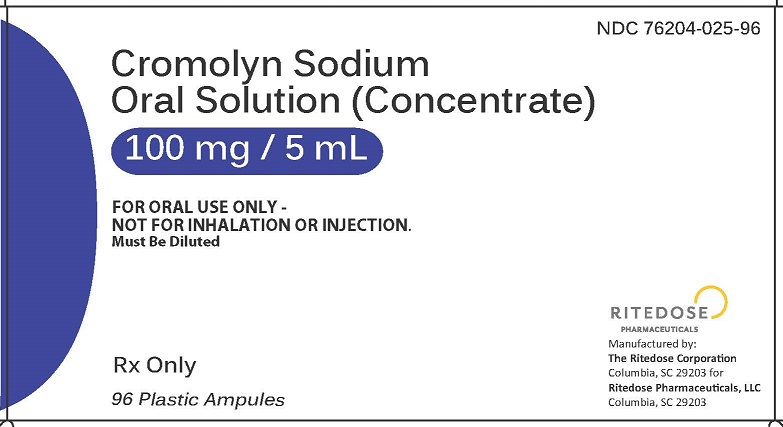
Cromolyn Sodium Oral Solution (Concentrate) 100 mg/5mL Solution, Concentrate — NDC 76204-025-96 (Billing 76204-0025-96)
This is a package of Cromolyn Sodium Oral Solution (Concentrate) 100 mg/5mL Solution, Concentrate from Ritedose Pharmaceuticals, LLC, no longer marketed (first marketed Dec 2021), no longer in the FDA NDC Directory; retail pharmacies pay about $0.3490 per mL (NADAC). It is this product's only package size.
NDC database record
One package, one record: these facts belong to NDC 76204-025-96 alone.
- Record
- FDA NDC Directory package listing · Human prescription drug
- Code segments
- 76204 labeler · 025 product · 96 package
- Package marketed since
- Dec 1, 2021
- Sample package
- No — commercial package
- Listing certified through
- Dec 31, 2026
- Barcode (UPC-A, from the NDC)
- 3 7620402596 6
- FDA record last changed
- Jul 24, 2026
Past resolved recalls for this product (1)
Identity & classification
Regulatory identifiers FDA, NLM and CMS codes for this package
Drug-database identifiers Medi-Span GPI and First Databank GCN / HICL / AHFS classification
- GSN (GCN sequence number): 025061
- GCN: 16925
- GPI-14 (Medi-Span): 52160015101320
- HICL (First Databank): 004526
- AHFS class code: 48:10.32.00
- RxCUI (RxNorm): 831261
Where does this data come from?
- FDA openFDA NDC Directory · synced Oct 8, 2026
- FDA label on DailyMed · label index refreshed Oct 8, 2026
- RxNorm (NLM RxNav) · catalog refreshed Oct 1, 2026
- Medi-Span GPI (licensed)
- First Databank (licensed) · refreshed Oct 8, 2026
RxNorm drug class
This medicine belongs to the Mast Cell Stabilizer class.
Where does this data come from?
- RxClass (NLM) · catalog refreshed Oct 1, 2026
Clinical
Patient education
Supplement & herbal interactions
Where does this data come from?
- MedlinePlus (NLM) · refreshed Oct 8, 2026
- FDA label on DailyMed · label index refreshed Oct 8, 2026
Ask a licensed pharmacist directly — free, answered by our team.
Pricing
A drug doesn't have one price. Each row is a different public payment system, and none is what you'd pay at the counter — that depends on your insurance. The ⓘ on each row explains what it measures.
| Price system | Per mL | Per package |
|---|---|---|
| Retail pharmacies payNADAC · weekly | $0.349 | $167.52 / 480 ml |
| Medicaid paysCMS SDUD · 12 mo | No recent Medicaid claims on file for this NDC — rare and low-volume NDCs are suppressed in the public data. | |
| Medicare drug plans payPart D · Q2 2026 | $0.3643 | $174.86 / 480 ml |
| Medicare Part B allowsASP · J8499 | No ASP payment limit on file for J8499 this quarter. | |
Where does this data come from?
- CMS NADAC weekly file · file of Oct 7, 2026
- CMS ASP pricing files · refreshed Sep 20, 2026
- CMS Medicaid State Drug Utilization Data · refreshed Oct 8, 2026
- CMS Part D plan pricing files · refreshed Sep 24, 2026
- VA National Acquisition Center price file
Billing & reimbursement
Where does this data come from?
- CMS ASP NDC-HCPCS crosswalk · refreshed Sep 22, 2026
- DMEPDAC NDC-HCPCS crosswalk
- openFDA NSDE billing units · refreshed Oct 7, 2026
Packaging — all sizes for this product
| Package NDC | Description | Marketing start | Marketing end | Status |
|---|---|---|---|---|
| 76204-0025-96 You're viewing this Main listing | 12 POUCH in 1 CARTON / 8 AMPULE in 1 POUCH / 5 mL in 1 AMPULE | 2021-12-01 | — | Inactivated by FDA |
Therapeutic equivalents
| Product | Labeler | Pack | NADAC/unit | TE | Status | Price vs. this |
|---|---|---|---|---|---|---|
| cromolyn sodium 100 mg/5mL 51525-0470-09 | Mylan | 12 pouches | $0.331 | AA | Discontinued | save 5% |
| Cromolyn Sodium 100 mg/5mL 16571-0600-96 | Rising | 12 pouches | $0.349 | AA | Availability likely | — |
| Cromolyn Sodium 100 mg/5mL 42571-0132-52 | Micro | 8 ampules | $0.349 | AA | Availability likely | — |
| Cromolyn Sodium Oral Solution (Concentrate) 100 mg/5mLthis 76204-0025-96 | Ritedose | 12 pouches | $0.349 | AA | Discontinued | — |
| Cromolyn Sodium 100 mg/5mL 81665-0104-96 | Omnivium | 12 pouches | $0.349 | AA | Availability likely | — |
| Gastrocrom 20 mg/mL 00037-0678-96 | Viatris | 12 pouches | $2.432 | AA | Availability likely | +597% |
Where does this data come from?
- FDA openFDA NDC Directory · synced Oct 8, 2026
- FDA Orange Book · refreshed Oct 3, 2026
- CMS NADAC weekly file · file of Oct 7, 2026
Availability & generic status
This product is an FDA-approved generic. Other versions of the same drug are listed under Therapeutic equivalents, least expensive first.
Where does this data come from?
- FDA Orange Book · refreshed Oct 3, 2026
Inactive Ingredients / Excipients
Inactive ingredients, also called excipients, are components of the drug product other than the active ingredient. They may include fillers, dyes, coatings, preservatives, flavors, or other formulation ingredients.
💡 Tap an ingredient (hover on desktop) to see what it is and why it’s used.
-
UNII 059QF0KO0R
Water is a liquid solvent that dissolves and mixes ingredients together in liquid medicines, syrups, and injections. It helps distribute the active drug evenly throughout the product.
1 inactive ingredient listed in the exact product block matched to this NDC.
Where does this data come from?
ingredient classCode="IACT" elements from the exact product block matched by this NDC. Label-section narrative from DailyMed / the openFDA label index is shown separately when available.- FDA label on DailyMed · label index refreshed Oct 8, 2026
- FDA openFDA NDC Directory · synced Oct 8, 2026
Inactive ingredient FAQ
Are inactive ingredients the same for every manufacturer?
Why might an inactive ingredient be missing?
Can inactive ingredients matter?
Manufacturer & labeler
More NDCs from Ritedose Pharmaceuticals, LLC labeler code 76204
- Albuterol Sulfate Inhalation Solution .63 mg/3mL Solution NDC 76204-010-01
- Albuterol Sulfate Inhalation Solution 1.25 mg/3mL Solution NDC 76204-011-01
- Arformoterol Tartrate Inhalation Solution 15 ug/2mL Solution NDC 76204-026-01
- Albuterol Sulfate Inhalation Solution, 0.5% 2.5 mg/.5mL Solution NDC 76204-027-01
- Cromolyn Sodium Inhalation Solution 20 mg/2mL Solution NDC 76204-028-60
- Tobramycin 300 mg/5mL Solution NDC 76204-029-56
- Formoterol Fumarate Inhalation Solution formoterol fumarate dihydrate 20 ug/2mL Solution NDC 76204-030-01
- Ipratropium Bromide .5 mg/2.5mL Solution NDC 76204-100-01
Where does this data come from?
- FDA openFDA NDC Directory · synced Oct 8, 2026
- Drugs@FDA
Full prescribing information FDA SPL
🎯 Indications and Usage ▾
Cromolyn Sodium Oral Solution (Concentrate) is indicated in the management of patients with mastocytosis. Use of this product has been associated with improvement in diarrhea, flushing, headaches, vomiting, urticaria, abdominal pain, nausea, and itching in some patients.
⏱️ Dosage and Administration ▾
NOT FOR INHALATION OR INJECTION. SEE DIRECTIONS FOR USE. The usual starting dose is as follows: Adults and Adolescents (13 Years and Older): Two ampules four times daily, taken one-half hour before meals and at bedtime.
Children 2-12 Years: One ampule four times daily, taken one-half hour before meals and at bedtime. Pediatric Patients Under 2 Years: Not recommended. If satisfactory control of symptoms is not achieved within two to three weeks, the dosage may be increased but should not exceed 40 mg/kg/day.
Patients should be advised that the effect of Cromolyn Sodium Oral Solution (Concentrate) therapy is dependent upon its administration at regular intervals, as directed. Maintenance Dose: Once a therapeutic response has been achieved, the dose may be reduced to the minimum required to maintain the patient with a lower degree of symptomatology. To prevent relapses, the dosage should be maintained.
Administration: Cromolyn Sodium Oral Solution (Concentrate) should be administered as a solution at least 1/2 hour before meals and at bedtime after preparation according to the following directions: 1. Break open ampule(s) and squeeze liquid contents of ampule(s) into a glass of water. 2.
Stir solution. 3. Drink all of the liquid.
⛔ Contraindications ▾
Cromolyn Sodium Oral Solution (Concentrate) is contraindicated in those patients who have shown hypersensitivity to cromolyn sodium.
⚠️ Warnings ▾
The recommended dosage should be decreased in patients with decreased renal or hepatic function. Severe anaphylactic reactions may occur rarely in association with cromolyn sodium administration.
🤒 Adverse Reactions ▾
Most of the adverse events reported in mastocytosis patients have been transient and could represent symptoms of the disease. The most frequently reported adverse events in mastocytosis patients who have received Cromolyn Sodium Oral Solution (Concentrate) during clinical studies were headache and diarrhea, each of which occurred in 4 of the 87 patients. Pruritus, nausea, and myalgia were each reported in 3 patients and abdominal pain, rash, and irritability in 2 patients each.
One report of malaise was also recorded. To report SUSPECTED ADVERSE REACTIONS, contact Ritedose Pharmaceuticals, LLC at 1-855-806-3300 or FDA at 1-800-FDA-1088 or www.fda.gov/medwatch. Other Adverse Events: Additional adverse events have been reported during studies in other clinical conditions and from worldwide postmarketing experience.
In most cases the available information is incomplete and attribution to the drug cannot be determined. The majority of these reports involve the gastrointestinal system and include: diarrhea, nausea, abdominal pain, constipation, dyspepsia, flatulence, glossitis, stomatitis, vomiting, dysphagia, esophagospasm. Other less commonly reported events (the majority representing only a single report) include the following: Skin: pruritus, rash, urticaria/angioedema, erythema/ burning, photosensitivity Musculoskeletal: arthralgia, myalgia, stiffness/weakness of legs Neurologic: headache, dizziness, hypoesthesia, paresthesia, migraine, convulsions, flushing Psychiatric: psychosis, anxiety, depression, hallucinations, behavior change, insomnia, nervousness Heart Rate: tachycardia, premature ventricular contractions (PVCs), palpitations Respiratory: pharyngitis, dyspnea Miscellaneous: fatigue, edema, unpleasant taste, chest pain, postprandial lightheadedness and lethargy, dysuria, urinary frequency, purpura, hepatic function test abnormal, polycythemia, neutropenia, pancytopenia, tinnitus, lupus erythematosus (LE) syndrome
🧬 Clinical Pharmacology ▾
In vitro and in vivo animal studies have shown that cromolyn sodium inhibits the release of mediators from sensitized mast cells. Cromolyn sodium acts by inhibiting the release of histamine and leukotrienes (SRS-A) from the mast cell. Cromolyn sodium has no intrinsic vasoconstrictor, antihistamine, or glucocorticoid activity.
Cromolyn sodium is poorly absorbed from the gastrointestinal tract. No more than 1% of an administered dose is absorbed by humans after oral administration, the remainder being excreted in the feces. Very little absorption of cromolyn sodium was seen after oral administration of 500 mg by mouth to each of 12 volunteers.
From 0.28 to 0.50% of the administered dose was recovered in the first 24 hours of urinary excretion in 3 subjects. The mean urinary excretion of an administered dose over 24 hours in the remaining 9 subjects was 0.45%.
📦 How Supplied / Storage and Handling ▾
Cromolyn Sodium Oral Solution (Concentrate) is an unpreserved, colorless solution supplied in a low density polyethylene plastic unit dose ampule with 8 ampules per foil pouch. Each 5 mL ampule contains 100 mg cromolyn sodium, USP, in purified water. NDC 76204-025-96 96 ampules x 5 mL (12 pouches x 8 ampules) Cromolyn Sodium Oral Solution (Concentrate) should be stored between 20° – 25°C (68° – 77°F) [see USP Controlled Room Temperature] and protected from light.
Do not use if it contains a precipitate or becomes discolored. Keep out of the reach of children. Store ampules in foil pouch until ready for use.
📋 Description ▾
Each 5 mL ampule of Cromolyn Sodium Oral Solution (Concentrate) contains 100 mg cromolyn sodium, USP, in purified water. Cromolyn sodium is a hygroscopic, white powder having little odor. It may leave a slightly bitter aftertaste.
Cromolyn Sodium Oral Solution (Concentrate) is clear, colorless, and sterile. It is intended for oral use. Chemically, cromolyn sodium is disodium 5,5’-[(2-hydroxy-trimethylene) dioxy]bis[4-oxo-4H-1-benzopyran-2-carboxylate].
The empirical formula is C 23 H 14 Na 2 O 11 ; the molecular weight is 512.34. Its chemical structure is: Pharmacologic Category: Mast cell stabilizer Therapeutic Category: Antiallergic chemical-structure
💬 Information for Patients ▾
Cromolyn Sodium Oral Solution (Concentrate) FOR ORAL USE ONLY – NOT FOR INHALATION OR INJECTION. MUST BE DILUTED. How to Use Cromolyn Sodium Oral Solution (Concentrate): As with all prescription drugs, follow the directions for dosage that your physician recommends.
The effect of Cromolyn Sodium Oral Solution (Concentrate) therapy is dependent upon its administration at REGULAR intervals, for as long as recommended by your physician. Usual Starting Dose: Adults and Adolescents (13 Years and Older): Two ampules four times daily, taken one-half hour before meals and at bedtime. Children 2-12 Years: One ampule four times daily, taken one-half hour before meals and at bedtime.
Note: Your physician may decide to increase OR decrease your dosage to achieve optimum results with Cromolyn Sodium Oral Solution (Concentrate). However, do not change your dose or stop taking Cromolyn Sodium Oral Solution (Concentrate) without first consulting your physician. Care & Storage: Cromolyn Sodium Oral Solution (Concentrate) should be stored between 20° - 25°C (68° - 77°F) and protected from light.
Do not use if it contains a precipitate (particles or cloudiness) or becomes discolored. Keep out of the reach of children. Store ampules in foil pouch until ready for use.
Recycling Information: Cromolyn Sodium Oral Solution (Concentrate) ampules are made with a low density polyethylene plastic (recycling material code: LDPE). Call your doctor for medical advice about side effects. You may report side effects to Ritedose Pharmaceuticals, LLC at 1-855-806-3300 or FDA at 1-800-FDA-1088 or www.fda.gov/medwatch..
Recycle Symbol
⚠️ Precautions ▾
In view of the biliary and renal routes of excretion of Cromolyn Sodium Oral Solution (Concentrate), consideration should be given to decreasing the dosage of the drug in patients with impaired renal or hepatic function. Carcinogenesis, Mutagenesis, and Impairment of Fertility: In carcinogenicity studies in mice, hamsters, and rats, cromolyn sodium had no neoplastic effects at intraperitoneal doses up to 150 mg/kg three days per week for 12 months in mice, at intraperitoneal doses up to 53 mg/kg three days per week for 15 weeks followed by 17.5 mg/kg three days per week for 37 weeks in hamsters, and at subcutaneous doses up to 75 mg/kg six days per week for 18 months in rats.
These doses in mice, hamsters, and rats are less than the maximum recommended daily oral dose in adults and children on a mg/m 2 basis. Cromolyn sodium showed no mutagenic potential in Ames Salmonella/microsome plate assays, mitotic gene conversion in Saccharomyces cerevisiae and in an in vitro cytogenetic study in human peripheral lymphocytes. In rats, cromolyn sodium showed no evidence of impaired fertility at subcutaneous doses up to 175 mg/kg in males (approximately equal to the maximum recommended daily oral dose in adults on a mg/m 2 basis) and 100 mg/kg in females (less than the maximum recommended daily oral dose in adults on a mg/m 2 basis).
Pregnancy: Pregnancy Category B. In reproductive studies in pregnant mice, rats, and rabbits, cromolyn sodium produced no evidence of fetal malformations at subcutaneous doses up to 540 mg/kg in mice (approximately equal to the maximum recommended daily oral dose in adults on a mg/m 2 basis) and 164 mg/kg in rats (less than the maximum recommended daily oral dose in adults on a mg/m 2 basis) or at intravenous doses up to 485 mg/kg in rabbits (approximately 4 times the maximum recommended daily oral dose in adults on a mg/m 2 basis).
There are, however, no adequate and well controlled studies in pregnant women. Because animal reproduction studies are not always predictive of human response, this drug should be used during pregnancy only if clearly needed. Drug Interaction During Pregnancy: In pregnant mice, cromolyn sodium alone did not cause significant increases in resorptions or major malformations at subcutaneous doses up to 540 mg/kg (approximately equal to the maximum recommended daily oral dose in adults on a mg/m 2 basis).
Isoproterenol alone increased both resorptions and major malformations (primarily cleft palate) at a subcutaneous dose of 2.7 mg/kg (approximately 7 times the maximum recommended daily inhalation dose in adults on a mg/m 2 basis). The incidence of major malformations increased further when cromolyn sodium at a subcutaneous dose of 540 mg/kg was added to isoproterenol at a subcutaneous dose of 2.7 mg/kg. No such interaction was observed in rats or rabbits.
Nursing Mothers: It is not known whether this drug is excreted in human milk. Because many drugs are excreted in human milk, caution should be exercised when Cromolyn Sodium Oral Solution (Concentrate) is administered to a nursing woman. Pediatric Use: In adult rats no adverse effects of cromolyn sodium were observed at oral doses up to 6144 mg/kg (approximately 25 times the maximum recommended daily oral dose in adults on a mg/m 2 basis).
In neonatal rats, cromolyn sodium increased mortality at oral doses of 1000 mg/kg or greater (approximately 9 times the maximum recommended daily oral dose in infants on a mg/m 2 basis) but not at doses of 300 mg/kg or less (approximately 3 times the maximum recommended daily oral dose in infants on a mg/m 2 basis). Plasma and kidney concentrations of cromolyn after oral administration to neonatal rats were up to 20 times greater than those in older rats. In term infants up to six months of age, available clinical data suggest that the dose should not exceed 20 mg/kg/day.
The use of this product in pediatric patients less than two years of age should be reserved for patients with severe disease in… [Excerpted — this section continues on DailyMed.]
🔬 Clinical Studies ▾
Four randomized, controlled clinical trials were conducted with Cromolyn Sodium Oral Solution (Concentrate) in patients with either cutaneous or systemic mastocytosis; two of which utilized a placebo-controlled crossover design, one utilized an active-controlled (chlorpheniramine plus cimetidine) crossover design, and one utilized a placebo-controlled parallel group design. Due to the rare nature of this disease, only 36 patients qualified for study entry, of whom 32 were considered evaluable. Consequently, formal statistical analyses were not performed.
Clinically significant improvement in gastrointestinal symptoms (diarrhea, abdominal pain) were seen in the majority of patients with some improvement also seen for cutaneous manifestations (urticaria, pruritus, flushing) and cognitive function. The benefit seen with Cromolyn Sodium Oral Solution (Concentrate) 200 mg QID was similar to chlorpheniramine (4 mg QID) plus cimetidine (300 mg QID) for both cutaneous and systemic symptoms of mastocytosis. Clinical improvement occurred within 2-6 weeks of treatment initiation and persisted for 2-3 weeks after treatment withdrawal.
Cromolyn Sodium Oral Solution (Concentrate) did not affect urinary histamine levels or peripheral eosinophilia, although neither of these variables appeared to correlate with disease severity. Positive clinical benefits were also reported for 37 of 51 patients who received Cromolyn Sodium Oral Solution (Concentrate) in United States and foreign humanitarian programs.
📖 Instructions for Use ▾
1. Open foil pouch by tearing at serrated edge as shown. 2. Remove ampule(s) from the strip. 3. Open the ampule by twisting off the tabbed top section 4. Squeeze liquid contents into a glass of water. Stir Solution. Drink all of the liquid. Discard the empty ampule. pi-illus-1 pi-illus-2 pi-illus-3 pi-illus-4
📄 Package Label / Principal Display Panel ▾
carton-front
About this NDC listing & data coverage
What data is (and isn’t) available for this NDC — tap to expand
| NDC identity (package / product / labeler codes) | ✓ Available |
| Labeler | ✓ Available |
| Product & package description | ✓ Available |
| Marketing category & status | ✓ Available |
| Active ingredient / dosage form / route | ✓ Available |
| FDA label (SPL via DailyMed) | ✓ Available |
| Package photos | ✓ Available |
| Inactive ingredients (structured) | ✓ Available |
| NADAC pharmacy acquisition price (CMS) | ✓ Available |
| Orange Book / therapeutic-equivalence data | ✓ Available |
| HCPCS J-code billing crosswalk | ✓ Available |
| Medicaid utilization (CMS SDUD) | — Not published for this NDC CMS reports utilization only for NDCs with Medicaid claims above its privacy threshold. |