
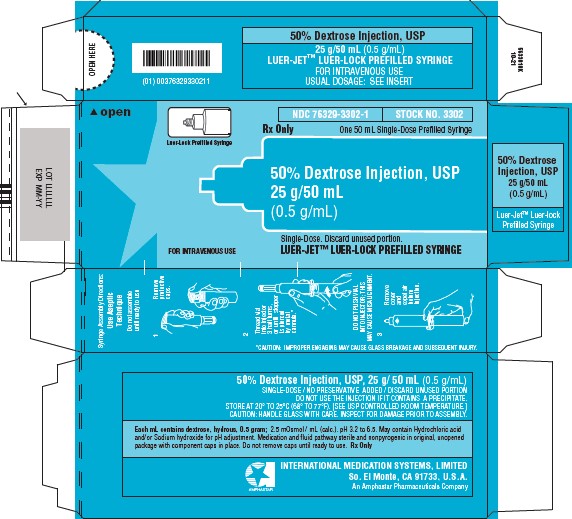
Dextrose Monohydrate 25 g/50mL Injection, Solution — NDC 76329-3302-1 (Billing 76329-3302-01)
This is a package of Dextrose Monohydrate 25 g/50mL Injection, Solution from International Medication Systems, Limited, marketed since Nov 2021 and currently FDA-listed. It is this product's only package size.
NDC database record
One package, one record: these facts belong to NDC 76329-3302-1 alone.
- Record
- FDA NDC Directory package listing · Human prescription drug
- Code segments
- 76329 labeler · 3302 product · 1 package
- Package marketed since
- Nov 11, 2021
- Sample package
- No — commercial package
- Listing certified through
- Dec 31, 2026
- Barcode (UPC-A, from the NDC)
- 3 7632933021 1
- Medicaid fills, this package
- 2,238 prescriptions in the last four reported quarters
- FDA record last changed
- Jul 24, 2026
Other active recalls for Dextrose Monohydrate (different manufacturers) — 3 · tap to view
Identity & classification
Regulatory identifiers FDA, NLM and CMS codes for this package
Drug-database identifiers Medi-Span GPI and First Databank GCN / HICL / AHFS classification
- GSN (GCN sequence number): 001989
- GCN: 06771
- GPI-14 (Medi-Span): 80100020002050
- HICL (First Databank): 000926
- AHFS class code: 40:20.00.00
- RxCUI (RxNorm): 727517
Where does this data come from?
- FDA openFDA NDC Directory · synced Oct 8, 2026
- FDA label on DailyMed · label index refreshed Oct 6, 2026
- RxNorm (NLM RxNav) · catalog refreshed Oct 1, 2026
- Medi-Span GPI (licensed)
- First Databank (licensed) · refreshed Oct 8, 2026
RxNorm drug class
This medicine belongs to the Other irrigating solutions class.
Where does this data come from?
- RxClass (NLM) · catalog refreshed Oct 1, 2026
Clinical
- Dextrose is essentially the same glucose your body gets from food, but in this case it's going directly into the bloodstream. That's important in two main situations: when blood su...
- Why is my loved one being given dextrose through an IV — isn't sugar just food?
- Yes, that's a real concern. Dextrose raises blood glucose, which is exactly what you need when blood sugar is too low. But if it's given too fast or in too high a concentration, it...
- Can dextrose actually cause high blood sugar? I thought it was for low blood sugar.
Patient education
Supplement & herbal interactions
Where does this data come from?
- MedlinePlus (NLM) · refreshed Oct 1, 2026
- FDA label on DailyMed · label index refreshed Oct 6, 2026
Ask a licensed pharmacist directly — free, answered by our team.
Pricing
A drug doesn't have one price. Each row is a different public payment system, and none is what you'd pay at the counter — that depends on your insurance. The ⓘ on each row explains what it measures.
| Price system | Per mL | Per package |
|---|---|---|
| Retail pharmacies payNADAC · weekly | Not in the retail survey — common for institutional, discontinued, or low-volume packs. | |
| Medicaid paysCMS SDUD · 12 mo | $4.75 | $237.65 / 50 ml |
| Medicare drug plans payPart D · quarterly | No Part D plan price is available for this NDC in our data. | |
| Medicare Part B allowsASP · A4216 | No ASP payment limit on file for A4216 this quarter. | |
Where does this data come from?
- CMS NADAC weekly file
- CMS ASP pricing files · refreshed Sep 20, 2026
- CMS Medicaid State Drug Utilization Data · through Q4 2025
- CMS Part D plan pricing files · refreshed Sep 24, 2026
- VA National Acquisition Center price file
Billing & reimbursement
Where does this data come from?
- CMS ASP NDC-HCPCS crosswalk · refreshed Sep 22, 2026
- DMEPDAC NDC-HCPCS crosswalk
- openFDA NSDE billing units · refreshed Oct 7, 2026
Packaging — all sizes for this product
| Package NDC | Description | Marketing start | Marketing end | Status |
|---|---|---|---|---|
| 76329-3302-01 You're viewing this Main listing | 1 SYRINGE in 1 CARTON / 50 mL in 1 SYRINGE | 2021-11-11 | — | Active |
Therapeutic equivalents
| Product | Labeler | Pack | NADAC/unit | TE | Status | Price vs. this |
|---|---|---|---|---|---|---|
| Dextrose 25 g/50mL 00404-9845-50 | Henry | 1 syringe | — | — | FDA listed | — |
| Dextrose 25 g/50mL 00409-7517-16 | Hospira, | 1 syringe | — | — | FDA listed | — |
| 50% Dextrose 25 g/50mL 51662-1216-01 | HF | 1 syringe | — | — | FDA listed | — |
| Dextrose Monohydrate 25 g/50mL 51662-1453-01 | HF | 1 syringe | — | — | Discontinued | — |
| Dextrose monohydrate 25 g/50mL 51662-1584-01 | HF | 1 syringe | — | AP | FDA listed | — |
| Dextrose 25 g/50mL 70518-4219-00 | REMEDYREPACK | 1 syringe | — | — | FDA listed | — |
| Dextrose 25 g/50mL 71872-7003-01 | Medical | 1 syringe | — | — | FDA listed | — |
| Dextrose 25 g/50mL 71872-7102-01 | Medical | 1 syringe | — | — | FDA listed | — |
| Dextrose Monohydrate 25 g/50mL 71872-7282-01 | Medical | 1 syringe | — | AP | FDA listed | — |
| Dextrose Monohydrate 25 g/50mLthis 76329-3302-01 | International | 1 syringe | — | AP | FDA listed | — |
| Dextrose 25 g/50mL 84549-0517-16 | ProPharma | 50 ml | — | — | FDA listed | — |
| Dextrose 25 g/50mL 71872-7057-01 | Medical | 1 vial | — | — | FDA listed | — |
| Dextrose 25 g/50mL 00404-9847-50 | Henry | 1 vial | — | — | FDA listed | — |
| Dextrose 25 g/50mL 00409-6648-02 | Hospira, | 25 vials | — | — | FDA listed | — |
Where does this data come from?
- FDA openFDA NDC Directory · synced Oct 8, 2026
- FDA Orange Book · refreshed Oct 3, 2026
- CMS NADAC weekly file
Availability & generic status
This product is an FDA-approved generic. Other versions of the same drug are listed under Therapeutic equivalents, least expensive first.
Where does this data come from?
- FDA Orange Book · refreshed Oct 3, 2026
Inactive Ingredients / Excipients
Inactive ingredients, also called excipients, are components of the drug product other than the active ingredient. They may include fillers, dyes, coatings, preservatives, flavors, or other formulation ingredients.
🧪 Avoiding an ingredient? See Dextrose inactive ingredients by manufacturer: every current product's list side by side, so you can ask your pharmacy for the version that does not list it.
💡 Tap an ingredient (hover on desktop) to see what it is and why it’s used.
-
UNII QTT17582CB
A strong acid used to adjust and maintain the proper pH level in liquid medicines, ensuring stability and preventing breakdown of active ingredients.
-
UNII 55X04QC32I
A strong alkaline chemical used to adjust and maintain the pH balance of liquid medicines. It helps keep the medicine stable and ensures it stays effective during storage.
-
UNII 059QF0KO0R
Water is a liquid solvent that dissolves and mixes ingredients together in liquid medicines, syrups, and injections. It helps distribute the active drug evenly throughout the product.
3 inactive ingredients listed in the exact product block matched to this NDC.
Where does this data come from?
ingredient classCode="IACT" elements from the exact product block matched by this NDC. Label-section narrative from DailyMed / the openFDA label index is shown separately when available.- FDA label on DailyMed · label index refreshed Oct 6, 2026
- FDA openFDA NDC Directory · synced Oct 8, 2026
Inactive ingredient FAQ
Are inactive ingredients the same for every manufacturer?
Why might an inactive ingredient be missing?
Can inactive ingredients matter?
Manufacturer & labeler
More NDCs from International Medication Systems, Limited labeler code 76329
- Naloxone Hydrochloride 1 mg/mL Injection NDC 76329-1469-1
- Morphine Sulfate 1 mg/30mL Injection NDC 76329-1912-1
- Lidocaine Hydrochloride 20 mg/mL Jelly NDC 76329-3011-5
- Lidocaine Hydrochloride 20 mg/mL Jelly NDC 76329-3012-5
- Lidocaine Hydrochloride 20 mg/mL Jelly NDC 76329-3013-5
- Lidocaine Hydrochloride 20 mg/mL Jelly NDC 76329-3015-5
- Calcium Chloride 100 mg/mL Injection NDC 76329-3304-1
- Epinephrine .1 mg/mL Injection NDC 76329-3318-1
- Regadenoson .08 mg/mL Injection, Solution NDC 76329-3321-0
- Atropine Sulfate .1 mg/mL Injection NDC 76329-3340-1
- Sodium Bicarbonate 84 mg/mL Injection NDC 76329-3352-1
- Naloxone Hydrochloride 1 mg/mL Injection NDC 76329-3369-1
Where does this data come from?
- FDA openFDA NDC Directory · synced Oct 8, 2026
- Drugs@FDA
Full prescribing information FDA SPL
🎯 Indications and Usage ▾
INDICATIONS AND USAGE 50% Dextrose Injection is indicated in the treatment of insulin hypoglycemia (hyperinsulinemia or insulin shock) to restore blood glucose levels. The solution is also indicated, after dilution, for intravenous infusion as a source of carbohydrate calories in patients whose oral intake is restricted or inadequate to maintain nutritional requirements. Slow infusion of hypertonic solutions is essential to ensure proper utilization of dextrose and avoid production of hyperglycemia.
⏱️ Dosage and Administration ▾
DOSAGE AND ADMINISTRATION For peripheral vein administration: Injection of the solution should be made slowly . The maximum rate at which dextrose can be infused without producing glycosuria is 0.5 g/kg of body weight/hour. About 95% of the dextrose is retained when infused at a rate of 0.8 g/kg/hr.
In insulin-induced hypoglycemia, intravenous injection of 10 to 25 grams of dextrose (20 to 50 mL of 50% dextrose) is usually adequate. Repeated doses and supportive treatment may be required in severe cases. A specimen for blood glucose determination should be taken before injecting the dextrose.
In such emergencies, dextrose should be administered promptly without awaiting pretreatment test results. For central vein administration: For total parenteral nutrition 50% Dextrose Injection, USP is administered by slow intravenous infusion (a) after admixture with amino acid solutions via an indwelling catheter with the tip positioned in a large central vein, preferably the superior vena cava, or (b) after dilution with sterile water for injection. Dosage should be adjusted to meet individual patient requirements.
Clinical evaluation and periodic laboratory determinations are necessary to monitor changes in fluid balance, electrolyte concentrations and acid-base balance during prolonged parenteral therapy or whenever the condition of the patient warrants such evaluation. The maximum rate of dextrose administration which does not result in glycosuria is the same as cited above. Parenteral drug products should be inspected visually for particulate matter and discoloration prior to administration, whenever solution and container permit.
See CONTRAINDICATIONS .
⛔ Contraindications ▾
CONTRAINDICATIONS A concentrated dextrose solution should not be used when intracranial or intraspinal hemorrhage is present, nor in the presence of delirium tremens if the patient is already dehydrated. Dextrose injection without electrolytes should not be administered simultaneously with blood through the same infusion set because of the possibility that pseudoagglutination of red cells may occur.
⚠️ Warnings ▾
WARNINGS 50% Dextrose Injection is hypertonic and may cause phlebitis and thrombosis at the site of injection. Significant hyperglycemia and possible hyperosmolar syndrome may result from too rapid administration. The physician should be aware of the symptoms of hyperosmolar syndrome, such as mental confusion and loss of consciousness, especially in patients with chronic uremia and those with known carbohydrate intolerance.
The intravenous administration of this solution can cause fluid and/or solute overloading resulting in dilution of serum electrolyte concentrations, overhydration, congested states or pulmonary edema. Additives may be incompatible. Consult with pharmacist if available.
When introducing additives, use aseptic technique, mix thoroughly and do not store. For peripheral vein administration: The solution should be given slowly, preferably through a small bore needle into a large vein, to minimize venous irritation. For central venous administration: Concentrated dextrose should be administered via central vein only after suitable dilution.
🤒 Adverse Reactions ▾
ADVERSE REACTIONS Hyperosmolar syndrome, resulting from excessively rapid administration of concentrated dextrose may cause mental confusion and/or loss of consciousness. Reactions which may occur because of the solution or the technique of administration include febrile response, infection at the site of injection, venous thrombosis or phlebitis extending from the site of injection, extravasation and hypervolemia. If an adverse reaction does occur, discontinue the infusion, evaluate the patient, institute appropriate therapeutic countermeasures and save the remainder of the fluid for examination if deemed necessary.
🆘 Overdosage ▾
OVERDOSAGE In the event of overhydration or solute overload during therapy, re-evalutate the patient and institute appropriate corrective measures. See WARNINGS and PRECAUTIONS
🧬 Clinical Pharmacology ▾
CLINICAL PHARMACOLOGY When administered intravenously this solution restores blood glucose levels in hypoglycemia and provides a source of carbohydrate calories. Carbohydrate in the form of dextrose may aid in minimizing liver glycogen depletion and exerts a protein-sparing action. Dextrose injection undergoes oxidation to carbon dioxide and water.
Water is an essential constituent of all body tissues and accounts for approximately 70% of total body weight. Average normal adult requirement ranges from two to three liters (1.0 to 1.5 liters each for insensible water loss by perspiration and urine production). Water balance is maintained by various regulatory mechanisms.
Water distribution depends primarily on the concentration of electrolytes in the body compartments and sodium (Na+) plays a major role in maintaining physiologic equilibrium.
📦 How Supplied / Storage and Handling ▾
HOW SUPPLIED 50% Dextrose Injection, USP 25 g/50 mL (0.5 g/mL) is supplied in single-dose prefilled syringes as follows: NDC No. Stock No. Container Size Needle 76329-3302-1 3302 50 mL None One shrink wrapped package containing 10 unit cartons, each containing a Luer-Jet™ Luer-Lock Prefilled Syringe.
Syringe Assembly Directions: USE ASEPTIC TECHNIQUE Do not assemble until ready to use. *CAUTION: IMPROPER ENGAGING MAY CAUSE GLASS BREAKAGE AND SUBSEQUENT INJURY. Exposure of pharmaceutical products to heat should be minimized. Avoid excessive heat.
Protect from freezing. Store at 20° to 25°C (68° to 77°F). [See USP Controlled Room Temperature.] Revised 01/21 6933010E © International Medication Systems, Ltd., 2021 International Medication Systems, Ltd. South El Monte, CA 91733, USA An Amphastar Pharmaceuticals Company Printed in USA instructions
📋 Description ▾
DESCRIPTION 50% Dextrose Injection, USP is a sterile, nonpyrogenic, hypertonic solution of dextrose in water for injection for intravenous injection as a fluid and nutrient replenisher. Each mL of fluid contains 0.5 g dextrose, hydrous which delivers 3.4 kcal/gram. The solution has an osmolarity of 2.5 mOsmol/mL (calc.) and a pH of 3.2-6.5.
May contain Hydrochloric acid and/or Sodium hydroxide for pH adjustment. The solution contains no bacteriostat, antimicrobial agent or added buffer and is intended only for use as a single-dose injection. When smaller doses are required, the unused portion should be discarded with the entire unit.
Dextrose, USP is chemically designated C 6 H 12 O 6 • H 2 O (D-glucose monohydrate), a hexose sugar freely soluble in water. Dextrose, hydrous has the following formula: Water for Injection, USP is chemically designated H 2 O. The delivery device is composed of a 50 mL glass syringe barrel with rubber stopper, and custom molded IMS injector with Luer Connector. structure
⚠️ Precautions ▾
PRECAUTIONS Do not use unless the solution is clear and seal is intact. Discard unused portion. Electrolyte deficits, particularly in serum potassium and phosphate, may occur during prolonged use of concentrated dextrose solutions.
Blood electrolyte monitoring is essential and fluid and electrolyte imbalances should be corrected. Essential vitamins and minerals also should be provided as needed. To minimize hyperglycemia and consequent glycosuria, it is desirable to monitor blood and urine glucose and if necessary, add insulin.
When a concentrated dextrose infusion is abruptly withdrawn, it is advisable to follow with the administration of 5% or 10% dextrose injection to avoid rebound hypoglycemia. Solutions containing dextrose should be used with caution in patients with known subclinical or overt diabetes mellitus. Care should be exercised to ensure that the needle is well within the lumen of the vein and that extravasation does not occur.
If thrombosis should occur during administration, the injection should be stopped and corrective measures instituted. Concentrated dextrose solutions should not be administered subcutaneously or intramuscularly. Carcinogenesis, Mutagenesis, Impairment of Fertility: Pregnancy Category C .
Animal reproduction studies have not been conducted with dextrose. It is also not known whether dextrose can cause fetal harm when administered to a pregnant woman or can affect reproduction capacity. Dextrose should be given to a pregnant woman only if clearly needed.
Nursing Mothers: It is not known whether this drug is excreted in human milk. Because many drugs are excreted in human milk, caution should be exercised when 50% Dextrose Injection, USP is administered to a nursing mother.
📄 Package Label / Principal Display Panel ▾
Carton Principal Display Panel Text: open Luer-Lock Prefilled Syringe NDC 76329-3302-1 STOCK NO. 3302 Rx Only One 50 mL Single-Dose Prefilled Syringe 50% Dextrose Injection, USP 25 g/50 mL (0.5 g/mL) FOR INTRAVENOUS USE Single use, do not reuse or resterilize. LUER-JET™ LUER-LOCK PREFILLED SYRINGE carton
Medicaid utilization & spend
About this NDC listing & data coverage
What data is (and isn’t) available for this NDC — tap to expand
| NDC identity (package / product / labeler codes) | ✓ Available |
| Labeler | ✓ Available |
| Product & package description | ✓ Available |
| Marketing category & status | ✓ Available |
| Active ingredient / dosage form / route | ✓ Available |
| FDA label (SPL via DailyMed) | ✓ Available |
| Package photos | ✓ Available |
| Inactive ingredients (structured) | ✓ Available |
| NADAC pharmacy acquisition price (CMS) | — Not published for this NDC CMS publishes NADAC only for NDCs reported in its retail-pharmacy survey. |
| Orange Book / therapeutic-equivalence data | ✓ Available |
| HCPCS J-code billing crosswalk | ✓ Available |
| Medicaid utilization (CMS SDUD) | ✓ Available |