
English Horsemint Drug Interactions, Uses, Effectiveness, Safety & More
What is this page for?
First and foremost: how English Horsemint interacts with medications. The heart of this page is the interaction list — every drug English Horsemint is known to interact with, and how serious each one is.
But these pages have grown well beyond that into a full monograph — what English Horsemint is, what people use it for and how strong the evidence is, its safety and side effects, and answers to the questions we’re asked most — written and reviewed by the clinical staff at HelloPharmacist. It’s educational information from our licensed clinical databases, not medical advice, and we don’t sell or endorse products. Our editorial policy
Check English Horsemint against your medication
Add one medicationDrugs that interact with English Horsemint
0 medications have a known interaction with English Horsemint, graded by severity. Select any drug for the full evidence-based detail.
We don’t currently list any known drug interactions for English Horsemint. This doesn’t guarantee none exist — always confirm with your pharmacist before combining supplements with your medications.
What Severity, Likelihood & Evidence Mean
Severity — How Serious It Can Be
- Major. Clinically significant; generally best avoided, or used only under direct professional supervision.
- Moderate. May need monitoring, a dose adjustment, or separating the times you take each one.
- Minor. Generally not clinically significant, but still worth noting and mentioning to your pharmacist.
- No known interaction. Checked against our sources with nothing documented — not the same as proven safety.
Likelihood — How Well It’s Documented
- Likely. Well-controlled human studies have demonstrated the likely existence of this interaction
- Probable. Interaction has not been documented in well-controlled studies, however, the interaction has been demonstrated in some small human studies or in controlled animal studies in conjunction with multiple case reports.
- Possible. Interaction has been documented in animal or in lab research, or the interaction has been documented in humans but is limited to case reports or conflicting clinical research exists
- Unlikely. Interaction has been demonstrated in animal or in lab research but has been shown not to occur in humans.
Where This Data Comes From
- Interaction records are evidence-graded and sourced from the Natural Medicines database (TRC Healthcare), the same reference used by pharmacists and hospitals.
- Each drug listed above links to the full report for that exact English Horsemint combination — clinical detail, likelihood, evidence level, and citations.
- Content is reviewed by licensed HelloPharmacist pharmacists — see our data sources and editorial standards.
English Horsemint: Uses, Safety & Side Effects
English horsemint (Mentha longifolia) is a wild mint used in cooking and traditional medicine, mostly for digestive and respiratory complaints. Human evidence for these uses is limited, and most data come from lab or animal studies. It is generally considered safe in food amounts, but concentrated extracts and the essential oil should be used cautiously and avoided during pregnancy and breastfeeding without medical advice.
- Scientific name
- Mentha longifolia
- Family
- Lamiaceae
- Part used
- Leaves and essential oil
- Common forms
- Tea, dried leaf, tincture, essential oil
- Digestive upset
- Gas and bloating
- Cough and congestion
- Nausea
- Antimicrobial (traditional use)
- Headache (topical/aromatic)
Popular and traditional uses — not proof it works. See “Uses & effectiveness” below for the evidence.
Likely fine in culinary food amounts, but concentrated extracts and essential oil lack strong human safety data.
Insufficient reliable information available; avoid using.
Read the full pregnancy detailInsufficient reliable information available; avoid using.
Read the full breastfeeding detailPregnancy & breastfeeding ratings are from Natural Medicines (Therapeutic Research Center). Safety guidance is general; always confirm with your pharmacist or doctor for your situation.
Overview
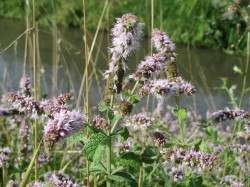
English horsemint (Mentha longifolia) is a type of wild mint in the same plant family as peppermint and spearmint. It is a perennial herb native to Europe, Asia, and parts of Africa, and it grows in moist places like stream banks and ditches. The plant has square stems, aromatic dark green leaves, and spikes of small pink to purple flowers.
People have long used this mint in cooking and folk medicine. The leaves are brewed into tea or used as a flavoring, and the plant also yields an aromatic essential oil. In traditional practice it is used mainly to ease digestive and respiratory complaints.
It is worth noting that Mentha longifolia is a different plant from American horsemint (Monarda punctata), even though both are sometimes called "horsemint."
How it works
Like other mints, English horsemint contains aromatic compounds in its essential oil, including menthol, menthone, pulegone, and related terpenes. The exact mix varies by plant variety and growing conditions.
These compounds are thought to relax the smooth muscle of the gut, which may help with cramping and gas, and to give the herb its cooling, soothing feel. Laboratory studies also suggest the oil can slow the growth of certain bacteria, fungi, and possibly act as an antioxidant.
It is important to remember that most of this information comes from test-tube and animal research. How well these effects translate to real benefits in people is not well established.
Does English Horsemint work?
How to read these evidence grades
Natural Medicines’ 7-point scale. We show each rating’s label word-for-word.
For English Horsemint, current evidence isn’t strong enough to rate any specific use. The conditions it has been studied for are listed below.
Also studied for 1 condition — evidence insufficient to rate
Insufficient Reliable Evidence To Rate Irritable bowel syndrome (IBS)
Clinical research shows that taking a mixture of powdered English horsemint leaves 150 mg, purple nut sedge tuber 150 mg, and ginger tuber 150 mg three times daily for 8 weeks improves abdominal pain, stool frequency, stool consistency, incomplete evacuation, and urgency when compared to baseline. These improvements are similar to taking the antispasmodic medication mebeverine 135 mg three times daily. It is not clear if this effect is due to English horsemint, the other ingredients, or the combination.
Source & disclaimer. Effectiveness ratings and evidence summaries are provided by Natural Medicines (Therapeutic Research Center) and shown as licensed. Where Natural Medicines hasn’t rated a use, HelloPharmacist’s pharmacists may add their own reviewed rating and evidence (each such entry is labeled). This is educational information, not medical advice — talk with your pharmacist or doctor before starting, stopping, or changing a supplement.
Safety & precautions
Used as a food or normal tea amount, English horsemint is generally considered well tolerated by most healthy adults. Concentrated extracts and especially the essential oil are much stronger and carry more risk; the oil should never be swallowed undiluted.
Some mint oils naturally contain pulegone, a compound that can be toxic to the liver in large amounts. For this reason, large or long-term doses of concentrated products are not advised. People with reflux (GERD) may find mint worsens heartburn.
For safety, pregnant and breastfeeding people should avoid medicinal amounts and the essential oil, since there is not enough reliable information to confirm it is safe. Children, older adults, and people with liver disease, gallbladder problems, or other chronic conditions should check with a pharmacist or doctor first. Keep essential oils away from infants and young children.
Side effects
In food-like amounts, side effects are uncommon. When they occur, they may include heartburn, mild stomach upset, or allergic reactions in people sensitive to plants in the mint family.
The essential oil is more likely to cause problems. Applied to the skin it can cause irritation, and taken by mouth in large amounts it may cause nausea or, rarely, more serious effects linked to compounds like pulegone. Stop use and seek medical care if you have trouble breathing, swelling, a rash, or signs of an allergic reaction.
Dosing
There is no well-established standardized dose for English horsemint. It is most commonly used as a tea made from the dried or fresh leaves, or as a flavoring in food.
Because product strengths vary widely, the best advice is to follow the directions on the product label and not exceed them. Essential oils are highly concentrated and should be used only as directed, well diluted, and never swallowed without professional guidance.
When in doubt, ask a pharmacist or doctor about whether and how to use it, especially if you take other medicines or have a health condition.
English Horsemint & Pregnancy
English Horsemint & Breastfeeding
© 2026 Therapeutic Research Center
Pregnancy & lactation ratings: Natural Medicines, Therapeutic Research Center
References & further reading
The 1 references that drive our English Horsemint monograph and interaction data, from the evidence-graded Natural Medicines (TRC Healthcare) database. Citations with a link open the study on PubMed or the publisher’s site.
- Sahib AS. Treatment of irritable bowel syndrome using a selected herbal combination of Iraqi folk medicines. J Ethnopharmacol 2013;148(3):1008-12. PubMed
This information is for education only and is not a substitute for professional medical advice. Always check with your pharmacist or doctor before starting, stopping, or combining supplements and medications.
Parts of this content are provided by the Therapeutic Research Center, LLC.
DISCLAIMER: Currently this does not check for drug-drug interactions. This is not an all-inclusive comprehensive list of potential interactions and is for informational purposes only. Not all interactions are known or well-reported in the scientific literature, and new interactions are continually being reported. Input is needed from a qualified healthcare provider including a pharmacist before starting any therapy. Application of clinical judgment is necessary.
© 2021 Therapeutic Research Center, LLC
Brands that make products with English Horsemint
8 brands in our database make a supplement containing English Horsemint.
Supplement products with English Horsemint
11 products in our database contain English Horsemint. Open any to see its full ingredient list and every drug interaction we check.
English Horsemint: Common Questions
What is English Horsemint used for, and does it work?
Does English Horsemint interact with prescription medications?
How are English Horsemint interactions rated?
Is it safe to take English Horsemint with my medications?
Where does this English Horsemint interaction information come from?
What is English Horsemint used for?
Is English Horsemint the same as the horsemint called Monarda?
Is English Horsemint safe during pregnancy or breastfeeding?
Can I use the essential oil instead of the tea?
Written and reviewed by the HelloPharmacist editorial staff. Our editorial policy
Products that contain English Horsemint
A rotating sample of real supplements in our database that list English Horsemint — open any to see its full ingredients and every drug interaction we check.
Have a question about English Horsemint?
Our pharmacists answer your medication & supplement questions — free.