
Citric Acid 1,000 mg Ingredients & Drug Interactions
by Nutricost
What is this page for?
First and foremost: checking Citric Acid 1,000 mg against your medications. The heart of this page is the interaction checker and the full interaction report — how this product’s ingredients may interact with prescription and over-the-counter medicines you may be taking.
Around that, we add a pharmacist’s high-level view of the product as a whole — what’s inside, the evidence for its stated use, how transparent the label is, and what safety data exists — so you can see the full picture in one place. It’s educational information from our licensed clinical databases and the clinical staff at HelloPharmacist — not medical advice — and we don’t sell or endorse products. Our editorial policy
Citric Acid 1,000 mg is a dietary supplement by Nutricost with 1 active ingredient. Its ingredients are commonly taken for food and drink flavoring or sourness, preservative and acidity adjuster, kidney stone prevention (as citrate salts).We don’t currently list a known drug interaction for its mapped ingredients — but that doesn’t guarantee none exist, so always confirm with your pharmacist.
HelloPharmacist Scorecard of Citric Acid 1,000 mg by Nutricost
Our pharmacy team’s full take, with four database checks built into the cards below — a summary of what is known, not a grade of the product itself.
What’s inside
Full disclosure
This product contains a single active ingredient: citric acid at 1,000 mg per capsule. Citric acid is an organic acid that occurs naturally in citrus fruits and is used in many foods and supplements.
The capsule also holds gelatin and magnesium stearate as inactive ingredients.
Does it work?
Couldn't assess
The evidence we have doesn't establish that citric acid works for acne, aging skin, dry mouth, kidney stones, melasma, or muscle cramps — the data for all of these uses shows insufficient reliable evidence to rate it. That means research hasn't yet determined whether it helps.
If you're considering this for a specific health concern, talk it over with your doctor or pharmacist.
How safe is it?
Well-documented data
Citric acid from food and small supplement amounts is generally recognized as safe. However, this is a concentrated supplement, and the safety notes advise you to check with your doctor before taking medicinal-dose citrate supplements.
When citric acid is used topically (on the skin), it's usually well tolerated at low concentrations, though it can cause mild irritation, tingling, or sun sensitivity. High concentrations or prolonged application can cause severe irritation, burns, or blistering.
Alpha hydroxy acids like citric acid can increase your skin's sensitivity to the sun, so sunscreen is wise if you use it on your face. In pregnancy and lactation, citric acid is rated as likely safe, but the concentrated form here calls for a conversation with your doctor or pharmacist first.
Meds to double-check
No known interactions
No interactions are documented in our data for citric acid. That said, check with your own doctor or pharmacist before adding any new supplement to your routine, especially if you take medications or have kidney, stomach, or other health concerns.
The bottom line
Scorecard at a glanceFully disclosed formula with no assessable stated purpose. No medication interactions are currently documented, and safety information is well characterized.
Citric acid from foods is safe, and this supplement has no documented medication interactions. Still, because it's a concentrated form, your doctor or pharmacist should weigh in before you start — especially if you're taking any medications or have a reason you're considering it.
They can advise whether it fits your situation.
Educational only — not medical advice; always confirm with your pharmacist. Our editorial policy · How we use AI
Assessment coverage: 1 of 1 active ingredient matched to our full ingredient reviews (monographs). Based on the product label dated Jun 20, 2024.
This Scorecard evaluates available label information, ingredient evidence, and known medication-safety considerations. It does not independently verify product identity, purity, potency, contamination, or manufacturing quality. How these ratings are computed
General information
Key facts about Citric Acid 1,000 mg, straight from the product label.
| Brand | Nutricost |
|---|---|
| Barcode (UPC) | 810014672045 |
| Net contents | 240 Capsule(s) |
| Market status | On market |
| Date entered into DSLD | Jun 20, 2024 |
| DSLD ID | 311684 |
| Product type | Non-nutrient/non-botanical |
| Supplement form | Capsule |
| Dietary claims / uses | All Other, Structure/Function |
| Intended target group(s) | Adult (18 - 50 Years), Gluten Free |
Everything in this section is reproduced from the manufacturer’s own product label — it’s the label speaking, not HelloPharmacist. We show it so you can see exactly what the maker states; we don’t verify or endorse those statements.
Supplement Facts
The label details for Citric Acid 1,000 mg by Nutricost, sourced from the NIH Dietary Supplement Label Database.
Supplement Facts
| Ingredient | Amount | % DV |
|---|---|---|
| Citric Acid | 1000 mg | -- |
Other ingredients: Gelatin, Magnesium Stearate
Tap any ingredient to jump to its full detail below.
These statements are the manufacturer’s wording, reproduced from the product label — the label is saying it, not HelloPharmacist. We don’t verify or endorse them.
Suggested/Recommended/Usage/Directions
Suggested use: As a dietary supplement, take 1 capsule daily with 8-12 oz of water or as directed by your healthcare professional.
Formulation
Third party tested
Non-GMO Gluten-free
Made and quality tested in the USA with globally sourced ingredients.
Non-GMO Product
Precautions
Warning: For healthy individuals 18 years and older.
Consult a healthcare professional prior to use if you are pregnant or nursing, taking medication, or have a medical condition.
Keep out of reach of children.
Do not use if safety seal is broken or missing.
Storage
Notice: Store in a cool, dry place.
Formula
Citric Acid 1,000mg per serving
FDA Statement of Identity
Dietary Supplement
FDA Disclaimer Statement
These statements have not been evaluated by the Food and Drug Administration. This product is not intended to diagnose, treat, cure, or prevent any disease.
Seals/Symbols
Nutricost Quality Guaranteed Third Party Tested GMP Compliant Facility
Is this label outdated? Report a formula or label change and our pharmacy team will review it.
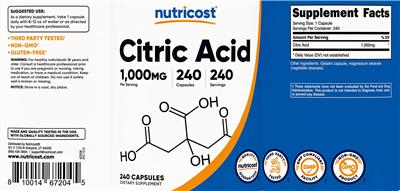
Citric Acid 1,000 mg by Nutricost label
The label scan from the NIH Dietary Supplement Label Database. Tap to enlarge.
Label images are published by the NIH Dietary Supplement Label Database for the version of this product on file. Always read your actual product label.
View the full label (PDF)The Ingredients in Citric Acid 1,000 mg by Nutricost
This is the 1 active ingredient this product is made of. Select it to open its full monograph.
Serving size1 Capsule(s) Dosage formCapsule Servings per container240 Amounts shown are per serving.
Citric Acid
No knowninteractions
Citric acid is a natural acid found in citrus fruits and is widely used as a safe food additive, flavoring, and preservative. In medicine, citrate for...
Citric Acid monograph & interactionsOther (inactive) ingredients: Gelatin, Magnesium Stearate. These complete the product’s ingredient list but are not active constituents.
Citric Acid 1,000 mg by Nutricost Drug Interactions
We don’t currently list any known drug interactions for the mapped ingredients in Citric Acid 1,000 mg. This doesn’t guarantee none exist — always confirm with your pharmacist before combining a supplement with your medications.
Brand information
Manufacturer and brand details for Citric Acid 1,000 mg, from the product label.
Nutricost
See all Nutricost products- Name
- Nutricost
- Street Address
- 351 E 1750 N
- City
- Vineyard
- State
- UT
- ZipCode
- 84059
- Phone Number
- (866) 438-3694
- Web Address
- www.nutricost.com
Citric Acid 1,000 mg by Nutricost: Common Questions
Does Citric Acid 1,000 mg by Nutricost interact with any medications?
How can one product interact with so many drugs?
Where does this information come from?
Is this safe to take if I'm pregnant or breastfeeding?
Will it help with kidney stones?
Can I use this on my face for acne or aging skin?
What side effects might I see?
Written and reviewed by the HelloPharmacist editorial staff. Our editorial policy
Not sure if Citric Acid 1,000 mg is safe with your meds?
Our pharmacists answer your medication & supplement questions — free.
Label information is sourced from the NIH Dietary Supplement Label Database and reflects the product version on file; always read your actual product label. This page is for education only and is not a substitute for professional medical advice. Confirm with your pharmacist or doctor before combining supplements and medications.
The Full Monographs Behind Citric Acid 1,000 mg’s Ingredients
Every ingredient we hold a full HelloPharmacist monograph for — uses, evidence, safety, and the complete interaction list.
Sources & How We Checked
Citric Acid 1,000 mg's label data comes from the NIH Dietary Supplement Label Database; the ingredient interaction data is from the Natural Medicines database, reviewed by our pharmacists.
- NIH Dietary Supplement Label Database (DSLD) — The official product label on file for this supplement.
- Natural Medicines (Therapeutic Research Center) — Evidence-graded clinical reference behind the ingredient interaction data.
Content is written and reviewed by licensed HelloPharmacist pharmacists. See our data sources and editorial standards for how this information is built and checked.
The 10 references behind this product’s interaction data
Every citation that drives the interaction findings for this product’s ingredients, from the evidence-graded Natural Medicines (TRC Healthcare) database. Open an ingredient to browse its citations — links open the study on PubMed or the publisher’s site.
Citric Acid 10 references
- Kurtzweil P. Alpha-hydroxy acids for skin care: Smooth sailing or rough seas? FDA 1999. Available at: /www.fda.gov/fdac/features/1998/298_ahas.html (Accessed 18 August 2000). DOI
- Erbagci Z, Akcali C. Biweekly serial glycolic acid peels vs. long-term daily use of topical low-strength glycolic acid in the treatment of atrophic acne scars. Int J Dermatol 2000;39:789-94.. PubMed
- Ghadishah D, Gorchynski J. Airway compromise after routine alpha-hydroxy facial peel administration. J Emerg Med 2002;22:353-5.. PubMed
- Baumann LS, Oresajo C, Yatskayer M, Dahl A, Figueras K. Comparison of clindamycin 1% and benzoyl peroxide 5% gel to a novel composition containing salicylic acid, capryloyl salicylic acid, HEPES, glycolic acid, citric acid, and dioic acid in the treatment
- Emtestam L, Svensson Å, Rensfeldt K. Treatment of seborrhoeic dermatitis of the scalp with a topical solution of urea, lactic acid, and propylene glycol (K301): results of two double-blind, randomised, placebo-controlled studies. Mycoses. 2012 Sep;55(5):3 PubMed
- Kaminaka C, Uede M, Matsunaka H, Furukawa F, Yamomoto Y. Clinical evaluation of glycolic acid chemical peeling in patients with acne vulgaris: a randomized, double-blind, placebo-controlled, split-face comparative study. Dermatol Surg. 2014 Mar;40(3):314- PubMed
- Köse O, Özmen I, Arca E. An open, comparative study of 10% potassium hydroxide solution versus salicylic and lactic acid combination in the treatment of molluscum contagiosum in children. J Dermatolog Treat. 2013 Aug;24(4):300-4. PubMed
- Vachiramon V, Sahawatwong S, Sirithanabadeekul P. Treatment of melasma in men with low-fluence Q-switched neodymium-doped yttrium-aluminum-garnet laser versus combined laser and glycolic acid peeling. Dermatol Surg. 2015 Apr;41(4):457-65. PubMed
- US Food and Drug Administration (FDA). Cosmetic Ingredients: Alpha Hydroxy Acids. August 2020. Available at: https://www.fda.gov/cosmetics/cosmetic-ingredients/alpha-hydroxy-acids. Accessed on October 19, 2021.
- Ormerod AD, van Voorst Vader PC, Majewski S, Vanscheidt W, Benjamin N, van der Meijden W. Evaluation of the efficacy, safety, and tolerability of 3 dose regimens of topical sodium nitrite with citric acid in patients with anogenital warts: A randomized cl DOI
Parts of this content are provided by the Therapeutic Research Center, LLC.
DISCLAIMER: Currently this does not check for drug-drug interactions. This is not an all-inclusive comprehensive list of potential interactions and is for informational purposes only. Not all interactions are known or well-reported in the scientific literature, and new interactions are continually being reported. Input is needed from a qualified healthcare provider including a pharmacist before starting any therapy. Application of clinical judgment is necessary.
© 2021 Therapeutic Research Center, LLC