
Mace Ingredients & Drug Interactions
by Herbal Terra
What is this page for?
First and foremost: checking Mace against your medications. The heart of this page is the interaction checker and the full interaction report — how this product’s ingredients may interact with prescription and over-the-counter medicines you may be taking.
Around that, we add a pharmacist’s high-level view of the product as a whole — what’s inside, the evidence for its stated use, how transparent the label is, and what safety data exists — so you can see the full picture in one place. It’s educational information from our licensed clinical databases and the clinical staff at HelloPharmacist — not medical advice — and we don’t sell or endorse products. Our editorial policy
Mace is a dietary supplement by Herbal Terra with 1 active ingredient. Its ingredients are commonly taken for digestive upset and gas, flavoring and culinary spice, nausea.Based on those ingredients, 500 medications have a known interaction with it, the most serious rated moderate. The ingredients most likely to interact are Mace Whole Aril Extract, Dry. Use the checker below to test your specific medication, or read the full HelloPharmacist Interaction Report.
Check Your Meds Against Mace by Herbal Terra
Ask about any prescription or over-the-counter medication and we check it for interactions with Mace by Herbal Terra — and tell you which ingredient is responsible.
AI summaries are generated from our interaction database for education only — always confirm with your pharmacist. How we use AI
Ask the Pharmacist
A licensed pharmacist will answer your question by email — free, usually within 24 hours.
Got it — thank you!
A licensed pharmacist will answer within 24 hours. Keep an eye on your email (worth checking spam, just in case).
HelloPharmacist Scorecard of Mace by Herbal Terra
Our pharmacy team’s full take, with four database checks built into the cards below — a summary of what is known, not a grade of the product itself.
What’s inside
Full disclosure
This product contains one active ingredient: Mace Whole Aril Extract, Dry. Mace is the seed covering (aril) of the nutmeg seed, dried and concentrated into a liquid form.
The extract is suspended in alcohol, water, and glycerin. Mace has traditionally been used for two purposes — managing menstrual cramps (dysmenorrhea) and treating loss of bladder control (urinary incontinence) — though we don't yet have strong evidence for either use.
Does it work?
Couldn't assess
The evidence for mace isn't established in our data. Both uses listed on the label — dysmenorrhea and urinary incontinence — are rated as having insufficient reliable evidence to rate their effectiveness.
That doesn't mean mace doesn't work; it means the clinical research so far isn't robust enough to say either way.
How safe is it?
Well-documented data
At food-level spice amounts, mace is generally well tolerated and no adverse effects have been reported. However, high or concentrated doses can be toxic.
Large intake of mace's relative, nutmeg, has been linked to severe cardiovascular, gastrointestinal, neurologic, and psychiatric events — including hallucinations, disorientation, dizziness, and in extreme cases, convulsions or coma. Theoretically, high doses of mace could produce similar effects, though no human cases have been reported.
During pregnancy, medicinal or large amounts should be avoided; ordinary food-level spice use is likely fine. While breastfeeding, there isn't enough safety data on concentrated supplements to know either way — talk with your pharmacist or doctor about your individual situation.
This product's concentrated form means it's riskier than spice from your kitchen.
Meds to double-check
Moderate interaction found
Before taking this mace extract, double-check if you use central nervous system depressants like sedatives or opioids (Moderate risk), drugs processed by the CYP1A2 enzyme system such as clozapine (Moderate risk), immunosuppressant medications (Moderate risk), or phenobarbital (Moderate risk). A pharmacist can run your specific drugs through the checker on this page.
The bottom line
Scorecard at a glanceFully disclosed formula with no assessable stated purpose. Moderate medication interactions have been identified, and safety information is well characterized.
Mace is a culinary spice with traditional uses that lack strong clinical evidence. If you take sedatives, sleep aids, immunosuppressants, phenobarbital, or drugs metabolized by the CYP1A2 enzyme, check your medications before using this concentrated extract.
Talk to your pharmacist, especially if you're pregnant, nursing, or taking prescription medications.
Educational only — not medical advice; always confirm with your pharmacist. Our editorial policy · How we use AI
Assessment coverage: 1 of 1 active ingredient matched to our full ingredient reviews (monographs). Based on the product label dated Jan 23, 2025.
This Scorecard evaluates available label information, ingredient evidence, and known medication-safety considerations. It does not independently verify product identity, purity, potency, contamination, or manufacturing quality. How these ratings are computed
General information
Key facts about Mace, straight from the product label.
| Brand | Herbal Terra |
|---|---|
| Barcode (UPC) | 6175033430798 |
| Net contents | 2 Fluid Ounce(s); 60 mL |
| Market status | On market |
| Date entered into DSLD | Jan 23, 2025 |
| DSLD ID | 325209 |
| Product type | Botanical |
| Supplement form | Liquid |
| Dietary claims / uses | All Other, Structure/Function |
| Intended target group(s) | Adult (18 - 50 Years), Gluten Free, Sugar Free |
Everything in this section is reproduced from the manufacturer’s own product label — it’s the label speaking, not HelloPharmacist. We show it so you can see exactly what the maker states; we don’t verify or endorse those statements.
Supplement Facts
The label details for Mace by Herbal Terra, sourced from the NIH Dietary Supplement Label Database.
Supplement Facts
| Ingredient | Amount | % DV |
|---|---|---|
| Mace Whole Aril Extract, Dry | 983 mg | -- |
Other ingredients: Alcohol, Water, Glycerin
Tap any ingredient to jump to its full detail below.
These statements are the manufacturer’s wording, reproduced from the product label — the label is saying it, not HelloPharmacist. We don’t verify or endorse them.
Suggested/Recommended/Usage/Directions
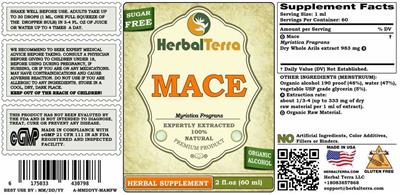
Shake well before use. Adults take up to 30 drops (1 mL, one full squeeze of the dropper bulb) in 3-4 fl. oz. of juice or water up to 4 times a day.
Precautions
We recommend to seek expert medical advice before taking. May have contraindications and cause adverse reaction.
Consult a physician before giving to children under 18, before using during pregnancy, if nursing, or if you are on any medications.
Consult a physician before giving to children under 18, before using during pregnancy, if nursing, or if you are on any medications. Keep out of the reach of children!
Do not use if you are allergic to any ingredients.
Storage
Store in a cool, dry, dark place.
FDA Disclaimer Statement
This product has not been evaluated by the FDA and is not intended to diagnose, treat, cure or prevent any disease.
Formulation
cGMP Made in compliance with cGMP 21 CFR 111 in an FDA registered and inspected facility.
Sugar free
Expertly extracted 100% natural Premium product
Organic alcohol
No artificial ingredients, color additives, fillers or binders.
Natural Gluten free
Formula
Myristica fragrans
Organic alcohol
FDA Statement of Identity
Herbal Supplement
Seals/Symbols
Made in USA
Is this label outdated? Report a formula or label change and our pharmacy team will review it.
Mace by Herbal Terra label
The label scan from the NIH Dietary Supplement Label Database. Tap to enlarge.
Label images are published by the NIH Dietary Supplement Label Database for the version of this product on file. Always read your actual product label.
View the full label (PDF)The Ingredients in Mace by Herbal Terra
This is the 1 active ingredient this product is made of. Select it to open its full monograph.
Serving size1 mL Dosage formLiquid Servings per container60 Amounts shown are per serving.
Mace Whole Aril Extract, Dry
Interacts with500 drugs
Mace is the lacy red covering of the nutmeg seed and comes from the same tree as nutmeg. It is mostly used as a cooking spice and in traditional medic...
Mace Whole Aril Extract, Dry monograph & interactionsOther (inactive) ingredients: Alcohol, Water, Glycerin. These complete the product’s ingredient list but are not active constituents.
Mace by Herbal Terra Drug Interactions
HelloPharmacist Interaction Report
Herbal Terra's Mace is a single-ingredient liquid extract that does interact with medications.
The most serious concern is with central nervous system depressants (like sedatives, sleeping pills, and opioids) — mace contains several volatile compounds with sedative effects, so combining it could intensify drowsiness and impair alertness. This is a Moderate-severity interaction.
Read the full breakdown — every affected drug type, severity by severity
Mace may also affect how your liver processes certain medications through the CYP1A2 enzyme system (Moderate severity). This means some drugs — including clozapine and others metabolized by this pathway — might be cleared from your body faster, making them less effective.
Additionally, the product could theoretically enhance the effects of immunosuppressant medications (Moderate severity), and may reduce the effectiveness of phenobarbital (Moderate severity).
We've documented no interactions for the inactive ingredients — alcohol, water, and glycerin — in this formulation. Altogether, these interactions span 496 individual medications.
Use the medication checker on this page to look up any specific prescriptions or over-the-counter drugs you take before starting this product.
Check your own medications below · Editorial policy · How we use AI
Want to check YOUR meds against Mace?
Ask about interactions with your drugs in plain English — “Can I take it with lisinopril?” — and we find you the answer in seconds, ingredient by ingredient.
Go to the checkerIngredients driving the most interactions
Individual Drug Interactions
The ingredients in Mace interact with 500 drugs. Click any drug to see the details.
1 of the 1 ingredient in Mace interact with drugs. Each result below shows which ingredient is responsible. Mace Whole Aril Extract, Dry
Acetaminophen, Chlorpheniramine, PseudoephedrineAlka-Seltzer PLUS Liquid Gels, Children's Tylenol Cold, Codimal, Comtrex, Extra Strength Tylenol Allergy Sinus, Lorsin +3 more
How Acetaminophen, Chlorpheniramine, Pseudoephedrine interacts with Mace — through 1 ingredient. Tap an ingredient for the detail:
Mace Whole Aril Extract, DryCytochrome P450 1a2 (cyp1a2) Substrates Moderate
Interaction Summary
Animal research suggests that intraperitoneal injections of myristicin, a constituent of mace, can induce cytochrome P450 1A2 (CYP1A2) enzyme system.
Read the full Mace Whole Aril Extract, Dry + Acetaminophen, Chlorpheniramine, Pseudoephedrine interactionAcetaminophen, ChlorzoxazoneAcetazone Forte, Extra Strength Tylenol Aches & Strains, Parafon Forte
How Acetaminophen, Chlorzoxazone interacts with Mace — through 1 ingredient. Tap an ingredient for the detail:
Mace Whole Aril Extract, DryCytochrome P450 1a2 (cyp1a2) Substrates Moderate
Interaction Summary
Animal research suggests that intraperitoneal injections of myristicin, a constituent of mace, can induce cytochrome P450 1A2 (CYP1A2) enzyme system.
Read the full Mace Whole Aril Extract, Dry + Acetaminophen, Chlorzoxazone interactionAcetaminophen, Chlorzoxazone, CodeineAcetazone Forte C8, Parafon Forte C8
How Acetaminophen, Chlorzoxazone, Codeine interacts with Mace — through 1 ingredient. Tap an ingredient for the detail:
Mace Whole Aril Extract, DryCytochrome P450 1a2 (cyp1a2) Substrates, Cns Depressants Moderate
Interaction Summary
Animal research suggests that intraperitoneal injections of myristicin, a constituent of mace, can induce cytochrome P450 1A2 (CYP1A2) enzyme system.
Read the full Mace Whole Aril Extract, Dry + Acetaminophen, Chlorzoxazone, Codeine interactionAcetaminophen, CodeineTylenol No.3, Tylenol w/ Codeine
How Acetaminophen, Codeine interacts with Mace — through 1 ingredient. Tap an ingredient for the detail:
Mace Whole Aril Extract, DryCns Depressants, Cytochrome P450 1a2 (cyp1a2) Substrates Moderate
Interaction Summary
Several volatile oils in mace, such as methyleugenol, isoeugenol, safrole, myristicin, 1,8-cineole, and geranyl acetate, seem to have sedative effects.
Read the full Mace Whole Aril Extract, Dry + Acetaminophen, Codeine interactionAcetaminophen, Codeine, DoxylamineMersyndol
How Acetaminophen, Codeine, Doxylamine interacts with Mace — through 1 ingredient. Tap an ingredient for the detail:
Mace Whole Aril Extract, DryCytochrome P450 1a2 (cyp1a2) Substrates, Cns Depressants Moderate
Interaction Summary
Animal research suggests that intraperitoneal injections of myristicin, a constituent of mace, can induce cytochrome P450 1A2 (CYP1A2) enzyme system.
Read the full Mace Whole Aril Extract, Dry + Acetaminophen, Codeine, Doxylamine interactionAcetaminophen, Codeine, MethocarbamolAcetaminophen, Codeine, Methocarbamol, Robaxacet 8
How Acetaminophen, Codeine, Methocarbamol interacts with Mace — through 1 ingredient. Tap an ingredient for the detail:
Mace Whole Aril Extract, DryCns Depressants, Cytochrome P450 1a2 (cyp1a2) Substrates Moderate
Interaction Summary
Several volatile oils in mace, such as methyleugenol, isoeugenol, safrole, myristicin, 1,8-cineole, and geranyl acetate, seem to have sedative effects.
Read the full Mace Whole Aril Extract, Dry + Acetaminophen, Codeine, Methocarbamol interactionAcetaminophen, Dexbrompheniramine, PseudoephedrineSinadrin Plus
How Acetaminophen, Dexbrompheniramine, Pseudoephedrine interacts with Mace — through 1 ingredient. Tap an ingredient for the detail:
Mace Whole Aril Extract, DryCytochrome P450 1a2 (cyp1a2) Substrates Moderate
Interaction Summary
Animal research suggests that intraperitoneal injections of myristicin, a constituent of mace, can induce cytochrome P450 1A2 (CYP1A2) enzyme system.
Read the full Mace Whole Aril Extract, Dry + Acetaminophen, Dexbrompheniramine, Pseudoephedrine interactionAcetaminophen, DextromethorphanTylenol Cough Ex Strength
How Acetaminophen, Dextromethorphan interacts with Mace — through 1 ingredient. Tap an ingredient for the detail:
Mace Whole Aril Extract, DryCytochrome P450 1a2 (cyp1a2) Substrates Moderate
Interaction Summary
Animal research suggests that intraperitoneal injections of myristicin, a constituent of mace, can induce cytochrome P450 1A2 (CYP1A2) enzyme system.
Read the full Mace Whole Aril Extract, Dry + Acetaminophen, Dextromethorphan interactionAcetaminophen, Dextromethorphan, Doxylamine, PseudoephedrineVicks NyQuil
How Acetaminophen, Dextromethorphan, Doxylamine, Pseudoephedrine interacts with Mace — through 1 ingredient. Tap an ingredient for the detail:
Mace Whole Aril Extract, DryCytochrome P450 1a2 (cyp1a2) Substrates Moderate
Interaction Summary
Animal research suggests that intraperitoneal injections of myristicin, a constituent of mace, can induce cytochrome P450 1A2 (CYP1A2) enzyme system.
Read the full Mace Whole Aril Extract, Dry + Acetaminophen, Dextromethorphan, Doxylamine, Pseudoephedrine interactionAcetaminophen, Dextromethorphan, Guaifenesin, PhenylephrineConar-A
How Acetaminophen, Dextromethorphan, Guaifenesin, Phenylephrine interacts with Mace — through 1 ingredient. Tap an ingredient for the detail:
Mace Whole Aril Extract, DryCytochrome P450 1a2 (cyp1a2) Substrates Moderate
Interaction Summary
Animal research suggests that intraperitoneal injections of myristicin, a constituent of mace, can induce cytochrome P450 1A2 (CYP1A2) enzyme system.
Read the full Mace Whole Aril Extract, Dry + Acetaminophen, Dextromethorphan, Guaifenesin, Phenylephrine interactionAcetaminophen, Dextromethorphan, Guaifenesin, PhenylpropanolamineAnatuss
How Acetaminophen, Dextromethorphan, Guaifenesin, Phenylpropanolamine interacts with Mace — through 1 ingredient. Tap an ingredient for the detail:
Mace Whole Aril Extract, DryCytochrome P450 1a2 (cyp1a2) Substrates Moderate
Interaction Summary
Animal research suggests that intraperitoneal injections of myristicin, a constituent of mace, can induce cytochrome P450 1A2 (CYP1A2) enzyme system.
Read the full Mace Whole Aril Extract, Dry + Acetaminophen, Dextromethorphan, Guaifenesin, Phenylpropanolamine interactionAcetaminophen, Dextromethorphan, Guaifenesin, PseudoephedrineRobitussin Cold, Severe Cold, Suphedrine Cold/Cough
How Acetaminophen, Dextromethorphan, Guaifenesin, Pseudoephedrine interacts with Mace — through 1 ingredient. Tap an ingredient for the detail:
Mace Whole Aril Extract, DryCytochrome P450 1a2 (cyp1a2) Substrates Moderate
Interaction Summary
Animal research suggests that intraperitoneal injections of myristicin, a constituent of mace, can induce cytochrome P450 1A2 (CYP1A2) enzyme system.
Read the full Mace Whole Aril Extract, Dry + Acetaminophen, Dextromethorphan, Guaifenesin, Pseudoephedrine interactionAcetaminophen, Dextromethorphan, Phenylpropanolamine, PyrilamineTheracaps
How Acetaminophen, Dextromethorphan, Phenylpropanolamine, Pyrilamine interacts with Mace — through 1 ingredient. Tap an ingredient for the detail:
Mace Whole Aril Extract, DryCytochrome P450 1a2 (cyp1a2) Substrates Moderate
Interaction Summary
Animal research suggests that intraperitoneal injections of myristicin, a constituent of mace, can induce cytochrome P450 1A2 (CYP1A2) enzyme system.
Read the full Mace Whole Aril Extract, Dry + Acetaminophen, Dextromethorphan, Phenylpropanolamine, Pyrilamine interactionAcetaminophen, Dextromethorphan, PseudoephedrineAlka-Seltzer PLUS Flu Liquid Gels, Non Aspirin Cold Caps, Tylenol Cold, Tylenol Flu Daytime Ex Strength, Tylenol Flu Ex Strength
How Acetaminophen, Dextromethorphan, Pseudoephedrine interacts with Mace — through 1 ingredient. Tap an ingredient for the detail:
Mace Whole Aril Extract, DryCytochrome P450 1a2 (cyp1a2) Substrates Moderate
Interaction Summary
Animal research suggests that intraperitoneal injections of myristicin, a constituent of mace, can induce cytochrome P450 1A2 (CYP1A2) enzyme system.
Read the full Mace Whole Aril Extract, Dry + Acetaminophen, Dextromethorphan, Pseudoephedrine interactionAcetaminophen, Dichloralantipyrine, IsomethepteneAmidrine, Midchlor, Migquin, Migratine
How Acetaminophen, Dichloralantipyrine, Isometheptene interacts with Mace — through 1 ingredient. Tap an ingredient for the detail:
Mace Whole Aril Extract, DryCytochrome P450 1a2 (cyp1a2) Substrates, Cns Depressants Moderate
Interaction Summary
Animal research suggests that intraperitoneal injections of myristicin, a constituent of mace, can induce cytochrome P450 1A2 (CYP1A2) enzyme system.
Read the full Mace Whole Aril Extract, Dry + Acetaminophen, Dichloralantipyrine, Isometheptene interactionAcetaminophen, Dichloralphenazone, IsomethepteneMidrin
How Acetaminophen, Dichloralphenazone, Isometheptene interacts with Mace — through 1 ingredient. Tap an ingredient for the detail:
Mace Whole Aril Extract, DryCns Depressants, Cytochrome P450 1a2 (cyp1a2) Substrates Moderate
Interaction Summary
Several volatile oils in mace, such as methyleugenol, isoeugenol, safrole, myristicin, 1,8-cineole, and geranyl acetate, seem to have sedative effects.
Read the full Mace Whole Aril Extract, Dry + Acetaminophen, Dichloralphenazone, Isometheptene interactionAcetaminophen, Dichlorophenazone, IsometheptaneIsocom
How Acetaminophen, Dichlorophenazone, Isometheptane interacts with Mace — through 1 ingredient. Tap an ingredient for the detail:
Mace Whole Aril Extract, DryCytochrome P450 1a2 (cyp1a2) Substrates, Cns Depressants Moderate
Interaction Summary
Animal research suggests that intraperitoneal injections of myristicin, a constituent of mace, can induce cytochrome P450 1A2 (CYP1A2) enzyme system.
Read the full Mace Whole Aril Extract, Dry + Acetaminophen, Dichlorophenazone, Isometheptane interactionAcetaminophen, DiphenhydramineTylenol PM, Tylenol PM Ex Strength
How Acetaminophen, Diphenhydramine interacts with Mace — through 1 ingredient. Tap an ingredient for the detail:
Mace Whole Aril Extract, DryCns Depressants, Cytochrome P450 1a2 (cyp1a2) Substrates Moderate
Interaction Summary
Several volatile oils in mace, such as methyleugenol, isoeugenol, safrole, myristicin, 1,8-cineole, and geranyl acetate, seem to have sedative effects.
Read the full Mace Whole Aril Extract, Dry + Acetaminophen, Diphenhydramine interactionAcetaminophen, Diphenhydramine, PseudoephedrineChildren's Tylenol Allergy, Cold Control, Contac Night Allergy Relief
How Acetaminophen, Diphenhydramine, Pseudoephedrine interacts with Mace — through 1 ingredient. Tap an ingredient for the detail:
Mace Whole Aril Extract, DryCytochrome P450 1a2 (cyp1a2) Substrates, Cns Depressants Moderate
Interaction Summary
Animal research suggests that intraperitoneal injections of myristicin, a constituent of mace, can induce cytochrome P450 1A2 (CYP1A2) enzyme system.
Read the full Mace Whole Aril Extract, Dry + Acetaminophen, Diphenhydramine, Pseudoephedrine interactionAcetaminophen, Doxylamine, PseudoephedrineEx Strength Tylenol Sinus Nighttime
How Acetaminophen, Doxylamine, Pseudoephedrine interacts with Mace — through 1 ingredient. Tap an ingredient for the detail:
Mace Whole Aril Extract, DryCytochrome P450 1a2 (cyp1a2) Substrates Moderate
Interaction Summary
Animal research suggests that intraperitoneal injections of myristicin, a constituent of mace, can induce cytochrome P450 1A2 (CYP1A2) enzyme system.
Read the full Mace Whole Aril Extract, Dry + Acetaminophen, Doxylamine, Pseudoephedrine interactionAcetaminophen, HydrocodoneAnexsia, Anodynos DHC, Azdone, Co-Gesic, Doucet, Lorcet +9 more
How Acetaminophen, Hydrocodone interacts with Mace — through 1 ingredient. Tap an ingredient for the detail:
Mace Whole Aril Extract, DryCytochrome P450 1a2 (cyp1a2) Substrates, Cns Depressants Moderate
Interaction Summary
Animal research suggests that intraperitoneal injections of myristicin, a constituent of mace, can induce cytochrome P450 1A2 (CYP1A2) enzyme system.
Read the full Mace Whole Aril Extract, Dry + Acetaminophen, Hydrocodone interactionAcetaminophen, IbuprofenCombogesic
How Acetaminophen, Ibuprofen interacts with Mace — through 1 ingredient. Tap an ingredient for the detail:
Mace Whole Aril Extract, DryCytochrome P450 1a2 (cyp1a2) Substrates Moderate
Interaction Summary
Animal research suggests that intraperitoneal injections of myristicin, a constituent of mace, can induce cytochrome P450 1A2 (CYP1A2) enzyme system.
Read the full Mace Whole Aril Extract, Dry + Acetaminophen, Ibuprofen interactionAcetaminophen, MeperidineDemerol APAP
How Acetaminophen, Meperidine interacts with Mace — through 1 ingredient. Tap an ingredient for the detail:
Mace Whole Aril Extract, DryCytochrome P450 1a2 (cyp1a2) Substrates, Cns Depressants Moderate
Interaction Summary
Animal research suggests that intraperitoneal injections of myristicin, a constituent of mace, can induce cytochrome P450 1A2 (CYP1A2) enzyme system.
Read the full Mace Whole Aril Extract, Dry + Acetaminophen, Meperidine interactionAcetaminophen, MethocarbamolRobaxacet
How Acetaminophen, Methocarbamol interacts with Mace — through 1 ingredient. Tap an ingredient for the detail:
Mace Whole Aril Extract, DryCytochrome P450 1a2 (cyp1a2) Substrates Moderate
Interaction Summary
Animal research suggests that intraperitoneal injections of myristicin, a constituent of mace, can induce cytochrome P450 1A2 (CYP1A2) enzyme system.
Read the full Mace Whole Aril Extract, Dry + Acetaminophen, Methocarbamol interactionAcetaminophen, OrphenadrineOrfenagesic
How Acetaminophen, Orphenadrine interacts with Mace — through 1 ingredient. Tap an ingredient for the detail:
Mace Whole Aril Extract, DryCytochrome P450 1a2 (cyp1a2) Substrates Moderate
Interaction Summary
Animal research suggests that intraperitoneal injections of myristicin, a constituent of mace, can induce cytochrome P450 1A2 (CYP1A2) enzyme system.
Read the full Mace Whole Aril Extract, Dry + Acetaminophen, Orphenadrine interactionAcetaminophen, OxycodonePercocet, Roxicet, Tylox, Xartemis XR
How Acetaminophen, Oxycodone interacts with Mace — through 1 ingredient. Tap an ingredient for the detail:
Mace Whole Aril Extract, DryCytochrome P450 1a2 (cyp1a2) Substrates, Cns Depressants Moderate
Interaction Summary
Animal research suggests that intraperitoneal injections of myristicin, a constituent of mace, can induce cytochrome P450 1A2 (CYP1A2) enzyme system.
Read the full Mace Whole Aril Extract, Dry + Acetaminophen, Oxycodone interactionAcetaminophen, Pamabrom, PyrilamineMidol Max Strength PMS, Pamprin, Pamprin ES
How Acetaminophen, Pamabrom, Pyrilamine interacts with Mace — through 1 ingredient. Tap an ingredient for the detail:
Mace Whole Aril Extract, DryCytochrome P450 1a2 (cyp1a2) Substrates Moderate
Interaction Summary
Animal research suggests that intraperitoneal injections of myristicin, a constituent of mace, can induce cytochrome P450 1A2 (CYP1A2) enzyme system.
Read the full Mace Whole Aril Extract, Dry + Acetaminophen, Pamabrom, Pyrilamine interactionAcetaminophen, PentazocineTalacen
How Acetaminophen, Pentazocine interacts with Mace — through 1 ingredient. Tap an ingredient for the detail:
Mace Whole Aril Extract, DryCytochrome P450 1a2 (cyp1a2) Substrates, Cns Depressants Moderate
Interaction Summary
Animal research suggests that intraperitoneal injections of myristicin, a constituent of mace, can induce cytochrome P450 1A2 (CYP1A2) enzyme system.
Read the full Mace Whole Aril Extract, Dry + Acetaminophen, Pentazocine interactionAcetaminophen, Phenylephrine, ChlorpheniramineSuper Cold Tabs
How Acetaminophen, Phenylephrine, Chlorpheniramine interacts with Mace — through 1 ingredient. Tap an ingredient for the detail:
Mace Whole Aril Extract, DryCytochrome P450 1a2 (cyp1a2) Substrates Moderate
Interaction Summary
Animal research suggests that intraperitoneal injections of myristicin, a constituent of mace, can induce cytochrome P450 1A2 (CYP1A2) enzyme system.
Read the full Mace Whole Aril Extract, Dry + Acetaminophen, Phenylephrine, Chlorpheniramine interactionAcetaminophen, PhenylpropanolamineTetra Caps
How Acetaminophen, Phenylpropanolamine interacts with Mace — through 1 ingredient. Tap an ingredient for the detail:
Mace Whole Aril Extract, DryCytochrome P450 1a2 (cyp1a2) Substrates Moderate
Interaction Summary
Animal research suggests that intraperitoneal injections of myristicin, a constituent of mace, can induce cytochrome P450 1A2 (CYP1A2) enzyme system.
Read the full Mace Whole Aril Extract, Dry + Acetaminophen, Phenylpropanolamine interactionEach ingredient & the kinds of drugs it affects
For each ingredient in Mace with known interactions, here are the types of medications it can affect. Open any type for the detail — or search your exact drug in the checker above.
Mace Whole Aril Extract, Dry
Cns Depressants
Several volatile oils in mace, such as methyleugenol, isoeugenol, safrole, myristicin, 1,8-cineole, and geranyl acetate, seem to have sedative effects. Evidence from animal research suggests that methyleugenol can induce anesthesia for a similar duration as pentobarbital. Due to the sedative effects of certain mace constituents, taking medicinal amounts of mace in combination with other CNS depressants may have additive effects. However, evidence from other animal research suggests that myristicin can reduce sleeping time in rats pretreated with phenobarbital. Until more is known, use medicinal amounts of mace cautiously in combination with CNS depressants. Some CNS depressants include clonazepam (Klonopin), lorazepam (Ativan), phenobarbital (Donnatal), zolpidem (Ambien), and others.
Cytochrome P450 1A2 (Cyp1A2) Substrates
Animal research suggests that intraperitoneal injections of myristicin, a constituent of mace, can induce cytochrome P450 1A2 (CYP1A2) enzyme system. Theoretically, concomitant use of mace with drugs metabolized by CYP1A2 may increase the clearance of these drugs and reduce their effects. Some substrates of CYP1A2 include clozapine (Clozaril), cyclobenzaprine (Flexeril), fluvoxamine (Luvox), haloperidol (Haldol), imipramine (Tofranil), mexiletine (Mexitil), olanzapine (Zyprexa), pentazocine (Talwin), propranolol (Inderal), tacrine (Cognex), theophylline, zileuton (Zyflo), zolmitriptan (Zomig), and others.
Immunosuppressants
Animal research suggests that mace lignans can suppress immune function. Theoretically, concomitant use might enhance the effects of immunosuppressant drugs. Immunosuppressant drugs include azathioprine (Imuran), basiliximab (Simulect), cyclosporine (Neoral, Sandimmune), daclizumab (Zenapax), muromonab-CD3 (OKT3, Orthoclone OKT3), mycophenolate (CellCept), tacrolimus (FK506, Prograf), sirolimus (Rapamune), prednisone (Deltasone, Orasone), and other corticosteroids (glucocorticoids).
Phenobarbital (Luminal)
Evidence from animal research suggests that myristicin, a constituent of mace, can reduce sleeping time in rats pretreated with phenobarbital. Theoretically, concomitant use may decrease the therapeutic effects of phenobarbital.
Brand information
Manufacturer and brand details for Mace, from the product label.
Herbal Terra
See all Herbal Terra products- Name
- Herbal Terra LLC
- Phone Number
- +18083857868
- Web Address
- herbalterra.com
Mace by Herbal Terra: Common Questions
Does Mace by Herbal Terra interact with any medications?
How can one product interact with so many drugs?
Where does this information come from?
Is mace safe to use if I'm pregnant?
Will this help my menstrual cramps or bladder control issues?
What happens if I take too much mace?
Can I use this if I take sleeping pills or opioids?
Does this product have fillers?
Is mace the same as nutmeg?
Written and reviewed by the HelloPharmacist editorial staff. Our editorial policy
Not sure if Mace is safe with your meds?
Our pharmacists answer your medication & supplement questions — free.
Label information is sourced from the NIH Dietary Supplement Label Database and reflects the product version on file; always read your actual product label. This page is for education only and is not a substitute for professional medical advice. Confirm with your pharmacist or doctor before combining supplements and medications.
The Full Monographs Behind Mace’s Ingredients
Every ingredient we hold a full HelloPharmacist monograph for — uses, evidence, safety, and the complete interaction list.
Sources & How We Checked
Mace's label data comes from the NIH Dietary Supplement Label Database; the ingredient interaction data is from the Natural Medicines database, reviewed by our pharmacists.
- NIH Dietary Supplement Label Database (DSLD) — The official product label on file for this supplement.
- Natural Medicines (Therapeutic Research Center) — Evidence-graded clinical reference behind the ingredient interaction data.
Content is written and reviewed by licensed HelloPharmacist pharmacists. See our data sources and editorial standards for how this information is built and checked.
The 18 references behind this product’s interaction data
Every citation that drives the interaction findings for this product’s ingredients, from the evidence-graded Natural Medicines (TRC Healthcare) database. Open an ingredient to browse its citations — links open the study on PubMed or the publisher’s site.
Mace 18 references
- McGuffin M, Hobbs C, Upton R, Goldberg A, eds. American Herbal Products Association's Botanical Safety Handbook. Boca Raton, FL: CRC Press, LLC 1997.
- Sangalli BC, Chiang W. Toxicology of nutmeg abuse. Clin Toxicol 2000;38:671-8. PubMed
- Hallstrom H, Thuvander A. Toxicological evaluation of myristicin. Nat Toxins 1997;5:186-92. DOI
- Jeong HG, Yun CH. Induction of rat hepatic cytochrome P450 enzymes by myristicin. Biochem Biophys Res Commun 1995;217:966-71. PubMed
- McKenna A, Nordt SP, Ryan J. Acute nutmeg poisoning. Eur J Emerg Med 2004;11:240-1. PubMed
- Panayotopoulos DJ, Chisholm DD. Hallucinogenic effect of nutmeg. Br Med J 1970;1:754. PubMed
- Stein U, Greyer H, Hentschel H. Nutmeg (myristicin) poisoning-report on a fatal case and a series of cases recorded by a poison information centre. Forensic Sci Int 2001;118:87-90. PubMed
- Venables GS, Evered D, Hall R. Letter: Nutmeg poisoning. Br Med J 1976;1:96. PubMed
- Carstairs SD, Cantrell FL. The spice of life: an analysis of nutmeg exposures in California. Clin Toxicol (Phila) 2011;49:177-80. PubMed
- Abernethy MK, Becker LB. Acute nutmeg intoxication. Am J Emerg Med 1992;10:429-30. PubMed
- Checker R, Chatterjee S, Sharma D, et al. Immunomodulatory and radioprotective effects of lignans derived from fresh nutmeg mace (Myristica fragrans) in mammalian splenocytes. Int Immunopharmacol. 2008;8(5):661-669. PubMed
- Sell AB, Carlini EA. Anesthetic action of methyleugenol and other eugenol derivatives. Pharmacology. 1976;14(4):367-77. PubMed
- Fundarò A, Cassone MC. [Action of essential oils of chamomile, cinnamon, absinthium, mace and origanum on operant conditioning behavior of the rat]. Boll Soc Ital Biol Sper. 1980;56(22):2375-80.
- Grover JK, Khandkar S, Vats V, Dhunnoo Y, Das D. Pharmacological studies on Myristica fragrans--antidiarrheal, hypnotic, analgesic and hemodynamic (blood pressure) parameters. Methods Find Exp Clin Pharmacol. 2002;24(10):675-80. PubMed
- Barceloux DG. Nutmeg (Myristica fragrans Houtt.). Dis Mon. 2009;55(6):373-9. PubMed
- Dooms-Goossens, A., Dubelloy, R., and Degreef, H. Contact and systemic contact-type dermatitis to spices. Dermatol Clin 1990;8(1):89-93. DOI
- Anjum A, Sultana A. A randomized comparative study of herbal decoction of Cassia fistula Linn pod's pericarp and Myristica fragrans Houtt arils vs. mefenamic acid in spasmodic dysmenorrhoea. J Complement Integr Med. 2018;16(2):/j/jcim.2019.16.issue-2/jcim
- Najeeya AGF, Sultana A. Efficacy of mace (Arils of Myristica fragrans Houtt) plus PFMT on symptoms in mixed urinary incontinence: a randomized placebo-controlled trial. Integr Med Res. 2018;7(4):307-315.
Parts of this content are provided by the Therapeutic Research Center, LLC.
DISCLAIMER: Currently this does not check for drug-drug interactions. This is not an all-inclusive comprehensive list of potential interactions and is for informational purposes only. Not all interactions are known or well-reported in the scientific literature, and new interactions are continually being reported. Input is needed from a qualified healthcare provider including a pharmacist before starting any therapy. Application of clinical judgment is necessary.
© 2021 Therapeutic Research Center, LLC