
Pumpkin Seed Oil 1000 mg Ingredients & Drug Interactions
by NOW
What is this page for?
First and foremost: checking Pumpkin Seed Oil 1000 mg against your medications. The heart of this page is the interaction checker and the full interaction report — how this product’s ingredients may interact with prescription and over-the-counter medicines you may be taking.
Around that, we add a pharmacist’s high-level view of the product as a whole — what’s inside, the evidence for its stated use, how transparent the label is, and what safety data exists — so you can see the full picture in one place. It’s educational information from our licensed clinical databases and the clinical staff at HelloPharmacist — not medical advice — and we don’t sell or endorse products. Our editorial policy
Pumpkin Seed Oil 1000 mg is a dietary supplement by NOW with 1 active ingredient. Its ingredients are commonly taken for benign prostatic hyperplasia (bph) symptoms, overactive bladder, eye and skin health (vitamin a source).Based on those ingredients, 1 medication has a known interaction with it, the most serious rated moderate. The ingredients most likely to interact are Pumpkin Seed Oil. Use the checker below to test your specific medication, or read the full HelloPharmacist Interaction Report.
Check Your Meds Against Pumpkin Seed Oil 1000 mg by NOW
Ask about any prescription or over-the-counter medication and we check it for interactions with Pumpkin Seed Oil 1000 mg by NOW — and tell you which ingredient is responsible.
AI summaries are generated from our interaction database for education only — always confirm with your pharmacist. How we use AI
Ask the Pharmacist
A licensed pharmacist will answer your question by email — free, usually within 24 hours.
Got it — thank you!
A licensed pharmacist will answer within 24 hours. Keep an eye on your email (worth checking spam, just in case).
HelloPharmacist Scorecard of Pumpkin Seed Oil 1000 mg by NOW
Our pharmacy team’s full take, with four database checks built into the cards below — a summary of what is known, not a grade of the product itself.
What’s inside
Full disclosure
This softgel contains 3 active ingredients: pumpkin seed oil and two types of fat — polyunsaturated and monounsaturated — that occur naturally in the seed oil itself. The capsule shell is made from bovine gelatin, with glycerin and water as inactive ingredients.
Does it work?
Moderate evidence
The evidence for pumpkin seed oil is mixed. It's possibly effective for benign prostatic hyperplasia (BPH) — enlarged prostate — meaning there's some support, though the research isn't conclusive.
For other uses listed here — male-pattern baldness, interstitial cystitis (a bladder condition), parasite infections, and urinary tract infections — we don't have enough reliable evidence to rate whether it works.
How safe is it?
Well-documented data
Pumpkin seed oil is generally well tolerated when taken by mouth. The most common side effects are mild: abdominal discomfort, diarrhea, nausea, and vomiting.
Rarely, anaphylaxis (a severe allergic reaction) has been reported. There are also two case reports of hair loss that occurred 1–3 weeks after eating bitter-tasting pumpkin or squash, thought to be from a compound called cucurbitacin; concentrated seed-oil supplements are unlikely to contain this in significant amounts, but it's worth knowing.
We don't have enough data on concentrated seed-oil supplements during pregnancy or breastfeeding — eating pumpkin as food is fine, but talk with your doctor or pharmacist before taking a concentrated supplement if you're pregnant or nursing.
Meds to double-check
Moderate interaction found
If you take lithium, this is the one to double-check. Pumpkin seed oil may increase lithium levels in your blood, and your dose might need adjustment.
Run your exact medications through the checker on this page before you start.
The bottom line
Scorecard at a glanceFully disclosed formula with some supporting evidence for its stated purpose. Moderate medication interactions have been identified, and safety information is well characterized.
Pumpkin seed oil may help with enlarged prostate symptoms, though the evidence isn't strong for other uses. If you take lithium, you'll want to check with us or your pharmacist before starting — it may affect your lithium levels.
Otherwise, it's generally well tolerated, but pregnancy and breastfeeding warrant a quick conversation with your doctor.
Educational only — not medical advice; always confirm with your pharmacist. Our editorial policy · How we use AI
Assessment coverage: 1 of 3 active ingredients matched to our full ingredient reviews (monographs). Based on the product label dated Jul 24, 2025.
This Scorecard evaluates available label information, ingredient evidence, and known medication-safety considerations. It does not independently verify product identity, purity, potency, contamination, or manufacturing quality. How these ratings are computed
General information
Key facts about Pumpkin Seed Oil 1000 mg, straight from the product label.
| Brand | NOW |
|---|---|
| Barcode (UPC) | 733739018403 |
| Net contents | 100 Softgel(s) |
| Market status | On market |
| Date entered into DSLD | Jul 24, 2025 |
| DSLD ID | 335299 |
| Product type | Fat/fatty Acid |
| Supplement form | Softgel Capsule |
| Dietary claims / uses | Nutrient, All Other |
| Intended target group(s) | Adult (18 - 50 Years), Kosher, Gluten Free, Dairy Free |
Everything in this section is reproduced from the manufacturer’s own product label — it’s the label speaking, not HelloPharmacist. We show it so you can see exactly what the maker states; we don’t verify or endorse those statements.
Supplement Facts
The label details for Pumpkin Seed Oil 1000 mg by NOW, sourced from the NIH Dietary Supplement Label Database.
Supplement Facts
| Ingredient | Amount | % DV |
|---|---|---|
| Calories | 20 Calorie(s) | -- |
| Saturated Fat | 0.5 Gram(s) | 3% |
| Total Fat | 2 Gram(s) | 3% |
| Polyunsaturated Fat | 1 Gram(s) | -- |
| Monounsaturated Fat | 0.5 Gram(s) | -- |
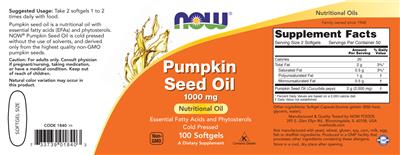
| Pumpkin Seed Oil | 2 Gram(s) | -- |
Other ingredients: Bovine Gelatin, Glycerin, Water
Tap any ingredient to jump to its full detail below.
These statements are the manufacturer’s wording, reproduced from the product label — the label is saying it, not HelloPharmacist. We don’t verify or endorse them.
Suggested/Recommended/Usage/Directions
Suggested Usage: Take 2 softgels 1 to 2 times daily with food.
Formula
Pumpkin Seed Oil is a nutritional oil with essential fatty acids (EFAs) and phytosterols. NOW Pumpkin Seed Oil is cold pressed without the use of solvents, and derived only from the highest quality non-GMO pumpkin seeds.
Nutritional Oil Essential Fatty Acids and Phytosterols Triangle K (Kosher) Contains Gelatin
Triangle K (Kosher) Contains Gelatin
Formulation
NOW Pumpkin Seed Oil is cold pressed without the use of solvents, and derived only from the highest quality non-GMO pumpkin seeds.
Natural color variation may occur in this product.
Cold pressed
Non-GMO
Not manufactured with yeast, wheat, gluten, soy, corn, milk, egg, fish or shellfish ingredients.
Precautions
Caution: For adults only.
Consult physician if pregnant/nursing, taking medication, or have a medical condition.
Keep out of reach of children.
Not manufactured with yeast, wheat, gluten, soy, corn, milk, egg, fish or shellfish ingredients. Produced in a GMP facility that processes other ingredients containing these allergens.
FDA Statement of Identity
A Dietary Supplement
Seals/Symbols
Triangle K (Kosher) Contains Gelatin
GMP Quality Assured
General Statements
Nutritional Oils Family owned since 1968.
Storage
Store in a cool, dry place after opening.
Is this label outdated? Report a formula or label change and our pharmacy team will review it.
Pumpkin Seed Oil 1000 mg by NOW label
The label scan from the NIH Dietary Supplement Label Database. Tap to enlarge.
Label images are published by the NIH Dietary Supplement Label Database for the version of this product on file. Always read your actual product label.
View the full label (PDF)The Ingredients in Pumpkin Seed Oil 1000 mg by NOW
This is the 1 active ingredient this product is made of. Select it to open its full monograph.
Serving size2 Softgel(s) Dosage formSoftgel Capsule Servings per container50 Amounts shown are per serving.
Pumpkin Seed Oil
Interacts with1 drug
Pumpkin is a nutritious squash, and its seeds and seed oil are the parts most often used as supplements, mainly for urinary and prostate symptoms. The...
Pumpkin Seed Oil monograph & interactionsOther (inactive) ingredients: Bovine Gelatin, Glycerin, Water. These complete the product’s ingredient list but are not active constituents.
Pumpkin Seed Oil 1000 mg by NOW Drug Interactions
HelloPharmacist Interaction Report
NOW's Pumpkin Seed Oil has one documented interaction: it may affect lithium levels.
Pumpkin seed oil is thought to have mild diuretic properties — meaning it helps your body shed water — and this might reduce how much lithium your kidneys excrete, causing levels to build up in your blood. If you take lithium for bipolar disorder or another condition, your dose may need adjustment.
Read the full breakdown — every affected drug type, severity by severity
The other two ingredients in this product — polyunsaturated fat and monounsaturated fat — we couldn't check against medications, as we hold no interaction data for them.
Before you start this supplement, run your exact medications through the checker below, especially if you take lithium or any other prescription drug.
Check your own medications below · Editorial policy · How we use AI
Want to check YOUR meds against Pumpkin Seed Oil 1000 mg?
Ask about interactions with your drugs in plain English — “Can I take it with lisinopril?” — and we find you the answer in seconds, ingredient by ingredient.
Go to the checkerIngredients driving the most interactions
Individual Drug Interactions
The ingredients in Pumpkin Seed Oil 1000 mg interact with 1 drug. Click any drug to see the details.
1 of the 1 ingredient in Pumpkin Seed Oil 1000 mg interact with drugs. Each result below shows which ingredient is responsible. Pumpkin Seed Oil
Lithium Carbonate (prescription Drug)Eskalith, Lithium Carbonate
How Lithium Carbonate (prescription Drug) interacts with Pumpkin Seed Oil 1000 mg — through 1 ingredient. Tap an ingredient for the detail:
Pumpkin Seed OilLithium Moderate
Interaction Summary
Pumpkin might reduce excretion and increase levels of lithium.
Read the full Pumpkin Seed Oil + Lithium Carbonate (prescription Drug) interactionEach ingredient & the kinds of drugs it affects
For each ingredient in Pumpkin Seed Oil 1000 mg with known interactions, here are the types of medications it can affect. Open any type for the detail — or search your exact drug in the checker above.
Pumpkin Seed Oil
Lithium
Pumpkin might reduce excretion and increase levels of lithium.
Pumpkin is thought to have diuretic properties. Theoretically, this might reduce excretion and increase levels of lithium. The dose of lithium might need to be decreased.
Brand information
Manufacturer and brand details for Pumpkin Seed Oil 1000 mg, from the product label.
NOW
See all NOW products- Name
- NOW FOODS
- Street Address
- 395 S. Glen Ellyn Rd.
- City
- Bloomingdale
- State
- IL
- ZipCode
- 60108
- Web Address
- nowfoods.com
Pumpkin Seed Oil 1000 mg by NOW: Common Questions
Does Pumpkin Seed Oil 1000 mg by NOW interact with any medications?
How can one product interact with so many drugs?
Where does this information come from?
Will pumpkin seed oil help with my enlarged prostate?
What are the most common side effects?
Is it safe to take during pregnancy or breastfeeding?
Can I take this if I have a pumpkin allergy?
Does pumpkin seed oil cause hair loss?
Written and reviewed by the HelloPharmacist editorial staff. Our editorial policy
Not sure if Pumpkin Seed Oil 1000 mg is safe with your meds?
Our pharmacists answer your medication & supplement questions — free.
Label information is sourced from the NIH Dietary Supplement Label Database and reflects the product version on file; always read your actual product label. This page is for education only and is not a substitute for professional medical advice. Confirm with your pharmacist or doctor before combining supplements and medications.
The Full Monographs Behind Pumpkin Seed Oil 1000 mg’s Ingredients
Every ingredient we hold a full HelloPharmacist monograph for — uses, evidence, safety, and the complete interaction list.
Sources & How We Checked
Pumpkin Seed Oil 1000 mg's label data comes from the NIH Dietary Supplement Label Database; the ingredient interaction data is from the Natural Medicines database, reviewed by our pharmacists.
- NIH Dietary Supplement Label Database (DSLD) — The official product label on file for this supplement.
- Natural Medicines (Therapeutic Research Center) — Evidence-graded clinical reference behind the ingredient interaction data.
Content is written and reviewed by licensed HelloPharmacist pharmacists. See our data sources and editorial standards for how this information is built and checked.
The 5 references behind this product’s interaction data
Every citation that drives the interaction findings for this product’s ingredients, from the evidence-graded Natural Medicines (TRC Healthcare) database. Open an ingredient to browse its citations — links open the study on PubMed or the publisher’s site.
Pumpkin 5 references
- Marks L, Partin AW, Epstein JI, et al. Effects of a saw palmetto herbal blend in men with symptomatic benign prostatic hyperplasia. J Urol 2000;163:1451-6. DOI
- Cho YH, Lee SY, Jeong DW, et al. Effect of pumpkin seed oil on hair growth in men with androgenetic alopecia: a randomized, double-blind, placebo-controlled trial. Evid Based Complement Alternat Med 2014;2014:549721. PubMed
- Vahlensieck W, Theurer C, Pfitzer E, Patz B, Banik N, Engelmann U. Effects of pumpkin seed in men with lower urinary tract symptoms due to benign prostatic hyperplasia in the one-year, randomized, placebo-controlled GRANU study. Urol Int 2015;94(3):286-95 PubMed
- Assouly P. Hair loss associated with cucurbit poisoning. JAMA Dermatol. 2018 May 1;154(5):617-618. PubMed
- Gawryjolek J, Ludwig H, Zbikowska-Götz M, Bartuzi Z, Krogulska A. Anaphylaxis after consumption of pumpkin seeds in a 2-y-old child tolerant to its pulp: A case study. Nutrition 2021;89:111272. PubMed
Parts of this content are provided by the Therapeutic Research Center, LLC.
DISCLAIMER: Currently this does not check for drug-drug interactions. This is not an all-inclusive comprehensive list of potential interactions and is for informational purposes only. Not all interactions are known or well-reported in the scientific literature, and new interactions are continually being reported. Input is needed from a qualified healthcare provider including a pharmacist before starting any therapy. Application of clinical judgment is necessary.
© 2021 Therapeutic Research Center, LLC