
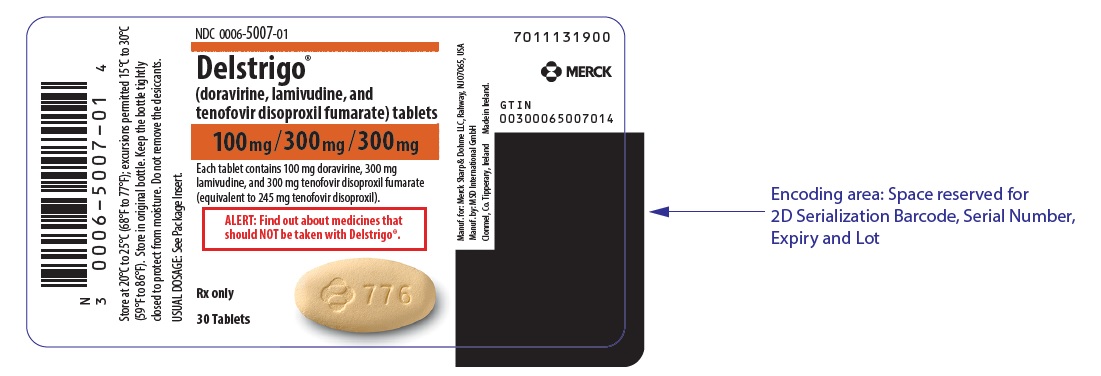
Delstrigo doravirine, lamivudine, and tenofovir disoproxil fumarate 100 mg; 300 mg; 300 mg Tablet, Film Coated, 30-count — NDC 0006-5007-01 (Billing 00006-5007-01)
This is a package of 30 tablets of Delstrigo doravirine, lamivudine, and tenofovir disoproxil fumarate 100 mg; 300 mg; 300 mg Tablet, Film Coated from Merck Sharp & Dohme LLC, marketed since Jul 2018 and currently FDA-listed; retail pharmacies pay about $93.06 per tablet (NADAC). It is this product's only package size.
NDC database record
One package, one record: these facts belong to NDC 0006-5007-01 alone.
- Record
- FDA NDC Directory package listing · Human prescription drug
- Code segments
- 0006 labeler · 5007 product · 01 package
- Package marketed since
- Jul 20, 2018
- Sample package
- No — commercial package
- Listing certified through
- Dec 31, 2027
- Billing quantity
- 30 EA per package
- Barcode (UPC)
- 0300065007014
- Medicaid fills, this package
- 5,434 prescriptions in the last four reported quarters
- FDA record last changed
- Oct 8, 2026
Identity & classification
Regulatory identifiers FDA, NLM and CMS codes for this package
Drug-database identifiers Medi-Span GPI and First Databank GCN / HICL / AHFS classification
- GSN (GCN sequence number): 078822
- GCN: 45217
- GPI-14 (Medi-Span): 12109903270320
- HICL (First Databank): 045195
- AHFS class code: 08:18.08.16
- RxCUI (RxNorm): 2055813
Where does this data come from?
- FDA openFDA NDC Directory · synced Oct 8, 2026
- FDA label on DailyMed · label index refreshed Oct 8, 2026
- RxNorm (NLM RxNav) · catalog refreshed Oct 1, 2026
- Medi-Span GPI (licensed)
- First Databank (licensed) · refreshed Oct 8, 2026
RxNorm drug class
This medicine belongs to the Human Immunodeficiency Virus 1 Non-Nucleoside Analog Reverse Transcriptase Inhibitor class.
Where does this data come from?
- RxClass (NLM) · catalog refreshed Oct 1, 2026
Clinical
- Delstrigo combines three antiretroviral medicines — doravirine, lamivudine, and tenofovir — into one tablet you take once a day. Each drug attacks HIV in a slightly different way,...
- What exactly is Delstrigo, and why is it three drugs in one pill?
- Some common medicines absolutely cannot be taken with Delstrigo — including certain seizure medications, some tuberculosis drugs like rifampin, and even the herbal supplement St. J...
- Can I take Delstrigo with my other medications?
Patient education
Supplement & herbal interactions
Where does this data come from?
- MedlinePlus (NLM) · refreshed Oct 8, 2026
- FDA label on DailyMed · label index refreshed Oct 8, 2026
Ask a licensed pharmacist directly — free, answered by our team.
Pricing
A drug doesn't have one price. Each row is a different public payment system, and none is what you'd pay at the counter — that depends on your insurance. The ⓘ on each row explains what it measures.
| Price system | Per ea | Per package |
|---|---|---|
| Retail pharmacies payNADAC · weekly | $93.061 | $2,791.82 / 30 tablets |
| Medicaid paysCMS SDUD · 12 mo | $91.17 | $2,735.04 / 30 tablets |
| Medicare drug plans payPart D · Q2 2026 | $92.17 | $2,765.03 / 30 tablets |
Where does this data come from?
- CMS NADAC weekly file · file of Oct 7, 2026
- CMS ASP pricing files · refreshed Sep 20, 2026
- CMS Medicaid State Drug Utilization Data · through Q1 2026
- CMS Part D plan pricing files · refreshed Sep 24, 2026
- VA National Acquisition Center price file
Packaging — all sizes for this product
| Package NDC | Description | Marketing start | Marketing end | Status |
|---|---|---|---|---|
| 00006-5007-01 You're viewing this Main listing | 30 TABLET, FILM COATED in 1 BOTTLE | 2018-07-20 | — | Active |
Therapeutic equivalents
| Product | Labeler | Pack | NADAC/unit | TE | Status | Price vs. this |
|---|---|---|---|---|---|---|
| Delstrigo 100 mg/1; 300 mg/1; 300 mgthis 00006-5007-01 | Merck | 30 tablets | $93.061 | — | Availability likely | — |
Where does this data come from?
- FDA openFDA NDC Directory · synced Oct 8, 2026
- FDA Orange Book · refreshed Oct 3, 2026
- CMS NADAC weekly file · file of Oct 7, 2026
Availability & generic status
We did not find an FDA-approved generic match for this exact strength, form and route. Patent/protection dates below may affect future generic timing.
Why the date isn’t exact: Generic timing can change because patents may be challenged, settled, licensed, added, removed, or worked around with a narrower label — and FDA approval does not always mean a pharmacy can get the generic today.
🛈 What do these terms mean?
- Patent
- Legal protection listed in the Orange Book that may delay generic approval or launch. Issued by the U.S. Patent & Trademark Office.
- Substance patent
- Covers the active drug molecule itself — the hardest to design around. A generic generally can’t launch until it expires.
- Formulation (product) patent
- Covers a specific formulation or dosage form. A generic can sometimes work around it with a different formulation.
- Method-of-use patent
- A patent covering one specific approved use of the drug — not necessarily the whole molecule. A generic can sometimes launch with a “skinny label” that carves out the protected use and keeps the others.
- Skinny label
- A generic label that omits a still-patented use when the FDA allows it — letting a generic reach the market for the unprotected uses.
- Exclusivity
- FDA-granted marketing protection, separate from patents — e.g. 5-yr new chemical entity, 7-yr orphan drug, or a +6-month pediatric extension.
- Paragraph IV
- A generic applicant’s formal challenge to a listed patent. It can potentially lead to earlier generic entry, but often involves litigation or a settlement.
- RLD / RS
- Reference Listed Drug — the brand product the FDA uses as the reference for generic applications. Reference Standard — the product the FDA expects generics to compare against in bioequivalence testing.
- TE / AB rating
- FDA therapeutic-equivalence rating. An AB rating generally means the FDA considers a generic therapeutically equivalent to — and substitutable for — the brand.
- LOE (loss of exclusivity)
- The latest patent or exclusivity currently listed — the loss-of-exclusivity / latest-listed-protection date shown on this page. Paragraph-IV challenges and settlements can move the real date earlier; FDA approval and a manufacturer’s decision to market can move it later.
Built from the FDA Orange Book. The bars above are scaled to each protection’s expiry; the red LOE marker is the last one to lapse.
| Patent | Type | Use code | Expires |
|---|---|---|---|
| US 8486975 ↗ | Drug substance | U-2629 | Aug 30, 2032 |
| US 8486975 ↗ | Drug substance | U-2395 | Aug 30, 2032 |
| US 8486975 ↗ | Drug substance | U-3307 | Aug 30, 2032 |
| US 10603282 ↗ | Drug product | — | Nov 29, 2036 |
| US 10842751 ↗ | Drug product | — | Nov 29, 2036 |
Is there a generic version of DELSTRIGO 100-300-300 MG TAB?
The FDA approved a generic — why can’t I get it at my pharmacy yet?
Why do different websites show different generic release dates?
What does “FDA listed” mean?
What does a patent or protection date mean here?
What does “current Orange Book estimate” mean?
Can a generic come out before the last patent expires?
Can a generic come out after the listed dates?
What is the difference between patents and exclusivity?
Why are there multiple patent dates?
Where does this data come from?
- FDA Orange Book · refreshed Oct 3, 2026
Inactive Ingredients / Excipients
Inactive ingredients, also called excipients, are components of the drug product other than the active ingredient. They may include fillers, dyes, coatings, preservatives, flavors, or other formulation ingredients.
🧪 Avoiding an ingredient? See Doravirine, Lamivudine, and Tenofovir inactive ingredients by manufacturer: every current product's list side by side, so you can ask your pharmacy for the version that does not list it.
💡 Tap an ingredient (hover on desktop) to see what it is and why it’s used.
-
UNII R12CBM0EIZ
A natural wax derived from a Brazilian palm tree, used as a coating and polish on tablets and capsules. It creates a smooth, shiny finish that protects the medicine and improves appearance.
-
UNII M28OL1HH48
Croscarmellose sodium is a plant-based substance derived from cellulose. It acts as a disintegrant, helping tablets and capsules break down quickly in the digestive system so the medicine can be absorbed.
-
UNII EX438O2MRT
Ferric oxide yellow is a naturally occurring iron compound used as a colorant in medications. It gives tablets, capsules, and other forms a yellow or golden hue for identification and appearance.
-
UNII 6N003M473W
Hypromellose acetate succinate is a modified cellulose polymer that dissolves in the small intestine. It's used as a coating material to protect the medicine from stomach acid and control where and when the drug is released in the digestive tract.
-
UNII 3NXW29V3WO
Hypromellose is a plant-based thickener made from cellulose. It's used in medicines as a binder to hold ingredients together, a coating for tablets, and a thickener for liquids.
-
UNII EWQ57Q8I5X
Lactose monohydrate is a natural sugar derived from milk. It serves as a filler and binder in tablets and capsules, helping create the proper size, texture, and consistency of the medicine.
-
UNII 70097M6I30
Magnesium stearate is a salt made from magnesium and stearic acid, a fatty substance. It's used in tablets and capsules as a lubricant and glidant to help ingredients flow smoothly during manufacturing and prevent sticking.
-
UNII OP1R32D61U
Microcrystalline cellulose is a purified form of cellulose, a natural fiber from plant sources. It acts as a binder and filler in tablets and capsules, helping hold ingredients together and give the medicine its shape and size.
-
UNII ETJ7Z6XBU4
Silicon dioxide is a naturally occurring mineral used as a glidant and anti-caking agent. It helps powder ingredients flow smoothly and prevents clumping during manufacturing and storage.
-
UNII 7CV7WJK4UI
Sodium stearyl fumarate is a synthetic compound made from stearyl alcohol and fumaric acid. It acts as a lubricant and glidant in tablets and capsules, helping ingredients flow smoothly during manufacturing and preventing sticking.
-
UNII 15FIX9V2JP
Titanium dioxide is a bright white mineral powder commonly used as a colorant and opacifying agent. It makes pills and tablets white or lighter in color and helps make coatings non-transparent.
-
UNII XHX3C3X673
Triacetin is a clear, oily liquid made from glycerin and acetic acid. It works as a plasticizer and solvent in medicines, helping soften coatings and improve how liquids mix together in formulations.
12 inactive ingredients listed in the exact product block matched to this NDC.
Where does this data come from?
ingredient classCode="IACT" elements from the exact product block matched by this NDC. Label-section narrative from DailyMed / the openFDA label index is shown separately when available.- FDA label on DailyMed · label index refreshed Oct 8, 2026
- FDA openFDA NDC Directory · synced Oct 8, 2026
Inactive ingredient FAQ
Are inactive ingredients the same for every manufacturer?
Why might an inactive ingredient be missing?
Can inactive ingredients matter?
Manufacturer & labeler
More NDCs from Merck Sharp & Dohme LLC labeler code 00006
- PNEUMOVAX 23 pneumococcal vaccine polyvalent 1 CAPSULAR POLYSACCHARIDE ANTIGEN 25 ug/.5mL; 2 CAPSULAR POLYSACCHARIDE ANTIGEN 25 ug/.5mL; 3 CAPSULAR POLYSACCHARIDE ANTIGEN 25 ug/.5mL Injection, Solution NDC 0006-4943-00
- RECOMBIVAX HB Hepatitis B Vaccine (Recombinant) 5 ug/.5mL Injection, Suspension NDC 0006-4981-00
- RECOMBIVAX HB Hepatitis B Vaccine (Recombinant) 40 ug/mL Injection, Suspension NDC 0006-4992-00
- RECOMBIVAX HB Hepatitis B Vaccine (Recombinant) 10 ug/mL Injection, Suspension NDC 0006-4995-00
- PREVYMIS LETERMOVIR 20 mg/mL Injection, Solution NDC 0006-5003-01
- PREVYMIS LETERMOVIR 20 mg/mL Injection, Solution NDC 0006-5004-01
- Verquvo vericiguat 2.5 mg Tablet, Film Coated NDC 0006-5028-01
- Verquvo vericiguat 5 mg Tablet, Film Coated NDC 0006-5029-01
- Verquvo vericiguat 10 mg Tablet, Film Coated NDC 0006-5030-01
- Lagevrio molnupiravir 200 mg Capsule NDC 0006-5055-06
- ENFLONSIA CLESROVIMAB 150 mg/mL Injection, Solution NDC 0006-5073-01
- KEYTRUDA QLEX pembrolizumab and berahyaluronidase alfa-pmph 2000 U/mL; 165 mg/mL Injection, Solution NDC 0006-5083-01
Where does this data come from?
- FDA openFDA NDC Directory · synced Oct 8, 2026
- Drugs@FDA
Full prescribing information FDA SPL
🚨 Boxed Warning ▾
WARNING: POSTTREATMENT ACUTE EXACERBATION OF HEPATITIS B Severe acute exacerbations of hepatitis B (HBV) have been reported in people with concomitant HIV-1 and HBV who have discontinued lamivudine or tenofovir disoproxil fumarate (TDF), which are components of DELSTRIGO. Hepatic function should be monitored closely with both clinical and laboratory follow-up for at least several months in patients who are coinfected with HIV-1 and HBV and discontinue DELSTRIGO. If appropriate, initiation of anti-hepatitis B therapy may be warranted [see Warnings and Precautions (5.2) ] .
WARNING: POSTTREATMENT ACUTE EXACERBATION OF HEPATITIS B See full prescribing information for complete boxed warning. Severe acute exacerbations of hepatitis B (HBV) have been reported in people with concomitant HIV-1 and HBV who have discontinued lamivudine or tenofovir disoproxil fumarate (TDF), two of the components of DELSTRIGO. Closely monitor hepatic function in these patients.
If appropriate, initiation of anti-hepatitis B therapy may be warranted. ( 5.2 )
🎯 Indications and Usage ▾
1 INDICATIONS AND USAGE DELSTRIGO ® is indicated as a complete regimen for the treatment of HIV-1 infection in adults and pediatric patients weighing at least 35 kg: with no prior antiretroviral treatment history, OR to replace the current antiretroviral regimen in those who are virologically-suppressed (HIV-1 RNA less than 50 copies per mL) on a stable antiretroviral regimen with no history of treatment failure and no known substitutions associated with resistance to the individual components of DELSTRIGO [see Clinical Studies (14) ] .
DELSTRIGO is a three-drug combination of doravirine (a non-nucleoside reverse transcriptase inhibitor [NNRTI]), lamivudine, and tenofovir disoproxil fumarate (both nucleoside analogue reverse transcriptase inhibitors) and is indicated as a complete regimen for the treatment of HIV-1 infection in adults and pediatric patients weighing at least 35 kg: with no antiretroviral treatment history, OR to replace the current antiretroviral regimen in those who are virologically-suppressed (HIV-1 RNA less than 50 copies per mL) on a stable antiretroviral regimen with no history of treatment failure and no known substitutions associated with resistance to the individual components of DELSTRIGO.
( 1 )
⏱️ Dosage and Administration ▾
2 DOSAGE AND ADMINISTRATION Testing: Prior to or when initiating DELSTRIGO, test for HBV infection. Prior to or when initiating DELSTRIGO, and during treatment with DELSTRIGO, on a clinically appropriate schedule, assess serum creatinine, estimated creatinine clearance, urine glucose and urine protein in all patients. In patients with chronic kidney disease, also assess serum phosphorus .
( 2.1 ) Recommended dosage: One tablet taken orally once daily with or without food in adults and pediatric patients weighing at least 35 kg. ( 2.2 ) Renal impairment: Not recommended in patients with estimated creatinine clearance below 50 mL per minute. ( 2.3 ) Dosage adjustment with rifabutin: Take one tablet of DELSTRIGO once daily, followed by one tablet of doravirine 100 mg (PIFELTRO) approximately 12 hours after the dose of DELSTRIGO.
( 2.4 )
2.1Testing When Initiating and During Treatment with DELSTRIGO Prior to or when initiating DELSTRIGO, test patients for HBV infection [see Warnings and Precautions (5.2) ]. Prior to or when initiating DELSTRIGO, and during treatment with DELSTRIGO, on a clinically appropriate schedule, assess serum creatinine, estimated creatinine clearance, urine glucose, and urine protein in all patients. In patients with chronic kidney disease, also assess serum phosphorus [see Warnings and Precautions (5.3) ].
2.2Recommended Dosage DELSTRIGO is a fixed-dose combination product containing 100 mg of doravirine (DOR), 300 mg of lamivudine (3TC), and 300 mg of TDF. The recommended dosage of DELSTRIGO in adults and pediatric patients weighing at least 35 kg is one tablet taken orally once daily with or without food [see Clinical Pharmacology (12.3) ] .
2.3Renal Impairment Because DELSTRIGO is a fixed-dose combination tablet and the dosage of lamivudine and TDF cannot be adjusted, DELSTRIGO is not recommended in patients with estimated creatinine clearance less than 50 mL/min [see Warnings and Precautions (5.3) and Use in Specific Populations (8.6) ] .
2.4Dosage Adjustment with Rifabutin If DELSTRIGO is co-administered with rifabutin, take one tablet of DELSTRIGO once daily, followed by one tablet of doravirine 100 mg (PIFELTRO) approximately 12 hours after the dose of DELSTRIGO for the duration of rifabutin co-administration [see Drug Interactions (7.2) and Clinical Pharmacology (12.3) ].
💊 Dosage Forms and Strengths ▾
3 DOSAGE FORMS AND STRENGTHS DELSTRIGO film-coated tablets are yellow, oval-shaped tablets, debossed with the corporate logo and 776 on one side and plain on the other side. Each tablet contains 100 mg doravirine, 300 mg lamivudine, and 300 mg tenofovir disoproxil fumarate (equivalent to 245 mg of tenofovir disoproxil). Tablets: 100 mg of doravirine, 300 mg of lamivudine, and 300 mg of tenofovir disoproxil fumarate. ( 3 )
⛔ Contraindications ▾
4 CONTRAINDICATIONS DELSTRIGO is contraindicated when co-administered with drugs that are strong cytochrome P450 (CYP)3A enzyme inducers as significant decreases in doravirine plasma concentrations may occur, which may decrease the effectiveness of DELSTRIGO [see Warnings and Precautions (5.4) , Drug Interactions (7.2) , and Clinical Pharmacology (12.3) ] . These drugs include, but are not limited to, the following: - the anticonvulsants carbamazepine, oxcarbazepine, phenobarbital, phenytoin - the androgen receptor inhibitor enzalutamide - the antimycobacterials rifampin, rifapentine - the cytotoxic agent mitotane - St.
John's wort ( Hypericum perforatum) DELSTRIGO is contraindicated in patients with a previous hypersensitivity reaction to lamivudine. DELSTRIGO is contraindicated when co-administered with drugs that are strong cytochrome P450 (CYP)3A enzyme inducers as significant decreases in doravirine plasma concentrations may occur, which may decrease the effectiveness of DELSTRIGO. ( 4 ) DELSTRIGO is contraindicated in patients with a previous hypersensitivity reaction to lamivudine.
⚠️ Warnings and Cautions ▾
5 WARNINGS AND PRECAUTIONS Severe skin reactions, including Stevens-Johnson syndrome (SJS)/toxic epidermal necrolysis (TEN), and Drug Rash with Eosinophilia and Systemic Symptoms (DRESS), have been reported. Discontinue DELSTRIGO immediately if signs or symptoms of severe skin reactions develop. ( 5.1 ) New onset or worsening renal impairment: Prior to or when initiating DELSTRIGO, and during treatment with DELSTRIGO, on a clinically appropriate schedule, assess serum creatinine, estimated creatinine clearance, urine glucose, and urine protein in all patients.
Avoid administering DELSTRIGO with concurrent or recent use of nephrotoxic drugs. ( 5.3 ) Bone loss and mineralization defects: Consider monitoring BMD in patients with a history of pathologic fracture or other risk factors of osteoporosis or bone loss. ( 5.5 ) Monitor for Immune Reconstitution Syndrome.
( 5.6 )
5.1Skin and Hypersensitivity Reactions Severe skin reactions, including Stevens-Johnson syndrome (SJS)/toxic epidermal necrolysis (TEN), have been reported during the postmarketing experience with doravirine-containing regimens [see Adverse Reactions (6.2) ] . In addition, Drug Rash with Eosinophilia and Systemic Symptoms (DRESS syndrome) was reported in a clinical trial with a two-drug regimen containing doravirine. Discontinue DELSTRIGO, and other medications known to be associated with severe skin reactions, immediately if a painful rash with mucosal involvement, a progressive severe rash, or a rash with constitutional symptoms, eosinophilia, lymphadenopathy, or other organ involvement develops.
Clinical status should be closely monitored, and appropriate therapy should be initiated.
5.2Severe Acute Exacerbation of Hepatitis B in People with Concomitant HIV-1 and HBV All patients with HIV-1 should be tested for the presence of HBV before initiating antiretroviral therapy. Severe acute exacerbations of hepatitis B (e.g., liver decompensated and liver failure) have been reported in people with concomitant HIV-1 and HBV who have discontinued products containing lamivudine and/or TDF, and may occur with discontinuation of DELSTRIGO. Patients who are coinfected with HIV-1 and HBV who discontinue DELSTRIGO should be closely monitored with both clinical and laboratory follow-up for at least several months after stopping treatment with DELSTRIGO.
If appropriate, initiation of anti-hepatitis B therapy may be warranted, especially in patients with advanced liver disease or cirrhosis, since post-treatment exacerbation of hepatitis may lead to hepatic decompensation and liver failure.
5.3New Onset or Worsening Renal Impairment Renal impairment, including cases of acute renal failure and Fanconi syndrome (renal tubular injury with severe hypophosphatemia), has been reported with the use of TDF, a component of DELSTRIGO. DELSTRIGO should be avoided with concurrent or recent use of a nephrotoxic agent (e.g., high-dose or multiple nonsteroidal anti-inflammatory drugs [NSAIDs]) [see Drug Interactions (7.1) ] . Cases of acute renal failure after initiation of high-dose or multiple NSAIDs have been reported in patients living with HIV with risk factors for renal dysfunction who appeared stable on TDF.
Some patients required hospitalization and renal replacement therapy. Alternatives to NSAIDs should be considered, if needed, in patients at risk for renal dysfunction. Persistent or worsening bone pain, pain in extremities, fractures, and/or muscular pain or weakness may be manifestations of proximal renal tubulopathy and should prompt an evaluation of renal function in at-risk patients.
Prior to or when initiating DELSTRIGO, and during treatment with DELSTRIGO, on a clinically appropriate schedule, assess serum creatinine, estimated creatinine clearance, urine glucose and urine protein in all patients. In patients with chronic kidney disease, also assess serum phosphorus. Discontinue DELSTRIGO in patients who develop clinically significant decreases in renal function or eviden… [Excerpted — this section continues on DailyMed.]
🤒 Adverse Reactions ▾
6 ADVERSE REACTIONS The following adverse reactions are discussed in other sections of the labeling: Skin and Hypersensitivity Reactions [see Warnings and Precautions (5.1) ] Severe Acute Exacerbation of Hepatitis B in people with concomitant HIV-1 and HBV [see Warnings and Precautions (5.2) ] New Onset or Worsening Renal Impairment [see Warnings and Precautions (5.3) ] Bone Loss and Mineralization Defects [see Warnings and Precautions (5.5) ] Immune Reconstitution Syndrome [see Warnings and Precautions (5.6) ] Most common adverse reactions (incidence greater than or equal to 5%, all grades) are dizziness, nausea, and abnormal dreams.
( 6.1 ) To report SUSPECTED ADVERSE REACTIONS, contact Merck Sharp & Dohme LLC at 1-877-888-4231 or FDA at 1-800-FDA-1088 or www.fda.gov/medwatch .
6.1Clinical Trials Experience Because clinical trials are conducted under widely varying conditions, adverse reaction rates observed in the clinical trials of a drug cannot be directly compared to rates in the clinical trials of another drug and may not reflect the rates observed in practice. Adverse Reactions in Adults with No Antiretroviral Treatment History The safety assessment of DELSTRIGO is based on Week 96 data from two Phase 3, randomized, international, multicenter, double-blind, active-controlled trials.
A total of 747 participants received doravirine either as the single entity in combination with other antiretroviral drugs as background regimens (n=383) or as the fixed-dose DELSTRIGO (n=364), and a total of 747 participants were randomized to control arms. In DRIVE-AHEAD (Protocol 021), 728 adult participants received either DELSTRIGO (n=364) or EFV/FTC/TDF once daily (n=364). By Week 96, 3% in the DELSTRIGO group and 7% in the EFV/FTC/TDF group had adverse events leading to discontinuation of study medication.
Adverse reactions reported in greater than or equal to 5% of participants in any treatment group in DRIVE-AHEAD are presented in Table 1. Table 1: Adverse Reactions Frequencies of adverse reactions are based on all adverse events attributed to trial drugs by the investigator. (All Grades) Reported in ≥5% No adverse reactions of Grade 2 or higher (moderate or severe) occurred in ≥2% of participants treated with DELSTRIGO. of Participants in Any Treatment Group in Adults with No Antiretroviral Treatment History in DRIVE-AHEAD (Week 96) DELSTRIGO Once Daily N=364 EFV/FTC/TDF Once Daily N=364 Dizziness 7% 32% Nausea 5% 7% Abnormal Dreams 5% 10% Headache 4% 5% Insomnia 4% 5% Diarrhea 4% 6% Somnolence 3% 7% Rash Rash: includes rash, rash erythematous, rash generalized, rash macular, rash maculo-papular, rash papular, rash pruritic.
2% 12% The majority (66%) of adverse reactions associated with DELSTRIGO occurred at severity Grade 1 (mild). Neuropsychiatric Adverse Events For DRIVE-AHEAD, the analysis of participants with neuropsychiatric adverse events by Week 48 is presented in Table 2. The proportion of participants who reported one or more neuropsychiatric adverse events was 24% and 57% in the DELSTRIGO and EFV/FTC/TDF groups, respectively.
A statistically significantly lower proportion of DELSTRIGO-treated participants compared to EFV/FTC/TDF-treated participants reported neuropsychiatric adverse events by Week 48 in the three pre-specified categories of dizziness, sleep disorders and disturbances, and altered sensorium. Table 2: DRIVE-AHEAD - Analysis of Participants with Neuropsychiatric Adverse Events All causality and all grade events were included in the analysis. (Week 48) DELSTRIGO Once Daily N=364 EFV/FTC/TDF Once Daily N=364 Treatment Difference (DELSTRIGO - EFV/FTC/TDF) Estimate (95% CI) The 95% CIs were calculated using Miettinen and Nurminen's method.
Categories pre-specified for statistical testing were dizziness (p <0.001), sleep disorders and disturbances (p <0.001), and altered sensorium (p=0.033). Sleep disorders and disturbances Predefined using MedDRA preferred terms including: abnormal dreams, hyposomnia, initial… [Excerpted — this section continues on DailyMed.]
🔄 Drug Interactions ▾
7 DRUG INTERACTIONS Because DELSTRIGO is a complete regimen, co-administration with other antiretroviral medications for treatment of HIV-1 infection is not recommended. ( 7.1 ) Consult the full prescribing information prior to and during treatment for important potential drug-drug interactions. ( 4 , 5.4 , 7 )
7.1Concomitant Use with Other Antiretroviral Medications Because DELSTRIGO is a complete regimen for the treatment of HIV-1 infection, co-administration with other antiretroviral medications for treatment of HIV-1 infection is not recommended. Information regarding potential drug-drug interactions with other antiretroviral medications is not provided.
7.2Effect of Other Drugs on DELSTRIGO Co-administration of DELSTRIGO with a CYP3A inducer decreases doravirine plasma concentrations, which may reduce DELSTRIGO efficacy [see Contraindications (4) , Warnings and Precautions (5.4) , and Clinical Pharmacology (12.3) ] . Co-administration of DELSTRIGO and drugs that are inhibitors of CYP3A may result in increased plasma concentrations of doravirine. Table 6 shows the significant drug interactions with the components of DELSTRIGO.
The drug interactions described are based on studies conducted with either DELSTRIGO or the components of DELSTRIGO as individual agents. Table 6: Drug Interactions with DELSTRIGO This table is not all-inclusive Concomitant Drug Class: Drug Name Effect on Concentration Clinical Comment ↑ = increase, ↓ = decrease All other drug-drug interactions shown are anticipated based on the known metabolic and elimination pathways. Androgen Receptors enzalutamide ↓ doravirine Co-administration is contraindicated with enzalutamide.
At least a 4-week cessation period is recommended prior to initiation of DELSTRIGO. Anticonvulsants carbamazepine oxcarbazepine phenobarbital phenytoin ↓ doravirine Co-administration is contraindicated with these anticonvulsants. At least a 4-week cessation period is recommended prior to initiation of DELSTRIGO.
Antimycobacterials rifampin The interaction between doravirine and the concomitant drug was evaluated in a clinical study. rifapentine ↓ doravirine Co-administration is contraindicated with rifampin or rifapentine. At least a 4-week cessation period is recommended prior to initiation of DELSTRIGO. rifabutin ↓ doravirine If DELSTRIGO is co-administered with rifabutin, one tablet of doravirine (PIFELTRO) should be taken approximately 12 hours after the dose of DELSTRIGO [see Dosage and Administration (2.4) ] . Cytotoxic Agents mitotane ↓ doravirine Co-administration is contraindicated with mitotane.
At least a 4-week cessation period is recommended prior to initiation of DELSTRIGO. Hepatitis C Antiviral Agents ledipasvir/sofosbuvir sofosbuvir/velpatasvir ↑ tenofovir Monitor for adverse reactions associated with TDF. Herbal Products St.
John's wort ↓ doravirine Co-administration is contraindicated with St. John's wort. At least a 4-week cessation period is recommended prior to initiation of DELSTRIGO.
Other Agents sorbitol ↓ lamivudine Co-administration of single doses of lamivudine and sorbitol resulted in a sorbitol dose-dependent reduction in lamivudine exposures. When possible, avoid use of sorbitol-containing medicines with lamivudine-containing medicines. Co-administration of DELSTRIGO with drugs that reduce renal function or compete for active tubular secretion may increase serum concentrations of lamivudine, tenofovir, and/or other renally eliminated drugs.
Some examples of drugs that are eliminated by active tubular secretion include, but are not limited to, acyclovir, cidofovir, ganciclovir, valacyclovir, valganciclovir, aminoglycosides (e.g., gentamicin), and high-dose or multiple NSAIDs [see Warnings and Precautions (5.3) and Clinical Pharmacology (12.3) ] . No clinically significant changes in concentration were observed for doravirine when co-administered with the following agents: TDF, lamivudine, elbasvir and grazoprevir, ledipasvir and sofosbuvir, ritonavir, ket… [Excerpted — this section continues on DailyMed.]
👥 Use in Specific Populations ▾
8 USE IN SPECIFIC POPULATIONS Pediatrics: Not recommended for patients weighing less than 35 kg. ( 8.4 )
8.1Pregnancy Pregnancy Exposure Registry There is a pregnancy exposure registry that monitors pregnancy outcomes in individuals exposed to DELSTRIGO during pregnancy. Healthcare providers are encouraged to register patients by calling the Antiretroviral Pregnancy Registry (APR) at 1-800-258-4263. Risk Summary There is insufficient prospective pregnancy data from the APR to adequately assess the risk of birth defects and miscarriage.
Doravirine use in individuals during pregnancy has not been evaluated; however, lamivudine and TDF use during pregnancy has been evaluated in a limited number of individuals reported to the APR. Available data from the APR show no difference in the overall risk of major birth defects for lamivudine and TDF compared with the background rate for major birth defects of 2.7% in the U.S. reference population of the Metropolitan Atlanta Congenital Defects Program (MACDP) ( see Data ) . The rate of miscarriage is not reported in the APR.
The estimated background rate of miscarriage in the clinically recognized pregnancies in the U.S. general population is 15-20%. Methodological limitations of the APR include the use of MACDP as the external comparator group. The MACDP population is not disease-specific, evaluates individuals and infants from the limited geographic area, and does not include outcomes for births that occurred at less than 20 weeks gestation.
In animal reproduction studies, oral administration of lamivudine to pregnant rabbits during organogenesis resulted in embryolethality at systemic exposure (AUC) similar to the recommended clinical dose; however, no adverse development effects were observed with oral administration of lamivudine to pregnant rats during organogenesis at plasma concentrations (C max ) 35 times the recommended clinical dose. No adverse developmental effects were observed when doravirine and TDF were administered separately at doses/exposures ≥8 (doravirine) and ≥14 (TDF) times those of the recommended human dose (RHD) of DELSTRIGO ( see Data ).
Data Human Data Lamivudine : The APR has received a total of over 13,000 prospective reports with follow-up data of possible exposure to lamivudine-containing regimens; over 5,900 reports in the first trimester; over 5,600 reports in the second trimester; and over 1,800 reports in the third trimester. Birth defects occurred in 170 of 5,472 (3.1%, 95% CI: 2.7% to 3.6%) live births for lamivudine-containing regimens (first trimester exposure); and 218 of 7,513 (2.9%, 95% CI: 2.5% to 3.3%) live births for lamivudine-containing regimens (second/third trimester exposure).
Among pregnant mothers in the U.S. reference population, the background rate of birth defects is 2.7%. There was no association between lamivudine and overall birth defects observed in the APR. TDF : The APR has received a total of over 7,000 prospective reports with follow-up data of possible exposure to tenofovir disoproxil-containing regimens; over 5,100 reports in the first trimester; over 1,300 reports in the second trimester; and over 600 reports in the third trimester.
Birth defects occurred in 113 of 4,576 (2.5%, 95% CI: 2.0% to 3.0%) live births for TDF-containing regimens (first trimester exposure); and 51 of 1,965 (2.6%, 95% CI: 1.9% to 3.4%) live births for TDF-containing regimens (second/third trimester exposure). Among pregnant mothers in the U.S. reference population, the background rate of birth defects is 2.7%. There was no association between tenofovir and overall birth defects observed in the APR.
Animal Data Doravirine : Doravirine was administered orally to pregnant rabbits (up to 300 mg/kg/day on gestation days (GD) 7 to 20) and rats (up to 450 mg/kg/day on GD 6 to 20 and separately from GD 6 to lactation/postpartum day 20). No significant toxicological effects on embryo-fetal (rats and rabbits) or pre/post-natal (rats) development were observe… [Excerpted — this section continues on DailyMed.]
🤰 Pregnancy ▾
8.1Pregnancy Pregnancy Exposure Registry There is a pregnancy exposure registry that monitors pregnancy outcomes in individuals exposed to DELSTRIGO during pregnancy. Healthcare providers are encouraged to register patients by calling the Antiretroviral Pregnancy Registry (APR) at 1-800-258-4263. Risk Summary There is insufficient prospective pregnancy data from the APR to adequately assess the risk of birth defects and miscarriage.
Doravirine use in individuals during pregnancy has not been evaluated; however, lamivudine and TDF use during pregnancy has been evaluated in a limited number of individuals reported to the APR. Available data from the APR show no difference in the overall risk of major birth defects for lamivudine and TDF compared with the background rate for major birth defects of 2.7% in the U.S. reference population of the Metropolitan Atlanta Congenital Defects Program (MACDP) ( see Data ) . The rate of miscarriage is not reported in the APR.
The estimated background rate of miscarriage in the clinically recognized pregnancies in the U.S. general population is 15-20%. Methodological limitations of the APR include the use of MACDP as the external comparator group. The MACDP population is not disease-specific, evaluates individuals and infants from the limited geographic area, and does not include outcomes for births that occurred at less than 20 weeks gestation.
In animal reproduction studies, oral administration of lamivudine to pregnant rabbits during organogenesis resulted in embryolethality at systemic exposure (AUC) similar to the recommended clinical dose; however, no adverse development effects were observed with oral administration of lamivudine to pregnant rats during organogenesis at plasma concentrations (C max ) 35 times the recommended clinical dose. No adverse developmental effects were observed when doravirine and TDF were administered separately at doses/exposures ≥8 (doravirine) and ≥14 (TDF) times those of the recommended human dose (RHD) of DELSTRIGO ( see Data ).
Data Human Data Lamivudine : The APR has received a total of over 13,000 prospective reports with follow-up data of possible exposure to lamivudine-containing regimens; over 5,900 reports in the first trimester; over 5,600 reports in the second trimester; and over 1,800 reports in the third trimester. Birth defects occurred in 170 of 5,472 (3.1%, 95% CI: 2.7% to 3.6%) live births for lamivudine-containing regimens (first trimester exposure); and 218 of 7,513 (2.9%, 95% CI: 2.5% to 3.3%) live births for lamivudine-containing regimens (second/third trimester exposure).
Among pregnant mothers in the U.S. reference population, the background rate of birth defects is 2.7%. There was no association between lamivudine and overall birth defects observed in the APR. TDF : The APR has received a total of over 7,000 prospective reports with follow-up data of possible exposure to tenofovir disoproxil-containing regimens; over 5,100 reports in the first trimester; over 1,300 reports in the second trimester; and over 600 reports in the third trimester.
Birth defects occurred in 113 of 4,576 (2.5%, 95% CI: 2.0% to 3.0%) live births for TDF-containing regimens (first trimester exposure); and 51 of 1,965 (2.6%, 95% CI: 1.9% to 3.4%) live births for TDF-containing regimens (second/third trimester exposure). Among pregnant mothers in the U.S. reference population, the background rate of birth defects is 2.7%. There was no association between tenofovir and overall birth defects observed in the APR.
Animal Data Doravirine : Doravirine was administered orally to pregnant rabbits (up to 300 mg/kg/day on gestation days (GD) 7 to 20) and rats (up to 450 mg/kg/day on GD 6 to 20 and separately from GD 6 to lactation/postpartum day 20). No significant toxicological effects on embryo-fetal (rats and rabbits) or pre/post-natal (rats) development were observed at exposures (AUC) approximately 9 times (rats) and 8 times (rabbits) the exposure in humans at the RHD… [Excerpted — this section continues on DailyMed.]
🧒 Pediatric Use ▾
8.4Pediatric Use The safety and efficacy of DELSTRIGO for the treatment of HIV-1 infection have been established in pediatric patients weighing at least 35 kg [see Indications and Usage (1) and Dosage and Administration (2.2) ] . Use of DELSTRIGO in this group is supported by evidence from adequate and well-controlled trials in adults with additional pharmacokinetic, safety, and efficacy data from an open-label trial in virologically-suppressed or treatment-naïve pediatric participants 12 to less than 18 years of age.
The safety and efficacy of DELSTRIGO in these pediatric participants were similar to that in adults, and there was no clinically significant difference in exposure for the components of DELSTRIGO. [see Adverse Reactions (6.1) , Clinical Pharmacology (12.3) , and Clinical Studies (14.3) ]. Safety and efficacy of DELSTRIGO in pediatric patients weighing less than 35 kg have not been established.
🧓 Geriatric Use ▾
8.5Geriatric Use Clinical trials of doravirine, lamivudine, or TDF did not include sufficient numbers of participants aged 65 years and over to determine whether they respond differently from younger participants. In general, caution should be exercised in the administration of DELSTRIGO in elderly patients reflecting the greater frequency of decreased hepatic, renal, or cardiac function, and of concomitant disease or other drug therapy [see Clinical Pharmacology (12.3) ].
🆘 Overdosage ▾
10 OVERDOSAGE No data are available on overdose of DELSTRIGO in patients and there is no known specific treatment for overdose with DELSTRIGO. If overdose occurs, the patient should be monitored and standard supportive treatment applied as required. Doravirine : There is no known specific treatment for overdose with doravirine.
Lamivudine : Because a negligible amount of lamivudine was removed via (4-hour) hemodialysis, continuous ambulatory peritoneal dialysis, and automated peritoneal dialysis, it is not known if continuous hemodialysis would provide clinical benefit in a lamivudine overdose event. TDF : TDF is efficiently removed by hemodialysis with an extraction coefficient of approximately 54%. Following a single 300 mg dose of TDF, a 4-hour hemodialysis session removed approximately 10% of the administered tenofovir dose.
🧬 Clinical Pharmacology ▾
12 CLINICAL PHARMACOLOGY
12.1Mechanism of Action DELSTRIGO is a fixed-dose combination of the antiretroviral drugs doravirine, lamivudine, and TDF [see Microbiology (12.4) ].
12.2Pharmacodynamics In a Phase 2 trial evaluating doravirine over a dose range of 0.25 to 2 times the recommended dose of doravirine in DELSTRIGO (in combination with FTC/TDF) in participants living with HIV with no antiretroviral treatment history, no exposure-response relationship for efficacy was identified for doravirine. Cardiac Electrophysiology At a doravirine dose of 1200 mg, which provides approximately 4 times the peak concentration observed following the recommended dose of doravirine in DELSTRIGO does not prolong the QT interval to any clinically relevant extent.
12.3Pharmacokinetics Single-dose administration of one DELSTRIGO tablet to healthy participants provided comparable exposures of doravirine, lamivudine, and tenofovir to administration of doravirine tablets (100 mg) plus lamivudine tablets (300 mg) plus TDF tablets (300 mg). Doravirine pharmacokinetics are similar in healthy participants and participants living with HIV. Pharmacokinetic properties of the components of DELSTRIGO are provided in Table 7.
Table 7: Pharmacokinetic Properties of the Components of DELSTRIGO Parameter Doravirine Lamivudine Tenofovir Abbreviations: NA=not available; AUC=area under the time concentration curve; C max =maximum concentration; C 24 =concentration at 24 hours; T max =time to C max ; V dss =apparent volume of distribution at steady state; t 1/2 =elimination half-life; CL/F=apparent clearance; CL renal = renal clearance General Steady State Exposure Presented as geometric mean (%CV: geometric coefficient of variation) or mean ± SD.
AUC 0-24 (mcg∙h/mL) 16.1 (29) Doravirine 100 mg once daily to participants living with HIV. 8.87 ±
1.83Lamivudine 300 mg once daily for 7 days to 60 healthy participants. 2.29 ±
0.69Single 300 mg dose of TDF to participants living with HIV in the fasted state. C max (mcg/mL) 0.962 (19) 2.04 ± 0.54 0.30 ±
0.09C 24 (mcg/mL) 0.396 (63) NA NA Absorption Absolute Bioavailability 64% 86% 25% T max (h) 2 NA 1 Effect of Food Geometric mean ratio [high-fat meal/fasting] and (90% confidence interval) for PK parameters. High fat meal is approximately 1000 kcal, 50% fat. The effect of food is not clinically relevant.
AUC Ratio 1.10 (1.01, 1.20) 0.93 (0.84, 1.03) 1.27 (1.17, 1.37) C max Ratio 0.95 (0.80, 1.12) 0.81 (0.65, 1.01) 0.88 (0.74, 1.04) C 24 Ratio 1.26 (1.13, 1.41) NA NA Distribution V dss Based on IV dose .
60.5 L
1.3 L/kg
1.3L/kg Plasma Protein Binding 76% < 36% <0.7% Elimination t 1/2 (h) 15 5-7 17 CL/F (mL/ min) 106 (35.2) 398.5 ± 69.1 1,043.7 ± 115.4 CL renal (mL/ min) 9.3 (18.6) 199.7 ± 56.9 243.5 ±
33.3Metabolism Primary Pathway(s) CYP3A Minor No CYP Metabolism Excretion Major route of elimination Metabolism Glomerular filtration and active tubular secretion Glomerular filtration and active tubular secretion Urine (unchanged) 6% 71% 70-80% Biliary/Fecal (unchanged) Minor NA NA Specific Populations In adults, no clinically significant differences in the pharmacokinetics of certain DELSTRIGO components were observed based on age ≥65 years (for doravirine), sex (for doravirine, lamivudine, tenofovir), and race/ethnicity (for doravirine, lamivudine).
The effects of age (≥65 years) on the pharmacokinetics of lamivudine and tenofovir, and the effect of race on the pharmacokinetics of tenofovir are unknown. Patients with Renal Impairment Doravirine : No clinically significant difference in the pharmacokinetics of doravirine were observed in participants with mild to severe renal impairment (creatinine clearance (CLcr) >15 mL/min, estimated by Cockcroft-Gault). Doravirine has not been studied in patients with end-stage renal disease or in patients undergoing dialysis.
Lamivudine: The AUC ∞ , C max , and half-life of lamivudine increased and CL/F decreased to a clinically significant extent with diminishing renal funct… [Excerpted — this section continues on DailyMed.]
🧬 Mechanism of Action ▾
12.1Mechanism of Action DELSTRIGO is a fixed-dose combination of the antiretroviral drugs doravirine, lamivudine, and TDF [see Microbiology (12.4) ].
📦 How Supplied / Storage and Handling ▾
16 HOW SUPPLIED/STORAGE AND HANDLING Each DELSTRIGO tablet contains 100 mg of doravirine, 300 mg of lamivudine, and 300 mg of tenofovir disoproxil fumarate (equivalent to 245 mg of tenofovir disoproxil), is yellow, oval-shaped, film-coated, and is debossed with the corporate logo and 776 on one side and plain on the other side. Each bottle contains 30 tablets (NDC 0006-5007-01) and silica gel desiccants, and is closed with a child-resistant closure. Store DELSTRIGO in the original bottle.
Keep the bottle tightly closed to protect from moisture. Do not remove the desiccants. Store DELSTRIGO at 20°C to 25°C (68°F to 77°F); excursions permitted to 15°C to 30°C (59°F to 86°F) [see USP Controlled Room Temperature].
📦 Storage and Handling ▾
Store DELSTRIGO in the original bottle. Keep the bottle tightly closed to protect from moisture. Do not remove the desiccants. Store DELSTRIGO at 20°C to 25°C (68°F to 77°F); excursions permitted to 15°C to 30°C (59°F to 86°F) [see USP Controlled Room Temperature].
📋 Description ▾
11 DESCRIPTION DELSTRIGO is a fixed-dose combination, film-coated tablet, containing doravirine, lamivudine, and TDF for oral administration. Doravirine is an HIV-1 non-nucleoside reverse transcriptase inhibitor (NNRTI). Lamivudine is the (-)enantiomer of a dideoxy analogue of cytidine and is an HIV-1 nucleoside analogue reverse transcriptase inhibitor.
TDF (a prodrug of tenofovir) is a fumaric acid salt of the bis-isopropoxycarbonyloxymethyl ester derivative of tenofovir. In vivo TDF is converted to tenofovir, an acyclic nucleoside phosphonate (nucleotide) analog of adenosine 5'-monophosphate. Tenofovir is an HIV-1 reverse transcriptase inhibitor.
Each tablet contains 100 mg of doravirine, 300 mg of lamivudine, and 300 mg of TDF (equivalent to 245 mg of tenofovir disoproxil) as active ingredients. The tablets include the following inactive ingredients: colloidal silicon dioxide, croscarmellose sodium, hypromellose acetate succinate, magnesium stearate, microcrystalline cellulose, and sodium stearyl fumarate. The tablets are film coated with a coating material containing the following inactive ingredients: hypromellose, iron oxide yellow, lactose monohydrate, titanium dioxide, and triacetin.
The coated tablets are polished with carnauba wax. Doravirine : The chemical name for doravirine is 3-chloro-5-[[1-[(4,5-dihydro-4-methyl-5-oxo-1 H -1,2,4-triazol-3-yl)methyl]-1,2-dihydro-2-oxo-4-(trifluoromethyl)-3-pyridinyl]oxy]benzonitrile. It has a molecular formula of C 17 H 11 ClF 3 N 5 O 3 and a molecular weight of 425.75.
It has the following structural formula: Doravirine is practically insoluble in water. Chemical Structure Lamivudine : The chemical name for lamivudine is (-)-1-[(2 R ,5 S )-2-(hydroxymethyl)-1,3-oxathiolan-5-yl]-cytosine. It has a molecular formula of C 8 H 11 N 3 O 3 S and a molecular weight of 229.26.
It has the following structural formula: Lamivudine is soluble in water. Chemical Structure TDF : The chemical name for TDF is 9-[(R)-2-[[bis[[(isopropoxycarbonyl)oxy]methoxy] phosphinyl]- methoxy]propyl]adenine fumarate (1:1). It has a molecular formula of C 19 H 30 N 5 O 10 P∙C 4 H 4 O 4 and a molecular weight of 635.52.
It has the following structural formula: TDF is slightly soluble in water. Chemical Structure
💬 Information for Patients ▾
17 PATIENT COUNSELING INFORMATION Advise the patient to read the FDA-approved patient labeling (Patient Information). Skin and Hypersensitivity Reactions Inform patients that severe skin reactions including Stevens-Johnson syndrome (SJS)/toxic epidermal necrolysis (TEN) and Drug Rash with Eosinophilia and Systemic Symptoms (DRESS) have been reported with doravirine-containing regimens. Advise patients to immediately contact their healthcare provider if they develop a rash.
Instruct patients to immediately stop taking DELSTRIGO and seek medical attention if a painful rash with mucosal involvement or a rash with constitutional symptoms develops [see Warnings and Precautions (5.1) ] . Severe Acute Exacerbation of Hepatitis B in people with concomitant HIV-1 and HBV Inform patients that severe acute exacerbations of hepatitis B have been reported in people with concomitant HIV-1 and HBV who have discontinued lamivudine or TDF and may occur with discontinuation of DELSTRIGO [see Warnings and Precautions (5.2) ] .
Advise patients not to discontinue DELSTRIGO without first informing their healthcare provider. Drug Interactions Inform patients that DELSTRIGO may interact with certain other drugs; therefore, advise patients to report to their healthcare provider the use of any other prescription or nonprescription medication or herbal products, including St. John's wort [see Contraindications (4) , Warnings and Precautions (5.4) , and Drug Interactions (7) ] .
For patients concomitantly receiving rifabutin, take one tablet of doravirine (PIFELTRO) 100 mg approximately 12 hours after the dose of DELSTRIGO [see Dosage and Administration (2.4) ] . New Onset or Worsening Renal Impairment Inform patients that renal impairment, including cases of acute renal failure and Fanconi syndrome, has been reported in association with the use of TDF. Advise patients to avoid DELSTRIGO with concurrent or recent use of a nephrotoxic agent (e.g., high-dose or multiple NSAIDS) [see Warnings and Precautions (5.3) ].
Bone Loss and Mineralization Defects Inform patients that decreases in bone mineral density have been observed with the use of TDF, a component of DELSTRIGO. Assessment of bone mineral density (BMD) should be considered in patients who have a history of pathologic bone fracture or other risk factors for osteoporosis or bone loss [see Warnings and Precautions (5.5) ] . Immune Reconstitution Syndrome Inform patients that in some patients with advanced HIV infection (AIDS), signs and symptoms of inflammation from previous infections may occur soon after anti-HIV treatment is started.
It is believed that these symptoms are due to an improvement in the body's immune response, enabling the body to fight infections that may have been present with no obvious symptoms. Advise patients to inform their healthcare provider immediately of any symptoms of infection [see Warnings and Precautions (5.6) ] . Dosing Instructions Advise patients to take DELSTRIGO every day at a regularly scheduled time with or without food.
Inform patients that it is important not to miss or skip doses as it can result in development of resistance. If a patient forgets to take DELSTRIGO, tell the patient to take the missed dose right away, unless it is almost time for the next dose. Advise the patient not to take 2 doses at one time and to take the next dose at the regularly scheduled time.
Pregnancy Registry Inform patients that there is an antiretroviral pregnancy registry to monitor fetal outcomes of pregnant individuals exposed to DELSTRIGO [see Use in Specific Populations (8.1) ]. Lactation Inform individuals with HIV-1 infection that the potential risks of breastfeeding include: (1) HIV-1 transmission (in HIV-1-negative infants), (2) developing viral resistance (in HIV-1-positive infants), and (3) serious adverse reactions in a breastfed infant similar to those seen in adults [see Use in Specific Populations (8.2) ].
🧬 Pharmacokinetics ▾
12.3Pharmacokinetics Single-dose administration of one DELSTRIGO tablet to healthy participants provided comparable exposures of doravirine, lamivudine, and tenofovir to administration of doravirine tablets (100 mg) plus lamivudine tablets (300 mg) plus TDF tablets (300 mg). Doravirine pharmacokinetics are similar in healthy participants and participants living with HIV. Pharmacokinetic properties of the components of DELSTRIGO are provided in Table 7.
Table 7: Pharmacokinetic Properties of the Components of DELSTRIGO Parameter Doravirine Lamivudine Tenofovir Abbreviations: NA=not available; AUC=area under the time concentration curve; C max =maximum concentration; C 24 =concentration at 24 hours; T max =time to C max ; V dss =apparent volume of distribution at steady state; t 1/2 =elimination half-life; CL/F=apparent clearance; CL renal = renal clearance General Steady State Exposure Presented as geometric mean (%CV: geometric coefficient of variation) or mean ± SD.
AUC 0-24 (mcg∙h/mL) 16.1 (29) Doravirine 100 mg once daily to participants living with HIV. 8.87 ±
1.83Lamivudine 300 mg once daily for 7 days to 60 healthy participants. 2.29 ±
0.69Single 300 mg dose of TDF to participants living with HIV in the fasted state. C max (mcg/mL) 0.962 (19) 2.04 ± 0.54 0.30 ±
0.09C 24 (mcg/mL) 0.396 (63) NA NA Absorption Absolute Bioavailability 64% 86% 25% T max (h) 2 NA 1 Effect of Food Geometric mean ratio [high-fat meal/fasting] and (90% confidence interval) for PK parameters. High fat meal is approximately 1000 kcal, 50% fat. The effect of food is not clinically relevant.
AUC Ratio 1.10 (1.01, 1.20) 0.93 (0.84, 1.03) 1.27 (1.17, 1.37) C max Ratio 0.95 (0.80, 1.12) 0.81 (0.65, 1.01) 0.88 (0.74, 1.04) C 24 Ratio 1.26 (1.13, 1.41) NA NA Distribution V dss Based on IV dose .
60.5 L
1.3 L/kg
1.3L/kg Plasma Protein Binding 76% < 36% <0.7% Elimination t 1/2 (h) 15 5-7 17 CL/F (mL/ min) 106 (35.2) 398.5 ± 69.1 1,043.7 ± 115.4 CL renal (mL/ min) 9.3 (18.6) 199.7 ± 56.9 243.5 ±
33.3Metabolism Primary Pathway(s) CYP3A Minor No CYP Metabolism Excretion Major route of elimination Metabolism Glomerular filtration and active tubular secretion Glomerular filtration and active tubular secretion Urine (unchanged) 6% 71% 70-80% Biliary/Fecal (unchanged) Minor NA NA Specific Populations In adults, no clinically significant differences in the pharmacokinetics of certain DELSTRIGO components were observed based on age ≥65 years (for doravirine), sex (for doravirine, lamivudine, tenofovir), and race/ethnicity (for doravirine, lamivudine).
The effects of age (≥65 years) on the pharmacokinetics of lamivudine and tenofovir, and the effect of race on the pharmacokinetics of tenofovir are unknown. Patients with Renal Impairment Doravirine : No clinically significant difference in the pharmacokinetics of doravirine were observed in participants with mild to severe renal impairment (creatinine clearance (CLcr) >15 mL/min, estimated by Cockcroft-Gault). Doravirine has not been studied in patients with end-stage renal disease or in patients undergoing dialysis.
Lamivudine: The AUC ∞ , C max , and half-life of lamivudine increased and CL/F decreased to a clinically significant extent with diminishing renal function (CLcr 111 to < 10 mL/min). TDF : A clinically significant increase in the C max and AUC of tenofovir was observed in participants with CLcr < 50 mL/min or with end stage renal disease requiring dialysis [see Warnings and Precautions (5.3) and Use in Specific Populations (8.6) ] . Patients with Hepatic Impairment Doravirine : No clinically significant difference in the pharmacokinetics of doravirine was observed in participants with moderate hepatic impairment (Child-Pugh score B) compared to participants without hepatic impairment.
Doravirine has not been studied in participants with severe hepatic impairment (Child-Pugh score C). Lamivudine: No clinically significant differences in lamivudine pharmacokinetics were observed with diminishing hepat… [Excerpted — this section continues on DailyMed.]
🧬 Pharmacodynamics ▾
12.2Pharmacodynamics In a Phase 2 trial evaluating doravirine over a dose range of 0.25 to 2 times the recommended dose of doravirine in DELSTRIGO (in combination with FTC/TDF) in participants living with HIV with no antiretroviral treatment history, no exposure-response relationship for efficacy was identified for doravirine. Cardiac Electrophysiology At a doravirine dose of 1200 mg, which provides approximately 4 times the peak concentration observed following the recommended dose of doravirine in DELSTRIGO does not prolong the QT interval to any clinically relevant extent.
🔬 Clinical Studies ▾
14 CLINICAL STUDIES
14.1Clinical Trial Results in Adults with No Antiretroviral Treatment History The efficacy of DELSTRIGO is based on the analyses of 96-week data from a randomized, multicenter, double-blind, active controlled Phase 3 trial (DRIVE-AHEAD, NCT02403674) in participants living with HIV with no antiretroviral treatment history (n=728). Participants were randomized and received at least 1 dose of either DELSTRIGO or EFV 600 mg/FTC 200 mg/TDF 300 mg once daily. At baseline, the median age of participants was 31 years, 15% were female, 52% were Non-White, 3% had hepatitis B or C coinfection, 14% had a history of AIDS, 21% had HIV-1 RNA greater than 100,000 copies/mL, and 88% had CD4+ T-cell count greater than 200 cells/mm 3 ; these characteristics were similar between treatment groups.
Week 96 outcomes for DRIVE-AHEAD are provided in Table 10. Mean CD4+ T-cell counts in the DELSTRIGO and EFV/FTC/TDF groups increased from baseline by 238 and 223 cells/mm 3 , respectively. Table 10: Virologic Outcome in DRIVE-AHEAD at Week 96 in HIV-1 Adult Participants with No Antiretroviral Treatment History Outcome DELSTRIGO Once Daily N=364 EFV/FTC/TDF Once Daily N=364 HIV-1 RNA <50 copies/mL 77% 74% Treatment Difference (95% CI) The 95% CI for the treatment difference was calculated using stratum-adjusted Mantel-Haenszel method.
3.8% (-2.4%, 10.0%) HIV-1 RNA ≥ 50 copies/mL Includes participants who discontinued study drug or study before Week 96 for lack or loss of efficacy and participants with HIV-1 RNA equal to or above 50 copies/mL in the Week 96 window. 15% 12% No Virologic Data at Week 96 Window 7% 14% Discontinued study due to AE or Death Includes participants who discontinued because of adverse event (AE) or death if this resulted in no virologic data in the Week 96 window. 3% 8% Discontinued study for Other Reasons Other reasons include: lost to follow-up, non-compliance with study drug, physician decision, pregnancy, protocol deviation, screen failure, withdrawal by participant.
4% 5% On study but missing data in window 1% 1% Proportion (%) of Participants With HIV-1 RNA <50 copies/mL at Week 96 by Baseline and Demographic Category Gender Male 78% (N = 305) 73% (N = 311) Female 75% (N = 59) 75% (N = 53) Race White 80% (N = 176) 74% (N = 170) Non-White 76% (N = 188) 74% (N = 194) Ethnicity Does not include participants whose ethnicity or viral subtypes were unknown. Hispanic or Latino 81% (N = 126) 77% (N = 119) Not Hispanic or Latino 76% (N = 238) 72% (N = 239) Baseline HIV-1 RNA (copies/mL) ≤100,000 copies/mL 80% (N = 291) 77% (N = 282) >100,000 copies/mL 67% (N = 73) 62% (N = 82) CD4+ T-cell Count (cells/mm 3 ) ≤200 cells/mm 3 59% (N = 44) 70% (N = 46) >200 cells/mm 3 80% (N = 320) 74% (N = 318) Viral Subtype Subtype B 80% (N = 232) 72% (N = 253) Subtype Non-B 73% (N = 130) 77% (N = 111)
14.2Clinical Trial Results in Virologically-Suppressed Adults The efficacy of switching from a baseline regimen consisting of two NRTIs in combination with a PI plus either ritonavir or cobicistat, or elvitegravir plus cobicistat, or an NNRTI to DELSTRIGO was evaluated in a randomized, open-label trial (DRIVE-SHIFT, NCT02397096), in virologically-suppressed adults living with HIV. Participants must have been virologically-suppressed (HIV-1 RNA <50 copies/mL) on their baseline regimen for at least 6 months prior to trial entry, with no history of virologic failure.
Participants were randomized to either switch to DELSTRIGO at baseline [n = 447, Immediate Switch Group (ISG)], or stay on their baseline regimen until Week 24, at which point they switched to DELSTRIGO [n = 223, Delayed Switch Group (DSG)]. At baseline, the median age of participants was 43 years, 16% were female, and 24% were Non-White, 21% were of Hispanic or Latino ethnicity, 3% had hepatitis B and/or C virus co-infection, 17% had a history of AIDS, 96% had CD4+ T-cell count greater than or equal to 200 cells/mm 3 , 70% were on a regimen containing a PI plus ritonavir,… [Excerpted — this section continues on DailyMed.]
🧪 Nonclinical Toxicology ▾
13 NONCLINICAL TOXICOLOGY
13.1Carcinogenesis, Mutagenesis, Impairment of Fertility Carcinogenesis Doravirine : Doravirine was not carcinogenic in long-term oral carcinogenicity studies in mice and rats at exposures up to 6 and 7 times, respectively, the human exposures at the RHD. A statistically significant incidence of thyroid parafollicular cell adenoma and carcinoma seen only in female rats at the high dose was within the range observed in historical controls. Lamivudine : Long-term carcinogenicity studies with lamivudine in mice and rats showed no evidence of carcinogenic potential at exposures up to 10 times (mice) and 58 times (rats) the human exposures at the RHD.
TDF : Long-term oral carcinogenicity studies of TDF in mice and rats were carried out at exposures up to approximately 16 times (mice) and 5 times (rats) those observed in humans at the RHD. At the high dose in female mice, liver adenomas were increased at exposures 16 times of that in humans. In rats, the study was negative for carcinogenic findings at exposures up to 5 times that observed in humans at the RHD.
Mutagenesis Doravirine : Doravirine was not genotoxic in a battery of in vitro or in vivo assays, including microbial mutagenesis, chromosomal aberration in Chinese hamster ovary cells, and in in vivo rat micronucleus assays. Lamivudine : Lamivudine was mutagenic in an L5178Y mouse lymphoma assay and clastogenic in a cytogenetic assay using cultured human lymphocytes. Lamivudine was not mutagenic in a microbial mutagenicity assay, in an in vitro cell transformation assay, in a rat micronucleus test, in a rat bone marrow cytogenetic assay, and in an assay for unscheduled DNA synthesis in rat liver.
Lamivudine showed no evidence of in vivo genotoxic activity in the rat at oral doses of up to 2,000 mg per kg, producing plasma levels of 35 to 45 times those in humans at the recommended dose for HIV-1 infection. TDF : TDF was mutagenic in the in vitro mouse lymphoma assay and negative in an in vitro bacterial mutagenicity test (Ames test). In an in vivo mouse micronucleus assay, TDF was negative when administered to male mice.
Impairment of Fertility Doravirine : There were no effects on fertility, mating performance or early embryonic development when doravirine was administered to rats up to the highest dose tested. Systemic exposures (AUC) to doravirine were approximately 7 times the exposure in humans at the RHD. Lamivudine : In a study of reproductive performance, lamivudine administered to rats at doses up to 4,000 mg per kg per day, producing plasma levels 47 to 70 times those in humans, revealed no evidence of impaired fertility and no effect on the survival, growth, and development to weaning of the offspring.
TDF : There were no effects on fertility, mating performance or early embryonic development when TDF was administered to male rats at a dose equivalent to 10 times the RHD based on body surface area comparisons for 28 days prior to mating and to female rats for 15 days prior to mating through day 7 of gestation. There was, however, an alteration of the estrous cycle in female rats.
📄 Carcinogenesis, Mutagenesis, Impairment of Fertility ▾
13.1Carcinogenesis, Mutagenesis, Impairment of Fertility Carcinogenesis Doravirine : Doravirine was not carcinogenic in long-term oral carcinogenicity studies in mice and rats at exposures up to 6 and 7 times, respectively, the human exposures at the RHD. A statistically significant incidence of thyroid parafollicular cell adenoma and carcinoma seen only in female rats at the high dose was within the range observed in historical controls. Lamivudine : Long-term carcinogenicity studies with lamivudine in mice and rats showed no evidence of carcinogenic potential at exposures up to 10 times (mice) and 58 times (rats) the human exposures at the RHD.
TDF : Long-term oral carcinogenicity studies of TDF in mice and rats were carried out at exposures up to approximately 16 times (mice) and 5 times (rats) those observed in humans at the RHD. At the high dose in female mice, liver adenomas were increased at exposures 16 times of that in humans. In rats, the study was negative for carcinogenic findings at exposures up to 5 times that observed in humans at the RHD.
Mutagenesis Doravirine : Doravirine was not genotoxic in a battery of in vitro or in vivo assays, including microbial mutagenesis, chromosomal aberration in Chinese hamster ovary cells, and in in vivo rat micronucleus assays. Lamivudine : Lamivudine was mutagenic in an L5178Y mouse lymphoma assay and clastogenic in a cytogenetic assay using cultured human lymphocytes. Lamivudine was not mutagenic in a microbial mutagenicity assay, in an in vitro cell transformation assay, in a rat micronucleus test, in a rat bone marrow cytogenetic assay, and in an assay for unscheduled DNA synthesis in rat liver.
Lamivudine showed no evidence of in vivo genotoxic activity in the rat at oral doses of up to 2,000 mg per kg, producing plasma levels of 35 to 45 times those in humans at the recommended dose for HIV-1 infection. TDF : TDF was mutagenic in the in vitro mouse lymphoma assay and negative in an in vitro bacterial mutagenicity test (Ames test). In an in vivo mouse micronucleus assay, TDF was negative when administered to male mice.
Impairment of Fertility Doravirine : There were no effects on fertility, mating performance or early embryonic development when doravirine was administered to rats up to the highest dose tested. Systemic exposures (AUC) to doravirine were approximately 7 times the exposure in humans at the RHD. Lamivudine : In a study of reproductive performance, lamivudine administered to rats at doses up to 4,000 mg per kg per day, producing plasma levels 47 to 70 times those in humans, revealed no evidence of impaired fertility and no effect on the survival, growth, and development to weaning of the offspring.
TDF : There were no effects on fertility, mating performance or early embryonic development when TDF was administered to male rats at a dose equivalent to 10 times the RHD based on body surface area comparisons for 28 days prior to mating and to female rats for 15 days prior to mating through day 7 of gestation. There was, however, an alteration of the estrous cycle in female rats.
📄 Patient Package Insert ▾
Patient Information DELSTRIGO ® (del-STREE-go) (doravirine, lamivudine, and tenofovir disoproxil fumarate) tablets This Patient Information has been approved by the U.S. Food and Drug Administration. Revised: 07/2026 What is the most important information I should know about DELSTRIGO?
DELSTRIGO can cause serious side effects, including: Worsening of hepatitis B virus infection (HBV). If you have Human Immunodeficiency Virus-1 (HIV-1) and HBV infection, your HBV infection may get worse (flare-up) if you stop taking DELSTRIGO. A "flare-up" is when your HBV infection suddenly returns in a worse way than before.
Your healthcare provider will test you for HBV infection before you start treatment with DELSTRIGO. Do not run out of DELSTRIGO. Refill your prescription or talk to your healthcare provider before your DELSTRIGO is all gone.
Do not stop taking DELSTRIGO without first talking to your healthcare provider. If you stop taking DELSTRIGO, your healthcare provider will need to check your health often and do blood tests regularly for several months to check your liver. Tell your healthcare provider about any new or unusual symptoms you may have after you stop taking DELSTRIGO.
For more information about side effects, see " What are the possible side effects of DELSTRIGO? " What is DELSTRIGO? DELSTRIGO is a prescription medicine that is used without other HIV-1 medicines to treat HIV-1 infection in adults and children who weigh at least 77 pounds (35 kg): who have not received HIV-1 medicines in the past, or to replace their current HIV-1 medicines for people whose healthcare provider determines that they meet certain requirements. HIV-1 is the virus that causes Acquired Immune Deficiency Syndrome (AIDS).
DELSTRIGO contains the prescription medicines doravirine, lamivudine and tenofovir disoproxil fumarate. It is not known if DELSTRIGO is safe and effective in children who weigh less than 77 pounds (35 kg). Who should not take DELSTRIGO?
Do not take DELSTRIGO if you take any of the following medicines: carbamazepine oxcarbazepine phenobarbital phenytoin enzalutamide rifampin rifapentine mitotane St. John's wort Ask your healthcare provider or pharmacist if you are not sure if your medicine is one that is listed above. If you have taken any of the medicines in the past 4 weeks, talk to your healthcare provider or pharmacist before starting treatment with DELSTRIGO.
Do not take DELSTRIGO if you have ever had an allergic reaction to lamivudine. What should I tell my healthcare provider before treatment with DELSTRIGO? Before treatment with DELSTRIGO, tell your healthcare provider about all of your medical conditions, including if you: have hepatitis B virus infection have kidney problems have bone problems, including a history of bone fractures are pregnant or plan to become pregnant.
It is not known if DELSTRIGO can harm your unborn baby. Tell your healthcare provider if you become pregnant during treatment with DELSTRIGO. Pregnancy Registry: There is a pregnancy registry for people who take DELSTRIGO during pregnancy.
The purpose of this registry is to collect information about the health of you and your baby. Talk to your healthcare provider about how you can take part in this registry. are breastfeeding or plan to breastfeed. Two of the medicines in DELSTRIGO (lamivudine and tenofovir) can pass into your breast milk.
Doravirine may pass to your baby in your breast milk. Talk with your healthcare provider about the following risks to your baby from breastfeeding during treatment with DELSTRIGO: the HIV-1 virus may pass to your baby if your baby does not have HIV-1 infection. the HIV-1 virus may become harder to treat if your baby has HIV-1 infection. your baby may get side effects from DELSTRIGO. Tell your healthcare provider about all the medicines you take, including prescription and over-the-counter medicines, vitamins, and herbal supplements.
Some medicines interact with DELSTRIGO. Keep a list of your medicines to show your he… [Excerpted — this section continues on DailyMed.]
📄 Recent Major Changes ▾
Warnings and Precautions ( 5.1 ) 7/2026
📄 Package Label / Principal Display Panel ▾
PRINCIPAL DISPLAY PANEL - 30 Tablet Bottle Label NDC 0006-5007-01 Delstrigo ® (doravirine, lamivudine, and tenofovir disoproxil fumarate) tablets 100mg/300mg /300mg Each tablet contains 100 mg doravirine, 300 mg lamivudine, and 300 mg tenofovir disoproxil fumarate (equivalent to 245 mg tenofovir disoproxil). ALERT: Find out about medicines that should NOT be taken with Delstrigo ® . Rx only 30 Tablets PRINCIPAL DISPLAY PANEL - 30 Tablet Bottle Label