
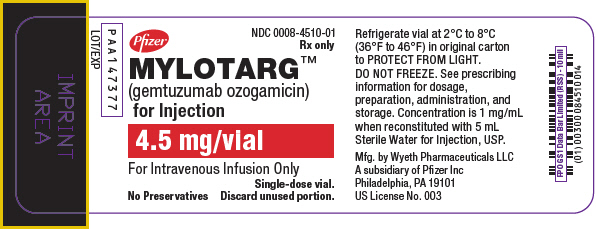
Mylotarg gemtuzumab ozogamicin 5 mg/5mL Injection, Powder, Lyophilized, For Solution — NDC 0008-4510-01 (Billing 00008-4510-01)
This is a package of Mylotarg gemtuzumab ozogamicin 5 mg/5mL Injection, Powder, Lyophilized, For Solution from Wyeth Pharmaceuticals LLC, a subsidiary of Pfizer Inc., marketed since Sep 2017 and currently FDA-listed. It is this product's only package size.
Identity & classification
Regulatory identifiers FDA, NLM and CMS codes for this package
Drug-database identifiers Medi-Span GPI and First Databank GCN / HICL / AHFS classification
- GSN (GCN sequence number): 077700
- GCN: 43806
- GPI-14 (Medi-Span): 21353630202117
- HICL (First Databank): 021218
- AHFS class code: 10:00.00.00
- RxCUI (RxNorm): 1944701
Where does this data come from?
- FDA openFDA NDC Directory · synced Oct 1, 2026
- FDA label on DailyMed · label index refreshed Oct 1, 2026
- RxNorm (NLM RxNav) · catalog refreshed Oct 1, 2026
- Medi-Span GPI (licensed)
- First Databank (licensed) · refreshed Oct 1, 2026
RxNorm drug class
This medicine belongs to the CD33-directed Immunoconjugate class.
Where does this data come from?
- RxClass (NLM) · catalog refreshed Oct 1, 2026
Clinical
Gemtuzumab ozogamicin injection is used alone or in combination with other chemotherapy medications to treat a certain type of acute myeloid leukemia (AML; a type of cancer that begins in the white blood cells) in adults and children 1 month of age and older who were recently found to have this cancer. It is also used alone to treat a certain type of AML in adults and children 2 years of age and older whose cancer worsened during or after treatment with other chemotherapy medications. Gemtuzumab ozogamicin injection is in a class of medications called monoclonal antibodies. It works by helping...
Read the full MedlinePlus article ↗- It treats CD33-positive acute myeloid leukemia (AML). That includes newly diagnosed AML in adults and children 1 month and older. It also includes AML that has come back or not res...
- It is given through a vein (IV infusion) by your healthcare team. Beforehand, you will get a steroid, an antihistamine, and acetaminophen to lower the chance of a reaction. Your te...
- Common ones include bleeding, infection, fever, nausea, vomiting, constipation, headache, rash, mouth sores, and low appetite. Your team will watch your blood counts and liver test...
- Call for fever or chills, trouble breathing, or dizziness during or after an infusion. Also call for unusual bleeding, painful belly swelling, rapid weight gain, or yellow skin or...
Patient education
Supplement & herbal interactions
Where does this data come from?
- MedlinePlus (NLM) · refreshed Oct 1, 2026
- FDA label on DailyMed · label index refreshed Oct 1, 2026
Ask a licensed pharmacist directly — free, answered by our team.
Pricing
A drug doesn't have one price. Each row is a different public payment system, and none is what you'd pay at the counter — that depends on your insurance. The ⓘ on each row explains what it measures.
| Price system | Per mL | Per package |
|---|---|---|
| Retail pharmacies payNADAC · weekly | Not in the retail survey — common for institutional, discontinued, or low-volume packs. | |
| Medicaid paysCMS SDUD · 12 mo | No recent Medicaid claims on file for this NDC — rare and low-volume NDCs are suppressed in the public data. | |
| Medicare drug plans payPart D · quarterly | No Part D plan price is available for this NDC in our data. | |
| Medicare Part B allowsASP · J9203 | $247.370 / J9203 unit | — |
Where does this data come from?
- CMS NADAC weekly file
- CMS ASP pricing files · refreshed Sep 20, 2026
- CMS Medicaid State Drug Utilization Data · refreshed Oct 3, 2026
- CMS Part D plan pricing files · refreshed Sep 24, 2026
- VA National Acquisition Center price file
Billing & reimbursement
Where does this data come from?
- CMS ASP NDC-HCPCS crosswalk · refreshed Sep 22, 2026
- DMEPDAC NDC-HCPCS crosswalk
- openFDA NSDE billing units · refreshed Sep 7, 2026
Packaging — all sizes for this product
| Package NDC | Description | Marketing start | Marketing end | Status |
|---|---|---|---|---|
| 00008-4510-01 You're viewing this Main listing | 1 VIAL, SINGLE-DOSE in 1 CARTON / 5 mL in 1 VIAL, SINGLE-DOSE | 2017-09-07 | — | Active |
Therapeutic equivalents
| Product | Labeler | Pack | NADAC/unit | TE | Status | Price vs. this |
|---|---|---|---|---|---|---|
| Mylotarg 5 mg/5mLthis 00008-4510-01 | Wyeth | 1 vial | — | — | FDA listed | — |
Where does this data come from?
- FDA openFDA NDC Directory · synced Oct 1, 2026
- FDA Purple Book · refreshed Sep 5, 2026
- CMS NADAC weekly file
Availability & biosimilar status
Biologics have no small-molecule generics; biosimilar competition is tracked in the FDA Purple Book.
Why the date isn’t exact: Biosimilar timing can change because patents may be challenged, settled, licensed, added or removed, and litigation can move the real date earlier or later.
🛈 What do these terms mean?
- Biologic patent
- A patent the reference product’s maker has publicly listed. A biosimilar generally can’t launch until these expire — unless they’re invalidated or resolved in a settlement.
- Reference-product exclusivity
- A flat 12 years of FDA market protection from the biologic’s first licensure (the BPCIA). No biosimilar can be licensed before it ends, regardless of patents.
- Interchangeable exclusivity
- The first interchangeable biosimilar can earn a period as the only interchangeable version (pharmacists can substitute it without the prescriber).
- Earliest biosimilar (LOE)
- The latest of all the dates above — the soonest a biosimilar can realistically reach the market. Litigation and settlements can move it earlier.
Biologics have no small-molecule “generics” — competition comes from FDA-licensed biosimilars, tracked in the FDA Purple Book.
| Code | What it grants | Expires |
|---|---|---|
| RefProduct | Reference-product exclusivity (12-year, BPCIA) — no biosimilar can be licensed before this date | Sep 1, 2029 |
Is there a biosimilar for MYLOTARG 4.5 MG VIAL?
Why do different websites show different biosimilar dates?
Can a biosimilar launch before the last patent expires?
What does “current Purple Book estimate” mean?
What does “FDA listed” mean?
What does a patent or protection date mean here?
Where does this data come from?
- FDA Purple Book · refreshed Sep 5, 2026
Inactive Ingredients / Excipients
Inactive ingredients, also called excipients, are components of the drug product other than the active ingredient. They may include fillers, dyes, coatings, preservatives, flavors, or other formulation ingredients.
💡 Tap an ingredient (hover on desktop) to see what it is and why it’s used.
-
UNII K3R6ZDH4DU
Dextran 40 is a sugar-based polymer derived from bacteria. It acts as a thickener and volume expander in liquid medicines, helping achieve proper consistency and stability.
-
UNII 451W47IQ8X
Sodium chloride is common table salt. It's used in medicines as a buffer to maintain proper pH, as a filler to add bulk, or to adjust the osmotic balance in liquid formulations.
-
UNII GR686LBA74
Sodium phosphate, dibasic is a salt derived from phosphoric acid. It acts as a buffer to help maintain the medicine's pH balance and may serve as a binder or filler in tablets and capsules.
-
UNII 3980JIH2SW
A salt form of phosphoric acid that acts as a buffer and pH adjuster in medicines. It helps keep the product at the correct acidity level for stability and effectiveness.
-
UNII C151H8M554
A natural sugar derived from sugar cane or sugar beets. It's used as a sweetener, filler, and binder to improve taste, add bulk, and help hold tablet or capsule ingredients together.
5 inactive ingredients listed in the exact product block matched to this NDC.
Where does this data come from?
ingredient classCode="IACT" elements from the exact product block matched by this NDC. Label-section narrative from DailyMed / the openFDA label index is shown separately when available.- FDA label on DailyMed · label index refreshed Oct 1, 2026
- FDA openFDA NDC Directory · synced Oct 1, 2026
Inactive ingredient FAQ
Are inactive ingredients the same for every manufacturer?
Why might an inactive ingredient be missing?
Can inactive ingredients matter?
Manufacturer & labeler
Where does this data come from?
- FDA openFDA NDC Directory · synced Oct 1, 2026
- Drugs@FDA
Full prescribing information FDA SPL
🚨 Boxed Warning ▾
WARNING: HEPATOTOXICITY Hepatotoxicity, including severe or fatal hepatic veno-occlusive disease (VOD), also known as sinusoidal obstruction syndrome (SOS), has been reported in association with the use of MYLOTARG as a single agent, and as part of a combination chemotherapy regimen. Monitor frequently for signs and symptoms of VOD after treatment with MYLOTARG. ( 5.1 and 6.1 ) WARNING: HEPATOTOXICITY See full prescribing information for complete boxed warning.
Hepatotoxicity, including severe or fatal hepatic veno-occlusive disease (VOD), also known as sinusoidal obstruction syndrome (SOS), has been reported in association with the use of MYLOTARG. ( 5.1 , 6.1 )
🎯 Indications and Usage ▾
1 INDICATIONS AND USAGE MYLOTARG is a CD33-directed antibody and cytotoxic drug conjugate indicated for: • treatment of newly-diagnosed CD33-positive acute myeloid leukemia (AML) in adults and pediatric patients 1 month and older ( 1.1 ). • treatment of relapsed or refractory CD33-positive AML in adults and pediatric patients 2 years and older ( 1.2 ).
1.1Newly-Diagnosed CD33-positive Acute Myeloid Leukemia (AML) MYLOTARG is indicated for the treatment of newly-diagnosed CD33-positive acute myeloid leukemia in adults and pediatric patients 1 month and older.
1.2Relapsed or Refractory CD33-positive AML MYLOTARG is indicated for the treatment of relapsed or refractory CD33-positive acute myeloid leukemia in adults and pediatric patients 2 years and older.
⏱️ Dosage and Administration ▾
2 DOSAGE AND ADMINISTRATION • Newly-diagnosed, de novo AML (combination regimen) Adults : - Induction: 3 mg/m 2 (up to one 4.5 mg vial) on Days 1, 4, and 7 in combination with daunorubicin and cytarabine ( 2.2 ). - Consolidation: 3 mg/m 2 on Day 1 (up to one 4.5 mg vial) in combination with daunorubicin and cytarabine ( 2.2 ). Pediatric patients 1 month and older : - 3 mg/m 2 for patients with body surface area (BSA) 0.6 m 2 or greater ( 2.2 ). - 0.1 mg/kg for patients with BSA less than 0.6 m 2 ( 2.2 ). - See Full Prescribing Information for complete dosing information ( 2.2 ). • Newly-diagnosed AML (single-agent regimen): Adults : - Induction: 6 mg/m 2 (not limited to one 4.5 mg vial) on Day 1 and 3 mg/m 2 (not limited to one 4.5 mg vial) on Day 8 ( 2.2 ). - Continuation: For patients without evidence of disease progression following induction, up to 8 continuation courses of MYLOTARG 2 mg/m 2 (not limited to one 4.5 mg vial) on Day 1 every 4 weeks ( 2.2 ). • Relapsed or refractory AML (single-agent regimen): Adults and pediatric patients 2 years and older: - 3 mg/m 2 (up to one 4.5 mg vial) on Days 1, 4, and 7 ( 2.2 ). • Premedicate with a corticosteroid, antihistamine, and acetaminophen ( 2.1 ).
2.1Premedication and Special Considerations • Premedicate adults with acetaminophen 650 mg orally and diphenhydramine 50 mg orally or intravenously 1 hour prior to MYLOTARG dosing and 1 mg/kg methylprednisolone or an equivalent dose of an alternative corticosteroid within 30 minutes prior to infusion of MYLOTARG. • Premedicate pediatric patients 1 month and older with acetaminophen 15 mg/kg (maximum of 650 mg) and diphenhydramine 1 mg/kg (maximum of 50 mg) 1 hour prior to MYLOTARG dosing, and 1 mg/kg methylprednisolone orally or intravenously within 30 minutes prior to infusion of MYLOTARG; additional doses of acetaminophen and diphenhydramine may be administered every 4 hours after the initial pretreatment dose.
Repeat with the same dose of methylprednisolone or an equivalent corticosteroid for any sign of an infusion reaction, such as fever, chills, hypotension, or dyspnea during the infusion or within 4 hours afterwards [see Warnings and Precautions (5.2) ] . • Use appropriate measures to prevent tumor lysis syndrome. • For patients with hyperleukocytosis (leukocyte count greater than or equal to 30 Gi/L), cytoreduction is recommended prior to administration of MYLOTARG.
2.2Recommended Dosage Newly-Diagnosed De Novo CD33-positive AML (Combination Regimen) Adults The recommended dose of MYLOTARG in adults is 3 mg/m 2 . A treatment course including MYLOTARG in combination therapy for adults with newly-diagnosed de novo CD33-positive AML consists of 1 induction cycle and 2 consolidation cycles [see Clinical Studies (14.1) ] . For the induction cycle, the recommended dose of MYLOTARG is 3 mg/m 2 (up to one 4.5 mg vial) on Days 1, 4, and 7 in combination with daunorubicin and cytarabine .
For patients requiring a second induction cycle, do NOT administer MYLOTARG during the second induction cycle. For the consolidation cycles, the recommended dose of MYLOTARG is 3 mg/m 2 on Day 1 (up to one 4.5 mg vial) in combination with daunorubicin and cytarabine. Pediatric Patients 1 Month and Older The recommended dose of MYLOTARG in pediatric patients 1 month and older is: • 3 mg/m 2 for patients with body surface area (BSA) greater than or equal to 0.6 m 2 • 0.1 mg/kg for patients with BSA less than 0.6 m 2 For Induction 1, MYLOTARG is given once in combination with standard chemotherapy.
No MYLOTARG is given in the second induction cycle [see Clinical Studies (14.1) ]. No MYLOTARG is given in the first or third intensification cycles. For Intensification 2, MYLOTARG is given once in combination with standard chemotherapy.
Consider the risks and potential benefits before giving MYLOTARG during Intensification 2 [see Adverse Reactions (6.1) ] . Newly-Diagnosed CD33-positive AML (Single-agent Regimen) A treatment course of MYLOTARG as a singl… [Excerpted — this section continues on DailyMed.]
💊 Dosage Forms and Strengths ▾
3 DOSAGE FORMS AND STRENGTHS For injection: 4.5 mg as a white to off-white lyophilized cake or powder in a single-dose vial for reconstitution and further dilution. For Injection: 4.5 mg as a lyophilized cake or powder in a single-dose vial for reconstitution and dilution ( 3 ).
⛔ Contraindications ▾
4 CONTRAINDICATIONS MYLOTARG is contraindicated in patients with a history of hypersensitivity to the active substance in MYLOTARG or any of its components or to any of the excipients. Reactions have included anaphylaxis [see Warnings and Precautions (5.2) , Adverse Reactions (6) ] . Hypersensitivity to MYLOTARG or any of its components ( 4 ).
⚠️ Warnings and Cautions ▾
5 WARNINGS AND PRECAUTIONS • Infusion-related reactions (including anaphylaxis): Premedicate with a corticosteroid, acetaminophen, and diphenhydramine. Monitor patients during and for at least 1 hour after the end of the infusion. Interrupt the infusion, administer steroids or antihistamines, or permanently discontinue treatment as necessary ( 2.1 , 5.2 , 6 ). • Hemorrhage: Severe, including fatal, hemorrhage may occur when MYLOTARG is used at recommended doses.
Monitor platelet counts frequently ( 5.3 , 6.1 ). • Embryo-fetal toxicity: Can cause fetal harm. Advise patients of reproductive potential of the potential risk to a fetus and to use effective contraception ( 5.6 , 8.1 , 8.3 ).
5.1Hepatotoxicity, Including Veno-occlusive Liver Disease (VOD) Hepatotoxicity, including life-threatening and sometimes fatal hepatic VOD events, have been reported in patients receiving MYLOTARG as a single agent or as part of a combination chemotherapy regimen [see Adverse Reactions (6) ]. In ALFA-0701, VOD events were reported in 6/131 (5%) adult patients during or following treatment with MYLOTARG, or following later hematopoietic stem cell transplantation (HSCT). The median time from the MYLOTARG dose to onset of VOD was 9 days (range: 2–298 days), with 5 events occurring within 28 days of any dose of MYLOTARG and 1 event occurring greater than 28 days after the last dose of MYLOTARG.
Three of the 6 VOD events were fatal. VOD was also reported in 2 patients in the control arm of ALFA-0701 after receiving MYLOTARG as a therapy for relapsed AML. In MyloFrance-1 (MYLOTARG 3 mg/m 2 on Days 1, 4 and 7), VOD events were reported in none of the 57 patients during or following treatment, or following HSCT after completion of MYLOTARG treatment.
In AAML0531, VOD events were reported in 25/520 (5%) pediatric patients in the MYLOTARG arm. VOD was fatal in 2 patients. Among 187 pediatric patients who underwent HSCT in the MYLOTARG arm, VOD occurred within 30 days post-HSCT in 20 (11%) patients.
Based on an analysis across trials, the risk of VOD was higher in adult patients who received higher doses of MYLOTARG as monotherapy, in patients with moderate or severe hepatic impairment prior to receiving MYLOTARG, in patients treated with MYLOTARG after HSCT, and in patients who underwent HSCT after treatment with MYLOTARG. Patients who had moderate/severe hepatic impairment prior to treatment with MYLOTARG were 8.7 times more likely to develop VOD compared to patients without moderate/severe hepatic impairment at baseline.
Patients treated with MYLOTARG for relapse after HSCT were 2.6 times more likely to develop VOD compared to patients without prior HSCT. Patients who underwent HSCT following MYLOTARG treatment were 2.9 times more likely to develop VOD after HSCT compared to patients without HSCT following MYLOTARG treatment. Although no relationship was found between VOD and time of HSCT relative to higher MYLOTARG monotherapy doses, the ALFA-0701 study recommended an interval of 2 months between the last dose of MYLOTARG and HSCT.
In MyloFrance-1, no patients underwent HSCT within 3.5 months of MYLOTARG therapy. Assess ALT, AST, total bilirubin, and alkaline phosphatase prior to each dose of MYLOTARG. After treatment with MYLOTARG, monitor frequently for signs and symptoms of VOD; these may include elevations in ALT, AST, total bilirubin, hepatomegaly (which may be painful), rapid weight gain, and ascites.
Monitoring only total bilirubin may not identify all patients at risk of VOD. For patients who develop abnormal liver tests, more frequent monitoring of liver tests and clinical signs and symptoms of hepatotoxicity is recommended. For patients who proceed to HSCT, monitor liver tests frequently during the post-HSCT period, as appropriate.
Manage signs or symptoms of hepatic toxicity by dose interruption or discontinuation of MYLOTARG [see Dosage and Administration (2.3) ] . In patients who experience VOD, discontinue MYLOTARG and treat according to… [Excerpted — this section continues on DailyMed.]
🤒 Adverse Reactions ▾
6 ADVERSE REACTIONS The following clinically significant adverse reactions are described elsewhere in the labeling: • Hepatotoxicity, including VOD [see Warnings and Precautions (5.1) ] • Infusion-related reactions [see Warnings and Precautions (5.2) ] • Hemorrhage [see Warnings and Precautions (5.3) ] The most common adverse reactions (greater than 15%) were hemorrhage, infection, fever, nausea, vomiting, constipation, headache, increased AST, increased ALT, rash, mucositis, febrile neutropenia, and decreased appetite ( 6 ).
To report SUSPECTED ADVERSE REACTIONS, contact Pfizer Inc. at 1-800-438-1985 or FDA at 1-800-FDA-1088 or www.fda.gov/medwatch .
6.1Clinical Trials Experience Because clinical trials are conducted under widely varying conditions, adverse reaction rates observed in the clinical trials of a drug cannot be directly compared to rates in the clinical trials of another drug and may not reflect the rates observed in practice. Combination Therapy in Newly-Diagnosed De Novo CD33-positive AML The safety of MYLOTARG in first-line combination therapy was evaluated in two prospective clinical trials, Study ALFA-0701 in adults and Study AAML0531 in pediatric patients.
Study ALFA-0701 The safety evaluation of MYLOTARG (3 mg/m 2 Day 1, 4 and 7 in combination with daunorubicin and cytarabine [DA]) in adults is based on data from ALFA-0701 for 131 patients treated with MYLOTARG plus DA and in 137 patients treated with DA alone [see Clinical Studies (14.1) ]. In this study, 123 patients received all 3 fractionated doses of MYLOTARG and 7 patients missed at least 1 dose, with a mean total dose administered during induction of 14.51 mg (range: 4.6–18.0). MYLOTARG was received by 91 (70%) patients in the MYLOTARG arm during Consolidation 1 and 64 (49%) patients in the MYLOTARG arm during Consolidation 2.
Safety data consisting of selected TEAEs considered most important for understanding the safety profile of MYLOTARG as well as all adverse events (AEs) that led to the permanent discontinuation of treatment were retrospectively collected. The selected TEAEs consisted of all grades hemorrhages, all grades VOD, and severe infections. Discontinuation due to any adverse reaction occurred in 31% of patients in the MYLOTARG arm versus 7% in the DA arm.
The most frequent (greater than or equal to 1%) adverse reactions for patients treated with MYLOTARG that led to permanent discontinuation were thrombocytopenia (15%), VOD (3%), and septic shock (2%). Fatal adverse reactions occurred in 8 patients (6%) in the MYLOTARG arm versus 3 patients (2%) in the DA arm. In the MYLOTARG arm, 3 patients died of VOD, 4 patients died of hemorrhage-related events (CNS hemorrhage, hemorrhagic shock), and 1 patient died of suspected cardiac cause.
In the DA arm, 3 patients died of sepsis. Table 2. Selected Grade 3 and Higher Adverse Reactions in Patients with Newly-Diagnosed De Novo AML in ALFA-0701 MYLOTARG + Daunorubicin + Cytarabine (n, %) Daunorubicin + Cytarabine (n, %) Abbreviations: AML=acute myeloid leukemia; N=number of patients; PT=preferred term.
Induction N = 131 N = 137 Infection Infection is a grouped term consisting of multiple preferred terms. 61 (47%) 53 (39%) Hemorrhage Hemorrhage is a grouped term consisting of multiple preferred terms. 24 (18%) 12 (9%) Veno-occlusive liver disease Veno-occlusive liver disease includes the following reported PTs: Veno-occlusive liver disease, veno-occlusive disease.
3 (2%) 0 Consolidation 1 N = 91 N = 103 Infection 50 (55%) 43 (42%) Hemorrhage 5 (5%) 0 Veno-occlusive liver disease 0 0 Consolidation 2 N = 64 N = 107 Infection 32 (50%) 54 (50%) Hemorrhage 4 (6%) 0 Veno-occlusive liver disease 0 0 All patients in ALFA-0701 developed severe neutropenia, thrombocytopenia and anemia. The incidence of Grade 3–4 thrombocytopenia that was prolonged in the absence of active leukemia was higher in patients treated with MYLOTARG (Table 3). Table 3.
Prolonged Cytopenias Platelets less than 50 Gi/L or neutrophils… [Excerpted — this section continues on DailyMed.]
👥 Use in Specific Populations ▾
8 USE IN SPECIFIC POPULATIONS Lactation: Advise not to breastfeed ( 8.2 ).
8.1Pregnancy Risk Summary Based on its mechanism of action and findings from animal studies [see Clinical Pharmacology (12.1) , Nonclinical Toxicology (13.1) ] , MYLOTARG can cause embryo-fetal harm when administered to a pregnant woman. There are no available data on MYLOTARG use in pregnant women to evaluate for a drug-associated risk. In animal reproduction studies, gemtuzumab ozogamicin caused embryo-fetal toxicity, including structural abnormalities and alterations to growth, at maternal systemic exposures that were greater than or equal to 0.4 times the exposure in patients at the maximum recommended dose based on AUC (see Data ) .
Advise pregnant women of the potential risk to a fetus. The estimated background risk of major birth defects and miscarriage for the indicated population is unknown. All pregnancies have a background risk of birth defect, loss, or other adverse outcomes.
In the U.S. general population, the estimated background risk of major birth defects and miscarriage in clinically recognized pregnancies is 2–4% and 15–20%, respectively. Data Animal Data In an embryo-fetal development study in rats, pregnant animals received daily intravenous doses up to 1.2 mg/m 2 /day gemtuzumab ozogamicin during the period of organogenesis. Embryo-fetal toxicities including fetal growth retardation as evidenced by decreased live fetal weights, incidence of fetal wavy ribs and delayed skeletal ossification were observed at greater than or equal to 0.15 mg/m 2 /day.
Increased embryo-fetal lethality and fetal morphological anomalies (digital malformations, absence of the aortic arch, anomalies in the long bones in the forelimbs, misshapen scapula, absence of a vertebral centrum, and fused sternebrae) were observed at greater than or equal to 0.36 mg/m 2 /day. All doses with embryo-fetal effects were observed in the presence of maternal toxicity that included decreases in gestational body weight gain, food consumption, and gravid uterine weight. The lowest dose at which embryo-fetal effects were observed in rats (0.15 mg/m 2 /day) was 0.4 times the exposure in patients at the maximum recommended human dose, based on AUC.
8.2Lactation Risk Summary There are no data on the presence of gemtuzumab ozogamicin or its metabolites in human milk, the effects on the breastfed infant, or the effects on milk production. Because of the potential for serious adverse reactions in the breastfed infant, advise women not to breastfeed during treatment with MYLOTARG and for at least 1 month after the final dose.
8.3Females and Males of Reproductive Potential MYLOTARG can cause embryo-fetal harm when administered to a pregnant woman [see Use in Specific Populations (8.1) ] . Pregnancy Testing Verify the pregnancy status in females of reproductive potential prior to initiating MYLOTARG. Contraception Females Advise females of reproductive potential to use effective contraception during treatment with MYLOTARG and for at least 6 months after the last dose [see Nonclinical Toxicology (13.1) ] .
Males Advise males with female partners of reproductive potential to use effective contraception during treatment with MYLOTARG and for at least 3 months after the last dose [see Nonclinical Toxicology (13.1) ] . Infertility Females Based on findings in animals, MYLOTARG may impair female fertility [see Nonclinical Toxicology (13.1) ] . Males Based on findings in animals, MYLOTARG may impair male fertility [see Nonclinical Toxicology (13.1) ] .
8.4Pediatric Use The safety and effectiveness of MYLOTARG in combination with standard chemotherapy have been established in pediatric patients 1 month and older with newly-diagnosed de novo AML. The use of MYLOTARG for this indication is supported by evidence of effectiveness from adequate and well-controlled studies in adults with supportive data on safety and effectiveness in Study AAML0531 (NCT00372593) [see Adverse Reactions (6.1) , Cl… [Excerpted — this section continues on DailyMed.]
🤰 Pregnancy ▾
8.1Pregnancy Risk Summary Based on its mechanism of action and findings from animal studies [see Clinical Pharmacology (12.1) , Nonclinical Toxicology (13.1) ] , MYLOTARG can cause embryo-fetal harm when administered to a pregnant woman. There are no available data on MYLOTARG use in pregnant women to evaluate for a drug-associated risk. In animal reproduction studies, gemtuzumab ozogamicin caused embryo-fetal toxicity, including structural abnormalities and alterations to growth, at maternal systemic exposures that were greater than or equal to 0.4 times the exposure in patients at the maximum recommended dose based on AUC (see Data ) .
Advise pregnant women of the potential risk to a fetus. The estimated background risk of major birth defects and miscarriage for the indicated population is unknown. All pregnancies have a background risk of birth defect, loss, or other adverse outcomes.
In the U.S. general population, the estimated background risk of major birth defects and miscarriage in clinically recognized pregnancies is 2–4% and 15–20%, respectively. Data Animal Data In an embryo-fetal development study in rats, pregnant animals received daily intravenous doses up to 1.2 mg/m 2 /day gemtuzumab ozogamicin during the period of organogenesis. Embryo-fetal toxicities including fetal growth retardation as evidenced by decreased live fetal weights, incidence of fetal wavy ribs and delayed skeletal ossification were observed at greater than or equal to 0.15 mg/m 2 /day.
Increased embryo-fetal lethality and fetal morphological anomalies (digital malformations, absence of the aortic arch, anomalies in the long bones in the forelimbs, misshapen scapula, absence of a vertebral centrum, and fused sternebrae) were observed at greater than or equal to 0.36 mg/m 2 /day. All doses with embryo-fetal effects were observed in the presence of maternal toxicity that included decreases in gestational body weight gain, food consumption, and gravid uterine weight. The lowest dose at which embryo-fetal effects were observed in rats (0.15 mg/m 2 /day) was 0.4 times the exposure in patients at the maximum recommended human dose, based on AUC.
🧒 Pediatric Use ▾
8.4Pediatric Use The safety and effectiveness of MYLOTARG in combination with standard chemotherapy have been established in pediatric patients 1 month and older with newly-diagnosed de novo AML. The use of MYLOTARG for this indication is supported by evidence of effectiveness from adequate and well-controlled studies in adults with supportive data on safety and effectiveness in Study AAML0531 (NCT00372593) [see Adverse Reactions (6.1) , Clinical Studies (14.1) ]. AAML0531 included patients in the following age groups: 2 patients less than 27 days old, 94 patients 28 days to less than 2 years old, 225 patients 2 years to less than 12 years old, 175 patients 12 years old to less than 18 years old, and 36 patients 18 years or older in the MYLOTARG plus chemotherapy arm.
The safety and effectiveness of MYLOTARG with standard chemotherapy in pediatric patients less than 1 month of age with newly-diagnosed de novo AML have not been established. The safety and effectiveness of MYLOTARG as a single agent in pediatric patients with newly-diagnosed AML have not been established. The safety and effectiveness of MYLOTARG as a single agent in the pediatric patients with relapsed or refractory AML is supported by a single-arm trial in 29 patients in the following age groups: 1 patient 1 month to less than 2 years old, 13 patients 2 years to less than 12 years old, and 15 patients 12 years to 18 years old.
A literature review included an additional 96 patients with ages ranging from 0.2 to 21 years. No differences in efficacy and safety were observed by age. The information on this use is discussed throughout the labeling.
The safety and effectiveness of MYLOTARG as a single agent in pediatric patients less than 2 years of age with relapsed or refractory AML have not been established.
🧓 Geriatric Use ▾
8.5Geriatric Use Use of MYLOTARG in combination with daunorubicin and cytarabine in newly-diagnosed adult patients with de novo AML is supported by a randomized, controlled trial that included 50 patients greater than or equal to 65 years old. No overall differences in safety or effectiveness were observed between these subjects and younger subjects. Use of MYLOTARG monotherapy in newly-diagnosed adult patients with AML is supported by a randomized controlled trial with 118 patients treated with MYLOTARG.
All patients were over the age of 60 years and 65% of patients were above 75 years. No overall differences in effectiveness were observed by age. Use of MYLOTARG as single-agent treatment of relapsed or refractory AML is supported by a single-arm trial that included 27 patients 65 years or older.
No overall differences in effectiveness were observed between these patients and younger patients. Elderly patients experienced a higher rate of fever and severe or greater infections.
🧬 Clinical Pharmacology ▾
12 CLINICAL PHARMACOLOGY
12.1Mechanism of Action Gemtuzumab ozogamicin is a CD33-directed antibody-drug conjugate (ADC). The antibody portion (hP67.6) recognizes human CD33 antigen. The small molecule, N-acetyl gamma calicheamicin, is a cytotoxic agent that is covalently attached to the antibody via a linker.
Nonclinical data suggest that the anticancer activity of gemtuzumab ozogamicin is due to the binding of the ADC to CD33-expressing tumor cells, followed by internalization of the ADC-CD33 complex, and the intracellular release of N-acetyl gamma calicheamicin dimethyl hydrazide via hydrolytic cleavage of the linker. Activation of N-acetyl gamma calicheamicin dimethyl hydrazide induces double-strand DNA breaks, subsequently inducing cell cycle arrest and apoptotic cell death.
12.2Pharmacodynamics Saturation of a high percentage of CD33 antigenic sites is presumed to be required for maximum delivery of calicheamicin to leukemic blast cells. Near maximal peripheral CD33 saturation was observed across studies after gemtuzumab ozogamicin dosing at dose levels of 2 mg/m 2 and above. At 9 mg/m 2 gemtuzumab ozogamicin (2 doses, 14 days apart), the risk for VOD increases as the C max of the first dose of gemtuzumab ozogamicin increases.
The increase in VOD is more prominent in patients with prior stem cell transplantation.
12.3Pharmacokinetics There are no clinical PK data for the fractionated regimen. When gemtuzumab ozogamicin is administered at 9 mg/m 2 (2 doses, 14 days apart), the C max following the first dose for patients who received 9 mg/m 2 gemtuzumab ozogamicin was 3.0 mg/L and increased to 3.6 mg/L after the second dose. Distribution N-acetyl gamma calicheamicin dimethyl hydrazide is approximately 97% bound to human plasma proteins in vitro.
Population PK analyses found the total volume of distribution of hP67.6 antibody (sum of V1 [6.31 L] and V2 [15.1 L]) to be approximately
21.4L in patients. Elimination The clearance (CL) value of hP67.6 from plasma was
0.35 L/h after the first dose and
0.15L/h after the second dose, a decrease of roughly 60%. The terminal plasma half-life (t ½ ) for hP67.6 was 62 hours after the first dose and 90 hours after the second dose. Metabolism In vitro studies demonstrated that N-acetyl gamma calicheamicin dimethyl hydrazide is extensively metabolized, primarily via nonenzymatic reduction of the disulfide moiety.
Specific Populations Age, race, sex, mild or moderate renal impairment (creatinine clearance [CLcr] 30–89 mL/min calculated by the Cockcroft-Gault equation) or mild hepatic impairment had no clinically significant effect on the pharmacokinetics of gemtuzumab ozogamicin. The pharmacokinetics of gemtuzumab ozogamicin in patients with severe renal impairment (CLcr 15–29 mL/min) or moderate (total bilirubin greater than 1.5× to 3.0× ULN) and severe hepatic impairment (total bilirubin greater than 3× ULN) is unknown. Drug Interaction Studies No clinical drug interaction studies have been performed.
In Vitro Studies At clinically relevant concentrations, gemtuzumab ozogamicin had a low potential to: • Inhibit CYP450 Enzymes : CYP1A2, CYP2A6, CYP2C8, CYP2C9, CYP2C19, CYP2D6, and CYP3A4/5. At clinically relevant concentrations, N-acetyl gamma calicheamicin dimethyl hydrazide had a low potential to: • Inhibit CYP450 Enzymes : CYP1A2, CYP2B6 , CYP2C8, CYP2C9, CYP2C19, CYP2D6, and CYP3A4/5. • Induce CYP450 Enzymes : CYP1A2, CYP2B6, and CYP3A4. • Inhibit UGT Enzymes : UGT1A1, UGT1A4, UGT1A6, UGT1A9, and UGT2B7. • Inhibit Drug Transporters : P-gp (P-glycoprotein), breast cancer resistance protein (BCRP), organic anion transporter (OAT)1 and OAT3, organic cation transporter (OCT)2, and organic anion transporting polypeptide (OATP)1B1 and OATP1B3.
🧬 Mechanism of Action ▾
12.1Mechanism of Action Gemtuzumab ozogamicin is a CD33-directed antibody-drug conjugate (ADC). The antibody portion (hP67.6) recognizes human CD33 antigen. The small molecule, N-acetyl gamma calicheamicin, is a cytotoxic agent that is covalently attached to the antibody via a linker.
Nonclinical data suggest that the anticancer activity of gemtuzumab ozogamicin is due to the binding of the ADC to CD33-expressing tumor cells, followed by internalization of the ADC-CD33 complex, and the intracellular release of N-acetyl gamma calicheamicin dimethyl hydrazide via hydrolytic cleavage of the linker. Activation of N-acetyl gamma calicheamicin dimethyl hydrazide induces double-strand DNA breaks, subsequently inducing cell cycle arrest and apoptotic cell death.
📦 How Supplied / Storage and Handling ▾
16 HOW SUPPLIED/STORAGE AND HANDLING MYLOTARG (gemtuzumab ozogamicin) for injection is a white to off-white lyophilized cake or powder supplied in a carton (NDC 0008-4510-01) containing one 4.5 mg single-dose vial [see Dosage and Administration (2) ] . Refrigerate (2°C to 8°C; 36°F to 46°F) MYLOTARG vials and store in the original carton to protect from light. DO NOT FREEZE.
MYLOTARG is a cytotoxic drug. Follow applicable special handling and disposal procedures. 1
📦 Storage and Handling ▾
Refrigerate (2°C to 8°C; 36°F to 46°F) MYLOTARG vials and store in the original carton to protect from light. DO NOT FREEZE. MYLOTARG is a cytotoxic drug. Follow applicable special handling and disposal procedures. 1
📋 Description ▾
11 DESCRIPTION Gemtuzumab ozogamicin is an antibody-drug conjugate (ADC) composed of the CD33-directed monoclonal antibody (hP67.6; recombinant humanized immunoglobulin [Ig] G4, kappa antibody produced by mammalian cell culture in NS0 cells) that is covalently linked to the cytotoxic agent N-acetyl gamma calicheamicin. Gemtuzumab ozogamicin consists of conjugated and unconjugated gemtuzumab. The conjugated molecules differ in the number of activated calicheamicin derivative moieties attached to gemtuzumab.
The number of conjugated calicheamicin derivatives per gemtuzumab molecule ranges from predominantly zero to 6, with an average of 2 to 3 moles of calicheamicin derivative per mole of gemtuzumab. MYLOTARG (gemtuzumab ozogamicin) for injection is supplied as a sterile, white to off-white, preservative-free lyophilized cake or powder for intravenous administration. Each single-dose vial delivers 4.5 mg gemtuzumab ozogamicin.
Inactive ingredients are dextran 40 (41.0 mg), sodium chloride (26.1 mg), sodium phosphate dibasic anhydrous (2.7 mg), sodium phosphate monobasic monohydrate (0.45 mg), and sucrose (69.8 mg). After reconstitution with 5 mL of Sterile Water for Injection USP, the concentration is 1 mg/mL of gemtuzumab ozogamicin with a deliverable volume of 4.5 mL (4.5 mg). Chemical Structure
💬 Information for Patients ▾
17 PATIENT COUNSELING INFORMATION Hepatotoxicity, Including Veno-occlusive Liver Disease (VOD) Inform patients that liver problems, including severe, life-threatening, or fatal VOD may develop during MYLOTARG treatment. Prior to receiving MYLOTARG, inform patients who previously received, or will receive an HSCT that they may be at increased risk for developing VOD. Inform patients that the risk of developing VOD after an allogeneic HSCT is increased after receiving treatment with MYLOTARG.
Inform patients that signs or symptoms of liver toxicity, including rapid weight gain, right upper quadrant pain and tenderness, hepatomegaly, and ascites should be monitored regularly during treatment, but these symptoms may not identify all patients at risk or prevent the complications of liver toxicity. Inform patients that liver problems may require dosing interruption or permanent discontinuation of MYLOTARG [see Warnings and Precautions (5.1) ]. Hemorrhage Inform patients that decreased platelet counts, which may be life-threatening, may develop during MYLOTARG treatment and that complications associated with decreased platelet counts may include bleeding/hemorrhage events, which may be life-threatening or fatal.
Inform patients to report signs and symptoms of bleeding/hemorrhage during treatment with MYLOTARG. Inform patients that severe bleeding/hemorrhage may require dosing interruption or permanent discontinuation of MYLOTARG [see Warnings and Precautions (5.3) ]. Infusion-Related Reactions Advise patients to contact their health care provider if they experience signs and symptoms of infusion-related reactions, including symptoms such as fever, chills, rash, or breathing problems [see Warnings and Precautions (5.2) ] .
Embryo-Fetal Toxicity Advise pregnant women of the potential risk to the fetus. Advise females of reproductive potential to inform their healthcare provider of a known or suspected pregnancy [see Warnings and Precautions (5.6) , Use in Specific Populations (8.1) ] . Advise females of reproductive potential to use effective contraception during treatment with MYLOTARG and for at least 6 months after the last dose [see Use in Specific Populations (8.3) ] .
Advise males with female partners of reproductive potential to use effective contraception during treatment with MYLOTARG and for at least 3 months after the last dose [see Use in Specific Populations (8.3) ] . Lactation Advise women not to breastfeed during treatment with MYLOTARG and for at least 1 month after the final dose [see Use in Specific Populations (8.2) ]. Infertility Advise males and females of reproductive potential that MYLOTARG may impair fertility [see Use in Specific Populations (8.3) ].
🧬 Pharmacokinetics ▾
12.3Pharmacokinetics There are no clinical PK data for the fractionated regimen. When gemtuzumab ozogamicin is administered at 9 mg/m 2 (2 doses, 14 days apart), the C max following the first dose for patients who received 9 mg/m 2 gemtuzumab ozogamicin was 3.0 mg/L and increased to 3.6 mg/L after the second dose. Distribution N-acetyl gamma calicheamicin dimethyl hydrazide is approximately 97% bound to human plasma proteins in vitro.
Population PK analyses found the total volume of distribution of hP67.6 antibody (sum of V1 [6.31 L] and V2 [15.1 L]) to be approximately
21.4L in patients. Elimination The clearance (CL) value of hP67.6 from plasma was
0.35 L/h after the first dose and
0.15L/h after the second dose, a decrease of roughly 60%. The terminal plasma half-life (t ½ ) for hP67.6 was 62 hours after the first dose and 90 hours after the second dose. Metabolism In vitro studies demonstrated that N-acetyl gamma calicheamicin dimethyl hydrazide is extensively metabolized, primarily via nonenzymatic reduction of the disulfide moiety.
Specific Populations Age, race, sex, mild or moderate renal impairment (creatinine clearance [CLcr] 30–89 mL/min calculated by the Cockcroft-Gault equation) or mild hepatic impairment had no clinically significant effect on the pharmacokinetics of gemtuzumab ozogamicin. The pharmacokinetics of gemtuzumab ozogamicin in patients with severe renal impairment (CLcr 15–29 mL/min) or moderate (total bilirubin greater than 1.5× to 3.0× ULN) and severe hepatic impairment (total bilirubin greater than 3× ULN) is unknown. Drug Interaction Studies No clinical drug interaction studies have been performed.
In Vitro Studies At clinically relevant concentrations, gemtuzumab ozogamicin had a low potential to: • Inhibit CYP450 Enzymes : CYP1A2, CYP2A6, CYP2C8, CYP2C9, CYP2C19, CYP2D6, and CYP3A4/5. At clinically relevant concentrations, N-acetyl gamma calicheamicin dimethyl hydrazide had a low potential to: • Inhibit CYP450 Enzymes : CYP1A2, CYP2B6 , CYP2C8, CYP2C9, CYP2C19, CYP2D6, and CYP3A4/5. • Induce CYP450 Enzymes : CYP1A2, CYP2B6, and CYP3A4. • Inhibit UGT Enzymes : UGT1A1, UGT1A4, UGT1A6, UGT1A9, and UGT2B7. • Inhibit Drug Transporters : P-gp (P-glycoprotein), breast cancer resistance protein (BCRP), organic anion transporter (OAT)1 and OAT3, organic cation transporter (OCT)2, and organic anion transporting polypeptide (OATP)1B1 and OATP1B3.
🧬 Pharmacodynamics ▾
12.2Pharmacodynamics Saturation of a high percentage of CD33 antigenic sites is presumed to be required for maximum delivery of calicheamicin to leukemic blast cells. Near maximal peripheral CD33 saturation was observed across studies after gemtuzumab ozogamicin dosing at dose levels of 2 mg/m 2 and above. At 9 mg/m 2 gemtuzumab ozogamicin (2 doses, 14 days apart), the risk for VOD increases as the C max of the first dose of gemtuzumab ozogamicin increases.
The increase in VOD is more prominent in patients with prior stem cell transplantation.
🔬 Clinical Studies ▾
14 CLINICAL STUDIES
14.1Newly-Diagnosed CD33-positive AML Study ALFA-0701 MYLOTARG in combination with chemotherapy was evaluated in ALFA-0701 (NCT00927498), a multicenter, randomized, open-label Phase 3 study of 271 patients with newly-diagnosed de novo AML ages 50 to 70 years. Patients were randomized (1:1) to receive induction therapy consisting of daunorubicin (60 mg/m 2 on Days 1 to 3) and cytarabine (200 mg/m 2 on Days 1 to 7) (DA) with (n=135) or without (n=136) MYLOTARG 3 mg/m 2 (up to maximum of one vial) on Days 1, 4, and 7.
Patients who did not achieve a response after first induction could receive a second induction with daunorubicin and cytarabine alone (daunorubicin 35 mg/m 2 /day on Days 1 and 2, and cytarabine 1 g/m 2 every 12 hours, on Day 1 to Day 3 without MYLOTARG). Patients with response received consolidation therapy with 2 courses of treatment including daunorubicin (60 mg/m 2 on Day 1 of consolidation course 1; 60 mg/m 2 on Days 1 and 2 of consolidation course 2) and cytarabine (1 g/m 2 every 12 hours on Days 1 to 4) with or without MYLOTARG 3 mg/m 2 (up to a maximum of one vial) on Day 1 according to their initial randomization.
Patients who experienced remission were also eligible for allogeneic transplantation. An interval of at least 2 months between the last dose of MYLOTARG and transplantation was recommended. The median age of the patients was 62 years (range, 50–70), 137 female and 134 male, and 88% had an Eastern Cooperative Oncology Group performance status (ECOG PS) of 0 to 1 at baseline.
Baseline characteristics were balanced between treatment arms with the exception of gender as a higher percentage of males were enrolled in the MYLOTARG arm (55%) than in the DA alone arm (44%). Overall, 59%, 65%, and 70% of patients had documented favorable/intermediate risk and 33%, 27%, and 21% had poor/adverse disease by the National Comprehensive Cancer Network (NCCN), European LeukemiaNet (ELN), and cytogenetic risk classifications, respectively. CD33 expression on AML blasts by flow cytometry harmonized from local laboratory results was determined in 194/271 (72%) patients overall.
Few patients (14%) had low CD33 expression (less than 30% of blasts), and none had no expression of CD33. Efficacy was established on the basis of event-free survival (EFS), measured from the date of randomization until induction failure, relapse, or death by any cause. Per protocol, induction failure was defined as failure to achieve CR or CRp in induction, and date of induction failure was defined as date of marrow evaluation after the last course of induction.
Median EFS was 17.3 months in the MYLOTARG arm versus 9.5 months in the control arm; hazard ratio (HR) 0.56 (95% CI: 0.42–0.76); 2-sided p less than 0.001 by log-rank test. In an exploratory analysis of EFS defined as failure to achieve CR in induction, relapse, or death from any cause and using the date of randomization as the date of induction failure, median EFS was 13.6 months for MYLOTARG + DA and 8.8 months for DA with HR 0.68 (95% CI: 0.51–0.91). The Kaplan-Meier plot for per-protocol EFS is shown in Figure 1.
There was no statistically significant difference between treatment arms in overall survival. Figure 1. Kaplan-Meier Plot of Event-Free Survival (mITT Population) ALFA-0701 Trial Abbreviations: C=cytarabine; D=daunorubicin; GO=gemtuzumab ozogamicin; mITT=modified intent-to-treat.
Figure 1 Study AAML0531 MYLOTARG in combination with chemotherapy was evaluated in AAML0531 (NCT00372593), a multicenter, randomized study of 1,063 patients with newly-diagnosed AML ages 0 to 29 years. Patients were randomized to 5-cycle chemotherapy alone or with a single dose of MYLOTARG (3 mg/m 2 /dose) administered once on Day 6 in Induction 1 and once on Day 7 in Intensification 2. All patients proceeded to Induction 2 regardless of remission status after Induction 1.
In the absence of active disease, a neutrophil count (ANC) >1 Gi/L and a platelet count >75 Gi/L was rec… [Excerpted — this section continues on DailyMed.]
🧪 Nonclinical Toxicology ▾
13 NONCLINICAL TOXICOLOGY
13.1Carcinogenesis, Mutagenesis, Impairment of Fertility Formal carcinogenicity studies have not been conducted with gemtuzumab ozogamicin. In toxicity studies, rats were dosed weekly for 6 weeks with gemtuzumab ozogamicin at doses up to 7.2 mg/m 2 /week. After 6 weeks of dosing, rats developed oval cell hyperplasia in the liver, which is considered a potentially preneoplastic finding, at 7.2 mg/m 2 /week (approximately 16 times the exposure in patients at the maximum recommended dose, based on AUC).
Other preneoplastic or neoplastic changes observed with other antibody-calicheamicin conjugates in rats included basophilic and/or eosinophilic altered cell foci and hepatocellular adenomas. The relevance of these animal findings to humans is uncertain. Gemtuzumab ozogamicin was clastogenic in vivo in the bone marrow of mice that received single doses greater than or equal to 22.1 mg/m 2 .
This is consistent with the known induction of DNA breaks by calicheamicin. N-acetyl gamma calicheamicin dimethyl hydrazide (the released cytotoxic agent) was mutagenic in the bacterial reverse mutation assay and clastogenic in the in vitro micronucleus assay in human TK6 cells. In a female fertility study, female rats were administered daily intravenous doses of gemtuzumab ozogamicin up to 1.08 mg/m 2 for 14 days before mating with untreated male rats.
Significant decreases in the numbers of corpora lutea and implants were observed at 1.08 mg/m 2 , and dose-related decreases and increases in the number of live and dead embryos were observed at doses tested (approximately 0.4 times the exposure in patients at the maximum recommended dose, based on AUC). Increased embryofetal lethality at ≥0.36 mg/m 2 was observed in the presence of maternal toxicity that included decreases in gestational body weight and food consumption. Additional findings in female reproductive organs (ovarian atrophy and decreased numbers of follicles associated with atrophy of the uterus, vagina and mammary glands) occurred in rats and monkeys after dosing with other antibody-calicheamicin conjugates.
Fertility was assessed in male rats administered daily intravenous doses of gemtuzumab ozogamicin from 0.12 to 1.08 mg/m 2 for 28 days, followed by mating with untreated females, either at the end of the dosing period or after a 9-week drug-free period. Male fertility index was decreased at doses ≥0.12 mg/m 2 (approximately 1.2 times the exposure in patients at the maximum recommended dose, based on AUC). Effects on testes and epididymides occurred at ≥0.12 mg/m 2 , including smaller size and lower weights in addition to adverse effects on sperm.
Partial recovery was noted for some effects. Additional effects in male reproductive organs occurred in repeat-dose toxicology studies and included effects on mammary gland, testes, and epididymides in rats at ≥2.4 mg/m 2 /week and effects on testes and epididymides in monkeys at 21.6 mg/m 2 /week. Testicular effects in male monkeys with other antibody-calicheamicin conjugates included degeneration of seminiferous tubules and decreased epididymidal sperm, which did not reverse following a 6-week drug-free period.
📄 Carcinogenesis, Mutagenesis, Impairment of Fertility ▾
13.1Carcinogenesis, Mutagenesis, Impairment of Fertility Formal carcinogenicity studies have not been conducted with gemtuzumab ozogamicin. In toxicity studies, rats were dosed weekly for 6 weeks with gemtuzumab ozogamicin at doses up to 7.2 mg/m 2 /week. After 6 weeks of dosing, rats developed oval cell hyperplasia in the liver, which is considered a potentially preneoplastic finding, at 7.2 mg/m 2 /week (approximately 16 times the exposure in patients at the maximum recommended dose, based on AUC).
Other preneoplastic or neoplastic changes observed with other antibody-calicheamicin conjugates in rats included basophilic and/or eosinophilic altered cell foci and hepatocellular adenomas. The relevance of these animal findings to humans is uncertain. Gemtuzumab ozogamicin was clastogenic in vivo in the bone marrow of mice that received single doses greater than or equal to 22.1 mg/m 2 .
This is consistent with the known induction of DNA breaks by calicheamicin. N-acetyl gamma calicheamicin dimethyl hydrazide (the released cytotoxic agent) was mutagenic in the bacterial reverse mutation assay and clastogenic in the in vitro micronucleus assay in human TK6 cells. In a female fertility study, female rats were administered daily intravenous doses of gemtuzumab ozogamicin up to 1.08 mg/m 2 for 14 days before mating with untreated male rats.
Significant decreases in the numbers of corpora lutea and implants were observed at 1.08 mg/m 2 , and dose-related decreases and increases in the number of live and dead embryos were observed at doses tested (approximately 0.4 times the exposure in patients at the maximum recommended dose, based on AUC). Increased embryofetal lethality at ≥0.36 mg/m 2 was observed in the presence of maternal toxicity that included decreases in gestational body weight and food consumption. Additional findings in female reproductive organs (ovarian atrophy and decreased numbers of follicles associated with atrophy of the uterus, vagina and mammary glands) occurred in rats and monkeys after dosing with other antibody-calicheamicin conjugates.
Fertility was assessed in male rats administered daily intravenous doses of gemtuzumab ozogamicin from 0.12 to 1.08 mg/m 2 for 28 days, followed by mating with untreated females, either at the end of the dosing period or after a 9-week drug-free period. Male fertility index was decreased at doses ≥0.12 mg/m 2 (approximately 1.2 times the exposure in patients at the maximum recommended dose, based on AUC). Effects on testes and epididymides occurred at ≥0.12 mg/m 2 , including smaller size and lower weights in addition to adverse effects on sperm.
Partial recovery was noted for some effects. Additional effects in male reproductive organs occurred in repeat-dose toxicology studies and included effects on mammary gland, testes, and epididymides in rats at ≥2.4 mg/m 2 /week and effects on testes and epididymides in monkeys at 21.6 mg/m 2 /week. Testicular effects in male monkeys with other antibody-calicheamicin conjugates included degeneration of seminiferous tubules and decreased epididymidal sperm, which did not reverse following a 6-week drug-free period.
📚 References ▾
15 REFERENCES 1. OSHA Hazardous Drugs. OSHA. http://www.osha.gov/SLTC/hazardousdrugs/index.html
📄 Recent Major Changes ▾
Dosage and Administration, Instructions for Reconstitution, Dilution, and Administration ( 2.4 ) 08/2021
📄 Package Label / Principal Display Panel ▾
PRINCIPAL DISPLAY PANEL - 4.5 mg Vial Label Pfizer NDC 0008-4510-01 Rx only MYLOTARG™ (gemtuzumab ozogamicin) for Injection 4.5 mg/vial For Intravenous Infusion Only Single-dose vial. No Preservatives Discard unused portion. Principal Display Panel - 4.5 mg Vial Label
PRINCIPAL DISPLAY PANEL - 4.5 mg Vial Carton Pfizer NDC 0008-4510-01 MYLOTARG™ (gemtuzumab ozogamicin) for Injection 4.5 mg/vial For Intravenous Infusion Only Reconstitution and dilution required No Preservatives One Single-Dose Vial. Discard unused portion. Rx only Principal Display Panel - 4.5 mg Vial Carton
Reported adverse events (FAERS)
Top reported reactions
Age at onset
Reporter sex
Serious outcomes
Where does this data come from?
About this NDC listing & data coverage
What data is (and isn’t) available for this NDC — tap to expand
| NDC identity (package / product / labeler codes) | ✓ Available |
| Labeler | ✓ Available |
| Product & package description | ✓ Available |
| Marketing category & status | ✓ Available |
| Active ingredient / dosage form / route | ✓ Available |
| FDA label (SPL via DailyMed) | ✓ Available |
| Package photos | ✓ Available |
| Inactive ingredients (structured) | ✓ Available |
| NADAC pharmacy acquisition price (CMS) | — Not published for this NDC CMS publishes NADAC only for NDCs reported in its retail-pharmacy survey. |
| Orange Book / therapeutic-equivalence data | ✓ Available |
| HCPCS J-code billing crosswalk | ✓ Available |
| Medicaid utilization (CMS SDUD) | — Not published for this NDC CMS reports utilization only for NDCs with Medicaid claims above its privacy threshold. |