
Prepidil dinoprostone .5 mg/3g Gel — NDC 0009-3359-01 (Billing 00009-3359-01)
This is a package of Prepidil dinoprostone .5 mg/3g Gel from Pharmacia & Upjohn Company LLC, marketed since Dec 1992 and currently FDA-listed. It is this product's only package size.
Identity & classification
Regulatory identifiers FDA, NLM and CMS codes for this package
Drug-database identifiers Medi-Span GPI and First Databank GCN / HICL / AHFS classification
- GSN (GCN sequence number): 017607
- GCN: 13580
- GPI-14 (Medi-Span): 29201030004020
- HICL (First Databank): 002988
- AHFS class code: 76:00.00.00
- RxCUI (RxNorm): 208397
Where does this data come from?
- FDA openFDA NDC Directory · synced Oct 1, 2026
- FDA label on DailyMed · label index refreshed Oct 1, 2026
- RxNorm (NLM RxNav) · catalog refreshed Oct 1, 2026
- Medi-Span GPI (licensed)
- First Databank (licensed) · refreshed Oct 1, 2026
RxNorm drug class
This medicine belongs to the Prostaglandin Analog class.
Where does this data come from?
- RxClass (NLM) · catalog refreshed Oct 1, 2026
Clinical
Dinoprostone is used to prepare the cervix for the induction of labor in pregnant women who are at or near term. This medication is sometimes prescribed for other uses; ask your doctor or pharmacist for more information.
Read the full MedlinePlus article ↗- Dinoprostone is a medication that mimics a natural hormone your body makes during late pregnancy to help prepare your cervix for labor. Your cervix needs to soften, thin out, and b...
- What exactly is dinoprostone, and why do I need it?
- Yes, you'll be awake throughout. Dinoprostone is placed in your vagina or cervix by your care team, and you'll be monitored closely the whole time. Some women feel mild cramping or...
- Will I be awake and aware during the process? What will it feel like?
Patient education
Supplement & herbal interactions
Some supplements/herbs that may interact with Dinoprostone — tap one for details:
Where does this data come from?
- MedlinePlus (NLM) · refreshed Oct 1, 2026
- FDA label on DailyMed · label index refreshed Oct 1, 2026
Ask a licensed pharmacist directly — free, answered by our team.
Pricing
A drug doesn't have one price. Each row is a different public payment system, and none is what you'd pay at the counter — that depends on your insurance. The ⓘ on each row explains what it measures.
| Price system | Per g | Per package |
|---|---|---|
| Retail pharmacies payNADAC · weekly | Not in the retail survey — common for institutional, discontinued, or low-volume packs. | |
| Medicaid paysCMS SDUD · 12 mo | No recent Medicaid claims on file for this NDC — rare and low-volume NDCs are suppressed in the public data. | |
| Medicare drug plans payPart D · quarterly | No Part D plan price is available for this NDC in our data. | |
Where does this data come from?
- CMS NADAC weekly file
- CMS ASP pricing files · refreshed Sep 20, 2026
- CMS Medicaid State Drug Utilization Data · refreshed Oct 2, 2026
- CMS Part D plan pricing files · refreshed Sep 24, 2026
- VA National Acquisition Center price file
Packaging — all sizes for this product
| Package NDC | Description | Marketing start | Marketing end | Status |
|---|---|---|---|---|
| 00009-3359-01 You're viewing this Main listing | 1 SYRINGE in 1 CARTON / 3 g in 1 SYRINGE | 2019-12-11 | — | Active |
Therapeutic equivalents
| Product | Labeler | Pack | NADAC/unit | TE | Status | Price vs. this |
|---|---|---|---|---|---|---|
| Prepidil .5 mg/3gthis 00009-3359-01 | Pharmacia | 1 syringe | — | — | FDA listed | — |
Where does this data come from?
- FDA openFDA NDC Directory · synced Oct 1, 2026
- FDA Orange Book · refreshed Sep 3, 2026
- CMS NADAC weekly file
Availability & generic status
We did not find an FDA-approved generic match for this exact strength, form and route.
Where does this data come from?
- FDA Orange Book · refreshed Sep 3, 2026
Inactive Ingredients / Excipients
Inactive ingredients, also called excipients, are components of the drug product other than the active ingredient. They may include fillers, dyes, coatings, preservatives, flavors, or other formulation ingredients.
💡 Tap an ingredient (hover on desktop) to see what it is and why it’s used.
-
240 mg / 3 g
UNII ETJ7Z6XBU4
Silicon dioxide is a naturally occurring mineral used as a glidant and anti-caking agent. It helps powder ingredients flow smoothly and prevents clumping during manufacturing and storage.
-
2760 mg / 3 g
UNII XHX3C3X673
Triacetin is a clear, oily liquid made from glycerin and acetic acid. It works as a plasticizer and solvent in medicines, helping soften coatings and improve how liquids mix together in formulations.
2 inactive ingredients listed in the exact product block matched to this NDC.
Where does this data come from?
ingredient classCode="IACT" elements from the exact product block matched by this NDC. Label-section narrative from DailyMed / the openFDA label index is shown separately when available.- FDA label on DailyMed · label index refreshed Oct 1, 2026
- FDA openFDA NDC Directory · synced Oct 1, 2026
Inactive ingredient FAQ
Are inactive ingredients the same for every manufacturer?
Why might an inactive ingredient be missing?
Can inactive ingredients matter?
Manufacturer & labeler
Where does this data come from?
- FDA openFDA NDC Directory · synced Oct 1, 2026
- Drugs@FDA
Full prescribing information FDA SPL
🎯 Indications and Usage ▾
INDICATIONS AND USAGE PREPIDIL Gel is indicated for ripening an unfavorable cervix in pregnant women at or near term with a medical or obstetrical need for labor induction.
⏱️ Dosage and Administration ▾
DOSAGE AND ADMINISTRATION NOTE: USE CAUTION IN HANDLING THIS PRODUCT TO PREVENT CONTACT WITH SKIN. WASH HANDS THOROUGHLY WITH SOAP AND WATER AFTER ADMINISTRATION. PREPIDIL Gel should be brought to room temperature (59° to 86°F; 15° to 30°C) just prior to administration.
Do not force the warming process by using a water bath or other source of external heat (eg, microwave oven). To prepare the product for use remove the protective end cap (to serve as plunger extension) and insert the protective end cap into the plunger stopper assembly in the barrel of syringe. Choose the appropriate length shielded catheter (10 mm or 20 mm) and aseptically remove the sterile shielded catheter from the package.
Careful vaginal examination will reveal the degree of effacement which will regulate the size of the shielded endocervical catheter to be used. That is, the 20 mm endocervical catheter should be used if no effacement is present, and the 10 mm catheter should be used if the cervix is 50% effaced. Firmly attach the catheter hub to the syringe tip as evidenced by a distinct click.
Fill the catheter with sterile gel by pushing the plunger assembly to expel air from the catheter prior to administration to the patient. Proper assembly of the dosing apparatus is shown below. To properly administer the product, the patient should be in a dorsal position with the cervix visualized using a speculum.
Using sterile technique, introduce the gel with the catheter provided into the cervical canal just below the level of the internal os. Administer the contents of the syringe by gentle expulsion and then remove the catheter. The gel is easily extrudable from the syringe.
Use the contents of one syringe for one patient only. No attempt should be made to administer the small amount of gel remaining in the catheter. The syringe, catheter, and any unused package contents should be discarded after use.
Following administration of PREPIDIL Gel, the patient should remain in the supine position for at least 15–30 minutes to minimize leakage from the cervical canal. If the desired response is obtained from PREPIDIL Gel, the recommended interval before giving intravenous oxytocin is 6–12 hours. If there is no cervical/uterine response to the initial dose of PREPIDIL Gel, repeat dosing may be given.
The recommended repeat dose is 0.5 mg dinoprostone with a dosing interval of 6 hours. The need for additional dosing and the interval must be determined by the attending physician based on the course of clinical events. The maximum recommended cumulative dose for a 24-hour period is 1.5 mg of dinoprostone (7.5 mL PREPIDIL Gel).
Figure
⛔ Contraindications ▾
CONTRAINDICATIONS Endocervically administered PREPIDIL Gel is not recommended for the following: a. Patients in whom oxytocic drugs are generally contraindicated or where prolonged contractions of the uterus are considered inappropriate, such as: • cases with a history of cesarean section or major uterine surgery • cases in which cephalopelvic disproportion is present • cases in which there is a history of difficult labor and/or traumatic delivery • grand multiparae with six or more previous term pregnancies cases with non-vertex presentation • cases with hyperactive or hypertonic uterine patterns • cases of fetal distress where delivery is not imminent • in obstetric emergencies where the benefit-to-risk ratio for either the fetus or the mother favors surgical intervention b.
Patients with hypersensitivity to prostaglandins or constituents of the gel (see WARNINGS and ADVERSE REACTIONS ). c. Patients with placenta previa or unexplained vaginal bleeding during this pregnancy. d. Patients for whom vaginal delivery is not indicated, such as vasa previa or active herpes genitalia.
⚠️ Warnings ▾
WARNINGS FOR HOSPITAL USE ONLY Dinoprostone, as with other potent oxytocic agents, should be used only with strict adherence to recommended dosages. Dinoprostone should be administered by physicians in a hospital that can provide immediate intensive care and acute surgical facilities. Women aged 30 years or older, those with complications during pregnancy and those with a gestational age over 40 weeks have been shown to have an increased risk of post-partum disseminated intravascular coagulation.
In addition, these factors may further increase the risk associated with labor induction (see ADVERSE REACTIONS ). Therefore, in these women, use of dinoprostone should be undertaken with caution. Measures should be applied to detect as soon as possible an evolving fibrinolysis in the immediate post-partum phase.
The Clinician should be alert that the intracervical placement of dinoprostone gel may result in inadvertent disruption and subsequent embolization of antigenic tissue causing in rare circumstances the development of Anaphylactoid Syndrome of Pregnancy (Amniotic Fluid Embolism). There have been post-marketing reports of serious and life-threatening hypersensitivity reactions including anaphylaxis and angioedema with PREPIDIL Gel (dinoprostone). Onset of these reported reactions occurred within minutes to hours after initiation with PREPIDIL Gel (dinoprostone).
If a hypersensitivity reaction is suspected, if possible remove PREPIDIL Gel (dinoprostone). Assess for other potential causes of the event, and institute symptomatic and supportive therapy, as needed.
🤒 Adverse Reactions ▾
ADVERSE REACTIONS PREPIDIL Gel is generally well-tolerated. In controlled trials, in which 1731 women were entered, the following events were reported at an occurrence of ≥ 1%: Adverse Reaction PGE 2 (N = 884) Control placebo gel or no treatment (N = 847) Maternal N (%) N (%) Uterine contractile abnormality 58 (6.6) 34 (4.0) Any gastrointestinal effect 50 (5.7) 22 (2.6) Back pain 27 (3.1) 0 (0) Warm feeling in vagina 13 (1.5) 0 (0) Fever 12 (1.4) 10 (1.2) Fetal Any fetal heart rate abnormality 150 (17.0) 123 (14.5) Bradycardia 36 (4.1) 26 (3.1) Deceleration Late 25 (2.8) 18 (2.1) Variable 38 (4.3) 29 (3.4) Unspecified 19 (2.1) 19 (2.2) In addition, in other trials amnionitis and intrauterine fetal sepsis have been associated with extra-amniotic intrauterine administration of PGE 2 .
Uterine rupture has been reported in association with the use of PREPIDIL Gel intracervically. Additional events reported in the literature, associated by the authors with the use of PREPIDIL Gel, included premature rupture of membranes, fetal depression (1 min Apgar < 7), and fetal acidosis (umbilical artery pH < 7.15). Post-marketing surveillance Blood and lymphatic system disorders An increased risk of post-partum disseminated intravascular coagulation has been described in patients whose labor was induced by pharmacological means, either with dinoprostone or oxytocin (see WARNINGS ) .
The frequency of this adverse event, however, appears to be rare (<1 per 1,000 labors). Immune system disorders Hypersensitivity reactions (e.g., Anaphylactic reaction, Anaphylactic shock, Anaphylactoid reaction).
🔄 Drug Interactions ▾
3. Drug Interactions PREPIDIL Gel may augment the activity of other oxytocic agents and their concomitant use is not recommended. For the sequential use of oxytocin following PREPIDIL Gel administration, a dosing interval of 6–12 hours is recommended.
🤰 Pregnancy ▾
5. Pregnancy Teratogenic Effects Prostaglandin E2 produced an increase in skeletal anomalies in rats and rabbits. No effect would be expected clinically, when used as indicated, since PREPIDIL Gel is administered after the period of organogenesis. PREPIDIL Gel has been shown to be embryotoxic in rats and rabbits, and any dose that produces sustained increased uterine tone could put the embryo or fetus at risk. See statements under General Precautions .
🧒 Pediatric Use ▾
6. Pediatric Use Safety and effectiveness in pediatric patients have not been established.
🆘 Overdosage ▾
OVERDOSAGE Overdosage with PREPIDIL Gel may be expressed by uterine hypercontractility and uterine hypertonus. Because of the transient nature of PGE 2 -induced myometrial hyperstimulation, nonspecific, conservative management was found to be effective in the vast majority of the cases; i.e., maternal position change and administration of oxygen to the mother. β-adrenergic drugs may be used as a treatment of hyperstimulation following the administration of PGE 2 for cervical ripening.
🧬 Clinical Pharmacology ▾
CLINICAL PHARMACOLOGY PREPIDIL Gel (dinoprostone) administered endocervically may stimulate the myometrium of the gravid uterus to contract in a manner similar to contractions seen in the term uterus during labor. Whether or not this action results from a direct effect of dinoprostone on the myometrium has not been determined. Dinoprostone is also capable of stimulating smooth muscle of the gastrointestinal tract in humans.
This activity may be responsible for the vomiting and/or diarrhea that is occasionally seen when dinoprostone is used for preinduction cervical ripening. In laboratory animals, and also in humans, large doses of dinoprostone can lower blood pressure, probably as a result of its effect on smooth muscle of the vascular system. With the doses of dinoprostone used for cervical ripening this effect has not been seen.
In laboratory animals, and also in humans, dinoprostone can elevate body temperature; however, with the dosing used for cervical ripening this effect has not been seen. In addition to an oxytocic effect, there is evidence suggesting that this agent has a local cervical effect in initiating softening, effacement, and dilation. These changes, referred to as cervical ripening, occur spontaneously as the normal pregnancy progresses toward term and allow evacuation of uterine contents by decreasing cervical resistance at the same time that myometrial activity increases.
While not completely understood, biochemical changes within the cervix during natural cervical ripening are similar to those following PGE 2 -induced ripening. Further, it has been shown that these changes can take place independent of myometrial activity; however, it is quite likely that PGE 2 administered endocervically produces effacement and softening by combined contraction-inducing and cervical-ripening properties. There is evidence to suggest that the changes that take place within the cervix are due to collagen degradation resulting from collagenase secretion as a response, at least in part, to PGE 2 .
Using an unvalidated assay, the following information was determined. When PREPIDIL Gel was administered endocervically to women undergoing preinduction ripening, results from measurement of plasma levels of the metabolite 13,14-dihydro-15-keto-PGE 2 (DHK-PGE 2 ) showed that PGE 2 was relatively rapidly absorbed and the T max was 0.5 to 0.75 hours. Plasma mean C max for gel-treated subjects was 433 ± 51 pg/mL versus 137 ± 24 pg/mL for untreated controls.
In those subjects in which a clinical response was observed, mean C max was 484 ± 57 pg/mL versus 213 ± 69 pg/mL in nonresponders and 219 ± 92 pg/mL in control subjects who had positive clinical progression toward normal labor. These elevated levels in gel-treated subjects appear to be largely a result of absorption of PGE 2 from the gel rather than from endogenous sources. PGE 2 is completely metabolized in humans.
PGE 2 is extensively metabolized in the lungs, and the resulting metabolites are further metabolized in the liver and kidney. The major route of elimination of the products of PGE 2 metabolism is the kidneys.
📦 How Supplied / Storage and Handling ▾
HOW SUPPLIED PREPIDIL Gel is available as a sterile semitranslucent viscous preparation for endocervical application: 0.5 mg PGE 2 per 3.0 g (2.5 mL) in syringe. In addition, each package contains two shielded catheters (10 mm and 20 mm tip) enclosed in sterile envelopes. The contents are not guaranteed sterile if envelopes are not intact.
Each 3 gram syringe applicator contains: dinoprostone, 0.5 mg; colloidal silicon dioxide, 240 mg; triacetin, 2760 mg. 1 × 3 gram syringe NDC 0009-3359-01 5 × 3 gram syringes NDC 0009-3359-02 PREPIDIL Gel needs to be stored under continuous refrigeration (36° to 46°F; 2° to 8°C).
📦 Storage and Handling ▾
PREPIDIL Gel needs to be stored under continuous refrigeration (36° to 46°F; 2° to 8°C).
📋 Description ▾
DESCRIPTION PREPIDIL Gel contains dinoprostone as the naturally occurring form of prostaglandin E 2 (PGE 2 ) and is designated chemically as (5Z, 11a, 13E, 15S)-11,15-Dihydroxy-9-oxo-prosta-5,13-dien-1-oic acid. The molecular formula is C 20 H 32 O 5 and the molecular weight is 352.5. Dinoprostone occurs as a white to off-white crystalline powder with a melting point within the range of 65° to 69°C.
It is soluble in ethanol, in 25% ethanol in water, and in water to the extent of 130 mg/100 mL. The active constituent of PREPIDIL Gel is dinoprostone 0.5 mg/3 g (2.5 mL gel); other constituents are colloidal silicon dioxide NF (240 mg/3 g) and triacetin USP (2760 mg/3 g). The structural formula is represented below: Chemical Structure
⚠️ Precautions ▾
PRECAUTIONS 1. General Precautions During use, uterine activity, fetal status, and character of the cervix (dilation and effacement) should be carefully monitored either by auscultation or electronic fetal monitoring to detect possible evidence of undesired responses, e.g., hypertonus, sustained uterine contractility, or fetal distress. In cases where there is a history of hypertonic uterine contractility or tetanic uterine contractions, it is recommended that uterine activity and the state of the fetus should be continuously monitored.
The possibility of uterine rupture should be borne in mind when high-tone myometrial contractions are sustained. Feto-pelvic relationships should be carefully evaluated before use of PREPIDIL Gel (see CONTRAINDICATIONS ). Caution should be exercised in administration of PREPIDIL Gel in patients with: • asthma or history of asthma • glaucoma or raised intraocular pressure Caution should be taken so as not to administer PREPIDIL Gel above the level of the internal os.
Careful vaginal examination will reveal the degree of effacement which will regulate the size of the shielded endocervical catheter to be used. That is, the 20 mm endocervical catheter should be used if no effacement is present, and the 10 mm catheter should be used if the cervix is 50% effaced. Placement of PREPIDIL Gel into the extra-amniotic space has been associated with uterine hyperstimulation.
As PREPIDIL Gel is extensively metabolized in the lung, liver, and kidney, and the major route of elimination is the kidney, PREPIDIL Gel should be used with caution in patients with renal and hepatic dysfunction. 2. Patients With Ruptured Membranes Caution should be exercised in the administration of PREPIDIL Gel in patients with ruptured membranes.
The safety of use of PREPIDIL Gel in these patients has not been determined. 3. Drug Interactions PREPIDIL Gel may augment the activity of other oxytocic agents and their concomitant use is not recommended.
For the sequential use of oxytocin following PREPIDIL Gel administration, a dosing interval of 6–12 hours is recommended. 4. Carcinogenesis, Mutagenesis, Impairment of Fertility Carcinogenic bioassay studies have not been conducted in animals with PREPIDIL Gel due to the limited indications for use and short duration of administration.
No evidence of mutagenicity was observed in the Micronucleus Test or Ames Assay. 5. Pregnancy Teratogenic Effects Prostaglandin E2 produced an increase in skeletal anomalies in rats and rabbits.
No effect would be expected clinically, when used as indicated, since PREPIDIL Gel is administered after the period of organogenesis. PREPIDIL Gel has been shown to be embryotoxic in rats and rabbits, and any dose that produces sustained increased uterine tone could put the embryo or fetus at risk. See statements under General Precautions .
6. Pediatric Use Safety and effectiveness in pediatric patients have not been established.
🔒 Drug Abuse and Dependence ▾
DRUG ABUSE AND DEPENDENCE No drug abuse or drug dependence has been seen with the use of PREPIDIL Gel.
📄 Carcinogenesis, Mutagenesis, Impairment of Fertility ▾
4. Carcinogenesis, Mutagenesis, Impairment of Fertility Carcinogenic bioassay studies have not been conducted in animals with PREPIDIL Gel due to the limited indications for use and short duration of administration. No evidence of mutagenicity was observed in the Micronucleus Test or Ames Assay.
📄 Package Label / Principal Display Panel ▾
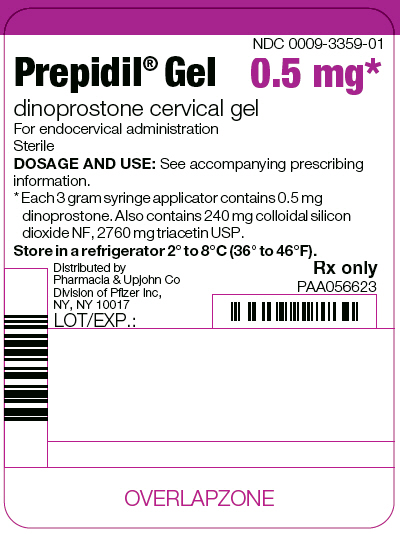
PRINCIPAL DISPLAY PANEL - 3 g Syringe Applicator Label NDC 0009-3359-01 Prepidil ® Gel 0.5 mg* dinoprostone cervical gel For endocervical administration Sterile DOSAGE AND USE: See accompanying prescribing information. * Each 3 gram syringe applicator contains 0.5 mg dinoprostone. Also contains 240 mg colloidal silicon dioxide NF, 2760 mg triacetin USP. Store in a refrigerator 2° to 8°C (36° to 46°F).
Distributed by Pharmacia & Upjohn Co Division of Pfizer Inc, NY, NY 10017 LOT/EXP.: Rx only PAA056623 PRINCIPAL DISPLAY PANEL - 3 g Syringe Applicator Label
PRINCIPAL DISPLAY PANEL - 3 g Syringe Label Prepidil ® Gel 0.5 mg dinoprostone cervical gel Sterile Store in a refrigerator 2° to 8°C (36° to 46°F). One 3 gram syringe Pfizer Injectables Distributed by Pharmacia & Upjohn Co Division of Pfizer Inc, NY, NY 10017 NDC 0009-3359-01 PAA056625 PRINCIPAL DISPLAY PANEL - 3 g Syringe Label
PRINCIPAL DISPLAY PANEL - 3 gram Syringe Carton Prepidil ® Gel 0.5 mg* dinoprostone cervical gel For endocervical administration Sterile Package includes 2 shielded catheters - 10 mm tip and 20 mm tip 1–3 gram syringe Pfizer Hospital NDC 0009-3359-01 Rx only PRINCIPAL DISPLAY PANEL - 3 gram Syringe Carton
PRINCIPAL DISPLAY PANEL - 3 g Syringe Bundle Label NDC 0009-3359-02 Contains 5 of NDC 0009-3359-01 Prepidil ® Gel 0.5 mg dinoprostone cervical gel 5–3 gram syringes Distributed by Pharmacia & Upjohn Co Division of Pfizer Inc, NY, NY 10017 Rx only PAA056624 PRINCIPAL DISPLAY PANEL - 3 g Syringe Bundle Label
About this NDC listing & data coverage
What data is (and isn’t) available for this NDC — tap to expand
| NDC identity (package / product / labeler codes) | ✓ Available |
| Labeler | ✓ Available |
| Product & package description | ✓ Available |
| Marketing category & status | ✓ Available |
| Active ingredient / dosage form / route | ✓ Available |
| FDA label (SPL via DailyMed) | ✓ Available |
| Package photos | ✓ Available |
| Inactive ingredients (structured) | ✓ Available |
| NADAC pharmacy acquisition price (CMS) | — Not published for this NDC CMS publishes NADAC only for NDCs reported in its retail-pharmacy survey. |
| Orange Book / therapeutic-equivalence data | — Not published for this NDC Applies only to products approved under an NDA/ANDA; many listings are out of scope. |
| HCPCS J-code billing crosswalk | — Not published for this NDC Most self-administered / retail products have no J-code — that is normal. |
| Medicaid utilization (CMS SDUD) | — Not published for this NDC CMS reports utilization only for NDCs with Medicaid claims above its privacy threshold. |