
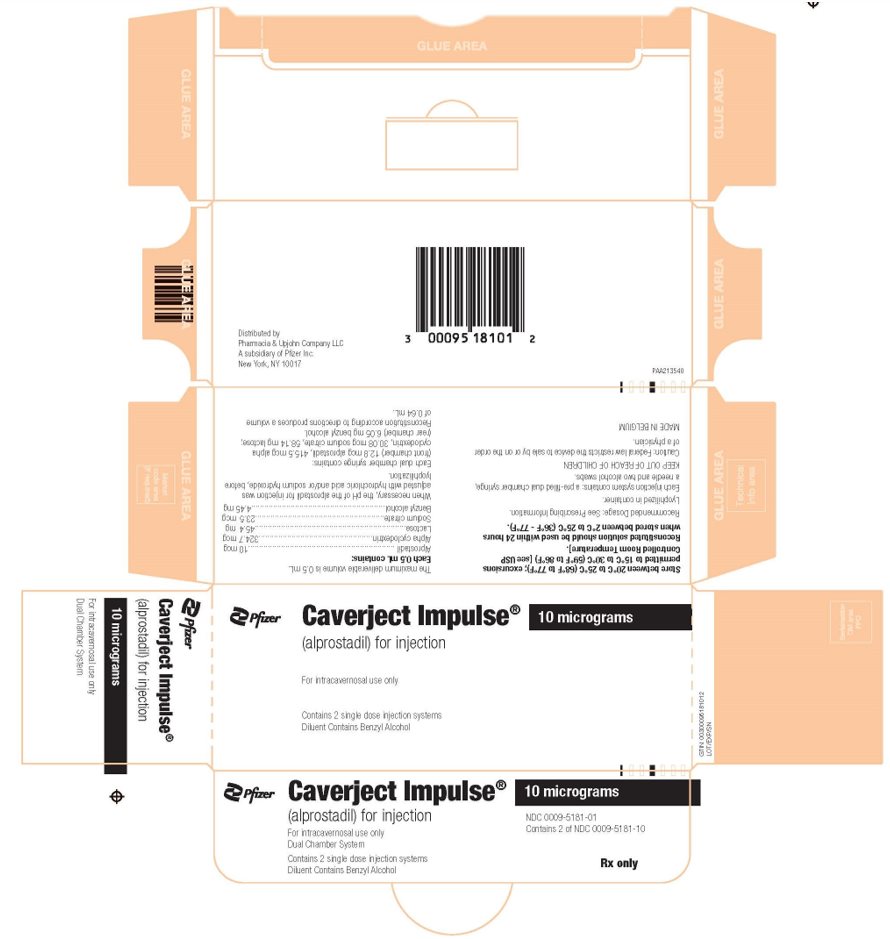
Caverject Impulse Alprostadil 10 ug/.5mL Injection, Powder, Lyophilized, For Solution, 2 syringes — NDC 0009-5181-01 (Billing 00009-5181-01)
This is a package of 2 syringes of Caverject Impulse Alprostadil 10 ug/.5mL Injection, Powder, Lyophilized, For Solution from Pharmacia & Upjohn Company LLC, marketed since Jun 2002 and currently FDA-listed; retail pharmacies pay about $82.49 per syringe (NADAC). It is this product's only package size.
NDC database record
One package, one record: these facts belong to NDC 0009-5181-01 alone.
- Record
- FDA NDC Directory package listing · Human prescription drug
- Code segments
- 0009 labeler · 5181 product · 01 package
- Package marketed since
- Jun 11, 2002
- Sample package
- No — commercial package
- Listing certified through
- Dec 31, 2026
- Billing quantity
- 2 EA per package
- Barcode (UPC-A, from the NDC)
- 3 0009518101 2
- FDA record last changed
- Jul 24, 2026
Identity & classification
Regulatory identifiers FDA, NLM and CMS codes for this package
Drug-database identifiers Medi-Span GPI and First Databank GCN / HICL / AHFS classification
- GSN (GCN sequence number): 023797
- GCN: 02294
- GPI-14 (Medi-Span): 40303010006410
- HICL (First Databank): 000177
- AHFS class code: 24:08.16.00
- RxCUI (RxNorm): 763470
Where does this data come from?
- FDA openFDA NDC Directory · synced Oct 8, 2026
- FDA label on DailyMed · label index refreshed Oct 6, 2026
- RxNorm (NLM RxNav) · catalog refreshed Oct 1, 2026
- Medi-Span GPI (licensed)
- First Databank (licensed) · refreshed Oct 8, 2026
RxNorm drug class
This medicine belongs to the Prostaglandin Analog class.
Where does this data come from?
- RxClass (NLM) · catalog refreshed Oct 1, 2026
Clinical
Alprostadil injection and suppositories are used to treat certain types of erectile dysfunction (impotence; inability to get or keep an erection) in men. Alprostadil injection is also sometimes used in combination with other tests to diagnose erectile dysfunction. Alprostadil is in a class of medications called vasodilators. It works by relaxing the muscles and blood vessels in the penis to keep enough blood in the penis so that an erection can occur. Alprostadil does not cure erectile dysfunction or increase sexual desire. Alprostadil does not prevent pregnancy or the spread of sexually trans...
Read the full MedlinePlus article ↗Patient education
Supplement & herbal interactions
Where does this data come from?
- MedlinePlus (NLM) · refreshed Oct 1, 2026
- FDA label on DailyMed · label index refreshed Oct 6, 2026
Ask a licensed pharmacist directly — free, answered by our team.
Pricing
A drug doesn't have one price. Each row is a different public payment system, and none is what you'd pay at the counter — that depends on your insurance. The ⓘ on each row explains what it measures.
| Price system | Per ea | Per package |
|---|---|---|
| Retail pharmacies payNADAC · weekly | $82.491 | $164.98 / 2 syringes |
| Medicaid paysCMS SDUD · 12 mo | No recent Medicaid claims on file for this NDC — rare and low-volume NDCs are suppressed in the public data. | |
| Medicare drug plans payPart D · quarterly | No Part D plan price is available for this NDC in our data. | |
| Medicare Part B allowsASP · J0270 | No ASP payment limit on file for J0270 this quarter. | |
Where does this data come from?
- CMS NADAC weekly file · file of Oct 7, 2026
- CMS ASP pricing files · refreshed Sep 20, 2026
- CMS Medicaid State Drug Utilization Data · refreshed Oct 8, 2026
- CMS Part D plan pricing files · refreshed Sep 24, 2026
- VA National Acquisition Center price file
Billing & reimbursement
Where does this data come from?
- CMS ASP NDC-HCPCS crosswalk · refreshed Sep 22, 2026
- DMEPDAC NDC-HCPCS crosswalk
- openFDA NSDE billing units · refreshed Oct 7, 2026
Packaging — all sizes for this product
| Package NDC | Description | Marketing start | Marketing end | Status |
|---|---|---|---|---|
| 00009-5181-01 You're viewing this Main listing | 2 SYRINGE in 1 CARTON / .5 mL in 1 SYRINGE | 2002-06-11 | — | Active |
Therapeutic equivalents
| Product | Labeler | Pack | NADAC/unit | TE | Status | Price vs. this |
|---|---|---|---|---|---|---|
| Caverject Impulse 10 ug/.5mLthis 00009-5181-01 | Pharmacia | 2 syringes | $82.491 | — | Availability likely | — |
Where does this data come from?
- FDA openFDA NDC Directory · synced Oct 8, 2026
- FDA Orange Book · refreshed Oct 3, 2026
- CMS NADAC weekly file · file of Oct 7, 2026
Availability & generic status
We did not find an FDA-approved generic match for this exact strength, form and route.
Where does this data come from?
- FDA Orange Book · refreshed Oct 3, 2026
Inactive Ingredients / Excipients
Inactive ingredients, also called excipients, are components of the drug product other than the active ingredient. They may include fillers, dyes, coatings, preservatives, flavors, or other formulation ingredients.
💡 Tap an ingredient (hover on desktop) to see what it is and why it’s used.
-
324.7 ug / 0.5 mL
UNII Z1LH97KTRM
Alfadex is a chemically modified starch derived from corn or potato. It acts as a solubilizer and stabilizer in medicines, helping drugs dissolve better and remain stable in liquid formulations.
-
4.45 mg / 0.5 mL
UNII LKG8494WBH
Benzyl alcohol is a clear liquid used as a preservative and solvent in medicines. It helps prevent bacterial and fungal growth and dissolves other ingredients to create uniform liquid formulations.
-
UNII QTT17582CB
A strong acid used to adjust and maintain the proper pH level in liquid medicines, ensuring stability and preventing breakdown of active ingredients.
-
45.4 mg / 0.5 mL
UNII J2B2A4N98G
Lactose is a natural sugar derived from milk. In medications, it serves as a filler and binder to add bulk and help hold tablet or capsule ingredients together during manufacturing.
-
23.5 ug / 0.5 mL
UNII 1Q73Q2JULR
Sodium citrate is a salt derived from citric acid. It works as a buffer to maintain the medicine's pH level and may also help improve taste or act as a preservative in the formulation.
-
UNII 55X04QC32I
A strong alkaline chemical used to adjust and maintain the pH balance of liquid medicines. It helps keep the medicine stable and ensures it stays effective during storage.
-
UNII 059QF0KO0R
Water is a liquid solvent that dissolves and mixes ingredients together in liquid medicines, syrups, and injections. It helps distribute the active drug evenly throughout the product.
7 inactive ingredients listed in the exact product block matched to this NDC.
Where does this data come from?
ingredient classCode="IACT" elements from the exact product block matched by this NDC. Label-section narrative from DailyMed / the openFDA label index is shown separately when available.- FDA label on DailyMed · label index refreshed Oct 6, 2026
- FDA openFDA NDC Directory · synced Oct 8, 2026
Inactive ingredient FAQ
Are inactive ingredients the same for every manufacturer?
Why might an inactive ingredient be missing?
Can inactive ingredients matter?
Manufacturer & labeler
More NDCs from Pharmacia & Upjohn Company LLC labeler code 00009
- Alprazolam 1 kg/kg Powder NDC 0009-5144-01
- Linezolid 1 kg/kg Powder NDC 0009-5157-01
- Hydrocortisone Acetate 1 kg/kg Powder NDC 0009-5161-01
- Epoprostenol Sodium 1 g/g Powder NDC 0009-5164-01
- Lincomycin hydrochloride 1 kg/kg Powder NDC 0009-5168-02
- Latanoprost 1 kg/kg Powder NDC 0009-5172-01
- Caverject Impulse Alprostadil 20 ug/.5mL Injection, Powder, Lyophilized, For Solution NDC 0009-5182-01
- Triazolam 1 kg/kg Powder NDC 0009-5188-01
- Minoxidil 1 kg/kg Powder NDC 0009-5230-02
- Neomycin Sulfate 1 kg/kg Powder NDC 0009-5238-01
- Hydrocortisone 1 kg/kg Powder NDC 0009-5275-01
- Eplerenone 1 kg/kg Powder NDC 0009-5276-01
Where does this data come from?
- FDA openFDA NDC Directory · synced Oct 8, 2026
- Drugs@FDA
Full prescribing information FDA SPL
🎯 Indications and Usage ▾
1 INDICATIONS AND USAGE CAVERJECT IMPULSE is a prostaglandin E1 agonist indicated • For the treatment of erectile dysfunction ( 1.1 ) • As an adjunct to other diagnostic tests in the diagnosis of erectile dysfunction ( 1.2 ).
1.1Erectile Dysfunction CAVERJECT IMPULSE is indicated for the treatment of erectile dysfunction.
1.2Diagnostic Test CAVERJECT IMPULSE is indicated as an adjunct to other diagnostic tests in the diagnosis of erectile dysfunction.
⏱️ Dosage and Administration ▾
2 DOSAGE AND ADMINISTRATION • Determine the most suitable dose and presentation of CAVERJECT to use. Use a new syringe for each dose of CAVERJECT ( 2.1 ). • Administer first intracavernosal injections in the health care provider’s office and titrate the dose for each patient to the lowest effective dose ( 2.1 ). • Instruct the patient on proper use and assess that they are well trained in the self-injection technique prior to initiation of at-home use ( 2.1 ). • Recommended dosage for erectile dysfunction ( 2.2 ): o Erectile dysfunction of vasculogenic, psychogenic, or mixed etiology: Initiate dosing with 2.5 mcg o Erectile dysfunction of pure neurogenic etiology (spinal cord injury): Initiate dosing with 1.25 mcg • Follow dose titration procedures for each type of erectile dysfunction and determine the maintenance dosage for patient home use in the health care provider’s office ( 2.2 ). • The recommended frequency of injection is no more than 3 times weekly, with at least 24 hours between each dose ( 2.2 ). • While on self-injection treatment, the patient should visit the prescribing health care provider’s office every 3 months to assess the efficacy and safety of the therapy ( 2.1 ). • Follow procedure for CAVERJECT IMPULSE syringe preparation ( 2.3 ). • Follow the procedure for CAVERJECT IMPULSE administration ( 2.4 ). • To diagnose erectile dysfunction (pharmacologic testing), inject CAVERJECT IMPULSE intracavernosally and monitor patients for the occurrence of an erection ( 2.2 ).
2.1Important Dosage and Administration Instructions • Alprostadil is available in different strengths and presentations. Determine the most suitable dose and presentation for each patient. Use a new syringe for each dose of CAVERJECT. • Titrate the dose of CAVERJECT IMPULSE for each patient to the lowest effective dose. • CAVERJECT IMPULSE doses greater than 60 mcg are not recommended. • Administer the first doses of CAVERJECT IMPULSE in the health care provider’s office by medically trained personnel. • Instruct the patient on proper use and assess that they are well trained in the self-injection technique prior to initiation of home use.
Refer to the Patient Information and Instructions for Use. • Re-evaluate patients regularly (every 3 months or as clinically appropriate) and determine if dosage adjustments are needed.
2.2Recommended Dosage for Erectile Dysfunction Erectile Dysfunction of Vasculogenic, Psychogenic, or Mixed Etiology. • Initiate dosing with 2.5 mcg of CAVERJECT IMPULSE intracavernousally as recommended [see Dosage and Administration 2.4 ] . • If there is a partial response at 2.5 mcg, administer another dose of 2.5 mcg within 1 hour. • During titration, no more than 2 doses should be given within a 24-hour period. • If additional titration is required, administer doses in increments of 5 to 10 mcg at least 24 hours apart. • The optimal dose should produce an erection suitable for intercourse that does not exceed a duration of 1 hour. • The patient must stay in the health care provider’s office until complete detumescence occurs.
Repeat the titration as necessary until the optimal dose is achieved. Doses greater than 60 mcg are not recommended. Erectile Dysfunction of Pure Neurogenic Etiology (Spinal Cord Injury): • Initiate dosing with 1.25 mcg of alprostadil using CAVERJECT. • If there is a partial response, administer another dose of CAVERJECT of 1.25 mcg within 1 hour. • No more than 2 doses during initial titration should be given within a 24-hour period. • If additional titration is required, administer a dose of 5 mcg at least 24 hours later. • The optimal dose should produce an erection suitable for intercourse that does not exceed a duration of 1 hour. • The patient must stay in the health care provider’s office until complete detumescence occurs.
Repeat the titration as necessary until the optimal dose is achieved. Doses greater than 60 mcg are not recommended. Maintenance Dosage for Patient Home Use: • Once the dos… [Excerpted — this section continues on DailyMed.]
💊 Dosage Forms and Strengths ▾
3 DOSAGE FORMS AND STRENGTHS Caverject Impulse (alprostadil) for injection contains sterile, freeze-dried alprostadil for reconstitution and sterile bacteriostatic water in a prefilled dual chamber glass cartridge. It is available in 10 mcg and 20 mcg strengths. For injection: 10 mcg and 20 mcg of alprostadil freeze-dried powder for reconstitution in single-dose, pre‑filled, dual chambered glass cartridge syringe.
The front chamber contains alprostadil and the rear chamber contains sterile bacteriostatic water. A 29 gauge needle system is also included. The reconstituted solution is clear.
For injection: 10 mcg or 20 mcg freeze-dried powder for reconstitution in a dual-chamber syringe ( 3 ).
⛔ Contraindications ▾
4 CONTRAINDICATIONS CAVERJECT IMPULSE is contraindicated: • in men who have a known hypersensitivity to the drug [see Adverse Reactions (6.1) ] • in men who have conditions that predispose them to priapism, such as sickle cell anemia or sickle cell trait, multiple myeloma, or leukemia [see Warnings and Precautions (5.1) ] • for the treatment of erectile dysfunction in men with fibrotic conditions of the penis, such as anatomical deformation, angulation, cavernosal fibrosis, or Peyronie's disease [see Warnings and Precautions (5.2) ] • in men with penile implants. • Known hypersensitivity to the drug ( 4 ). • Men who have conditions that predispose them to priapism, such as sickle cell anemia or sickle cell trait, multiple myeloma, or leukemia ( 4 ). • Treatment of erectile dysfunction in men with fibrotic conditions of the penis, such as anatomical deformation, angulation, cavernosal fibrosis, or Peyronie's disease ( 4 ). • Men with penile implants ( 4 ).
⚠️ Warnings and Cautions ▾
5 WARNINGS AND PRECAUTIONS • Prolonged erection and priapism have occurred in patients receiving CAVERJECT. To minimize the chances of this occurring, titrate CAVERJECT IMPULSE slowly to the lowest effective dose ( 2.1 ). Advise patients to seek immediate medical assistance for an erection that persists longer than 4 hours ( 5.1 ). • Penile fibrosis has occurred in patients receiving CAVERJECT.
Follow patients regularly to detect signs of penile fibrosis. Discontinue in patients who develop penile angulation or cavernosal fibrosis ( 5.2 ). • Hypotension - injections of CAVERJECT IMPULSE can lead to increased peripheral blood levels of alprostadil, especially in patients with significant corpora cavernosa venous leakage. Avoid use in patients with known cavernosal venous leakage ( 5.3 ). • Injection site bleeding may occur in patients taking anticoagulants, such as warfarin or heparin.
Compress the site of injection with an alcohol swab or sterile gauze for 5 minutes ( 5.4 ). • Cardiovascular risk related to underlying medical conditions - Underlying treatable medical causes of erectile dysfunction should be diagnosed and treated prior to initiation of therapy ( 5.5 ). • Risks of use in combination with other vasoactive medications injected intracavernosally - Safety and efficacy of combinations of CAVERJECT and other vasoactive agents have not been systematically studied. Use of such combinations is not recommended ( 5.6 ). • Risk of needle breakage – A superfine needle is used for CAVERJECT IMPULSE and cases of needle breakage have been reported.
Careful instruction in proper patient handling and injection techniques may minimize this risk ( 5.7 ). • Benzyl alcohol – Serious and fatal adverse reactions can occur in neonates and low birth weight infants treated with benzyl alcohol-preserved formulations in infusion solutions, including CAVERJECT IMPULSE. CAVERJECT IMPULSE is not indicated in neonates and infants ( 5.8 ). • Counsel patients about sexually transmitted diseases . Counsel patients about the protective measures necessary to guard against sexually transmitted disease including the Human Immunodeficiency Virus (HIV) ( 5.9 ).
5.1Prolonged Erection and Priapism Prolonged erection, defined as erection lasting between 4 to 6 hours in duration, occurred in 4% of 1,861 patients treated up to 18 months in studies of CAVERJECT. The incidence of priapism (erections lasting more than 6 hours in duration) was 0.4%. In the event of an erection that persists longer than 4 hours, the patient should seek immediate medical assistance.
If priapism is not treated immediately, penile tissue damage and permanent loss of potency may result. To minimize the chances of prolonged erection or priapism, titrate CAVERJECT IMPULSE to the lowest effective dose [ see Dosage and Administration (2.1 ]. In addition, do not use CAVERJECT IMPULSE in patients who have conditions that predispose them to priapism, such as sickle cell anemia or sickle cell trait, multiple myeloma, or leukemia [see Contraindications (4) ] .
5.2Penile Fibrosis The overall incidence of penile fibrosis reported in clinical studies with CAVERJECT was 3%. In one self-injection clinical study where duration of use was up to 18 months, the incidence of penile fibrosis was 7.8%. Physical examination of the penis should be performed periodically to detect signs of penile fibrosis. Treatment with CAVERJECT IMPULSE should be discontinued in patients who develop penile angulation or cavernosal fibrosis.
5.3Hypotension Intracavernous injections of CAVERJECT IMPULSE can increase peripheral blood levels of alprostadil which can result in hypotension. Avoid use of CAVERJECT IMPULSE in patients with known cavernosal venous leakage.
5.4Injection Site Bleeding When Used with Anticoagulants Patients on anticoagulants, such as warfarin or heparin, may have increased propensity for injection site bleeding after intracavernosal injection with CAVERJECT IMPULSE. Compress the site of injection… [Excerpted — this section continues on DailyMed.]
🤒 Adverse Reactions ▾
6 ADVERSE REACTIONS The following are discussed in more detail in other sections of the labeling: • Prolonged Erection and Priapism [see Warnings and Precautions (5.1) ] • Penile Fibrosis [see Warnings and Precautions (5.2) ] Most common (≥10%) adverse reactions: penile pain ( 6.1 ). To report SUSPECTED ADVERSE REACTIONS, contact Pfizer at (1-800-438-1985 and www.pfizer.com ) or FDA at 1-800-FDA-1088 or http://www.fda.gov/medwatch .
6.1Clinical Trials Experience Because clinical trials are conducted under widely varying conditions, adverse reaction rates observed in the clinical trials of a drug cannot be directly compared to rates in the clinical trials of another drug and may not reflect the rates observed in clinical practice. CAVERJECT IMPULSE was evaluated in 87 patients in an open-label crossover study of 6 weeks treatment duration that compared the formulation of alprostadil for injection contained in CAVERJECT IMPULSE with the formulation contained in CAVERJECT.
Doses used in this study ranged from 2.5 mcg to 20 mcg. Adverse reactions reported for the CAVERJECT IMPULSE formulation included: penis disorder (4.6%), prolonged erection (1.1%), injection site erythema (1.1%), rash (1.1%), dizziness (1.1%), and hematospermia (1.1%). Penis disorder included penile pain, post-injection pain, and pain with erection.
CAVERJECT IMPULSE was also evaluated in 63 patients in a single-dose, double-blind, crossover study that compared CAVERJECT IMPULSE with CAVERJECT. Doses used in this study ranged from 2.5 mcg to 20 mcg. Adverse reactions reported for the CAVERJECT IMPULSE formulation included: penile pain (1.6%) and pruritus (1.6%).
In addition to the adverse reactions observed for CAVERJECT IMPULSE in these two studies, the following adverse reactions have been reported in clinical studies of CAVERJECT: Local Adverse Reactions: Local adverse reactions derived from 1861 patients in clinical studies of CAVERJECT, including an 18-month, open-label study, are shown in Table 1. Table 1. Local Adverse Reactions Reported by ≥ 1% of Patients Treated with CAVERJECT for up to 18 Months Penile pain 37% Prolonged erection 4% Penile fibrosis 3% Injection site hematoma 3% Penis disorder Penis disorder includes: numbness, irritation, sensitivity, pruritus, erythema, skin tear, discoloration, itching.
3% Injection site ecchymosis 2% Penile rash 1% Penile edema 1% The following local adverse reactions were reported in < 1% of patients: injection site hemorrhage, injection site inflammation, injection site itching, injection site swelling, injection site edema, urethral bleeding, penile warmth, numbness, irritation, sensitivity, pruritus, erythema, painful erection, and abnormal ejaculation. In these studies, no local adverse reactions were reported in the 294 patients who received placebo, except for penile pain (2%).
Penile Pain: In the majority of the cases, penile pain was rated mild or moderate in intensity. Three percent of patients discontinued treatment because of penile pain Prolonged Erection/Priapism: Prolonged erection was defined as an erection that lasted for 4 to 6 hours; priapism was defined as an erection that lasted 6 hours or longer. In clinical studies, the frequency of prolonged erection after CAVERJECT was 4%, while the frequency of priapism was 0.4% [see Warnings and Precautions (5.1) ].
Penile Hematoma/Ecchymosis: In clinical studies, the frequency of penile hematoma and ecchymosis was 3% and 2%, respectively. Systemic Adverse Reactions : Systemic adverse reactions reported by ≥ 1% of subjects in clinical studies of CAVERJECT included: dizziness (1%). The following systemic adverse reactions were reported in < 1% of patients: testicular pain, scrotal edema, hematuria, pelvic pain, hypotension, vasodilation, vasovagal reaction, diaphoresis, rash, and non-application site pruritus.
Three patients (0.2%) discontinued due to symptomatic hypotension. No systemic adverse reactions were reported in the 294 patients who received pl… [Excerpted — this section continues on DailyMed.]
🔄 Drug Interactions ▾
7 DRUG INTERACTIONS The potential for pharmacokinetic drug-drug interactions between alprostadil and other agents administered orally or intracavernosally has not been formally studied [see Warnings and Precautions (5.6) ] .
👥 Use in Specific Populations ▾
8 USE IN SPECIFIC POPULATIONS
8.1Pregnancy CAVERJECT IMPULSE is not indicated for use in females.
8.2Lactation CAVERJECT IMPULSE is not indicated for use in females.
8.4Pediatric Use CAVERJECT IMPULSE is not indicated for use in pediatric patients [see Warnings and Precautions (5.8) ] .
8.5Geriatric Use A total of 341 subjects included in clinical studies were 65 and older. No overall differences in safety and effectiveness were observed between these subjects and younger subjects, and the other reported clinical experience has not identified differences in responses between elderly and younger patients.
🤰 Pregnancy ▾
8.1Pregnancy CAVERJECT IMPULSE is not indicated for use in females.
🧒 Pediatric Use ▾
8.4Pediatric Use CAVERJECT IMPULSE is not indicated for use in pediatric patients [see Warnings and Precautions (5.8) ] .
🧓 Geriatric Use ▾
8.5Geriatric Use A total of 341 subjects included in clinical studies were 65 and older. No overall differences in safety and effectiveness were observed between these subjects and younger subjects, and the other reported clinical experience has not identified differences in responses between elderly and younger patients.
🆘 Overdosage ▾
10 OVERDOSAGE Overdosage was not observed in clinical trials with CAVERJECT IMPULSE. If intracavernous overdose of CAVERJECT IMPULSE occurs, the patient should be under medical supervision until any systemic effects have resolved and/or until penile detumescence has occurred. Treatment of any systemic symptoms (e.g., hypotension) would be appropriate.
🧬 Clinical Pharmacology ▾
12 CLINICAL PHARMACOLOGY
12.1Mechanism of Action Alprostadil induces erection by relaxation of trabecular smooth muscle and by dilation of cavernosal arteries. This leads to expansion of lacunar spaces and entrapment of blood by compressing the venules against the tunica albuginea, a process referred to as the corporal veno-occlusive mechanism.
12.2Pharmacodynamics There are no results from pharmacodynamic studies in humans.
12.3Pharmacokinetics Absorption: For the treatment of erectile dysfunction, alprostadil is administered by injection into the corpora cavernosa. The absolute bioavailability of alprostadil has not been determined. Distribution: Following intracavernosal injection of 20 mcg alprostadil, mean peripheral plasma concentrations of alprostadil at 30 and 60 minutes after injection (89 and 102 picograms/mL, respectively) were not significantly greater than baseline levels of endogenous alprostadil (96 picograms/mL).
Plasma levels of alprostadil were measured using a radioimmunoassay method. Alprostadil is bound in plasma primarily to albumin (81% bound) and to a lesser extent α-globulin IV-4 fraction (55% bound). No significant binding to erythrocytes or white blood cells was observed.
Metabolism: Alprostadil is converted to compounds, which are further metabolized prior to excretion. Following intravenous administration, approximately 80% of circulating alprostadil is metabolized in one pass through the lungs, primarily by beta- and omega-oxidation. Following intracavernosal injection of 20 mcg alprostadil, peripheral levels of the major circulating metabolite, 13, 14-dihydro-15-oxo-PGE 1 , increased to reach a peak 30 minutes after injection and returned to pre-dose levels by 60 minutes after injection.
Excretion: The metabolites of alprostadil are excreted primarily by the kidney, with almost 90% of an administered intravenous dose excreted in urine within 24 hours post-dose. The remainder of the dose is excreted in the feces. There is no evidence of tissue retention of alprostadil or its metabolites following intravenous administration.
Pharmacokinetics in Specific Populations Geriatric: The potential effect of age on the pharmacokinetics of alprostadil has not been formally evaluated. Race: The potential effect of race on the pharmacokinetics of alprostadil has not been formally evaluated. Renal and Hepatic Insufficiency: The pharmacokinetics of alprostadil have not been formally studied in patients with renal or hepatic insufficiency.
🧬 Mechanism of Action ▾
12.1Mechanism of Action Alprostadil induces erection by relaxation of trabecular smooth muscle and by dilation of cavernosal arteries. This leads to expansion of lacunar spaces and entrapment of blood by compressing the venules against the tunica albuginea, a process referred to as the corporal veno-occlusive mechanism.
📦 How Supplied / Storage and Handling ▾
16 HOW SUPPLIED/STORAGE AND HANDLING CAVERJECT IMPULSE is supplied as a disposable, single-dose, dual chamber syringe system. The system includes a glass cartridge, which contains sterile, freeze-dried alprostadil in the front chamber and sterile bacteriostatic water for reconstitution in the rear chamber. The syringes contain either 12.8 or 25.6 mcg of alprostadil to allow delivery of a maximum of 10 or 20 mcg/0.5mL.
Store the unreconstituted product at 68°F to 77°F (20°C to 25°C); excursions permitted to 59°F to 86°F (15°C to 30°C) [see USP Controlled Room Temperature]. When reconstituted and used as directed, the deliverable amount for the 10 mcg strength is 10 mcg/0.5 mL or an increment of 10 mcg/0.5 mL: 2.5 mcg/0.125 mL, 5 mcg/0.25 mL, or 7.5 mcg/0.375 mL of alprostadil. The deliverable amount for the 20 microgram strength is 20 mcg/0.5 mL or an increment of 20 mcg/0.5 mL: 5 mcg/ 0.125 mL, 10 mcg/0.250 mL, or 15 mcg/0.375 mL of alprostadil.
The reconstituted solution should be used within 24 hours when stored between 36–77°F (2°C to 25°C). Do not freeze. CAVERJECT IMPULSE is supplied in a carton containing 2 blister trays.
Each blister tray contains one dual chamber syringe system, one needle and 2 alcohol swabs. It is available in the following strengths: 10 mcg NDC 0009-5181-01 20 mcg NDC 0009-5182-01
📋 Description ▾
11 DESCRIPTION CAVERJECT IMPULSE contains alprostadil a synthetic form of prostaglandin E 1 (PGE 1 ) and is designated chemically as (11α,13E,15S)-11,15-dihydroxy-9-oxoprost-13-en-1-oic acid. The molecular weight is 354.49. Alprostadil is a white to off-white crystalline powder with a melting point between 115° and 116°C.
Its solubility at 35°C is 8000 micrograms (mcg) per 100 milliliter double distilled water. The structural formula of alprostadil is represented below: CAVERJECT IMPULSE is available as a disposable, single-dose, dual chamber syringe system. The system includes a glass cartridge which contains sterile, freeze-dried alprostadil in the front chamber and sterile bacteriostatic water for injection in the rear chamber.
The alprostadil is reconstituted with the sterile bacteriostatic water just before injection. CAVERJECT IMPULSE is available in two strengths for intracavernosal administration: 10 microgram – The reconstituted solution has a volume of 0.64 mL. The delivered volume, 0.5 mL, contains 10 micrograms (mcg) of alprostadil, 324.7 mcg of alpha cyclodextrin, 45.4 mg of lactose, 23.5 mcg of sodium citrate, and 4.45 mg of benzyl alcohol.
20 microgram – The reconstituted solution has a volume of 0.64 mL. The delivered volume, 0.5 mL, contains 20 micrograms (mcg) of alprostadil, 649.3 mcg of alpha cyclodextrin, 45.4 mg of lactose, 23.5 mcg of sodium citrate, and 4.45 mg of benzyl alcohol. During manufacture, the pH of the alprostadil for injection was adjusted with hydrochloric acid and/or sodium hydroxide before lyophilization.
Chemical Structure
💬 Information for Patients ▾
17 PATIENT COUNSELING INFORMATION Advise the patient to read the FDA-approved patient labeling (Patient Information and Instructions for Use) Dosing and Self-Administration To ensure safe and effective use of CAVERJECT IMPULSE, instruct and train the patient in the self-injection technique before he begins treatment with CAVERJECT IMPULSE, at home. Inform the patient the initial dose administration and dose titration will take place in the health care provider’s office [see Dosage and Administration (2.1) ] . Once the home dose of CAVERJECT IMPULSE has been established instruct the patient not to change the dose without consulting their health care provider.
The patient may expect an erection to occur within 5 to 20 minutes and it should last no longer than 1 hour. CAVERJECT IMPULSE should be used no more than 3 times per week, with at least 24 hours between each use. Inform the patient that they must visit the health care provider’s office for regular check-ups for assessment of the therapeutic benefit and safety of treatment with CAVERJECT IMPULSE.
When self-administering the patient should be instructed to [see Dosage and Administration (2.3 , 2.4) ] : • Discard any reconstituted solution with precipitates or discoloration • Administer the injection along the dorso-lateral aspect of the proximal third of the penis • Wipe the intended injection site with an alcohol swab prior to injection • Avoid visible veins during injection • Alternate the side of the penis that is injected and the site of injection • Compress the site of injection with an alcohol swab or sterile gauze for 5 minutes • Use each CAVERJECT IMPULSE system only once and discard after use • Not use a bent needle.
Do not attempt to straighten a bent needle. Remove the needle from the syringe, discard it, and attach a new, unused sterile needle to the syringe • Not re-use or share needles and to properly discard after use. Needle Breakage Advise patients that needle breakage has occurred during self-injection of CAVERJECT.
Advise patients to insert the needle perpendicular to the long axis of the penis to avoid bending or breakage of the needle [see Warnings and Precautions (5.7) and Adverse Reactions (6.2) ] . Penile Pain Advise patients that the most frequently occurring side-effect is penile pain after injection and is usually mild to moderate in severity [see Adverse Reactions (6.1) ] . Priapism A potentially serious adverse reaction with CAVERJECT IMPULSE is priapism.
Instruct the patient to seek immediate medical assistance if an erection persists for longer than 4 hours [see Warnings and Precautions (5.1) ] . Penile Fibrosis Penile fibrosis has been reported in clinical studies with CAVERJECT. Advise the patient to report any penile pain that was not present before or that increased in intensity, as well as the occurrence of nodules or hard tissue in the penis or curvature of the erect penis to his physician as soon as possible. [see Warnings and Precautions (5.2) ] .
Injection Site Reactions Inform the patient that injection of CAVERJECT IMPULSE can induce a small amount of bleeding at the site of injection and that hematoma and ecchymosis may occur. Advise the patient to report any persistent redness, tenderness or swelling [see Warnings and Precautions (5.4) ] . Sexually Transmitted Disease Use of CAVERJECT IMPULSE offers no protection from the transmission of sexually transmitted diseases.
Advise the patient about the protective measures that are necessary to guard against the spread of sexually transmitted diseases, including the human immunodeficiency virus (HIV) [see Warnings and Precautions (5.9) ] .
🧬 Pharmacokinetics ▾
12.3Pharmacokinetics Absorption: For the treatment of erectile dysfunction, alprostadil is administered by injection into the corpora cavernosa. The absolute bioavailability of alprostadil has not been determined. Distribution: Following intracavernosal injection of 20 mcg alprostadil, mean peripheral plasma concentrations of alprostadil at 30 and 60 minutes after injection (89 and 102 picograms/mL, respectively) were not significantly greater than baseline levels of endogenous alprostadil (96 picograms/mL).
Plasma levels of alprostadil were measured using a radioimmunoassay method. Alprostadil is bound in plasma primarily to albumin (81% bound) and to a lesser extent α-globulin IV-4 fraction (55% bound). No significant binding to erythrocytes or white blood cells was observed.
Metabolism: Alprostadil is converted to compounds, which are further metabolized prior to excretion. Following intravenous administration, approximately 80% of circulating alprostadil is metabolized in one pass through the lungs, primarily by beta- and omega-oxidation. Following intracavernosal injection of 20 mcg alprostadil, peripheral levels of the major circulating metabolite, 13, 14-dihydro-15-oxo-PGE 1 , increased to reach a peak 30 minutes after injection and returned to pre-dose levels by 60 minutes after injection.
Excretion: The metabolites of alprostadil are excreted primarily by the kidney, with almost 90% of an administered intravenous dose excreted in urine within 24 hours post-dose. The remainder of the dose is excreted in the feces. There is no evidence of tissue retention of alprostadil or its metabolites following intravenous administration.
Pharmacokinetics in Specific Populations Geriatric: The potential effect of age on the pharmacokinetics of alprostadil has not been formally evaluated. Race: The potential effect of race on the pharmacokinetics of alprostadil has not been formally evaluated. Renal and Hepatic Insufficiency: The pharmacokinetics of alprostadil have not been formally studied in patients with renal or hepatic insufficiency.
🧬 Pharmacodynamics ▾
12.2Pharmacodynamics There are no results from pharmacodynamic studies in humans.
🔬 Clinical Studies ▾
14 CLINICAL STUDIES The efficacy of CAVERJECT IMPULSE was based upon clinical studies of CAVERJECT. The efficacy of CAVERJECT was investigated in men with a diagnosis of erectile dysfunction due to psychogenic, vasculogenic, neurogenic, and/or mixed etiology in two double-blind placebo-controlled studies (Study 1 and Study 2) and in one 6-month open-label study (Study 3). In clinical studies (Study 1 and Study 3), over 80% of patients experienced an erection sufficient for sexual intercourse after intracavernosal injection of CAVERJECT.
Study 1: A total of 153 men with ED with a mean age of 53 years (range 23–69 years) were enrolled. The study had three phases: a 2.5 week, randomized, double-blind, placebo-controlled crossover phase in which each man received in-office injections of placebo or 2.5 mcg, 5 mcg, 7.5 mcg, or 10 mcg of CAVERJECT; a 2 week, open-label, in-office dose-titration phase to identify the optimum home-use dose (the latter dose was defined as a dose inducing an erection sufficient for intercourse and lasting ≤ 60 minutes); and a 4-week open-label, at-home phase.
In the double-blind placebo-controlled, crossover phase, each dose of CAVERJECT was significantly more effective than placebo by clinical evaluation ("full penile rigidity") and by RigiScan criteria (≥ 70% rigidity for at least 10 minutes); there was no response to placebo. The percentage of responders increased with increasing doses of CAVERJECT. The overall response rates in the crossover and dose-titration phases were 76% (117/153) by clinical evaluation and 51% (78/152) by RigiScan criteria.
Seventy-three percent of the injections in 102 men who used CAVERJECT in the at-home phase resulted in satisfactory intercourse. Seventy-five percent of the men who used CAVERJECT in the at-home phase remained on the dose identified as optimum for them during the dose-titration phase; 17% and 8% of the men decreased or increased their dose, respectively. The mean duration of erection per injection was 70.8 minutes.
Study 2: A total of 296 men with ED with a mean age of 54 years (range 21–74 years) were enrolled in this double-blind, placebo controlled, parallel-arm design study. The men were randomly assigned to one of five groups and received either a single dose of placebo, 2.5 mcg, 5 mcg, 10 mcg, or 20 mcg of CAVERJECT. No patient responded to placebo.
The differences in the response rates in both the clinical and the RigiScan evaluations between each of the doses of CAVERJECT and placebo were statistically significant. There was also a statistically significant dose-response relationship with higher clinical response rates and higher RigiScan response rates with increasing doses of CAVERJECT (with exception of the 10-mcg dose). The mean duration of erection after injection ranged from 12 minutes after the 2.5-mcg dose to 44 minutes after the 20-mcg dose and the relationship was linear ( p = .025, linear regression analysis).
Study 3: The efficacy of CAVERJECT was further evaluated in a 6-month, open-label, at-home study in 683 men with ED with a mean age of 58 years (range 20–79 years). The optimum dose of CAVERJECT was established by titration in 89% of men (606/683). A total of 471/683 men (69%) completed the 6-month study.
Eighty-seven percent of the 13,762 injections of CAVERJECT administered resulted in satisfactory sexual activity. The mean duration of erection was 67.5 minutes. The formulation of alprostadil contained in CAVERJECT IMPULSE was compared to CAVERJECT in 87 men with ED in a single-blind, crossover study.
The doses used by the patients in the study ranged from 2.5 mcg to 20 mcg and were the same for both formulations. The efficacy of the two formulations was shown to be comparable, as assessed by the 30-point erectile function (EF) domain score from the International Index of Erectile Function (IIEF) and by a physician-assessment score for erectile response. The mean EF domain scores for CAVERJECT and CAVERJECT IMPULSE were 26.6 (SD=5.… [Excerpted — this section continues on DailyMed.]
🧪 Nonclinical Toxicology ▾
13 NONCLINICAL TOXICOLOGY
13.1Carcinogenesis, Mutagenesis, Impairment of Fertility Carcinogenesis Long-term carcinogenicity studies have not been conducted. Mutagenesis The following battery of mutagenicity assays revealed no potential for mutagenesis: bacterial mutation (Ames), alkaline elution, rat micronucleus, sister chromatid exchange, CHO/HGPRT mammalian cell forward gene mutation, and unscheduled DNA synthesis (UDS). Impairment of Fertility Rat reproductive studies indicate that alprostadil at doses of up to 0.2 mg/kg/day does not adversely affect or alter male rat fertility.
These doses are approximately 32-fold higher than the maximum recommended human dose of 60 mcg based on body surface area.
📄 Carcinogenesis, Mutagenesis, Impairment of Fertility ▾
13.1Carcinogenesis, Mutagenesis, Impairment of Fertility Carcinogenesis Long-term carcinogenicity studies have not been conducted. Mutagenesis The following battery of mutagenicity assays revealed no potential for mutagenesis: bacterial mutation (Ames), alkaline elution, rat micronucleus, sister chromatid exchange, CHO/HGPRT mammalian cell forward gene mutation, and unscheduled DNA synthesis (UDS). Impairment of Fertility Rat reproductive studies indicate that alprostadil at doses of up to 0.2 mg/kg/day does not adversely affect or alter male rat fertility.
These doses are approximately 32-fold higher than the maximum recommended human dose of 60 mcg based on body surface area.
📄 Patient Package Insert ▾
Patient Information CAVERJECT IMPULSE ® [KAV-er-jeckt] (alprostadil) for injection, for intracavernosal use Read this Patient Information before you start using CAVERJECT IMPULSE and each time you get a refill. There may be new information. This information does not take the place of talking to your healthcare provider about your medical condition or your treatment.
What is CAVERJECT IMPULSE? CAVERJECT IMPULSE is a prescription medicine used: • to treat erectile dysfunction (ED). • with other medical tests to diagnose ED. CAVERJECT IMPULSE is not meant for use in women or children under 18 years of age.
Do not use CAVERJECT IMPULSE if you: • are allergic to alprostadil or any of the ingredients in CAVERJECT. See the end of this leaflet for a complete list of ingredients in CAVERJECT. • have certain medical problems that might cause you to have an erection that lasts for more than 4 hours, such as sickle cell anemia, sickle cell trait, multiple myeloma, leukemia. • have a deformed penis shape • have a penile implant Before you use CAVERJECT IMPULSE, tell your healthcare provider if you: • have had an erection that lasted more than 4 hours • have sickle cell trait or sickle cell anemia • have or have had a blood cell cancer called multiple myeloma or leukemia • have a deformed penis shape • have a penile implant • have low blood pressure (hypotension) • have bleeding problems • have or have had heart problems such as a heart attack, irregular heartbeat, angina, chest pain, narrowing of the aortic valve or heart failure • have any other medical conditions Tell your healthcare provider about all the medicines you take, including prescription and over-the-counter medicines, vitamins, and herbal supplements.
CAVERJECT IMPULSE may affect the way other medicines work, and other medicines may affect the way CAVERJECT IMPULSE works causing side effects. Especially tell your healthcare provider if you take any other medicines that are injected into your penis (intracavernosally) or certain medicines called anticoagulant medicines (such as heparin or warfarin). Ask your healthcare provider or pharmacist for a list of these medicines, if you are not sure.
Know the medicines you take. Keep a list of them to show to your healthcare provider and pharmacist when you get a new medicine. How should I use CAVERJECT IMPULSE? • See the detailed Instructions for Use that comes with your CAVERJECT IMPULSE for information about how to prepare and inject CAVERJECT IMPULSE the right way. • Use CAVERJECT IMPULSE exactly as your healthcare provider tells you to. • Your healthcare provider will tell you how much CAVERJECT IMPULSE to use and when to use it. • Your healthcare provider may change your dose if needed.
Do not change your dose of CAVERJECT IMPULSE without first talking to your healthcare provider. • Your healthcare provider should show you how to prepare and inject CAVERJECT IMPULSE the right way before you inject it for the first time. • CAVERJECT IMPULSE should not be used more than 3 times per week. • CAVERJECT IMPULSE should not be used more than 1 time every 24 hours. • Change the exact place and side of the penis that you inject Caverject Impulse each time you use it. • CAVERJECT IMPULSE is for one use only and should be thrown away properly after a single use.
You should see your healthcare provider every 3 months for check-ups to be sure that CAVERJECT IMPULSE is working the right way and to change your CAVERJECT IMPULSE dose if needed. What are the possible side effects of CAVERJECT IMPULSE? CAVERJECT IMPULSE may cause serious side effects, including: • an erection that will not go away.
If you have an erection that lasts more than 4 hours, get medical help right away. If it is not treated right away, this condition can permanently damage your penis. • deformed penis shape (penile fibrosis). Your healthcare provider should check your penis regularly for signs of penile fibrosis.
You should not continue to use CAVERJECT IMPULSE if you ge… [Excerpted — this section continues on DailyMed.]
📖 Instructions for Use ▾
INSTRUCTIONS FOR USE CAVERJECT [KAV-er-jeckt]® (alprostadil) for injection, for intracavernosal use Before you use CAVERJECT, your doctor must train you in how to prepare and give the injection properly. Before using CAVERJECT, talk to your doctor about what to expect when using it, possible side effects, and what to do if side effects occur. Your dose has been selected for your individual needs.
Do not change your dose without consulting your doctor. If you are not sure of the volume or dose to be used, talk to your doctor or pharmacist. Follow these instructions exactly to properly prepare the syringe for use, and to correctly inject a sterile (germ-free) dose of CAVERJECT.
Supplies Needed The CAVERJECT IMPULSE carton contains two (2) sealed plastic trays, with one dose of Caverject in each tray. Each tray contains: (a) a syringe , (b) a separate needle assembly and (c) two alcohol swabs . The syringe and the needle assembly are shown in Figure A (below).
Please note that the needle assembly is packaged as a single piece and is sealed with a paper cover on the bottom. DO NOT try to assemble the syringe until you have read ALL of the instructions. First-read through ALL of the instructions (Step 1 through Step 12) before trying to assemble the syringe.
Then go back to Step 1 and begin to prepare the syringe for use. CAVERJECT IMPULSE is available in two versions: the 10 mcg strength (white plunger) and the 20 mcg strength (blue plunger). Each syringe is designed to be used only one time , but you can select the dose that will be delivered: • The 10 mcg strength syringe (white plunger) can deliver 10 mcg (the full dose), or one of three partial doses: 7.5 mcg, or 5 mcg, or 2.5 mcg. • The 20 mcg strength syringe (blue plunger) can deliver 20 mcg (the full dose), or one of three partial doses: 15 mcg, or 10 mcg, or 5 mcg.
If you deliver a partial dose there will be left-over solution in the syringe – this is normal. MAKE SURE YOU HAVE THE CORRECT STRENGTH OF CAVERJECT IMPULSE to deliver your assigned dose INSTRUCTIONS for PREPARING the SYRINGE (Step 1 through Step 12) Wash your hands thoroughly and dry them with a clean towel. STEP 1.
Open the sealed plastic tray. Remove the syringe, the needle assembly, and the alcohol swabs from the tray. All items should be present.
Look at the needle assembly . The needle assembly is a sealed unit that contains the outer protective cap, the inner protective cap, and the superfine needle, as shown in Figure A. It is sealed with a small round paper cover (not shown in Figure A).
Do not open the needle assembly at this point – leave it sealed inside the outer protective cap. Next, examine the syringe . Find the location of the dose window .
Right now you will not see anything in this window, but at a later Step, a number will appear in this window (the dose to be delivered). Finally, look at the Plunger, but do not move it at this time . During the assembly process, some Steps may ask you to ROTATE the plunger and other steps may ask you to PUSH the plunger.
It is important to only rotate the plunger – or only push – as directed in each Step, but DO NOT do both at the same time. Never PUSH on the plunger – even slightly – while trying to rotate it. This can cause the plastic threads on the plunger rod to stick.
STEP 2. Open the packet containing the alcohol swab, and then pick up the syringe. Use the alcohol swab to wipe the rubber membrane at the tip of the syringe (Figure B).
Discard the alcohol swab. STEP 3. Pick up the Needle Assembly .
Grab the paper tab and peel off the paper cover (lid) from the bottom of the needle assembly (Figure C). STEP 4. Hold the needle assembly by the cap.
Pick up the syringe with your other hand. Press the needle assembly onto the tip of the syringe and turn it clockwise (like tightening a screw) until the needle assembly is firmly locked into place. Remove (twist off - clockwise) the outer protective cap from the needle (Figure D), but DO NOT REMOVE the inner p… [Excerpted — this section continues on DailyMed.]
📄 Package Label / Principal Display Panel ▾
PRINCIPAL DISPLAY PANEL - 10 microgram Syringe Label Caverject Impulse ® Dual Chamber System (alprostadil) for injection 10 micrograms KEEP OUT OF REACH OF CHILDREN Distributed by Pharmacia & Upjohn Company LLC A subsidiary of Pfizer Inc. New York, NY 10017 PAA213741 LOT/EXP PRINCIPAL DISPLAY PANEL - 10 microgram Syringe Label
PRINCIPAL DISPLAY PANEL - 10 micrograms Syringe Carton Pfizer Caverject Impulse ® (alprostadil) for injection 10 micrograms NDC 0009-5181-01 Contains 2 of NDC 0009-5181-10 For intracavernosal use only Dual Chamber System Contains 2 single dose injection systems Diluent Contains Benzyl Alcohol Rx only PRINCIPAL DISPLAY PANEL - 10 micrograms Syringe Carton
PRINCIPAL DISPLAY PANEL - 20 microgram Syringe Label Caverject Impulse ® Dual Chamber System (alprostadil) for injection 20 micrograms KEEP OUT OF REACH OF CHILDREN Distributed by Pharmacia & Upjohn Company LLC A subsidiary of Pfizer Inc. New York, NY 10017 PAA213743 LOT/EXP PRINCIPAL DISPLAY PANEL - 20 microgram Syringe Label
PRINCIPAL DISPLAY PANEL - 20 micrograms Syringe Carton Pfizer Caverject Impulse ® (alprostadil) for injection 20 micrograms NDC 0009-5182-01 Contains 2 of NDC 0009-5182-11 For intracavernosal use only Dual Chamber System Contains 2 single dose injection systems Diluent Contains Benzyl Alcohol Rx only PRINCIPAL DISPLAY PANEL - 20 micrograms Syringe Carton