
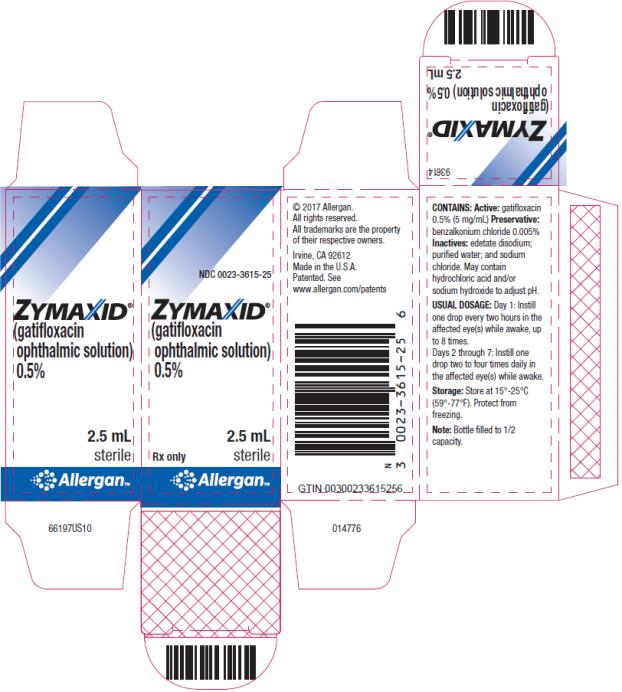
ZYMAXID gatifloxacin 5 mg/mL Solution/ Drops, 1 bottle — NDC 0023-3615-25 (Billing 00023-3615-25)
This is a package of 1 bottle of ZYMAXID gatifloxacin 5 mg/mL Solution/ Drops from Allergan, Inc., marketed since May 2010 and currently FDA-listed.
NDC database record
One package, one record: these facts belong to NDC 0023-3615-25 alone.
- Record
- FDA NDC Directory package listing · Human prescription drug
- Code segments
- 0023 labeler · 3615 product · 25 package
- Package marketed since
- May 19, 2010
- Sample package
- No — commercial package
- Listing certified through
- Dec 31, 2027
- Barcode (UPC-A, from the NDC)
- 3 0023361525 6
- FDA record last changed
- Aug 20, 2026
Identity & classification
Regulatory identifiers FDA, NLM and CMS codes for this package
Drug-database identifiers Medi-Span GPI and First Databank GCN / HICL / AHFS classification
- GSN (GCN sequence number): 066373
- GCN: 28627
- HICL (First Databank): 020788
- AHFS class code: 52:04.04.00
- RxCUI (RxNorm): 992395
Where does this data come from?
- FDA openFDA NDC Directory · synced Oct 1, 2026
- FDA label on DailyMed · label index refreshed Oct 5, 2026
- RxNorm (NLM RxNav) · catalog refreshed Oct 1, 2026
- Medi-Span GPI (licensed)
- First Databank (licensed) · refreshed Oct 1, 2026
RxNorm drug class
This medicine belongs to the Quinolone Antimicrobial class.
Where does this data come from?
- RxClass (NLM) · catalog refreshed Oct 1, 2026
Clinical
Gatifloxacin ophthalmic solution is used to treat bacterial conjunctivitis (pinkeye; infection of the membrane that covers the outside of the eyeballs and the inside of the eyelids) in adults and children 1 year of age and older. Gatifloxacin is in a class of antibiotics called fluoroquinolones. It works by killing the bacteria that cause infection.
Read the full MedlinePlus article ↗- Zymaxid is an antibiotic eye drop used to treat bacterial pink eye (bacterial conjunctivitis). It targets specific bacteria that commonly cause eye infections, like Staphylococcus...
- Yes, the schedule is a bit different on the first day. On Day 1, you put one drop in the affected eye every two hours while you're awake, up to 8 times. Starting on Day 2 and throu...
- How do I use the drops, and does the schedule change over time?
- The most common things people notice are mild eye irritation, eye pain, and sometimes a strange taste in the mouth — that last one sounds odd, but it happens with eye drops because...
Patient education
Supplement & herbal interactions
Some supplements/herbs that may interact with Gatifloxacin — tap one for details:
Gatifloxacin may be associated with lower levels of 7 nutrients — worth a chat with your pharmacist, not a cause for alarm.
Where does this data come from?
- MedlinePlus (NLM) · refreshed Oct 1, 2026
- FDA label on DailyMed · label index refreshed Oct 5, 2026
Ask a licensed pharmacist directly — free, answered by our team.
Pricing
A drug doesn't have one price. Each row is a different public payment system, and none is what you'd pay at the counter — that depends on your insurance. The ⓘ on each row explains what it measures.
| Price system | Per mL | Per package |
|---|---|---|
| Retail pharmacies payNADAC · weekly | Not in the retail survey — common for institutional, discontinued, or low-volume packs. | |
| Medicaid paysCMS SDUD · 12 mo | No recent Medicaid claims on file for this NDC — rare and low-volume NDCs are suppressed in the public data. | |
| Medicare drug plans payPart D · quarterly | No Part D plan price is available for this NDC in our data. | |
Where does this data come from?
- CMS NADAC weekly file
- CMS ASP pricing files · refreshed Sep 20, 2026
- CMS Medicaid State Drug Utilization Data · refreshed Oct 5, 2026
- CMS Part D plan pricing files · refreshed Sep 24, 2026
- VA National Acquisition Center price file
Packaging — all sizes for this product
| Package NDC | Description | Marketing start | Marketing end | Status |
|---|---|---|---|---|
| 00023-3615-01 0023-3615-01 Main listing | 1 BOTTLE, DROPPER in 1 CARTON / 1 mL in 1 BOTTLE, DROPPER Sample | 2010-05-19 | — | Active |
| 00023-3615-25 You're viewing this | 1 BOTTLE, DROPPER in 1 CARTON / 2.5 mL in 1 BOTTLE, DROPPER | 2010-05-19 | — | Active |
Pack size FAQ
What quantity is in this package?
How does this package differ from NDC 00023-3615-01?
What NDC number is used to bill for this package of ZYMAXID gatifloxacin 5 mg/mL Solution/ Drops?
Therapeutic equivalents
| Product | Labeler | Pack | NADAC/unit | TE | Status | Price vs. this |
|---|---|---|---|---|---|---|
| Gatifloxacin 5 mg/mL 61314-0672-25 | Sandoz | 1 bottle | $8.855 | AT | Availability likely | — |
| Gatifloxacin 5 mg/mL 69315-0331-02 | Leading | 2.5 ml | $8.855 | AT | Availability likely | — |
| Zymaxid 5 mg/mLthis 00023-3615-25 | Allergan, | 1 bottle | — | AT | FDA listed | — |
| Gatifloxacin Ophthalmic Solution 0.5% 5 mg/mL 65145-0207-01 | Caplin | 1 bottle | — | AT | FDA listed | — |
Where does this data come from?
- FDA openFDA NDC Directory · synced Oct 1, 2026
- FDA Orange Book · refreshed Oct 3, 2026
- CMS NADAC weekly file
Availability & generic status
FDA-approved generic versions are listed, and recent pricing/market data suggests they may be available — see Therapeutic equivalents.
Where does this data come from?
- FDA Orange Book · refreshed Oct 3, 2026
Inactive Ingredients / Excipients
Inactive ingredients, also called excipients, are components of the drug product other than the active ingredient. They may include fillers, dyes, coatings, preservatives, flavors, or other formulation ingredients.
💡 Tap an ingredient (hover on desktop) to see what it is and why it’s used.
-
UNII F5UM2KM3W7
Benzalkonium chloride is a chemical compound that works as a preservative and antimicrobial agent in medications. It prevents bacterial and fungal growth in liquid formulations to keep the product safe during storage and use.
-
UNII 7FLD91C86K
Edetate disodium is a chemical compound that binds and removes certain metal ions. In medicines, it acts as a preservative and stabilizer by preventing metals like calcium from interfering with the product's shelf life and consistency.
-
UNII QTT17582CB
A strong acid used to adjust and maintain the proper pH level in liquid medicines, ensuring stability and preventing breakdown of active ingredients.
-
UNII 451W47IQ8X
Sodium chloride is common table salt. It's used in medicines as a buffer to maintain proper pH, as a filler to add bulk, or to adjust the osmotic balance in liquid formulations.
-
UNII 55X04QC32I
A strong alkaline chemical used to adjust and maintain the pH balance of liquid medicines. It helps keep the medicine stable and ensures it stays effective during storage.
-
UNII 059QF0KO0R
Water is a liquid solvent that dissolves and mixes ingredients together in liquid medicines, syrups, and injections. It helps distribute the active drug evenly throughout the product.
6 inactive ingredients listed in the exact product block matched to this NDC.
Where does this data come from?
ingredient classCode="IACT" elements from the exact product block matched by this NDC. Label-section narrative from DailyMed / the openFDA label index is shown separately when available.- FDA label on DailyMed · label index refreshed Oct 5, 2026
- FDA openFDA NDC Directory · synced Oct 1, 2026
Inactive ingredient FAQ
Are inactive ingredients the same for every manufacturer?
Why might an inactive ingredient be missing?
Can inactive ingredients matter?
Manufacturer & labeler
More NDCs from Allergan, Inc. labeler code 00023
- REFRESH TEARS PF carboxymethylcellulose sodium, Glycerin 5 mg/mL; 9 mg/mL Solution/ Drops NDC 0023-3110-10
- LUMIGAN bimatoprost .1 mg/mL Solution/ Drops NDC 0023-3205-02
- REFRESH OPTIVE carboxymethylcellulose sodium and glycerin 5 mg/mL; 9 mg/mL Solution/ Drops NDC 0023-3240-01
- Ozurdex dexamethasone .7 mg Implant NDC 0023-3348-07
- Refresh Optive Carboxymethylcellulose Sodium, Glycerin 5 mg/mL; 9 mg/mL Solution/ Drops NDC 0023-3416-05
- ACUVAIL ketorolac tromethamine 4.5 mg/mL Solution/ Drops NDC 0023-3507-05
- LATISSE bimatoprost .3 mg/mL Solution/ Drops NDC 0023-3616-05
- ACZONE dapsone 50 mg/g Gel NDC 0023-3670-03
- Refresh Relieva PF Xtra Carboxymethylcellulose Sodium and Glycerin 5 mg/mL; 9 mg/mL Solution/ Drops NDC 0023-3782-10
- BOTOX Cosmetic onabotulinumtoxinA 50 [USP'U]/1 Injection, Powder, Lyophilized, For Solution NDC 0023-3919-50
- BOTOX onabotulinumtoxinA 200 [USP'U]/1 Injection, Powder, Lyophilized, For Solution NDC 0023-3921-02
- Refresh Optive Mega-3 PF carboxymethylcellulose sodium, Glycerin, Polysorbate 80 5 mg/mL; 10 mg/mL; 80 5 mg/mL Solution/ Drops NDC 0023-3988-05
Where does this data come from?
- FDA openFDA NDC Directory · synced Oct 1, 2026
- Drugs@FDA
Full prescribing information FDA SPL
🎯 Indications and Usage ▾
1 INDICATIONS AND USAGE ZYMAXID ® is indicated for the treatment of bacterial conjunctivitis caused by susceptible strains of the following organisms: Aerobic gram-positive bacteria: Staphylococcus aureus Staphylococcus epidermidis Streptococcus mitis group * Streptococcus oralis * Streptococcus pneumoniae Aerobic gram-negative bacteria: Haemophilus influenzae *Efficacy for these organisms were studied in fewer than 10 infections . ZYMAXID ® is a quinolone antimicrobial indicated for the treatment of bacterial conjunctivitis caused by susceptible strains of the following organisms: Haemophilus influenzae, Staphylococcus aureus, Staphylococcus epidermidis, Streptococcus mitis group , Streptococcus oralis, Streptococcus pneumoniae ( 1 )
⏱️ Dosage and Administration ▾
2 DOSAGE AND ADMINISTRATION Day 1: Instill one drop every two hours in the affected eye(s) while awake, up to 8 times. Day 2 through Day 7: Instill one drop two to four times daily in the affected eye(s) while awake. Day 1: Instill one drop every two hours in the affected eye(s) while awake, up to 8 times on Day 1. Days 2 through 7: Instill one drop two to four times daily in the affected eye(s) while awake on Days 2 through 7. ( 2 )
💊 Dosage Forms and Strengths ▾
3 DOSAGE FORMS AND STRENGTHS Ophthalmic solution: 0.5% gatifloxacin (5 mg/mL) Ophthalmic solution: 0.5% gatifloxacin (5mg/mL) ( 3 )
⛔ Contraindications ▾
4 CONTRAINDICATIONS ZYMAXID ® is contraindicated in patients with a history of hypersensitivity to gatifloxacin, to other quinolones, or to any of the components in this medication [see Warnings and Precautions ( 5.1 )] . ZYMAXID ® is contraindicated in patients with a history of hypersensitivity to gatifloxacin, to other quinolones, or to any of the components in this medication. ( 4 )
⚠️ Warnings and Cautions ▾
5 WARNINGS AND PRECAUTIONS Hypersensitivity ( 5.1 ) Growth of Resistant Organisms with Prolonged Use ( 5.2 ) Corneal Endothelial Cell Injury ( 5.3 )
5.1Hypersensitivity Some patients receiving topical ophthalmic gatifloxacin experienced hypersensitivity reactions including anaphylactic reactions, angioedema (including pharyngeal, laryngeal, or facial edema), dyspnea, urticaria, and itching, even following a single dose. Rare cases of Stevens-Johnson Syndrome were reported in association with topical ophthalmic gatifloxacin use. If an allergic reaction to gatifloxacin occurs, discontinue the drug [see Patient Counseling Information ( 17 )] .
5.2Growth of Resistant Organisms with Prolonged Use Prolonged use of ZYMAXID ® may result in overgrowth of nonsusceptible organisms, including fungi. If superinfection occurs, discontinue use and institute alternative therapy. Whenever clinical judgment dictates, examine the patient with the aid of magnification, such as slit lamp biomicroscopy and where appropriate, fluorescein staining.
5. 3 Corneal Endothelial Cell Injury ZYMAXID ® is for topical ophthalmic use. ZYMAXID ® may cause corneal endothelial cell injury if introduced directly into the anterior chamber of the eye.
🤒 Adverse Reactions ▾
6 ADVERSE REACTIONS The following serious adverse reactions are described elsewhere in the labeling: Hypersensitivity [ see Contraindications ( 4 ) and Warnings and Precautions ( 5.1 ) ] Growth of Resistant Organisms With Prolonged Use [ see Warnings and Precautions ( 5.2 ) ] Corneal Endothelial Cell Injury [ see Warnings and Precautions ( 5.3 ) ] Most common adverse reactions occurring in ≥ 1 % of patients included worsening of conjunctivitis, eye irritation, dysgeusia, and eye pain. ( 6 ) To report SUSPECTED ADVERSE REACTIONS, contact Allergan at 1-800-433-8871 or FDA at 1-800-FDA-1088 or www.fda.gov/medwatch.
6. 1 Clinical Studies Experience Because clinical studies are conducted under widely varying conditions, adverse reaction rates observed in the clinical studies of a drug cannot be directly compared to rates in the clinical studies of another drug and may not reflect the rates observed in practice. In clinical studies of patients with bacterial conjunctivitis treated with ZYMAXID ® (N=717), the most frequently reported adverse reactions occurring in ≥ 1 % of patients were: worsening of the conjunctivitis, eye irritation, dysgeusia, and eye pain.
Additional adverse reactions reported with other formulations of gatifloxacin ophthalmic solution in other clinical studies included chemosis, conjunctival hemorrhage, dry eye, eye discharge, eyelid edema, headache, increased lacrimation, keratitis, red eye, papillary conjunctivitis, and reduced visual acuity.
6.2Postmarketing Experience The following adverse reactions have been identified during post-approval use of ZYMAXID ® or with other formulations of gatifloxacin ophthalmic solution. Because these reactions are reported voluntarily from a population of uncertain size, it is not always possible to reliably estimate their frequency or establish a causal relationship to drug exposure. These reactions included anaphylactic reactions and angioedema (including pharyngeal, oral or facial edema), blepharitis, dyspnea, eye pruritus, eye swelling (including corneal and conjunctival edema), hypersensitivity, including signs and symptoms of eye allergy and allergic dermatitis, nausea, pruritus (including pruritus generalized, rash, urticaria), and vision blurred.
👥 Use in Specific Populations ▾
8 USE IN SPECIFIC POPULATIONS
8.1Pregnancy Risk Summary There are no available data on the use of ZYMAXID ® in pregnant women to inform a drug-associated risk. Administration of oral gatifloxacin to pregnant rats and rabbits throughout organogenesis did not produce adverse development outcomes at clinically relevant doses. Administration of gatifloxacin to rats during late gestation through lactation did not produce adverse maternal, fetal or neonatal effects at clinically relevant doses.
Data Animal Data Oral administration of gatifloxacin to pregnant rats throughout organogenesis produced teratogenic effects in rat fetuses, including skeletal/craniofacial malformations, delayed ossification, atrial enlargement, and reduced fetal weight, at doses greater than or equal to 150 mg/kg/day (approximately 600-fold higher than the maximum recommended human ophthalmic dose [MRHOD] for ZYMAXID ® of 0.04 mg/kg/day, on a mg/m 2 basis). No teratogenic effects were observed in rat or rabbit fetuses at doses of gatifloxacin up to 50 mg/kg/day (approximately 200- and 400-fold higher than the MRHOD, respectively, on a mg/m 2 basis).
In a perinatal/postnatal study in rats, oral administration of gatifloxacin during late gestation through lactation produced an increase in late gestation fetal loss and neonatal/perinatal mortality at 200 mg/kg/day (approximately 800-fold higher than the MRHOD on a mg/m 2 basis).
8.2Lactation Risk Summary There is no information regarding the presence of ZYMAXID ® in human milk, the effect of gatifloxacin on breastfed infants, or the effect of gatifloxacin on milk production. Gatifloxacin was found in the breast milk of rats following oral administration of gatifloxacin during lactation. However, systemic levels of gatifloxacin following topical ocular administration are low [see Clinical Pharmacology ( 12.3 ) ], and it is not known whether gatifloxacin would be present in maternal milk at measurable levels following topical ocular administration.
The developmental and health benefits of breastfeeding should be considered along with the mother’s clinical need for ZYMAXID ® and any potential adverse effects on the breastfed child from ZYMAXID ® .
8.4Pediatric Use The safety and effectiveness of ZYMAXID ® in infants below one year of age have not been established. ZYMAXID ® has been demonstrated in clinical trials to be safe and effective for the treatment of bacterial conjunctivitis in pediatric patients one year or older [ see Clinical Studies ( 14 ) ] .
8.5Geriatric Use No overall differences in safety or effectiveness have been observed between elderly and younger patients.
🤰 Pregnancy ▾
8.1Pregnancy Risk Summary There are no available data on the use of ZYMAXID ® in pregnant women to inform a drug-associated risk. Administration of oral gatifloxacin to pregnant rats and rabbits throughout organogenesis did not produce adverse development outcomes at clinically relevant doses. Administration of gatifloxacin to rats during late gestation through lactation did not produce adverse maternal, fetal or neonatal effects at clinically relevant doses.
Data Animal Data Oral administration of gatifloxacin to pregnant rats throughout organogenesis produced teratogenic effects in rat fetuses, including skeletal/craniofacial malformations, delayed ossification, atrial enlargement, and reduced fetal weight, at doses greater than or equal to 150 mg/kg/day (approximately 600-fold higher than the maximum recommended human ophthalmic dose [MRHOD] for ZYMAXID ® of 0.04 mg/kg/day, on a mg/m 2 basis). No teratogenic effects were observed in rat or rabbit fetuses at doses of gatifloxacin up to 50 mg/kg/day (approximately 200- and 400-fold higher than the MRHOD, respectively, on a mg/m 2 basis).
In a perinatal/postnatal study in rats, oral administration of gatifloxacin during late gestation through lactation produced an increase in late gestation fetal loss and neonatal/perinatal mortality at 200 mg/kg/day (approximately 800-fold higher than the MRHOD on a mg/m 2 basis).
🧒 Pediatric Use ▾
8.4Pediatric Use The safety and effectiveness of ZYMAXID ® in infants below one year of age have not been established. ZYMAXID ® has been demonstrated in clinical trials to be safe and effective for the treatment of bacterial conjunctivitis in pediatric patients one year or older [ see Clinical Studies ( 14 ) ] .
🧓 Geriatric Use ▾
8.5Geriatric Use No overall differences in safety or effectiveness have been observed between elderly and younger patients.
🧬 Clinical Pharmacology ▾
12 CLINICAL PHARMACOLOGY
12.1Mechanism of Action Gatifloxacin is a quinolone antimicrobial [ see Microbiology ( 12.4 ) ] .
12.3Pharmacokinetics Gatifloxacin ophthalmic solution 0.5% was administered to one eye of 6 healthy male subjects each in an escalated dosing regimen starting with a single 2 drop dose, then 2 drops 4 times daily for 7 days, and finally 2 drops 8 times daily for 3 days. At all time points, serum gatifloxacin levels were below the lower limit of quantification (5 ng/mL) in all subjects.
12.4Microbiology Gatifloxacin is an 8-methoxyfluoroquinolone with a 3-methylpiperazinyl substituent at C7. The antibacterial action of gatifloxacin results from inhibition of DNA gyrase and topoisomerase IV. DNA gyrase is an essential enzyme that is involved in the replication, transcription, and repair of bacterial DNA.
Topoisomerase IV is an enzyme known to play a key role in the partitioning of the chromosomal DNA during bacterial cell division. The mechanism of action of fluoroquinolones including gatifloxacin is different from that of aminoglycoside, macrolide, and tetracycline antibiotics. Therefore, gatifloxacin may be active against pathogens that are resistant to these antibiotics and these antibiotics may be active against pathogens that are resistant to gatifloxacin.
There is no cross-resistance between gatifloxacin and the aforementioned classes of antibiotics. Cross-resistance has been observed between systemic gatifloxacin and some other fluoroquinolones. Resistance to gatifloxacin in vitro develops via multiple-step mutations.
Resistance to gatifloxacin in vitro occurs at a general frequency of 1 x 10 -7 to 10 -10 . Gatifloxacin has been shown to be active against most isolates of the following organisms both microbiologically and clinically, in conjunctival infections: Aerobic gram-positive bacteria: Staphylococcus aureus Staphylococcus epidermidis Streptococcus mitis group* Streptococcus oralis * Streptococcus pneumoniae Aerobic gram-negative bacteria: Haemophilus influenzae *Efficacy for these organisms were studied in fewer than 10 infections.
🧬 Mechanism of Action ▾
12.1Mechanism of Action Gatifloxacin is a quinolone antimicrobial [ see Microbiology ( 12.4 ) ] .
📦 How Supplied / Storage and Handling ▾
16 HOW SUPPLIED/STORAGE AND HANDLING ZYMAXID ® (gatifloxacin ophthalmic solution) 0.5% is supplied sterile in a white, low density polyethylene (LDPE) bottle with a controlled dropper tip, and a tan, high impact polystyrene (HIPS) cap in the following size: 2.5 mL in 5 mL bottle: NDC 0023-3615-25 Storage: Store at 15°-25°C (59°-77°F). Protect from freezing.
📋 Description ▾
11 DESCRIPTION ZYMAXID ® is a quinolone antimicrobial topical ophthalmic solution for the treatment of bacterial conjunctivitis. Its chemical name is (±)-1-Cyclopropyl-6-fluoro-1,4-dihydro-8-methoxy-7-(3-methyl-1-piperazinyl)-4-oxo-3-quinolinecarboxylic acid, sesquihydrate. Its molecular formula is C 19 H 22 FN 3 O 4 · 1½ H 2 O and its molecular weight is 402.42.
Its chemical structure is: ZYMAXID ® is a clear, pale yellow, sterile, preserved aqueous solution with an osmolality of 260-330 mOsm/kg and a pH of 5.1-5.7. ZYMAXID ® contains the active ingredient gatifloxacin 0.5% (5 mg/mL) and the inactive ingredients benzalkonium chloride 0.005%, edetate disodium, sodium chloride and purified water. ZYMAXID ® may contain hydrochloric acid and/or sodium hydroxide to adjust pH.
The chemical structure of ZYMAXID® is a quinolone antimicrobial topical ophthalmic solution for the treatment of bacterial conjunctivitis. Its chemical name is (±)-1-Cyclopropyl-6-fluoro-1,4-dihydro-8-methoxy-7-(3-methyl-1-piperazinyl)-4-oxo-3-quinolinecarboxylic acid, sesquihydrate. Its molecular formula is C19H22FN3O4 • 1½ H2O and its molecular weight is 402.42.
💬 Information for Patients ▾
17 PATIENT COUNSELING INFORMATION Avoiding Contamination of the Product Instruct patients to avoid contaminating the applicator tip with material from the eye, fingers, or other source. Potential for Hypersensitivity Reactions Advise patients to discontinue use immediately and contact the physician at the first sign of a rash or hypersensitivity reaction [see Warnings and Precautions ( 5.1 ) and Contraindication ( 4 ) ] . © 2017 Allergan. All rights reserved.
All trademarks are the property of their respective owners. Patented. See www.allergan.com/patents Irvine, CA 92612 Made in the U.S.A.
72366US14
🧬 Pharmacokinetics ▾
12.3Pharmacokinetics Gatifloxacin ophthalmic solution 0.5% was administered to one eye of 6 healthy male subjects each in an escalated dosing regimen starting with a single 2 drop dose, then 2 drops 4 times daily for 7 days, and finally 2 drops 8 times daily for 3 days. At all time points, serum gatifloxacin levels were below the lower limit of quantification (5 ng/mL) in all subjects.
🔬 Clinical Studies ▾
6. 1 Clinical Studies Experience Because clinical studies are conducted under widely varying conditions, adverse reaction rates observed in the clinical studies of a drug cannot be directly compared to rates in the clinical studies of another drug and may not reflect the rates observed in practice. In clinical studies of patients with bacterial conjunctivitis treated with ZYMAXID ® (N=717), the most frequently reported adverse reactions occurring in ≥ 1 % of patients were: worsening of the conjunctivitis, eye irritation, dysgeusia, and eye pain.
Additional adverse reactions reported with other formulations of gatifloxacin ophthalmic solution in other clinical studies included chemosis, conjunctival hemorrhage, dry eye, eye discharge, eyelid edema, headache, increased lacrimation, keratitis, red eye, papillary conjunctivitis, and reduced visual acuity.
14 CLINICAL STUDIES In two randomized, double-masked, multicenter clinical trials, where patients 1-89 years of age were dosed for 5 days, ZYMAXID ® was clinically superior to its vehicle on day 6 in patients with conjunctivitis and positive conjunctival cultures. Clinical outcomes for the trials demonstrated clinical success (resolution of conjunctival hyperemia and conjunctival discharge) in 58% (193/333) of patients for the gatifloxacin-treated groups versus 45% (148/325) for the vehicle-treated groups. Microbiological outcomes for the same clinical trials demonstrated a statistically superior eradication rate for causative pathogens of 90% (301/333) for gatifloxacin vs.
70% (228/325) for vehicle. Please note that microbiological eradication does not always correlate with clinical outcome in anti-infective trials.
🧪 Nonclinical Toxicology ▾
13 NONCLINICAL TOXICOLOGY
13.1Carcinogenesis, Mutagenesis, Impairment of Fertility Carcinogenesis There was no increase in neoplasms among B6C3F1 mice given gatifloxacin in the diet for 18 months at doses averaging 81 mg/kg/day in males and 90 mg/kg/day in females. These doses are approximately 175-fold higher than the maximum recommended ophthalmic dose (MRHOD) of 0.04 mg/kg/day ZYMAXID ® in a 60 kg human (on a mg/m 2 basis). A statistically significant increase in the incidence of large granular lymphocyte (LGL) leukemia was seen in male rats treated with 100 mg/kg/day (approximately 405-fold higher than the MRHOD, on a mg/m 2 basis).
Fischer 344 rats have a high spontaneous background rate of LGL leukemia and the incidence in high-dose males only slightly exceeded the historical control range established for this strain. There was no increase in neoplasms among Fischer 344 rats given gatifloxacin in the diet for 2 years at doses averaging 47 mg/kg/day in males and 139 mg/kg/day in females (approximately 190- and 560-fold higher than the MRHOD, respectively), on a mg/m 2 basis. Mutagenesis In genetic toxicity tests, gatifloxacin was positive in 1 of 5 strains used in bacterial reverse mutation assays: Salmonella strain TA102.
Gatifloxacin was positive in in vitro mammalian cell mutation and chromosome aberration assays. Gatifloxacin was positive in in vitro unscheduled DNA synthesis in rat hepatocytes but not human leukocytes. Gatifloxacin was negative in in vivo micronucleus tests in mice, cytogenetics test in rats, and DNA repair test in rats.
The genotoxic findings are similar to findings obtained with other quinolones and may be due to the pharmacologic inhibitory effects of high concentrations of gatifloxacin on eukaryotic type II DNA topoisomerase. Impairment of Fertility Oral administration of gatifloxacin produced no adverse effects on fertility or reproduction in rats at doses up to 200 mg/kg/day (approximately 800-fold higher than the MRHOD, on a mg/m 2 basis).
📄 Carcinogenesis, Mutagenesis, Impairment of Fertility ▾
13.1Carcinogenesis, Mutagenesis, Impairment of Fertility Carcinogenesis There was no increase in neoplasms among B6C3F1 mice given gatifloxacin in the diet for 18 months at doses averaging 81 mg/kg/day in males and 90 mg/kg/day in females. These doses are approximately 175-fold higher than the maximum recommended ophthalmic dose (MRHOD) of 0.04 mg/kg/day ZYMAXID ® in a 60 kg human (on a mg/m 2 basis). A statistically significant increase in the incidence of large granular lymphocyte (LGL) leukemia was seen in male rats treated with 100 mg/kg/day (approximately 405-fold higher than the MRHOD, on a mg/m 2 basis).
Fischer 344 rats have a high spontaneous background rate of LGL leukemia and the incidence in high-dose males only slightly exceeded the historical control range established for this strain. There was no increase in neoplasms among Fischer 344 rats given gatifloxacin in the diet for 2 years at doses averaging 47 mg/kg/day in males and 139 mg/kg/day in females (approximately 190- and 560-fold higher than the MRHOD, respectively), on a mg/m 2 basis. Mutagenesis In genetic toxicity tests, gatifloxacin was positive in 1 of 5 strains used in bacterial reverse mutation assays: Salmonella strain TA102.
Gatifloxacin was positive in in vitro mammalian cell mutation and chromosome aberration assays. Gatifloxacin was positive in in vitro unscheduled DNA synthesis in rat hepatocytes but not human leukocytes. Gatifloxacin was negative in in vivo micronucleus tests in mice, cytogenetics test in rats, and DNA repair test in rats.
The genotoxic findings are similar to findings obtained with other quinolones and may be due to the pharmacologic inhibitory effects of high concentrations of gatifloxacin on eukaryotic type II DNA topoisomerase. Impairment of Fertility Oral administration of gatifloxacin produced no adverse effects on fertility or reproduction in rats at doses up to 200 mg/kg/day (approximately 800-fold higher than the MRHOD, on a mg/m 2 basis).
📄 Recent Major Changes ▾
Contraindications, Hypersensitivity ( 4 ) 09/2016 Warnings and Precautions, Hypersensitivity ( 5.1 ) 09/2016
📄 Package Label / Principal Display Panel ▾
PRINCIPAL DISPLAY PANEL NDC 0023-3615-25 ZYMAXID (gatifloxacin ophthalmic solution) 0.5% 2.5 mL Rx Only Sterile PRINCIPAL DISPLAY PANEL NDC 0023-3615-25 ZYMAXID (gatifloxacin ophthalmic solution) 0.5% 2.5 mL Rx Only Sterile
Medicare Part D spend CMS · PART D · 2026 (Q1)
Reported adverse events (FAERS)
Top reported reactions
Age at onset
Reporter sex
Serious outcomes
Where does this data come from?
About this NDC listing & data coverage
What data is (and isn’t) available for this NDC — tap to expand
| NDC identity (package / product / labeler codes) | ✓ Available |
| Labeler | ✓ Available |
| Product & package description | ✓ Available |
| Marketing category & status | ✓ Available |
| Active ingredient / dosage form / route | ✓ Available |
| FDA label (SPL via DailyMed) | ✓ Available |
| Package photos | ✓ Available |
| Inactive ingredients (structured) | ✓ Available |
| NADAC pharmacy acquisition price (CMS) | — Not published for this NDC CMS publishes NADAC only for NDCs reported in its retail-pharmacy survey. |
| Orange Book / therapeutic-equivalence data | ✓ Available |
| HCPCS J-code billing crosswalk | — Not published for this NDC Most self-administered / retail products have no J-code — that is normal. |
| Medicaid utilization (CMS SDUD) | — Not published for this NDC CMS reports utilization only for NDCs with Medicaid claims above its privacy threshold. |