
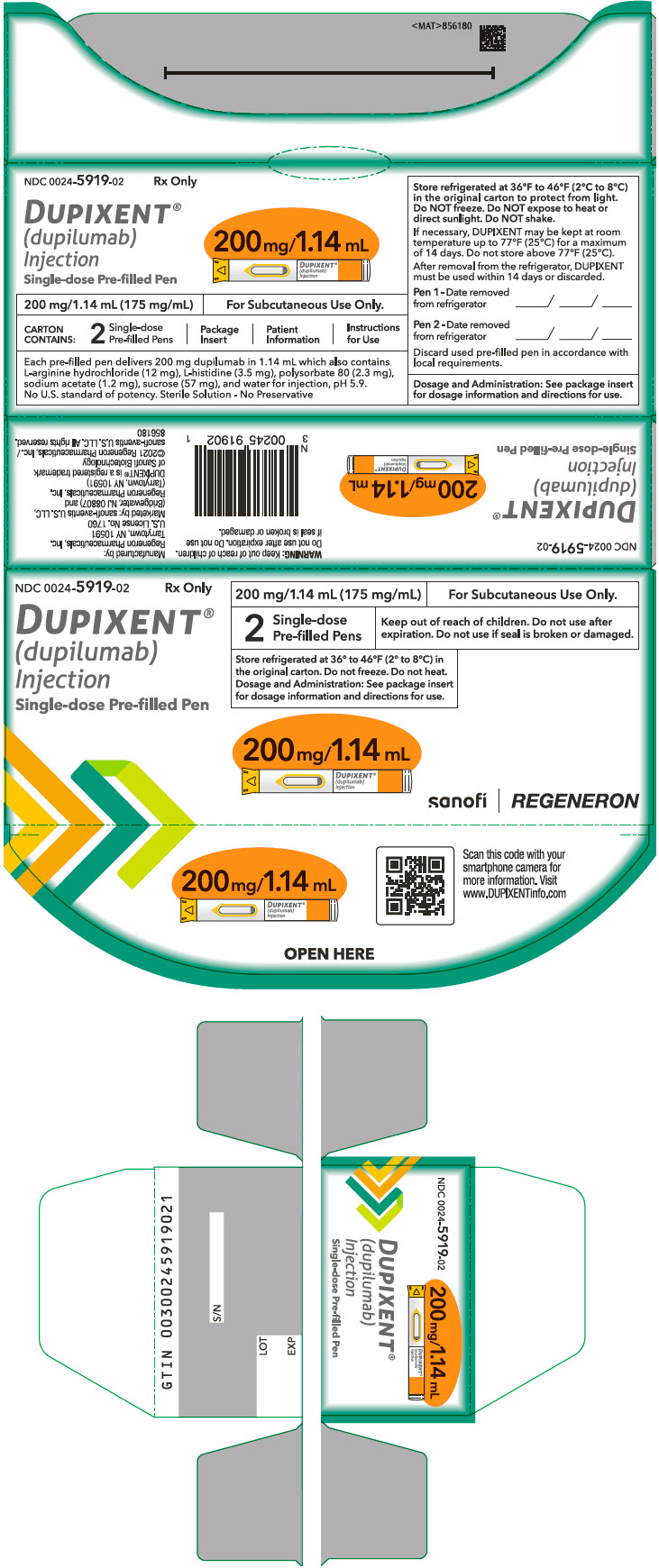
Dupixent Dupilumab 200 mg/1.14mL Injection, Solution, 2 syringes — NDC 0024-5919-02 (Billing 00024-5919-02)
NDC 0024-5919-02 (billing 00024-5919-02) is a package of 2 syringes of Dupixent Dupilumab 200 mg/1.14mL Injection, Solution from Sanofi-Aventis U.S. LLC, marketed since Jun 2021 and currently FDA-listed; retail pharmacies pay about $1,778.86 per mL (NADAC). It is the main listing for this product, which comes in 2 package sizes.
Identity & classification
Regulatory identifiers FDA, NLM and CMS codes for this package
Drug-database identifiers Medi-Span GPI and First Databank GCN / HICL / AHFS classification
- GSN (GCN sequence number): 081615
- GCN: 48785
- HICL (First Databank): 044180
- AHFS class code: 84:92.00.00
- RxCUI (RxNorm): 1876401
- 11-digit billing NDC: 00024591902
Where does this data come from?
- FDA openFDA NDC Directory · synced Oct 1, 2026
- FDA label on DailyMed · label index refreshed Oct 1, 2026
- RxNorm (NLM RxNav) · catalog refreshed Sep 24, 2026
- Medi-Span GPI (licensed)
- First Databank (licensed) · refreshed Oct 1, 2026
RxNorm drug class
This medicine belongs to the Interleukin-4 Receptor alpha Antagonist class.
Where does this data come from?
- RxClass (NLM) · catalog refreshed Sep 24, 2026
Clinical
Dupilumab injection is used for the following: to treat eczema (atopic dermatitis; a skin disease that causes dry, itchy skin and red, scaly rashes) to treat asthma (chronic inflammatory condition of the airways in the lungs causing them to narrow and swell) to treat chronic rhinosinusitis with nasal polyps (a chronic inflammation of nasal cavity and sinuses with polyps, noncancerous growths) to treat eosinophilic esophagitis (EoE; a condition when blood cells build up in and damage the esophagus [tube that connects the mouth to the stomach]) to treat prurigo nodularis (a skin condi...
Read the full MedlinePlus article ↗- Dupixent is used for a whole range of inflammatory conditions — not just one. It's approved for moderate-to-severe eczema (atopic dermatitis), certain types of asthma, chronic nasa...
- Yes — Dupixent is a subcutaneous injection, meaning it goes just under the skin, and most people learn to do it at home. You inject it into your thigh, abdomen (not too close to th...
- How do I take Dupixent, and can I do it at home?
- The most common ones are redness or irritation at the injection site and eye problems — particularly conjunctivitis (pink eye) or eyelid inflammation, especially if you have eczema...
Patient education
Supplement & herbal interactions
Where does this data come from?
- MedlinePlus (NLM) · refreshed Oct 1, 2026
- FDA label on DailyMed · label index refreshed Oct 1, 2026
Ask a licensed pharmacist directly — free, answered by our team.
Pricing
A drug doesn't have one price. Each row is a different public payment system, and none is what you'd pay at the counter — that depends on your insurance. The ⓘ on each row explains what it measures.
| Price system | Per mL | Per package |
|---|---|---|
| Retail pharmacies payNADAC · weekly | $1,778.860 | $4,055.80 / 2.28 ml |
| Medicaid paysCMS SDUD · 12 mo | $1,681.83 | $3,834.58 / 2.28 ml |
| Medicare drug plans payPart D · Q2 2026 | $1,799.14 | $4,102.03 / 2.28 ml |
Where does this data come from?
- CMS NADAC weekly file · file of Sep 30, 2026
- CMS ASP pricing files · refreshed Sep 20, 2026
- CMS Medicaid State Drug Utilization Data · through Q1 2026
- CMS Part D plan pricing files · refreshed Sep 24, 2026
- VA National Acquisition Center price file
Packaging — all sizes for this product
| Package NDC | Description | Per unit | Per pack | Marketing start | Marketing end | Status |
|---|---|---|---|---|---|---|
| 00024-5919-02 0024-5919-02 You're viewing this Main listing | 2 SYRINGE, GLASS in 1 CARTON (0024-5919-02) / 1.14 mL in 1 SYRINGE, GLASS (0024-5919-00) | $1,778.86 / mL | $4,055.80 | 2021-06-14 | — | Active |
| 00024-5919-20 0024-5919-20 | 2 SYRINGE, GLASS in 1 CARTON (0024-5919-20) / 1.14 mL in 1 SYRINGE, GLASS (0024-5919-01) | — | — | 2021-06-14 | — | Active |
In Medicaid, this is the most-dispensed pack of this product — about 100% of fills over the last four reported quarters. See all packs ↓
Pack size FAQ
What quantity is in NDC 00024-5919-02?
What is the difference between NDC 00024-5919-02 and NDC 00024-5919-20?
What NDC number is used to bill for this package of Dupixent Dupilumab 200 mg/1.14mL Injection, Solution?
Prices are the latest CMS NADAC pharmacy acquisition cost per NDC; per-pack figures are per-unit × pack quantity, shown only when the pack is denominated in the same measure NADAC prices.
Therapeutic equivalents
| Product | Labeler | Pack | NADAC/unit | TE | Status | Price vs. this |
|---|---|---|---|---|---|---|
| Dupixent 200 mg/1.14mL 00024-5918-01 | Sanofi-Aventis | 2 syringes | $1,773.740 | — | Availability likely | +0% |
| Dupixent 200 mg/1.14mLthis 00024-5919-02 | Sanofi-Aventis | 2 syringes | $1,778.860 | — | Availability likely | — |
Where does this data come from?
- FDA openFDA NDC Directory · synced Oct 1, 2026
- FDA Purple Book · refreshed Sep 5, 2026
- CMS NADAC weekly file · file of Sep 30, 2026
Availability & biosimilar status
Biologics have no small-molecule generics; biosimilar competition is tracked in the FDA Purple Book.
Why the date isn’t exact: Biosimilar timing can change because patents may be challenged, settled, licensed, added or removed, and litigation can move the real date earlier or later.
🛈 What do these terms mean?
- Biologic patent
- A patent the reference product’s maker has publicly listed. A biosimilar generally can’t launch until these expire — unless they’re invalidated or resolved in a settlement.
- Reference-product exclusivity
- A flat 12 years of FDA market protection from the biologic’s first licensure (the BPCIA). No biosimilar can be licensed before it ends, regardless of patents.
- Interchangeable exclusivity
- The first interchangeable biosimilar can earn a period as the only interchangeable version (pharmacists can substitute it without the prescriber).
- Earliest biosimilar (LOE)
- The latest of all the dates above — the soonest a biosimilar can realistically reach the market. Litigation and settlements can move it earlier.
Biologics have no small-molecule “generics” — competition comes from FDA-licensed biosimilars, tracked in the FDA Purple Book.
| Code | What it grants | Expires |
|---|---|---|
| RefProduct | Reference-product exclusivity (12-year, BPCIA) — no biosimilar can be licensed before this date | Mar 28, 2029 |
Is there a biosimilar for DUPIXENT 200 MG/1.14 ML PEN?
Why do different websites show different biosimilar dates?
Can a biosimilar launch before the last patent expires?
What does “current Purple Book estimate” mean?
What does “FDA listed” mean?
What does a patent or protection date mean here?
Where does this data come from?
- FDA Purple Book · refreshed Sep 5, 2026
Inactive Ingredients / Excipients
Inactive ingredients, also called excipients, are components of the drug product other than the active ingredient. They may include fillers, dyes, coatings, preservatives, flavors, or other formulation ingredients.
💡 Tap an ingredient (hover on desktop) to see what it is and why it’s used.
-
UNII F7LTH1E20Y
Arginine hydrochloride is an amino acid salt used as a buffer and pH adjuster in medicines. It helps maintain the correct acidity level to keep the drug stable and effective.
-
UNII 4QD397987E
An amino acid used as a buffer and stabilizer in medications. It helps maintain the pH balance and protects the active drug from breaking down during storage and use.
-
UNII 6OZP39ZG8H
Polysorbate 80 is a synthetic emulsifier derived from sorbitol and oleic acid. It helps mix oil and water-based ingredients together in medications and improves how the product disperses in the body.
-
UNII 4550K0SC9B
Sodium acetate is a salt derived from acetic acid. It acts as a buffer to help maintain the medicine's pH stability and may serve as a preservative or solubilizer in liquid formulations.
-
UNII C151H8M554
A natural sugar derived from sugar cane or sugar beets. It's used as a sweetener, filler, and binder to improve taste, add bulk, and help hold tablet or capsule ingredients together.
-
UNII 059QF0KO0R
Water is a liquid solvent that dissolves and mixes ingredients together in liquid medicines, syrups, and injections. It helps distribute the active drug evenly throughout the product.
6 inactive ingredients listed in the exact product block matched to this NDC.
Where does this data come from?
ingredient classCode="IACT" elements from the exact product block matched by this NDC. Label-section narrative from DailyMed / the openFDA label index is shown separately when available.- FDA label on DailyMed · label index refreshed Oct 1, 2026
- FDA openFDA NDC Directory · synced Oct 1, 2026
Inactive ingredient FAQ
Are inactive ingredients the same for every manufacturer?
Why might an inactive ingredient be missing?
Can inactive ingredients matter?
Manufacturer & labeler
Where does this data come from?
- FDA openFDA NDC Directory · synced Oct 1, 2026
- Drugs@FDA
Full prescribing information FDA SPL
🎯 Indications and Usage ▾
1 INDICATIONS AND USAGE DUPIXENT is an interleukin-4 receptor alpha antagonist indicated: Atopic Dermatitis for the treatment of adult and pediatric patients aged 6 months and older with moderate-to-severe AD whose disease is not adequately controlled with topical prescription therapies or when those therapies are not advisable. DUPIXENT can be used with or without topical corticosteroids. ( 1.1 ) Asthma as an add-on maintenance treatment of adult and pediatric patients aged 6 years and older with moderate-to-severe asthma characterized by an eosinophilic phenotype or with oral corticosteroid dependent asthma.
( 1.2 ) Limitations of Use: Not for the relief of acute bronchospasm or status asthmaticus. ( 1.2 ) Chronic Rhinosinusitis with Nasal Polyps as an add-on maintenance treatment in adult and pediatric patients aged 12 years and older with inadequately controlled chronic rhinosinusitis with nasal polyps (CRSwNP). ( 1.3 ) Eosinophilic Esophagitis for the treatment of adult and pediatric patients aged 1 year and older, weighing at least 15 kg, with eosinophilic esophagitis (EoE).
( 1.4 ) Prurigo Nodularis for the treatment of adult patients with prurigo nodularis (PN). ( 1.5 ) Chronic Obstructive Pulmonary Disease as an add-on maintenance treatment of adult patients with inadequately controlled chronic obstructive pulmonary disease (COPD) and an eosinophilic phenotype. ( 1.6 ) Limitations of Use: Not for the relief of acute bronchospasm.
( 1.6 ) Chronic Spontaneous Urticaria for the treatment of adult and pediatric patients aged 2 years and older with chronic spontaneous urticaria (CSU) who remain symptomatic despite H1 antihistamine treatment. ( 1.7 ) Limitations of Use: Not indicated for other forms of urticaria. ( 1.7 ) Bullous Pemphigoid for the treatment of adult patients with bullous pemphigoid (BP).
( 1.8 ) Allergic Fungal Rhinosinusitis for the treatment of adult and pediatric patients aged 6 years and older with allergic fungal rhinosinusitis (AFRS) who have a history of sino-nasal surgery. ( 1.9 )
1.1Atopic Dermatitis DUPIXENT is indicated for the treatment of adult and pediatric patients aged 6 months and older with moderate-to-severe atopic dermatitis (AD) whose disease is not adequately controlled with topical prescription therapies or when those therapies are not advisable. DUPIXENT can be used with or without topical corticosteroids.
1.2Asthma DUPIXENT is indicated as an add-on maintenance treatment of adult and pediatric patients aged 6 years and older with moderate-to-severe asthma characterized by an eosinophilic phenotype or with oral corticosteroid dependent asthma. Limitations of Use DUPIXENT is not indicated for the relief of acute bronchospasm or status asthmaticus.
1.3Chronic Rhinosinusitis with Nasal Polyps DUPIXENT is indicated as an add-on maintenance treatment in adult and pediatric patients aged 12 years and older with inadequately controlled chronic rhinosinusitis with nasal polyps (CRSwNP).
1.4Eosinophilic Esophagitis DUPIXENT is indicated for the treatment of adult and pediatric patients aged 1 year and older, weighing at least 15 kg, with eosinophilic esophagitis (EoE).
1.5Prurigo Nodularis DUPIXENT is indicated for the treatment of adult patients with prurigo nodularis (PN).
1.6Chronic Obstructive Pulmonary Disease DUPIXENT is indicated as an add-on maintenance treatment of adult patients with inadequately controlled chronic obstructive pulmonary disease (COPD) and an eosinophilic phenotype. Limitations of Use DUPIXENT is not indicated for the relief of acute bronchospasm.
1.7Chronic Spontaneous Urticaria DUPIXENT is indicated for the treatment of adult and pediatric patients aged 2 years and older with chronic spontaneous urticaria (CSU) who remain symptomatic despite H1 antihistamine treatment. Limitations of Use: DUPIXENT is not indicated for treatment of other forms of urticaria.
1.8Bullous Pemphigoid DUPIXENT is indicated for the treatment of adult patients with bullous pemphigoi… [Excerpted — this section continues on DailyMed.]
⏱️ Dosage and Administration ▾
2 DOSAGE AND ADMINISTRATION DUPIXENT is administered by subcutaneous injection. ( 2.1 ) Atopic Dermatitis Dosage in Adults ( 2.3 ): Recommended dosage is an initial dose of 600 mg (two 300 mg injections), followed by 300 mg given every 2 weeks (Q2W). Dosage in Pediatric Patients 6 Months to 5 Years of Age ( 2.3 ): Body Weight Recommended Dosage For pediatric patients 6 months to 5 years of age, no initial loading dose is recommended 5 to less than 15 kg 200 mg (one 200 mg injection) every 4 weeks (Q4W) 15 to less than 30 kg 300 mg (one 300 mg injection) every 4 weeks (Q4W) Dosage in Pediatric Patients 6 Years to 17 Years of Age ( 2.3 ): Body Weight Initial Loading Dose Subsequent Dosage Q2W – every 2 weeks; Q4W – every 4 weeks 15 to less than 30 kg 600 mg (two 300 mg injections) 300 mg Q4W 30 to less than 60 kg 400 mg (two 200 mg injections) 200 mg Q2W 60 kg or more 600 mg (two 300 mg injections) 300 mg Q2W Asthma Dosage in Adult and Pediatric Patients 12 Years and Older ( 2.4 ): Initial Loading Dose Subsequent Dosage 400 mg (two 200 mg injections) 200 mg every 2 weeks (Q2W) Or 600 mg (two 300 mg injections) 300 mg every 2 weeks (Q2W) Dosage for patients with oral corticosteroid-dependent asthma or with co-morbid moderate-to-severe AD, CRSwNP, or AFRS For pediatric patients 12 years to 17 years of age (≥60 kg) and adults with AFRS 600 mg (two 300 mg injections) 300 mg every 2 weeks (Q2W) Dosage in Pediatric Patients 6 Years to 11 Years of Age ( 2.4 ): Body Weight Recommended Dosage For pediatric patients 6 years to 11 years of age, no initial loading dose is recommended 15 to less than 30 kg 300 mg every 4 weeks (Q4W) 30 kg or more 200 mg every 2 weeks (Q2W) For pediatric patients 6 years to 11 years old with asthma and co-morbid moderate-to-severe atopic dermatitis, follow the recommended dosage as per Table 2 which includes an initial loading dose.
( 2.3 ) Chronic Rhinosinusitis with Nasal Polyps ( 2.5 ): Recommended dosage for adult and pediatric patients 12 years of age and older is 300 mg given every 2 weeks (Q2W). Eosinophilic Esophagitis ( 2.6 ): Body Weight Recommended Dosage in Adult and Pediatric Patients 1 Year and Older, Weighing At Least 15 kg 15 to less than 30 kg 200 mg every 2 weeks (Q2W) 30 to less than 40 kg 300 mg every 2 weeks (Q2W) 40 kg or more 300 mg every week (QW) Prurigo Nodularis ( 2.7 ): Recommended dosage for adult patients is an initial dose of 600 mg (two 300 mg injections), followed by 300 mg given every 2 weeks (Q2W).
Chronic Obstructive Pulmonary Disease ( 2.8 ): Recommended dosage for adult patients is 300 mg given every 2 weeks (Q2W). Chronic Spontaneous Urticaria Dosage in Adults ( 2.9 ): Recommended dosage is an initial dose of 600 mg (two 300 mg injections), followed by 300 mg given every 2 weeks (Q2W). Dosage in Pediatric Patients 2 Years to 5 Years of Age ( 2.9 ): Body Weight Recommended Dosage For pediatric patients 2 years to 5 years of age with CSU, no initial loading dose is recommended 5 to less than 15 kg 200 mg (one 200 mg injection) every 4 weeks (Q4W) 15 to less than 30 kg 300 mg (one 300 mg injection) every 4 weeks (Q4W) Dosage in Pediatric Patients 6 Years to 17 Years of Age ( 2.9 ): Body Weight Initial Loading Dose Subsequent Dosage Q2W – every 2 weeks; Q4W – every 4 weeks 15 to less than 30 kg 600 mg (two 300 mg injections) 300 mg Q4W 30 to less than 60 kg 400 mg (two 200 mg injections) 200 mg Q2W 60 kg or more 600 mg (two 300 mg injections) 300 mg Q2W Bullous Pemphigoid ( 2.10 ): Recommended dosage for adult patients is an initial dose of 600 mg (two 300 mg injections), followed by 300 mg given every other week (Q2W).
Use DUPIXENT in combination with a tapering course of oral corticosteroids. Allergic Fungal Rhinosinusitis Dosage in Adults ( 2.11 ): Recommended dosage is 300 mg given every 2 weeks (Q2W). Dosage in Pediatric Patients 6 Years to 17 Years of Age ( 2.11 ) : Body Weight Recommended Dosage Q2W – every 2 weeks; Q4W – every 4 weeks 15 to less than 30 kg 300 mg Q4W… [Excerpted — this section continues on DailyMed.]
💊 Dosage Forms and Strengths ▾
3 DOSAGE FORMS AND STRENGTHS DUPIXENT is a clear to slightly opalescent, colorless to pale yellow solution in a: Single-dose pre-filled syringe with needle shield as: Injection: 300 mg/2 mL (150 mg/mL) Injection: 200 mg/1.14 mL (175 mg/mL) Single-dose pre-filled pen as: Injection: 300 mg/2 mL (150 mg/mL) Injection: 200 mg/1.14 mL (175 mg/mL) Single-Dose Pre-Filled Syringe with Needle Shield ( 3 ): Injection: 300 mg/2 mL (150 mg/mL) Injection: 200 mg/1.14 mL (175 mg/mL) Single-Dose Pre-Filled Pen ( 3 ): Injection: 300 mg/2 mL (150 mg/mL) Injection: 200 mg/1.14 mL (175 mg/mL)
⛔ Contraindications ▾
4 CONTRAINDICATIONS DUPIXENT is contraindicated in patients who have known hypersensitivity to dupilumab or any excipients of DUPIXENT [see Warnings and Precautions (5.1) ] . Known hypersensitivity to dupilumab or any excipients in DUPIXENT. ( 4 )
⚠️ Warnings and Cautions ▾
5 WARNINGS AND PRECAUTIONS Hypersensitivity: Hypersensitivity reactions including anaphylaxis, acute generalized exanthematous pustulosis (AGEP), serum sickness, angioedema, urticaria, rash, erythema nodosum, and erythema multiforme have occurred. Discontinue DUPIXENT in the event of a hypersensitivity reaction. ( 5.1 ) Conjunctivitis, Keratitis, and Blepharitis: Advise patients to promptly report new onset or worsening eye symptoms to their healthcare provider.
If symptoms persist or worsen, consider discontinuation of DUPIXENT. Consider ophthalmological examination, as appropriate. ( 5.2 ) Eosinophilic Conditions: Be alert to vasculitic rash, worsening pulmonary symptoms, cardiac complications, kidney injury and/or neuropathy, especially upon reduction of oral corticosteroids.
( 5.3 ) Reduction of Corticosteroid Dosage: Do not discontinue systemic, topical, or inhaled corticosteroids abruptly upon initiation of DUPIXENT. Decrease steroids gradually, if appropriate. ( 5.5 ) Psoriasis: Advise patients to report new-onset psoriasis symptoms to their healthcare provider.
If symptoms persist or worsen, consider dermatologic evaluation and/or discontinuation of DUPIXENT. ( 5.7 ) Arthralgia and Psoriatic Arthritis: Advise patients to report new onset joint symptoms to their healthcare provider. If symptoms persist or worsen, consider rheumatological evaluation and/or discontinuation of DUPIXENT.
( 5.8 ) Parasitic (Helminth) Infections: Treat pre-existing helminth infections before initiating DUPIXENT. If patients become infected while receiving DUPIXENT and do not respond to anti-helminth treatment, discontinue DUPIXENT until the infection resolves. ( 5.9) Vaccinations: Avoid use of live vaccines.
( 5.10 )
5.1Hypersensitivity Hypersensitivity reactions, including anaphylaxis, acute generalized exanthematous pustulosis (AGEP), serum sickness or serum sickness-like reactions, angioedema, generalized urticaria, rash, erythema nodosum and erythema multiforme have been reported. A case of AGEP was reported in an adult subject who participated in the bullous pemphigoid development program. If a clinically significant hypersensitivity reaction occurs, institute appropriate therapy and discontinue DUPIXENT [see Adverse Reactions (6.1 , 6.2) and Clinical Pharmacology (12.6) ] .
5.2Conjunctivitis, Keratitis, and Blepharitis Conjunctivitis and keratitis adverse reactions have been reported in clinical trials [see Adverse Reactions (6.1) ] . Conjunctivitis and keratitis occurred more frequently in AD subjects who received DUPIXENT compared to those who received placebo. Conjunctivitis was the most frequently reported eye disorder.
Most subjects with conjunctivitis or keratitis recovered or were recovering during the treatment period. Among subjects with asthma, the frequencies of conjunctivitis and keratitis were similar between DUPIXENT and placebo. In adult subjects with CRSwNP, the frequency of conjunctivitis was 2% in the DUPIXENT group compared to 1% in the placebo group in the 24-week safety pool; these subjects recovered.
Among subjects with EoE, there were no reports of conjunctivitis and keratitis in the DUPIXENT group in placebo-controlled trials. In subjects with PN, the frequency of conjunctivitis was 4% in the DUPIXENT group compared to 1% in the placebo group; these subjects recovered or were recovering during the treatment period. Among subjects with COPD, the frequency of conjunctivitis and keratitis was 1.4% and 0.1% in the DUPIXENT group and 1% and 0% in the placebo group, respectively.
In subjects with CSU, the frequency of conjunctivitis was similar between DUPIXENT and placebo. Among subjects with BP, the frequency of conjunctivitis and keratitis was 7.5% and 3.8% in the DUPIXENT group and 0% and 0% in the placebo group, respectively. Conjunctivitis, keratitis, and blepharitis adverse reactions have also been reported with DUPIXENT in postmarketing settings, predominantly in AD patients.
Some patients reported varying de… [Excerpted — this section continues on DailyMed.]
🤒 Adverse Reactions ▾
6 ADVERSE REACTIONS The following clinically significant adverse reactions are described elsewhere in the labeling: Hypersensitivity [see Warnings and Precautions (5.1) ] Conjunctivitis and Keratitis [see Warnings and Precautions (5.2) ] Psoriasis [see Warnings and Precautions (5.7) ] Arthralgia and Psoriatic Arthritis [see Warnings and Precautions (5.8) ] Parasitic (Helminth) Infections [see Warnings and Precautions (5.9) ] Most common adverse reactions are: Atopic Dermatitis (incidence ≥1%): injection site reactions, conjunctivitis, blepharitis, oral herpes, keratitis, eye pruritus, other herpes simplex virus infection, dry eye, and eosinophilia.
( 6.1 ) Asthma (incidence ≥1%): injection site reactions, oropharyngeal pain, and eosinophilia. ( 6.1 ) Chronic Rhinosinusitis with Nasal Polyps (incidence ≥1%): injection site reactions, eosinophilia, insomnia, toothache, gastritis, arthralgia, and conjunctivitis. ( 6.1 ) Eosinophilic Esophagitis (incidence ≥2%): injection site reactions, upper respiratory tract infections, arthralgia, and herpes viral infections.
( 6.1 ) Prurigo Nodularis (incidence ≥2%): nasopharyngitis, conjunctivitis, herpes infection, dizziness, myalgia, and diarrhea. ( 6.1 ) Chronic Obstructive Pulmonary Disease (incidence ≥2%): viral infection, headache, nasopharyngitis, back pain, diarrhea, arthralgia, urinary tract infection, local administration reactions, rhinitis, eosinophilia, toothache, and gastritis. ( 6.1 ) Chronic Spontaneous Urticaria (incidence ≥2%): injection site reactions.
( 6.1 ) Bullous Pemphigoid (incidence ≥2%): arthralgia, conjunctivitis, vision blurred, herpes viral infections, keratitis. ( 6.1 ) Allergic Fungal Rhinosinusitis: similar to adverse reactions for Chronic Rhinosinusitis with Nasal Polyps. ( 6.1 ) To report SUSPECTED ADVERSE REACTIONS, contact Regeneron at 1-844-387-4936 or FDA at 1-800-FDA-1088 or www.fda.gov/medwatch.
6.1Clinical Trials Experience Because clinical trials are conducted under widely varying conditions, adverse reaction rates observed in the clinical trials of a drug cannot be directly compared to rates in the clinical trials of another drug and may not reflect the rates observed in practice. Atopic Dermatitis Adults with Atopic Dermatitis Three randomized, double-blind, placebo-controlled, multicenter trials (SOLO 1, SOLO 2, and CHRONOS) and one dose-ranging trial (AD-1021) evaluated the safety of DUPIXENT in subjects with moderate-to-severe atopic dermatitis (AD) [see Clinical Studies (14.1) ] .
In terms of co-morbid conditions, 48% of the subjects had asthma, 49% had allergic rhinitis, 37% had food allergy, and 27% had allergic conjunctivitis. In these 4 trials, 1472 subjects were treated with subcutaneous injections of DUPIXENT, with or without concomitant topical corticosteroids (TCS). A total of 739 subjects were treated with DUPIXENT for at least 1 year in the development program for moderate-to-severe AD.
SOLO 1, SOLO 2, and AD-1021 compared the safety of DUPIXENT monotherapy to placebo through Week 16. CHRONOS compared the safety of DUPIXENT + TCS to placebo + TCS through Week 52. AD-1225 is a multicenter, open-label extension (OLE) trial which assessed the long-term safety of repeat doses of DUPIXENT through 260 weeks of treatment in adults with moderate-to-severe AD who had previously participated in controlled trials of DUPIXENT or had been screened for SOLO 1 or SOLO 2.
The safety data in AD-1225 reflect exposure to DUPIXENT 200 mg QW, 300 mg QW and 300 mg Q2W in 2677 subjects, including 2254 exposed for at least 52 weeks, 1224 exposed for at least 100 weeks, 561 exposed for at least 148 weeks and 179 exposed for at least 260 weeks. Weeks 0 to 16 (SOLO 1, SOLO 2, CHRONOS, and AD-1021) In DUPIXENT monotherapy trials (SOLO 1, SOLO 2, and AD-1021) through Week 16, the proportion of subjects who discontinued treatment because of adverse events was 1.9% in both the DUPIXENT 300 mg Q2W and placebo groups.
Table 9 summarizes the adverse reactions that o… [Excerpted — this section continues on DailyMed.]
👥 Use in Specific Populations ▾
8 USE IN SPECIFIC POPULATIONS
8.1Pregnancy Pregnancy Exposure Registry There is a pregnancy exposure registry that monitors pregnancy outcomes in women exposed to DUPIXENT during pregnancy. Risk Summary Available data from case reports and case series with DUPIXENT use in pregnant women have not identified a drug-associated risk of major birth defects, miscarriage, or adverse maternal or fetal outcomes. Human IgG antibodies are known to cross the placental barrier; therefore, DUPIXENT may be transmitted from the mother to the developing fetus.
There are adverse effects on maternal and fetal outcomes associated with asthma in pregnancy ( see Clinical Considerations ). In an enhanced pre- and post-natal developmental study, no adverse developmental effects were observed in offspring born to pregnant monkeys after subcutaneous administration of a homologous antibody against interleukin-4-receptor alpha (IL-4Rα) during organogenesis through parturition at doses up to 10-times the maximum recommended human dose (MRHD) ( see Data ) . The background risk of major birth defects and miscarriage for the indicated populations are unknown.
All pregnancies have a background risk of birth defect, loss or other adverse outcomes. In the U.S. general population, the estimated background risk of major birth defects and miscarriage in clinically recognized pregnancies is 2% to 4% and 15% to 20%, respectively. Clinical Considerations Disease-Associated Maternal and/or Embryo-fetal Risk In women with poorly or moderately controlled asthma, evidence demonstrates that there is an increased risk of preeclampsia in the mother and prematurity, low birth weight, and small for gestational age in the neonate.
The level of asthma control should be closely monitored in pregnant women and treatment adjusted as necessary to maintain optimal control. Fetal/Neonatal Adverse Reactions Transport of endogenous IgG antibodies across the placenta increases as pregnancy progresses, and peaks during the third trimester. Therefore, DUPIXENT may be present in infants exposed in utero .
The potential clinical impact of dupilumab exposure in infants exposed in utero should be considered. Data Animal Data In an enhanced pre- and post-natal development toxicity study, pregnant cynomolgus monkeys were administered weekly subcutaneous doses of homologous antibody against IL-4Rα up to 10 times the MRHD (on a mg/kg basis of 100 mg/kg/week) from the beginning of organogenesis to parturition. No treatment-related adverse effects on embryo-fetal toxicity or malformations, or on morphological, functional, or immunological development were observed in the infants from birth through 6 months of age.
8.2Lactation Risk Summary There are no data on the presence of dupilumab in human milk, the effects on the breastfed infant, or the effects on milk production. Maternal IgG is known to be present in human milk. The effects of local gastrointestinal exposure and limited systemic exposure to dupilumab on the breastfed infant are unknown.
The developmental and health benefits of breastfeeding should be considered along with the mother's clinical need for DUPIXENT and any potential adverse effects on the breastfed child from DUPIXENT or from the underlying maternal condition.
8.4Pediatric Use Atopic Dermatitis The safety and effectiveness of DUPIXENT have been established in pediatric patients 6 months of age and older with moderate-to-severe AD, whose disease is not adequately controlled with topical prescription therapies or when those therapies are not advisable. Use of DUPIXENT in this age group is supported by data from the following clinical trials: AD-1526 which included 251 pediatric subjects 12 years of age and older with moderate-to-severe AD. Of the 251 subjects, 82 were treated with DUPIXENT 200 mg Q2W (<60 kg) or 300 mg Q2W (≥60 kg) and 85 were treated with matching placebo AD-1652 which included 367 pediatric subjects 6 to 11 years of age with severe AD.
Of the 367 subjects,… [Excerpted — this section continues on DailyMed.]
🤰 Pregnancy ▾
8.1Pregnancy Pregnancy Exposure Registry There is a pregnancy exposure registry that monitors pregnancy outcomes in women exposed to DUPIXENT during pregnancy. Risk Summary Available data from case reports and case series with DUPIXENT use in pregnant women have not identified a drug-associated risk of major birth defects, miscarriage, or adverse maternal or fetal outcomes. Human IgG antibodies are known to cross the placental barrier; therefore, DUPIXENT may be transmitted from the mother to the developing fetus.
There are adverse effects on maternal and fetal outcomes associated with asthma in pregnancy ( see Clinical Considerations ). In an enhanced pre- and post-natal developmental study, no adverse developmental effects were observed in offspring born to pregnant monkeys after subcutaneous administration of a homologous antibody against interleukin-4-receptor alpha (IL-4Rα) during organogenesis through parturition at doses up to 10-times the maximum recommended human dose (MRHD) ( see Data ) . The background risk of major birth defects and miscarriage for the indicated populations are unknown.
All pregnancies have a background risk of birth defect, loss or other adverse outcomes. In the U.S. general population, the estimated background risk of major birth defects and miscarriage in clinically recognized pregnancies is 2% to 4% and 15% to 20%, respectively. Clinical Considerations Disease-Associated Maternal and/or Embryo-fetal Risk In women with poorly or moderately controlled asthma, evidence demonstrates that there is an increased risk of preeclampsia in the mother and prematurity, low birth weight, and small for gestational age in the neonate.
The level of asthma control should be closely monitored in pregnant women and treatment adjusted as necessary to maintain optimal control. Fetal/Neonatal Adverse Reactions Transport of endogenous IgG antibodies across the placenta increases as pregnancy progresses, and peaks during the third trimester. Therefore, DUPIXENT may be present in infants exposed in utero .
The potential clinical impact of dupilumab exposure in infants exposed in utero should be considered. Data Animal Data In an enhanced pre- and post-natal development toxicity study, pregnant cynomolgus monkeys were administered weekly subcutaneous doses of homologous antibody against IL-4Rα up to 10 times the MRHD (on a mg/kg basis of 100 mg/kg/week) from the beginning of organogenesis to parturition. No treatment-related adverse effects on embryo-fetal toxicity or malformations, or on morphological, functional, or immunological development were observed in the infants from birth through 6 months of age.
🧒 Pediatric Use ▾
8.4Pediatric Use Atopic Dermatitis The safety and effectiveness of DUPIXENT have been established in pediatric patients 6 months of age and older with moderate-to-severe AD, whose disease is not adequately controlled with topical prescription therapies or when those therapies are not advisable. Use of DUPIXENT in this age group is supported by data from the following clinical trials: AD-1526 which included 251 pediatric subjects 12 years of age and older with moderate-to-severe AD. Of the 251 subjects, 82 were treated with DUPIXENT 200 mg Q2W (<60 kg) or 300 mg Q2W (≥60 kg) and 85 were treated with matching placebo AD-1652 which included 367 pediatric subjects 6 to 11 years of age with severe AD.
Of the 367 subjects, 120 were treated with DUPIXENT 300 mg Q4W + TCS (15 to <30 kg) or 200 mg Q2W + TCS (≥30 kg) and 123 were treated with matching placebo + TCS AD-1539 which included 162 pediatric subjects 6 months to 5 years of age with moderate-to-severe AD. Of the 162 subjects, 83 were treated with DUPIXENT 200 mg Q4W + TCS (5 to <15 kg) or 300 mg Q4W + TCS (15 to <30 kg) and 79 subjects were assigned to be treated with matching placebo + TCS AD-1434, an open-label extension study that enrolled 275 pediatric subjects 12 years of age and older treated with DUPIXENT ± TCS, 368 pediatric subjects 6 to 11 years of age treated with DUPIXENT ± TCS, and 180 pediatric subjects 6 months to 5 years of age treated with DUPIXENT ± TCS Liberty-AD-HAFT which included 27 pediatric subjects 12 years of age and older with atopic dermatitis with moderate-to-severe hand and/or foot involvement treated with DUPIXENT (N=14) or matching placebo (N=13) The safety and effectiveness were generally consistent between pediatric and adult patients.
In addition, hand-foot-and-mouth disease was reported in 9 (5%) pediatric subjects and skin papilloma was reported in 4 (2%) pediatric subjects 6 months to 5 years of age treated with DUPIXENT ± TCS in AD-1434. These cases did not lead to study drug discontinuation [see Adverse Reactions (6.1) and Clinical Studies (14.1) ] . Safety and effectiveness of DUPIXENT have not been established in pediatric patients younger than 6 months of age with AD.
Asthma The safety and effectiveness of DUPIXENT for an add-on maintenance treatment in patients with moderate-to-severe asthma characterized by an eosinophilic phenotype or with oral corticosteroid dependent asthma have been established in pediatric patients 6 years of age and older. Use of DUPIXENT for this indication is supported by evidence from adequate and well-controlled studies in adult and pediatric patients 6 years and older [see Clinical Studies (14.2)] . Pediatric Subjects 12 to 17 Years of Age : A total of 107 pediatric subjects 12 to 17 years of age with moderate-to-severe asthma were enrolled in QUEST and received either 200 mg (N=21) or 300 mg (N=18) DUPIXENT (or matching placebo either 200 mg [N=34] or 300 mg [N=34]) Q2W.
Asthma exacerbations and lung function were assessed in both pediatric subjects 12 to 17 years of age and adults. For both the 200 mg and 300 mg Q2W doses, improvements in FEV 1 (LS mean change from baseline at Week 12) were observed (0.36 L and
0.27L, respectively). For the 200 mg Q2W dose, subjects had a reduction in the rate of severe exacerbations that was consistent with adults. Dupilumab exposure was higher in pediatric subjects 12 to 17 years of age than that in adults at the respective dose level which was mainly accounted for by difference in body weight [see Clinical Pharmacology (12.3) ] .
The adverse event profile in pediatric subjects 12 to 17 years of age was generally similar to the adults [see Adverse Reactions (6.1) ] . Pediatric Subjects 6 to 11 Years of Age : A total of 408 pediatric subjects 6 to 11 years of age with moderate-to-severe asthma were enrolled in VOYAGE, which evaluated doses of 100 mg Q2W or 200 mg Q2W. Improvement in asthma exacerbations and lung function were demonstrated [see Clinical Studies (14.2)… [Excerpted — this section continues on DailyMed.]
🧓 Geriatric Use ▾
8.5Geriatric Use Of the 1539 subjects with AD exposed to DUPIXENT in a dose-ranging study and placebo-controlled trials, 70 subjects were 65 years or older. Clinical trials of DUPIXENT in AD did not include sufficient numbers of subjects aged 65 years and older to determine whether they respond differently from younger subjects. Of the 1977 subjects with asthma exposed to DUPIXENT, a total of 240 subjects were 65 years or older.
Efficacy and safety in this age group were similar to the overall study population. Of the 440 subjects with CRSwNP exposed to DUPIXENT, a total of 79 subjects were 65 years or older. Efficacy and safety in this age group were similar to the overall study population.
Clinical studies of DUPIXENT in EoE did not include sufficient numbers of subjects aged 65 years and older to determine whether they respond differently from younger adult subjects. Of the 152 subjects with PN exposed to DUPIXENT, a total of 37 were 65 years or older including 8 subjects 75 years or older. Clinical trials did not include a sufficient number of subjects 65 years of age and older to determine whether they respond differently from younger adult subjects.
Of the 1874 subjects with COPD randomized in clinical trials of DUPIXENT, a total of 1072 were 65 years or older, while 244 subjects were 75 years or older. No overall differences in safety or effectiveness of DUPIXENT have been observed between subjects 65 years of age and older and younger adult subjects. Of the 198 subjects with CSU exposed to DUPIXENT, a total of 30 subjects were 65 years or older, including 7 subjects 75 years or older.
Efficacy and safety in subjects 65 years or older were similar to the overall study population. Of the 53 subjects with BP exposed to DUPIXENT, a total of 40 were 65 years or older, including 22 subjects 75 years or older. Ten percent of subjects aged 65 years and older treated with DUPIXENT had an adverse reaction of vision blurred compared to zero in younger adult subjects.
Clinical studies of DUPIXENT in AFRS did not include sufficient numbers of subjects aged 65 and over to determine whether they respond differently from younger subjects.
🆘 Overdosage ▾
10 OVERDOSAGE There is no specific treatment for DUPIXENT overdose. In the event of overdosage, contact Poison Control (1-800-222-1222) for the latest recommendations and monitor the patient for any signs or symptoms of adverse reactions and institute appropriate symptomatic treatment immediately.
🧬 Clinical Pharmacology ▾
12 CLINICAL PHARMACOLOGY
12.1Mechanism of Action Dupilumab is a human monoclonal IgG4 antibody that inhibits interleukin-4 (IL-4) and interleukin-13 (IL-13) signaling by specifically binding to the IL-4Rα subunit shared by the IL-4 and IL-13 receptor complexes. Dupilumab inhibits IL-4 signaling via the Type I receptor and both IL-4 and IL-13 signaling through the Type II receptor. Inflammation driven by IL-4 and IL-13 is an important component in the pathogenesis of asthma, AD, CRSwNP, EoE, PN, COPD, CSU, BP, and AFRS.
Multiple cell types that express IL-4Rα (e.g., mast cells, basophils, eosinophils, macrophages, lymphocytes, epithelial cells, goblet cells) and inflammatory mediators (e.g., histamine, eicosanoids, leukotrienes, cytokines, chemokines) are involved in inflammation. Blocking IL-4Rα with dupilumab inhibits IL-4 and IL-13 cytokine-induced inflammatory responses, including the release of proinflammatory cytokines, chemokines, nitric oxide, and IgE. The mechanism of dupilumab action has not been definitively established.
12.2Pharmacodynamics Consistent with inhibition of IL-4 and IL-13 signaling, dupilumab treatment decreased certain biomarkers of inflammation. In asthma subjects, fractional exhaled nitric oxide (FeNO) and circulating concentrations of eotaxin-3, total IgE, allergen specific IgE, TARC, and periostin were decreased relative to placebo. Reductions in these biomarkers were comparable for the 300 mg Q2W and 200 mg Q2W regimens.
These markers were near maximal suppression after 2 weeks of treatment, except for IgE which declined more slowly. These effects were sustained throughout treatment. The median percent reduction from baseline in total IgE concentrations with dupilumab treatments was 52% at Week 24 (DRI12544) and 70% at Week 52 (QUEST).
For FeNO, the mean percent reduction from baseline at Week 2 was 35% and 24% in DRI12544 and QUEST, respectively, and in the overall safety population, the mean FeNO level decreased to 20 ppb. A continuous decline in total IgE in serum was observed in CSU trials. In AFRS subjects, total IgE concentrations showed a progressive decline with dupilumab treatment throughout the 52-week treatment period.
Antibody Response to Non-Live Vaccines During DUPIXENT Treatment In a clinical study, adult subjects with AD were treated once weekly for 16 weeks with 300 mg of DUPIXENT (twice the recommended dosing frequency). After 12 weeks of administration, subjects received a Tdap vaccine and a meningococcal polysaccharide vaccine. Antibody responses to tetanus toxoid and serogroup C meningococcal polysaccharide were assessed 4 weeks later.
Antibody responses to both tetanus toxoid and serogroup C meningococcal polysaccharide were similar in DUPIXENT-treated and placebo-treated subjects. Antibody responses to the other active components of both vaccines were not assessed. Antibody responses to other non-live vaccines were also not assessed.
12.3Pharmacokinetics The pharmacokinetics of dupilumab is similar in subjects with AD, asthma, CRSwNP, EoE, PN, COPD, CSU, BP, and AFRS. Absorption Following an initial subcutaneous (SC) dose of 600 mg, 400 mg, or 300 mg, dupilumab reached peak mean ± SD concentrations (C max ) of 70.1±24.1 mcg/mL, 41.8±12.4 mcg/mL, or 30.5±9.39 mcg/mL, respectively, by approximately 1 week post dose. Steady-state concentrations were achieved by Week 16 following the administration of 600 mg starting dose and 300 mg dose either weekly or Q2W, or 400 mg starting dose and 200 mg dose Q2W, or 300 mg Q2W without a loading dose.
Across clinical trials, the mean ± SD steady-state trough concentrations ranged from 55.3±34.3 mcg/mL to 80.2±35.3 mcg/mL for 300 mg administered Q2W, from 173±75.9 mcg/mL to 195±71.7 mcg/mL for 300 mg administered weekly, and from 29.2±18.7 to 36.5±22.2 mcg/mL for 200 mg administered Q2W. The bioavailability of dupilumab following a SC dose is similar between AD, asthma, CRSwNP, EoE, PN, COPD, CSU, BP, and AFRS subjects, ranging between 6… [Excerpted — this section continues on DailyMed.]
🧬 Mechanism of Action ▾
12.1Mechanism of Action Dupilumab is a human monoclonal IgG4 antibody that inhibits interleukin-4 (IL-4) and interleukin-13 (IL-13) signaling by specifically binding to the IL-4Rα subunit shared by the IL-4 and IL-13 receptor complexes. Dupilumab inhibits IL-4 signaling via the Type I receptor and both IL-4 and IL-13 signaling through the Type II receptor. Inflammation driven by IL-4 and IL-13 is an important component in the pathogenesis of asthma, AD, CRSwNP, EoE, PN, COPD, CSU, BP, and AFRS.
Multiple cell types that express IL-4Rα (e.g., mast cells, basophils, eosinophils, macrophages, lymphocytes, epithelial cells, goblet cells) and inflammatory mediators (e.g., histamine, eicosanoids, leukotrienes, cytokines, chemokines) are involved in inflammation. Blocking IL-4Rα with dupilumab inhibits IL-4 and IL-13 cytokine-induced inflammatory responses, including the release of proinflammatory cytokines, chemokines, nitric oxide, and IgE. The mechanism of dupilumab action has not been definitively established.
📦 How Supplied / Storage and Handling ▾
16 HOW SUPPLIED/STORAGE AND HANDLING How Supplied DUPIXENT (dupilumab) Injection is a clear to slightly opalescent, colorless to pale yellow solution, supplied in single-dose pre-filled syringes with needle shield or pre-filled pens. The pre-filled syringe with needle shield is designed to deliver: 300 mg of DUPIXENT in 2 mL solution (NDC 0024-5914-00) 200 mg of DUPIXENT in 1.14 mL solution (NDC 0024-5918-00) The pre-filled pen is designed to deliver: 300 mg of DUPIXENT in 2 mL solution (NDC 0024-5915-00) 200 mg of DUPIXENT in 1.14 mL solution (NDC 0024-5919-00) DUPIXENT is available in cartons containing 2 pre-filled syringes with needle shield or 2 pre-filled pens.
Pack Size 300 mg/2 mL (150 mg/mL) Pre-filled Syringe with Needle Shield 200 mg/1.14 mL (175 mg/mL) Pre-filled Syringe with Needle Shield Pack of 2 syringes NDC 0024-5914-01 NDC 0024-5918-01 Pack Size 300 mg/2 mL (150 mg/mL) Pre-filled Pen 200 mg/1.14 mL (175 mg/mL) Pre-filled Pen Pack of 2 pens NDC 0024-5915-02 NDC 0024-5919-02 Storage and Handling DUPIXENT is sterile and preservative-free. Discard any unused portion. Store refrigerated at 2°C to 8°C (36°F to 46°F) in the original carton to protect from light.
If necessary, DUPIXENT may be kept at room temperature up to 25°C (77°F) for a maximum of 14 days. Do not store above 25°C (77°F). After removal from the refrigerator, DUPIXENT must be used within 14 days or discarded.
Do not expose DUPIXENT to heat or direct sunlight. Do NOT freeze. Do NOT shake.
📦 Storage and Handling ▾
Storage and Handling DUPIXENT is sterile and preservative-free. Discard any unused portion. Store refrigerated at 2°C to 8°C (36°F to 46°F) in the original carton to protect from light.
If necessary, DUPIXENT may be kept at room temperature up to 25°C (77°F) for a maximum of 14 days. Do not store above 25°C (77°F). After removal from the refrigerator, DUPIXENT must be used within 14 days or discarded.
Do not expose DUPIXENT to heat or direct sunlight. Do NOT freeze. Do NOT shake.
📋 Description ▾
11 DESCRIPTION Dupilumab, an interleukin-4 receptor alpha antagonist, is a human monoclonal antibody of the IgG4 subclass that binds to the IL-4Rα subunit and inhibits IL-4 and IL-13 signaling. Dupilumab has an approximate molecular weight of 147 kDa. Dupilumab is produced by recombinant DNA technology in Chinese Hamster Ovary cell suspension culture.
DUPIXENT (dupilumab) Injection is supplied as a sterile, preservative-free, clear to slightly opalescent, colorless to pale yellow solution for subcutaneous injection. DUPIXENT is provided as either a single-dose pre-filled syringe with needle shield or a single-dose pre-filled pen in a siliconized Type-1 clear glass syringe. The needle cap is not made with natural rubber latex.
Each 300 mg pre-filled syringe or pre-filled pen delivers 300 mg dupilumab in 2 mL which also contains L-arginine hydrochloride (10.5 mg), L-histidine (6.2 mg), polysorbate 80 (4 mg), sodium acetate (2 mg), sucrose (100 mg), and water for injection, pH 5.9. Each 200 mg pre-filled syringe or pre-filled pen delivers 200 mg dupilumab in 1.14 mL which also contains L-arginine hydrochloride (12 mg), L-histidine (3.5 mg), polysorbate 80 (2.3 mg), sodium acetate (1.2 mg), sucrose (57 mg), and water for injection, pH 5.9.
💬 Information for Patients ▾
17 PATIENT COUNSELING INFORMATION Advise the patient to read the FDA-approved patient labeling (Patient Information and Instructions for Use). Pregnancy Registry There is a pregnancy exposure registry that monitors pregnancy outcomes in women exposed to DUPIXENT during pregnancy [see Use in Specific Populations (8.1) ] . Administration Instructions Provide proper training to patients and/or caregivers on proper subcutaneous injection technique, including aseptic technique, and the preparation and administration of DUPIXENT prior to use.
Advise patients to follow sharps disposal recommendations [see Dosage and Administration (2.1) and Instructions for Use] . Hypersensitivity Advise patients to discontinue DUPIXENT and to seek immediate medical attention if they experience any symptoms of systemic hypersensitivity reactions [see Warnings and Precautions (5.1) ] . Advise patients to report signs and symptoms of AGEP to their healthcare provider [see Warnings and Precautions (5.1) ] .
Conjunctivitis, Keratitis, and Blepharitis Advise patients to promptly consult their healthcare provider if new onset or worsening eye symptoms develop [see Warnings and Precautions (5.2) ] . Eosinophilic Conditions Advise patients to notify their healthcare provider if they present with clinical features of eosinophilic pneumonia or eosinophilic granulomatosis with polyangiitis [see Warnings and Precautions (5.3) ] . Not for Acute Symptoms of Asthma or Chronic Obstructive Pulmonary Disease or Acute Deteriorating Disease Inform patients that DUPIXENT does not treat acute symptoms or acute exacerbations of asthma or COPD.
Inform patients to seek medical advice if their asthma or COPD remains uncontrolled or worsens after initiation of treatment with DUPIXENT [see Warnings and Precautions (5.4) ] . Reduction in Corticosteroid Dosage Inform patients to not discontinue systemic or inhaled corticosteroids except under the direct supervision of a healthcare provider. Inform patients that reduction in corticosteroid dose may be associated with systemic withdrawal symptoms and/or unmask conditions previously suppressed by systemic corticosteroid therapy [see Warnings and Precautions (5.5) ] .
Patients with Co-morbid Asthma Advise patients with co-morbid asthma not to adjust or stop their asthma treatment without talking to their healthcare providers [see Warnings and Precautions (5.6) ] . Psoriasis Advise patients that cases of new-onset psoriasis have been reported with the use of DUPIXENT. Advise patients to report new-onset psoriasis symptoms to their healthcare provider [see Warnings and Precautions (5.7) ] .
Arthralgia and Psoriatic Arthritis Advise patients that cases of new-onset psoriatic arthritis have been reported with the use of DUPIXENT. Advise patients to report new onset or worsening joint symptoms to their healthcare provider [see Warnings and Precautions (5.8) ] . Parasitic (Helminth) Infections Advise patients to notify their healthcare provider if they present with clinical features consistent with helminthic infection [see Warnings and Precautions (5.9) ] .
Vaccinations Advise patients that vaccination with live vaccines is not recommended immediately prior to and while they are receiving DUPIXENT. Instruct patients to inform their healthcare provider that they are taking DUPIXENT prior to a potential vaccination [see Warnings and Precautions (5.10) ] .
🧬 Pharmacokinetics ▾
12.3Pharmacokinetics The pharmacokinetics of dupilumab is similar in subjects with AD, asthma, CRSwNP, EoE, PN, COPD, CSU, BP, and AFRS. Absorption Following an initial subcutaneous (SC) dose of 600 mg, 400 mg, or 300 mg, dupilumab reached peak mean ± SD concentrations (C max ) of 70.1±24.1 mcg/mL, 41.8±12.4 mcg/mL, or 30.5±9.39 mcg/mL, respectively, by approximately 1 week post dose. Steady-state concentrations were achieved by Week 16 following the administration of 600 mg starting dose and 300 mg dose either weekly or Q2W, or 400 mg starting dose and 200 mg dose Q2W, or 300 mg Q2W without a loading dose.
Across clinical trials, the mean ± SD steady-state trough concentrations ranged from 55.3±34.3 mcg/mL to 80.2±35.3 mcg/mL for 300 mg administered Q2W, from 173±75.9 mcg/mL to 195±71.7 mcg/mL for 300 mg administered weekly, and from 29.2±18.7 to 36.5±22.2 mcg/mL for 200 mg administered Q2W. The bioavailability of dupilumab following a SC dose is similar between AD, asthma, CRSwNP, EoE, PN, COPD, CSU, BP, and AFRS subjects, ranging between 61% and 66%. Distribution The estimated total volume of distribution was approximately 4.8±1.3 L.
Elimination The metabolic pathway of dupilumab has not been characterized. As a human monoclonal IgG4 antibody, dupilumab is expected to be degraded into small peptides and amino acids via catabolic pathways in the same manner as endogenous IgG. After the last steady-state dose of 300 mg QW, 300 mg Q2W, 200 mg Q2W, 300 mg Q4W, or 200 mg Q4W dupilumab, the median times to non-detectable concentration (<78 ng/mL) ranged from 9 to 13 weeks in adults and pediatric subjects 12 years of age and older.
Population pharmacokinetic analyses indicate the median times to non-detectable concentration are approximately 1.5 times (up to 19 weeks) and 2.5 times (up to 32 weeks) longer in pediatric subjects 6 to 11 years of age and pediatric subjects 6 months to 5 years of age, respectively. Dose Linearity Dupilumab exhibited nonlinear target-mediated pharmacokinetics with exposures increasing in a greater than dose-proportional manner. The systemic exposure increased by 30-fold when the dose increased 8-fold following a single dose of dupilumab from 75 mg to 600 mg (i.e., 0.25-times to 2-times the recommended dose).
Weight Dupilumab trough concentrations were lower in subjects with higher body weight. Immunogenicity Development of antibodies to dupilumab was associated with lower serum dupilumab concentrations. A few subjects who had high antibody titers also had no detectable serum dupilumab concentrations.
Specific Populations Age Based on population pharmacokinetic analysis, age did not affect dupilumab clearance in adults and in pediatric subjects 6 to 17 years of age. In pediatric subjects 6 months to 5 years of age, clearance increased with age. Geriatric Patients No overall differences in the pharmacokinetics of dupilumab were observed between elderly and younger adult subjects.
Pediatric Patients Atopic Dermatitis For pediatric subjects 12 years of age and older with AD receiving every 2 week dosing (Q2W) with either 200 mg (<60 kg) or 300 mg (≥60 kg), the mean ± SD steady-state trough concentration of dupilumab was 54.5±27.0 mcg/mL. For pediatric subjects 6 to 11 years of age with AD receiving every 2 week dosing (Q2W) with 200 mg (≥30 kg) or every 4 week dosing (Q4W) with 300 mg (<30 kg), mean ± SD steady-state trough concentration was 86.0±34.6 mcg/mL and 98.7±33.2 mcg/mL, respectively.
For pediatric subjects 6 months to 5 years of age with AD receiving every 4 week dosing (Q4W) with 300 mg (≥15 to <30 kg) or 200 mg (≥5 to <15 kg), the mean ± SD steady-state trough concentration was 110±42.8 mcg/mL and 109±50.8 mcg/mL, respectively. Asthma A total of 107 pediatric subjects 12 to 17 years of age with asthma were enrolled in QUEST. The mean ± SD steady-state trough concentrations of dupilumab were 107±51.6 mcg/mL and 46.7±26.9 mcg/mL, respectively, for 300 mg or 200 mg administered Q2W.
In VOYAGE, du… [Excerpted — this section continues on DailyMed.]
🧬 Pharmacodynamics ▾
12.2Pharmacodynamics Consistent with inhibition of IL-4 and IL-13 signaling, dupilumab treatment decreased certain biomarkers of inflammation. In asthma subjects, fractional exhaled nitric oxide (FeNO) and circulating concentrations of eotaxin-3, total IgE, allergen specific IgE, TARC, and periostin were decreased relative to placebo. Reductions in these biomarkers were comparable for the 300 mg Q2W and 200 mg Q2W regimens.
These markers were near maximal suppression after 2 weeks of treatment, except for IgE which declined more slowly. These effects were sustained throughout treatment. The median percent reduction from baseline in total IgE concentrations with dupilumab treatments was 52% at Week 24 (DRI12544) and 70% at Week 52 (QUEST).
For FeNO, the mean percent reduction from baseline at Week 2 was 35% and 24% in DRI12544 and QUEST, respectively, and in the overall safety population, the mean FeNO level decreased to 20 ppb. A continuous decline in total IgE in serum was observed in CSU trials. In AFRS subjects, total IgE concentrations showed a progressive decline with dupilumab treatment throughout the 52-week treatment period.
Antibody Response to Non-Live Vaccines During DUPIXENT Treatment In a clinical study, adult subjects with AD were treated once weekly for 16 weeks with 300 mg of DUPIXENT (twice the recommended dosing frequency). After 12 weeks of administration, subjects received a Tdap vaccine and a meningococcal polysaccharide vaccine. Antibody responses to tetanus toxoid and serogroup C meningococcal polysaccharide were assessed 4 weeks later.
Antibody responses to both tetanus toxoid and serogroup C meningococcal polysaccharide were similar in DUPIXENT-treated and placebo-treated subjects. Antibody responses to the other active components of both vaccines were not assessed. Antibody responses to other non-live vaccines were also not assessed.
🔬 Clinical Studies ▾
14 CLINICAL STUDIES
14.1Atopic Dermatitis Adults with Atopic Dermatitis Three randomized, double-blind, placebo-controlled trials (SOLO 1 (NCT02277743), SOLO 2 (NCT02277769), and CHRONOS (NCT02260986)) enrolled a total of 2119 adult subjects with moderate-to-severe AD not adequately controlled by topical medication(s). Disease severity was defined by an Investigator's Global Assessment (IGA) score ≥3 in the overall assessment of AD lesions on a severity scale of 0 to 4, an Eczema Area and Severity Index (EASI) score ≥16 on a scale of 0 to 72, and a minimum body surface area involvement of ≥10%.
At baseline, the mean age of subjects was 38 years; 59% of subjects were male, 67% were White, 24% were Asian, and 6% were Black; 52% of subjects had a baseline IGA score of 3 (moderate AD), and 48% of subjects had a baseline IGA of 4 (severe AD). The baseline mean EASI score was 33 and the baseline weekly averaged Peak Pruritus Numeric Rating Scale (NRS) was 7 on a scale of 0-10. In all three trials, subjects in the DUPIXENT group received subcutaneous injections of DUPIXENT 600 mg at Week 0, followed by 300 mg every 2 weeks (Q2W).
In the monotherapy trials (SOLO 1 and SOLO 2), subjects received DUPIXENT or placebo for 16 weeks. In the concomitant therapy trial (CHRONOS), subjects received DUPIXENT or placebo with concomitant topical corticosteroids (TCS) and as needed topical calcineurin inhibitors for problem areas only, such as the face, neck, intertriginous and genital areas for 52 weeks. All three trials assessed the primary endpoint, the change from baseline to Week 16 in the proportion of subjects with an IGA 0 (clear) or 1 (almost clear) and at least a 2-point improvement.
Other endpoints included the proportion of subjects with EASI-75 (improvement of at least 75% in EASI score from baseline), and reduction in itch as defined by at least a 4-point improvement in the Peak Pruritus NRS from baseline to Week 16. Clinical Response at Week 16 (SOLO 1, SOLO 2, and CHRONOS) The results of the DUPIXENT monotherapy trials (SOLO 1 and SOLO 2) and the DUPIXENT with concomitant TCS trial (CHRONOS) are presented in Table 18. Table 18: Efficacy Results of DUPIXENT with or without Concomitant TCS at Week 16 (FAS) in Adult Subjects with Moderate-to-Severe AD SOLO 1 SOLO 2 CHRONOS DUPIXENT 300 mg Q2W Placebo DUPIXENT 300 mg Q2W Placebo DUPIXENT 300 mg Q2W + TCS Placebo + TCS Number of subjects randomized (FAS) Full Analysis Set (FAS) includes all subjects randomized.
224 224 233 236 106 315 IGA 0 or 1 Responder was defined as a subject with an IGA 0 or 1 ("clear" or "almost clear") and a reduction of ≥2 points on a 0-4 IGA scale. , Subjects who received rescue treatment or with missing data were considered as non-responders. 38% 10% 36% 9% 39% 12% EASI-75 51% 15% 44% 12% 69% 23% EASI-90 36% 8% 30% 7% 40% 11% Number of subjects with baseline Peak Pruritus NRS score ≥4 213 212 225 221 102 299 Peak Pruritus NRS (≥4-point improvement) 41% 12% 36% 10% 59% 20% Figure 1: Proportion of Adult Subjects with Moderate-to-Severe AD with ≥4-point Improvement on the Peak Pruritus NRS in SOLO 1 In the primary analyses of the efficacy endpoints, subjects who received rescue treatment or with missing data were considered non-responders. and SOLO 2 Studies (FAS) Full Analysis Set (FAS) includes all subjects randomized.
SOLO 1 SOLO 2 In CHRONOS, of the 421 subjects, 353 had been on study for 52 weeks at the time of data analysis. Of these 353 subjects, responders at Week 52 represent a mixture of subjects who maintained their efficacy from Week 16 (e.g., 53% of DUPIXENT IGA 0 or 1 responders at Week 16 remained responders at Week 52) and subjects who were non-responders at Week 16 who later responded to treatment (e.g., 24% of DUPIXENT IGA 0 or 1 non-responders at Week 16 became responders at Week 52). Results of supportive analyses of the 353 subjects in the DUPIXENT with concomitant TCS trial (CHRONOS) are presented in Table 19.
Table 19: Efficacy Results (IGA… [Excerpted — this section continues on DailyMed.]
🧪 Nonclinical Toxicology ▾
13 NONCLINICAL TOXICOLOGY
13.1Carcinogenesis, Mutagenesis, Impairment of Fertility Animal studies have not been conducted to evaluate the carcinogenic or mutagenic potential of dupilumab. No effects on fertility parameters such as reproductive organs, menstrual cycle length, or sperm analysis were observed in sexually mature mice that were subcutaneously administered a homologous antibody against IL-4Rα at doses up to 200 mg/kg/week.
📄 Carcinogenesis, Mutagenesis, Impairment of Fertility ▾
13.1Carcinogenesis, Mutagenesis, Impairment of Fertility Animal studies have not been conducted to evaluate the carcinogenic or mutagenic potential of dupilumab. No effects on fertility parameters such as reproductive organs, menstrual cycle length, or sperm analysis were observed in sexually mature mice that were subcutaneously administered a homologous antibody against IL-4Rα at doses up to 200 mg/kg/week.
📄 Patient Package Insert ▾
This Patient Information has been approved by the U.S. Food and Drug Administration. Revised: April 2026 PATIENT INFORMATION DUPIXENT ® (DU-pix-ent) (dupilumab) injection, for subcutaneous use What is DUPIXENT?
DUPIXENT is a prescription medicine used: to treat adults and children 6 months of age and older with moderate-to-severe eczema (atopic dermatitis or AD) that is not well controlled with prescription therapies used on the skin (topical), or who cannot use topical therapies. DUPIXENT can be used with or without topical corticosteroids. with other asthma medicines for the maintenance treatment of moderate-to-severe asthma in adults and children 6 years of age and older whose asthma is not controlled with their current asthma medicines.
DUPIXENT helps prevent severe asthma attacks (exacerbations) and can improve your breathing. DUPIXENT may also help reduce the amount of oral corticosteroids you need while preventing severe asthma attacks and improving your breathing. with other medicines for the maintenance treatment of chronic rhinosinusitis with nasal polyps (CRSwNP) in adults and children 12 years of age and older whose disease is not controlled. to treat adults and children 1 year of age and older with eosinophilic esophagitis (EoE), who weigh at least 33 pounds (15 kg). to treat adults with prurigo nodularis (PN). with other medicines for the maintenance treatment of adults with inadequately controlled chronic obstructive pulmonary disease (COPD) and a high number of blood eosinophils (a type of white blood cell that may contribute to your COPD).
DUPIXENT is used to reduce the number of flare-ups (the worsening of your COPD symptoms for several days) and can improve your breathing. to treat adults and children 2 years of age and older with chronic spontaneous urticaria (CSU), who continue to have hives that are not controlled with H1 antihistamine treatment. to treat adults with bullous pemphigoid (BP). to treat adults and children 6 years of age and older with allergic fungal rhinosinusitis (AFRS) who have had surgery on their nose or sinuses in the past. DUPIXENT is not used to relieve sudden breathing problems and will not replace an inhaled rescue medicine or to treat any other forms of hives (urticaria).
DUPIXENT works by blocking two proteins that contribute to a type of inflammation that plays a major role in AD, asthma, CRSwNP, EoE, PN, COPD, CSU, BP, and AFRS. It is not known if DUPIXENT is safe and effective in children with: AD under 6 months of age. Asthma under 6 years of age.
CRSwNP under 12 years of age. EoE under 1 year of age, or who weigh less than 33 pounds (15 kg). PN under 18 years of age.
COPD under 18 years of age. COPD is most often seen in adults. CSU under 2 years of age, or who weigh less than 11 pounds (5 kg).
BP under 18 years of age. BP is most often seen in adults. AFRS under 6 years of age.
Do not use DUPIXENT if you are allergic to dupilumab or to any of the ingredients in DUPIXENT. See the end of this Patient Information leaflet for a complete list of ingredients in DUPIXENT. Before using DUPIXENT, tell your healthcare provider about all your medical conditions, including if you: have eye problems. have a parasitic (helminth) infection. are scheduled to receive any vaccinations.
You should not receive a "live vaccine" right before and during treatment with DUPIXENT. are pregnant or plan to become pregnant. It is not known whether DUPIXENT will harm your unborn baby. Pregnancy Exposure Registry.
There is a pregnancy exposure registry for women who use DUPIXENT during pregnancy. The purpose of this registry is to collect information about the health of you and your baby. are breastfeeding or plan to breastfeed. It is not known whether DUPIXENT passes into your breast milk.
Tell your healthcare provider about all of the medicines you take, including prescription and over-the-counter medicines, vitamins, and herbal supplements. Especially tell your healthcare provider if you: are taking… [Excerpted — this section continues on DailyMed.]
📖 Instructions for Use ▾
INSTRUCTIONS FOR USE DUPIXENT ® (DU-pix-ent) (dupilumab) injection, for subcutaneous use Single-Dose Pre-filled Syringe with Needle Shield Read this Instructions for Use before using the DUPIXENT Pre-filled Syringe. Do not inject yourself or someone else until you have been shown how to inject DUPIXENT. Your healthcare provider can show you or your caregiver how to prepare and inject a dose of DUPIXENT before you try to do it yourself the first time.
Keep these instructions for future use. Call your healthcare provider if you have any questions. This device is a Single-Dose Pre-filled Syringe (called "DUPIXENT Syringe" in these instructions).
It contains 300 mg of DUPIXENT for injection under the skin (subcutaneous injection). The parts of the DUPIXENT Syringe are shown below: Important Information Read all of the instructions carefully before using the DUPIXENT Syringe. Ask your healthcare provider how often you will need to inject the medicine.
In children 12 years of age and older, it is recommended that DUPIXENT be administered by or under supervision of an adult. In children 6 months to less than 12 years of age, DUPIXENT should be given by a caregiver. Rotate the injection site each time you inject.
Do not use the DUPIXENT Syringe if it has been dropped on a hard surface or damaged. Do not use the DUPIXENT Syringe if the Needle Cap is missing or not securely attached. Do not touch the Plunger Rod until you are ready to inject.
Do not inject through clothes. Do not get rid of any air bubble in the DUPIXENT Syringe. To reduce the risk of accidental needle sticks, each pre-filled syringe has a Needle Shield that is automatically activated to cover the needle after you have given your injection.
Do not pull back on the Plunger Rod at any time. Do not remove the Needle Cap until just before you give the injection. Throw away (dispose of) the used DUPIXENT Single-Dose Pre-filled Syringe right away after use.
See " Step 13: Dispose " below. Do not re-use a DUPIXENT Single-Dose Pre-filled Syringe . How should I store DUPIXENT?
Keep DUPIXENT Syringes and all medicines out of the reach of children. Store DUPIXENT Syringes in the refrigerator between 36°F to 46°F (2°C to 8°C). Store DUPIXENT Syringes in the original carton to protect them from light.
DUPIXENT Syringes can be stored at room temperature up to 77°F (25°C) up to 14 days. Throw away (dispose of) any DUPIXENT Syringes that have been left at room temperature for longer than 14 days. Do not shake the DUPIXENT Syringe.
Do not heat the DUPIXENT Syringe. Do not freeze the DUPIXENT Syringe. Do not put the DUPIXENT Syringe into direct sunlight.
Step 1: Remove Remove the DUPIXENT Syringe from the carton by holding the middle of the Syringe Body. Do not pull off the Needle Cap until you are ready to inject. Do not use the DUPIXENT Syringe if it has been dropped on a hard surface or damaged.
Step 2: Prepare Ensure you have the following: the DUPIXENT Pre-filled Syringe 1 alcohol wipe* 1 cotton ball or gauze* a sharps disposal container* (See Step 13 ) * Items not included in the carton Step 3: Check When you receive your DUPIXENT Syringes, always check to see that: you have the correct medicine and dose. the expiration date on the Single-Dose Pre-filled Syringe has not passed. Do not use the DUPIXENT Syringe if the expiration date has passed. Step 4: Inspect Look at the medicine through the Viewing Window on the DUPIXENT Syringe: Check to see if the liquid is clear and colorless to pale yellow.
Note: You may see an air bubble, this is normal. Do not use the DUPIXENT Syringe if the liquid is discolored or cloudy, or if it contains visible flakes or particles. Step 5: Wait 45 minutes Lay the DUPIXENT Syringe on a flat surface and let it naturally warm to room temperature for at least 45 minutes.
Do not heat the DUPIXENT Syringe. Do not put the DUPIXENT Syringe into direct sunlight. Do not keep DUPIXENT Syringes at room temperature for more than 14 days.
Throw away (dispose of) any D… [Excerpted — this section continues on DailyMed.]
📄 Recent Major Changes ▾
Indications and Usage, Chronic Spontaneous Urticaria ( 1.7 ) 04/2026 Indications and Usage, Bullous Pemphigoid ( 1.8 ) 06/2025 Indications and Usage, Allergic Fungal Rhinosinusitis ( 1.9 ) 02/2026 Dosage and Administration, Chronic Spontaneous Urticaria ( 2.9 ) 04/2026 Dosage and Administration, Bullous Pemphigoid ( 2.10 ) 06/2025 Dosage and Administration, Allergic Fungal Rhinosinusitis ( 2.11 ) 02/2026 Dosage and Administration, Missed Doses ( 2.12 ) 06/2025 Warnings and Precautions, Hypersensitivity ( 5.1 ) 06/2025 Warnings and Precautions, Conjunctivitis, Keratitis, and Blepharitis ( 5.2 ) 04/2026
📄 Package Label / Principal Display Panel ▾
PRINCIPAL DISPLAY PANEL - 300 mg/2 mL Syringe Carton NDC 0024-5914-01 Rx Only DUPIXENT ® (dupilumab) Injection 300 mg/2 mL (150 mg/mL) For Subcutaneous Use Only. 300 mg/2 mL Per Pre-filled Syringe 2 Single-dose Pre-filled Syringes with Needle Shield Keep out of reach of children. Do not use after expiration.
Do not use if seal is broken or damaged. Store refrigerated at 36° to 46°F (2° to 8°C) in the original carton. Dosage and Administration: See package insert for dosage information and directions for use. sanofi | REGENERON PRINCIPAL DISPLAY PANEL - 300 mg/2 mL Syringe Carton
PRINCIPAL DISPLAY PANEL - 200 mg/1.14 mL Syringe Carton NDC 0024-5918-01 Rx Only DUPIXENT ® (dupilumab) Injection 200 mg/1.14 mL (175 mg/mL) For Subcutaneous Use Only. 200 mg/1.14 mL Per Pre-filled Syringe 2 Single-dose Pre-filled Syringes with Needle Shield Keep out of reach of children. Do not use after expiration.
Do not use if seal is broken or damaged. Store refrigerated at 36° to 46°F (2° to 8°C) in the original carton. Dosage and Administration: See package insert for dosage information and directions for use. sanofi | REGENERON PRINCIPAL DISPLAY PANEL - 200 mg/1.14 mL Syringe Carton
PRINCIPAL DISPLAY PANEL - 300 mg/2 mL Pen Carton NDC 0024-5915-02 Rx Only DUPIXENT ® (dupilumab) Injection Single-dose Pre-filled Pen 300 mg/2 mL (150 mg/mL) For Subcutaneous Use Only. 2 Single-dose Pre-filled Pens Keep out of reach of children. Do not use after expiration.
Do not use if seal is broken or damaged. Store refrigerated at 36°F to 46°F (2°C to 8°C) in the original carton. Do NOT freeze.
Do NOT heat. Recommended dosage: See Prescribing Information. 300 mg/2 mL Per Pre-filled Pen New Pen Design sanofi | REGENERON PRINCIPAL DISPLAY PANEL - 300 mg/2 mL Pen Carton
PRINCIPAL DISPLAY PANEL - 200 mg/1.14 mL Pen Carton NDC 0024-5919-02 Rx Only DUPIXENT ® (dupilumab) Injection Single-dose Pre-filled Pen 200 mg/1.14 mL (175 mg/mL) For Subcutaneous Use Only. 2 Single-dose Pre-filled Pens Keep out of reach of children. Do not use after expiration.
Do not use if seal is broken or damaged. Store refrigerated at 36°F to 46°F (2°C to 8°C) in the original carton. Do not freeze.
Do not heat. Recommended dosage: See Prescribing Information. 200 mg/1.14 mL Per Pre-filled Pen New Pen Design sanofi | REGENERON PRINCIPAL DISPLAY PANEL - 200 mg/1.14 mL Pen Carton
PRINCIPAL DISPLAY PANEL - 100 mg/0.67 mL Syringe Carton NDC 0024-5911-02 Rx Only DUPIXENT ® (dupilumab) Injection 100 mg/0.67 mL (150 mg/mL) For Subcutaneous Use Only. 2 Single-dose Pre-filled Syringes with Needle Shield Keep out of reach of children. Do not use after expiration.
Do not use if seal is broken or damaged. Store refrigerated at 36° to 46°F (2° to 8°C) in the original carton. Dosage and Administration: See package insert for dosage information and directions for use.
100 mg/0.67 mL sanofi | REGENERON PRINCIPAL DISPLAY PANEL - 100 mg/0.67 mL Syringe Carton