
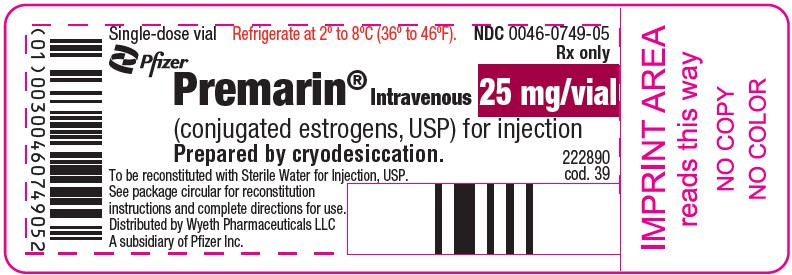
Premarin CONJUGATED ESTROGENS 25 mg/5mL Injection, Powder, Lyophilized, For Solution — NDC 0046-0749-05 (Billing 00046-0749-05)
This is a package of Premarin CONJUGATED ESTROGENS 25 mg/5mL Injection, Powder, Lyophilized, For Solution from Wyeth Pharmaceuticals LLC, a subsidiary of Pfizer Inc., marketed since Dec 1956 and currently FDA-listed. It is this product's only package size.
Identity & classification
Regulatory identifiers FDA, NLM and CMS codes for this package
Drug-database identifiers Medi-Span GPI and First Databank GCN / HICL / AHFS classification
- GSN (GCN sequence number): 003210
- GCN: 10890
- GPI-14 (Medi-Span): 24000015002110
- HICL (First Databank): 001424
- AHFS class code: 68:16.04.00
- RxCUI (RxNorm): 211975
Where does this data come from?
- FDA openFDA NDC Directory · synced Oct 1, 2026
- FDA label on DailyMed · label index refreshed Oct 1, 2026
- RxNorm (NLM RxNav) · catalog refreshed Oct 1, 2026
- Medi-Span GPI (licensed)
- First Databank (licensed) · refreshed Oct 1, 2026
RxNorm drug class
This medicine belongs to the Estrogen class.
Where does this data come from?
- RxClass (NLM) · catalog refreshed Oct 1, 2026
Clinical
The estradiol cypionate and estradiol valerate forms of estrogen injection are used to treat hot flushes (hot flashes; sudden strong feelings of heat and sweating) and/or vaginal dryness, itching, and burning in women who are experiencing menopause (change of life; the end of monthly menstrual periods). However, women who need a medication only to treat vaginal dryness, itching, or burning should consider a different treatment. These forms of estrogen injection are also sometimes used to treat the symptoms of low estrogen in young women who do not produce enough estrogen naturally. The estradi...
Read the full MedlinePlus article ↗Patient education
Supplement & herbal interactions
Some supplements/herbs that may interact with Conjugated Estrogens — tap one for details:
Conjugated Estrogens may be associated with lower levels of 5 nutrients — worth a chat with your pharmacist, not a cause for alarm.
Where does this data come from?
- MedlinePlus (NLM) · refreshed Oct 1, 2026
- FDA label on DailyMed · label index refreshed Oct 1, 2026
Ask a licensed pharmacist directly — free, answered by our team.
Pricing
A drug doesn't have one price. Each row is a different public payment system, and none is what you'd pay at the counter — that depends on your insurance. The ⓘ on each row explains what it measures.
| Price system | Per mL | Per package |
|---|---|---|
| Retail pharmacies payNADAC · weekly | Not in the retail survey — common for institutional, discontinued, or low-volume packs. | |
| Medicaid paysCMS SDUD · 12 mo | $46.27 | $231.36 / 5 ml |
| Medicare drug plans payPart D · quarterly | No Part D plan price is available for this NDC in our data. | |
| Medicare Part B allowsASP · J1410 | $401.503 / J1410 unit | — |
Where does this data come from?
- CMS NADAC weekly file
- CMS ASP pricing files · refreshed Sep 20, 2026
- CMS Medicaid State Drug Utilization Data · through Q4 2025
- CMS Part D plan pricing files · refreshed Sep 24, 2026
- VA National Acquisition Center price file
Billing & reimbursement
Where does this data come from?
- CMS ASP NDC-HCPCS crosswalk · refreshed Sep 22, 2026
- DMEPDAC NDC-HCPCS crosswalk
- openFDA NSDE billing units · refreshed Sep 7, 2026
Packaging — all sizes for this product
| Package NDC | Description | Marketing start | Marketing end | Status |
|---|---|---|---|---|
| 00046-0749-05 You're viewing this Main listing | 1 VIAL in 1 CARTON / 5 mL in 1 VIAL | 1956-12-01 | — | Active |
Therapeutic equivalents
| Product | Labeler | Pack | NADAC/unit | TE | Status | Price vs. this |
|---|---|---|---|---|---|---|
| Premarin 25 mg/5mLthis 00046-0749-05 | Wyeth | 1 vial | — | — | FDA listed | — |
Where does this data come from?
- FDA openFDA NDC Directory · synced Oct 1, 2026
- FDA Orange Book · refreshed Sep 3, 2026
- CMS NADAC weekly file
Availability & generic status
We did not find an FDA-approved generic match for this exact strength, form and route.
Where does this data come from?
- FDA Orange Book · refreshed Sep 3, 2026
Inactive Ingredients / Excipients
Inactive ingredients, also called excipients, are components of the drug product other than the active ingredient. They may include fillers, dyes, coatings, preservatives, flavors, or other formulation ingredients.
💡 Tap an ingredient (hover on desktop) to see what it is and why it’s used.
-
200 mg / 5 mL
UNII EWQ57Q8I5X
Lactose monohydrate is a natural sugar derived from milk. It serves as a filler and binder in tablets and capsules, helping create the proper size, texture, and consistency of the medicine.
-
12.2 mg / 5 mL
UNII 1Q73Q2JULR
Sodium citrate is a salt derived from citric acid. It works as a buffer to maintain the medicine's pH level and may also help improve taste or act as a preservative in the formulation.
2 inactive ingredients listed in the exact product block matched to this NDC.
Where does this data come from?
ingredient classCode="IACT" elements from the exact product block matched by this NDC. Label-section narrative from DailyMed / the openFDA label index is shown separately when available.- FDA label on DailyMed · label index refreshed Oct 1, 2026
- FDA openFDA NDC Directory · synced Oct 1, 2026
Inactive ingredient FAQ
Are inactive ingredients the same for every manufacturer?
Why might an inactive ingredient be missing?
Can inactive ingredients matter?
Manufacturer & labeler
Where does this data come from?
- FDA openFDA NDC Directory · synced Oct 1, 2026
- Drugs@FDA
Full prescribing information FDA SPL
🚨 Boxed Warning ▾
WARNING: ENDOMETRIAL CANCER, CARDIOVASCULAR DISORDERS, BREAST CANCER and PROBABLE DEMENTIA Estrogen-Alone Therapy Endometrial Cancer There is an increased risk of endometrial cancer in a woman with a uterus who uses unopposed estrogens. Adding a progestin to estrogen therapy has been shown to reduce the risk of endometrial hyperplasia, which may be a precursor to endometrial cancer. Adequate diagnostic measures, including directed or random endometrial sampling when indicated, should be undertaken to rule out malignancy in postmenopausal women with undiagnosed persistent or recurring abnormal genital bleeding.
(See WARNINGS, Malignant Neoplasms, Endometrial cancer .) Cardiovascular Disorders and Probable Dementia Estrogen-alone therapy should not be used for the prevention of cardiovascular disease or dementia. (See CLINICAL STUDIES and WARNINGS, Cardiovascular Disorders and Probable Dementia .) The Women's Health Initiative (WHI) estrogen-alone substudy reported increased risks of stroke and deep vein thrombosis (DVT) in postmenopausal women (50 to 79 years of age) during 7.1 years of treatment with daily oral conjugated estrogens (CE) [0.625 mg]-alone, relative to placebo.
(See CLINICAL STUDIES and WARNINGS, Cardiovascular disorders .) The WHI Memory Study (WHIMS) estrogen-alone ancillary study of the WHI reported an increased risk of developing probable dementia in postmenopausal women 65 years of age or older during 5.2 years of treatment with daily CE (0.625 mg)-alone, relative to placebo. It is unknown whether this finding applies to younger postmenopausal women. (See CLINICAL STUDIES and WARNINGS, Probable Dementia and PRECAUTIONS, Geriatric Use .) In the absence of comparable data, these risks should be assumed to be similar for other doses of CE and other dosage forms of estrogens.
Estrogens with or without progestins should be prescribed at the lowest effective doses and for the shortest duration consistent with treatment goals and risks for the individual woman. Estrogen Plus Progestin Therapy Cardiovascular Disorders and Probable Dementia Estrogen plus progestin therapy should not be used for the prevention of cardiovascular disease or dementia. (See CLINICAL STUDIES and WARNINGS, Cardiovascular disorders and Probable Dementia .) The WHI estrogen plus progestin substudy reported increased risks of DVT, pulmonary embolism (PE), stroke and myocardial infarction (MI) in postmenopausal women (50 to 79 years of age) during 5.6 years of treatment with daily oral CE (0.625 mg) combined with medroxyprogesterone acetate (MPA) [2.5 mg], relative to placebo.
(See CLINICAL STUDIES and WARNINGS, Cardiovascular disorders .) The WHIMS estrogen plus progestin ancillary study of the WHI reported an increased risk of developing probable dementia in postmenopausal women 65 years of age or older during 4 years of treatment with daily CE (0.625 mg) combined with MPA (2.5 mg), relative to placebo. It is unknown whether this finding applies to younger postmenopausal women. (See CLINICAL STUDIES and WARNINGS, Probable Dementia and PRECAUTIONS, Geriatric Use .) Breast Cancer The WHI estrogen plus progestin substudy also demonstrated an increased risk of invasive breast cancer.
(See CLINICAL STUDIES and WARNINGS, Malignant Neoplasms, Breast cancer .) In the absence of comparable data, these risks should be assumed to be similar for other doses of CE and MPA, and other combinations and dosage forms of estrogens and progestins. Estrogens with or without progestins should be prescribed at the lowest effective doses and for the shortest duration consistent with treatment goals and risks for the individual woman.
🎯 Indications and Usage ▾
INDICATIONS AND USAGE Premarin Intravenous (conjugated estrogens, USP) for injection is indicated in the treatment of abnormal uterine bleeding due to hormonal imbalance in the absence of organic pathology. Premarin Intravenous is indicated for short-term use only, to provide a rapid and temporary increase in estrogen levels.
⏱️ Dosage and Administration ▾
DOSAGE AND ADMINISTRATION For treatment of abnormal uterine bleeding due to hormonal imbalance in the absence of organic pathology: One 25 mg injection, intravenously or intramuscularly. Intravenous use is preferred since more rapid response can be expected from this mode of administration. Repeat in 6 to 12 hours if necessary.
The use of Premarin Intravenous for injection does not preclude the advisability of other appropriate measures. One should adhere to the usual precautionary measures governing intravenous administration. Injection should be made SLOWLY to obviate the occurrence of flushes.
Infusion of Premarin Intravenous for injection with other agents is not generally recommended. In emergencies, however, when an infusion has already been started it may be expedient to make the injection into the tubing just distal to the infusion needle. If so used, compatibility of solutions must be considered.
COMPATIBILITY OF SOLUTIONS Premarin Intravenous is compatible with normal saline, dextrose, and invert sugar solutions. It is not compatible with protein hydrolysate, ascorbic acid, or any solution with an acid pH.
⛔ Contraindications ▾
CONTRAINDICATIONS Premarin Intravenous therapy should not be used in individuals with any of the following conditions: 1. Undiagnosed abnormal genital bleeding. 2.
Known, suspected, or history of breast cancer. 3. Known or suspected estrogen-dependent neoplasia.
4. Active DVT, PE or a history of these conditions. 5.
Active arterial thromboembolic disease (for example, stroke and MI) or a history of these conditions. 6. Known anaphylactic reaction and angioedema to Premarin Intravenous therapy.
7. Known liver dysfunction or disease. 8.
Known protein C, protein S, or antithrombin deficiency or other known thrombophilic disorders. 9. Known or suspected pregnancy.
⚠️ Warnings ▾
WARNINGS See BOXED WARNINGS . Premarin Intravenous for injection is indicated for short-term use. However, warnings, precautions and adverse reactions associated with oral Premarin treatment should be taken into account.
1. Cardiovascular Disorders An increased risk of stroke and DVT has been reported with estrogen-alone therapy. An increased risk of PE, DVT, stroke, and MI has been reported with estrogen plus progestin therapy.
Should any of these events occur or be suspected, estrogen with or without progestin therapy should be discontinued immediately. Risk factors for arterial vascular disease (for example, hypertension, diabetes mellitus, tobacco use, hypercholesterolemia, and obesity) and/or venous thromboembolism (VTE) (for example, personal history or family history of VTE, obesity, and systemic lupus erythematosus) should be managed appropriately. a. Stroke In the WHI estrogen-alone substudy, a statistically significant increased risk of stroke was reported in women 50 to 79 years of age receiving daily CE (0.625 mg)-alone compared to women in the same age group receiving placebo (45 versus 33 per 10,000 women-years).
(See CLINICAL STUDIES .) The increase in risk was demonstrated in year 1 and persisted. Should a stroke occur or be suspected, estrogen-alone therapy should be discontinued immediately. Subgroup analyses of women 50 to 59 years of age suggest no increased risk of stroke for those women receiving CE (0.625 mg)-alone versus those receiving placebo (18 versus 21 per 10,000 women-years).
In the WHI estrogen plus progestin substudy, a statistically significant increased risk of stroke was reported in women 50 to 79 years of age receiving daily CE (0.625 mg) plus MPA (2.5 mg) compared to women in the same age group receiving placebo (33 versus 25 per 10,000 women-years). (See CLINICAL STUDIES .) The increase in risk was demonstrated after the first year and persisted. Should a stroke occur or be suspected, estrogen plus progestin therapy should be discontinued immediately. b.
Coronary heart disease In the WHI estrogen-alone substudy, no overall effect on CHD events (defined as nonfatal MI, silent MI, or CHD death) was reported in women receiving estrogen-alone compared to placebo. (See CLINICAL STUDIES .) In the WHI estrogen plus progestin substudy, there was a non-statistically significant increased risk of CHD events reported in women receiving daily CE (0.625 mg) plus MPA (2.5 mg) compared to women receiving placebo (41 versus 34 per 10,000 women-years). An increase in relative risk was demonstrated in year 1, and a trend toward decreasing relative risk was reported in years 2 through 5.
In postmenopausal women with documented heart disease (n = 2,763, average 66.7 years of age), in a controlled clinical trial of secondary prevention of cardiovascular disease (Heart and Estrogen/Progestin Replacement Study; HERS), treatment with daily CE 0.625 mg/MPA 2.5 mg demonstrated no cardiovascular benefit. During an average follow-up of 4.1 years, treatment with CE plus MPA did not reduce the overall rate of CHD events in postmenopausal women with established coronary heart disease. There were more CHD events in the CE plus MPA-treated group than in the placebo group in year one, but not during the subsequent years.
Two thousand three hundred and twenty-one (2,321) women from the original HERS trial agreed to participate in an open-label extension of HERS, HERS II. Average follow-up in HERS II was an additional 2.7 years, for a total of 6.8 years overall. Rates of CHD events were comparable among women in the CE plus MPA group and the placebo group in the HERS, the HERS II, and overall. c.
Venous thromboembolism In the WHI estrogen-alone substudy, the risk of VTE (DVT and PE), was increased for women receiving daily CE (0.625 mg)-alone compared to placebo (30 versus 22 per 10,000 women-years), although only the increased risk of DVT reached statistical significance (23 versus 15 per 10,000 women-years). The increase…
🤒 Adverse Reactions ▾
ADVERSE REACTIONS See BOXED WARNINGS , WARNINGS , and PRECAUTIONS . Premarin Intravenous for injection is indicated for short-term use. However, the warnings, precautions and adverse reactions associated with oral Premarin treatment should be taken into account.
The following adverse reactions have been identified during post-approval use of oral or intravenous Premarin. Because these reactions are reported voluntarily from a population of uncertain size, it is not possible to reliably estimate their frequency or establish a causal relationship to drug exposure. Genitourinary system Abnormal uterine bleeding/spotting.
Dysmenorrhea or pelvic pain. Increase in size of uterine leiomyomata. Vaginitis, including vaginal candidiasis.
Change in amount of cervical secretion. Change in cervical ectropion. Ovarian cancer.
Endometrial hyperplasia. Endometrial cancer. Breasts Tenderness, enlargement, pain, discharge, galactorrhea.
Fibrocystic breast changes. Breast cancer. Cardiovascular Deep and superficial venous thrombosis.
Pulmonary embolism. Thrombophlebitis. Myocardial infarction.
Stroke. Increase in blood pressure. Gastrointestinal Nausea, vomiting.
Abdominal cramps, bloating. Cholestatic jaundice. Increased incidence of gallbladder disease.
Pancreatitis. Enlargement of hepatic hemangiomas. Ischemic colitis.
Skin Chloasma or melasma that may persist when drug is discontinued. Erythema multiforme. Erythema nodosum.
Hemorrhagic eruption. Loss of scalp hair. Hirsutism.
Pruritis. Rash. Eyes Retinal vascular thrombosis.
Intolerance to contact lenses. Central Nervous System Headache. Migraine.
Dizziness. Mental depression. Exacerbation of chorea.
Nervousness. Exacerbation of epilepsy. Dementia.
Possible growth potentiation of benign meningioma. Miscellaneous Increase or decrease in weight. Glucose intolerance.
Aggravation of porphyria. Edema. Arthralgia.
Leg cramps. Changes in libido. Urticaria.
Hypocalcemia (preexisting condition). Injection site pain. Injection site edema.
Phlebitis (injection site). Exacerbation of asthma. Increased triglycerides.
🔄 Drug / Laboratory Test Interactions ▾
D. Drug-Laboratory Test Interactions 1. Accelerated prothrombin time, partial thromboplastin time, and platelet aggregation time; increased platelet count; increased factors II, VII antigen, VIII antigen, VIII coagulant activity, IX, X, XII, VII-X complex, II-VII-X complex, and beta-thromboglobulin; decreased levels of anti-factor Xa and antithrombin III, decreased antithrombin III activity; increased levels of fibrinogen and fibrinogen activity; increased plasminogen antigen and activity.
2. Increased thyroid-binding globulin (TBG) leading to increased circulating total thyroid hormone, as measured by protein-bound iodine (PBI), T 4 levels (by column or by radioimmunoassay) or T 3 levels by radioimmunoassay. T 3 resin uptake is decreased, reflecting the elevated TBG.
Free T 4 and free T 3 concentrations are unaltered. Patients on thyroid replacement therapy may require higher doses of thyroid hormone. 3.
Other binding proteins may be elevated in serum, i.e., corticosteroid binding globulin (CBG), SHBG, leading to increased total circulating corticosteroids and sex steroids respectively. Free hormone concentrations, such as testosterone and estradiol, may be decreased. Other plasma proteins may be increased (angiotensinogen/renin substrate, alpha-1-antitrypsin, ceruloplasmin).
4. Increased plasma high-density lipoprotein (HDL) and HDL 2 subfraction concentrations, reduced low-density lipoprotein (LDL) cholesterol concentration, increased triglyceride levels. 5.
Impaired glucose tolerance.
🤰 Pregnancy ▾
F. Pregnancy Premarin Intravenous should not be used during pregnancy. (See CONTRAINDICATIONS .)
🧒 Pediatric Use ▾
H. Pediatric Use Estrogen therapy has been used for the induction of puberty in adolescents with some forms of pubertal delay. Safety and effectiveness in pediatric patients have not otherwise been established.
Large and repeated doses of estrogen over an extended time period have been shown to accelerate epiphyseal closure, which could result in short adult stature if treatment is initiated before the completion of physiologic puberty in normally developing children. If estrogen is administered to patients whose bone growth is not complete, periodic monitoring of bone maturation and effects on epiphyseal centers is recommended during estrogen administration. Estrogen treatment of prepubertal girls also induces premature breast development and vaginal cornification, and may induce vaginal bleeding.
In boys, estrogen treatment may modify the normal pubertal process and induce gynecomastia.
🧓 Geriatric Use ▾
I. Geriatric Use There have not been sufficient numbers of geriatric patients involved in studies utilizing Premarin to determine whether those over 65 years of age differ from younger subjects in their response to Premarin. The Women's Health Initiative Studies In the WHI estrogen-alone substudy (daily CE [0.625 mg]-alone versus placebo), there was a higher relative risk of stroke in women greater than 65 years of age.
(See CLINICAL STUDIES .) In the WHI estrogen plus progestin substudy (daily CE [0.625 mg] plus MPA [2.5 mg] versus placebo), there was a higher relative risk of nonfatal stroke and invasive breast cancer in women greater than 65 years of age. (See CLINICAL STUDIES .) The Women's Health Initiative Memory Study In the WHIMS ancillary studies of postmenopausal women 65 to 79 years of age, there was an increased risk of developing probable dementia in women receiving estrogen-alone or estrogen plus progestin when compared to placebo.
(See CLINICAL STUDIES and WARNINGS, Probable Dementia .) Since both ancillary studies were conducted in women 65 to 79 years of age, it is unknown whether these findings apply to younger postmenopausal women. (See CLINICAL STUDIES and WARNINGS, Probable Dementia .)
🆘 Overdosage ▾
OVERDOSAGE Overdosage of estrogen may cause nausea, vomiting, breast tenderness, abdominal pain, drowsiness and fatigue, and withdrawal bleeding may occur in women. Treatment of overdose consists of discontinuation of Premarin therapy with institution of appropriate symptomatic care.
🧬 Clinical Pharmacology ▾
CLINICAL PHARMACOLOGY Endogenous estrogens are largely responsible for the development and maintenance of the female reproductive system and secondary sexual characteristics. Although circulating estrogens exist in a dynamic equilibrium of metabolic interconversions, estradiol is the principal intracellular human estrogen and is substantially more potent than its metabolites, estrone and estriol, at the receptor level. The primary source of estrogen in normally cycling adult women is the ovarian follicle, which secretes 70 to 500 mcg of estradiol daily, depending on the phase of the menstrual cycle.
After menopause, most endogenous estrogen is produced by conversion of androstenedione, secreted by the adrenal cortex, to estrone in the peripheral tissues. Thus, estrone and the sulfate-conjugated form, estrone sulfate, are the most abundant circulating estrogen in postmenopausal women. Estrogens act through binding to nuclear receptors in estrogen-responsive tissues.
To date, two estrogen receptors have been identified. These vary in proportion from tissue to tissue. Circulating estrogens modulate the pituitary secretion of the gonadotropins, luteinizing hormone (LH) and follicle stimulating hormone (FSH), through a negative feedback mechanism.
Estrogens act to reduce the elevated levels of these gonadotropins seen in postmenopausal women. Pharmacokinetics A. Absorption Conjugated estrogens are water-soluble and are well-absorbed through the skin, mucous membranes, and gastrointestinal tract after release from the drug formulation.
B. Distribution The distribution of exogenous estrogens is similar to that of endogenous estrogens. Estrogens are widely distributed in the body and are generally found in higher concentration in the sex hormone target organs.
Estrogens circulate in the blood largely bound to sex hormone-binding globulin (SHBG) and albumin. C. Metabolism Exogenous estrogens are metabolized in the same manner as endogenous estrogens.
Circulating estrogens exist in a dynamic equilibrium of metabolic interconversions. These transformations take place mainly in the liver. Estradiol is converted reversibly to estrone, and both can be converted to estriol, which is a major urinary metabolite.
Estrogens also undergo enterohepatic recirculation via sulfate and glucuronide conjugation in the liver, biliary secretion of conjugates into the intestine, and hydrolysis in the intestine followed by reabsorption. In postmenopausal women a significant proportion of the circulating estrogens exist as sulfate conjugates, especially estrone sulfate, which serves as a circulating reservoir for the formation of more active estrogens. D.
Excretion Estradiol, estrone, and estriol are excreted in the urine along with glucuronide and sulfate conjugates. E. Special Populations No pharmacokinetic studies were conducted in special populations, including patients with renal or hepatic impairment.
F. Drug Interactions Data from a single-dose drug-drug interaction study involving oral CE and MPA indicate that the pharmacokinetic dispositions of both drugs are not altered when the drugs are coadministered. No other clinical drug-drug interaction studies have been conducted with conjugated estrogens.
In vitro and in vivo studies have shown that estrogens are metabolized partially by cytochrome P450 3A4 (CYP3A4). Therefore, inducers or inhibitors of CYP3A4 may affect estrogen drug metabolism. Inducers of CYP3A4, such as St.
John's wort (Hypericum perforatum) preparations, phenobarbital, carbamazepine, and rifampin, may reduce plasma concentrations of estrogens, possibly resulting in a decrease in therapeutic effects and/or changes in the uterine bleeding profile. Inhibitors of CYP3A4, such as erythromycin, clarithromycin, ketoconazole, itraconazole, ritonavir and grapefruit juice, may increase plasma concentrations of estrogens and may result in side effects.
📦 How Supplied / Storage and Handling ▾
HOW SUPPLIED NDC 0046-0749-05–Each package provides one single-dose vial containing 25 mg/vial of conjugated estrogens, USP, for injection (also lactose 200 mg, sodium citrate 12.2 mg, and simethicone 0.2 mg). The pH is adjusted with sodium hydroxide or hydrochloric acid. Premarin Intravenous (conjugated estrogens, USP) for injection is prepared by cryodesiccation.
📦 Storage and Handling ▾
DIRECTIONS FOR STORAGE AND RECONSTITUTION STORAGE BEFORE RECONSTITUTION Store package in refrigerator, 2° to 8°C (36° to 46°F). TO RECONSTITUTE Reconstitute Premarin Intravenous with 5 mL of Sterile Water for Injection, USP. Introduce the sterile diluent slowly against the side of the vial and agitate gently. Do not shake violently. Use immediately after reconstitution.
📋 Description ▾
DESCRIPTION Premarin Intravenous (conjugated estrogens, USP) for injection contains a mixture of conjugated estrogens obtained exclusively from natural sources, occurring as the sodium salts of water-soluble estrogen sulfates blended to represent the average composition of materials derived from pregnant mares' urine. It is a mixture of sodium estrone sulfate and sodium equilin sulfate. It contains as concomitant components, as sodium sulfate conjugates, 17α-dihydroequilin, 17α-estradiol, and 17β-dihydroequilin.
Each single-dose vial contains 25 mg/vial of conjugated estrogens, USP, in a sterile lyophilized cake which also contains lactose 200 mg, sodium citrate 12.2 mg, and simethicone 0.2 mg. The pH is adjusted with sodium hydroxide or hydrochloric acid. The reconstituted solution is suitable for intravenous or intramuscular injection.
💬 Information for Patients ▾
B. Patient Information Physicians are advised to discuss the contents of the PATIENT INFORMATION leaflet with patients who are being treated with Premarin Intravenous.
Medicaid utilization & spend
Medicare Part D spend CMS · PART D · 2026 (Q1)
About this NDC listing & data coverage
What data is (and isn’t) available for this NDC — tap to expand
| NDC identity (package / product / labeler codes) | ✓ Available |
| Labeler | ✓ Available |
| Product & package description | ✓ Available |
| Marketing category & status | ✓ Available |
| Active ingredient / dosage form / route | ✓ Available |
| FDA label (SPL via DailyMed) | ✓ Available |
| Package photos | ✓ Available |
| Inactive ingredients (structured) | ✓ Available |
| NADAC pharmacy acquisition price (CMS) | — Not published for this NDC CMS publishes NADAC only for NDCs reported in its retail-pharmacy survey. |
| Orange Book / therapeutic-equivalence data | — Not published for this NDC Applies only to products approved under an NDA/ANDA; many listings are out of scope. |
| HCPCS J-code billing crosswalk | ✓ Available |
| Medicaid utilization (CMS SDUD) | ✓ Available |