
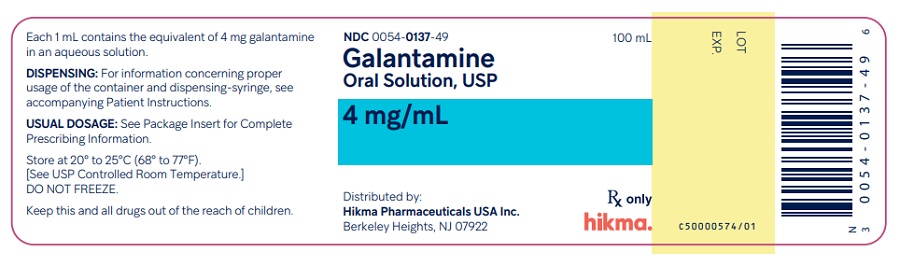
Galantamine Hydrobromide 4 mg/mL Solution, 100 mL — NDC 0054-0137-49 (Billing 00054-0137-49)
This is a package of 100 mL of Galantamine Hydrobromide 4 mg/mL Solution from Hikma Pharmaceuticals USA Inc., marketed since Aug 2009 and currently FDA-listed. It is this product's only package size.
NDC database record
One package, one record: these facts belong to NDC 0054-0137-49 alone.
- Record
- FDA NDC Directory package listing · Human prescription drug
- Code segments
- 0054 labeler · 0137 product · 49 package
- Package marketed since
- Aug 14, 2009
- Sample package
- No — commercial package
- Listing certified through
- Dec 31, 2026
- Billing quantity
- 100 mL per package
- Barcode (UPC-A, from the NDC)
- 3 0054013749 6
- Medicaid fills, this package
- 13 prescriptions in the last four reported quarters
- FDA record last changed
- Jul 24, 2026
Identity & classification
Regulatory identifiers FDA, NLM and CMS codes for this package
Drug-database identifiers Medi-Span GPI and First Databank GCN / HICL / AHFS classification
- GSN (GCN sequence number): 048437
- GCN: 13898
- GPI-14 (Medi-Span): 62051030102020
- HICL (First Databank): 016520
- AHFS class code: 12:04.00.00
- RxCUI (RxNorm): 860901
Where does this data come from?
- FDA openFDA NDC Directory · synced Oct 8, 2026
- FDA label on DailyMed · label index refreshed Oct 6, 2026
- RxNorm (NLM RxNav) · catalog refreshed Oct 1, 2026
- Medi-Span GPI (licensed)
- First Databank (licensed) · refreshed Oct 8, 2026
RxNorm drug class
This medicine belongs to the Cholinesterase Inhibitor class.
Where does this data come from?
- RxClass (NLM) · catalog refreshed Oct 1, 2026
Clinical
Galantamine is used to treat the symptoms of Alzheimer's disease (AD; a brain disease that affects memory, thinking, and behavior). Galantamine is in a class of medications called acetylcholinesterase inhibitors. It works by increasing the amount of a certain naturally occurring substance in the brain.
Read the full MedlinePlus article ↗- It treats mild to moderate dementia of the Alzheimer’s type. It helps manage symptoms by boosting a brain chemical involved in memory and thinking. It does not stop the disease fro...
- The extended-release capsule is taken once a day in the morning, preferably with food. The tablets and oral solution are taken twice a day with morning and evening meals. Drink ple...
- Nausea is the most common, along with vomiting, diarrhea, dizziness, headache and less appetite. These mostly show up while the dose is going up. Nausea usually lasts about a week...
- Stop the medicine and call right away if you get a skin rash. Also call for fainting, a very slow heartbeat, seizures, black or bloody stools, or trouble urinating or breathing.
Patient education
Supplement & herbal interactions
Where does this data come from?
- MedlinePlus (NLM) · refreshed Oct 1, 2026
- FDA label on DailyMed · label index refreshed Oct 6, 2026
Ask a licensed pharmacist directly — free, answered by our team.
Pricing
A drug doesn't have one price. Each row is a different public payment system, and none is what you'd pay at the counter — that depends on your insurance. The ⓘ on each row explains what it measures.
| Price system | Per mL | Per package |
|---|---|---|
| Retail pharmacies payNADAC · weekly | Not in the retail survey — common for institutional, discontinued, or low-volume packs. | |
| Medicaid paysCMS SDUD · 12 mo | $3.10 | $309.86 / 100 ml |
| Medicare drug plans payPart D · Q2 2026 | $2.71 | $271.33 / 100 ml |
Where does this data come from?
- CMS NADAC weekly file
- CMS ASP pricing files · refreshed Sep 20, 2026
- CMS Medicaid State Drug Utilization Data · through Q1 2026
- CMS Part D plan pricing files · refreshed Sep 24, 2026
- VA National Acquisition Center price file
Packaging — all sizes for this product
| Package NDC | Description | Marketing start | Marketing end | Status |
|---|---|---|---|---|
| 00054-0137-49 You're viewing this Main listing | 100 mL in 1 BOTTLE | 2009-08-14 | — | Active |
Therapeutic equivalents
| Product | Labeler | Pack | NADAC/unit | TE | Status | Price vs. this |
|---|---|---|---|---|---|---|
| Galantamine Hydrobromide 4 mg/mLthis 00054-0137-49 | Hikma | 100 ml | — | — | FDA listed | — |
Where does this data come from?
- FDA openFDA NDC Directory · synced Oct 8, 2026
- FDA Orange Book · refreshed Oct 3, 2026
- CMS NADAC weekly file
Availability & generic status
This product is an FDA-approved generic. Other versions of the same drug are listed under Therapeutic equivalents, least expensive first.
Where does this data come from?
- FDA Orange Book · refreshed Oct 3, 2026
Inactive Ingredients / Excipients
Inactive ingredients, also called excipients, are components of the drug product other than the active ingredient. They may include fillers, dyes, coatings, preservatives, flavors, or other formulation ingredients.
🧪 Avoiding an ingredient? See Galantamine inactive ingredients by manufacturer: every current product's list side by side, so you can ask your pharmacy for the version that does not list it.
💡 Tap an ingredient (hover on desktop) to see what it is and why it’s used.
-
UNII A2I8C7HI9T
Methylparaben is a preservative derived from benzoic acid that prevents growth of bacteria, fungi, and mold in medicines. It extends the product's shelf life and maintains safety during storage.
-
UNII Z8IX2SC1OH
Propylparaben is a chemical preservative used to prevent bacterial and fungal growth in medicines and personal care products. It helps extend shelf life and maintain product safety during storage.
-
UNII SB8ZUX40TY
Saccharin sodium is an artificial sweetener made from saccharin salt. It's added to medicines to improve taste, especially in liquid formulations for children or bitter drugs.
-
UNII 059QF0KO0R
Water is a liquid solvent that dissolves and mixes ingredients together in liquid medicines, syrups, and injections. It helps distribute the active drug evenly throughout the product.
4 inactive ingredients listed in the exact product block matched to this NDC.
Where does this data come from?
ingredient classCode="IACT" elements from the exact product block matched by this NDC. Label-section narrative from DailyMed / the openFDA label index is shown separately when available.- FDA label on DailyMed · label index refreshed Oct 6, 2026
- FDA openFDA NDC Directory · synced Oct 8, 2026
Inactive ingredient FAQ
Are inactive ingredients the same for every manufacturer?
Why might an inactive ingredient be missing?
Can inactive ingredients matter?
Manufacturer & labeler
More NDCs from Hikma Pharmaceuticals USA Inc. labeler code 00054
- Zaleplon 10 mg Capsule NDC 0054-0085-25
- Calcium Acetate 667 mg Capsule NDC 0054-0088-13
- Ramipril 1.25 mg Capsule NDC 0054-0106-25
- Ramipril 2.5 mg Capsule NDC 0054-0107-20
- Ramipril 5 mg Capsule NDC 0054-0108-20
- Ramipril 10 mg Capsule NDC 0054-0109-25
- Acarbose 25 mg Tablet NDC 0054-0140-25
- Acarbose 50 mg Tablet NDC 0054-0141-20
- Acarbose 100 mg Tablet NDC 0054-0142-25
- Mycophenolate Mofetil 250 mg Capsule NDC 0054-0163-25
- Mycophenolate Mofetil 500 mg Tablet NDC 0054-0166-25
- Buprenorphine 2 mg Tablet NDC 0054-0176-13
Where does this data come from?
- FDA openFDA NDC Directory · synced Oct 8, 2026
- Drugs@FDA
Full prescribing information FDA SPL
🎯 Indications and Usage ▾
1 INDICATIONS AND USAGE Galantamine is indicated for the treatment of mild to moderate dementia of the Alzheimer’s type. Galantamine is a cholinesterase inhibitor indicated for the treatment of mild to moderate dementia of the Alzheimer’s type. ( 1 )
⏱️ Dosage and Administration ▾
2 DOSAGE AND ADMINISTRATION • Galantamine Oral Solution: Recommended starting dosage is 4 mg (1 mL) twice daily; increase dose to initial maintenance dosage of 8 mg (2 mL) twice daily after a minimum of 4 weeks. Based on clinical benefit and tolerability, dosage may be increased to 12 mg (3 mL) twice daily after a minimum of 4 weeks at 8 mg (2 mL) twice daily. ( 2.2 ) • Take with meals; ensure adequate fluid intake during treatment.
( 2.2 ) • Hepatic Impairment: should not exceed 16 mg (4 mL)/day for moderate hepatic impairment; do not use in patients with severe hepatic impairment. ( 2.3 ) • Renal Impairment: should not exceed 16 mg (4 mL)/day for creatinine clearance 9 mL to 59 mL/min; do not use in patients with creatinine clearance less than 9 mL/min. ( 2.4 )
2.2Galantamine Oral Solution The dosage of galantamine tablets shown to be effective in controlled clinical trials is 16 mg to 32 mg/day given as twice daily dosing. As the dosage of 32 mg/day is less well tolerated than lower dosages and does not provide increased effectiveness, the recommended dosage range is 16 mg to 24 mg/day given twice daily. The dosage of 24 mg/day did not provide a statistically significant greater clinical benefit than 16 mg/day.
It is possible, however, that a daily dosage of 24 mg of galantamine might provide additional benefit for some patients. The recommended starting dosage of galantamine oral solution is 4 mg (1 mL) twice a day (8 mg (2 mL)/day). The dosage should be increased to the initial maintenance dosage of 8 mg (2 mL) twice a day (16 mg (4 mL)/day) after a minimum of 4 weeks.
A further increase to 12 mg (3 mL) twice a day (24 mg (6 mL)/day) should be attempted after a minimum of 4 weeks at 8 mg (2 mL) twice a day (16 mg (4 mL)/day). Dosage increases should be based upon assessment of clinical benefit and tolerability of the previous dose. Galantamine oral solution should be administered twice a day, preferably with morning and evening meals.
Patients and caregivers should be advised to ensure adequate fluid intake during treatment. If therapy has been interrupted for more than three days, the patient should be restarted at the lowest dosage and the dosage escalated to the current dose. The abrupt withdrawal of galantamine in those patients who had been receiving dosages in the effective range was not associated with an increased frequency of adverse events in comparison with those continuing to receive the same dosages of that drug.
The beneficial effects of galantamine are lost, however, when the drug is discontinued.
2.3Dosage in Patients with Hepatic Impairment In patients with moderate hepatic impairment (Child-Pugh score of 7 to 9), the dosage should generally not exceed 16 mg (4 mL)/day. The use of galantamine in patients with severe hepatic impairment (Child-Pugh score of 10 to 15) is not recommended [see Clinical Pharmacology (12.3) ].
2.4Dosage in Patients with Renal Impairment In patients with creatinine clearance of 9 mL to 59 mL/min, the dosage should generally not exceed 16 mg (4 mL)/day. In patients with creatinine clearance less than 9 mL/min, the use of galantamine is not recommended [see Clinical Pharmacology (12.3) ] .
💊 Dosage Forms and Strengths ▾
3 DOSAGE FORMS AND STRENGTHS Galantamine Oral Solution USP, 4 mg/mL is a clear, colorless to pale yellow solution supplied in 100 mL bottles with a calibrated (in milliliters) syringe. The minimum calibrated volume is 0.5 mL, while the maximum calibrated volume is 5 mL. Oral Solution – 4 mg/mL ( 3 )
⛔ Contraindications ▾
4 CONTRAINDICATIONS Galantamine is contraindicated in patients with known hypersensitivity to galantamine hydrobromide or to any excipients used in the formulation. Known hypersensitivity to galantamine hydrobromide or any excipients. ( 4 )
⚠️ Warnings and Cautions ▾
5 WARNINGS AND PRECAUTIONS • Serious Skin Reactions: discontinue at first appearance of skin rash. ( 5.1 ) • All patients should be considered at risk for adverse effects on cardiac conduction, including bradycardia and AV block, due to vagotonic effects on sinoatrial and atrioventricular nodes. ( 5.3 ) • Active or Occult Gastrointestinal Bleeding: monitor, especially those with an increased risk for developing ulcers.
( 5.4 ) • Cholinomimetics may cause bladder outflow obstruction. ( 5.5 ) • Monitor for respiratory adverse events in patients with a history of severe asthma or obstructive pulmonary disease. ( 5.7 )
5.1Serious Skin Reactions Serious skin reactions (Stevens-Johnson syndrome and acute generalized exanthematous pustulosis) have been reported in patients receiving galantamine. Inform patients and caregivers that the use of galantamine should be discontinued at the first appearance of a skin rash, unless the rash is clearly not drug-related. If signs or symptoms suggest a serious skin reaction, use of this drug should not be resumed and alternative therapy should be considered.
5.2Anesthesia Galantamine, as a cholinesterase inhibitor, is likely to exaggerate the neuromuscular blocking effects of succinylcholine-type and similar neuromuscular blocking agents during anesthesia.
5.3Cardiovascular Conditions Because of their pharmacological action, cholinesterase inhibitors have vagotonic effects on the sinoatrial and atrioventricular nodes, leading to bradycardia and AV block. Bradycardia and all types of heart block have been reported in patients both with and without known underlying cardiac conduction abnormalities [see Adverse Reactions (6.1 , 6.2) ] . Therefore, all patients should be considered at risk for adverse effects on cardiac conduction.
Patients treated with galantamine up to 24 mg/day using the recommended dosing schedule showed a dose-related increase in risk of syncope (placebo 0.7% [2/286]; 4 mg twice daily 0.4% [3/692]; 8 mg twice daily 1.3% [7/552]; 12 mg twice daily 2.2% [6/273]).
5.4Gastrointestinal Conditions Through their primary action, cholinomimetics may be expected to increase gastric acid secretion due to increased cholinergic activity. Therefore, patients should be monitored closely for symptoms of active or occult gastrointestinal bleeding, especially those with an increased risk for developing ulcers, e.g., those with a history of ulcer disease or patients using concurrent nonsteroidal anti-inflammatory drugs (NSAIDs). Clinical studies of galantamine have shown no increase, relative to placebo, in the incidence of either peptic ulcer disease or gastrointestinal bleeding.
Galantamine, as a predictable consequence of its pharmacological properties, has been shown to produce nausea, vomiting, diarrhea, anorexia, and weight loss. During therapy, the patient’s weight should be monitored.
5.5Genitourinary Conditions Although this was not observed in clinical trials with galantamine, cholinomimetics may cause bladder outflow obstruction.
5.6Neurological Conditions Seizures: Cholinesterase inhibitors are believed to have some potential to cause generalized convulsions [see Adverse Reactions (6.2) ] . Seizure activity may also be a manifestation of Alzheimer’s disease. Patients with Alzheimer’s disease should be monitored closely for seizures while taking galantamine.
5.7Pulmonary Conditions Because of its cholinomimetic action, galantamine should be prescribed with care to patients with a history of severe asthma or obstructive pulmonary disease. Respiratory function should be monitored closely for the occurrence of respiratory adverse effects.
5.8Deaths in Subjects with Mild Cognitive Impairment (MCI) In two randomized placebo controlled trials of 2 years duration in patients with mild cognitive impairment (MCI), a total of 13 patients on galantamine (n=1026) and 1 patient on placebo (n=1022) died. The deaths were due to various causes which could be expected in an elderly population; a… [Excerpted — this section continues on DailyMed.]
🤒 Adverse Reactions ▾
6 ADVERSE REACTIONS Serious adverse reactions are discussed in more detail in the following sections of the labeling: • Serious Skin Reactions [see Warnings and Precautions (5.1) ] • Cardiovascular Conditions [see Warnings and Precautions (5.3) ] • Gastrointestinal Conditions [see Warnings and Precautions (5.4) ] • Genitourinary Conditions [see Warnings and Precautions (5.5) ] • Neurological Conditions [see Warnings and Precautions (5.6) ] • Pulmonary Conditions [see Warnings and Precautions (5.7) ] • Deaths in Subjects with Mild cognitive impairment (MCI) [see Warnings and Precautions (5.8) ] The most common adverse reactions (≥5%) were nausea, vomiting, diarrhea, dizziness, headache, and decreased appetite.
( 6.1 ) To report SUSPECTED ADVERSE REACTIONS, contact Hikma Pharmaceuticals USA Inc. at 1-800-962-8364 or FDA at 1-800-FDA-1088 or www.fda.gov/medwatch.
6.1Clinical Trials Experience Because clinical trials are conducted under widely varying conditions, adverse reaction rates observed in the clinical trials of a drug cannot be directly compared to rates in the clinical trials of another drug and may not reflect the rates observed in practice. The most common adverse reactions in galantamine-treated patients from double-blind clinical trials (≥5%) were nausea, vomiting, diarrhea, dizziness, headache, and decreased appetite. The most common adverse reactions associated with discontinuation (≥1%) in galantamine-treated patients from double-blind clinical trials were nausea (6.2%), vomiting (3.3%), decreased appetite (1.5%), and dizziness (1.3%).
The safety of the extended-release capsule and immediate-release tablet formulations of galantamine was evaluated in 3956 galantamine-treated patients who participated in 8 placebo-controlled clinical studies and 1454 subjects in 5 open-label clinical studies with mild to moderate dementia of the Alzheimer’s type. In clinical studies, the safety profile of once-daily treatment with extended-release galantamine was similar in frequency and nature to that seen with tablets. The information presented in this section was derived from pooled double-blind studies and from pooled open-label data.
Commonly-Observed Adverse Reactions in Double-Blind, Placebo-Controlled Clinical Trials: Table 1 lists the adverse reactions reported in ≥1% of galantamine-treated patients in 8 placebo-controlled, double-blind clinical trials. Table 1: Adverse Reactions Reported by ≥1% of Galantamine-Treated Patients in Pooled Placebo-Controlled, Double-Blind Clinical Trials System/Organ Class Adverse Reaction Galantamine (n=3956) % Placebo (n=2546) % Metabolism and Nutrition Disorders Decreased Appetite 7.4
2.1Psychiatric Disorders Depression 3.6
2.3Nervous System Disorders Headache 7.1
5.5Dizziness 7.5
3.4Tremor 1.6
0.7Somnolence 1.5
0.8Syncope 1.4
0.6Lethargy 1.3
0.4Cardiac Disorders Bradycardia 1.0
0.3Gastrointestinal Disorders Nausea 20.7
5.5Vomiting 10.5
2.3Diarrhea 7.4
4.9Abdominal Discomfort 2.1
0.7Abdominal Pain 3.8
2.0Dyspepsia 1.5
1.0Musculoskeletal and Connective Tissue Disorders Muscle Spasms 1.2
0.5General Disorders and Administration Site Conditions Fatigue 3.5
1.8Asthenia 2.0
1.5Malaise 1.1
0.5Investigations Decreased Weight 4.7
1.5Injury, Poisoning and Procedural Complications Fall 3.9
3.0Laceration 1.1
0.5The majority of these adverse reactions occurred during the dose-escalation period. In those patients who experienced the most frequent adverse reaction, nausea, the median duration of the nausea was 5 to 7 days. Other Adverse Reactions Observed in Clinical Trials of Galantamine: The following adverse reactions occurred in <1% of all galantamine-treated patients (n=3956) in the above double-blind, placebo-controlled clinical trial data sets.
In addition, the following also includes all adverse reactions reported at any frequency rate in patients (n=1454) who participated in open-label studies. Adverse reactions listed in Table 1 above were not included below: Metabolism a… [Excerpted — this section continues on DailyMed.]
🔄 Drug Interactions ▾
7 DRUG INTERACTIONS • Potential to interfere with the activity of anticholinergic medications. ( 7.1 ) • Synergistic effect expected when given concurrently with succinylcholine, other cholinesterase inhibitors, similar neuromuscular blocking agents, or cholinergic agonists. ( 7.2 )
7.1Use with Anticholinergics Galantamine has the potential to interfere with the activity of anticholinergic medications [see Clinical Pharmacology (12.3) ] .
7.2Use with Cholinomimetics and Other Cholinesterase Inhibitors A synergistic effect is expected when cholinesterase inhibitors are given concurrently with succinylcholine, other cholinesterase inhibitors, similar neuromuscular blocking agents or cholinergic agonists such as bethanechol [see Clinical Pharmacology (12.3) ] .
👥 Use in Specific Populations ▾
8 USE IN SPECIFIC POPULATIONS Pregnancy: Based on animal data may cause fetal harm. ( 8.1 )
8.1Pregnancy There are no adequate and well-controlled studies in pregnant women. In studies conducted in animals, administration of galantamine during pregnancy resulted in developmental toxicity (increased incidence of morphological abnormalities and decreased growth in offspring) at doses similar to or greater than those used clinically. Galantamine should be used during pregnancy only if the potential benefit justifies the potential risk to the fetus.
In rats, administration of galantamine (oral doses of 2 mg, 8 mg, or 16 mg/kg/day), from day 14 (females) or day 60 (males) prior to mating and continuing in females through the period of organogenesis, resulted in an increased incidence of fetal skeletal variations at the two highest doses. The no-effect dose for embryo-fetal developmental toxicity in rats (2 mg/kg/day) is approximately equal to the maximum recommended human dose (MRHD of 24 mg/day) on a body surface area (mg/m 2 ) basis. When galantamine (oral doses of 4 mg, 12 mg, 28 mg, or 48 mg/kg/day) was administered to pregnant rabbits throughout the period of organogenesis, small increases in fetal visceral malformations and skeletal variations were observed at the highest dose.
The no-effect dose for embryo-fetal developmental toxicity in rabbits (28 mg/kg/day) is approximately 20 times the MRHD on a mg/m 2 basis. In a study in which pregnant rats were orally dosed with galantamine (2 mg, 8 mg, or 16 mg/kg/day) from the beginning of organogenesis through day 21 post-partum, pup weights were decreased at birth and during the lactation period at the two highest doses. The no-effect dose for pre- and postnatal developmental toxicity in rats (2 mg/kg/day) is approximately equal to the MRHD on a mg/m 2 basis.
8.3Nursing Mothers It is not known whether this drug is excreted in human milk. Because many drugs are excreted in human milk, caution should be exercised when galantamine is administered to a nursing woman.
8.4Pediatric Use The safety and effectiveness in pediatric patients have not been established.
8.5Geriatric Use Eight double-blind, placebo-controlled clinical trials and 5 open-label trials in a total of 6519 patients have investigated galantamine in the treatment of mild to moderate dementia of the Alzheimer’s type [see Adverse Reactions (6.1) and Clinical Studies (14) ] . The mean age of patients enrolled in these clinical studies was 75 years; 78% of these patients were between 65 and 84 years of age, and 10% of patients were 85 years of age or older.
8.6Hepatic Impairment In patients with moderate hepatic impairment, a dosage adjustment is recommended. The use of galantamine in patients with severe hepatic impairment is not recommended [see Dosage and Administration (2.3) and Clinical Pharmacology (12.3) ] .
8.7Renal Impairment In patients with a creatinine clearance of 9 mL to 59 mL/min, a dosage adjustment is recommended. The use of galantamine in patients with creatinine clearance less than 9 mL/min is not recommended [see Dosage and Administration (2.4) and Clinical Pharmacology (12.3) ] .
🤰 Pregnancy ▾
8.1Pregnancy There are no adequate and well-controlled studies in pregnant women. In studies conducted in animals, administration of galantamine during pregnancy resulted in developmental toxicity (increased incidence of morphological abnormalities and decreased growth in offspring) at doses similar to or greater than those used clinically. Galantamine should be used during pregnancy only if the potential benefit justifies the potential risk to the fetus.
In rats, administration of galantamine (oral doses of 2 mg, 8 mg, or 16 mg/kg/day), from day 14 (females) or day 60 (males) prior to mating and continuing in females through the period of organogenesis, resulted in an increased incidence of fetal skeletal variations at the two highest doses. The no-effect dose for embryo-fetal developmental toxicity in rats (2 mg/kg/day) is approximately equal to the maximum recommended human dose (MRHD of 24 mg/day) on a body surface area (mg/m 2 ) basis. When galantamine (oral doses of 4 mg, 12 mg, 28 mg, or 48 mg/kg/day) was administered to pregnant rabbits throughout the period of organogenesis, small increases in fetal visceral malformations and skeletal variations were observed at the highest dose.
The no-effect dose for embryo-fetal developmental toxicity in rabbits (28 mg/kg/day) is approximately 20 times the MRHD on a mg/m 2 basis. In a study in which pregnant rats were orally dosed with galantamine (2 mg, 8 mg, or 16 mg/kg/day) from the beginning of organogenesis through day 21 post-partum, pup weights were decreased at birth and during the lactation period at the two highest doses. The no-effect dose for pre- and postnatal developmental toxicity in rats (2 mg/kg/day) is approximately equal to the MRHD on a mg/m 2 basis.
🧒 Pediatric Use ▾
8.4Pediatric Use The safety and effectiveness in pediatric patients have not been established.
🧓 Geriatric Use ▾
8.5Geriatric Use Eight double-blind, placebo-controlled clinical trials and 5 open-label trials in a total of 6519 patients have investigated galantamine in the treatment of mild to moderate dementia of the Alzheimer’s type [see Adverse Reactions (6.1) and Clinical Studies (14) ] . The mean age of patients enrolled in these clinical studies was 75 years; 78% of these patients were between 65 and 84 years of age, and 10% of patients were 85 years of age or older.
🆘 Overdosage ▾
10 OVERDOSAGE Because strategies for the management of overdose are continually evolving, it is advisable to contact a poison control center to determine the latest recommendations for the management of an overdose of any drug. As in any case of overdose, general supportive measures should be utilized. Signs and symptoms of significant overdosing of galantamine are predicted to be similar to those of overdosing of other cholinomimetics.
These effects generally involve the central nervous system, the parasympathetic nervous system, and the neuromuscular junction. In addition to muscle weakness or fasciculations, some or all of the following signs of cholinergic crisis may develop: severe nausea, vomiting, gastrointestinal cramping, salivation, lacrimation, urination, defecation, sweating, bradycardia, hypotension, respiratory depression, collapse and convulsions. Increasing muscle weakness is a possibility and may result in death if respiratory muscles are involved.
Tertiary anticholinergics such as atropine may be used as an antidote for galantamine overdosage. Intravenous atropine sulfate titrated to effect is recommended at an initial dose of 0.5 mg to 1.0 mg i.v. with subsequent doses based upon clinical response. Atypical responses in blood pressure and heart rate have been reported with other cholinomimetics when co-administered with quaternary anticholinergics.
It is not known whether galantamine and/or its metabolites can be removed by dialysis (hemodialysis, peritoneal dialysis, or hemofiltration). Dose-related signs of toxicity in animals included hypoactivity, tremors, clonic convulsions, salivation, lacrimation, chromodacryorrhea, mucoid feces, and dyspnea. In one postmarketing report, one patient who had been taking 4 mg of galantamine daily for a week inadvertently ingested eight 4 mg tablets (32 mg total) on a single day.
Subsequently, she developed bradycardia, QT prolongation, ventricular tachycardia and torsades de pointes accompanied by a brief loss of consciousness for which she required hospital treatment. Two additional cases of accidental ingestion of 32 mg (nausea, vomiting, and dry mouth; nausea, vomiting, and substernal chest pain) and one of 40 mg (vomiting), resulted in brief hospitalizations for observation with full recovery. One patient, who was prescribed 24 mg/day and had a history of hallucinations over the previous two years, mistakenly received 24 mg twice daily for 34 days and developed hallucinations requiring hospitalization.
Another patient, who was prescribed 16 mg/day of oral solution, inadvertently ingested 160 mg (40 mL) and experienced sweating, vomiting, bradycardia, and near-syncope one hour later, which necessitated hospital treatment. His symptoms resolved within 24 hours.
🧬 Clinical Pharmacology ▾
12 CLINICAL PHARMACOLOGY
12.1Mechanism of Action Although the etiology of cognitive impairment in Alzheimer’s disease (AD) is not fully understood, it has been reported that acetylcholine-producing neurons degenerate in the brains of patients with Alzheimer’s disease. The degree of this cholinergic loss has been correlated with degree of cognitive impairment and density of amyloid plaques (a neuropathological hallmark of Alzheimer’s disease). Galantamine, a tertiary alkaloid, is a competitive and reversible inhibitor of acetylcholinesterase.
While the precise mechanism of galantamine’s action is unknown, it is postulated to exert its therapeutic effect by enhancing cholinergic function. This is accomplished by increasing the concentration of acetylcholine through reversible inhibition of its hydrolysis by cholinesterase. If this mechanism is correct, galantamine’s effect may lessen as the disease process advances and fewer cholinergic neurons remain functionally intact.
There is no evidence that galantamine alters the course of the underlying dementing process.
12.3Pharmacokinetics The pharmacokinetics of galantamine are linear over a dose range of 8 mg to 32 mg/day. Absorption and Distribution: Galantamine is absorbed with time to peak concentration of about 1 hour. The absolute bioavailability of galantamine is about 90%.
The bioavailability of the tablet formulation was the same as the bioavailability of the oral solution formulation. Food did not affect the AUC of galantamine, but C max was decreased by 25% and T max was delayed by 1.5 hours, when galantamine was administered with food. The mean volume of distribution of galantamine is 175 L.
The plasma protein binding of galantamine is 18% at therapeutically relevant concentrations. In whole blood, galantamine is mainly distributed to blood cells (52.7%). The blood to plasma concentration ratio of galantamine is 1.2.
Metabolism and Elimination: Galantamine is metabolized by hepatic cytochrome P450 enzymes, glucuronidated, and excreted unchanged in the urine. In vitro studies indicate that cytochrome CYP2D6 and CYP3A4 were the major cytochrome P450 isoenzymes involved in the metabolism of galantamine, and inhibitors of both pathways increase oral bioavailability of galantamine modestly. O-demethylation, mediated by CYP2D6 was greater in extensive metabolizers of CYP2D6 than in poor metabolizers.
In plasma from both poor and extensive metabolizers, however, unchanged galantamine and its glucuronide accounted for most of the sample radioactivity. In studies of oral 3 H-galantamine, unchanged galantamine and its glucuronide, accounted for most plasma radioactivity in poor and extensive CYP2D6 metabolizers. Up to 8 hours post-dose, unchanged galantamine accounted for 39% to 77% of the total radioactivity in the plasma, and galantamine glucuronide for 14% to 24%.
By 7 days, 93% to 99% of the radioactivity had been recovered, with about 95% in urine and about 5% in the feces. Total urinary recovery of unchanged galantamine accounted for, on average, 32% of the dose and that of galantamine glucuronide for another 12% on average. After i.v. or oral administration, about 20% of the dose was excreted as unchanged galantamine in the urine in 24 hours, representing a renal clearance of about 65 mL/min, about 20% to 25% of the total plasma clearance of about 300 mL/min.
Galantamine has a terminal half-life of about 7 hours. Specific Populations: Elderly : Data from clinical trials in patients with Alzheimer’s disease indicate that galantamine concentrations are 30% to 40% higher in those patients than in healthy young subjects. Gender and Race : A population pharmacokinetic analysis (on 539 men and 550 women) indicates that galantamine clearance is about 20% lower in women than in men (which is explained by a lower body weight in women) and that race (n=1029 White, 24 Black, 13 Asian and 23 other) did not affect the clearance of galantamine.
Hepatic Impairment : Following a single 4… [Excerpted — this section continues on DailyMed.]
🧬 Mechanism of Action ▾
12.1Mechanism of Action Although the etiology of cognitive impairment in Alzheimer’s disease (AD) is not fully understood, it has been reported that acetylcholine-producing neurons degenerate in the brains of patients with Alzheimer’s disease. The degree of this cholinergic loss has been correlated with degree of cognitive impairment and density of amyloid plaques (a neuropathological hallmark of Alzheimer’s disease). Galantamine, a tertiary alkaloid, is a competitive and reversible inhibitor of acetylcholinesterase.
While the precise mechanism of galantamine’s action is unknown, it is postulated to exert its therapeutic effect by enhancing cholinergic function. This is accomplished by increasing the concentration of acetylcholine through reversible inhibition of its hydrolysis by cholinesterase. If this mechanism is correct, galantamine’s effect may lessen as the disease process advances and fewer cholinergic neurons remain functionally intact.
There is no evidence that galantamine alters the course of the underlying dementing process.
📦 How Supplied / Storage and Handling ▾
16 HOW SUPPLIED/STORAGE AND HANDLING
16.1How Supplied Galantamine Oral Solution, USP 4 mg/mL oral solution is supplied in a 100 mL bottle as a clear, colorless to pale yellow solution with a calibrated (in milliliters) syringe. The minimum calibrated volume is 0.5 mL, while the maximum calibrated volume is 5 mL. NDC 0054-0137-49: Bottle of 100 mL
16.2Storage and Handling Galantamine Oral Solution, USP should be stored at 20° to 25°C (68° to 77°F). [See USP Controlled Room Temperature.] DO NOT FREEZE. Keep this and all drugs out of the reach of children.
📋 Description ▾
11 DESCRIPTION Galantamine Oral Solution, USP contains galantamine hydrobromide, USP, a reversible, competitive acetylcholinesterase inhibitor, as the hydrobromide salt. Galantamine hydrobromide is known chemically as (4a S ,6 R ,8a S )-4a,5,9,10,11,12-hexahydro-3-methoxy-11-methyl-6 H -benzofuro[3a,3,2- ef ][2]benzazepin-6-ol hydrobromide. It has an empirical formula of C 17 H 21 NO 3 •HBr and a molecular weight of 368.27.
Galantamine hydrobromide, USP is a white to off-white powder and is sparingly soluble in water. The structural formula is: Galantamine Oral Solution, USP contains 4 mg (as 5.13 mg galantamine hydrobromide, USP) per mL. The inactive ingredients are methylparaben, propylparaben, purified water and saccharin sodium.
Galantamine may contain hydrochloric acid and/or sodium hydroxide to adjust pH. Chemical Structure
💬 Information for Patients ▾
17 PATIENT COUNSELING INFORMATION Serious Skin Reactions: Advise patients and caregivers to discontinue galantamine and seek immediate medical attention at the first appearance of skin rash [see Warnings and Precautions (5.1) ] . General Dosing Guidance: Instruct caregivers about the recommended dosage and administration of galantamine. Galantamine oral solution should be administered twice per day, preferably with the morning and evening meals.
Dose escalation (dose increases) should follow a minimum of four weeks at prior dose. If therapy has been interrupted for more than three days, the patient should be restarted with the lowest dose and then re-titrated to an appropriate dosage [see Dosage and Administration (2) ] . Advise patients and caregivers to ensure adequate fluid intake during treatment [see Dosage and Administration (2) ] .
Advise patients and caregivers that the most frequent adverse events associated with use of the drug can be minimized by following the recommended dosage and administration. Oral Solution Instruction Sheet: Instruct caregivers in the correct procedure for administering galantamine oral solution. In addition, inform them of the existence of an Instruction Sheet (included with the product) describing how the solution is to be administered.
Urge caregivers to read this sheet prior to administering galantamine oral solution, and to direct questions about the administration of the solution to either their physician or pharmacist. Distributed by: Hikma Pharmaceuticals USA Inc. Berkeley Heights, NJ 07922 C50000575/03 Revised October 2023
🍼 Nursing Mothers ▾
8.3Nursing Mothers It is not known whether this drug is excreted in human milk. Because many drugs are excreted in human milk, caution should be exercised when galantamine is administered to a nursing woman.
🧬 Pharmacokinetics ▾
12.3Pharmacokinetics The pharmacokinetics of galantamine are linear over a dose range of 8 mg to 32 mg/day. Absorption and Distribution: Galantamine is absorbed with time to peak concentration of about 1 hour. The absolute bioavailability of galantamine is about 90%.
The bioavailability of the tablet formulation was the same as the bioavailability of the oral solution formulation. Food did not affect the AUC of galantamine, but C max was decreased by 25% and T max was delayed by 1.5 hours, when galantamine was administered with food. The mean volume of distribution of galantamine is 175 L.
The plasma protein binding of galantamine is 18% at therapeutically relevant concentrations. In whole blood, galantamine is mainly distributed to blood cells (52.7%). The blood to plasma concentration ratio of galantamine is 1.2.
Metabolism and Elimination: Galantamine is metabolized by hepatic cytochrome P450 enzymes, glucuronidated, and excreted unchanged in the urine. In vitro studies indicate that cytochrome CYP2D6 and CYP3A4 were the major cytochrome P450 isoenzymes involved in the metabolism of galantamine, and inhibitors of both pathways increase oral bioavailability of galantamine modestly. O-demethylation, mediated by CYP2D6 was greater in extensive metabolizers of CYP2D6 than in poor metabolizers.
In plasma from both poor and extensive metabolizers, however, unchanged galantamine and its glucuronide accounted for most of the sample radioactivity. In studies of oral 3 H-galantamine, unchanged galantamine and its glucuronide, accounted for most plasma radioactivity in poor and extensive CYP2D6 metabolizers. Up to 8 hours post-dose, unchanged galantamine accounted for 39% to 77% of the total radioactivity in the plasma, and galantamine glucuronide for 14% to 24%.
By 7 days, 93% to 99% of the radioactivity had been recovered, with about 95% in urine and about 5% in the feces. Total urinary recovery of unchanged galantamine accounted for, on average, 32% of the dose and that of galantamine glucuronide for another 12% on average. After i.v. or oral administration, about 20% of the dose was excreted as unchanged galantamine in the urine in 24 hours, representing a renal clearance of about 65 mL/min, about 20% to 25% of the total plasma clearance of about 300 mL/min.
Galantamine has a terminal half-life of about 7 hours. Specific Populations: Elderly : Data from clinical trials in patients with Alzheimer’s disease indicate that galantamine concentrations are 30% to 40% higher in those patients than in healthy young subjects. Gender and Race : A population pharmacokinetic analysis (on 539 men and 550 women) indicates that galantamine clearance is about 20% lower in women than in men (which is explained by a lower body weight in women) and that race (n=1029 White, 24 Black, 13 Asian and 23 other) did not affect the clearance of galantamine.
Hepatic Impairment : Following a single 4 mg dose of galantamine tablets, the pharmacokinetics of galantamine in subjects with mild hepatic impairment (n=8; Child-Pugh score of 5 to 6) were similar to the pharmacokinetics of galantamine in healthy subjects. In patients with moderate hepatic impairment (n=8; Child Pugh score of 7 to 9), galantamine clearance was decreased by about 25% compared to galantamine clearance in normal volunteers. Exposure to galantamine would be expected to increase further with increasing degree of hepatic impairment [see Dosage and Administration (2.3) and Use in Specific Populations (8.6) ].
Renal Impairment : Following a single 8 mg dose of galantamine tablets, AUC increased by 37% and 67% in patients with moderate and severe renal impairment, respectively, compared with normal volunteers [see Dosage and Administration (2.4) and Use in Specific Populations (8.7) ]. CYP2D6 Poor Metabolizers : Approximately 7% of the normal population has a genetic variation that leads to reduced levels of activity of CYP2D6 isozyme. Such individuals have been referred to as poor metabolizers.… [Excerpted — this section continues on DailyMed.]
🔬 Clinical Studies ▾
14 CLINICAL STUDIES The effectiveness of galantamine as a treatment for Alzheimer’s disease is demonstrated by the results of 5 randomized, double-blind, placebo-controlled clinical investigations in patients with probable Alzheimer’s disease, 4 with the immediate-release tablet and 1 with the extended-release capsule [diagnosed by NINCDS-ADRDA criteria, with Mini-Mental State Examination scores that were ≥10 and ≤24]. Doses studied with the tablet formulation were 8 mg to 32 mg/day given as twice daily doses. In 3 of the 4 studies with the tablet, patients were started on a low dose of 8 mg, then titrated weekly by 8 mg/day to 24 mg or 32 mg as assigned.
In the fourth study (USA 4-week Dose Escalation Fixed-Dose Study) dose escalation of 8 mg/day occurred over 4-week intervals. The mean age of patients participating in these 4 galantamine trials was 75 years with a range of 41 to 100. Approximately 62% of patients were women and 38% were men.
The racial distribution was White 94%, Black 3% and other races 3%. Two other studies examined a three times daily dosing regimen; these also showed or suggested benefit but did not suggest an advantage over twice daily dosing.
14.1Study Outcome Measures In each study, the primary effectiveness of galantamine was evaluated using a dual outcome assessment strategy as measured by the Alzheimer’s Disease Assessment Scale (ADAS-cog) and the Clinician’s Interview Based Impression of Change that required the use of caregiver information (CIBIC-plus). The ability of galantamine to improve cognitive performance was assessed with the cognitive sub-scale of the Alzheimer’s Disease Assessment Scale (ADAS-cog), a multi-item instrument that has been extensively validated in longitudinal cohorts of Alzheimer’s disease patients.
The ADAS-cog examines selected aspects of cognitive performance including elements of memory, orientation, attention, reasoning, language and praxis. The ADAS-cog scoring range is from 0 to 70, with higher scores indicating greater cognitive impairment. Elderly normal adults may score as low as 0 or 1, but it is not unusual for non-demented adults to score slightly higher.
The patients recruited as participants in each study using the tablet formulation had mean scores on ADAS-cog of approximately 27 units, with a range from 5 to 69. Experience gained in longitudinal studies of ambulatory patients with mild to moderate Alzheimer’s disease suggests that they gain 6 to 12 units a year on the ADAS-cog. Lesser degrees of change, however, are seen in patients with very mild or very advanced disease because the ADAS-cog is not uniformly sensitive to change over the course of the disease.
The annualized rate of decline in the placebo patients participating in galantamine trials was approximately 4.5 units per year. The ability of galantamine to produce an overall clinical effect was assessed using a Clinician’s Interview Based Impression of Change that required the use of caregiver information, the CIBIC-plus. The CIBIC-plus is not a single instrument and is not a standardized instrument like the ADAS-cog.
Clinical trials for investigational drugs have used a variety of CIBIC formats, each different in terms of depth and structure. As such, results from a CIBIC-plus reflect clinical experience from the trial or trials in which it was used and cannot be compared directly with the results of CIBIC-plus evaluations from other clinical trials. The CIBIC-plus used in the trials was a semi-structured instrument based on a comprehensive evaluation at baseline and subsequent time-points of 4 major areas of patient function: general, cognitive, behavioral and activities of daily living.
It represents the assessment of a skilled clinician based on his/her observation at an interview with the patient, in combination with information supplied by a caregiver familiar with the behavior of the patient over the interval rated. The CIBIC-plus is scored as a seven point categorical rating, ranging fro… [Excerpted — this section continues on DailyMed.]
🧪 Nonclinical Toxicology ▾
13 NONCLINICAL TOXICOLOGY
13.1Carcinogenesis, Mutagenesis, Impairment of Fertility Carcinogenesis: In a 24-month oral carcinogenicity study in rats, an increase in endometrial adenocarcinomas was observed at 10 mg/kg/day (4 times the MRHD of 24 mg/day on a mg/m 2 basis or 6 times on a plasma exposure [AUC] basis) and 30 mg/kg/day (12 times MRHD on a mg/m 2 basis or 19 times on an AUC basis). No increase in neoplastic changes was observed in females at 2.5 mg/kg/day (equivalent to the MRHD on a mg/m 2 basis or 2 times on an AUC basis) or in males up to the highest dose tested of 30 mg/kg/day (12 times the MRHD on a mg/m 2 and AUC basis).
Galantamine was not carcinogenic in a 6-month carcinogenicity study in transgenic (P 53-deficient) mice at oral doses up to 20 mg/kg/day, or in a 24-month carcinogenicity study in mice at oral doses up to 10 mg/kg/day (equivalent to the MRHD on a plasma AUC basis). Mutagenesis: Galantamine was negative in a battery of in vitro (bacterial reverse mutation, mouse lymphoma tk , and chromosomal aberration in mammalian cells) and in vivo (mouse micronucleus) genotoxicity assays. Impairment of Fertility: No impairment of fertility was seen in rats given up to 16 mg/kg/day (7 times the MRHD on a mg/m 2 basis) for 14 days prior to mating in females and for 60 days prior to mating in males.
📄 Carcinogenesis, Mutagenesis, Impairment of Fertility ▾
13.1Carcinogenesis, Mutagenesis, Impairment of Fertility Carcinogenesis: In a 24-month oral carcinogenicity study in rats, an increase in endometrial adenocarcinomas was observed at 10 mg/kg/day (4 times the MRHD of 24 mg/day on a mg/m 2 basis or 6 times on a plasma exposure [AUC] basis) and 30 mg/kg/day (12 times MRHD on a mg/m 2 basis or 19 times on an AUC basis). No increase in neoplastic changes was observed in females at 2.5 mg/kg/day (equivalent to the MRHD on a mg/m 2 basis or 2 times on an AUC basis) or in males up to the highest dose tested of 30 mg/kg/day (12 times the MRHD on a mg/m 2 and AUC basis).
Galantamine was not carcinogenic in a 6-month carcinogenicity study in transgenic (P 53-deficient) mice at oral doses up to 20 mg/kg/day, or in a 24-month carcinogenicity study in mice at oral doses up to 10 mg/kg/day (equivalent to the MRHD on a plasma AUC basis). Mutagenesis: Galantamine was negative in a battery of in vitro (bacterial reverse mutation, mouse lymphoma tk , and chromosomal aberration in mammalian cells) and in vivo (mouse micronucleus) genotoxicity assays. Impairment of Fertility: No impairment of fertility was seen in rats given up to 16 mg/kg/day (7 times the MRHD on a mg/m 2 basis) for 14 days prior to mating in females and for 60 days prior to mating in males.
📖 Instructions for Use ▾
PATIENT INFORMATION INSTRUCTION SHEET Galantamine Oral Solution, USP (ga lan′ ta meen) Rx only USING YOUR GALANTAMINE DISPENSING-SYRINGE AND BOTTLE Follow the directions below to use your galantamine dispensing-syringe and bottle, unless your doctor gave you different directions. IMPORTANT: Read these instructions before using Galantamine Oral Solution. To open the bottle and use the syringe (plastic tube): The bottle comes with a child-proof cap.
Here is how to open it: 1. Push the plastic cap on the bottle down while turning the cap counter-clockwise (to the left) (Figure 1). Remove the unscrewed cap.
Figure 1 2. Pull the syringe out of the carton. The syringe is a tube that you use to measure your dose of galantamine.
Place the syringe fully into the bottle of galantamine (Figure 2). Figure 2 3. While holding the bottom ring of the syringe, invert bottle and pull the syringe plunger up to the level that equals the dose prescribed by your doctor.
Use the markings on the syringe to guide you. This will draw the medicine into the syringe (Figures 3a-3b). Figure 3a Figure 3b 4.
Be careful not to push the plunger in during this step. Hold the bottom ring of the syringe. Turn bottle upright and remove the entire syringe from the bottle (Figures 4a-4b).
Figure 4a Figure 4b 5. Empty all the medicine in the syringe into 3 to 4 ounces (100 mL) of any non-alcoholic drink. To do this, push the plunger all the way in (Figures 5a-5b).
Figure 5a Figure 5b 6. Stir the drink well (Figure 6). Drink all of the mixture right away.
Figure 6 7. Replace the plastic cap on the bottle by turning it clock-wise (to the right) (Figure 7). Figure 7 8.
Rinse the empty syringe by inserting the open end of the syringe into a glass of water, pulling the plunger out, and pushing the plunger in to remove the water (Figures 8a-8b). Figure 8a Figure 8b For more information about galantamine, see the leaflet that came with the package. Storage Galantamine Oral Solution, USP should be stored at 20° to 25°C (68° to 77°F). [See USP Controlled Room Temperature.] DO NOT FREEZE.
Keep out of reach of children. Galantamine Oral Solution USP, 4 mg/mL Each 1 mL contains the equivalent of 4 mg galantamine in an aqueous solution. Call your doctor for medical advice about side effects.
You may report side effects to FDA at 1-800-FDA-1088. This Patient Information has been approved by the U.S. Food and Drug Administration.
Distributed by: Hikma Pharmaceuticals USA Inc. Berkeley Heights, NJ 07922 C50000575/03 Revised October 2023 Instruction Figure 1 Instruction Figure 2 Instruction Figure 3a Instruction Figure 3b Instruction Figure 4a Instruction Figure 4b Instruction Figure 5a Instruction Figure 5b Instruction Figure 6 Instruction Figure 7 Instruction Figure 8a Instruction Figure 8b
📄 Package Label / Principal Display Panel ▾
PRINCIPAL DISPLAY PANEL – 100 mL Bottle Label NDC 0054- 0137 -49 100 mL Galantamine Oral Solution, USP 4 mg/mL Rx only 100 mL Bottle Label
Medicaid utilization & spend
Medicare Part D spend CMS · PART D · 2026 (Q1)
About this NDC listing & data coverage
What data is (and isn’t) available for this NDC — tap to expand
| NDC identity (package / product / labeler codes) | ✓ Available |
| Labeler | ✓ Available |
| Product & package description | ✓ Available |
| Marketing category & status | ✓ Available |
| Active ingredient / dosage form / route | ✓ Available |
| FDA label (SPL via DailyMed) | ✓ Available |
| Package photos | ✓ Available |
| Inactive ingredients (structured) | ✓ Available |
| NADAC pharmacy acquisition price (CMS) | — Not published for this NDC CMS publishes NADAC only for NDCs reported in its retail-pharmacy survey. |
| Orange Book / therapeutic-equivalence data | — Not published for this NDC Applies only to products approved under an NDA/ANDA; many listings are out of scope. |
| HCPCS J-code billing crosswalk | — Not published for this NDC Most self-administered / retail products have no J-code — that is normal. |
| Medicaid utilization (CMS SDUD) | ✓ Available |