
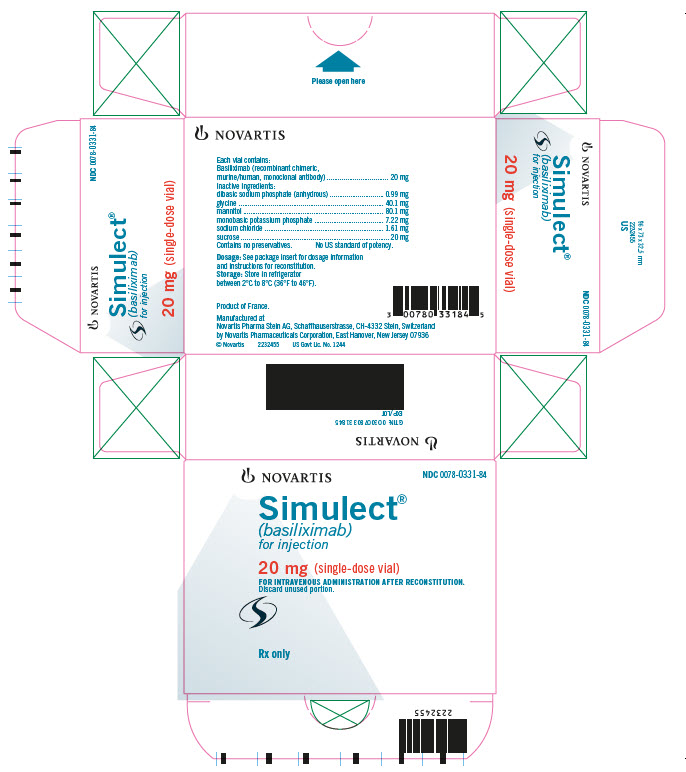
Simulect basiliximab 20 mg/5mL Injection, Powder, For Solution — NDC 0078-0331-84 (Billing 00078-0331-84)
This is a package of Simulect basiliximab 20 mg/5mL Injection, Powder, For Solution from Novartis Pharmaceuticals Corporation, marketed since May 1998 and currently FDA-listed. It is this product's only package size.
NDC database record
One package, one record: these facts belong to NDC 0078-0331-84 alone.
- Record
- FDA NDC Directory package listing · Human prescription drug
- Code segments
- 0078 labeler · 0331 product · 84 package
- Package marketed since
- May 12, 1998
- Sample package
- No — commercial package
- Listing certified through
- Dec 31, 2026
- Barcode (UPC-A, from the NDC)
- 3 0078033184 5
- FDA record last changed
- Jul 24, 2026
Identity & classification
Regulatory identifiers FDA, NLM and CMS codes for this package
Drug-database identifiers Medi-Span GPI and First Databank GCN / HICL / AHFS classification
- GSN (GCN sequence number): 039803
- GCN: 64731
- GPI-14 (Medi-Span): 99405015002120
- HICL (First Databank): 018390
- AHFS class code: 90:28.16.92
- RxCUI (RxNorm): 1656643
Where does this data come from?
- FDA openFDA NDC Directory · synced Oct 8, 2026
- FDA label on DailyMed · label index refreshed Oct 6, 2026
- RxNorm (NLM RxNav) · catalog refreshed Oct 1, 2026
- Medi-Span GPI (licensed)
- First Databank (licensed) · refreshed Oct 8, 2026
RxNorm drug class
This medicine belongs to the Interleukin-2 Receptor Blocking Antibody class.
Where does this data come from?
- RxClass (NLM) · catalog refreshed Oct 1, 2026
Clinical
- Your immune system is designed to attack anything it doesn't recognize — including a transplanted kidney. Simulect works by blocking a key signal on immune cells that would otherwi...
- What exactly does Simulect do, and why do I need it after my kidney transplant?
- No — Simulect is a very short course of just two intravenous doses. The first is given a couple of hours before your transplant surgery, and the second comes 4 days later. After th...
- Most people who get Simulect experience side effects similar to any transplant patient on immunosuppression — things like nausea, constipation, swelling, high blood pressure, or he...
Patient education
Supplement & herbal interactions
Some supplements/herbs that may interact with Basiliximab — tap one for details:
Where does this data come from?
- MedlinePlus (NLM) · refreshed Oct 1, 2026
- FDA label on DailyMed · label index refreshed Oct 6, 2026
Ask a licensed pharmacist directly — free, answered by our team.
Pricing
A drug doesn't have one price. Each row is a different public payment system, and none is what you'd pay at the counter — that depends on your insurance. The ⓘ on each row explains what it measures.
| Price system | Per mL | Per package |
|---|---|---|
| Retail pharmacies payNADAC · weekly | Not in the retail survey — common for institutional, discontinued, or low-volume packs. | |
| Medicaid paysCMS SDUD · 12 mo | No recent Medicaid claims on file for this NDC — rare and low-volume NDCs are suppressed in the public data. | |
| Medicare drug plans payPart D · quarterly | No Part D plan price is available for this NDC in our data. | |
| Medicare Part B allowsASP · J0480 | $4,905.049 / J0480 unit | — |
Where does this data come from?
- CMS NADAC weekly file
- CMS ASP pricing files · refreshed Sep 20, 2026
- CMS Medicaid State Drug Utilization Data · refreshed Oct 8, 2026
- CMS Part D plan pricing files · refreshed Sep 24, 2026
- VA National Acquisition Center price file
Billing & reimbursement
Where does this data come from?
- CMS ASP NDC-HCPCS crosswalk · refreshed Sep 22, 2026
- DMEPDAC NDC-HCPCS crosswalk
- openFDA NSDE billing units · refreshed Oct 7, 2026
Packaging — all sizes for this product
| Package NDC | Description | Marketing start | Marketing end | Status |
|---|---|---|---|---|
| 00078-0331-84 You're viewing this Main listing | 1 VIAL, SINGLE-USE in 1 CARTON / 5 mL in 1 VIAL, SINGLE-USE | 1998-05-12 | — | Active |
Therapeutic equivalents
| Product | Labeler | Pack | NADAC/unit | TE | Status | Price vs. this |
|---|---|---|---|---|---|---|
| Simulect 20 mg/5mLthis 00078-0331-84 | Novartis | 1 vial | — | — | FDA listed | — |
Where does this data come from?
- FDA openFDA NDC Directory · synced Oct 8, 2026
- FDA Purple Book · refreshed Oct 5, 2026
- CMS NADAC weekly file
Availability & biosimilar status
Biologics have no small-molecule generics; biosimilar competition is tracked in the FDA Purple Book.
Where does this data come from?
- FDA Purple Book · refreshed Oct 5, 2026
Inactive Ingredients / Excipients
Inactive ingredients, also called excipients, are components of the drug product other than the active ingredient. They may include fillers, dyes, coatings, preservatives, flavors, or other formulation ingredients.
🧪 Avoiding an ingredient? See Basiliximab Injection inactive ingredients by manufacturer: every current product's list side by side, so you can ask your pharmacy for the version that does not list it.
💡 Tap an ingredient (hover on desktop) to see what it is and why it’s used.
-
40 mg / 5 mL
UNII TE7660XO1C
Glycine is an amino acid used in medicines as a buffer to help stabilize pH and improve taste. It may also serve as a filler or binder to give the product proper form and consistency.
-
80 mg / 5 mL
UNII 3OWL53L36A
A natural sugar alcohol derived from seaweed or synthesized in the lab. It's used as a filler to add bulk, a sweetener in sugar-free formulas, and a disintegrant to help tablets break apart in the stomach.
-
7.22 mg / 5 mL
UNII 4J9FJ0HL51
Potassium phosphate, monobasic is a salt compound used in medicines as a pH buffer and electrolyte source. It helps stabilize the acidity level of liquid and powdered formulations.
-
1.61 mg / 5 mL
UNII 451W47IQ8X
Sodium chloride is common table salt. It's used in medicines as a buffer to maintain proper pH, as a filler to add bulk, or to adjust the osmotic balance in liquid formulations.
-
0.99 mg / 5 mL
UNII 22ADO53M6F
A mineral salt derived from phosphoric acid, used as a buffer to maintain the pH balance of the medication and help stabilize the active ingredients.
-
20 mg / 5 mL
UNII C151H8M554
A natural sugar derived from sugar cane or sugar beets. It's used as a sweetener, filler, and binder to improve taste, add bulk, and help hold tablet or capsule ingredients together.
6 inactive ingredients listed in the exact product block matched to this NDC.
Where does this data come from?
ingredient classCode="IACT" elements from the exact product block matched by this NDC. Label-section narrative from DailyMed / the openFDA label index is shown separately when available.- FDA label on DailyMed · label index refreshed Oct 6, 2026
- FDA openFDA NDC Directory · synced Oct 8, 2026
Inactive ingredient FAQ
Are inactive ingredients the same for every manufacturer?
Why might an inactive ingredient be missing?
Can inactive ingredients matter?
Manufacturer & labeler
More NDCs from Novartis Pharmaceuticals Corporation labeler code 00078
- Neoral cyclosporine 25 mg Capsule, Liquid Filled NDC 0078-0246-15
- Neoral cyclosporine 100 mg Capsule, Liquid Filled NDC 0078-0248-15
- Femara letrozole 2.5 mg Tablet, Film Coated NDC 0078-0249-15
- Neoral cyclosporine 100 mg/mL Solution NDC 0078-0274-22
- Diovan HCT valsartan and hydrochlorothiazide 80 mg; 12.5 mg Tablet, Film Coated NDC 0078-0314-34
- Diovan HCT valsartan and hydrochlorothiazide 160 mg; 12.5 mg Tablet, Film Coated NDC 0078-0315-34
- Trileptal oxcarbazepine 300 mg Tablet, Film Coated NDC 0078-0337-05
- Trileptal oxcarbazepine 60 mg/mL Suspension NDC 0078-0357-52
- Diovan valsartan 80 mg Tablet NDC 0078-0358-34
- Diovan valsartan 160 mg Tablet NDC 0078-0359-34
- Diovan valsartan 320 mg Tablet NDC 0078-0360-34
- Lotrel amlodipine besylate and benazepril hydrochloride 10 mg; 20 mg Capsule NDC 0078-0364-05
Where does this data come from?
- FDA openFDA NDC Directory · synced Oct 8, 2026
- Drugs@FDA
Full prescribing information FDA SPL
🚨 Boxed Warning ▾
WARNING Only physicians experienced in immunosuppression therapy and management of organ transplantation patients should prescribe Simulect ® (basiliximab). The physician responsible for Simulect administration should have complete information requisite for the follow-up of the patient. Patients receiving the drug should be managed in facilities equipped and staffed with adequate laboratory and supportive medical resources.
🎯 Indications and Usage ▾
INDICATIONS AND USAGE Simulect ® (basiliximab) is indicated for the prophylaxis of acute organ rejection in patients receiving renal transplantation when used as part of an immunosuppressive regimen that includes cyclosporine, USP (MODIFIED), and corticosteroids. The efficacy of Simulect for the prophylaxis of acute rejection in recipients of other solid organ allografts has not been demonstrated.
⏱️ Dosage and Administration ▾
DOSAGE AND ADMINISTRATION Simulect ® (basiliximab) is used as part of an immunosuppressive regimen that includes cyclosporine, USP (MODIFIED) and corticosteroids. Simulect is for central or peripheral intravenous administration only. Reconstituted Simulect should be given either as a bolus injection or diluted to a volume of 25 mL (10-mg vial) or 50 mL (20-mg vial) with 0.9% Sodium Chloride Injection, USP or 5% Dextrose Injection, USP and administered as an intravenous infusion over 20 to 30 minutes.
Bolus administration may be associated with nausea, vomiting and local reactions, including pain. Simulect should only be administered once it has been determined that the patient will receive the graft and concomitant immunosuppression. Patients previously administered Simulect should only be re-exposed to a subsequent course of therapy with extreme caution due to the potential risk of hypersensitivity (see WARNINGS).
Parenteral drug products should be inspected visually for particulate matter and discoloration before administration. After reconstitution, Simulect should be a clear-to-opalescent, colorless solution. If particulate matter is present or the solution is colored, do not use.
Care must be taken to assure sterility of the prepared solution because the drug product does not contain any antimicrobial preservatives or bacteriostatic agents. It is recommended that after reconstitution, the solution should be used immediately. If not used immediately, it can be stored at 2ºC to 8ºC (36ºF to 46ºF) for 24 hours or at room temperature for 4 hours.
Discard the reconstituted solution if not used within 24 hours. No incompatibility between Simulect and polyvinyl chloride bags or infusion sets has been observed. No data are available on the compatibility of Simulect with other intravenous substances.
Other drug substances should not be added or infused simultaneously through the same intravenous line. Adults In adult patients, the recommended regimen is two doses of 20 mg each. The first 20-mg dose should be given within 2 hours prior to transplantation surgery.
The recommended second 20-mg dose should be given 4 days after transplantation. The second dose should be withheld if complications, such as severe hypersensitivity reactions to Simulect or graft loss occur. Pediatric In pediatric patients weighing less than 35 kg, the recommended regimen is two doses of 10 mg each.
In pediatric patients weighing 35 kg or more, the recommended regimen is two doses of 20 mg each. The first dose should be given within 2 hours prior to transplantation surgery. The recommended second dose should be given 4 days after transplantation.
The second dose should be withheld if complications, such as severe hypersensitivity reactions to Simulect or graft loss occur. Reconstitution of 10 mg Simulect ® Vial To prepare the reconstituted solution, add 2.5 mL of Sterile Water for Injection, USP, using aseptic technique, to the vial containing the Simulect powder. Shake the vial gently to dissolve the powder.
The reconstituted solution is isotonic and may be given either as a bolus injection or diluted to a volume of 25 mL with 0.9% Sodium Chloride Injection, USP or 5% Dextrose Injection, USP for infusion. When mixing the solution, gently invert the bag in order to avoid foaming; DO NOT SHAKE . Reconstitution of 20 mg Simulect ® Vial To prepare the reconstituted solution, add 5 mL of Sterile Water for Injection, USP, using aseptic technique, to the vial containing the Simulect powder.
Shake the vial gently to dissolve the powder. The reconstituted solution is isotonic and may be given either as a bolus injection or diluted to a volume of 50 mL with 0.9% Sodium Chloride Injection, USP or 5% Dextrose Injection, USP for infusion. When mixing the solution, gently invert the bag in order to avoid foaming; DO NOT SHAKE .
⛔ Contraindications ▾
CONTRAINDICATIONS Simulect ® (basiliximab) is contraindicated in patients with known hypersensitivity to basiliximab or any other component of the formulation. See composition of Simulect under DESCRIPTION. WARNINGS.
See Boxed WARNING. General Simulect ® (basiliximab) should be administered under qualified medical supervision. Patients should be informed of the potential benefits of therapy and the risks associated with administration of immunosuppressive therapy.
While neither the incidence of lymphoproliferative disorders nor opportunistic infections was higher in Simulect-treated patients than in placebo-treated patients, patients on immunosuppressive therapy are at increased risk for developing these complications and should be monitored accordingly. Hypersensitivity Severe acute (onset within 24 hours) hypersensitivity reactions, including anaphylaxis have been observed both on initial exposure to Simulect and/or following re-exposure after several months. These reactions may include hypotension, tachycardia, cardiac failure, dyspnea, wheezing, bronchospasm, pulmonary edema, respiratory failure, urticaria, rash, pruritus, and/or sneezing.
Extreme caution should be exercised in all patients previously given Simulect when being administered a subsequent course of Simulect. A subgroup of patients may be particularly at risk of developing severe hypersensitivity reactions on re-administration. These are patients in whom concomitant immunosuppression was discontinued prematurely (e.g., due to abandoned transplantation or early loss of the graft) following the initial administration of Simulect.
If a severe hypersensitivity reaction occurs, therapy with Simulect should be permanently discontinued. Medications for the treatment of severe hypersensitivity reactions, including anaphylaxis should be available for immediate use.
⚠️ Warnings ▾
WARNINGS. See Boxed WARNING.
🤒 Adverse Reactions ▾
ADVERSE REACTIONS Because clinical trials are conducted under widely varying conditions, adverse reaction rates observed in the clinical trials of a drug cannot be directly compared to rates in the clinical trials of another drug and may not reflect the rates observed in practice. The adverse reaction information from clinical trials does, however, provide a basis for identifying the adverse events that appear to be related to drug use and for approximating rates. The incidence of adverse events for Simulect ® (basiliximab) was determined in four randomized, double-blind, placebo-controlled clinical trials for the prevention of renal allograft rejection.
Two of the studies (Study 1 and Study 2), used a dual maintenance immunosuppressive regimen comprised of cyclosporine, USP (MODIFIED) and corticosteroids, whereas the other two studies (Study 3 and Study 4) used a triple-immunosuppressive regimen comprised of cyclosporine, USP (MODIFIED), corticosteroids, and either azathioprine or mycophenolate mofetil. Simulect did not appear to add to the background of adverse events seen in organ transplantation patients as a consequence of their underlying disease and the concurrent administration of immunosuppressants and other medications.
Adverse events were reported by 96% of the patients in the placebo-treated group and 96% of the patients in the Simulect-treated group. In the four placebo-controlled studies, the pattern of adverse events in 590 patients treated with the recommended dose of Simulect was similar to that in 594 patients treated with placebo. Simulect did not increase the incidence of serious adverse events observed compared with placebo.
The most frequently reported adverse events were gastrointestinal disorders, reported in 69% of Simulect-treated patients and 67% of placebo-treated patients. The incidence and types of adverse events were similar in Simulect-treated and placebo-treated patients. The following adverse events occurred in ≥ 10% of Simulect-treated patients: Gastrointestinal System: constipation, nausea, abdominal pain, vomiting, diarrhea, dyspepsia; Body as a Whole-General: pain, peripheral edema, fever, viral infection; Metabolic and Nutritional: hyperkalemia, hypokalemia, hyperglycemia, hypercholesterolemia, hypophosphatemia, hyperuricemia; Urinary System: urinary tract infection; Respiratory System: dyspnea, upper respiratory tract infection; Skin and Appendages: surgical wound complications, acne; Cardiovascular Disorders-General: hypertension; Central and Peripheral Nervous System: headache, tremor; Psychiatric: insomnia; Red Blood Cell: anemia.
The following adverse events, not mentioned above, were reported with an incidence of ≥ 3% and < 10% in pooled analysis of patients treated with Simulect in the four controlled clinical trials, or in an analysis of the two dual-therapy trials: Body as a Whole-General: accidental trauma, asthenia, chest pain, increased drug level, infection, face edema, fatigue, dependent edema, generalized edema, leg edema, malaise, rigors, sepsis; Cardiovascular: abnormal heart sounds, aggravated hypertension, angina pectoris, cardiac failure, chest pain, hypotension; Endocrine: increased glucocorticoids; Gastrointestinal : enlarged abdomen, esophagitis, flatulence, gastrointestinal disorder, gastroenteritis, GI hemorrhage, gum hyperplasia, melena, moniliasis, ulcerative stomatitis; Heart Rate and Rhythm: arrhythmia, atrial fibrillation, tachycardia; Metabolic and Nutritional: acidosis, dehydration, diabetes mellitus, fluid overload, hypercalcemia, hyperlipemia, hypertriglyceridemia, hypocalcemia, hypoglycemia, hypomagnesemia, hypoproteinemia, weight increase; Musculoskeletal: arthralgia, arthropathy, back pain, bone fracture, cramps, hernia, myalgia, leg pain; Nervous System: dizziness, neuropathy, paraesthesia, hypoesthesia; Platelet and Bleeding: hematoma, hemorrhage, purpura, thrombocytopenia, thrombosis; Psychiatric: agitation, anxiety, depression; Red Blood Cell: poly… [Excerpted — this section continues on DailyMed.]
🔄 Drug Interactions ▾
Drug Interactions No dose adjustment is necessary when Simulect is added to triple-immunosuppression regimens, including cyclosporine, corticosteroids, and either azathioprine or mycophenolate mofetil. Three clinical trials have investigated Simulect use in combination with triple-therapy regimens. Pharmacokinetics were assessed in two of these trials.
Total body clearance of Simulect was reduced by an average 22% and 51% when azathioprine and mycophenolate mofetil, respectively, were added to a regimen consisting of cyclosporine, USP (MODIFIED) and corticosteroids. Nonetheless, the range of individual Simulect clearance values in the presence of azathioprine (12-57 mL/h) or mycophenolate mofetil (7-54 mL/h) did not extend outside the range observed with dual therapy (10-78 mL/h). The following medications have been administered in clinical trials with Simulect with no increase in adverse reactions: ATG/ALG, azathioprine, corticosteroids, cyclosporine, mycophenolate mofetil, and muromonab-CD3.
Carcinogenesis/Mutagenesis/Impairment of Fertility No mutagenic potential of Simulect was observed in the i n vitro assays with Salmonella (Ames) and V79 Chinese hamster cells. No long-term or fertility studies in laboratory animals have been performed to evaluate the potential of Simulect to produce carcinogenicity or fertility impairment, respectively. There are no adequate and well-controlled studies in pregnant women.
No maternal toxicity, embryotoxicity, or teratogenicity was observed in cynomolgus monkeys 100 days post coitum following dosing with basiliximab during the organogenesis period; blood levels in pregnant monkeys were 13-fold higher than those seen in human patients. Immunotoxicology studies have not been performed in the offspring. Because IgG molecules are known to cross the placental barrier, because the IL-2 receptor may play an important role in development of the immune system, and because animal reproduction studies are not always predictive of human response, Simulect should only be used in pregnant women when the potential benefit justifies the potential risk to the fetus.
Women of childbearing potential should use effective contraception before beginning Simulect therapy, during therapy, and for 4 months after completion of Simulect therapy. Nursing Mothers It is not known whether Simulect is excreted in human milk. Because many drugs, including human antibodies are excreted in human milk, and because of the potential for adverse reactions, a decision should be made to discontinue nursing or to discontinue the drug, taking into account the importance of the drug to the mother.
Pediatric Use No randomized, placebo-controlled studies have been completed in pediatric patients. In a safety and pharmacokinetic study, 41 pediatric patients (1-11 years of age [n = 27], 12-16 years of age [n = 14], median age 8.1 years) were treated with Simulect via intravenous bolus injection in addition to standard immunosuppressive agents, including cyclosporine, USP (MODIFIED), corticosteroids, azathioprine, and mycophenolate mofetil. The acute rejection rate at 6 months was comparable to that in adults in the triple-therapy trials.
The most frequently reported adverse events were hypertension, hypertrichosis, and rhinitis (49% each), urinary tract infections (46%), and fever (39%). Overall, the adverse event profile was consistent with general clinical experience in the pediatric renal transplantation population and with the profile in the controlled adult renal transplantation studies. The available pharmacokinetic data in children and adolescents are described in CLINICAL PHARMACOLOGY and DOSAGE AND ADMINISTRATION.
It is not known whether the immune response to vaccines, infection, and other antigenic stimuli administered or encountered during Simulect therapy is impaired or whether such response will remain impaired after Simulect therapy. Geriatric Use Controlled clinical studies of Simulect have included a small number of pa… [Excerpted — this section continues on DailyMed.]
🧒 Pediatric Use ▾
Pediatric Use No randomized, placebo-controlled studies have been completed in pediatric patients. In a safety and pharmacokinetic study, 41 pediatric patients (1-11 years of age [n = 27], 12-16 years of age [n = 14], median age 8.1 years) were treated with Simulect via intravenous bolus injection in addition to standard immunosuppressive agents, including cyclosporine, USP (MODIFIED), corticosteroids, azathioprine, and mycophenolate mofetil. The acute rejection rate at 6 months was comparable to that in adults in the triple-therapy trials.
The most frequently reported adverse events were hypertension, hypertrichosis, and rhinitis (49% each), urinary tract infections (46%), and fever (39%). Overall, the adverse event profile was consistent with general clinical experience in the pediatric renal transplantation population and with the profile in the controlled adult renal transplantation studies. The available pharmacokinetic data in children and adolescents are described in CLINICAL PHARMACOLOGY and DOSAGE AND ADMINISTRATION.
It is not known whether the immune response to vaccines, infection, and other antigenic stimuli administered or encountered during Simulect therapy is impaired or whether such response will remain impaired after Simulect therapy.
🧓 Geriatric Use ▾
Geriatric Use Controlled clinical studies of Simulect have included a small number of patients 65 years and older (Simulect 28; placebo 32). From the available data comparing Simulect and placebo-treated patients, the adverse event profile in patients ≥ 65 years of age is not different from patients < 65 years of age and no age-related dosing adjustment is required. Caution must be used in giving immunosuppressive drugs to elderly patients.
🆘 Overdosage ▾
OVERDOSAGE A maximum tolerated dose of Simulect ® (basiliximab) has not been determined in patients. During the course of clinical studies, Simulect has been administered to adult renal transplantation patients in single doses of up to 60 mg, or in divided doses over 3-5 days of up to 120 mg, without any associated serious adverse events. There has been one spontaneous report of a pediatric renal transplantation patient who received a single 20-mg dose (2.3 mg/kg) without adverse events.
🧬 Clinical Pharmacology ▾
CLINICAL PHARMACOLOGY General Mechanism of Action: Basiliximab functions as an IL-2 receptor antagonist by binding with high affinity (K a = 1 x 10 10 M -1 ) to the alpha chain of the high affinity IL-2 receptor complex and inhibiting IL-2 binding. Basiliximab is specifically targeted against IL-2Rα, which is selectively expressed on the surface of activated T-lymphocytes. This specific high affinity binding of Simulect ® (basiliximab) to IL-2Rα competitively inhibits IL-2-mediated activation of lymphocytes, a critical pathway in the cellular immune response involved in allograft rejection.
While in the circulation, Simulect impairs the response of the immune system to antigenic challenges. Whether the ability to respond to repeated or ongoing challenges with those antigens returns to normal after Simulect is cleared is unknown (see PRECAUTIONS). Pharmacokinetics Adults : Single-dose and multiple-dose pharmacokinetic studies have been conducted in patients undergoing first kidney transplantation.
Cumulative doses ranged from 15 mg up to 150 mg. Peak mean ± SD serum concentration following intravenous infusion of 20 mg over 30 minutes is 7.1 ± 5.1 mg/L. There is a dose-proportional increase in C max and area under the curve (AUC) up to the highest tested single dose of 60 mg.
The volume of distribution at steady state is 8.6 ±
4.1L. The extent and degree of distribution to various body compartments have not been fully studied. The terminal half-life is 7.2 ± 3.2 days.
Total body clearance is 41 ± 19 mL/h. No clinically relevant influence of body weight or gender on distribution volume or clearance has been observed in adult patients. Elimination half-life was not influenced by age (20-69 years), gender or race (see DOSAGE AND ADMINISTRATION).
Pediatric : The pharmacokinetics of Simulect have been assessed in 39 pediatric patients undergoing renal transplantation. In infants and children (1-11 years of age, n = 25), the distribution volume and clearance were reduced by about 50% compared to adult renal transplantation patients. The volume of distribution at steady state was 4.8 ±
2.1L, half-life was 9.5 ± 4.5 days and clearance was 17 ± 6 mL/h. Disposition parameters were not influenced to a clinically relevant extent by age (1-11 years of age), body weight (9-37 kg) or body surface area (0.44-1.20 m 2 ) in this age group. In adolescents (12-16 years of age, n = 14), disposition was similar to that in adult renal transplantation patients. The volume of distribution at steady state was 7.8 ±
5.1L, half-life was 9.1 ± 3.9 days and clearance was 31 ± 19 mL/h (see DOSAGE AND ADMINISTRATION). Pharmacodynamics Complete and consistent binding to IL-2Rα in adults is maintained as long as serum Simulect levels exceed 0.2 mcg/mL. As concentrations fall below this threshold, the IL-2Rα sites are no longer fully bound and the number of T-cells expressing unbound IL-2Rα returns to pretherapy values within 1-2 weeks.
The relationship between serum concentration and receptor saturation was assessed in 13 pediatric patients and was similar to that characterized in adult renal transplantation patients. In vitro studies using human tissues indicate that Simulect binds only to lymphocytes. The duration of clinically relevant IL-2 receptor blockade after the recommended course of Simulect is not known.
When basiliximab was added to a regimen of cyclosporine, USP (MODIFIED) and corticosteroids in adult patients, the duration of IL-2Rα saturation was 36 ± 14 days (mean ± SD), similar to that observed in pediatric patients (36 ± 14 days) (see DOSAGE AND ADMINISTRATION). When basiliximab was added to a triple therapy regimen consisting of cyclosporine, USP (MODIFIED), corticosteroids, and azathioprine in adults, the duration was 50 ± 20 days and when added to cyclosporine, USP (MODIFIED), corticosteroids, and mycophenolate mofetil in adults, the duration was 59 ± 17 days (see PRECAUTIONS, Drug Interactions).
No significant changes to circulating lym… [Excerpted — this section continues on DailyMed.]
📦 How Supplied / Storage and Handling ▾
HOW SUPPLIED Simulect ® (basiliximab) is supplied in a single-dose glass vial. Each carton contains one of the following 1 Simulect 10 mg vial…………………………………………………….NDC 0078-0393-61 1 Simulect 20 mg vial…………………………………………………….NDC 0078-0331-84 Store lyophilized Simulect under refrigerated conditions at 2ºC to 8ºC (36ºF to 46ºF). Do not use beyond the expiration date stamped on the vial.
📋 Description ▾
DESCRIPTION Basiliximab is a chimeric (murine/human) monoclonal antibody (IgG 1 к ), produced by recombinant DNA technology, that functions as an immunosuppressive agent, specifically binding to and blocking the interleukin-2 receptor α-chain (IL-2Rα, also known as CD25 antigen) on the surface of activated T-lymphocytes. Based on the amino acid sequence, the calculated molecular weight of the protein is 144 kilodaltons. It is a glycoprotein obtained from fermentation of an established mouse myeloma cell line genetically engineered to express plasmids containing the human heavy and light chain constant region genes and mouse heavy and light chain variable region genes encoding the RFT5 antibody that binds selectively to the IL-2Rα.
Simulect ® (basiliximab) for injection is a sterile, preservative-free lyophilisate, which is available in single-dose vials and is available in 10 mg and 20 mg strengths for intravenous administration after reconstitution. Each 10-mg vial contains 10 mg of basiliximab, and dibasic sodium phosphate (anhydrous) (0.50 mg), glycine (20.3 mg), mannitol (40.6 mg), monobasic potassium phosphate (3.66 mg), sodium chloride (0.82 mg), and sucrose (10.1 mg) to be reconstituted in 2.5 mL of Sterile Water for Injection, USP. Each 20-mg vial contains 20 mg of basiliximab, and dibasic sodium phosphate (anhydrous) (0.99 mg), glycine (40.1 mg), mannitol (80.1 mg), monobasic potassium phosphate (7.22 mg), sodium chloride (1.61 mg), and sucrose (20 mg) to be reconstituted in 5 mL of Sterile Water for Injection, USP.
⚠️ Precautions ▾
PRECAUTIONS General It is not known whether Simulect ® (basiliximab) use will have a long-term effect on the ability of the immune system to respond to antigens first encountered during Simulect-induced immunosuppression. Immunogenicity Of renal transplantation patients treated with Simulect and tested for anti-idiotype antibodies, 4/339 developed an anti-idiotype antibody response, with no deleterious clinical effect upon the patient. In none of these cases was there evidence that the presence of anti-idiotype antibody accelerated Simulect clearance or decreased the period of receptor saturation.
In Study 2, the incidence of human anti-murine antibody (HAMA) in renal transplantation patients treated with Simulect was 2/138 in patients not exposed to muromonab-CD3 and 4/34 in patients who subsequently received muromonab-CD3. The available clinical data on the use of muromonab-CD3 in patients previously treated with Simulect suggest that subsequent use of muromonab-CD3 or other murine anti-lymphocytic antibody preparations is not precluded. These data reflect the percentage of patients whose test results were considered positive for antibodies to Simulect in an ELISA assay, and are highly dependent on the sensitivity and specificity of the assay.
Additionally the observed incidence of antibody positivity in an assay may be influenced by several factors, including sample handling, concomitant medications, and underlying disease. For these reasons, comparison of the incidence of antibodies to Simulect with the incidence of antibodies to other products may be misleading. Drug Interactions No dose adjustment is necessary when Simulect is added to triple-immunosuppression regimens, including cyclosporine, corticosteroids, and either azathioprine or mycophenolate mofetil.
Three clinical trials have investigated Simulect use in combination with triple-therapy regimens. Pharmacokinetics were assessed in two of these trials. Total body clearance of Simulect was reduced by an average 22% and 51% when azathioprine and mycophenolate mofetil, respectively, were added to a regimen consisting of cyclosporine, USP (MODIFIED) and corticosteroids.
Nonetheless, the range of individual Simulect clearance values in the presence of azathioprine (12-57 mL/h) or mycophenolate mofetil (7-54 mL/h) did not extend outside the range observed with dual therapy (10-78 mL/h). The following medications have been administered in clinical trials with Simulect with no increase in adverse reactions: ATG/ALG, azathioprine, corticosteroids, cyclosporine, mycophenolate mofetil, and muromonab-CD3. Carcinogenesis/Mutagenesis/Impairment of Fertility No mutagenic potential of Simulect was observed in the i n vitro assays with Salmonella (Ames) and V79 Chinese hamster cells.
No long-term or fertility studies in laboratory animals have been performed to evaluate the potential of Simulect to produce carcinogenicity or fertility impairment, respectively. There are no adequate and well-controlled studies in pregnant women. No maternal toxicity, embryotoxicity, or teratogenicity was observed in cynomolgus monkeys 100 days post coitum following dosing with basiliximab during the organogenesis period; blood levels in pregnant monkeys were 13-fold higher than those seen in human patients.
Immunotoxicology studies have not been performed in the offspring. Because IgG molecules are known to cross the placental barrier, because the IL-2 receptor may play an important role in development of the immune system, and because animal reproduction studies are not always predictive of human response, Simulect should only be used in pregnant women when the potential benefit justifies the potential risk to the fetus. Women of childbearing potential should use effective contraception before beginning Simulect therapy, during therapy, and for 4 months after completion of Simulect therapy.
Nursing Mothers It is not known whether Simulect is excreted in human milk. Because many drugs, including hu… [Excerpted — this section continues on DailyMed.]
🍼 Nursing Mothers ▾
Nursing Mothers It is not known whether Simulect is excreted in human milk. Because many drugs, including human antibodies are excreted in human milk, and because of the potential for adverse reactions, a decision should be made to discontinue nursing or to discontinue the drug, taking into account the importance of the drug to the mother.
🧬 Pharmacokinetics ▾
Pharmacokinetics Adults : Single-dose and multiple-dose pharmacokinetic studies have been conducted in patients undergoing first kidney transplantation. Cumulative doses ranged from 15 mg up to 150 mg. Peak mean ± SD serum concentration following intravenous infusion of 20 mg over 30 minutes is 7.1 ± 5.1 mg/L.
There is a dose-proportional increase in C max and area under the curve (AUC) up to the highest tested single dose of 60 mg. The volume of distribution at steady state is 8.6 ±
4.1L. The extent and degree of distribution to various body compartments have not been fully studied. The terminal half-life is 7.2 ± 3.2 days.
Total body clearance is 41 ± 19 mL/h. No clinically relevant influence of body weight or gender on distribution volume or clearance has been observed in adult patients. Elimination half-life was not influenced by age (20-69 years), gender or race (see DOSAGE AND ADMINISTRATION).
Pediatric : The pharmacokinetics of Simulect have been assessed in 39 pediatric patients undergoing renal transplantation. In infants and children (1-11 years of age, n = 25), the distribution volume and clearance were reduced by about 50% compared to adult renal transplantation patients. The volume of distribution at steady state was 4.8 ±
2.1L, half-life was 9.5 ± 4.5 days and clearance was 17 ± 6 mL/h. Disposition parameters were not influenced to a clinically relevant extent by age (1-11 years of age), body weight (9-37 kg) or body surface area (0.44-1.20 m 2 ) in this age group. In adolescents (12-16 years of age, n = 14), disposition was similar to that in adult renal transplantation patients. The volume of distribution at steady state was 7.8 ±
5.1L, half-life was 9.1 ± 3.9 days and clearance was 31 ± 19 mL/h (see DOSAGE AND ADMINISTRATION).
🧬 Pharmacodynamics ▾
Pharmacodynamics Complete and consistent binding to IL-2Rα in adults is maintained as long as serum Simulect levels exceed 0.2 mcg/mL. As concentrations fall below this threshold, the IL-2Rα sites are no longer fully bound and the number of T-cells expressing unbound IL-2Rα returns to pretherapy values within 1-2 weeks. The relationship between serum concentration and receptor saturation was assessed in 13 pediatric patients and was similar to that characterized in adult renal transplantation patients.
In vitro studies using human tissues indicate that Simulect binds only to lymphocytes. The duration of clinically relevant IL-2 receptor blockade after the recommended course of Simulect is not known. When basiliximab was added to a regimen of cyclosporine, USP (MODIFIED) and corticosteroids in adult patients, the duration of IL-2Rα saturation was 36 ± 14 days (mean ± SD), similar to that observed in pediatric patients (36 ± 14 days) (see DOSAGE AND ADMINISTRATION).
When basiliximab was added to a triple therapy regimen consisting of cyclosporine, USP (MODIFIED), corticosteroids, and azathioprine in adults, the duration was 50 ± 20 days and when added to cyclosporine, USP (MODIFIED), corticosteroids, and mycophenolate mofetil in adults, the duration was 59 ± 17 days (see PRECAUTIONS, Drug Interactions). No significant changes to circulating lymphocyte numbers or cell phenotypes were observed by flow cytometry.
🔬 Clinical Studies ▾
CLINICAL STUDIES The safety and efficacy of Simulect ® (basiliximab) for the prophylaxis of acute organ rejection in adults following cadaveric- or living-donor renal transplantation were assessed in four randomized, double-blind, placebo-controlled clinical studies (1,184 patients). Of these four, two studies (Study 1 [EU/CAN] and Study 2 [US Study]) compared two 20-mg doses of Simulect with placebo, each administered intravenously as an infusion, as part of a standard immunosuppressive regimen comprised of cyclosporine, USP (MODIFIED) and corticosteroids.
The other two controlled studies compared two 20-mg doses of Simulect with placebo, each administered intravenously as a bolus injection, as part of a standard triple-immunosuppressive regimen comprised of cyclosporine, USP (MODIFIED), corticosteroids and either azathioprine or mycophenolate mofetil (Study 3 and Study 4, respectively). The first dose of Simulect or placebo was administered within 2 hours prior to transplantation surgery (Day 0) and the second dose administered on Day 4 post-transplantation. The regimen of Simulect was chosen to provide 30-45 days of IL-2Rα saturation.
Seven hundred twenty-nine patients were enrolled in the two studies using a dual maintenance immunosuppressive regimen comprised of cyclosporine, USP (MODIFIED) and corticosteroids, of which 363 patients were treated with Simulect and 358 patients were placebo-treated. Study 1 was conducted at 21 sites in Europe and Canada (EU/CAN Study); Study 2 was conducted at 21 sites in the USA (US Study). Patients 18-75 years of age undergoing first cadaveric- (Study 1 and Study 2) or living-donor (Study 2 only) renal transplantation, with ≥ 1 HLA mismatch, were enrolled.
1,2 The primary efficacy endpoint in both studies was the incidence of death, graft loss or an episode of acute rejection during the first 6 months post-transplantation. Secondary efficacy endpoints included the primary efficacy variable measured during the first 12 months post-transplantation, the incidence of biopsy-confirmed acute rejection during the first 6 and 12 months post-transplantation and patient survival and graft survival, each measured at 12 months post-transplantation. Table 1 summarizes the results of these studies.
Figure 1 displays the Kaplan-Meier estimates of the percentage of patients by treatment group experiencing the primary efficacy endpoint during the first 12 months post-transplantation for Study 2. Patients in both studies receiving Simulect experienced a significantly lower incidence of biopsy-confirmed rejection episodes at both 6 and 12 months post-transplantation. There was no difference in the rate of delayed graft function, patient survival, or graft survival between Simulect-treated patients and placebo-treated patients in either study.
There was no evidence that the clinical benefit of Simulect was limited to specific subpopulations based on age, gender, race, donor type (cadaveric or living donor allograft), or history of diabetes mellitus. Table 1. Efficacy Parameters (Percentage of Patients) *USP (MODIFIED).
Dual-therapy Regimen (cyclosporine* and corticosteroids) Study 1 Study 2 Placebo (N = 185) Simulect ® (N = 190) p-value Placebo (N = 173) Simulect ® (N = 173) p-value Primary endpoint Death, graft loss or acute rejection episode (0-6 months) 57% 42% 0.003 55% 38% 0.002 Secondary endpoints Death, graft loss or acute rejection episode (0-12 months) 60% 46% 0.007 58% 41% 0.001 Biopsy-confirmed rejection episode (0-6 months) 44% 30% 0.007 46% 33% 0.015 Biopsy-confirmed rejection episode (0-12 months) 46% 32% 0.005 49% 35% 0.009 Patient survival (12 months) 97% 95% 0.29 96% 97%
0.56Patients with functioning graft (12 months) 87% 88% 0.70 93% 95%
0.50Two double-blind, randomized, placebo-controlled studies (Study 3 and Study 4) assessed the safety and efficacy of Simulect for the prophylaxis of acute renal transplant rejection in adults when used in combination with a triple immunosuppressive regi… [Excerpted — this section continues on DailyMed.]
📄 Carcinogenesis, Mutagenesis, Impairment of Fertility ▾
Carcinogenesis/Mutagenesis/Impairment of Fertility No mutagenic potential of Simulect was observed in the i n vitro assays with Salmonella (Ames) and V79 Chinese hamster cells. No long-term or fertility studies in laboratory animals have been performed to evaluate the potential of Simulect to produce carcinogenicity or fertility impairment, respectively. There are no adequate and well-controlled studies in pregnant women.
No maternal toxicity, embryotoxicity, or teratogenicity was observed in cynomolgus monkeys 100 days post coitum following dosing with basiliximab during the organogenesis period; blood levels in pregnant monkeys were 13-fold higher than those seen in human patients. Immunotoxicology studies have not been performed in the offspring. Because IgG molecules are known to cross the placental barrier, because the IL-2 receptor may play an important role in development of the immune system, and because animal reproduction studies are not always predictive of human response, Simulect should only be used in pregnant women when the potential benefit justifies the potential risk to the fetus.
Women of childbearing potential should use effective contraception before beginning Simulect therapy, during therapy, and for 4 months after completion of Simulect therapy.
📚 References ▾
REFERENCES Kahan, B.D., Rajagopalan P.R. and Hall M., Transplantation, 67, 276-284 (1999). Nashan, B., Moore R., Amlot P., Schmidt A.-G., Abeywickrama K. and Soulillou J.-P., Lancet 350, 1193-1198 (1997). Manufactured by: Novartis Pharmaceuticals Corporation East Hanover, New Jersey 07936 US License No. 1244 © Novartis T2020-125 Revised: August 2020
📄 Package Label / Principal Display Panel ▾
PRINCIPAL DISPLAY PANEL NOVARTIS NDC 0078-0393-61 Simulect ® (basiliximab) for injection 10 mg (single-dose vial) FOR INTRAVENOUS ADMINISTRATION AFTER RECONSTITUTION. Discard unused portion. Rx only NOVARTIS NDC 0078-0393-61 Simulect® (basiliximab) for injection 10 mg (single-dose vial) FOR INTRAVENOUS ADMINISTRATION AFTER RECONSTITUTION. Discard unused portion. Rx only
PRINCIPAL DISPLAY PANEL NOVARTIS NDC 0078-0331-84 Simulect ® (basiliximab) for injection 20 mg (single-dose vial) FOR INTRAVENOUS ADMINISTRATION AFTER RECONSTITUTION. Discard unused portion. Rx only NOVARTIS NDC 0078-0331-84 Simulect® (basiliximab) for injection 20 mg (single-dose vial) FOR INTRAVENOUS ADMINISTRATION AFTER RECONSTITUTION. Rx only
Reported adverse events (FAERS)
Top reported reactions
Age at onset
Reporter sex
Serious outcomes
Where does this data come from?
About this NDC listing & data coverage
What data is (and isn’t) available for this NDC — tap to expand
| NDC identity (package / product / labeler codes) | ✓ Available |
| Labeler | ✓ Available |
| Product & package description | ✓ Available |
| Marketing category & status | ✓ Available |
| Active ingredient / dosage form / route | ✓ Available |
| FDA label (SPL via DailyMed) | ✓ Available |
| Package photos | ✓ Available |
| Inactive ingredients (structured) | ✓ Available |
| NADAC pharmacy acquisition price (CMS) | — Not published for this NDC CMS publishes NADAC only for NDCs reported in its retail-pharmacy survey. |
| Orange Book / therapeutic-equivalence data | — Not published for this NDC Applies only to products approved under an NDA/ANDA; many listings are out of scope. |
| HCPCS J-code billing crosswalk | ✓ Available |
| Medicaid utilization (CMS SDUD) | — Not published for this NDC CMS reports utilization only for NDCs with Medicaid claims above its privacy threshold. |