
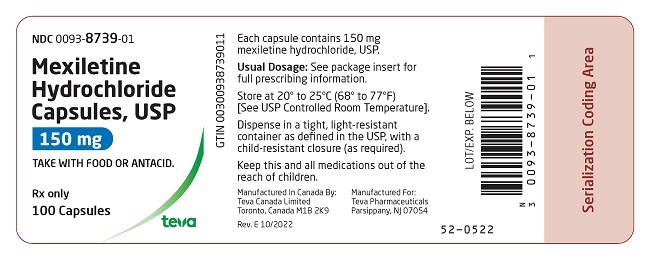
Mexiletine Hydrochloride 150 mg Capsule, 100-count — NDC 0093-8739-01 (Billing 00093-8739-01)
This is a package of 100 capsules of Mexiletine Hydrochloride 150 mg Capsule from Teva Pharmaceuticals USA, Inc., marketed since Mar 2023 and currently FDA-listed; retail pharmacies pay about $0.2225 per capsule (NADAC). It is the main listing for this product, which comes in 2 package sizes.
NDC database record
One package, one record: these facts belong to NDC 0093-8739-01 alone.
- Record
- FDA NDC Directory package listing · Drug for further processing
- Code segments
- 0093 labeler · 8739 product · 01 package
- Listing certified through
- Dec 31, 2026
- Billing quantity
- 100 EA per package
- Barcode (UPC-A, from the NDC)
- 3 0093873901 1
- Medicaid fills, this package
- 1,593 prescriptions in the last four reported quarters
- FDA record last changed
- Oct 8, 2026
Identity & classification
Regulatory identifiers FDA, NLM and CMS codes for this package
Drug-database identifiers Medi-Span GPI and First Databank GCN / HICL / AHFS classification
- GSN (GCN sequence number): 000267
- GCN: 12210
- GPI-14 (Medi-Span): 35200025100105
- HICL (First Databank): 000084
- AHFS class code: 24:04.04.08
Where does this data come from?
- FDA openFDA NDC Directory · synced Oct 1, 2026
- FDA label on DailyMed · label index refreshed Oct 6, 2026
- RxNorm (NLM RxNav) · catalog refreshed Oct 1, 2026
- Medi-Span GPI (licensed)
- First Databank (licensed) · refreshed Oct 1, 2026
Clinical
- It treats dangerous ventricular arrhythmias, which are abnormal fast rhythms from the lower heart chambers, like sustained ventricular tachycardia. It is not meant for milder rhyth...
- Take it by mouth, usually about every 8 hours, with food or an antacid. That helps with stomach upset. Follow your prescriber's schedule and don't change it on your own.
- Many people get stomach upset, dizziness, shakiness, coordination trouble or nervousness. These often ease with food or a dose change, so tell your doctor if they bother you. Don't...
- Call if you faint, have a very slow or irregular heartbeat, or get a rash with fever or swollen glands. Also call for seizures, confusion, black stools, unusual bruising or infecti...
Patient education
Supplement & herbal interactions
Where does this data come from?
- MedlinePlus (NLM) · refreshed Oct 1, 2026
- FDA label on DailyMed · label index refreshed Oct 6, 2026
Ask a licensed pharmacist directly — free, answered by our team.
Pricing
A drug doesn't have one price. Each row is a different public payment system, and none is what you'd pay at the counter — that depends on your insurance. The ⓘ on each row explains what it measures.
| Price system | Per ea | Per package |
|---|---|---|
| Retail pharmacies payNADAC · weekly | $0.223 | $22.25 / 100 capsules |
| Medicaid paysCMS SDUD · 12 mo | $0.4652 | $46.52 / 100 capsules |
| Medicare drug plans payPart D · Q2 2026 | $0.6000 | $60.00 / 100 capsules |
Where does this data come from?
- CMS NADAC weekly file · file of Sep 30, 2026
- CMS ASP pricing files · refreshed Sep 20, 2026
- CMS Medicaid State Drug Utilization Data · through Q4 2025
- CMS Part D plan pricing files · refreshed Sep 24, 2026
- VA National Acquisition Center price file
Packaging — all sizes for this product
| Package NDC | Description | Per unit | Per pack | Marketing start | Marketing end | Status |
|---|---|---|---|---|---|---|
| 00093-8739-01 You're viewing this Main listing | 100 CAPSULE in 1 BOTTLE | $0.2225 / ea | $22.25 | 1995-06-05 | — | Active |
| 00093-8739-99 0093-8739-99 | 62500 CAPSULE in 1 PAIL | — | — | — | — | Active |
You're viewing the smallest of 2 pack sizes for this product.
In Medicaid, this is the most-dispensed pack of this product — about 100% of fills over the last four reported quarters. See all packs ↓
Pack size FAQ
What quantity is in this package?
How does this package differ from NDC 00093-8739-99?
What NDC number is used to bill for this package of Mexiletine Hydrochloride 150 mg Capsule?
Prices are the latest CMS NADAC pharmacy acquisition cost per NDC; per-pack figures are per-unit × pack quantity, shown only when the pack is denominated in the same measure NADAC prices.
Therapeutic equivalents
| Product | Labeler | Pack | NADAC/unit | TE | Status | Price vs. this |
|---|---|---|---|---|---|---|
| Mexiletine Hydrochloride 150 mgthis 00093-8739-01 | Teva | 100 capsules | $0.222 | — | Availability likely | — |
| Mexiletine Hydrochloride 150 mg 00527-4107-37 | Lannett | 100 capsules | $0.222 | AB | Discontinued | — |
| Mexiletine hydrochloride 150 mg 31722-0036-01 | Camber | 100 capsules | $0.222 | AB | Availability likely | — |
| Mexiletine Hydrochloride 150 mg 50742-0239-01 | Ingenus | 100 capsules | $0.222 | AB | Availability likely | — |
| Mexiletine hydrochloride 150 mg 60687-0778-21 | American | 30 capsules | $0.222 | AB | Availability likely | — |
| Mexiletine Hydrochloride 150 mg 62559-0820-01 | ANI | 100 capsules | $0.222 | AB | Availability likely | — |
| Mexiletine Hydrochloride 150 mg 62756-0955-01 | Sun | 100 capsules | $0.222 | AB | Availability likely | — |
| Mexiletine Hydrochloride 150 mg 64980-0666-01 | Rising | 100 capsules | $0.222 | AB | Availability likely | — |
| Mexiletine Hydrochloride 150 mg 33342-0555-11 | Macleods | 100 capsules | — | AB | FDA listed | — |
| Mexiletine Hydrochloride 150 mg 42291-0624-01 | AvKARE | 100 capsules | — | AB | FDA listed | — |
| Mexiletine Hydrochloride 150 mg 51407-0379-01 | Golden | 100 capsules | — | AB | FDA listed | — |
| Mexiletine Hydrochloride 150 mg 63629-2145-01 | Bryant | 100 capsules | — | AB | FDA listed | — |
| Mexiletine Hydrochloride 150 mg 63629-9179-01 | Bryant | 100 capsules | — | AB | FDA listed | — |
| Mexiletine Hydrochloride 150 mg 71335-2922-01 | Bryant | 100 capsules | — | AB | FDA listed | — |
| Mexiletine Hydrochloride 150 mg 72162-1772-01 | Bryant | 100 capsules | — | AB | FDA listed | — |
| Mexiletine Hydrochloride 150 mg 72162-1782-01 | Bryant | 100 capsules | — | AB | FDA listed | — |
| Mexiletine Hydrochloride 150 mg 82012-0027-04 | Senores | 100 capsules | — | — | FDA listed | — |
| Mexiletine Hydrochloride 150 mg 71335-3171-01 | Bryant | 90 capsules | — | AB | FDA listed | — |
| Mexiletine Hydrochloride 150 mg 87564-0052-10 | Amerisyn | 100 capsules | — | AB | FDA listed | — |
Where does this data come from?
- FDA openFDA NDC Directory · synced Oct 1, 2026
- FDA Orange Book · refreshed Oct 3, 2026
- CMS NADAC weekly file · file of Sep 30, 2026
Availability & generic status
FDA-approved generic versions are listed, and recent pricing/market data suggests they may be available — see Therapeutic equivalents.
Where does this data come from?
- FDA Orange Book · refreshed Oct 3, 2026
What it looks like
Where does this data come from?
- FDA label on DailyMed · label index refreshed Oct 6, 2026
Inactive Ingredients / Excipients
Inactive ingredients, also called excipients, are components of the drug product other than the active ingredient. They may include fillers, dyes, coatings, preservatives, flavors, or other formulation ingredients.
🧪 Avoiding an ingredient? See Mexiletine inactive ingredients by manufacturer: every current product's list side by side, so you can ask your pharmacy for the version that does not list it.
💡 Tap an ingredient (hover on desktop) to see what it is and why it’s used.
-
UNII 3K9958V90M
A liquid solvent derived from fermentation or chemical synthesis. In medicines, alcohol dissolves active ingredients, helps preserve the product, and improves how the body absorbs certain drugs.
-
UNII 5138Q19F1X
Ammonia is a colorless gas made from nitrogen and hydrogen. It's used in medicines as a pH buffer to maintain the correct acidity level and help keep the product stable.
-
UNII 8PJ61P6TS3
Butyl alcohol is a clear liquid organic solvent derived from petroleum or natural sources. In medicines, it helps dissolve active ingredients and serves as a solvent in liquid formulations and some topical products.
-
UNII 767IP0Y5NH
A synthetic red colorant used to give medicines their color. It helps patients identify their medication and makes the product visually appealing.
-
UNII 35SW5USQ3G
A synthetic yellow dye used to color medicines. It helps make tablets, capsules, and liquids visually distinct so patients can easily identify their medication.
-
UNII H3R47K3TBD
FD&C Blue No. 1 is a synthetic blue dye approved for use in foods and medicines. It serves as a colorant to give the medication its distinctive appearance and help with product identification.
-
UNII L06K8R7DQK
A synthetic blue dye approved by the FDA for use in medications and foods. It serves as a colorant to make pills and liquids visually distinct and easier to identify.
-
UNII WZB9127XOA
A synthetic red dye used to color medications and make them easier to identify. It serves as a colorant in tablets, capsules, and liquid formulations.
-
UNII H77VEI93A8
A synthetic yellow dye used to color medications. It helps identify the drug and make it visually distinctive, with no effect on how the medicine works.
-
UNII XM0M87F357
A dark iron oxide compound that gives medicines their black or dark color. It's used as a colorant in tablets and capsules to help identify the product and make it visually distinctive.
-
UNII 2G86QN327L
Gelatin is a protein derived from animal collagen, commonly used in medicines as a gelling agent and capsule material. It helps create soft or hard capsule shells that hold and release medication, and can also thicken liquid formulations.
-
UNII ND2M416302
Isopropyl alcohol is a clear liquid solvent derived from petroleum. In medicines, it dissolves active ingredients and other components, helps the product flow smoothly, and aids in sterilization during manufacturing.
-
UNII 70097M6I30
Magnesium stearate is a salt made from magnesium and stearic acid, a fatty substance. It's used in tablets and capsules as a lubricant and glidant to help ingredients flow smoothly during manufacturing and prevent sticking.
-
UNII 6DC9Q167V3
Propylene glycol is a clear liquid derived from petroleum or vegetable sources. It acts as a solvent, humectant, and preservative in medicines, helping dissolve active ingredients and maintain product stability.
-
UNII 46N107B71O
Shellac is a natural resin secreted by the lac beetle. It's used as a coating on tablets and capsules to control how quickly the medicine dissolves and to improve appearance and stability.
-
UNII ETJ7Z6XBU4
Silicon dioxide is a naturally occurring mineral used as a glidant and anti-caking agent. It helps powder ingredients flow smoothly and prevents clumping during manufacturing and storage.
-
UNII O8232NY3SJ
A plant-based carbohydrate derived from corn kernels. It acts as a filler to add bulk, a binder to hold ingredients together, and a disintegrant to help the tablet break apart in your stomach for absorption.
-
UNII 15FIX9V2JP
Titanium dioxide is a bright white mineral powder commonly used as a colorant and opacifying agent. It makes pills and tablets white or lighter in color and helps make coatings non-transparent.
18 inactive ingredients listed in the exact product block matched to this NDC.
Where does this data come from?
ingredient classCode="IACT" elements from the exact product block matched by this NDC. Label-section narrative from DailyMed / the openFDA label index is shown separately when available.- FDA label on DailyMed · label index refreshed Oct 6, 2026
- FDA openFDA NDC Directory · synced Oct 1, 2026
Inactive ingredient FAQ
Are inactive ingredients the same for every manufacturer?
Why might an inactive ingredient be missing?
Can inactive ingredients matter?
Manufacturer & labeler
More NDCs from Teva Pharmaceuticals USA, Inc. labeler code 00093
- Eletriptan Hydrobromide 20 mg Tablet, Film Coated NDC 0093-8310-18
- Eletriptan Hydrobromide 40 mg Tablet, Film Coated NDC 0093-8311-18
- Glyburide 1.25 mg Tablet NDC 0093-8342-01
- Glyburide 2.5 mg Tablet NDC 0093-8343-01
- Glyburide 5 mg Tablet NDC 0093-8344-01
- Amoxicillin and Clavulanate Potassium 600 mg/5mL; 42.9 mg/5mL Powder, For Suspension NDC 0093-8675-74
- Mexiletine Hydrochloride 200 mg Capsule NDC 0093-8740-01
- Mexiletine Hydrochloride 250 mg Capsule NDC 0093-8741-01
- Cyclosporine Modified 25 mg Capsule, Liquid Filled NDC 0093-9018-65
- Cyclosporine Modified 50 mg Capsule, Liquid Filled NDC 0093-9019-65
- Cyclosporine Modified 100 mg Capsule, Liquid Filled NDC 0093-9020-65
- Venlafaxine Hydrochloride 25 mg Tablet NDC 0093-9147-01
Where does this data come from?
- FDA openFDA NDC Directory · synced Oct 1, 2026
- Drugs@FDA
Full FDA label FDA SPL
📄 FDA label ▾
No FDA label is on file for this product yet. Labels load from openFDA / DailyMed and refresh weekly.
Medicaid utilization & spend
Medicaid utilization by pack size
About this NDC listing & data coverage
What "drug for further processing" means
FDA lists this package under the "drug for further processing" marketing category: Teva Pharmaceuticals USA, Inc. supplies it to other companies for further processing or repackaging (blister cards that are later repackaged or co-packaged are a common example). The units themselves are a finished dosage form — which is why pricing or Medicaid data can still appear — but this exact package code may not be the presentation a retail pharmacy dispenses.
What data is (and isn’t) available for this NDC — tap to expand
| NDC identity (package / product / labeler codes) | ✓ Available |
| Labeler | ✓ Available |
| Product & package description | ✓ Available |
| Marketing category & status | ✓ Available |
| Active ingredient / dosage form / route | ✓ Available |
| FDA label (SPL via DailyMed) | ✓ Available |
| Package photos | ✓ Available |
| Inactive ingredients (structured) | ✓ Available |
| NADAC pharmacy acquisition price (CMS) | ✓ Available |
| Orange Book / therapeutic-equivalence data | — Not published for this NDC Applies only to products approved under an NDA/ANDA; many listings are out of scope. |
| HCPCS J-code billing crosswalk | — Not published for this NDC Most self-administered / retail products have no J-code — that is normal. |
| Medicaid utilization (CMS SDUD) | ✓ Available |