
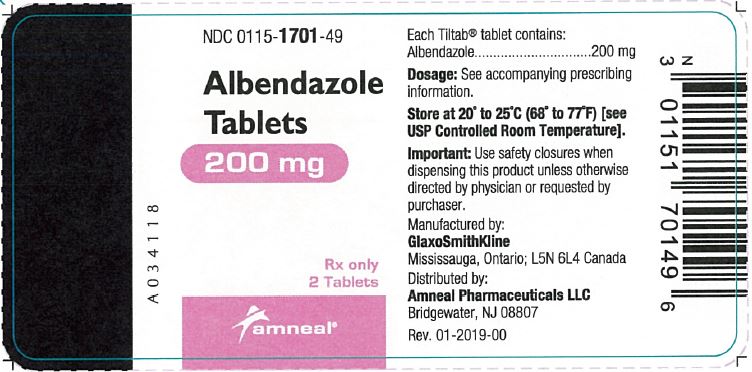
Albendazole 200 mg Tablet, Film Coated, 2-count — NDC 0115-1701-49 (Billing 00115-1701-49)
This is a package of 2 tablets of Albendazole 200 mg Tablet, Film Coated from Amneal Pharmaceuticals of New York LLC, marketed since Jun 1996 and currently FDA-listed; retail pharmacies pay about $12.61 per tablet (NADAC). It is this product's only package size.
NDC database record
One package, one record: these facts belong to NDC 0115-1701-49 alone.
- Record
- FDA NDC Directory package listing · Human prescription drug
- Code segments
- 0115 labeler · 1701 product · 49 package
- Package marketed since
- Jun 11, 1996
- Sample package
- No — commercial package
- Listing certified through
- Dec 31, 2026
- Billing quantity
- 2 EA per package
- Barcode (UPC)
- 0301151701496
- FDA record last changed
- Oct 8, 2026
Identity & classification
Regulatory identifiers FDA, NLM and CMS codes for this package
Drug-database identifiers Medi-Span GPI and First Databank GCN / HICL / AHFS classification
- GSN (GCN sequence number): 019283
- GCN: 53290
- GPI-14 (Medi-Span): 15000002000320
- HICL (First Databank): 007864
- AHFS class code: 08:08.00.00
- RxCUI (RxNorm): 199672
Where does this data come from?
- FDA openFDA NDC Directory · synced Oct 8, 2026
- FDA label on DailyMed · label index refreshed Oct 6, 2026
- RxNorm (NLM RxNav) · catalog refreshed Oct 1, 2026
- Medi-Span GPI (licensed)
- First Databank (licensed) · refreshed Oct 8, 2026
RxNorm drug class
This medicine belongs to the Anthelmintic class.
Where does this data come from?
- RxClass (NLM) · catalog refreshed Oct 1, 2026
Clinical
- Albendazole is used to treat two serious parasitic infections caused by tapeworm larvae. One is neurocysticercosis, where tapeworm larvae infect the brain and nervous system after...
- Yes, it really does matter. Taking albendazole with a fatty meal — like something containing healthy fats — can increase the amount of active drug that gets into your system by up...
- Do I have to take it with food? Does it really matter?
- Common side effects include nausea, vomiting, stomach pain, headache, dizziness, and sometimes temporary hair thinning — these are usually mild and go away after treatment ends. El...
Patient education
Supplement & herbal interactions
Some supplements/herbs that may interact with Albendazole — tap one for details:
Where does this data come from?
- MedlinePlus (NLM) · refreshed Oct 1, 2026
- FDA label on DailyMed · label index refreshed Oct 6, 2026
Ask a licensed pharmacist directly — free, answered by our team.
Pricing
A drug doesn't have one price. Each row is a different public payment system, and none is what you'd pay at the counter — that depends on your insurance. The ⓘ on each row explains what it measures.
| Price system | Per ea | Per package |
|---|---|---|
| Retail pharmacies payNADAC · weekly | $12.609 | $25.22 / 2 tablets |
| Medicaid paysCMS SDUD · 12 mo | No recent Medicaid claims on file for this NDC — rare and low-volume NDCs are suppressed in the public data. | |
| Medicare drug plans payPart D · Q2 2026 | $13.97 | $27.94 / 2 tablets |
Where does this data come from?
- CMS NADAC weekly file · file of Nov 23, 2022
- CMS ASP pricing files · refreshed Sep 20, 2026
- CMS Medicaid State Drug Utilization Data · refreshed Oct 8, 2026
- CMS Part D plan pricing files · refreshed Sep 24, 2026
- VA National Acquisition Center price file
Packaging — all sizes for this product
| Package NDC | Description | Marketing start | Marketing end | Status |
|---|---|---|---|---|
| 00115-1701-49 You're viewing this Main listing | 2 TABLET, FILM COATED in 1 BOTTLE | 1996-06-11 | — | Active |
Therapeutic equivalents
| Product | Labeler | Pack | NADAC/unit | TE | Status | Price vs. this |
|---|---|---|---|---|---|---|
| Albendazole 200 mg 00591-2712-02 | Actavis | 2 tablets | $4.146 | — | Availability likely | save 67% |
| Albendazole 200 mg 42799-0110-02 | Edenbridge | 2 tablets | $4.146 | AB | Availability likely | save 67% |
| Albendazole 200 mg 43598-0452-02 | Dr.Reddys | 2 tablets | $4.146 | AB | Availability likely | save 67% |
| Albendazole 200 mg 72205-0051-08 | Novadoz | 2 tablets | $4.146 | AB | Availability likely | save 67% |
| Albendazole 200 mgthis 00115-1701-49 | Amneal | 2 tablets | $12.609 | — | FDA listed | — |
| Albendazole 200 mg 46708-0681-02 | Alembic | 2 tablets | — | AB | FDA listed | — |
| Albendazole 200 mg 51407-0258-02 | Golden | 2 tablets | — | AB | FDA listed | — |
| Albendazole 200 mg 62332-0681-02 | Alembic | 2 tablets | — | AB | FDA listed | — |
| Albenza 200 mg 64896-0693-49 | Amneal | 2 tablets | — | — | FDA listed | — |
| Albendazole 200 mg 72162-2359-02 | Bryant | 2 tablets | — | AB | FDA listed | — |
Where does this data come from?
- FDA openFDA NDC Directory · synced Oct 8, 2026
- FDA Orange Book · refreshed Oct 3, 2026
- CMS NADAC weekly file · file of Nov 23, 2022
Availability & generic status
FDA-approved generic versions are listed, and recent pricing/market data suggests they may be available — see Therapeutic equivalents.
Where does this data come from?
- FDA Orange Book · refreshed Oct 3, 2026
Inactive Ingredients / Excipients
Inactive ingredients, also called excipients, are components of the drug product other than the active ingredient. They may include fillers, dyes, coatings, preservatives, flavors, or other formulation ingredients.
🧪 Avoiding an ingredient? See Albendazole inactive ingredients by manufacturer: every current product's list side by side, so you can ask your pharmacy for the version that does not list it.
💡 Tap an ingredient (hover on desktop) to see what it is and why it’s used.
-
UNII R12CBM0EIZ
A natural wax derived from a Brazilian palm tree, used as a coating and polish on tablets and capsules. It creates a smooth, shiny finish that protects the medicine and improves appearance.
-
UNII OP1R32D61U
Microcrystalline cellulose is a purified form of cellulose, a natural fiber from plant sources. It acts as a binder and filler in tablets and capsules, helping hold ingredients together and give the medicine its shape and size.
-
UNII 3NXW29V3WO
Hypromellose is a plant-based thickener made from cellulose. It's used in medicines as a binder to hold ingredients together, a coating for tablets, and a thickener for liquids.
-
UNII EWQ57Q8I5X
Lactose monohydrate is a natural sugar derived from milk. It serves as a filler and binder in tablets and capsules, helping create the proper size, texture, and consistency of the medicine.
-
UNII 70097M6I30
Magnesium stearate is a salt made from magnesium and stearic acid, a fatty substance. It's used in tablets and capsules as a lubricant and glidant to help ingredients flow smoothly during manufacturing and prevent sticking.
-
UNII FZ989GH94E
Povidone is a synthetic polymer made from a plastic-like material. It acts as a binder to hold tablet ingredients together and as a disintegrant to help the tablet break apart in your stomach so the medicine can be absorbed.
-
UNII A9CO00M9HV
Saccharin sodium monohydrate is an artificial sweetener derived from saccharin. It's added to medicines to improve taste and mask bitter flavors, making medications easier to take.
-
UNII 368GB5141J
A detergent and foaming agent derived from coconut or palm oil. In medications, it helps break down and mix oil and water-based ingredients, aids in tablet disintegration, and improves how the drug dissolves and spreads in the mouth or digestive system.
-
UNII 5856J3G2A2
A starch-based powder made from potatoes and processed with sodium. It acts as a disintegrant, helping the tablet or capsule break apart quickly in the stomach so the medicine can be absorbed.
-
UNII O8232NY3SJ
A plant-based carbohydrate derived from corn kernels. It acts as a filler to add bulk, a binder to hold ingredients together, and a disintegrant to help the tablet break apart in your stomach for absorption.
10 inactive ingredients listed in the exact product block matched to this NDC.
Where does this data come from?
ingredient classCode="IACT" elements from the exact product block matched by this NDC. Label-section narrative from DailyMed / the openFDA label index is shown separately when available.- FDA label on DailyMed · label index refreshed Oct 6, 2026
- FDA openFDA NDC Directory · synced Oct 8, 2026
Inactive ingredient FAQ
Are inactive ingredients the same for every manufacturer?
Why might an inactive ingredient be missing?
Can inactive ingredients matter?
Manufacturer & labeler
More NDCs from Amneal Pharmaceuticals of New York LLC labeler code 00115
- Budesonide Inhalation .5 mg/2mL Suspension NDC 0115-1689-74
- epinephrine .3 mg/.3mL Injection NDC 0115-1694-30
- epinephrine .15 mg/.15mL Injection NDC 0115-1695-30
- Hydrocortisone 5 mg Tablet NDC 0115-1696-06
- Hydrocortisone 10 mg Tablet NDC 0115-1697-01
- Hydrocortisone 20 mg Tablet NDC 0115-1700-01
- Dexmethylphenidate hydrochloride 25 mg Capsule, Extended Release NDC 0115-1709-01
- Dexmethylphenidate hydrochloride 35 mg Capsule, Extended Release NDC 0115-1710-01
- Apixaban 2.5 mg Tablet, Film Coated NDC 0115-1721-01
- Apixaban 5 mg Tablet, Film Coated NDC 0115-1722-01
- Ultramicrosize Griseofulvin 125 mg Tablet, Coated NDC 0115-1724-01
- Ultramicrosize Griseofulvin 250 mg Tablet, Coated NDC 0115-1725-01
Where does this data come from?
- FDA openFDA NDC Directory · synced Oct 8, 2026
- Drugs@FDA
Full prescribing information FDA SPL
🎯 Indications and Usage ▾
1 INDICATIONS AND USAGE Albendazole is an anthelmintic drug indicated for: Treatment of parenchymal neurocysticercosis due to active lesions caused by larval forms of the pork tapeworm, Taenia solium . ( 1.1 ) Treatment of cystic hydatid disease of the liver, lung, and peritoneum, caused by the larval form of the dog tapeworm, Echinococcus granulosus . ( 1.2 )
1.1Neurocysticercosis Albendazole is indicated for the treatment of parenchymal neurocysticercosis due to active lesions caused by larval forms of the pork tapeworm, Taenia solium .
1.2Hydatid Disease Albendazole is indicated for the treatment of cystic hydatid disease of the liver, lung, and peritoneum, caused by the larval form of the dog tapeworm, Echinococcus granulosus .
⏱️ Dosage and Administration ▾
2 DOSAGE AND ADMINISTRATION Patients weighing 60 kg or greater, 400 mg twice daily; less than 60 kg, 15 mg/kg/day in divided doses twice daily (maximum total daily dose 800 mg). Albendazole tablets should be taken with food. ( 2 ) Hydatid disease: 28-day cycle followed by 14-day albendazole-free interval for a total of 3 cycles. ( 2 ) Neurocysticercosis: 8 to 30 days. ( 2 ) See additional important information in the Full Prescribing Information. ( 2 )
2.1Dosage Dosing of albendazole will vary depending upon the indication. Albendazole tablets may be crushed or chewed and swallowed with a drink of water. Albendazole tablets should be taken with food [see Clinical Pharmacology (12.3) ] .
Table 1: Albendazole Dosage Indication Patient Weight Dose Duration Hydatid Disease 60 kg or greater 400 mg twice daily, with meals 28-day cycle followed by a 14-day albendazole-free interval, for a total of 3 cycles Less than 60 kg 15 mg/kg/day given in divided doses twice daily with meals (maximum total daily dose 800 mg) Neurocysticercosis 60 kg or greater 400 mg twice daily, with meals 8 to 30 days Less than 60 kg 15 mg/kg/day given in divided doses twice daily with meals (maximum total daily dose 800 mg)
2.2Concomitant Medication to Avoid Adverse Reactions Patients being treated for neurocysticercosis should receive appropriate steroid and anticonvulsant therapy as required. Oral or intravenous corticosteroids should be considered to prevent cerebral hypertensive episodes during the first week of treatment [see Warnings and Precautions (5.3) ] .
2.3Monitoring for Safety Before and During Treatment Monitor blood counts at the beginning of each 28-day cycle of therapy, and every 2 weeks while on therapy with albendazole in all patients [see Warnings and Precautions (5.1) ] . Monitor liver enzymes (transaminases) at the beginning of each 28-day cycle of therapy, and at least every 2 weeks during treatment with albendazole in all patients [see Warnings and Precautions (5.5) ] . Obtain a pregnancy test in women of reproductive potential prior to therapy [see Warnings and Precautions (5.2) ] .
💊 Dosage Forms and Strengths ▾
3 DOSAGE FORMS AND STRENGTHS Tablet: 200 mg Tablet: 200 mg ( 3 )
⛔ Contraindications ▾
4 CONTRAINDICATIONS Albendazole is contraindicated in patients with known hypersensitivity to the benzimidazole class of compounds or any components of albendazole. Patients with known hypersensitivity to the benzimidazole class of compounds or any components of albendazole.
⚠️ Warnings and Cautions ▾
5 WARNINGS AND PRECAUTIONS Bone Marrow Suppression: Fatalities have been reported due to bone marrow suppression; monitor blood counts in all patients at the beginning of each 28-day cycle of therapy, and every 2 weeks while on therapy. Discontinue albendazole if clinically significant changes in blood counts occur. ( 5.1 , 5.4 ) Embryo-fetal Toxicity: Obtain pregnancy test in women of reproductive potential prior to therapy and avoid usage in pregnant women except in clinical circumstances where no alternative management is appropriate.
Discontinue therapy if pregnancy occurs and apprise patient of potential hazard to the fetus. ( 5.2 ) Risk of Neurologic Symptoms: Neurocysticercosis patients may experience cerebral hypertensive episodes, seizures or focal neurologic deficits after initiation of therapy; begin appropriate steroid and anticonvulsant therapy. ( 5.3 ) Risk of Retinal Damage in Retinal Cysticercosis: Cases of retinal involvement have been reported; examine the patient for the presence of retinal lesions before initiating therapy for neurocysticercosis.
( 5.4 ) Hepatic Effects. Elevations of liver enzymes may occur. Monitor liver enzymes before the start of each treatment cycle and at least every 2 weeks while on albendazole therapy and discontinue if clinically significant elevations occur.
( 5.5 )
5.1Bone Marrow Suppression Fatalities associated with the use of albendazole have been reported due to granulocytopenia or pancytopenia. Albendazole may cause bone marrow suppression, aplastic anemia, and agranulocytosis. Monitor blood counts at the beginning of each 28-day cycle of therapy, and every 2 weeks while on therapy with albendazole in all patients.
Patients with liver disease and patients with hepatic echinococcosis are at increased risk for bone marrow suppression and warrant more frequent monitoring of blood counts. Discontinue albendazole if clinically significant decreases in blood cell counts occur.
5.2Embryo-fetal Toxicity Albendazole may cause fetal harm and should not be used in pregnant women except in clinical circumstances where no alternative management is appropriate. Obtain pregnancy test prior to prescribing albendazole to women of reproductive potential. Advise women of reproductive potential to use effective birth control for the duration of albendazole therapy and for one month after end of therapy.
Immediately discontinue albendazole if a patient becomes pregnant and apprise the patient of the potential hazard to the fetus [see Use in Specific Populations (8.1 , 8.3 )] .
5.3Risk of Neurologic Symptoms in Neurocysticercosis Patients being treated for neurocysticercosis should receive steroid and anticonvulsant therapy to prevent neurological symptoms (e.g. seizures, increased intracranial pressure and focal signs) as a result of an inflammatory reaction caused by death of the parasite within the brain.
5.4Risk of Retinal Damage in Patients with Retinal Neurocysticercosis Cysticercosis may involve the retina. Before initiating therapy for neurocysticercosis, examine the patient for the presence of retinal lesions. If such lesions are visualized, weigh the need for anticysticeral therapy against the possibility of retinal damage resulting from inflammatory damage caused by albendazole-induced death of the parasite.
5.5Hepatic Effects In clinical trials, treatment with albendazole has been associated with mild to moderate elevations of hepatic enzymes in approximately 16% of patients. These elevations have generally returned to normal upon discontinuation of therapy. There have also been case reports of acute liver failure of uncertain causality and hepatitis [see Adverse Reactions (6) ] .
Monitor liver enzymes (transaminases) before the start of each treatment cycle and at least every 2 weeks during treatment. If hepatic enzymes exceed twice the upper limit of normal, consideration should be given to discontinuing albendazole therapy based on individual patient circumstances. Restarting… [Excerpted — this section continues on DailyMed.]
🤒 Adverse Reactions ▾
6 ADVERSE REACTIONS Adverse reactions 1% or greater in hydatid disease: abnormal liver function tests, abdominal pain, nausea/vomiting, reversible alopecia, headache, dizziness/vertigo, fever. ( 6.1 ) Adverse reactions 1% or greater in neurocysticercosis: headache, nausea/vomiting, raised intracranial pressure, meningeal signs. ( 6.1 ) To report SUSPECTED ADVERSE REACTIONS, contact Amneal Pharmaceuticals at 1-877-835-5472 or FDA at 1-800-FDA-1088 or www.fda.gov/medwatch.
6.1Clinical Trials Experience Because clinical trials are conducted under widely varying conditions, adverse reaction rates observed in the clinical trials of a drug cannot be directly compared to rates in the clinical trials of another drug and may not reflect the rates observed in practice. The adverse reaction profile of albendazole differs between hydatid disease and neurocysticercosis. Adverse reactions occurring with a frequency of 1% or greater in either disease are described in Table 2 below.
These symptoms were usually mild and resolved without treatment. Treatment discontinuations were predominantly due to leukopenia (0.7%) or hepatic abnormalities (3.8% in hydatid disease). The following incidence reflects adverse reactions that were reported to be at least possibly or probably related to albendazole.
T able 2: Adverse Reaction Incidence 1% or Greater in Hydatid Disease and Neurocysticercosis A dverse Reaction H ydatid Disease N eurocysticercosis G astrointestinal Abdominal Pain 6 0 Nausea 4 6 Vomiting 4 6 G eneral disorders and administration site conditions Fever 1 0 Investigations Elevated Hepatic Enzymes 16 less than 1 N ervous system disorders Dizziness 1 less than 1 Headache 1 11 Meningeal Signs 0 1 Raised Intracranial Pressure 0 2 Vertigo 1 less than 1 Skin and subcutaneous tissue disorders Reversible Alopecia 2 less than 1 The following adverse events were observed at an incidence of less than 1%: Blood and Lymphatic System Disorders: There have been reports of leukopenia, granulocytopenia, pancytopenia, agranulocytosis, or thrombocytopenia [see Warnings and Precautions (5.1) ] .
Immune System Disorders: Hypersensitivity reactions, including rash and urticaria.
6.2Postmarketing Experience The following adverse reactions have been identified during post-approval use of albendazole. Because these reactions are reported voluntarily from a population of uncertain size, it is not always possible to reliably estimate their frequency or establish a causal relationship to drug exposure. Blood and Lymphatic System Disorders: Aplastic anemia, bone marrow suppression, neutropenia.
Eye Disorders: Vision blurred. Gastrointestinal Disorders: Diarrhea. General System Disorders: Asthenia.
Hepatobiliary Disorders: Elevations of hepatic enzymes, hepatitis, acute liver failure. Musculoskeletal and Connective Tissue Disorders: Rhabdomyolysis. Nervous System Disorders: Somnolence, convulsion.
Renal and Urinary Disorders: Acute renal failure. Skin and Subcutaneous Tissue Disorders: Erythema multiforme, Stevens-Johnson syndrome.
🔄 Drug Interactions ▾
7 DRUG INTERACTIONS Dexamethasone: Steady-state trough concentrations of albendazole sulfoxide were about 56% higher when dexamethasone was coadministered with each dose of albendazole. ( 7.1 ) Praziquantel: In the fed state increased mean maximum plasma concentration and area under the curve of albendazole sulfoxide by about 50% in healthy subjects. ( 7.2 ) Cimetidine: Increased albendazole sulfoxide concentrations in bile and cystic fluid by about 2-fold in hydatid cyst patients.
( 7.3 ) Theophylline: Albendazole induces cytochrome P450 1A in human hepatoma cells; therefore, it is recommended that plasma concentrations of theophylline be monitored during and after treatment. ( 5.5 , 7.4 )
7.1Dexamethasone Steady-state trough concentrations of albendazole sulfoxide were about 56% higher when 8 mg dexamethasone was co-administered with each dose of albendazole (15 mg/kg/day) in 8 neurocysticercosis patients.
7.2Praziquantel In the fed state, praziquantel (40 mg/kg) increased mean maximum plasma concentration and area under the curve of albendazole sulfoxide by about 50% in healthy subjects (n = 10) compared with a separate group of subjects (n = 6) given albendazole alone. Mean T max and mean plasma elimination half-life of albendazole sulfoxide were unchanged. The pharmacokinetics of praziquantel were unchanged following co-administration with albendazole (400 mg).
7.3Cimetidine Albendazole sulfoxide concentrations in bile and cystic fluid were increased (about 2-fold) in hydatid cyst patients treated with cimetidine (10 mg/kg/day) (n = 7) compared with albendazole (20 mg/kg/day) alone (n = 12). Albendazole sulfoxide plasma concentrations were unchanged 4 hours after dosing.
7.4Theophylline Following a single dose of albendazole (400 mg), the pharmacokinetics of theophylline (aminophylline 5.8 mg/kg infused over 20 minutes) were unchanged. Albendazole induces cytochrome P450 1A in human hepatoma cells; therefore, it is recommended that plasma concentrations of theophylline be monitored during and after treatment.
👥 Use in Specific Populations ▾
8 USE IN SPECIFIC POPULATIONS
8.1Pregnancy Risk Summary There are limited data on use of albendazole in pregnant women to inform a drug-associated risk of major birth defects and miscarriage. In published studies, single-dose albendazole exposure during pregnancy did not show evidence of an increased risk of adverse maternal or fetal outcomes; however, this finding cannot be extrapolated to multiple-dose exposures ( see Data ). In animal reproductive studies, oral administration of albendazole during gestation caused embryotoxicity and skeletal malformations in pregnant rats (at oral doses of 0.10 times and 0.32 times the recommended human dose based on body surface area in mg/m 2 ) and pregnant rabbits (at oral doses of 0.60 times the recommended human dose based on body surface area in mg/m 2 ).
Albendazole was also associated with maternal toxicity in rabbits (at doses of 0.60 times the recommended human dose based on body surface area in mg/m 2 ) ( see Data ). Albendazole should be used during pregnancy only if the potential benefit justifies the potential risk to the fetus. Albendazole should not be used in pregnant women except in clinical circumstances where no alternative management is appropriate.
If a patient becomes pregnant while taking this drug, albendazole should be discontinued immediately. If pregnancy occurs while taking this drug, the patient should be apprised of the potential hazard to the fetus. The estimated background risk of major birth defects and miscarriage for the indicated population is unknown.
In the U.S. general population, the estimated background risk of major birth defects and miscarriage in clinically recognized pregnancies is 2 to 4% and 15 to 20%, respectively. Data Human Data A Cochrane review could not provide sufficient evidence of the impact of antihelminthics (including albendazole) on the pregnancy outcomes of low birthweight, perinatal mortality and preterm birth. In a large trial of about 2507 women, albendazole use during the second or third trimester of pregnancy had no overall effect on birth weight, perinatal mortality, or congenital anomalies.
With a limited sample size and single-does exposure, another study could not rule out a two-fold increased risk of major malformations [4.7% vs. 2.2%; OR 2.2 (95% confidence interval (CI) 0.5 to 10.1); p = 0.26]. Animal Data Albendazole has been shown to be teratogenic (to cause embryotoxicity and skeletal malformations) in pregnant rats and rabbits.
The teratogenic response in the rat was shown at oral doses of 10 and 30 mg/kg/day (0.10 times and 0.32 times the recommended human dose based on body surface area in mg/m 2 , respectively) during gestation days 6 to 15 and in pregnant rabbits at oral doses of 30 mg/kg/day (0.60 times the recommended human dose based on body surface area in mg/m 2 ) administered during gestation days 7 to 19. In the rabbit study, maternal toxicity (33% mortality) was noted at 30 mg/kg/day. In mice, no teratogenic effects were observed at oral doses up to 30 mg/kg/day (0.16 times the recommended human dose based on body surface area in mg/m 2 ), administered during gestation days 6 to 15.
8.2Lactation Risk Summary There are no data on the presence of albendazole in human milk, the effects on the breast-fed infant or the effects on milk production. Albendazole is excreted in animal milk. The developmental and health benefits of breastfeeding should be considered along with the mother’s clinical need for albendazole and any potential adverse effects on the breastfed child from albendazole or from the underlying maternal condition.
8.3Females and Males of Reproductive Potential Pregnancy Testing Obtain pregnancy test prior to prescribing albendazole to women of reproductive potential. Contraception Females Advise women of reproductive potential to use effective birth control for the duration of albendazole therapy and for one month after end of therapy.
8.4Pediatric Use Hydatid disease is uncommon in infant… [Excerpted — this section continues on DailyMed.]
🤰 Pregnancy ▾
8.1Pregnancy Risk Summary There are limited data on use of albendazole in pregnant women to inform a drug-associated risk of major birth defects and miscarriage. In published studies, single-dose albendazole exposure during pregnancy did not show evidence of an increased risk of adverse maternal or fetal outcomes; however, this finding cannot be extrapolated to multiple-dose exposures ( see Data ). In animal reproductive studies, oral administration of albendazole during gestation caused embryotoxicity and skeletal malformations in pregnant rats (at oral doses of 0.10 times and 0.32 times the recommended human dose based on body surface area in mg/m 2 ) and pregnant rabbits (at oral doses of 0.60 times the recommended human dose based on body surface area in mg/m 2 ).
Albendazole was also associated with maternal toxicity in rabbits (at doses of 0.60 times the recommended human dose based on body surface area in mg/m 2 ) ( see Data ). Albendazole should be used during pregnancy only if the potential benefit justifies the potential risk to the fetus. Albendazole should not be used in pregnant women except in clinical circumstances where no alternative management is appropriate.
If a patient becomes pregnant while taking this drug, albendazole should be discontinued immediately. If pregnancy occurs while taking this drug, the patient should be apprised of the potential hazard to the fetus. The estimated background risk of major birth defects and miscarriage for the indicated population is unknown.
In the U.S. general population, the estimated background risk of major birth defects and miscarriage in clinically recognized pregnancies is 2 to 4% and 15 to 20%, respectively. Data Human Data A Cochrane review could not provide sufficient evidence of the impact of antihelminthics (including albendazole) on the pregnancy outcomes of low birthweight, perinatal mortality and preterm birth. In a large trial of about 2507 women, albendazole use during the second or third trimester of pregnancy had no overall effect on birth weight, perinatal mortality, or congenital anomalies.
With a limited sample size and single-does exposure, another study could not rule out a two-fold increased risk of major malformations [4.7% vs. 2.2%; OR 2.2 (95% confidence interval (CI) 0.5 to 10.1); p = 0.26]. Animal Data Albendazole has been shown to be teratogenic (to cause embryotoxicity and skeletal malformations) in pregnant rats and rabbits.
The teratogenic response in the rat was shown at oral doses of 10 and 30 mg/kg/day (0.10 times and 0.32 times the recommended human dose based on body surface area in mg/m 2 , respectively) during gestation days 6 to 15 and in pregnant rabbits at oral doses of 30 mg/kg/day (0.60 times the recommended human dose based on body surface area in mg/m 2 ) administered during gestation days 7 to 19. In the rabbit study, maternal toxicity (33% mortality) was noted at 30 mg/kg/day. In mice, no teratogenic effects were observed at oral doses up to 30 mg/kg/day (0.16 times the recommended human dose based on body surface area in mg/m 2 ), administered during gestation days 6 to 15.
🧒 Pediatric Use ▾
8.4Pediatric Use Hydatid disease is uncommon in infants and young children. In neurocysticercosis, the efficacy of albendazole in children appears to be similar to that in adults.
🧓 Geriatric Use ▾
8.5Geriatric Use In patients aged 65 and older with either hydatid disease or neurocysticercosis, there was insufficient data to determine whether the safety and effectiveness of albendazole is different from that of younger patients.
🆘 Overdosage ▾
10 OVERDOSAGE In case of overdosage, symptomatic therapy and general supportive measures are recommended.
🧬 Clinical Pharmacology ▾
12 CLINICAL PHARMACOLOGY
12.1Mechanism of Action Albendazole is a synthetic, antihelminthic drug of the class benzimidazole [see Clinical Pharmacology (12.4) ] .
12.3Pharmacokinetics Absorption Albendazole is poorly absorbed from the gastrointestinal tract due to its low aqueous solubility. Albendazole concentrations are negligible or undetectable in plasma as it is rapidly converted to the sulfoxide metabolite prior to reaching the systemic circulation. The systemic anthelmintic activity has been attributed to the primary metabolite, albendazole sulfoxide.
Oral bioavailability appears to be enhanced when albendazole is coadministered with a fatty meal (estimated fat content 40 grams) as evidenced by higher (up to 5-fold on average) plasma concentrations of albendazole sulfoxide as compared to the fasted state. Maximal plasma concentrations of albendazole sulfoxide were achieved 2 hours to 5 hours after dosing and were on average 1310 ng/mL (range 460 ng/mL to 1580 ng/mL) following oral doses of albendazole (400 mg) in 6 hydatid disease patients, when administered with a fatty meal.
Plasma concentrations of albendazole sulfoxide increased in a dose-proportional manner over the therapeutic dose range following ingestion of a high-fat meal (fat content 43.1 grams). The mean apparent terminal elimination half-life of albendazole sulfoxide ranged from 8 hours to 12 hours in 25 healthy subjects, as well as in 14 hydatid and 8 neurocysticercosis patients. Following 4 weeks of treatment with albendazole (200 mg three times daily), 12 patients’ plasma concentrations of albendazole sulfoxide were approximately 20% lower than those observed during the first half of the treatment period, suggesting that albendazole may induce its own metabolism.
Distribution Albendazole sulfoxide is 70% bound to plasma protein and is widely distributed throughout the body; it has been detected in urine, bile, liver, cyst wall, cyst fluid, and cerebrospinal fluid (CSF). Concentrations in plasma were 3-fold to 10-fold and 2-fold to 4-fold higher than those simultaneously determined in cyst fluid and CSF, respectively. Metabolism and Excretion Albendazole is rapidly converted in the liver to the primary metabolite, albendazole sulfoxide, which is further metabolized to albendazole sulfone and other primary oxidative metabolites that have been identified in human urine.
Following oral administration, albendazole has not been detected in human urine. Urinary excretion of albendazole sulfoxide is a minor elimination pathway with less than 1% of the dose recovered in the urine. Biliary elimination presumably accounts for a portion of the elimination as evidenced by biliary concentrations of albendazole sulfoxide similar to those achieved in plasma.
Specific Populations Pediatrics Following single-dose administration of 200 mg to 300 mg (approximately 10 mg/kg) albendazole to 3 fasted and 2 fed pediatric patients with hydatid cyst disease (age range 6 to 13 years), albendazole sulfoxide pharmacokinetics were similar to those observed in fed adults. Geriatrics Although no studies have investigated the effect of age on albendazole sulfoxide pharmacokinetics, data in 26 hydatid cyst patients (up to 79 years) suggest pharmacokinetics similar to those in young healthy subjects.
12.4Microbiology Mechanism of Action Albendazole binds to the colchicine-sensitive site of β-tubulin inhibiting their polymerization into microtubules. The decrease in microtubules in the intestinal cells of the parasites decreases their absorptive function, especially the uptake of glucose by the adult and larval forms of the parasites, and also depletes glycogen storage. Insufficient glucose results in insufficient energy for the production of adenosine trisphosphate (ATP) and the parasite eventually dies.
Mechanism of Resistance Parasitic resistance to albendazole is caused by changes in amino acids that result in changes in the β-tubulin protein. This causes reduced binding of the drug… [Excerpted — this section continues on DailyMed.]
🧬 Mechanism of Action ▾
12.1Mechanism of Action Albendazole is a synthetic, antihelminthic drug of the class benzimidazole [see Clinical Pharmacology (12.4) ] .
📦 How Supplied / Storage and Handling ▾
16 HOW SUPPLIED/STORAGE AND HANDLING
16.1How Supplied Each white to off-white, circular, biconvex, bevel-edged film coated, TILTAB tablet is debossed with “ap” and “550” and contains 200 mg of albendazole. Bottles of 2 Tablets NDC 0115-1701-49
16.2Storage and Handling Store at 20° to 25°C (68° to 77°F) [See USP Controlled Room Temperature].
16.1How Supplied Each white to off-white, circular, biconvex, bevel-edged film coated, TILTAB tablet is debossed with “ap” and “550” and contains 200 mg of albendazole. Bottles of 2 Tablets NDC 0115-1701-49
📦 Storage and Handling ▾
16.2Storage and Handling Store at 20° to 25°C (68° to 77°F) [See USP Controlled Room Temperature].
📋 Description ▾
11 DESCRIPTION Albendazole is an orally administered anthelmintic drug. Chemically, it is methyl 5-(propylthio)-2-benzimidazolecarbamate. Its molecular formula is C 12 H 15 N 3 O 2 S.
Its molecular weight is 265.34. It has the following chemical structure: Albendazole is a white to yellowish powder. It is freely soluble in anhydrous formic acid and very slightly soluble in ether and in methylene chloride.
Albendazole is practically insoluble in alcohol and in water. Each white to off-white, circular, biconvex, bevel-edged film coated, TILTAB tablet is debossed with “ap” and “550” and contains 200 mg of albendazole. Inactive ingredients consist of: carnauba wax, hypromellose, lactose monohydrate, magnesium stearate, microcrystalline cellulose, povidone, sodium lauryl sulfate, sodium saccharin, sodium starch glycolate, and starch. methyl 5-(propylthio)-2-benzimidazolecarbamate
💬 Information for Patients ▾
17 PATIENT COUNSELING INFORMATION Patients should be advised that: Some people, particularly children, may experience difficulties swallowing the albendazole tablets whole. Take albendazole with food. Albendazole may cause fetal harm, therefore, obtain a pregnancy test in women of reproductive potential prior to initiating therapy [see Use in Specific Populations (8.1 , 8.3 )] .
Advise women of reproductive potential to use effective birth control while on albendazole and for one month after completing treatment [see Use in Specific Populations (8.3) ] . During albendazole therapy, monitor blood counts and liver enzymes every 2 weeks because of the possibility of harm to the liver or bone marrow [see Warnings and Precautions (5.5) ] . TILTAB is a registered trademark of GlaxoSmithKline, used with permission.
Manufactured by: GlaxoSmithKline Mississauga, Ontario L5N 6L4 Canada Distributed by: Amneal Pharmaceuticals LLC Bridgewater, NJ 08807 1905-03 Rev. 09-2019-01
🍼 Nursing Mothers ▾
8.3Females and Males of Reproductive Potential Pregnancy Testing Obtain pregnancy test prior to prescribing albendazole to women of reproductive potential. Contraception Females Advise women of reproductive potential to use effective birth control for the duration of albendazole therapy and for one month after end of therapy.
🧬 Pharmacokinetics ▾
12.3Pharmacokinetics Absorption Albendazole is poorly absorbed from the gastrointestinal tract due to its low aqueous solubility. Albendazole concentrations are negligible or undetectable in plasma as it is rapidly converted to the sulfoxide metabolite prior to reaching the systemic circulation. The systemic anthelmintic activity has been attributed to the primary metabolite, albendazole sulfoxide.
Oral bioavailability appears to be enhanced when albendazole is coadministered with a fatty meal (estimated fat content 40 grams) as evidenced by higher (up to 5-fold on average) plasma concentrations of albendazole sulfoxide as compared to the fasted state. Maximal plasma concentrations of albendazole sulfoxide were achieved 2 hours to 5 hours after dosing and were on average 1310 ng/mL (range 460 ng/mL to 1580 ng/mL) following oral doses of albendazole (400 mg) in 6 hydatid disease patients, when administered with a fatty meal.
Plasma concentrations of albendazole sulfoxide increased in a dose-proportional manner over the therapeutic dose range following ingestion of a high-fat meal (fat content 43.1 grams). The mean apparent terminal elimination half-life of albendazole sulfoxide ranged from 8 hours to 12 hours in 25 healthy subjects, as well as in 14 hydatid and 8 neurocysticercosis patients. Following 4 weeks of treatment with albendazole (200 mg three times daily), 12 patients’ plasma concentrations of albendazole sulfoxide were approximately 20% lower than those observed during the first half of the treatment period, suggesting that albendazole may induce its own metabolism.
Distribution Albendazole sulfoxide is 70% bound to plasma protein and is widely distributed throughout the body; it has been detected in urine, bile, liver, cyst wall, cyst fluid, and cerebrospinal fluid (CSF). Concentrations in plasma were 3-fold to 10-fold and 2-fold to 4-fold higher than those simultaneously determined in cyst fluid and CSF, respectively. Metabolism and Excretion Albendazole is rapidly converted in the liver to the primary metabolite, albendazole sulfoxide, which is further metabolized to albendazole sulfone and other primary oxidative metabolites that have been identified in human urine.
Following oral administration, albendazole has not been detected in human urine. Urinary excretion of albendazole sulfoxide is a minor elimination pathway with less than 1% of the dose recovered in the urine. Biliary elimination presumably accounts for a portion of the elimination as evidenced by biliary concentrations of albendazole sulfoxide similar to those achieved in plasma.
Specific Populations Pediatrics Following single-dose administration of 200 mg to 300 mg (approximately 10 mg/kg) albendazole to 3 fasted and 2 fed pediatric patients with hydatid cyst disease (age range 6 to 13 years), albendazole sulfoxide pharmacokinetics were similar to those observed in fed adults. Geriatrics Although no studies have investigated the effect of age on albendazole sulfoxide pharmacokinetics, data in 26 hydatid cyst patients (up to 79 years) suggest pharmacokinetics similar to those in young healthy subjects.
🧪 Nonclinical Toxicology ▾
13 NONCLINICAL TOXICOLOGY
13.1Carcinogenesis, Mutagenesis, Impairment of Fertility Long-term carcinogenicity studies were conducted in mice and rats. No evidence of increased incidence of tumors was found in the mice or rats at up to 400 mg/kg/day or 20 mg/kg/day respectively (2 times and 0.2 times the recommended human dose on a body surface area basis). In genotoxicity tests, albendazole was found negative in an Ames Salmonella/Microsome Plate mutation assay, Chinese Hamster Ovary chromosomal aberration test, and in vivo mouse micronucleus test.
In the in vitro BALB/3T3 cells transformation assay, albendazole produced weak activity in the presence of metabolic activation while no activity was found in the absence of metabolic activation. Albendazole did not adversely affect male or female fertility in the rat at an oral dose of 30 mg/kg/day (0.32 times the recommended human dose based on body surface area in mg/m 2 ).
📄 Carcinogenesis, Mutagenesis, Impairment of Fertility ▾
13.1Carcinogenesis, Mutagenesis, Impairment of Fertility Long-term carcinogenicity studies were conducted in mice and rats. No evidence of increased incidence of tumors was found in the mice or rats at up to 400 mg/kg/day or 20 mg/kg/day respectively (2 times and 0.2 times the recommended human dose on a body surface area basis). In genotoxicity tests, albendazole was found negative in an Ames Salmonella/Microsome Plate mutation assay, Chinese Hamster Ovary chromosomal aberration test, and in vivo mouse micronucleus test.
In the in vitro BALB/3T3 cells transformation assay, albendazole produced weak activity in the presence of metabolic activation while no activity was found in the absence of metabolic activation. Albendazole did not adversely affect male or female fertility in the rat at an oral dose of 30 mg/kg/day (0.32 times the recommended human dose based on body surface area in mg/m 2 ).
📄 Package Label / Principal Display Panel ▾
PRINCIPAL DISPLAY PANEL 1