
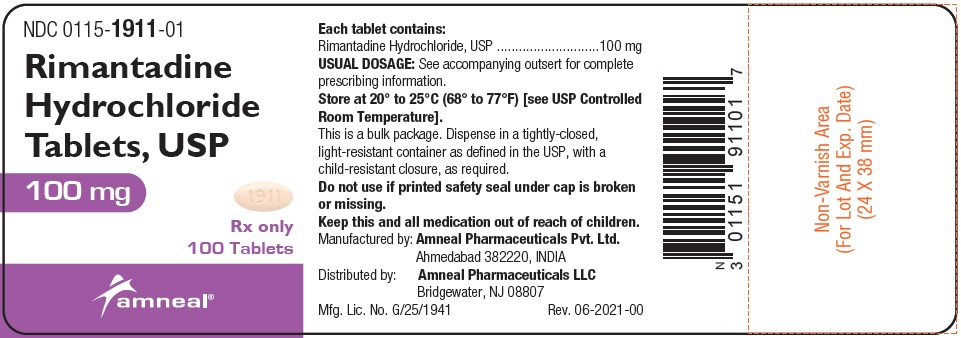
Rimantadine Hydrochloride 100 mg Tablet, Film Coated, 100-count — NDC 0115-1911-01 (Billing 00115-1911-01)
This is a package of 100 tablets of Rimantadine Hydrochloride 100 mg Tablet, Film Coated from Amneal Pharmaceuticals of New York LLC, marketed since Nov 2021 and currently FDA-listed. It is the main listing for this product, which comes in 2 package sizes.
NDC database record
One package, one record: these facts belong to NDC 0115-1911-01 alone.
- Record
- FDA NDC Directory package listing · Human prescription drug
- Code segments
- 0115 labeler · 1911 product · 01 package
- Package marketed since
- Nov 16, 2021
- Sample package
- No — commercial package
- Listing certified through
- Dec 31, 2026
- Billing quantity
- 100 EA per package
- Barcode (UPC-A, from the NDC)
- 3 0115191101 7
- FDA record last changed
- Oct 8, 2026
Identity & classification
Regulatory identifiers FDA, NLM and CMS codes for this package
Drug-database identifiers Medi-Span GPI and First Databank GCN / HICL / AHFS classification
- GSN (GCN sequence number): 020987
- GCN: 00730
- GPI-14 (Medi-Span): 12500070100320
- HICL (First Databank): 008646
- AHFS class code: 08:18.04.00
- RxCUI (RxNorm): 856605
Where does this data come from?
- FDA openFDA NDC Directory · synced Oct 8, 2026
- FDA label on DailyMed · label index refreshed Oct 8, 2026
- RxNorm (NLM RxNav) · catalog refreshed Oct 1, 2026
- Medi-Span GPI (licensed)
- First Databank (licensed) · refreshed Oct 8, 2026
RxNorm drug class
This medicine belongs to the Influenza A M2 Protein Inhibitor class.
Where does this data come from?
- RxClass (NLM) · catalog refreshed Oct 1, 2026
Clinical
- It helps prevent influenza A in adults and children 1 to 16. It also treats influenza A in adults. It won’t work against influenza B.
- As soon as possible, ideally within 48 hours of your first symptoms. Treatment usually lasts about 7 days.
- When should I start it if I already have flu symptoms?
- No. It is not a substitute for the yearly flu vaccine. Also, if you plan to get the nasal spray flu vaccine, timing around rimantadine matters, so ask me or your doctor.
Patient education
Supplement & herbal interactions
Where does this data come from?
- MedlinePlus (NLM) · refreshed Oct 8, 2026
- FDA label on DailyMed · label index refreshed Oct 8, 2026
Ask a licensed pharmacist directly — free, answered by our team.
Pricing
A drug doesn't have one price. Each row is a different public payment system, and none is what you'd pay at the counter — that depends on your insurance. The ⓘ on each row explains what it measures.
| Price system | Per each | Per package |
|---|---|---|
| Retail pharmacies payNADAC · weekly | Not in the retail survey — common for institutional, discontinued, or low-volume packs. | |
| Medicaid paysCMS SDUD · 12 mo | No recent Medicaid claims on file for this NDC — rare and low-volume NDCs are suppressed in the public data. | |
| Medicare drug plans payPart D · Q2 2026 | $2.27 | $226.96 / 100 tablets |
Where does this data come from?
- CMS NADAC weekly file
- CMS ASP pricing files · refreshed Sep 20, 2026
- CMS Medicaid State Drug Utilization Data · refreshed Oct 8, 2026
- CMS Part D plan pricing files · refreshed Sep 24, 2026
- VA National Acquisition Center price file
Packaging — all sizes for this product
| Package NDC | Description | Marketing start | Marketing end | Status |
|---|---|---|---|---|
| 00115-1911-01 You're viewing this Main listing | 100 TABLET, FILM COATED in 1 BOTTLE | 2021-11-16 | — | Active |
| 00115-1911-02 0115-1911-02 | 500 TABLET, FILM COATED in 1 BOTTLE | 2021-11-16 | — | Active |
You're viewing the smallest of 2 pack sizes for this product.
Pack size FAQ
What quantity is in this package?
How does this package differ from NDC 00115-1911-02?
What NDC number is used to bill for this package of Rimantadine Hydrochloride 100 mg Tablet, Film Coated?
Therapeutic equivalents
| Product | Labeler | Pack | NADAC/unit | TE | Status | Price vs. this |
|---|---|---|---|---|---|---|
| Rimantadine Hydrochloride 100 mgthis 00115-1911-01 | Amneal | 100 tablets | — | — | FDA listed | — |
Where does this data come from?
- FDA openFDA NDC Directory · synced Oct 8, 2026
- FDA Orange Book · refreshed Oct 3, 2026
- CMS NADAC weekly file
Availability & generic status
This product is an FDA-approved generic. Other versions of the same drug are listed under Therapeutic equivalents, least expensive first.
Where does this data come from?
- FDA Orange Book · refreshed Oct 3, 2026
Inactive Ingredients / Excipients
Inactive ingredients, also called excipients, are components of the drug product other than the active ingredient. They may include fillers, dyes, coatings, preservatives, flavors, or other formulation ingredients.
🧪 Avoiding an ingredient? See Rimantadine inactive ingredients by manufacturer: every current product's list side by side, so you can ask your pharmacy for the version that does not list it.
💡 Tap an ingredient (hover on desktop) to see what it is and why it’s used.
-
UNII OP1R32D61U
Microcrystalline cellulose is a purified form of cellulose, a natural fiber from plant sources. It acts as a binder and filler in tablets and capsules, helping hold ingredients together and give the medicine its shape and size.
-
UNII H77VEI93A8
A synthetic yellow dye used to color medications. It helps identify the drug and make it visually distinctive, with no effect on how the medicine works.
-
UNII 3NXW29V3WO
Hypromellose is a plant-based thickener made from cellulose. It's used in medicines as a binder to hold ingredients together, a coating for tablets, and a thickener for liquids.
-
UNII 70097M6I30
Magnesium stearate is a salt made from magnesium and stearic acid, a fatty substance. It's used in tablets and capsules as a lubricant and glidant to help ingredients flow smoothly during manufacturing and prevent sticking.
-
UNII 3WJQ0SDW1A
Polyethylene glycol is a synthetic liquid or solid polymer used in medicines as a solvent, lubricant, and humectant. It helps dissolve active ingredients, reduces friction during manufacturing, and retains moisture in the final product.
-
UNII 5856J3G2A2
A starch-based powder made from potatoes and processed with sodium. It acts as a disintegrant, helping the tablet or capsule break apart quickly in the stomach so the medicine can be absorbed.
6 inactive ingredients listed in the exact product block matched to this NDC.
Where does this data come from?
ingredient classCode="IACT" elements from the exact product block matched by this NDC. Label-section narrative from DailyMed / the openFDA label index is shown separately when available.- FDA label on DailyMed · label index refreshed Oct 8, 2026
- FDA openFDA NDC Directory · synced Oct 8, 2026
Inactive ingredient FAQ
Are inactive ingredients the same for every manufacturer?
Why might an inactive ingredient be missing?
Can inactive ingredients matter?
Manufacturer & labeler
More NDCs from Amneal Pharmaceuticals of New York LLC labeler code 00115
- Methylphenidate Hydrochloride 5 mg Tablet NDC 0115-1800-01
- Methylphenidate Hydrochloride 10 mg Tablet NDC 0115-1801-01
- Methylphenidate Hydrochloride 20 mg Tablet NDC 0115-1802-01
- Hydroxyzine Pamoate 25 mg Capsule NDC 0115-1803-01
- Hydroxyzine Pamoate 50 mg Capsule NDC 0115-1804-01
- Colesevelam hydrochloride 3.75 g For Suspension NDC 0115-1864-18
- Pyridostigmine Bromide 30 mg Tablet NDC 0115-2134-01
- Terbutaline Sulfate 2.5 mg Tablet NDC 0115-2611-01
- Terbutaline Sulfate 5 mg Tablet NDC 0115-2622-01
- Chloroquine Phosphate 250 mg Tablet NDC 0115-2790-02
- Pyridostigmine Bromide 60 mg Tablet NDC 0115-3511-01
- Dantrolene Sodium 25 mg Capsule NDC 0115-4411-01
Where does this data come from?
- FDA openFDA NDC Directory · synced Oct 8, 2026
- Drugs@FDA
Full prescribing information FDA SPL
🎯 Indications and Usage ▾
INDICATIONS AND USAGE Rimantadine hydrochloride tablet is indicated for the prophylaxis and treatment of illness caused by various strains of influenza A virus in adults (17 years and older). Rimantadine hydrochloride tablet is indicated for prophylaxis against influenza A virus in children (1 year to 16 years of age). Prophylaxis In controlled studies of children (1 year to 16 years of age), healthy adults (17 years and older), and elderly patients (65 years of age and older), rimantadine hydrochloride has been shown to be safe and effective in preventing signs and symptoms of infection caused by various strains of influenza A virus.
Since rimantadine hydrochloride does not completely prevent the host immune response to influenza A infection, individuals who take this drug may still develop immune responses to natural disease or vaccination and may be protected when later exposed to antigenically-related viruses. Following vaccination during an influenza outbreak, rimantadine hydrochloride prophylaxis should be considered for the 2 to 4 week time period required to develop an antibody response. However, the safety and effectiveness of rimantadine hydrochloride prophylaxis have not been demonstrated for longer than 6 weeks.
Treatment Rimantadine hydrochloride therapy should be considered for adults (17 years and older) who develop an influenza-like illness during known or suspected influenza A infection in the community. When administered within 48 hours after onset of signs and symptoms of infection caused by influenza A virus strains, rimantadine hydrochloride has been shown to reduce the duration of fever and systemic symptoms. The following points should be considered before initiating treatment or prophylaxis with rimantadine hydrochloride: Rimantadine hydrochloride is not a substitute for early vaccination on an annual basis as recommended by the Centers for Disease Control and Prevention Advisory Committee on Immunization Practices.
Influenza viruses change over time. Emergence of resistance mutations could decrease drug effectiveness. Other factors (for example, changes in viral virulence) might also diminish clinical benefit of antiviral drugs.
Prescribers should consider available information on influenza drug susceptibility patterns and treatment effects when deciding whether to use rimantadine hydrochloride.
⏱️ Dosage and Administration ▾
DOSAGE AND ADMINISTRATION For Prophylaxis in Adults and Children Adults (17 years and older) The recommended adult dose of rimantadine hydrochloride is 100 mg twice a day. Study durations ranged from 11 days to 6 weeks in adult and elderly patients. In patients with severe hepatic dysfunction, severe renal impairment (CrCl 5 to 29 mL/min) or renal failure (CrCl ≤ 10 mL/min) and in elderly nursing home patients, a dose reduction to 100 mg daily is recommended.
Because of the potential for accumulation of rimantadine metabolites during multiple dosing, patients with hepatic or renal impairment should be monitored for adverse effects. Children (1 year to 16 years of age) Study duration ranged from 5 weeks to 6 weeks in pediatric subjects. In children 1 year to 9 years of age, rimantadine hydrochloride should be administered once a day, at a dose of 5 mg/kg but not exceeding 150 mg.
For children 10 years of age or older, use the adult dose. (see Directions for Compounding of an Oral Suspension from Rimantadine Hydrochloride Tablets to prepare an oral suspension for administration to children and patients with difficulty swallowing tablets). Children (Birth to 11 months) The safety and efficacy of rimantadine hydrochloride for prophylaxis of influenza in pediatric patients younger than 1 year of age have not been established.
For Treatment in Adults Adults (17 years and older) The recommended adult dose of rimantadine hydrochloride is 100 mg twice a day for 7 days. In patients with severe hepatic dysfunction, severe renal impairment (CrCl 5 to 29 mL/min) or renal failure (CrCl ≤ 10 mL/min) and elderly nursing home patients, a dose reduction to 100 mg daily is recommended. Because of the potential for accumulation of rimantadine metabolites during multiple dosing, patients with hepatic or renal impairment should be monitored for adverse effects.
Rimantadine hydrochloride therapy should be initiated as soon as possible, preferably within 48 hours after onset of signs and symptoms of influenza A infection. Therapy should be continued for approximately seven days from the initial onset of symptoms. Children (16 years of age and younger) Rimantadine hydrochloride is not indicated for treatment of influenza in pediatric patients 16 years or younger.
Directions for the Compounding of an Oral Suspension from Rimantadine Hydrochloride Tablets (Final Concentration = 10 mg/mL) 1 These directions are provided for use only during emergency situations, for patients who have difficulty swallowing tablets or where lower doses are needed. The pharmacist may compound a suspension (10 mg/mL) from rimantadine hydrochloride tablets, 100 mg using Ora-Sweet ® † . Other vehicles have not been studied.
To make an oral suspension (10 mg/mL) from 100 mg rimantadine hydrochloride tablets, you will need the following: 100 mg tablets of rimantadine hydrochloride Ora-Sweet ® (a vehicle manufactured by Paddock Laboratories) a graduated cylinder a mortar and pestle an Amber Glass or Polyethylene terephthalate plastic (PET) bottle a funnel (optional) Compounding Procedures A 100 mg tablet of rimantadine hydrochloride is required for each 10 mL of compounded oral suspension to make a concentration of 10 mg/mL. A compounded oral suspension is stable for 14 days.
Therefore, the maximum amount of oral suspension that can be dispensed to a patient should not exceed a 14 day supply. Step A: Guidance for how to determine the Number of Tablets and Total Volume needed to compound a 10 mg/mL oral suspension for each patient. 1.
Verify the prescribed dose is correct. 2. Calculate the mg amount of rimantadine hydrochloride needed for the duration of therapy.
(Daily Dose) × (Number of days) = (mg of rimantadine hydrochloride) For example, 75 mg/day × 10 days = 750 mg 3. Round up the mg of rimantadine hydrochloride amount to the next 100 mg designation. For example, Round up 750 mg to 800 mg 4.
Calculate the Number of 100 mg tablets that are required for the compounded oral susp… [Excerpted — this section continues on DailyMed.]
⛔ Contraindications ▾
CONTRAINDICATIONS Rimantadine hydrochloride tablet is contraindicated in patients with known hypersensitivity to drugs of the adamantane class, including rimantadine and amantadine.
🤒 Adverse Reactions ▾
ADVERSE REACTIONS In 1,027 patients treated with rimantadine hydrochloride in controlled clinical trials at the recommended dose of 200 mg daily, the most frequently reported adverse events involved the gastrointestinal and nervous systems. Incidence >1%: Adverse events reported most frequently (1 % to 3%) at the recommended dose in controlled clinical trials are shown in the table below. Rimantadine (n=1,027) Control (n=986) Nervous System Insomnia 2.1% 0.9% Dizziness 1.9% 1.1% Headache 1.4% 1.3% Nervousness 1.3% 0.6% Fatigue 1.0% 0.9% Gastrointestinal System Nausea 2.8% 1.6% Vomiting 1.7% 0.6% Anorexia 1.6% 0.8% Dry mouth 1.5% 0.6% Abdominal Pain 1.4% 0.8% Body as a Whole Asthenia 1.4% 0.5% Less frequent adverse events (0.3 to 1%) at the recommended dose in controlled clinical trials were: Gastrointestinal System: diarrhea, dyspepsia; Nervous System: impairment of concentration, ataxia, somnolence, agitation, depression; Skin and Appendages: rash; Hearing and Vestibular: tinnitus; Respiratory: dyspnea.
Additional adverse events (less than 0.3%) reported at recommended doses in controlled clinical trials were: Nervous System: gait abnormality, euphoria, hyperkinesia, tremor, hallucination, confusion, convulsions; Respiratory: bronchospasm, cough; Cardiovascular: pallor, palpitation, hypertension, cerebrovascular disorder, cardiac failure, pedal edema, heart block, tachycardia, syncope; Reproduction: non-puerperal lactation; Special Senses: taste loss/change, parosmia. Rates of adverse events, particularly those involving the gastrointestinal and nervous systems, increased significantly in controlled studies using higher than recommended doses of rimantadine hydrochloride.
In most cases, symptoms resolved rapidly with discontinuation of treatment. In addition to the adverse events reported above, the following were also reported at higher than recommended doses: increased lacrimation, increased micturition frequency, fever, rigors, agitation, constipation, diaphoresis, dysphagia, stomatitis, hypesthesia and eye pain. Adverse Reactions in Trials of Rimantadine and Amantadine: In a six-week prophylaxis study of 436 healthy adults comparing rimantadine with amantadine and placebo, the following adverse reactions were reported with an incidence >1%.
Rimantadine 200 mg/day (n=145) Placebo (n=143) Amantadine 200 mg/day (n=148) Nervous System Insomia 3.4% 0.7% 7.0% Nervousness 2.1% 0.7% 2.8% Impaired Concentration 2.1% 1.4% 2.1% Dizziness 0.7% 0.0% 2.1% Depression 0.7% 0.7% 3.5% Total % of subjects with adverse reactions 6.9% 4.1% 14.7% Total % of subjects withdrawn due to adverse reactions 6.9% 3.4% 14.0% Geriatric Use Approximately 200 patients over the age of 65 were evaluated for safety in controlled clinical trials with rimantadine hydrochloride. Geriatric subjects who received either 200 mg or 400 mg of rimantadine daily for 1 to 50 days experienced considerably more central nervous system and gastrointestinal adverse events than comparable geriatric subjects receiving placebo.
Central nervous system events including dizziness, headache, anxiety, asthenia, and fatigue, occurred up to two times more often in subjects treated with rimantadine than in those treated with placebo. Gastrointestinal symptoms, particularly nausea, vomiting, and abdominal pain occurred at least twice as frequently in subjects receiving rimantadine than in those receiving placebo. The gastrointestinal symptoms appeared to be dose related.
In patients over 65, the recommended dose is 100 mg, daily (see CLINCAL PHARMACOLOGY and DOSAGE AND ADMINISTRATION ). To report SUSPECTED ADVERSE REACTIONS, contact Amneal Pharmaceuticals at 1-877-835-5472 or FDA at 1-800-FDA-1088 or www.fda.gov/medwatch.
🔄 Drug Interactions ▾
Drug Interactions Acetaminophen: Rimantadine hydrochloride, 100 mg, was given twice daily for 13 days to 12 healthy volunteers. On day 11, acetaminophen (650 mg four times daily) was started and continued for 8 days. The pharmacokinetics of rimantadine were assessed on days 11 and 13.
Co-administration with acetaminophen reduced the peak concentration and AUC values for rimantadine by approximately 11%. Aspirin: Rimantadine hydrochloride, 100 mg, was given twice daily for 13 days to 12 healthy volunteers. On day 11, aspirin (650 mg, four times daily) was started and continued for 8 days.
The pharmacokinetics of rimantadine were assessed on days 11 and 13. Peak plasma concentrations and AUC of rimantadine were reduced approximately 10% in the presence of aspirin. Cimetidine: When a single 100 mg dose of rimantadine hydrochloride was administered with steady-state cimetidine (300 mg four times a day), there were no statistically significant differences in rimantadine C max or AUC between rimantadine hydrochloride alone and rimantadine hydrochloride in the presence of cimetdine.
Live Attenuated Influenza Vaccine (LAIV): The concurrent use of rimantadine hydrochloride with live attenuated intranasal influenza vaccine has not been evaluated. However, because of potential interference between these products, the live attenuated intranasal influenza vaccine should not be administered until 48 hours after cessation of rimantadine hydrochloride and rimantadine hydrochloride should not be administered until two weeks after the administration of live attenuated intranasal influenza vaccine unless medically indicated.
The concern about potential interference arises principally from the potential for antiviral drugs to inhibit replication of live vaccine virus.
🤰 Pregnancy ▾
Pregnancy Teratogenic Effects : There are no adequate and well-controlled studies in pregnant women. Rimantadine is reported to cross the placenta in mice. Rimantadine has been shown to be embryotoxic in rats when given at a dose of 200 mg/kg/d (11 times the MRHD based on mg/m 2 ).
At this dose the embryotoxic effect consisted of increased fetal resorption in rats; this dose also produced a variety of maternal effects including ataxia, tremors, convulsions and significantly reduced weight gain. No embryotoxicity was observed when rabbits were given doses up to 50 mg/kg/d (approximately 0.1 times the MRHD based on AUC), but evidence of a developmental abnormality in the form of a change in the ratio of fetuses with 12 or 13 ribs were noted. This ratio is normally about 50:50 in a litter but was 80:20 after rimantadine treatment.
However, in a repeat embryofetal toxicity study in rabbits at doses up to 50 mg/kg/d (approximately 0.1 times the MRHD based on AUC), this abnormality was not observed. Nonteratogenic Effects: Rimantadine was administered to pregnant rats in a peri- and postnatal reproduction toxicity study at doses of 30 mg/kg/d, 60 mg/kg/d and 120 mg/kg/d (1.7, 3.4 and 6.8 times the MRHD based on mg/m 2 ). Maternal toxicity during gestation was noted at the two higher doses of rimantadine, and at the highest dose, 120 mg/kg/day, there was an increase in pup mortality during the first 2 to 4 days postpartum.
Decreased fertility of the F1 generation was also noted for the two higher doses. For these reasons, rimantadine hydrochloride should be used during pregnancy only if the potential benefit justifies the risk to the fetus.
🧒 Pediatric Use ▾
Pediatric Use In children (1 year to 16 years of age), rimantadine hydrochloride is recommended for the prophylaxis of influenza A. The safety and effectiveness of rimantadine hydrochloride in the treatment of symptomatic influenza infection in children (1 year to 16 years of age) have not been established. Prophylaxis studies with rimantadine hydrochloride have not been performed in children below the age of 1 year.
🆘 Overdosage ▾
OVERDOSAGE As with any overdose, supportive therapy should be administered as indicated. Overdoses of a related drug, amantadine, have been reported with adverse reactions consisting of agitation, hallucinations, cardiac arrhythmia and death. The administration of intravenous physostigmine (a cholinergic agent) at doses of 1 to 2 mg in adults (Ref.
7) and 0.5 mg in children (Ref. 8) repeated as needed as long as the dose did not exceed 2 mg/hour has been reported anecdotally to be beneficial in patients with central nervous system effects from overdoses of amantadine.
🧬 Clinical Pharmacology ▾
CLINICAL PHARMACOLOGY Mechanism of Action The mechanism of action of rimantadine is not fully understood. Rimantadine appears to exert its inhibitory effect early in the viral replicative cycle, possibly inhibiting the uncoating of the virus. Genetic studies suggest that a virus protein specified by the virion M 2 gene plays an important role in the susceptibility of influenza A virus to inhibition by rimantadine.
Microbiology Rimantadine inhibits the replication in cell culture of influenza A virus isolates from each of the three antigenic subtypes, i.e., H1N1, H2N2 and H3N2, that have been isolated from man. Rimantadine has little or no activity against influenza B virus (Ref. 1, 2).
Rimantadine does not appear to interfere with the immunogenicity of inactivated influenza A vaccine. A quantitative relationship between the susceptibility in cell culture of influenza A virus to rimantadine and clinical response to therapy has not been established. Susceptibility test results, expressed as the concentration of the drug required to inhibit virus replication by 50% or more in a cell culture system, vary greatly (from 19 nM to 93 µM) depending upon the assay protocol used, size of the virus inoculum, isolates of the influenza A virus strains tested, and the cell types used (Ref.
2). Resistance Influenza A virus isolates resistant to rimantadine have been selected in cell culture and in vivo as a result of treatment. Rimantadine-resistant strains of influenza A virus have emerged among freshly isolated strains in closed settings where rimantadine has been used.
Resistant viruses have been shown to be transmissible and to cause typical influenza illness (Ref. 3, 9). Substitutions at any one of five amino acid positions in the transmembrane domain of M 2 confer resistance to rimantadine.
The most common substitution causing resistance among influenza A (H1N1) and A (H3N2) is S31N. Other less common substitutions that cause resistance include substitutions A30F, V27A, V30A, and L26F. Rimantadine resistance has been observed in circulating seasonal influenza and pandemic isolates from individuals who have not received rimantadine.
Swine-origin influenza A (H1N1) (S-OIV) viruses that were resistant to rimantadine have been shown to contain the S31N substitution. Existing primers used for detection of adamantine resistance in seasonal viruses do not work with all tested S-OIVs (Ref. 11).
The CDC should be consulted for questions regarding resistance to rimantadine in circulating influenza strains. Cross-Resistance Cross-resistance among the adamantanes, rimantadine and amantadine, has been observed. Resistance to rimantadine confers cross-resistance to amantadine and vice-versa.
Substitutions that confer resistance to rimantadine include (most frequently) M 2 S31N, as well as the less common changes V27A, V30A, L26F and A30T (Ref. 10). Pharmacokinetics Although the pharmacokinetic profile of rimantadine hydrochloride has been described, no pharmacodynamic data establishing a correlation between plasma concentration and its antiviral effect are available.
Rimantadine hydrochloride is absorbed after oral administration. The mean ± SD peak plasma concentration after a single 100 mg dose of rimantadine hydrochloride was 74 ± 22 ng/mL (range: 45 to 138 ng/mL). The time to peak concentration was 6 ± 1 hours in healthy adults (age 20 to 44 years).
The single dose elimination half-life in this population was 25.4 ± 6.3 hours (range: 13 to 65 hours). The single dose elimination half-life in a group of healthy 71 to 79 year-old subjects was 32 ± 16 hours (range: 20 to 65 hours). After the administration of rimantadine 100 mg twice daily to healthy volunteers (age 18 to 70 years) for 10 days, area under the curve (AUC) values were approximately 30% greater than predicted from a single dose.
Plasma trough levels at steady state ranged between 118 and 468 ng/mL. In these patients no age-related differences in pharmacokinetics were detected. However,… [Excerpted — this section continues on DailyMed.]
🧬 Mechanism of Action ▾
Mechanism of Action The mechanism of action of rimantadine is not fully understood. Rimantadine appears to exert its inhibitory effect early in the viral replicative cycle, possibly inhibiting the uncoating of the virus. Genetic studies suggest that a virus protein specified by the virion M 2 gene plays an important role in the susceptibility of influenza A virus to inhibition by rimantadine.
📦 How Supplied / Storage and Handling ▾
HOW SUPPLIED Rimantadine Hydrochloride Tablets USP, 100 mg — Each orange, oval, film-coated, convex-faced tablet is debossed with "G" on one side and "1911" on the other side. They are available as follows: Bottles of 100: NDC 0115-1911-01 Bottles of 500: NDC 0115-1911-02 Store at 20° to 25°C (68° to 77°F) [see USP Controlled Room Temperature].
📋 Description ▾
DESCRIPTION Rimantadine hydrochloride, USP is a synthetic antiviral drug available as a 100 mg film-coated tablet. Each film-coated tablet contains 100 mg of rimantadine hydrochloride, USP. In addition, each tablet contains the following inactive ingredients: hypromellose, magnesium stearate, microcrystalline cellulose, sodium starch glycolate, type A and FD&C Yellow No.
6 Aluminium Lake. Film coating material, Opadry (YS-1-19025-A), contains hypromellose and polyethylene glycol. Rimantadine hydrochloride, USP is a white to off-white crystalline powder which is freely soluble in water (50 mg/mL at 20°C).
Chemically, rimantadine hydrochloride, USP is tricyclo [3.3.1.1 3.7 ]-decane-1-methanamine, α-methyl-, hydrochloride, with a molecular formula of C 12 H 21 N•HCl, a molecular weight of 215.77 and the following structural formula: 1
⚠️ Precautions ▾
PRECAUTIONS General An increased incidence of seizures has been reported in patients with a history of epilepsy who received the related drug amantadine. In clinical trials of rimantadine hydrochloride, the occurrence of seizure-like activity was observed in a small number of patients with a history of seizures who were not receiving anticonvulsant medication while taking rimantadine hydrochloride. If seizures develop, rimantadine hydrochloride should be discontinued.
The safety and pharmacokinetics of rimantadine in hepatic insufficiency have only been evaluated after single dose administration. In a study of 14 subjects with chronic liver disease (mostly stabilized cirrhotics), no alterations in the pharmacokinetics were observed after the administration of a single dose of rimantadine. However, the apparent clearance of rimantadine following a single dose to 10 patients with severe liver dysfunction was 50% lower than reported for healthy subjects.
Because of the potential for accumulation of rimantadine and its metabolites in plasma, caution should be exercised when patients with hepatic insufficiency are treated with rimantadine. Following multiple-dose administration of rimantadine, there were no clinically relevant differences in rimantadine systemic exposure between subjects with mild or moderate renal impairment compared to healthy subjects. In subjects with severe renal impairment, rimantadine systemic exposure increased by 81%, compared with healthy subjects.
Because of the potential for increased accumulation of rimantadine metabolites in renally impaired subjects, caution should be exercised when these patients are treated with rimantadine. Transmission of rimantadine resistant virus should be considered when treating patients whose contacts are at high risk for influenza A illness. Influenza A virus strains resistant to rimantadine can emerge during treatment and such resistant strains have been shown to be transmissible and to cause typical influenza illness (Ref.
3). Although the frequency, rapidity, and clinical significance of the emergence of drug-resistant virus are not yet established, several small studies have demonstrated that 10% to 30% of patients with initially sensitive virus, upon treatment with rimantadine, shed rimantadine resistant virus. (Ref.
3, 4, 5, 6) Clinical response to rimantadine, although slower in those patients who subsequently shed resistant virus, was not significantly different from those who did not shed resistant virus. (Ref. 3) No data are available in humans that address the activity or effectiveness of rimantadine therapy in subjects infected with resistant virus.
Serious bacterial infections may begin with influenza-like symptoms or may coexist with or occur as complications during the course of influenza. Rimantadine hydrochloride has not been shown to prevent such complications. Drug Interactions Acetaminophen: Rimantadine hydrochloride, 100 mg, was given twice daily for 13 days to 12 healthy volunteers.
On day 11, acetaminophen (650 mg four times daily) was started and continued for 8 days. The pharmacokinetics of rimantadine were assessed on days 11 and 13. Co-administration with acetaminophen reduced the peak concentration and AUC values for rimantadine by approximately 11%.
Aspirin: Rimantadine hydrochloride, 100 mg, was given twice daily for 13 days to 12 healthy volunteers. On day 11, aspirin (650 mg, four times daily) was started and continued for 8 days. The pharmacokinetics of rimantadine were assessed on days 11 and 13.
Peak plasma concentrations and AUC of rimantadine were reduced approximately 10% in the presence of aspirin. Cimetidine: When a single 100 mg dose of rimantadine hydrochloride was administered with steady-state cimetidine (300 mg four times a day), there were no statistically significant differences in rimantadine C max or AUC between rimantadine hydrochloride alone and rimantadine hydrochloride in the presence of cimetdine. Live Attenuated Influe… [Excerpted — this section continues on DailyMed.]
🍼 Nursing Mothers ▾
Nursing Mothers Rimantadine hydrochloride should not be administered to nursing mothers because of the adverse effects noted in offspring of rats treated with rimantadine during the nursing period. Rimantadine is concentrated in rat milk in a dose-related manner: 2 to 3 hours following administration of rimantadine, rat breast milk levels were approximately twice those observed in the serum.
🧬 Pharmacokinetics ▾
Pharmacokinetics Although the pharmacokinetic profile of rimantadine hydrochloride has been described, no pharmacodynamic data establishing a correlation between plasma concentration and its antiviral effect are available. Rimantadine hydrochloride is absorbed after oral administration. The mean ± SD peak plasma concentration after a single 100 mg dose of rimantadine hydrochloride was 74 ± 22 ng/mL (range: 45 to 138 ng/mL).
The time to peak concentration was 6 ± 1 hours in healthy adults (age 20 to 44 years). The single dose elimination half-life in this population was 25.4 ± 6.3 hours (range: 13 to 65 hours). The single dose elimination half-life in a group of healthy 71 to 79 year-old subjects was 32 ± 16 hours (range: 20 to 65 hours).
After the administration of rimantadine 100 mg twice daily to healthy volunteers (age 18 to 70 years) for 10 days, area under the curve (AUC) values were approximately 30% greater than predicted from a single dose. Plasma trough levels at steady state ranged between 118 and 468 ng/mL. In these patients no age-related differences in pharmacokinetics were detected.
However, in a comparison of three groups of healthy older subjects (age 50 to 60, 61 to 70 and 71 to 79 years), the 71 to 79 year-old group had average AUC values, peak concentrations and elimination half-life values at steady state that were 20 to 30% higher than the other two groups. Steady-state concentrations in elderly nursing home patients (age 68 to 102 years) were 2- to 4-fold higher than those seen in healthy young and elderly adults. The pharmacokinetic profile of rimantadine in children has not been established.
Following oral administration, rimantadine is extensively metabolized in the liver with less than 25% of the dose excreted in the urine as unchanged drug. Three hydroxylated metabolites have been found in plasma. These metabolites, an additional conjugated metabolite and parent drug account for 74 ± 10% (n=4) of a single 200 mg dose of rimantadine excreted in urine over 72 hours.
In a group (n=14) of patients with chronic liver disease, the majority of whom were stabilized cirrhotics, the pharmacokinetics of rimantadine were not appreciably altered following a single 200 mg oral dose compared to six healthy subjects who were sex, age and weight matched to six of the patients with liver disease. After administration of a single 200 mg dose to patients (n=10) with severe hepatic dysfunction, AUC was approximately 3-fold larger, elimination half-life was approximately 2-fold longer and apparent clearance was about 50% lower when compared to historic data from healthy subjects.
Rimantadine pharmacokinetics were evaluated following administration of 100 mg rimantadine hydrochloride twice daily for 14 days to subjects with mild (creatinine clearance [CrCl] 50 mL/min to 80 mL/min), moderate ([CrCl] 30 mL/min to 49 mL/min), and severe ([CrCl] 5 mL/min to 29 mL/min) renal impairment and to healthy subjects (CrCl > 80 mL/min). There were no clinically relevant differences in rimantadine C max , C min , and AUC 0-τ between subjects with mild or moderate renal impairment compared to healthy subjects.
In subjects with severe renal impairment, rimantadine C max , C min , and AUC 0-τ on Day 14 increased by 75%, 82%, and 81%, respectively, compared to healthy subjects. The rimantadine elimination half-life was slightly prolonged (increase of 18% or less) in subjects with mild and moderate renal impairment but increased by 49% in subjects with severe renal impairment compared to healthy subjects. After a single 200 mg oral dose of rimantadine was given to eight hemodialysis patients (CrCl 0 mL/min to 10 mL/min), there was a 1.6-fold increase in the elimination half-life and a 40% decrease in apparent clearance compared to age-matched healthy subjects.
Hemodialysis did not contribute to the clearance of rimantadine. The in vitro human plasma protein binding of rimantadine is about 40% over typical plasma concentrations. Albumin is th… [Excerpted — this section continues on DailyMed.]
📄 Carcinogenesis, Mutagenesis, Impairment of Fertility ▾
Carcinogenesis, Mutagenesis, and Impairment of Fertility Carcinogenesis: Oral administration of rimantadine to rats for 2 years at doses up to 100 mg/kg/d [approximately 11 to 14 times the maximum recommended human dose (MRHD) based on AUC] showed no evidence of increased tumor incidence. Mutagenesis: No mutagenic effects were seen when rimantadine was evaluated in several standard assays for mutagenicity. Impairment of Fertility: A reproduction study in male and female rats did not show detectable impairment of fertility at dosages up to 60 mg/kg/day (3 times the MRHD based on mg/m 2 ).
📚 References ▾
REFERENCES 1. Belshe RB, Burk B, Newman F, et al. J Infect Dis.
1989; 159(3):430-435. 2. Sim IS, Cerruti RL, Connell EV.
J Respir Dis. 1989 (Suppl): S46-S51. 3.
Hayden FG, Belshe RB, Clover RD, et al. N Engl J Med. 1989; 321(25), 1696-1702.
4. Hall CB, Dolin R, Gala CL, et al. Pediatrics.
1987; 80(2): 275-282. 5. Thompson J, Fleet W, Lawrence E, et al.
J Med Virol. 1987; 21(3): 249-255. 6.
Belshe RB, Smith MH, Hall CB, et al. J Virol. 1988; 62(5): 1508-1512.
7. Casey DE. N Engl J Med.
1978; 298(9):516. 8. Berkowitz CD.
J Pediatr. 1979; 95(1): 144-145. 9.
Hayden FG, Sperber SJ, Belshe RB, et al. Antimicrob Agents Chemother. 1991; 35(9): 1741-1747.
10. Deyde VM, Xu X, Bright RA, et al. J Infect Dis.
2007; 196(2): 249-257. 11. CDC.
MMWR Morb Mortal Wkly Rep. 2009; 58(16): 433-435. † Ora-Sweet ® is a registered trademark of Paddock Laboratories. Manufactured by: Amneal Pharmaceuticals Pvt.
Ltd. Ahmedabad 382220, INDIA Distributed by: Amneal Pharmaceuticals LLC Bridgewater, NJ 08807 Rev. 06-2021-00
📄 Package Label / Principal Display Panel ▾
PRINCIPAL DISPLAY PANEL NDC 0115-1911-01 Rimantadine Hydrochloride Tablets, USP 100 mg Rx only 100 Tablets Amneal Pharmaceuticals LLC 1
About this NDC listing & data coverage
What data is (and isn’t) available for this NDC — tap to expand
| NDC identity (package / product / labeler codes) | ✓ Available |
| Labeler | ✓ Available |
| Product & package description | ✓ Available |
| Marketing category & status | ✓ Available |
| Active ingredient / dosage form / route | ✓ Available |
| FDA label (SPL via DailyMed) | ✓ Available |
| Package photos | ✓ Available |
| Inactive ingredients (structured) | ✓ Available |
| NADAC pharmacy acquisition price (CMS) | — Not published for this NDC CMS publishes NADAC only for NDCs reported in its retail-pharmacy survey. |
| Orange Book / therapeutic-equivalence data | — Not published for this NDC Applies only to products approved under an NDA/ANDA; many listings are out of scope. |
| HCPCS J-code billing crosswalk | — Not published for this NDC Most self-administered / retail products have no J-code — that is normal. |
| Medicaid utilization (CMS SDUD) | — Not published for this NDC CMS reports utilization only for NDCs with Medicaid claims above its privacy threshold. |